A communist journalist who chose the scene over the party line
At a workers’ council election, hearing “we have absolutely no experience of electing people,” he thought: “So much for ‘people’s democracy.”
Peter Fryer was an English Marxist writer and journalist who sought both truth within the communist movement and international solidarity. In Hungary in 1956 he reported a workers’ and students’ uprising, but the Daily Worker censored or suppressed his dispatches, and he answered with Hungarian Tragedy. The conflict led to his expulsion from the Communist Party and contributed to the crisis that split British communism, after which he became a major historian of Black Britain.
Career timeline
1942Joined the Young Communist League
1943–1947Reporter, Yorkshire Post
1945Joined the Communist Party of Great Britain
1948–1956Parliamentary and foreign correspondent, Daily Worker
1956Covered the Hungarian Revolution and wrote Hungarian Tragedy
1957–1959Editor of The Newsletter and founding member of the Socialist Labour League
Catholic intellectual of Solidarity who became the Eastern Bloc's first non-communist prime minister
We split away the history of our recent past with a thick line. We will be responsible only for what we have done to help extract Poland from her current predicament, from now on.
A Polish Catholic lay intellectual, he founded and edited the independent monthly Więź in 1958 and served in parliament from 1961 to 1971 as part of the Znak Catholic deputies' circle, practicing conscientious opposition within the system. He led Solidarity's board of experts during the Gdańsk strike of 1980, became the first editor of Tygodnik Solidarność, was interned for a year under martial law, and emerged as a key architect of the 1989 Round Table negotiations. On 24 August 1989 he was appointed prime minister, the first non-communist head of government in the Eastern Bloc in over forty years, and launched radical market reforms through the Balcerowicz Plan while declaring a 'thick line' separating the new government from the past. After losing the 1990 presidential election to Lech Wałęsa, he founded the Democratic Union and led it through the post-communist transition.
Career timeline
1958–1981Founds and edits the Więź monthly
1961–1971Sejm deputy, Znak Catholic circle
1980Heads Solidarity board of experts, Gdańsk strike
The internationalist icon who traded a stethoscope for a rifle
“Create two, three, many Vietnams.” — Message to the Tricontinental, 1967
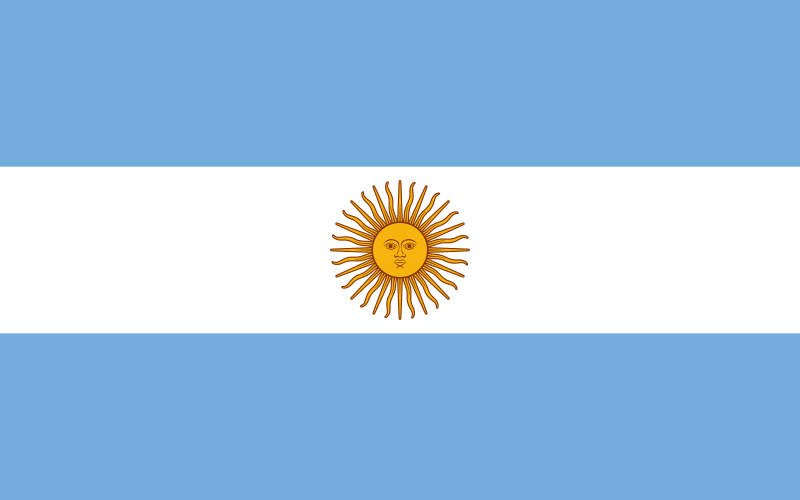
Argentine Marxist revolutionary. As a guerrilla comandante of the Cuban Revolution, he played a key role in overthrowing the Batista regime in 1959. He then devoted himself to the international revolutionary struggle, leading guerrilla campaigns in the Congo and Bolivia, where he was captured and executed in 1967.
Career timeline
1948–1953Medical student; the journeys across Latin America
1955Meets Castro in Mexico; joins the 26th of July Movement
1956–1959Guerrilla comandante; takes Santa Clara
1959–1965President of the National Bank; Minister of Industry
1960Published Guerrilla Warfare
1965–1967Guerrilla campaigns in the Congo and Bolivia
The carpenter who became the unofficial leader of Poznań June
He later recalled: "I was so outraged that I took an upholstery knife and began climbing the loudspeaker pole to cut the wires."
Stanisław Matyja was a carpenter at Poznań's Cegielski (ZISPO) works who, trusted by his workmates, became the voice of workers' rights. As head of the 27-member delegation that negotiated in Warsaw in June 1956, he won promises of wage rises and tax refunds, but when the government reneged overnight he emerged as the unofficial leader of the 28 June uprising. Arrested and savagely beaten after the suppression, then sacked from the factory, he was honoured by Solidarity in 1980 and unveiled the Poznań Crosses memorial in 1981.
Career timeline
1946–1949Resumed education at Poznań's School of Building Trades
1951Hired as a carpenter at the Cegielski (ZISPO) works
1953First to protest ZISPO labour-rights violations; elected works-council delegate
1956.06Head of the 27-member Warsaw delegation; emerged as unofficial leader of Poznań June
1958Sacked on a fabricated charge, given the 'wolf's ticket'
The Romanian general who switched sides on the morning of the revolution and brought down a dictator
On the morning of 22 December, he asked a trusted doctor to put a plaster cast on his perfectly healthy left leg, hoping to avoid being sent back to crush the revolution.
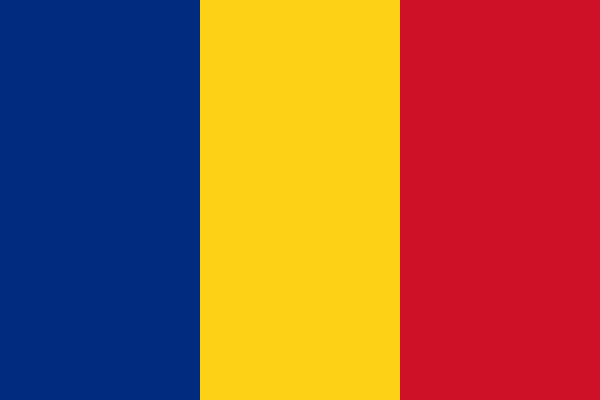
A Romanian communist artillery officer, he rose to deputy defense minister by 1986. On 22 December 1989, moments after Ceaușescu appointed him defense minister, he issued the order withdrawing troops to barracks, then organized the dictator's helicopter escape before defecting to the revolution. On 25 December he organized and oversaw the drumhead trial and execution of Nicolae and Elena Ceaușescu. After the revolution he served as defense minister and national economy minister, but in 2008 was convicted of aggravated manslaughter for the Timișoara crackdown and sentenced to fifteen years.
Career timeline
1949Graduates from Sibiu Artillery Officer School
1952–1981Artillery and logistics staff officer, rises to colonel
1981–1986Deputy Minister of National Defense
1986–1989First Deputy Minister of National Defense
1989.12.17–20Dispatched to command crackdown on Timișoara uprising
1989.12.22Appointed defense minister; issues Order 38 recalling troops to barracks, joins revolution
1989.12.25Organizes the drumhead trial and execution of Nicolae and Elena Ceaușescu
1990–1991Minister of National Economy → Minister of National Defense
Khalq strongman who engineered the Saur Revolution and fell to Soviet guns three months after seizing power
Amin ordered his adjutant to warn the Soviet advisers of the attack. The adjutant replied, 'It is the Soviets who are shooting.' Amin snatched an ashtray and hurled it at him, shouting, 'You're lying! That cannot be!'
Amin was the de facto number two of the PDPA's Khalq faction and the military architect of the April 1978 Saur Revolution. Drawn to Marxism while studying in the United States, he returned to Afghanistan and built a network of officers that made the coup possible, then climbed from deputy premier through foreign and defense ministries to become the regime's true strongman. In September 1979 he deposed and executed his mentor Nur Muhammad Taraki and seized the party leadership and all top state posts, but his brutal purges and the spreading insurgency convinced the Kremlin he was uncontrollable. On 27 December 1979 KGB special forces stormed the Tajbeg Palace and killed him, opening the Soviet-Afghan War.
Career timeline
1957–1965Studies at Columbia and Wisconsin, drawn to Marxism
1966Joins PDPA, sides with Khalq faction
1969Elected sole Khalq MP
1973–1978Party military organizer, builds officer network
1978.04Directs the Saur Revolution
1978–1979DPM → FM → PM → concurrent Defense Minister
1979.09Deposes Taraki, becomes General Secretary and head of state
1979.12.27Killed by Soviet special forces in Operation Storm-333
The Parcham leader installed by the Soviet invasion who presided over seven years of war but never won legitimacy
"The Soviet comrades love me boundlessly, and for the sake of my personal safety, they don't obey even my own orders": the puppet president's confession to a friend about his gilded imprisonment.
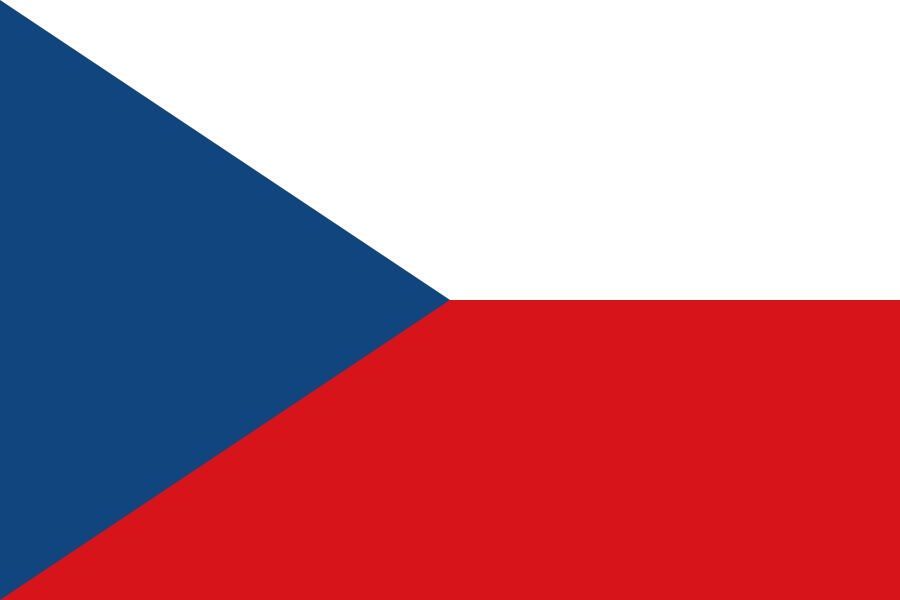
Babrak Karmal was a founding member of the People's Democratic Party of Afghanistan (PDPA) and leader of its Parcham (Banner) faction, serving as deputy prime minister after the 1978 Saur Revolution before being purged by the Khalq faction and exiled as ambassador to Czechoslovakia. Dismissed from that post and hunted by an Afghan hit squad, he spent months hiding in a remote forest lodge under the protection of the Czechoslovak secret police until the Soviet invasion of December 1979 installed him as president. During his rule he attempted to broaden the regime's base through amnesties, a new tricolor flag, and a constitutional framework, but was widely dismissed as a Soviet puppet as the war against the mujahideen bogged down. In 1986 Mikhail Gorbachev engineered his removal; he spent his final decade in Moscow exile, dying of liver cancer in 1996.
Career timeline
1965Co-founded the PDPA, led the Parcham faction
1965–1973Member of Parliament
1978.4–6Deputy Chairman, Revolutionary Council
1978.7–9Ambassador to Czechoslovakia
1979.12–1986.11Chairman, Revolutionary Council; PDPA General Secretary
1979.12–1981.6Chairman of the Council of Ministers
From fired shipyard worker to 'mother of independent Poland'
On the strike's third day, after Wałęsa declared it over, she and Alina Pienkowska blocked the gates and turned the workers back, transforming a pay dispute into a solidarity strike.
A crane operator at the Gdańsk Lenin Shipyard whose dismissal in August 1980 set off the strike that became Solidarity, the first independent trade union in the Eastern Bloc. She worked sixteen years as a welder, exceeded 270% of her output quota and was honored as a Hero of Socialist Labor, but after publicly accusing a supervisor of embezzling the workers' fund she faced secret-police harassment and became an open dissident. On the strike's third day, after Wałęsa declared it over, she and Alina Pienkowska ran to turn the workers back from the gates and transformed a pay dispute into a solidarity strike. She later broke with Wałęsa, denouncing his 'cult of personality' and the union's drift from its founding ideals, and died in the 2010 Smolensk air crash.
Career timeline
1950Joined the Gdańsk Lenin Shipyard, working sixteen years as a welder before becoming a crane operator
1968Denounced a supervisor's embezzlement of the workers' fund; her whole department defended her against dismissal
1978Co-founded the Free Trade Unions of the Coast (WZZ) and edited the underground paper Robotnik Wybrzeża
1980-08-07Dismissed for illegal union activity, five months before retirement
1980-08-14Her firing ignited the Gdańsk strike; served on the MKS presidium and signed the August Agreement
1980-09Member of the presidium of the NSZZ Solidarity founding committee
1981-12Co-organized the shipyard strike after martial law, then spent nineteen months in internment and prison
1990Returned briefly to the shipyard, retired in 1991, and kept criticizing Wałęsa and post-Solidarity politics
The East German Politburo spokesman whose mistake brought down the Berlin Wall
Asked 'When does it take effect?' at the press conference, he shuffled through his papers and replied: 'As far as I know… immediately, without delay.'
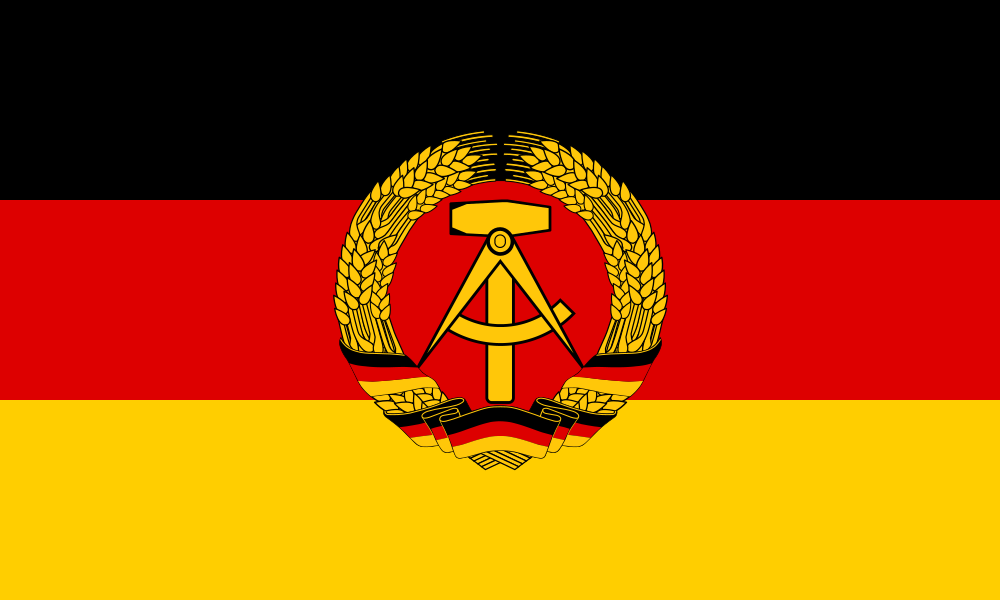
The GDR's leading propagandist, he rose from editor-in-chief of Neues Deutschland to SED Politburo member and First Secretary of East Berlin. On 9 November 1989, asked at a press conference when new travel regulations would take effect, he answered 'immediately, without delay,' triggering the rush that breached the Berlin Wall that night. He later called his mistake 'the final nail in the coffin' of the regime; after reunification he was convicted for the border deaths, but his public acceptance of moral guilt earned him a reduced sentence.
Career timeline
1947Began journalism career as editor at FDGB paper Tribüne
1952Joined the SED
1967–1968Studied at the CPSU party academy in Moscow
1978–1985Editor-in-chief of Neues Deutschland, the SED central organ
1981–1989SED Central Committee member and Politburo candidate, full member from 1984
1985–1989First Secretary of the SED East Berlin district
1989.11.09Triggered the Wall's fall by announcing travel rules effective immediately
1997–2000Sentenced to 3 years for border deaths; pardoned after serving one
Ceaușescu's protégé who ordered his execution and led Romania's post-communist transition
'Quite shameful, but necessary': Iliescu's later verdict on the drumhead trial and execution of the Ceaușescus.
A Romanian Communist Party elite, Iliescu led the National Salvation Front (FSN) during the December 1989 revolution that ended the Ceaușescu regime. He authorised the drumhead trial and execution of Nicolae and Elena Ceaușescu on Christmas Day, then won Romania's first free presidential election in 1990 with 85% of the vote. His reputation was scarred by the Mineriads, in which miners were summoned to Bucharest to crush peaceful opposition protests, and he was later charged with crimes against humanity for deaths during the revolution. He served three presidential terms, steering Romania into NATO and closing EU accession negotiations, yet the unresolved question (popular revolution or coup d'état) shadowed him to the end.
Career timeline
1953Joined the Romanian Communist Party
1965–1971CC member, Propaganda chief, Youth Minister
1971Sidelined by Ceaușescu, demoted to provincial posts
1984–1989Removed from CC; director of Editura Tehnică publishing house
1989.12Co-founded FSN, became interim president
1990–1996President of Romania (first and second terms)
The Marxist revolutionary who overthrew Portuguese colonial rule and led Mozambique to independence
“The liberation of Africa is the liberation of the continent, or it is nothing.”
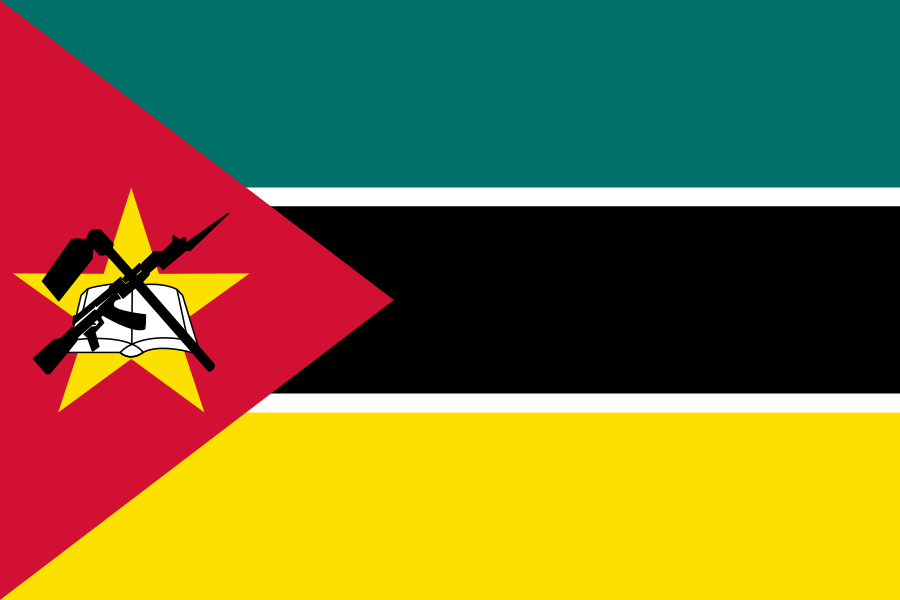
Mozambique's independence leader and first president. As FRELIMO chairman, he waged armed struggle to end Portuguese colonial rule and built a socialist state. A crucial ally of liberation movements against Rhodesia and South African apartheid.
Career timeline
1963Exiled to Tanzania, joins FRELIMO; guerrilla training in Algeria
1966FRELIMO Secretary for Defense
1968Commander-in-chief of the Mozambican liberation army
1970Becomes FRELIMO President; adopts Marxism-Leninism as party ideology
1974Negotiates independence with Portugal's new government — Lusaka Accord
1975–1986First President of the People's Republic of Mozambique
1984Signs the Nkomati non-aggression pact with South Africa
1986.10Killed in plane crash at Mbuzini, South Africa, returning from Zambia
A dissident socialist who linked workers’ self-management to civic solidarity
When the strikes began in 1980, he declared that the stranglehold on workers’ organisation and free information had finally been broken.
Jacek Kuroń was a Polish historian and organiser who tried to separate socialist ideals from the rule of party bureaucracy. His Open Letter to the Party, written with Karol Modzelewski, argued that the bureaucracy dominated workers and proposed workers’ councils and democratic pluralism. A co-founder of the Workers’ Defence Committee in 1976, he connected intellectuals with workers and became a leading adviser to Solidarity in 1980, advocating a programme of self-management. Interned on the first night of martial law in December 1981, he continued to support the underground union and later served as labour and social policy minister during Poland’s post-1989 transition.
Career timeline
1955–1961Co-organiser of the socialist scout movement and commander of the Walterowcy troop
1965–1967Co-author of the Open Letter to the Party; political prisoner
1968–1971Organiser of the March student protests; political prisoner
1976–1977Co-founder of the Workers’ Defence Committee (KOR)
1980–1981Adviser to Solidarity’s National Commission
1981–1984Martial-law internee and defendant in the KOR trial
A shipyard leader caught between two landmark agreements
“The chairman will be Jurczyk,” and the delegates answered the decision with applause.
Marian Jurczyk was a shipyard worker and labor leader who brought Szczecin's August 1980 strike into negotiations with the state. He signed the Szczecin Agreement on 30 August, accepting economic concessions without a guarantee of free trade unions, while the broader Gdańsk settlement the next day made the contrast between the two ports historically clear. Interned and later arrested under martial law, he went on to pursue an independent union course outside Lech Wałęsa's camp.
Career timeline
1954–1970Worker at the Adolf Warski Szczecin Shipyard
1970–1971Participant and strike-committee member in Szczecin workers' protests
1980.08Chair of the Szczecin Shipyard and Interfactory Strike Committees
1980.08.30Signatory of the Szczecin Agreement
1980–1981Chair of the Solidarity Interfactory Workers' Commission and member of its National Coordinating Commission
1981–1984Internee and defendant in a political trial under martial law
The diplomat who opened Bulgaria's post-Zhivkov transition
Negotiations after Zhivkov's removal in 1989 marked the start of the dismantling of communist rule in Bulgaria.
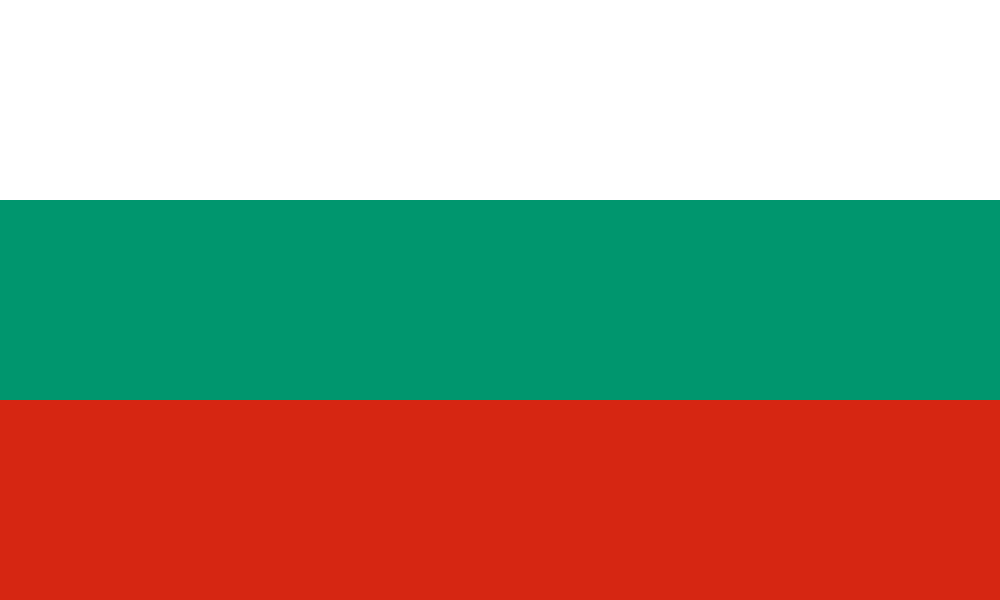
A longtime communist foreign-policy leader, he publicly called for change in October 1989, became party general secretary after Todor Zhivkov's removal, and served as head of state in the early negotiated transition to multiparty politics.
Career timeline
1971–1989Bulgarian foreign minister
1989–1990General secretary of the Bulgarian Communist Party
1989–1990Head of state and president during transition
The successor between a Soviet birth record and the Paektu myth
One sentence at the 25 April 1992 military parade: "Glory to the heroic soldiers of the Korean People's Army!" — his only recorded public utterance in 17 years of rule.
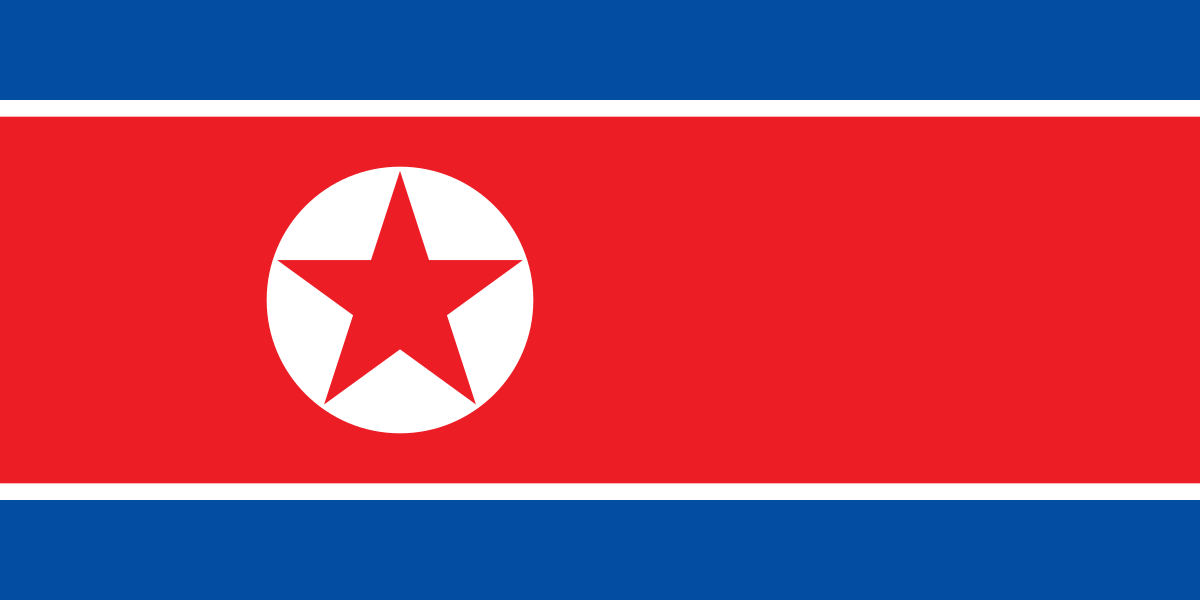
Consolidated as successor from the 1970s, he inherited power after Kim Il Sung's death in 1994 and led the DPRK for 17 years through post-Soviet isolation, economic crisis, and the nuclear confrontation with the United States.
Career timeline
1941/1942Divergent Soviet and DPRK birth narratives
1964–1974Rose through the Workers’ Party Central Committee
1980Consolidated as successor at the Sixth Party Congress
1991–1994Supreme Commander and prepared succession to state power
Guyanese Marxist historian who demonstrated how Europe underdeveloped Africa, scholar-activist of the Pan-African revolution
"For the only great men among the unfree and the oppressed are those who struggle to destroy the oppressor." — How Europe Underdeveloped Africa (1972)
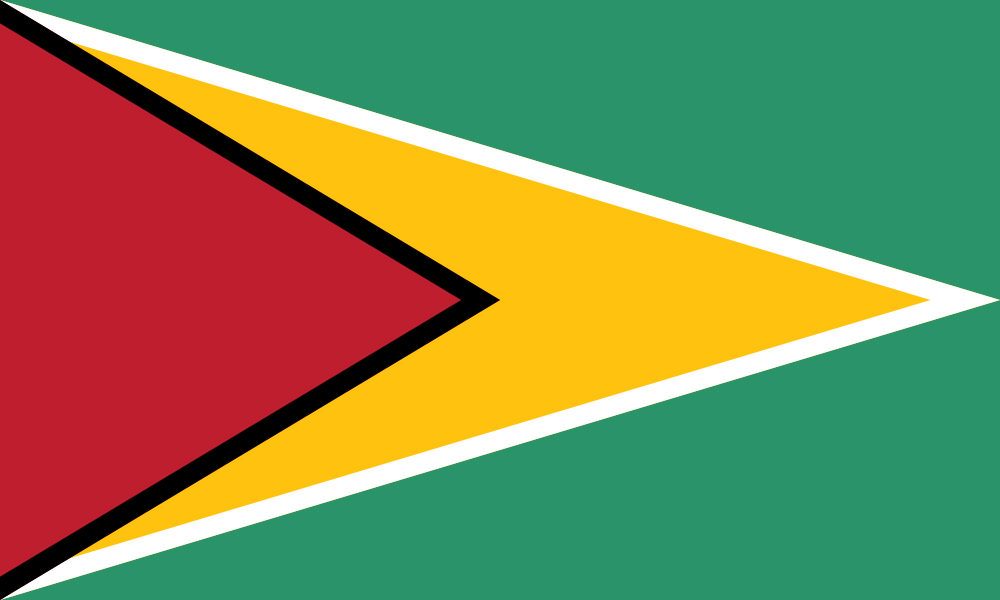
Born into a working-class family in Georgetown, Rodney earned a PhD in African history at SOAS, University of London at age 24. Teaching at the University of Dar es Salaam and the University of the West Indies, he developed a distinctive synthesis of Pan-Africanism and Marxism. His landmark 1972 book How Europe Underdeveloped Africa demonstrated how the slave trade, colonialism, and the capitalist world system structurally produced Africa's underdevelopment, shifting the paradigm of Third World historiography. Returning to Guyana in 1974, he helped lead the Working People's Alliance, advocating a multiracial socialist politics rooted in working-class solidarity.
Career timeline
1963BA History (first-class honours), University College of the West Indies
1966PhD African History, SOAS, University of London
1966–1974Lecturer then associate professor, University of Dar es Salaam & UWI Mona
1968Banned from Jamaica by Hugh Shearer government; Rodney Riots erupt
1972Publishes How Europe Underdeveloped Africa
1974–1980Returns to Guyana; active in the Working People's Alliance
1979Arrested on arson charges; dismissed for lack of evidence
The SACP leader who kept the revolutionary flame alive after laying down arms
“We are negotiating to create better conditions for socialism. I am a communist.” — Interview shortly before his assassination, 1993
General Secretary of the South African Communist Party and Chief of Staff of Umkhonto we Sizwe, he led the left wing of the liberation movement from armed struggle through the turn to negotiations. His assassination by a far-right immigrant in 1993 nearly derailed South Africa's democratic transition, but instead galvanized the final agreement on the 1994 elections.
Career timeline
1957Joined ANC Youth League at age 15
1959–1961Studied English, Latin and classics at Fort Hare University
1961Joined the South African Communist Party
1962Joined Umkhonto we Sizwe (MK)
1963Arrested; fled to Lesotho; adopted the name Chris
1967–1969Zimbabwean War of Liberation: joint MK-ZIPRA operations
1969Co-signed the 'Hani Memorandum' criticizing ANC/MK leadership
1974Elected to ANC National Executive Committee
1982MK Chief of Staff; directed guerrilla operations from Lusaka
1990Returned permanently to South Africa after ANC unbanning
1991.12Elected SACP General Secretary, succeeding Joe Slovo
1993.4.10Shot dead outside his Boksburg home by a far-right immigrant
The Caribbean revolutionary who cut illiteracy from 35% to 5% and declared 'we are not in anybody's backyard'
“We are not in anybody's backyard, and we are definitely not for sale.” — Hunter College, New York, August 1983
Grenadian revolutionary and Prime Minister of the People's Revolutionary Government (1979–1983). After studying law in London, he returned to lead the New JEWEL Movement (NJM), toppling the corrupt Gairy regime in 1979. In power, he reduced illiteracy from 35% to 5%, unemployment from 50% to 14%, and introduced free healthcare, equal pay, and paid maternity leave. He built an international airport with Cuban cooperation and held fast to an anti-imperialist line: 'We are not in anybody's backyard, and we are definitely not for sale.' Executed in a 1983 internal coup by Deputy PM Bernard Coard, his death triggered the US invasion of Grenada.
Career timeline
1944Born on Aruba, then a Dutch colony
1963–1969Studied law in London; called to the Bar at Gray's Inn
1970Returned to Grenada; gained fame defending striking nurses
1973Co-founded the New JEWEL Movement (NJM); Joint Coordinating Secretary
1973–1974'Bloody Sunday' arrest and beating; father shot dead on 'Bloody Monday'
1976–1979Leader of the Opposition against Gairy's dictatorship
1979.3Revolution deposed Gairy; became Prime Minister of the PRG
1979–1983Slashed illiteracy and unemployment; free healthcare, women's rights; built airport with Cuba
1983.10.19Arrested and executed by firing squad in Bernard Coard's coup
The last communist president of Afghanistan, who outlasted the Soviet withdrawal by three years before the Taliban tortured and hanged him
"I didn't want to be president, you talked me into it, insisted on it, and promised support. Now you are throwing me and the Republic of Afghanistan to its fate." To Shevardnadze, autumn 1991
A Pashtun doctor who joined the PDPA's Parcham faction as a student, Najibullah rose through six brutal years at the helm of KHAD, the Afghan secret police, where his ruthless efficiency drew the attention of Yuri Andropov and the KGB. Installed by Moscow as party leader in 1986, he launched a 'National Reconciliation' that restored Islam, introduced multi-party politics, and erased communist symbols from the constitution, yet the war ground on; he opposed the Soviet withdrawal, pleading with Shevardnadze to leave volunteers to defend the Kabul highway, but after February 1989 held power alone for three more years. When Soviet dissolution ended aid and General Dostum defected, his government collapsed in 1992; he sheltered in the UN compound in Kabul, until Taliban fighters dragged him out in September 1996, tortured and castrated him, and hung his corpse from a traffic pole.
Career timeline
1965Joined PDPA Parcham faction
1977PDPA Central Committee member
1978Ambassador to Iran, soon dismissed; exile in Eastern Europe
The 'African Che' who traded the state Mercedes fleet for Renault 5s
“While revolutionaries as individuals can be murdered, you cannot kill ideas.” — speech a week before his assassination, 1987
A Marxist pan-Africanist revolutionary of Burkina Faso. Taking power at thirty-three in 1983, he renamed the country 'land of upright people' and drove mass vaccination, literacy and women's-rights campaigns. He rejected IMF structural adjustment and was assassinated in the 1987 coup of his comrade Blaise Compaoré.
Career timeline
1983Takes power at thirty-three; the National Council of the Revolution
1983–1987Vaccination, literacy, reforestation and women's-rights campaigns
1984Renames the country Burkina Faso, 'land of upright people'
1987.7The Addis Ababa speech: Africa must repudiate its debt
1987.10Assassinated in the coup of his comrade Compaoré
1987Delivered Women’s Liberation and the African Freedom Struggle on International Women’s Day
The shipyard nurse who, when the regime declared the strike over, held workers back and turned it into a solidarity strike
"You betrayed them. Now the authorities will crush us like bedbugs." To Wałęsa, the moment he declared the strike over.
A nurse at the Gdańsk Lenin Shipyard, she joined the founding of the Free Trade Unions of the Coast (WZZ) in 1978 and wrote for its underground paper The Coastal Worker on workplace safety and occupational disease, becoming one of the most determined opposition activists on the Baltic coast. On 16 August 1980, after management granted pay rises and Wałęsa declared the strike over, Pienkowska and Anna Walentynowicz physically blocked the shipyard gates and appealed to workers not to abandon the other factories that had joined them in solidarity, turning a local settlement into a movement-wide solidarity strike. Her intervention made the Inter-Enterprise Strike Committee (MKS) possible; she drafted demand number 16 on healthcare reform among the Twenty-One Demands and became a signatory of the Gdańsk Agreement on 31 August.
Career timeline
1978Co-founded WZZ, edited underground paper Robotnik Wybrzeża
1980.08.14–16Shipyard strike: handled external communications, decisive role in continuing the strike
1980.08.17–31MKS Presidium member, co-drafted 21 Demands, signed Gdańsk Agreement
1980–1981National chair, Solidarity Health Service Section
1981.12–1982.07Interned under martial law
1982–1989Underground Solidarity work, aid to victims of repression
The dissident strategist who negotiated a peaceful transition with communist power
A revolution for a constitution, not a paradise. An anti-utopian revolution. Because utopias lead to the guillotine and the gulag.
Raised in a communist family in Warsaw, he became a dissident after his imprisonment in the 1968 political crisis. As a strategist for the Workers' Defence Committee (KOR) and Solidarity, he participated in the 1989 Round Table talks, then as the founding editor of Gazeta Wyborcza led the election campaign and proposed the 'Your President, Our Prime Minister' formula that enabled a peaceful division of power with the communists. He later withdrew from politics to remain an influential journalist and liberal democratic voice.
Career timeline
1968Imprisoned for dissident activity
1977Active in Workers' Defence Committee (KOR)
1980–1989Solidarity adviser, re-imprisoned under martial law
1989Round Table negotiator, founding editor of Gazeta Wyborcza
1989.07Proposes 'Your President, Our Prime Minister' formula
Marxist feminist philosopher who theorised the prison-industrial complex, co-founder of Critical Resistance
"I now declare publicly before the court, before the people of this country that I am innocent of all charges which have been leveled against me by the state of California." — courtroom declaration, 5 January 1971
American Marxist-feminist philosopher and foundational theorist of prison abolition. Joining CPUSA in 1968, she ran for Vice President in 1980 and 1984. Her 1970 arrest and sixteen-month imprisonment, ending in full acquittal, sparked a global solidarity campaign. Her landmark Women, Race & Class (1981) established intersectional analysis of race, gender and class; she went on to theorise the prison-industrial complex. In 1997 she co-founded Critical Resistance to advance abolition democracy. Distinguished Professor Emerita at UC Santa Cruz, she has stood at the crossroads of radical thought and practice for over five decades.
Career timeline
1944Born in Birmingham, Alabama; raised in the 'Dynamite Hill' Black middle-class neighbourhood
1965Graduates Brandeis magna cum laude; studies under Herbert Marcuse
1968Joins CPUSA; directs political education for Black Panther Party's LA chapter
1969Appointed assistant professor of philosophy at UCLA; fired for CPUSA membership, reinstated by court order
1970–1972Arrested, placed on FBI Ten Most Wanted list; acquitted of all charges after 16 months' imprisonment
1979Awarded the Lenin Peace Prize by the Soviet Union
1980, 1984CPUSA vice-presidential candidate, running mate of Gus Hall
1981Publishes Women, Race & Class, a classic of intersectional analysis
1991Leaves CPUSA; co-founds Committees of Correspondence for Democracy and Socialism
1991–2008Professor of History of Consciousness and Feminist Studies at UC Santa Cruz; retires as Distinguished Professor Emerita in 2008
1997Co-founds Critical Resistance, institutional anchor of the prison abolition movement
2003Publishes Are Prisons Obsolete?, a popular manifesto for abolition democracy
Cold War historian who analyzed the Soviet withdrawal from Afghanistan as a 'long goodbye'
"A truly international history of the war... is at this point very far away," he conceded in the opening of A Long Goodbye.
A historian of Soviet and Russian foreign policy and Central Asia. His 2011 book A Long Goodbye: The Soviet Withdrawal from Afghanistan, drawing on archives and interviews, demonstrated that the Soviet decision to withdraw was a 'long goodbye' shaped as much by domestic politics as by the battlefield. After a BA at George Washington University and a PhD at the LSE, he taught for a decade at the University of Amsterdam and is now Professor at Temple University; his second book, Laboratory of Socialist Development (2018), won the Davis and Hewett prizes.
Career timeline
~2000BA, George Washington University
2009PhD in International History, LSE
~2010–2020Senior Lecturer in East European Studies, University of Amsterdam
2011A Long Goodbye: The Soviet Withdrawal from Afghanistan (Harvard University Press)
2018Laboratory of Socialist Development (Cornell UP); won Davis and Hewett prizes
~2020–Professor of Russian, Soviet, and post-Soviet Studies, Temple University