In the 1990 presidential selection, the legislature chose Askar Akayev over Masaliyev as the republic's first president.
Absamat Masaliyev was a Kyrgyz Soviet politician who rose from mining engineering to lead the Communist Party of Kirghizia. He directed the republic's party and state institutions amid late-Soviet political opening and ethnic conflict, seeking to preserve the existing socialist order. After losing the 1990 presidential selection to Askar Akayev, he continued in communist politics and parliamentary work.
Career timeline
1956–1961Engineering posts at Kyzyl-Kyya coal mines and Kyrgyzugol
1961–1973Industrial and transport posts in Osh regional and republican party bodies
1973–1974Chairman of the Frunze City Executive Committee
1974–1979Secretary of the Central Committee of the Communist Party of Kirghizia
1979–1985First Secretary of the Issyk-Kul Regional Party Committee
1985–1991First Secretary of the Central Committee of the Communist Party of Kirghizia
1990Chairman of the Supreme Soviet of the Kirghiz SSR
1991Consultant to the ideological department of the CPSU Central Committee
First professional Koryak writer and USSR People's Deputy
After his 1989 election as a USSR People's Deputy, he refused a Moscow apartment and returned to his native Palana. 'Each of my books is a Confession for me,' he said.
The first professional Koryak writer, widely known by his pen name Koyanto (Коянто, 'Reindeer Man'), he was a foundational figure of Koryak literature. After graduating from the Northern Faculty of the Herzen Pedagogical Institute in Leningrad and the Higher Literary Courses at the Gorky Literary Institute, he devoted his life to rendering the lives, myths, and identity of the Koryak and other northern indigenous peoples in poetry and prose, beginning with his first collection Songs of Alney (1969). His prose work The Upper People Can Wait (1976) stirred controversy with its sharp critique of Soviet bureaucratic policies toward the North. In 1989 he was elected a USSR People's Deputy from the Koryak Autonomous Okrug, championing indigenous rights, and after the Soviet dissolution he continued to serve his homeland as chair of the human rights commission and adviser to the governor.
Career timeline
1956Worked as teacher, methodologist, and cultural center director in Koryak Autonomous Okrug
1969Published first poetry collection Songs of Alney; adopted pen name 'Koyanto'
1972Member, Union of Writers of the USSR
1974Co-founded the Kamchatka Writers' Organization
1976Published The Upper People Can Wait, a controversial critique of northern bureaucracy
1989–1991USSR People's Deputy (Koryak Autonomous Okrug); member, Commission on Social and Economic Development of Republics and Autonomous Regions
1990s–2000sExpert at the Presidential Representative Office, adviser to the governor, chair of the Human Rights Commission of Koryak Autonomous Okrug
2002–2012Chaired the Human Rights Commission; taught Northern literature at Palana Pedagogical College
The last Communist Party first secretary of Soviet Armenia
He left the CPSU Politburo because the Nagorno-Karabakh question remained unresolved.
Vladimir Movsisyan was a politician who rose through the agricultural and party administration of Soviet Armenia. In 1990 he became first secretary of the republic’s Communist Party and a member of the CPSU Politburo, but left the Politburo after the Nagorno-Karabakh question remained unresolved. After the Soviet collapse, he remained involved in refugee administration, defence, and agricultural policy, helping shape the institutions of independent Armenia.
Career timeline
1958–1965Chief veterinarian in several districts of the Armenian SSR
1969–1973First secretary of the Artashat district party committee
1975–1978Head of the Agriculture Department of the Communist Party of Armenia
1984–1990First deputy chairman of the Council of Ministers of the Armenian SSR
1990First secretary of the Communist Party of Armenia and member of the CPSU Politburo
1991Deputy Minister of Agriculture and Food of the USSR
The reformist Politburo member who called 1956 a 'popular uprising' and dismantled his own party's orthodoxy
In West Berlin he said the East German 'anti-fascist protective rampart' was a 'disgrace' that had to come down.
A reformist member of the Hungarian Socialist Workers' Party (MSZMP) Politburo and the ideological patron of the reformers. On 28 January 1989 he told radio listeners that the 1956 Hungarian Revolution was a 'popular uprising,' demolishing the party's foundational lie; in May that year, in West Berlin, he called the Berlin Wall a 'disgrace.' Together with Otto von Habsburg he sponsored the Pan-European Picnic in August 1989, opening the first crack in the Iron Curtain, and later stood as the Socialist Party's presidential candidate but was defeated.
Career timeline
1950Joined the Hungarian Working People's Party
1957–1969Agitprop head and secretary, Bács-Kiskun County committee
1976–1980Minister of Culture
1980–1982Minister of Education
1982–1988Secretary-General, Patriotic People's Front
1988–1989MSZMP Politburo member and Minister of State
1989.01Declared the 1956 Revolution a 'popular uprising'
1990MSZP Deputy President and presidential candidate; defeated
An intelligence officer whose restraint mattered at the nuclear brink
Seeing unusual Soviet nuclear readiness, he advised against raising NATO's alert level.
Leonard H. Perroots was a U.S. Air Force general and military intelligence specialist whose career intersected with the management of nuclear danger late in the Cold War. As assistant chief of staff for intelligence, U.S. Air Forces in Europe, during Able Archer 83 in 1983, he observed unusual Soviet nuclear readiness but advised against raising NATO alert levels, avoiding a potentially dangerous escalation. He later directed the Defense Intelligence Agency and left a significant retrospective account of the war scare, illustrating how intelligence judgment can shape decisions at the nuclear brink.
Career timeline
1955Commissioned in the U.S. Air Force
1970년대Air Force command and intelligence assignments
1982–1984Assistant Chief of Staff for Intelligence, U.S. Air Forces in Europe
1983Advised against escalating NATO alert levels during Able Archer 83
1984–1985Deputy Chief of Staff for Intelligence, U.S. Air Force
1985–1988Director of the Defense Intelligence Agency
A Belarusian party organizer who sought continuity as the Union dissolved
After the 1991 coup failed, he called the State Committee's formation “a crime against the party.”
Anatoly Malofeyev was a Soviet and Belarusian politician who rose from industrial work through party administration to republican leadership. In the final years of perestroika, he led Belarus's Communist Party with a record of regional administration and a union-preserving party line, and supported the State Committee on the State of Emergency in 1991. After the coup's defeat, he sought to preserve the party organization and later worked in the parliamentary politics of independent Belarus.
Career timeline
1933Born in Gomel
1949–1952Mechanic at railway-car repair plants in Gomel and Minsk
1952–1956Served in the Soviet Navy
1962–1975Worked in Gomel and Mozyr party organizations, becoming Mozyr city first secretary and a Gomel regional party secretary
1978–1985Chairman of the Gomel regional executive committee and first secretary of the Communist Party of Belarus regional committee
1985–1990First secretary of the Communist Party of Belarus Minsk regional committee
1990–1991First secretary of the Communist Party of Belarus Central Committee and member of the CPSU Politburo
1996–2000First chairman of the House of Representatives of Belarus's National Assembly
A Soviet republican leader who asserted institutional authority in crisis
“A state of emergency was declared and troops were sent in without the republic’s consent.”
Elmira Kafarova was an Azerbaijani Soviet politician and diplomat who moved through education and foreign-affairs administration before leading the republic’s Supreme Soviet. In January 1990, she publicly protested the declaration of emergency in Baku and the entry of Soviet troops, stating that the decision had been taken while she was in Moscow and without her knowledge. Her institutional dissent, unusual within the Soviet republican leadership, illuminates how the nationalities crisis became a collision among republican institutions, a mass movement, and Union power.
Career timeline
1958Graduated from Azerbaijan State University; pursued philological research
1966–1970First Secretary of the Komsomol Central Committee of the Azerbaijan SSR
1971Ideology secretary of the Baku City Party Committee
1980–1983Minister of Education of the Azerbaijan SSR
1983–1987Minister of Foreign Affairs of the Azerbaijan SSR
1987–1989Deputy Chair of the Council of Ministers of the Azerbaijan SSR
1989–1990Chair of the Presidium of the Supreme Soviet of the Azerbaijan SSR
1990–1992Chair of the Supreme Soviet of Azerbaijan
Architect of the 500 Days programme, radical reform economist who tried to convert the Soviet planned economy to the market in one leap
It is not a question now of saving socialism, communism or any other -ism, it is a question of saving our country, our people — at a Party Central Committee plenum, 1990
Born near Leningrad. A student of Kantorovich, he advanced input-output modelling and optimal planning theory, became a full academician (1987), and Academician-Secretary of the Economics Department (1989). In 1990, under Gorbachev and Yeltsin's joint mandate, he led the working group that drafted the '500 Days' programme for market transition, a radical plan directly opposing Abalkin's gradualism. Not adopted at Union level but partially implemented in Russia, it became the intellectual foundation for his student Gaidar's 1992 shock therapy. After the collapse he headed the 'Reforma' foundation, helped found the United Democratic Party, and served as honorary president of Spartak Moscow.
Career timeline
1958–1959Economist at the Research Financial Institute, USSR Ministry of Finance
1959–1965Researcher at the Research Economic Institute (NIEI) under Gosplan
1965–1976Deputy director and department head at TsEMI, USSR Academy of Sciences
1970–1983Chair of Mathematical Methods of Economic Analysis, Economics Faculty, Moscow State University
1974 / 1987Corresponding member, then full academician of the USSR Academy of Sciences
1976–1986Senior researcher at All-Union Institute for Systems Studies; taught economics at MIPT
1986–1989Researcher at the Institute of Economics and Forecasting of Scientific-Technical Progress
1989.12Member of the State Commission on Economic Reform
1989–1996Academician-Secretary of Economics Department, USSR Academy of Sciences / RAS
1990Head of the 500 Days working group; member of the USSR Presidential Council
1990–1991Member of the CPSU Central Committee
1991Chair of organizing committee for United Democratic Party; head of 'Reforma' International Foundation
1991.6Yeltsin's confidant in the RSFSR presidential election
The historian who called the conservative majority 'aggressively obedient'
27 May 1989, at the First Congress of People's Deputies, to the conservative deputies: "You here make up an aggressively obedient majority. … We are creating a Stalinist-Brezhnevite Supreme Soviet."
A historian who coined the phrase 'aggressively obedient majority' to describe the conservative bloc at the First Congress of People's Deputies in 1989. A scholar of the French Annales school, he led the de-Stalinization of Soviet historiography as rector of the Moscow State Institute of History and Archives (1986–1991) and served as co-chair of the Inter-Regional Deputies Group alongside Sakharov and Yeltsin, driving democratic reform. In 1991 he founded the Russian State University for the Humanities (RSUH), carving an independent intellectual space out of a former Party school, and spent his final decades openly criticizing the authoritarian drift of both Yeltsin and Putin.
Career timeline
1957–66Komsomol secretary, Krasnoyarsk hydroelectric station
1972–81Professor and pro-rector, Higher Komsomol School
1983–86History editor, Kommunist journal
1986–91Rector, Moscow State Institute of History and Archives; leads de-Stalinization of Soviet historiography
1989–93People's Deputy of the USSR; co-chair, Inter-Regional Deputies Group
1990–92Co-founder and co-chair, Democratic Russia movement; quits CPSU
1991–2003Founder and rector, Russian State University for the Humanities (RSUH)
The communist propagandist who became Ukraine's first president and signed the Soviet Union out of existence
It was a long road we walked to Belavezha. It was not by accident; it was our deliberate choice because we had no other option.
A party man who spent three decades climbing the propaganda and ideology apparatus of the Ukrainian Communist Party, Kravchuk pivoted to 'national communism' after becoming chairman of the Supreme Soviet in 1990. At the Novo-Ogaryovo negotiations he insisted on a confederation, not a federation, and delayed the signing of the new Union Treaty until September; after the August 1991 coup collapsed, he presided over Ukraine's Declaration of Independence on 24 August. Elected Ukraine's first president on 1 December 1991, he signed the Belavezha Accords with Yeltsin and Shushkevich a week later, formally ending the Soviet Union. His presidency saw the surrender of Ukraine's nuclear arsenal and a deep economic slump, but he stepped down after a peaceful electoral defeat and remained active in politics as a deputy.
Career timeline
1958–70From political-economy teacher to head of agitation and propaganda, Chernivtsi region
1970–80Rose through CC CPU agitation and propaganda department
1980–88Head of CC CPU agitation and propaganda department
1988–89Head of CC CPU ideology department
1989–90.6CC CPU secretary, Politburo member, second secretary
1990.7–1991.8Chairman of Supreme Soviet of Ukraine; presided over independence declaration
1991.12–1994.7First President of Ukraine; signed Belavezha Accords; lost to Kuchma
1994–2006People's Deputy, parliamentary leader of SDPU(o)
The nuclear physicist who demanded Chernobyl truth, hosted the meeting that dissolved the USSR, and called Gorbachev to tell him
Gorbachev asked, 'Have you thought about the international reaction?' I answered, 'Yeltsin is on the phone with Bush right now. Bush seems to be in favor!'
A nuclear physicist from Minsk, he was a professor at Belarusian State University and a specialist in radio electronics. In 1986, as a member of the Chernobyl investigation commission, he demanded the truth be made public against the Soviet cover-up and was removed, an experience that propelled him into politics. As chairman of the Belarusian Supreme Soviet in 1991, he hosted Boris Yeltsin and Leonid Kravchuk at the Viskuli hunting lodge for what was billed as a discussion of oil and gas supplies; when the conversation turned to dissolving the USSR, he was the first to say he would sign, and he was the one who telephoned Gorbachev to inform him the Soviet Union had ceased to exist. The first head of state of independent Belarus, he was ousted in 1994 by Alexander Lukashenko's corruption allegations and spent his final decades in Minsk as an unyielding opposition elder.
Career timeline
1956Graduated, Faculty of Physics and Mathematics, BSU
1963–1965Associate Professor, Nuclear Physics, BSU
1966–1970Vice-Rector for Research, Minsk Radio Engineering Institute
Propaganda-trained culture minister who executed glasnost-era cultural liberalization
In June 1989, the USSR Supreme Soviet reviewed Premier Ryzhkov's proposed cabinet and rejected Zakharov's renomination as culture minister. For the first time in decades, the rubber-stamp legislature told a sitting minister he was unqualified and sent him packing.
Trained as an economist, he rose through the Leningrad party organization's propaganda and agitation apparatus to reach Moscow, where Gorbachev appointed him Minister of Culture in 1986. His tenure oversaw a decisive shift in Soviet cultural policy: the publication of previously banned books, the relaxation of film censorship, and expanded autonomy for artistic creation. He personally mediated the acrimonious split of the Moscow Art Theatre. In 1989 the newly empowered Supreme Soviet rejected his renomination, the first major case of the legislature exercising real confirmation power over a sitting minister. After leaving office, he served as deputy premier of the Russian republic and later wrote memoirs judging the Gorbachev era a 'reign of missed opportunities.'
Career timeline
1957–1973Lecturer in political economy at Tomsk and Leningrad institutes; doctorate in economics (1973)
1973–1983Head of Propaganda and Agitation Department, then Secretary of Leningrad Oblast Committee, overseeing culture, science, and education
1983–1986First Deputy Chief of CC Propaganda Department → Second Secretary of Moscow City Committee under Boris Yeltsin
1986–1989Minister of Culture of the USSR, lifting bans on books, easing censorship, and granting theatres autonomy during glasnost
1989–1990Deputy Chairman of the RSFSR Council of Ministers
A liberal economist who helped design the transition from a planned to a market economy
Yevgeny Yasin was an economist who developed reform proposals for moving the late Soviet planned economy toward a market economy. As a co-author in the Shatalin group’s 500 Days programme, he helped formulate a blueprint for rapid market transition, then worked in the reforming Russian state after the Soviet collapse. As Yeltsin’s economy minister, he represented the liberal reform line while confronting disputes over the transition’s social costs and the state’s capacity. He later shaped economic policy education and public debate through the Higher School of Economics and the Liberal Mission Foundation.
Career timeline
1957Graduated from the Odesa Institute of Hydraulic Engineering; bridge-construction engineer
1963Graduated from Moscow State University, Faculty of Economics
1964–1973Head of department and laboratory at the Research Institute of the Central Statistical Administration
1973–1989Headed a laboratory at the Central Institute of Economics and Mathematics, USSR Academy of Sciences
1989–1991Department head at the USSR Council of Ministers’ State Commission on Economic Reform; co-author of the 500 Days programme
1994–1997Minister of Economy of the Russian Federation
1998–2021Academic supervisor of the Higher School of Economics
2000–2019President of the Liberal Mission Foundation
The party apparatus gatekeeper who managed Gorbachev's documents, then betrayed him
On August 18, 1991, Boldin flew to Foros alongside Baklanov, Varennikov, and Shenin to deliver an ultimatum to Gorbachev — the man whose paper flow he had managed for a decade.
An economist by training who graduated from the Timiryazev Agricultural Academy and the CC Academy of Social Sciences, he worked in the Central Committee apparatus from 1961 and later served as agricultural department head and economic commentator at Pravda. In 1981 he became Gorbachev's assistant, and in 1987 he was appointed head of the CC General Department, the office controlling the entire document flow of the Politburo and Secretariat, adding the post of presidential chief of staff in 1990. During the August 1991 coup, however, he sided with the State Emergency Committee and was one of the four emissaries who flew to Foros to confront Gorbachev; arrested after the coup's failure, he was detained and then amnestied in 1994.
Career timeline
1961–65Central Committee apparatus
1969–81Pravda agricultural department head and economic commentator
1981–87Assistant to CC Secretary and General Secretary Gorbachev
1987–91Head of the CC General Department
1990–91Chief of Staff to the President of the USSR
On August 19, 1991, the day the GKChP coup began, Shebarshin 'demonstratively' played tennis all day.
The last chief of the KGB First Chief Directorate, a career officer who built decades of field experience in Pakistan, India, and Iran. He kept his distance from the August 1991 coup, served a single day as acting KGB chairman after its failure before Boris Yeltsin blocked him, and later chronicled Soviet foreign intelligence's final chapter in his memoirs.
Career timeline
1958–1962Interpreter and Third Secretary, Soviet Embassy in Pakistan
1962Joined KGB First Chief Directorate, trained at School No. 101
1964–1968KGB intelligence officer under diplomatic cover, Pakistan
1971–1977Deputy rezident, then rezident, KGB India
1979–1983KGB rezident in Iran
1983–1987Deputy chief, then chief, Information-Analytical Directorate, PGU KGB
1987–1989Deputy chief of PGU KGB (Middle East and Africa)
1989–1991Deputy Chairman of the KGB and Chief of the First Chief Directorate
Ukrainian SSR head of state during Chernobyl who pushed the evacuation of 526,000 children from Kyiv against Moscow's resistance
Recalling the interior deputy minister's report on the morning of 26 April 1986: 'The fire was put out, everything is fine. The people? Some are having a wedding, some are gardening, some are fishing in the Pripyat River.'
As Chairwoman of the Presidium of the Supreme Soviet of the Ukrainian SSR during the Chernobyl disaster, she defied Moscow's directives and oversaw the evacuation of 526,000 children from Kyiv and contaminated zones in just five days. Born the daughter of a miner in Kryvyi Rih, she rose through Komsomol and the deputy ministry of education to become the republic's formal head of state in 1985, spending her tenure navigating between central information control and the realities on the ground. In 1989 she refused to sign the resolution banning the People's Movement of Ukraine (Rukh), and after retirement led children's and women's welfare foundations while maintaining a sympathetic view of the Soviet system and a critical stance toward independent Ukraine.
Career timeline
1954–1957Pioneer leader, geography teacher, school Komsomol secretary in Kryvyi Rih
1957–1962Secretary of Kryvyi Rih city Komsomol, then Dzerzhinsky district party committee
1962–1969Secretary and department head, Komsomol Central Committee of Ukraine
1969–1972Deputy Minister of Education, Ukrainian SSR
1975–1985Deputy Chair, Presidium of the Supreme Soviet, Ukrainian SSR
1985–1990Chair of the Presidium, Supreme Soviet, Ukrainian SSR (head of state)
1985–1989Deputy Chair, Presidium of the Supreme Soviet, USSR
The first director of Chernobyl who built the plant and was held responsible for its catastrophe
In the station courtyard I saw pieces of graphite under my feet, but I still could not imagine that the reactor had been destroyed.
Born in Tashkent as the eldest son of Russian workers, he studied energy engineering and built his career at thermal power plants. In 1970 he was appointed construction manager and first director of the Chernobyl Nuclear Power Plant, which he led for sixteen years; plagued by construction delays and defective materials, he submitted his resignation, but a Party supervisor tore it up. Dismissed immediately after the 1986 disaster, he was sentenced to ten years in 1988; after his release he continued working on Chernobyl liquidation until his death in Kyiv in 2021.
Career timeline
1959Graduated Tashkent Polytechnic, joined Angren Thermal Power Plant
1966Rose to deputy chief engineer at Slavyansk Thermal Power Plant
1970–1986First director and construction manager, Chernobyl Nuclear Power Plant
1986.07Expelled from CPSU and dismissed after the disaster; arrested in August
1988.07Sentenced to 10 years, served in Donetsk penal colony
1991.09Released early, worked in Ukraine's trade ministry
1995–2015Chernobyl liquidation work at Ukrinterenergo
Soviet physicist who linked fusion science, Chernobyl, and nuclear disarmament
Less than a month after absorbing radiation at Chernobyl, Velikhov chaired an international meeting on nuclear test-ban verification — turning disaster into a disarmament opening.
Soviet physicist who pioneered plasma physics for controlled fusion and MHD power. His 1959 thesis discovered magnetorotational instability, now foundational to astrophysics; in 1962 he identified electrothermal instability. He led the Soviet controlled-fusion program from 1973 and was Vice-President of the USSR Academy of Sciences (1978–1991), bridging the Kurchatov Institute and the Academy. During Chernobyl (1986) he served as Gorbachev's science advisor for reactor containment, then led science diplomacy for nuclear disarmament. After the Soviet collapse he sustained the Kurchatov Institute and became founding chairman of ITER, building the framework for joint US-Soviet-European-Japanese fusion research.
Career timeline
1958Graduated from Moscow State University, Physics
1961Joined the Kurchatov Institute of Atomic Energy
1971–1978Director, Magnetic Laboratory, Troitsk branch
1973–1991Scientific head, Soviet controlled-fusion program
1978–1991Vice-President, USSR Academy of Sciences
1986Science advisor to Gorbachev for Chernobyl cleanup
1989–1990Member, CPSU Central Committee
1989–2015Director → President → Honorary President, Kurchatov Institute
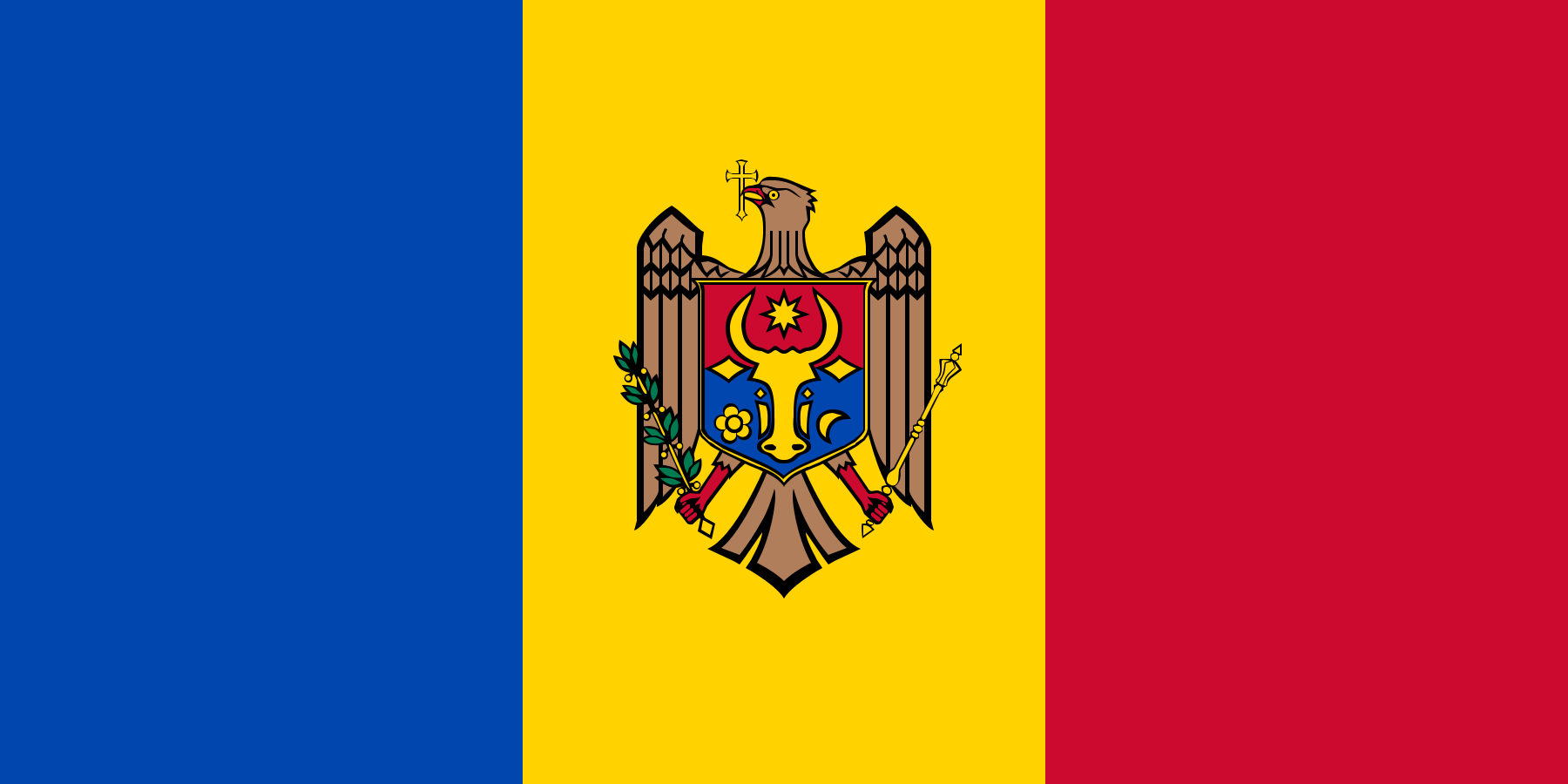
The final head of Soviet Moldavia's Communist Party
He called the 1991 banning of the Communist Party “an illegitimate act.”
Grigore Eremei was a Moldavian party and state official whose career reached its decisive moment at the end of the Soviet system. As First Secretary of the Communist Party of Moldavia in 1991, he occupied the republic's leading party post while the Union was breaking apart and Moldova moved toward independence. After the party was dissolved, he continued in public life as a Moldovan diplomat and parliamentarian, linking a Soviet political career to the institutions of the independent republic.
Career timeline
1952Began working as a village secondary-school librarian
1954–1956Served in the Soviet Army
1966–1970First Secretary of the Kotovsk district party committee
1970–1980Deputy and First Deputy Chairman of the Council of Ministers of the Moldavian SSR
1980–1990Chairman of the Moldavian republican council of trade unions
1989–1991People's Deputy of the USSR
1991First Secretary of the Communist Party of Moldavia and member of the CPSU Politburo
The Kurchatov chemist who led science at Chernobyl, then left the full truth on tapes before hanging himself
"I did not lie in Vienna… but I did not tell the full truth."
Valery Legasov was a Soviet inorganic chemist and first deputy director of the Kurchatov Institute of Atomic Energy, who arrived at the Chernobyl disaster site on the evening of 26 April 1986 as the scientific leader of the government commission. He proposed dropping boron and sand into the burning reactor, spent a total of 60 days on site, and later presented a five-hour report to the IAEA in Vienna that drew international attention but stopped short of revealing the RBMK reactor's full design flaws. On 27 April 1988, the day after the disaster's second anniversary, he hanged himself in his Moscow apartment; the audio tapes he recorded beforehand exposed the cover-ups and systemic failures of the Soviet nuclear establishment and became a primary source for historians.
Career timeline
1961–1964Engineer → shift supervisor, Siberian Chemical Combine (Tomsk-7)
1964–1972Researcher, Kurchatov Institute; Candidate of Chemical Sciences 1967, Doctor of Chemical Sciences 1972
1972–1983Deputy director for scientific work, Kurchatov Institute
1981Full member, USSR Academy of Sciences
1983–1988First deputy director, Kurchatov Institute; Chair of Radiochemistry, Moscow State University
1986–1988Member, government commission for Chernobyl accident liquidation
Gromyko protégé and arms negotiator remembered for the "Walk in the Woods"
On July 16, 1982, Kvitsinsky and Paul Nitze left the formal Geneva arms talks for an unofficial walk in the woods, sketching a compromise on intermediate-range nuclear forces. Both governments rejected it — but the conversation became Lee Blessing's Broadway play "A Walk in the Woods."
A leading Soviet Germanist and protégé of Andrei Gromyko, Yuli Kvitsinsky served on the front lines of Soviet diplomacy toward the West for over three decades. As head of the Soviet delegation to the Geneva INF negotiations from 1981, his famous "walk in the woods" with American negotiator Paul Nitze in July 1982, an informal attempt to sketch a compromise on intermediate-range nuclear missiles, became an iconic Cold War moment that later inspired a Broadway play. As Ambassador to West Germany (1986–1990), he helped prepare the "Two Plus Four" treaty framework for German reunification, and as First Deputy Minister of Foreign Affairs in 1991 he oversaw European security affairs. After a post-Soviet hiatus, he returned as Russia's ambassador to Norway (1997–2003) and served as a CPRF deputy in the State Duma until his death.
Career timeline
1959–1965Translator, attaché, third secretary, second secretary, USSR Embassy in the GDR
1965–1978Second secretary, first secretary, expert-consultant, deputy head, Third European Department, USSR MFA
1978–1981Minister-Counsellor, USSR Embassy in the FRG
1981–1986Ambassador-at-Large, USSR MFA; head of USSR delegation to Geneva nuclear arms talks
1986–1990Ambassador of the USSR to the FRG; candidate member (1986–89), full member (1989–90) of CPSU Central Committee
1990–1991Deputy Minister of Foreign Affairs of the USSR
1991First Deputy Minister of Foreign Affairs of the USSR (May–September)
1997–2003Ambassador of Russia to Norway
2003–2010Deputy, State Duma (4th & 5th convocations); First Deputy Chairman, International Affairs Committee
Last First Secretary of the Ukrainian Communist Party on the eve of the Soviet dissolution
Addressing the Central Committee upon his election as First Secretary in June 1990: "We will never return to the days when the party monopolised power. But neither will we allow Ukraine to become a testing ground for political experiments."
A mechanical engineer by training, Gurenko rose from technologist to factory director at the Donetsk Machine-Building Plant before turning to party work in 1976. He served as secretary of the Donetsk Oblast Party Committee and deputy chairman of the Ukrainian SSR Council of Ministers, and took part in the disaster response as deputy chairman of the state commission after the 1986 Chernobyl accident. Backed by Gorbachev, he became First Secretary of the Ukrainian Communist Party Central Committee and a full member of the CPSU Politburo in June 1990, only to resign in August 1991 when party activity was banned after the failed coup. In independent Ukraine he returned to parliament and chaired the economic policy committee, helping reorganize the former communist political current.
Career timeline
1958–1976Donetsk Machine-Building Plant: engineer-technologist → director (1970–1976)
1976–1980Secretary, Donetsk Oblast Committee, Communist Party of Ukraine
1980–1987Deputy Chairman, Council of Ministers, Ukrainian SSR
1986Deputy Chairman, State Commission for the Chernobyl accident
1987–1990Secretary → Second Secretary, CPU Central Committee
1990–1991First Secretary, CPU Central Committee; Member, CPSU Politburo
1998–2006People's Deputy, Verkhovna Rada (3rd–4th convocations); Chairman, Committee on Economic Policy
Institutional backbone of the Gorbachev presidency, from General Department chief to head of the Presidential Apparatus
The day Gorbachev won the Nobel Peace Prize in 1990, he called Revenko in and joked, 'Want to see a Soviet millionaire?' The two then allocated the entire million-plus dollars to children's oncology centres and Chernobyl areas. When done, Gorbachev smiled: 'Well, no more millionaire.'
A Ukrainian Soviet apparatchik who served as head of the CPSU Central Committee General Department and chief of the USSR Presidential Apparatus, forming the institutional core of perestroika governance. Rising through Komsomol and party bodies in Odessa and Kiev, he was called to Moscow in 1984 and became head of the General Department in 1985, controlling the Central Committee's document flow and functioning as Gorbachev's closest staff officer. With the creation of the presidency in 1990, he served on the Presidential Council and then as head of the Presidential Apparatus, managing the shift from party to presidential administration. After the USSR's dissolution he was vice president of the Gorbachev Foundation before returning to Kiev.
The general who gave the operational order to clear Rustaveli Avenue
'Not a single demonstrator died from a shovel. That was invented by Mr Sobchak together with the Georgian fascists.'
As commander of the Transcaucasus Military District, he gave the operational order to clear the independence rally on Tbilisi's Rustaveli Avenue on 9 April 1989, an action that left 21 civilians dead. The Sobchak commission named him, yet the chain of command ran upward to Defence Minister Yazov and the republican party leadership, and Rodionov became the only figure publicly held to account within that structure. He had previously commanded the 40th Army in Afghanistan (1985–86), and in 1996 Yeltsin made him Russia's Defence Minister, only to sack him ten months later when he refused to subordinate the army's budget to the government's reform plans.
Career timeline
1954–1970Graduates Oryol Tank School, serves with Group of Soviet Forces Germany, gold medal at Malinovsky Armoured Academy
1970–1980Commands regiment, then deputy commander and commander 24th 'Iron' Motor Rifle Division. General Staff Academy with distinction
1980–1986Commander 28th Army Corps (Czechoslovakia), Commander 5th Army (Far East), Commander 40th Army in Afghanistan
1986–1989First Deputy Commander Moscow Military District, then Commander Transcaucasus Military District. Directs dispersal of Tbilisi rally, 9 April 1989
1989–1997Head of General Staff Academy (1989–96). RF Defence Minister (1996–97), sacked for refusing to subordinate military budget to government reform plans