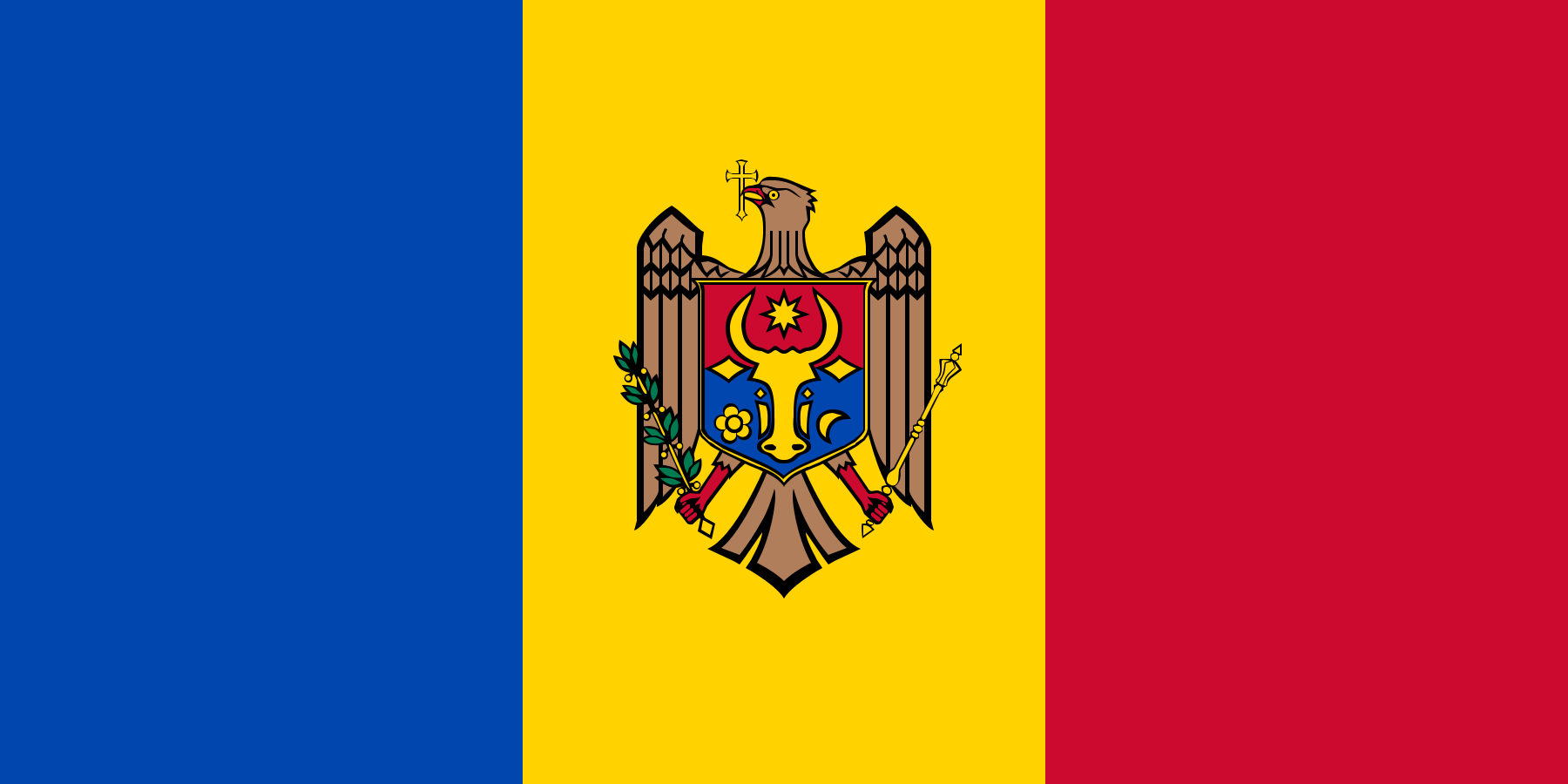
A politician who moved from Soviet party leadership to Moldova's presidency
In the 1996 runoff, backed by left and centrist forces, he defeated Mircea Snegur to win the presidency.
Pyotr Luchinsky rose through the party apparatus of the Moldavian Soviet republic and became a link between late Soviet republican politics and the making of the independent Moldovan state. He became first secretary of the Communist Party of Moldova's Central Committee in 1989 and served on the CPSU Politburo from 1990 to 1991. After independence, he was ambassador to Russia and speaker of parliament before winning the 1996 presidential election and serving as Moldova's second president from 1997 to 2001. His career shows how Soviet institutional continuity and the adjustment of a new state's sovereignty and foreign orientation could converge in one politician.
Career timeline
1960–1971Instructor, department head, secretary and first secretary of the Moldavian Leninist Komsomol Central Committee
1971–1976Secretary of the Communist Party of Moldova Central Committee and member of its Politburo
1976–1978First secretary of the Communist Party's Chișinău City Committee
1978–1986Deputy chief of a department of the CPSU Central Committee
1986–1989Second secretary of the Communist Party of Tajikistan Central Committee
1989–1990First secretary of the Communist Party of Moldova Central Committee
1990–1991Secretary of the CPSU Central Committee and member of its Politburo
The Tamanskaya Division battalion chief of staff who turned ten tanks to defend the White House during the August coup
I decided that whatever order I was given, I wouldn't shoot anyone.
A Soviet Army major serving as chief of staff of a tank battalion in the Guards Tamanskaya Motor Rifle Division. On 19 August 1991, he led ten tanks to the Kalinin Bridge near the White House under GKChP orders, but after meeting Vice President Alexander Rutskoi, he turned his tanks around to defend the Russian parliament. The tank from his battalion, No. 110, was the one Boris Yeltsin climbed to deliver his historic speech, an image that became the symbol of the coup's defeat. After the coup he was ostracized within the division, left the army in 2000, and spent the 1990s scraping by on security and funeral-agent jobs.
Career timeline
~1991Chief of Staff, Tank Battalion, Tamanskaya Guards Motor Rifle Division (Major)
1991.08.19Defected with ten tanks to Yeltsin's side, defended the White House
1991–1992Remained in Tamanskaya Division (promoted to Lieutenant Colonel by Shaposhnikov, 1992)
1992–2000Served in Timiryazevsky District Military Commissariat
2000Retired as Lieutenant Colonel
2000년대 이후Various security and funeral-sector jobs; deputy security chief at a Moscow-area factory
A Russian general shaped by obedience and uncompromising war
In August 1991, three protesters died when the armored column he commanded collided with a barricade in a Moscow tunnel.
Sergey Surovikin is a Russian military commander who began as a late-Soviet officer and rose to the highest levels of the post-Soviet armed forces. During the August 1991 coup attempt, he led a Taman Division BMP battalion into a Moscow tunnel where three protesters died in the confrontation; he was detained, but charges were dropped on the grounds that he had followed orders. He later commanded in Afghanistan, Chechnya, Syria, and Ukraine, gaining recognition for operational effectiveness alongside scrutiny over civilian harm. His career traces one route by which the Soviet command structure survived its state’s dissolution and reappeared in Russia’s militarized power.
Career timeline
1987Graduated from the Omsk Higher Combined-Arms Command School; platoon and company commander in the Taman Guards Motor Rifle Division
1989–1991Served in Afghanistan; commander of the 1st Motor Rifle Battalion, Taman Division
1991Commanded a BMP battalion deployed in Moscow during the August coup; detained after the tunnel clash and later cleared
1995–2002Studied at the Frunze Military Academy and General Staff Academy; held commands in Tajikistan and Chechnya
2017–2021Commanded Russian forces in Syria; appointed Aerospace Forces commander-in-chief and promoted to Army General
2022–2023Commanded Russia’s Southern Group and then the joint force in the invasion of Ukraine
2023–현재Deputy commander of the joint force; later removed as Aerospace Forces chief and placed at the Defence Ministry’s disposal
The last-generation secretary who rebuilt the Russian Communist Party
On 25 October 1991 Kuptsov met Yeltsin at the Kremlin and urged him to rescind the ban on the Russian Communist Party. Yeltsin refused; Kuptsov then spent a year and a half as the underground First Secretary, steering the party to its reconstituting congress.
A metallurgical engineer who rose from a Vologda collective farm and steel mill through the party ranks, he served as First Secretary of the Vologda Regional Committee (1985–1990). In 1990 he was brought to Moscow as a CPSU Central Committee Secretary, heading the department for socio-political organizations and helping found the Communist Party of the RSFSR. Elected its First Secretary in August 1991 to replace the hardline Ivan Polozkov, he refused to endorse the GKChP coup but was nonetheless investigated for 'complicity.' After Yeltsin banned the party, Kuptsov kept its organizational skeleton alive underground and steered the February 1993 reconstituting congress that became the CPRF, then served eleven years as Zyuganov's first deputy chairman while the new Russian Communist Party consolidated.
Career timeline
1955–1958Collective farm worker, reading-room manager, and military service, Vologda Oblast
1958–1974Rolling-mill operator, foreman, and party committee secretary, Cherepovets Metallurgical Plant
1974–1979First Secretary, Cherepovets City Party Committee
1979–1984First Secretary, Vologda City Party Committee
1984–1985Second Secretary, Vologda Regional Party Committee
1985–1990First Secretary, Vologda Regional Party Committee
1989–1991People's Deputy of the USSR
1990–1991CPSU CC Secretary for socio-political organizations
1991.8–11First Secretary, CP RSFSR Central Committee
1993–2004First Deputy Chairman, CPRF Central Committee
1995–2011Deputy, State Duma of the Russian Federation (2nd–5th convocations)
The last Gosplan chairman who presided over the dissolution of Soviet planning
On the end of the planned economy: "We proposed a mechanism to bring the vulnerable closer to public goods through the market. But nobody wanted to listen."
The last steward of Soviet central planning, he managed the transition from plan to market as First Deputy Prime Minister and inaugural Minister of Economy and Forecasting under the Pavlov government, when Gosplan was reorganized into the new ministry in May 1991. After the USSR's dissolution, he transformed into a successful post-Soviet industrial entrepreneur, founding the Avtotor auto assembly group.
Career timeline
1969–1974Engineer at VAZ construction site → Komsomol official in Tolyatti
1976–1982Deputy head then head of planning and economic department, VAZ
1982–1985Deputy general director for economics and planning, KAMAZ
1985–1988Department head at State Committee for Labor → Council of Ministers apparatus
1989–1991Chairman, USSR State Committee for Labor and Social Questions
1991.3–1991.5Deputy Prime Minister of the USSR
1991.5–1991.11First Deputy PM and Minister of Economy and Forecasting (Gosplan successor)
1991 이후Founded International Privatization Fund → Chairman of Avtotor Holding
Technocrat who ran Soviet heavy machine-building in its late decades
When Ustinov ordered mortar production at his plant, his minister Afanasyev warned: 'Make one and I hand you to the prosecutor.' Velichko organized a 'heroic storm,' delivered them, and recalled it as 'nervous, not to say absurd, conditions.'
A technocrat who rose from lathe operator to director of Leningrad's Bolshevik plant, Velichko served as minister for energy, heavy, and transport machine-building (1975–1991) and First Deputy Chairman of the USSR Council of Ministers (1991). His ministries built the Atommash nuclear complex, reactor systems for over a dozen nuclear plants, ICBM ground equipment, and the Buran shuttle launch complex. When other industrial ministries faltered in the late 1980s, his proved resilient enough that the government twice consolidated troubled ministries under his leadership. After the Soviet collapse he remained an industrial elder, chairing Tyazhenergomash and advising on Russian industrial policy.
The last Chief of the Soviet General Staff, who refused to fire on civilians and twice drafted military reform
“These were young people expressing their views in the square. The task before me was to resolve the conflict without bloodshed.” — when asked why he refused the Kazakh party leadership's order to deploy troops against the 1986 Alma-Ata protests.
A professional soldier who rose from conscript to the highest military post in the USSR: Chief of the General Staff. As commander of the Central Asian Military District, he refused the Kazakh party leadership's demand to send troops against the December 1986 Alma-Ata protests, resolving the standoff without bloodshed. Twice entrusted with drafting military reform, first as First Deputy Chief of the General Staff under Gorbachev and again as Chief in 1991, he advocated shorter conscription, brigade-based organization, and a defensive posture, clashing with Defence Minister Yazov and later the Russian military establishment. Appointed Chief of the General Staff after the August 1991 coup, he held the post barely four months before the Soviet Union itself dissolved, making him the last man to hold the office.
Career timeline
1954Conscripted, artillery regiment, Turkestan Military District
1967–1968Motor rifle battalion commander, GSVG — seized airfield and key points near Prague
1979–1981Commander, 28th Combined Arms Army, Belorussian Military District
1984–1987Commander, Central Asian Military District — refused to deploy troops to Alma-Ata, Dec 1986
1987–1988First Deputy Chief, General Staff — drafted military reform, clashed with Yazov, removed
1989–1991First Deputy Chief of General Staff & Warsaw Pact Joint Armed Forces Chief of Staff
1991.8Chief of the General Staff, USSR — appointed after coup, dismissed as USSR dissolved
1992–1994Military inspector-adviser, presidential military adviser, retired 1994
Leader of the Lithuanian independence movement
1932–
The musicologist who led the first nation out of the Soviet Union
On the night of 11 March 1990, when the act restoring independence passed without a vote against, he declared from the chair that Lithuania was once more an independent state: the first republic to walk out of the USSR, and the Kremlin's first notice of secession.
A Lithuanian musicologist and the leading authority on the painter-composer Ciurlionis, Landsbergis joined the founding of the reform movement Sajudis in 1988 and became its chairman. On 11 March 1990, as chairman of the Lithuanian Supreme Council, he carried the act restoring independence, becoming head of the first republic to declare its departure from the USSR. He held that independence through Moscow's economic blockade and the bloody suppression attempt of January 1991, and later served as speaker of the Seimas and a member of the European Parliament, the patriarch of the Lithuanian right.
Career timeline
1955Graduated from the Lithuanian Conservatory (now Lithuanian Academy of Music and Theatre)
1978–1990Professor at the Lithuanian Conservatory and Vilnius Pedagogical University
1988–1990Chairman of the Sąjūdis Seimas Council
1989–1990People's Deputy of the USSR Congress of People's Deputies
1990–1992Chairman of the Supreme Council of Lithuania (head of state)
1993–2003Chairman of the Homeland Union (Conservative Party)
Gorbachev's last agriculture Politburo member: operational chief of perestroika farm policy
In August 1991, when the GKChP was formed, Stroev refused to recognise it — one of the few perestroika-era Politburo members who did not side with the coup.
Stroev began as a collective-farm shepherd in the Oryol countryside and graduated from the Michurinsk Horticultural Institute, a classic Soviet agricultural technocrat. Over three decades he rose through the Oryol party apparatus to become oblast first secretary in 1985, and in 1989 Gorbachev brought him to Moscow as Central Committee Secretary for Agriculture, adding Politburo membership in 1990. As the operational chief of perestroika farm policy, he oversaw the reorganisation of the agro-industrial complex and the response to a deepening food crisis, and he refused to endorse the GKChP during the August 1991 coup. After the Soviet collapse he reinvented himself as a post-Soviet regional heavyweight, serving as governor of Oryol Oblast (1993–2009) and chairman of the Federation Council (1996–2001).
Career timeline
1973–1984Secretary for Agriculture, Oryol Oblast Party Committee
1984–1985Instructor, CPSU Central Committee
1985–1989First Secretary, Oryol Oblast Party Committee
1986–1991Member, CPSU Central Committee
1989–1991CPSU Central Committee Secretary (Agriculture)
A Moscow party organizer at the Soviet Union's end
His life, he later recalled, was divided into a before and after the Communist Party ban.
Yuri Prokofyev was a Soviet party cadre who rose through Moscow's party and administrative organizations. As first secretary of the Moscow City Party Committee, he worked at the point where reform collided with the party's disintegration, and joined the Politburo in 1990. He was involved in the activity of the State Committee on the State of Emergency in 1991 without being a member, then turned to memoir writing and technology enterprises after the Soviet Union and the Communist Party were banned.
Career timeline
1957Pioneer leader at a Moscow school
1960Joined the Communist Party of the Soviet Union
1968Cadre in the Moscow City Party Committee's organizational work
1977–1985Secretary and first secretary of the Kuibyshev District Party Committee in Moscow
1986–1988Secretary of the Moscow City Executive Committee
1988–1989Secretary and second secretary of the Moscow City Party Committee
1989–1991First secretary of the Moscow City Party Committee
1990–1991Member of the CPSU Central Committee and Politburo