Architect of perestroika cadres, last surviving Politburo member
In January 1989, Vilnius city party leaders sent Razumovsky a second appeal for a response to their criticisms — none came, and that December the Lithuanian CP declared independence.
Gorbachev's cadre chief, Razumovsky headed the CC Organizational-Party Work Department (1985–1988) and chaired the Party Building and Cadre Policy Commission (1988–1990), driving the largest personnel turnover of perestroika. An agronomist who rose to First Secretary of Krasnodar Kraikom (1983–1985), he became CC Secretary and candidate Politburo member in 1986. Under Gorbachev's banner of intra-party democracy, his rigid delegate quotas fueled a backlash in Lithuania's Communist Party that contributed to its secession. He later served as Consul General in Shanghai (1990–1992) and is, as of 2025, the last living member of the 1986 Politburo.
Career timeline
1958Graduated Kuban Agricultural Institute, collective farm agronomist
1959–1961First Secretary, district Komsomol committee
1964–1967First Secretary, Korenovsk District Party Committee
1967–1971Head, Organizational-Party Work Dept, Krasnodar Kraikom
1971–1973Deputy then head of sector, CC Org-Party Work Dept
1973–1981Chairman, Krasnodar Krai Executive Committee
1981–1983Head, Agricultural Dept, USSR Council of Ministers Admin
1983–1985First Secretary, Krasnodar Kraikom CPSU
1985–1988Head, CC Org-Party Work Dept (succeeding Ligachev)
1986–1990Secretary, CPSU Central Committee
1988Head, CC Party Building and Cadre Work Dept
1988–1990Chairman, CC Commission on Party Building and Cadre Policy; candidate PB member
Party leadership
1945–
○ Left politics after the Soviet collapse
A Georgian party official at the edge of Soviet collapse
“The law should be enforced, but it should be enforced without victims.”
Givi Gumbaridze was a Communist Party official who rose from archival and party-organizational work to the top leadership of the Georgian Soviet Socialist Republic. A former state-security chief, he governed as national mobilization intensified and party rule collided with popular demands. After the bloody Tbilisi crackdown of 1989, he called for both accountability and order, but could not reverse the crisis of Soviet authority.
Career timeline
1966–1967Served in the Soviet Army
1968–1972Researcher in Georgia’s central state archives and aide in the republic’s Supreme Soviet apparatus
1977–1983Official in the Georgian Communist Party Central Committee’s administrative-organs department
1983–1985First Secretary of the Zestafoni District Party Committee
1988First Secretary of the Tbilisi City Party Committee
1988–1989Chairman of the Georgian SSR Committee for State Security
1989–1990First Secretary of the Communist Party of Georgia
1990–1991Member of the CPSU Politburo
1989–1990Chairman of the Presidium of the Supreme Soviet of the Georgian SSR
Architect of the 500 Days Program: perestroika economist who drafted a rapid transition from planned economy to market
During coal-mine research in the 1970s, a collapse trapped him and four workers waist-deep in ice water for ten hours. Three died in hospital after rescue. Yavlinsky later recalled: "We were saved, but three out of five died in hospital."
Soviet economist and politician from Lviv. After graduating from the Plekhanov Institute and researching coal-mine labour, he became head of the Joint Economic Department of the USSR Council of Ministers in 1989 under Leonid Abalkin. In 1990, with Mikhail Zadornov and Aleksei Mikhailov, he authored the 500 Days Program (a roadmap for transitioning from a planned to a market economy in under two years) and was appointed Deputy Chairman of the RSFSR Council of Ministers. When Gorbachev compromised with Nikolai Ryzhkov's alternative, Yavlinsky resigned in October 1990; he founded the EPICenter think tank and later launched Yabloko in 1993, becoming a fixture of Russia's liberal opposition.
Career timeline
1976–1980Researcher, All-Union Coal Industry Management Research Institute (VNIUUgol)
1980–1989Sector head for heavy industry → deputy head of consolidated department → head of social development and population, State Committee for Labour and Social Affairs
1989–1990Head, Joint Economic Department, USSR Council of Ministers
1990.7–11Deputy Chairman, RSFSR Council of Ministers; Chairman, State Commission for Economic Reform
1991.8–12Deputy Chairman, USSR Committee for Operational Management of the National Economy (vice-premier rank)
1991.10–12Member, Political Consultative Council under the President of the USSR
1990–1993Founder and director, EPICenter for Economic and Political Research
Organizational-Party Work deputy chief who witnessed Sumgait, and said 'we were a day late'
Gorbachev says we were three hours late: nothing of the sort. We were a day late! Because we waited a whole day for the decision to send in troops.
A railway engineer who rose through the party apparatus to become deputy head of the CPSU Central Committee Organizational-Party Work Department (1987–1988) under Gorbachev. On the night of February 28, 1988, he and KGB deputy chairman Filipp Bobkov arrived in Sumgait, where he witnessed the mutilated corpses of the pogrom and later testified that Moscow's response was 'a day late, not three hours.' He later served as First Secretary of the Zaporizhzhia obkom (1988–1990) and Second Secretary of the Central Committee of the Communist Party of Ukraine and Politburo member (1990–1991), before working in Moscow as vice-president of the Russian Union of Commodity Producers after the USSR dissolved.
Career timeline
1959Graduated Moscow Railway Engineering Institute; worked at Zaporizhzhia Electric Locomotive Repair Plant
1960–1967Komsomol secretary → First Secretary, Zaporizhzhia Oblast Komsomol
1967–1974First Secretary, Lenin District Party Committee → Mayor of Zaporizhzhia
1974–1986Secretary for industry → Second Secretary, Zaporizhzhia Obkom CPU
1987–1988Deputy Head, CC Organizational-Party Work Department
1988.02Joined Volsky's group, dispatched to Sumgait
1988–1990First Secretary, Zaporizhzhia Obkom CPU
1990–1991Second Secretary and Politburo member, CC CPU
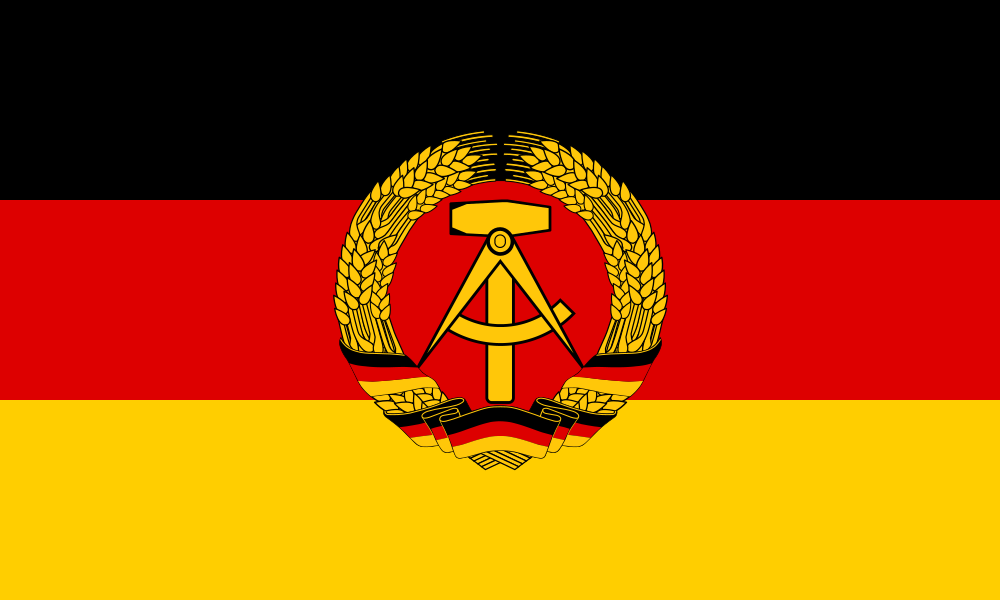
From border controller to the officer who ordered the Wall opened
“That’s why I gave my people the order: Open the barrier!”
Harald Jäger was a border-control officer who served the East German Ministry for State Security, enforcing the state’s travel controls and intelligence work. On 9 November 1989, without clear direction from his superiors, he faced a growing crowd and the danger of violence at Bornholmer Straße. He belonged to the machinery of control, yet that night he ordered the barrier opened, allowing thousands of East German citizens into West Berlin. He later acknowledged both the GDR’s inner contradictions and the freedom brought by the Wall’s fall.
Career timeline
1943Born in Bautzen
1961Volunteered for the German Border Police
1964–1989Served in the Ministry for State Security passport-control units
1976–1981Studied at the Stasi Law College and earned a law degree
1989Deputy commander at the Bornholmer Straße crossing
1989.11.09Ordered the Bornholmer Straße barrier opened without authorization
Estonian former political prisoner who survived the Soviet camps and co-organized the first open rally of the Baltic independence movement
The Hirvepark demonstration, Ahonen said, 'broke open the path for the expression of opinion,' an historic turn he called 'the icebreaker effect.'
Heiki Ahonen was born in 1956 in Pärnu, Estonia. His grandfather was shot by the NKVD, his father imprisoned in the camps, and his mother deported to Siberia: every member of his family was repressed. Joining the underground resistance in 1977, he distributed samizdat and fed information on Soviet human rights violations to Western journalists; convicted of anti-Soviet agitation in 1983, he served five years in the Perm labour camps. Released in early 1987, he co-organised the Hirvepark rally that August, the first open mass demonstration demanding disclosure of the Nazi-Soviet pact's secret protocols, breaking the dam for the Baltic independence movement; then was forcibly expelled by the KGB, spent a decade in exile, and came home as the founding director of the Museum of Occupations.
Career timeline
1977–1983Underground resistance, samizdat distribution, human rights documentation
1983–1987Five years in Perm labour camps (anti-Soviet agitation)
1987.08Co-founder of MRP-AEG, co-organiser of Hirvepark rally
1988.01Co-founder, Estonian National Independence Party (ERSP)
1988–1989Deputy chairman, Help Center for Estonian Political Prisoners (Stockholm)
1989–1998Director of Estonian service, Radio Free Europe (Munich/Prague)
2003–2012Founding director, Museum of Occupations, Tallinn
The artist who gave the Singing Revolution its name
On 11 September 1988, from the stage of Eestimaa Laul before 300,000 people, he declared: "One day, no matter what, we will win!" Those words became the slogan of Estonia's freedom struggle.
An Estonian artist and caricaturist, Valk coined the term "Singing Revolution" in an article published in Sirp ja Vasar on 17 June 1988, a week after the spontaneous night-singing demonstrations at the Tallinn Song Festival Grounds. At the Eestimaa Laul gathering that September, he declared before 300,000 people, "One day, no matter what, we will win!" (Ükskord me võidame niikuinii!), a phrase that became the independence movement's defining slogan. A founding member of the Estonian Heritage Society and the Popular Front (Rahvarinne), he served in the Estonian Supreme Council from 1990 to 1992 and voted on 20 August 1991 for the restoration of independence.
Career timeline
1955–1961Studied metalwork at the Estonian State Art Institute, graduated
1972–1976Chief artist of the Estonian SSR Art Fund
1979–1987First Secretary of the Estonian SSR Artists' Union board (non-party)
1987Founding member of the Estonian Heritage Society
1987–1989Lecturer at Tallinn Art University
1988Co-founder of the Estonian Popular Front (Rahvarinne), designed its logo
1990–1992Member of the Estonian Supreme Council; voted for the restoration of independence on 20 August 1991
An Estonian legal scholar who challenged the Soviet official narrative in the language of law
On the Yakovlev commission, he argued that the Estonian Soviet Socialist Republic was legally null and void.
Igor Gräzin is an Estonian legal scholar and politician whose work has ranged across legal theory, philosophy of law, and comparative jurisprudence. Elected to the Congress of People's Deputies of the Soviet Union in 1989, he served on the Yakovlev commission examining the secret protocols and the legal meaning of the Baltic states' incorporation. His intervention brought legal expertise into the political struggle over sovereignty and historical memory during the Soviet Union's final crisis.
Career timeline
1952Born in Tartu
1975Graduated in law from Tartu State University
1979–1987Researched law at Soviet state and law institutions and earned a doctorate
1988–1989Headed the law department of the Estonian Academy of Sciences Institute of Philosophy, Sociology and Law
1989–1991Member of the Congress of People's Deputies and the Yakovlev commission
1990–2000Professor and researcher at the University of Notre Dame
The conservative apparatchik who founded the Russian republic's Communist Party
Gorbachev later said: 'I have known Polozkov for a very long time. He is an honest, decent fellow, but stupid and uneducated. Someone writes something for him, and he recites it.'
Founding First Secretary of the Communist Party of the RSFSR (1990–1991), the first republican-level Communist Party in Russian history, and the public face of the conservative anti-perestroika opposition within the CPSU. In May 1990 he contested Boris Yeltsin for the chairmanship of the RSFSR Supreme Soviet and led in early counts before the Politburo ordered him to stand down; weeks later the founding congress elected him to lead the new Russian party. A provincial apparatchik who had run the Krasnodar party organization for five years, he rose to the CPSU Politburo but was caught between reformers and hardliners, resigning after a heart attack in August 1991. He remained a symbolic elder of the Russian communist movement through the CPRF's consultative council after the party's dissolution.
Career timeline
1957–1962Komsomol and party functionary, Solntsevo district, Kursk Oblast
1969–1972Deputy department head, Kursk Oblast Party Committee
1972Chairman, Rylsk District Executive Committee
1973–1978, 1980–1983CPSU Central Committee apparatus
1983–1984Ideology secretary, Krasnodar Krai Party Committee
1984–1985Sector head, Organizational-Party Work Dept, CPSU CC
1985–1990First Secretary, Krasnodar Krai Party Committee
1990–1991First Secretary, CPRSFSR CC · CPSU Politburo member
The physicist who walked Latvia out of the USSR and commanded the nights of the barricades
On the night of 20 January 1991, after Soviet special forces stormed Latvia's Interior Ministry, killing five, Godmanis telephoned Soviet interior minister Boris Pugo, who told him: 'I was not involved.'
A Latvian physicist turned politician, Godmanis earned his doctorate in solid-state physics and taught at the University of Latvia before joining the Latvian Popular Front in 1987. After the Front's victory in the 1990 Supreme Council elections, he became the first prime minister of a Latvia that had declared the restoration of its independence, and during the January 1991 barricades he coordinated the defense of strategic sites and personally telephoned Soviet interior minister Boris Pugo, who denied any involvement in the OMON attack. He returned as prime minister in 2007, steering Latvia through the global financial crisis until his resignation in 2009.
Career timeline
1973–1988Lecturer at University of Latvia, researcher at Institute of Solid State Physics
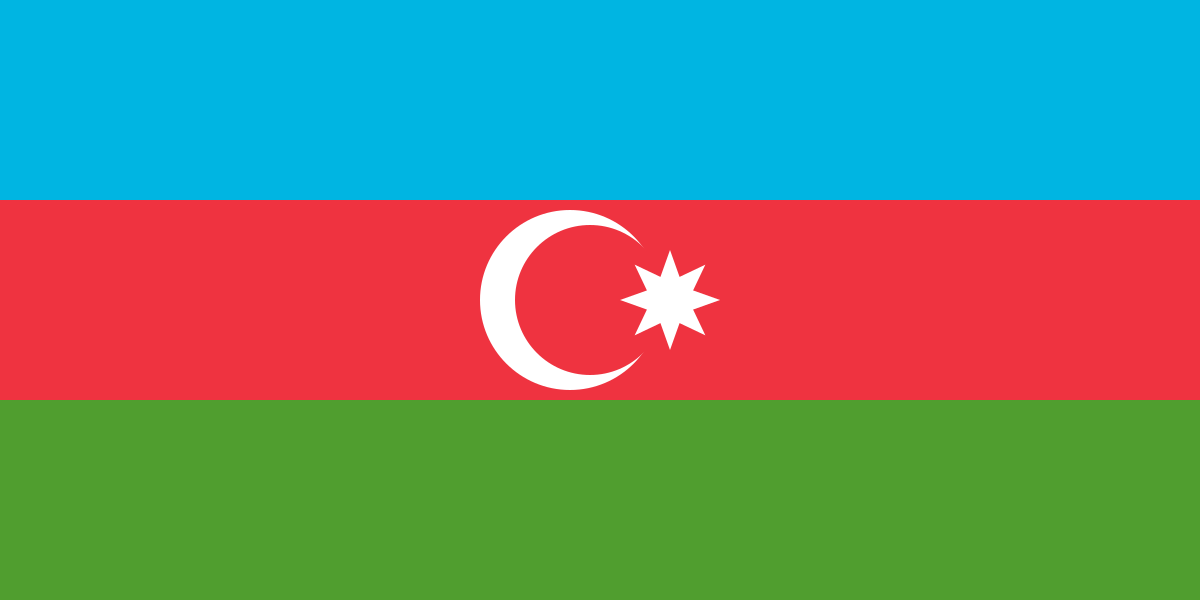
The Sumgait party boss handed a flag and photographed at the head of the mob
Left isolated by the crowd, the republic flag thrust into his hands, Muslimzade walked where the mob led him; the scene was filmed and sent to the Party Central Committee.
A Komsomol careerist who rose to first secretary of the Sumgait city party committee, he was the party official who faced the crowd at the outset of the February 1988 Sumgait pogrom and, in attempting to calm it, found himself handed an Azerbaijan SSR flag and photographed leading the march. Muslimzade later maintained that he was steering the column away from the Armenian district toward the sea, but the tail of the procession splintered into groups that fanned out into Armenian neighbourhoods. Dismissed from all posts and expelled from the party days after the pogrom, he became both a scapegoat for the violence and an enduring symbol of the party's loss of control.
Career timeline
1971–1974Instructor, Press Department, Ministry of Communications, Azerbaijan SSR; secretary, 26 Baku Commissars District Committee, Komsomol
1974–1978Head of Komsomol Organisations Dept, CC Komsomol of Azerbaijan; Chairman, Committee of Youth Organisations; instructor, Organisational-Party Work Dept, CC CP Azerbaijan
1978–1985First Secretary, Central Committee of the Lenin Komsomol of Azerbaijan
1985–1988First Secretary, Sumgait City Committee, Communist Party of Azerbaijan
1989–1991Vice-President, Azerbaijan Association of Joint Ventures and International Unions
1991People's Deputy, Supreme Council of the Republic of Azerbaijan
The shipyard worker who helped launch independent unionism
“We had been preparing for the strike for seven days, and the day came when it had to begin here in the shipyard.”
Jerzy Borowczak was a young Gdańsk shipyard worker who helped open the way to Poland's independent trade-union movement in 1980. With Bogdan Felski and Ludwik Prądzyński, he launched the strike on 14 August, demanding Anna Walentynowicz's reinstatement, higher wages, and a memorial to the victims of 1970. He continued resisting after martial law, enduring internment and dismissal before returning to the shipyard in 1989.
Career timeline
1977Graduated from the Gdańsk Shipbuilding Technical School
1979Worker at Gdańsk Shipyard and collaborator with the Free Trade Unions of the Coast
1980Launched the August strike with Bogdan Felski and Ludwik Prądzyński
1980–1981Founding member and deputy chair of the Solidarność shipyard committee
1981–1982Resisted martial law and was interned at Iława
1982–1989Worked for the Świetlik high-altitude work cooperative after dismissal
1989–1993Returned to the shipyard and chaired its Solidarność committee
2000–2023Member of the Polish Sejm and director of the Gdańsk Solidarity Centre Foundation
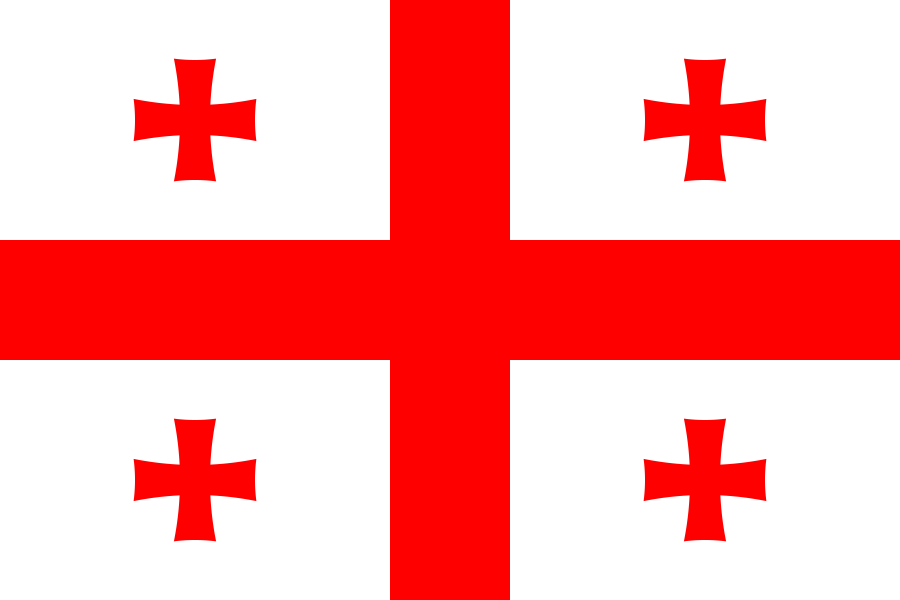
The Georgian First Secretary who asked Moscow for troops, then resigned after 21 died
Patiashvili later recalled: 'Gorbachev phoned and said, in a tone that left no room for argument: The square must be cleared immediately, and the army will handle it. I understood he knew about the plan and supported it.'
He succeeded Shevardnadze as First Secretary of the Georgian Communist Party in 1985, but dismantled most of his predecessor's reform experiments and drove the opposition underground. In April 1989, facing independence protests sparked by the Abkhaz autonomy dispute, he asked Moscow to send troops and on 8 April convened the republic's Defence Council, which decided to disperse the demonstrators by force. Before dawn the next day, Soviet troops armed with sapper shovels and poison gas descended on unarmed civilians, killing 21; Patiashvili accepted responsibility and resigned within two weeks. He remained in Georgian politics, twice ran for president against Shevardnadze, and supported the 2003 Rose Revolution, though he later criticized Saakashvili.
Career timeline
1965–1973Komsomol posts in Georgia, rising to First Secretary
1973–1974First Secretary, Gori District Party Committee
1974–1985Secretary for Agriculture, CP of Georgia
1985–1989.4First Secretary, CP of Georgia
1989–1991Director, scientific-production association and research institute
1995, 2000Presidential candidate, runner-up to Shevardnadze
The last Soviet trade minister, formed in consumer cooperatives
In 1987, he reported declining sugar reserves to the government, putting figures to the consumer crisis.
Kondrat Terekh was a Soviet economic administrator whose career began in consumer cooperatives and reached the management of all-Union consumer distribution. Experience in Belarusian cooperatives and republican government brought him to the post of Minister of Trade during late perestroika. His government reporting on the sugar shortage in 1987 recorded how tensions between production and distribution appeared as an everyday consumer crisis.
Career timeline
1952–1954Senior accountant in a rural consumer cooperative
1954–1958Served in the Soviet Navy
1959–1963Director of Vileyka city food trade
1967–1977Minsk regional trade chief and First Deputy Chairman of Belkoopsoyuz
1977–1984Chairman of Belkoopsoyuz
1984–1986Deputy Chairman of the Council of Ministers of the Byelorussian SSR
The deputy defence minister who, at Tbilisi, pushed for force without waiting for the Politburo
"A decision must be adopted here on the scene": to the Georgian Defence Council, Tbilisi, 8 April 1989
A career officer who rose from Suvorov military school to the top of the Soviet Army, Kochetov was promoted to Army General in 1988 and appointed First Deputy Minister of Defence in January 1989. That April he was dispatched to Tbilisi, where he told the Georgian Defence Council that 'the magnitude of the crisis is not fully appreciated in Moscow' and that 'a decision must be adopted here on the scene,' opening the path to the use of force without Politburo clearance. The crackdown on 9 April killed 21 people, and subsequent documentary research established that Kochetov was acting on Yazov's instructions and that Gorbachev had not been informed in advance.
Career timeline
1952Graduated Lvov Infantry School; platoon and company commander, GSVG
1965Graduated Frunze Military Academy; regimental commander, North Caucasus MD
1973Graduated General Staff Academy; commander, 24th 'Iron' Division
1977–1979Commander, 7th Guards Army
1982–1985Commander, Southern Group of Forces (Hungary)
1985–1988Commander, Transcaucasus Military District
The dissident architect who walked out of a Soviet prison camp and opened Estonia's political road to independence
On 23 August 1987 at noon, Hirvepark stood empty until the stroke of twelve, when two to five thousand people suddenly filled it. Parek recalled: 'Unbelievable! Something had to be done.'
The daughter of an Estonian officer, she was deported to Siberia at seven and spent four years in exile. Working as an architect, she was arrested in 1983 for anti-Soviet samizdat activity and imprisoned for four years; seven months after her release she co-founded the MRP-AEG and organised the Hirvepark rally of August 1987. That rally became the starting point of the Baltic independence movement, and the following year she was elected chair of the ERSP, Estonia's first non-communist party. After independence she served as interior minister in the first post-Soviet government, resigning in the 1993 Pullapää crisis, and later converted to Catholicism, living at Pirita Convent while leading the drive to build a memorial to the victims of Stalinism.
Career timeline
1963–1983Worked as an architect at design institutes in Tallinn and Tartu
1983–1987Arrested for anti-Soviet agitation, imprisoned in Dubravlag women's political section
1987Co-founded the MRP-AEG, organised the Hirvepark rally
1988–1992Chair of the Estonian National Independence Party (ERSP)
1990–1992Member of the Congress of Estonia
1992Presidential candidate, fourth place with 4.3% of the vote
1992–1993Minister of the Interior of Estonia (Mart Laar cabinet)
1997–Co-founder and head of Caritas Eesti; resident at Pirita Convent
Nuclear industry minister who inherited Sredmash in the shadow of Chernobyl
Ryabev later recalled: 'I was in Chernobyl from 2 May and worked there more than a month. All that time I felt something terrible, heavy for all of us had happened — and pain and resentment at what had occurred.'
A physicist from Vologda who trained at MIFI and began his career at the secret nuclear weapons institute VNIIEF in Sarov. As director of VNIIEF from 1974, he led development of new nuclear warheads before moving to the Central Committee's Defense Industry Department to oversee the entire medium machine-building sector. In November 1986, in the immediate aftermath of Chernobyl, he succeeded Yefim Slavsky as Minister of Medium Machine-Building, taking command of the entire Soviet nuclear weapons and atomic energy complex. He later served as Deputy Chairman of the USSR Council of Ministers with responsibility for the fuel and energy complex. After the Soviet collapse, as First Deputy Minister of Atomic Energy of the Russian Federation, he helped preserve the nuclear weapons complex and devoted himself to the multi-volume documentary history of the Soviet atomic project.
Career timeline
1957–1963Engineer, senior engineer at VNIIEF (KB-11), Sarov
1963–19672nd Secretary, Kremlyov City Party Committee
1967–1969Deputy chief engineer for production, VNIIEF
1974–1978Director, VNIIEF
1978–1984Head of medium machine-building sector, Defense Industry Dept., CC CPSU
1984–1986Deputy, then 1st Deputy Minister of Medium Machine-Building
1986–1989Minister of Medium Machine-Building, USSR
1989–1991Deputy Chairman, USSR Council of Ministers; Chairman, Bureau for Fuel-Energy Complex
1993–20021st Deputy Minister of Atomic Energy, Russian Federation
Sociologist raised within the Soviet system who became an intellectual pillar of the Baltic independence movement
At the founding congress of Rahvarinne in October 1988, sociologist Marju Lauristin stood with Edgar Savisaar on the podium and laid the intellectual foundations of the independence movement.
Marju Lauristin was born in Tallinn as the daughter of leading Estonian communist politicians and studied journalism and sociology at Tartu University. In 1980 she signed the 'Letter of 40,' publicly resisting the Russification policies that were suffocating the Estonian language and culture, an act that set her political course as an intellectual. In 1988 she co-founded Rahvarinne (the Estonian Popular Front) with Edgar Savisaar, organized its founding congress, and became the figure most associated with the movement's intellectual leadership. After the restoration of independence she served as Estonia's first Minister of Social Affairs and continued as a professor at Tartu University, studying the sociology of post-socialist transition.
Career timeline
1966Graduated Tartu State University (journalism and sociology)
1976PhD in journalism, Moscow University
1980Signed the Letter of 40
1988Co-founded Rahvarinne, member of its first leadership
1989–1990People's Deputy of the USSR
1990–1992Deputy Speaker of Estonian Supreme Council; Constitutional Assembly member
1990–1995First chair of the Estonian Social Democratic Party
1992–1994Minister of Social Affairs of Estonia
2003–2021Professor of Social Communication, University of Tartu
A party cadre who moved from army organization to the late Soviet Politburo
In April 1991, while responsible secretary of the All-Army Party Committee, he joined the late Soviet Politburo.
Mikhail Semyonovich Surkov was a Soviet party organizer and politician whose career developed within the armed forces' political apparatus. After working in party-control posts in the army, he entered the Politburo shortly before the Soviet Union's dissolution, embodying the late system's reliance on institutional cadres amid crisis. He later carried that experience into the Communist Party of the Russian Federation, the State Duma, and the Accounts Chamber.
Career timeline
1960Began working as an apprentice fitter
1965–1977Served in the Soviet armed forces and graduated from the Lenin Military-Political Academy
1988–1990Head of the political department of a combined-arms army
1990–1991Secretary of the All-Army Party Committee and responsible secretary of the party commission under the Main Political Directorate
1991Member of the CPSU Central Committee and Politburo member
1995–1999State Duma deputy and deputy chair of the Defence Committee for the Communist faction
2000–2007Auditor of the Accounts Chamber of the Russian Federation
The last minister who tried to preserve the Soviet machine-tool industry through perestroika
Asked in 2012 about the state of the industry, Panichev answered: 'Many development programs have already been adopted. Over thirty government documents on machine-tool building alone. Nothing has budged.'
Nikolai Panichev was the last Minister of Machine Tool and Instrument Building Industry of the USSR (1986–1991), a production administrator who rose from lathe operator to director at the Leningrad Ilyich plant over twenty-five years before joining the ministry. As minister he sought to keep Soviet machine-tool manufacturing competitive by introducing CNC machines, flexible manufacturing modules, and robotic complexes, but the sector was caught between the old command system and the half-built market reforms. After the Soviet collapse he founded the Russian machine-tool association Stankoinstrument and chaired the public council of former USSR and RSFSR ministers. His 2004 memoir Razlom (Fracture) offers a first-hand account of late-Soviet industrial achievement and the failure of reform.
Career timeline
1953–1955Served in the Soviet Army
1955–1956Chairman, Dribin District DOSAAF Committee
The general who sent men onto the Chernobyl roof when the robots died
'How is this possible?' I still cannot stop asking myself. 'Did we come from the Stone Age, to collect sheets of lead and cut makeshift protection for vital organs?'
A Soviet civil defence general and doctor of technical sciences. Four months after the Chernobyl explosion, when every remote-controlled robot had failed, the government commission handed him the most dangerous decontamination zone. He ordered lead sheeting stripped from the walls of government offices and improvised into protective gear, then ran 3,828 soldiers through the roofs of reactor 3 in 40–90-second shifts; they cleared 200 tonnes of highly radioactive debris by hand. He developed radiation sickness, wrote two books about the operation, and was nominated for Hero of the Soviet Union, only to be struck from the list after a conflict with the chief of staff of the Kiev Military District.
Career timeline
1953Graduated Kharkov Military Technical School
1963Graduated Kharkov Automobile and Highway Institute, mechanical engineering
1967–72Instructor at Moscow Military School of Civil Defence; adjuncture at Kuibyshev Engineering Academy
1972–86Senior specialist, Military Technical Committee; First Deputy Chief, All-Union Civil Defence Research Institute; Deputy Chief of Civil Defence Staff, RSFSR
1986Commander, removal of highly radioactive debris from Chernobyl danger zones
1988Commander, rescue operations after the Spitak earthquake
1990s–Published memoirs; member of Union of Russian Writers; Sholokhov Literary Prize
The chief engineer who refused to believe the reactor was destroyed and kept pumping water into its ruins
He smashed his glasses and cut his wrists with the shards, forcing the court to postpone his trial.
Nikolai Fomin was a Soviet nuclear engineer who joined the Chernobyl plant in 1972 and rose to chief engineer in 1981. Arriving at the plant shortly after the April 26, 1986 explosion, he refused to accept reports that the reactor was destroyed and ordered water to be pumped into the wreckage of Unit 4 for hours, while sending a subordinate on a reconnaissance mission that delivered a fatal radiation dose. Arrested after the disaster, he was sentenced to 10 years but was released early after a pre-trial suicide attempt and subsequent confinement in a psychiatric hospital; he later worked at the Kalinin Nuclear Power Plant before retiring.
Career timeline
1972Started at Chernobyl NPP
1981–1986Chief Engineer, Chernobyl NPP
1987Sentenced to 10 years; imprisoned
1988Transferred to psychiatric hospital; released early
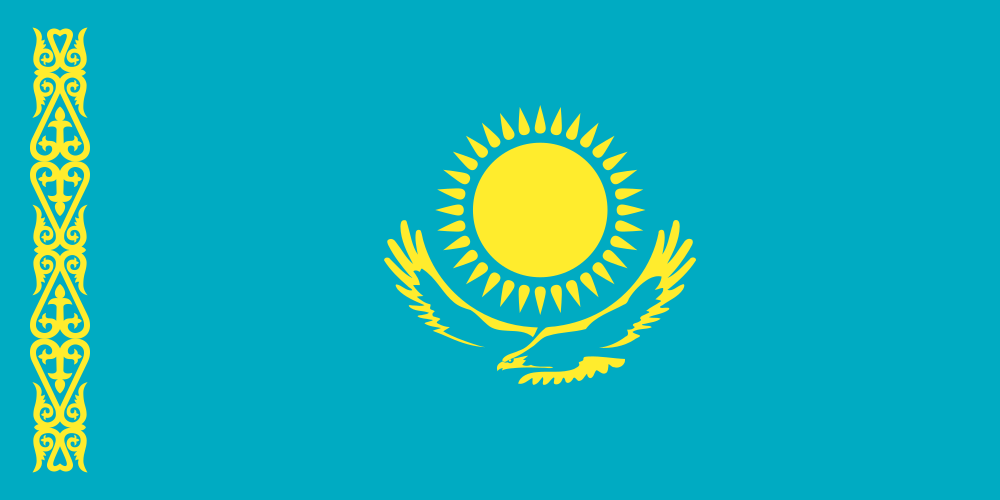
Kazakhstan's thirty-year ruler, defender of the union to its last day
On 8 December 1991 Yeltsin's side telephoned from the Belovezha forest urging him to join; he did not turn his plane. Eight days later his Kazakhstan became the last republic to declare independence, and the union's formal death certificate, the Alma-Ata Protocol, was signed in his capital.
Starting as a blast-furnace worker, Nazarbayev rose through the Kazakh premiership and party first secretaryship to become president of Kazakhstan in 1990, and at Novo-Ogaryovo was the strongest advocate of the new union treaty. Absent from the Belovezha Accords, his Kazakhstan became the last republic to declare independence from the USSR. Ruling for nearly thirty years thereafter, he laid the foundations of the new state through nuclear renunciation, the transfer of the capital and pragmatic multi-vector diplomacy, while leaving behind the charges of authoritarian rule, a personality cult and dynastic corruption. He kept real power after leaving the presidency in 2019, until the unrest of January 2022 ended his era completely.
Career timeline
1960–1969Worker at the Karaganda Metallurgical Combine (blast furnace, casting machines, dispatcher, gasman). Joined CPSU in 1962. Graduated from the Higher Technical School at the Karaganda Metallurgical Combine in 1967.
1969–1973Party and Komsomol work in Temirtau.
1973–1978Secretary of the Party Committee, Karaganda Metallurgical Combine — effectively second-in-command at the 30,000-worker enterprise.
1978–1979Secretary, then Second Secretary, Karaganda Regional Party Committee.
1979–1984Secretary of the Central Committee of the Communist Party of Kazakhstan (industry, transport, communications).
1984–1989Chairman of the Council of Ministers of the Kazakh SSR (Prime Minister). At 44, the youngest head of government of any Soviet republic.
1989–1991First Secretary of the Central Committee of the Communist Party of Kazakhstan. Concurrently President of the Kazakh SSR from 1990. Member of the CPSU Politburo, 1990–1991.
1990–2019President of Kazakhstan (first elected April 1990 as President of the Kazakh SSR; first president after independence, December 1991). Re-elected 1991, 1999, 2005, 2011, 2015. Resigned March 2019.
He recalled interpreting as searching for the threads connecting two languages.
Pavel Palazhchenko is an interpreter and writer whose work documents the decisive conversational spaces of late Soviet diplomacy. As the English interpreter for Mikhail Gorbachev and Eduard Shevardnadze, he took part in the US-Soviet summits at Geneva, Reykjavik, Malta and elsewhere. His memoir records not only leaders’ words but also the working processes of arms-control negotiations and the growth of trust, offering a Soviet-side account of the peaceful end of the Cold War. He later continued as an international-relations analyst and press official at the Gorbachev Foundation.
Career timeline
1966–1972Studied translation and interpreting at the Maurice Thorez Moscow Institute of Foreign Languages
1972–1974Completed the UN interpreter courses, then taught and interpreted at his institute
1974–1979Worked in the Russian section of the UN Secretariat interpretation service
1980–1985Worked in the USSR Foreign Ministry’s interpretation and US-Canada departments
1985–1991Chief English interpreter for Gorbachev and Shevardnadze, participating in US-Soviet summits
1991Worked in the office of the President of the USSR
1992–현재International-relations and press official and analyst at the Gorbachev Foundation
1997Published My Years with Gorbachev and Shevardnadze: The Memoir of a Soviet Interpreter