The revolutionary wave that spread from October across Europe and Asia, the communists and socialists of the Comintern era, interwar statesmen, fascism and the Spanish Civil War, and the leaders and commanders of the Second World War.
“¡No pasarán!”: the voice of anti-fascism that refused to let Franco's armies pass
“If we let the fascists continue the crimes they are committing in Spain, aggressive fascism will fall upon other peoples of Europe too. The Spanish people prefer to die on their feet than live on their knees.” — Paris solidarity rally, 3 September 1936
The iconic leader of the Spanish Communist Party (PCE), whose cry of "¡No pasarán!" during the Civil War became the universal rallying cry of anti-fascism. She resisted the Franco dictatorship from exile and publicly opposed the 1968 Soviet invasion of Czechoslovakia.
Career timeline
1917Joins the Spanish Socialist Workers' Party (PSOE)
1918First article in El Minero Vizcaíno; adopts pen name 'Pasionaria'
1922Co-founds the unified Communist Party of Spain (PCE)
1930Elected to the PCE Central Committee
1933Founding president of the Union of Anti-Fascist Women
19357th Comintern Congress — elected candidate member of the ECCI
1936.2Elected to the Cortes for Asturias
1936.7Radio address “¡No pasarán!” — calls for the defence of Madrid against the fascist armies
1937Elected Vice-President of the Cortes
1939–1942Soviet exile — continues Comintern work
1941–1963Directs short-wave Radio España Independiente (Radio Pirenaica)
1942–1960General Secretary of the PCE
1945Co-founds the Women's International Democratic Federation; Vice-President
1960–1989Chair of the PCE
1968Publicly opposes the Soviet intervention in Czechoslovakia
1977Returns to Spain after Franco's death; re-elected to the Cortes after 41 years
The anarchist metalworker who broke the rising in Barcelona and led the column that carried his name
Reported from an interview with the Canadian journalist Pierre van Paassen in Barcelona in 1936: “We are not in the least afraid of ruins. We are going to inherit the earth. The bourgeoisie may blast and ruin its own world before it leaves the stage of history. We carry a new world, here, in our hearts.” The words are famous, though the exact wording of the interview is disputed.
A metalworker born into a railwayman''s family in León. Sacked after the general strike of 1917, he fled to France and became an anarchist, and through Los Solidarios and Los Errantes he passed from bank expropriations and an attempt on the king''s life to prisons across Europe and Latin America. In July 1936 he led the workers who stormed the Atarazanas barracks and broke the military rising in Catalonia, losing his old comrade Francisco Ascaso in the fight. He then raised the six-thousand-strong Durruti Column, took it to the Aragon front and pressed the collectivization of land and factories in the liberated zone. In November he joined the defence of Madrid, was shot at the Casa de Campo front on the 19th and died the next day; whether the bullet came from the enemy, from his own side or from his own malfunctioning weapon is still argued. Hundreds of thousands followed his coffin through Barcelona.
Career timeline
1896Born in León, second of eight children of a railway worker
1913–1917Joined the metalworkers' union; sacked by the Northern Railway for the 1917 general strike and fled to France
1918–1919Became an anarchist in exile and joined the CNT on his return
1920–1922Formed Los Justicieros; the plot against Alfonso XIII was uncovered and he fled to Zaragoza
1922–1923Organized Los Solidarios with Ascaso and García Oliver; expropriated the Bank of Spain in Gijón
1924–1926Expropriation raids through Cuba, Mexico, Chile and Argentina; arrested in Paris and held in La Santé
1927–1931Released, lived in Belgium and worked with the FAI; returned to Barcelona when the Second Republic was proclaimed
1931–1936Founded the affinity group Nosotros; repeated arrests and deportations made him the face of the CNT left
1936.07.19–20Led the workers who took the Atarazanas barracks in Barcelona; his comrade Francisco Ascaso was killed
1936.07–11Raised the Durruti Column for the Aragon front and pressed collectivization in the liberated zone
1936.11.14Brought part of his column to the defence of Madrid
1936.11.19–20Shot at the Casa de Campo front and died the next day; the source of the bullet is still disputed
1936.11.22Buried in Barcelona, hundreds of thousands following the coffin
A revolutionary who pursued workers' unity across communist divisions
After his arrest in 1936, Maurín remained in prison throughout the war, leaving the POUM under Andreu Nin's leadership in his absence.
Joaquín Maurín was a Spanish communist politician and labor activist who sought a mass revolutionary politics rooted in Catalonia. He led the Workers' and Peasants' Bloc while breaking with the Communist Party's Stalinist line, then co-founded the POUM with Andreu Nin in 1935 and became its first general secretary. Trapped in the insurgent zone when the military uprising began in 1936, he was arrested and spent the Civil War in prison, leaving Nin to lead the party in his absence. After his release and exile, he worked in New York as a writer and news-agency organizer, documenting the experience of the Spanish revolution.
Career timeline
1914–1920Taught in Lleida and joined the CNT
1920–1922Lleida CNT secretary and editor of Lucha Social
1921–1922Provisional secretary of the CNT national executive
1924–1930Organizer of the Catalan-Balearic Communist Federation
1931–1935General secretary of the Workers' and Peasants' Bloc
1935–1936Co-founder and first general secretary of the POUM
1936Popular Front deputy for Barcelona
1949–1973Founder of the American Literary Agency and writer in New York
CPGB founding member, chief theoretician for half a century, and pioneer of Marxist historiography on India
After Khrushchev's 1956 Secret Speech, Dutt told the CPGB Political Bureau: 'On Stalin's sun there were, unsurprisingly, some spots.' The Soviet system, he added, had 'demonstrated the ability of a socialist society to recognise and correct its mistakes.'
Founding member of the Communist Party of Great Britain and its chief theoretician for half a century, a Marxist historian and journalist. His Fascism and Social Revolution (1934) analysed fascism as an extreme form of monopoly-capitalist crisis, his India Today (1940) pioneered Marxist historiography on India, and he served as CPGB General Secretary in 1939–1941, replacing Harry Pollitt over the party's anti-war line at the outbreak of World War II.
Career timeline
1920Founding member, CPGB
1921–1974Founded and edited Labour Monthly (53 years)
1923–1965Member, CPGB Executive Committee
1924Alternate member, ECCI Presidium
1925–1935Comintern representative (Belgium & Sweden); supervised Communist Party of India
An Allied commander caught between military gains and civilian cost
On 27 July 1953, Mark W. Clark signed the Korean Armistice Agreement at Panmunjom for the United Nations Command.
Mark W. Clark was a United States Army general who commanded in both world wars and the Korean War, combining staff work with field command in coalition warfare. In Italy he led the capture of Rome and accepted the German surrender, but his decisions around the Rapido-Garigliano crossing and the bombing of Monte Cassino remained subjects of criticism. As Commander in Chief of the United Nations Command during the final phase of the Korean War, he combined military pressure with armistice negotiations and signed the agreement on 27 July 1953 for the UNC side. His career shows how the pursuit of American military advantage could expose both the workings of coalition command and the destructive costs of war.
Career timeline
1917Second lieutenant, U.S. Army Infantry
1942Deputy commander, Allied forces for Operation Torch
1943–1944Commanding General, U.S. Fifth Army, Italian campaign
1944–1945Commander, 15th Army Group, Italy
1945–1947Commander in Chief, U.S. occupation forces in Austria
1947–1949Commanding General, U.S. Sixth Army
1949–1952Chief, U.S. Army Field Forces
1952–1953Commander in Chief, United Nations Command and Far East Command
Nazi Party propaganda chief and minister who promoted antisemitism and dictatorship.
Joseph Goebbels was a Nazi Party propaganda leader who headed the party organization in Berlin from 1926 and became its propaganda chief in 1930. Appointed minister of propaganda by Hitler in 1933, he brought the press, film, radio, and cultural life under Nazi ideological control and promoted antisemitism and persecution of Jews. He was a chief instigator of the November 1938 pogrom and later campaigned for total war.
Career timeline
1926–1945Nazi Party Gauleiter for Berlin
1930–1945Nazi Party propaganda chief
1933–1945Minister of Public Enlightenment and Propaganda
Father of the Republic of Indonesia, the Marxist who fused communism with Islam
“If you think you can direct the Indonesian revolution from Moscow, you are no different from the colonialists.” — to Alimin, who came to Manila seeking approval for the 1926 uprising
Chairman of the Indonesian Communist Party and author of 'Towards the Republic of Indonesia.' He argued Marxism and Pan-Islamism must unite, broke with the Comintern, and after 1945 shook the fledgling republic with his demand for uncompromised independence.
Career timeline
1913Graduates from Kweekschool at Fort de Kock; receives high adat title of datuk
1913–1919Studies in the Netherlands; radicalised by the October Revolution and turns to Marxism
1919–1920Teaches children of tea-plantation coolies in Deli, Sumatra; writes 'Land of Paupers'
1921.6Founds 'Sarekat Islam Schools' (Tan Malaka Schools) in Semarang; spreads to Bandung
1921.12Elected chairman of the PKI at the Semarang congress, succeeding Semaun
1922Arrested by Dutch authorities; exiled to the Netherlands; stands as CPN parliamentary candidate
1922–1923Attends the Fourth Comintern Congress in Moscow; advocates communism–Pan-Islamism alliance
1923–1925Comintern Eastern Bureau agent; writes 'Towards the Republic of Indonesia' in Canton
1925–1927Based in Manila; opposes the PKI's 1926 uprising but fails to stop it
1927Founds the Indonesian Republic Party (PARI) in Bangkok, breaking with the Comintern
1927–1942Underground across China, Singapore, and the Philippines under aliases; writes 'Madilog'
1945–1946Returns to Indonesia; founds the Struggle Union (Persatuan Perjuangan); forces Sjahrir cabinet's temporary fall
1946–1948Arrested and imprisoned by Republican government; writes autobiography 'From Jail to Jail'
1949.2.21Captured and executed by Republican forces at Blimbing, East Java
Mannerheim's secret envoy to Berlin who brokered the German-Finnish military pact that led to the Continuation War
When Himmler asked him to lead Finnish armed resistance after the 1944 ceasefire, Talvela replied he would do so only 'on the orders of Marshal Mannerheim.'
A product of the Jäger movement, Talvela rose to prominence during the Winter War when his Group Talvela destroyed two Soviet divisions at Tolvajärvi, securing Finland's first major victory. In the autumn of 1940, Mannerheim dispatched him as a personal envoy to Berlin, where he negotiated secret military coordination between the Finnish and German general staffs: the diplomatic bridge that brought Finland into the Continuation War alongside the Wehrmacht. After the war he worked as a businessman and served on the Helsinki city council; the second recipient of the Mannerheim Cross, he was promoted to general of the infantry in 1966.
Career timeline
1916Jäger volunteer, 27th Royal Prussian Jäger Battalion
1918Battalion commander (Whites), Finnish Civil War; major
1919–1922C-in-C, Aunus expedition; battalion commander, Viena expedition
1926–1927Commander, Savo Jäger Regiment
1939.12–1940.04Commander Group Talvela (Tolvajärvi victory), then III Corps; major general
1940.09Mannerheim's personal envoy to Berlin; negotiated German-Finnish military coordination
1941.06–1942.01Commander, VI Corps, Army of Karelia; Mannerheim Cross (3 Aug 1941)
1942–1944Finnish army representative at German High Command; lt. general; commanded Aunus Group 1944
The anarchist IV Army Corps commander who saved Casado's Madrid coup from Communist counter-attack
'I was aghast at donning a military uniform, but I could see no other option. From here on my conduct will bear witness to my integrity.'
A Madrid bricklayer who led the CNT construction union and was jailed on the eve of the war, he was freed when the rising began and organized a column that crushed the revolt in Guadalajara and Cuenca. Rising to command the 14th Division and then the IV Army Corps, he routed the Italian CTV at the Battle of Guadalajara and became one of the Republic's most prominent anarchist commanders. In March 1939 he backed Casado's coup against the Negrín government's Communist dependence, and when Communist forces were closing in on Madrid, Mera's IV Corps reserves entered the city and crushed the resistance in three days, sealing the path by which the war would end.
Career timeline
1931Secretary of the Madrid CNT construction union
1936.07Organized a militia column, retook Guadalajara and Cuenca
1936.11–1937Commander of the 14th Division
1937–1939Commander of the IV Army Corps
1939.03Backed Casado's coup, crushed Communist resistance in Madrid
1939–1942Exile in Oran and Casablanca, extradited to Spain by Vichy regime
1946–1975Freed, re-exiled to France, worked as a bricklayer in Paris
A communist who carried working-class militancy into armed resistance
“They have numbers; united, they will have strength.”
A metalworker and trade-union organizer, Charles Tillon entered the French Communist Party after leading a 1919 naval mutiny and rose through the CGTU and party leadership. In 1940 he called for national liberation joined to working-class unity, then organized and led the communist armed resistance by consolidating the FTP from 1941. After Liberation he served as a minister and deputy in reconstruction, but conflicts with the party leadership removed him from power in 1952 and ended in his expulsion in 1970.
Career timeline
1916–1921French Navy mechanic; led the 1919 mutiny aboard Guichen and was imprisoned
1921–1931Joined the French Communist Party; led CGTU unions in Ille-et-Vilaine and Nantes
1931–1936CGTU national leadership; Communist Party Central Committee member and alternate Politburo member
1936–1940Deputy in the Chamber of Deputies; assisted Republican refugees in Spain
1940–1944Clandestine Communist leadership; founded and commanded the National Military Committee and FTP
1944–1947Minister of Air, Armaments, and Reconstruction; mayor of Aubervilliers and deputy
1952–1970Removed from the Communist leadership, rehabilitated in 1957, and expelled in 1970
The Saint-Denis Communist who demanded the popular front first and ended a fascist
In April 1934 he sent an open letter to the Comintern demanding immediate joint action with the Socialists. In June he was expelled; in July the party signed the very pact he had demanded
A metalworker from Saint-Denis who became a deputy at twenty-six and rose to the executive committee of the Comintern as one of the French Communist Party's young leaders. He was jailed for agitation against the Rif war, sent to China as a Comintern envoy in 1927, and elected mayor of Saint-Denis in 1931. Immediately after the February 1934 crisis he demanded, publicly and ahead of the party line, immediate joint action with the Socialists; he refused a summons to Moscow and was expelled on 27 June. A month later the party signed the very pact of unity of action he had called for, and he was already outside it. In 1936 he founded the Parti Populaire Français and moved toward fascism; in 1941 he helped create the Légion des Volontaires Français against Bolshevism and fought on the Eastern Front in German uniform; he was killed in Germany in February 1945 when Allied aircraft strafed his car.
Career timeline
1898Born to a working-class family at Bresles in the Oise
1915–1922Metalworker at Saint-Denis; joins the Communist youth movement
1923–1924Leads the Communist Youth International; elected deputy in 1924
1925Jailed for agitation against the Rif war
1927Sent to China as a Comintern envoy
1931–1937Mayor of Saint-Denis
1934.02–06Publicly demands joint action with the Socialists, refuses a summons to Moscow, expelled on 27 June
1936Founds the Parti Populaire Français
1941–1944Helps found the anti-Bolshevik French volunteer legion; serves on the Eastern Front in German uniform
1945.02Killed in Germany when Allied aircraft strafe his car
Marxist playwright who weaponized theatre for class struggle through epic theatre and the Verfremdungseffekt
When I read Marx's Capital, I understood my plays — Marx was the only spectator for my plays I'd ever come across.
Bertolt Brecht was the 20th century's most important Marxist playwright and the founder of epic theatre, a poet and director who transformed the stage into a forum for class consciousness and anti-capitalist critique. After embracing Marxism under Karl Korsch in the late 1920s, he developed the Verfremdungseffekt — a defamiliarization technique that broke emotional immersion to provoke critical reflection — and with works like The Threepenny Opera, Mother Courage and Her Children, and The Good Person of Szechwan, he fused avant-garde form with popular idiom to anatomize capitalism and war. Driven out by the Nazis in 1933, he lived in exile in Scandinavia and the US—where HUAC investigated him in 1947—before returning to found the Berliner Ensemble with Helene Weigel in East Berlin in 1949, defining postwar theatre worldwide until his death in 1956.
Career timeline
1922Wins Kleist Prize for Drums in the Night
1924Moves to Berlin; assistant dramaturg at Deutsches Theater
1928The Threepenny Opera premieres, biggest Berlin hit of the 1920s
1933Flees Nazi Germany; begins 15-year exile through Scandinavia and the US
1947Testifies before HUAC in Hollywood; leaves the US the next day
1949Founds Berliner Ensemble in East Berlin with Helene Weigel
Heroic Corps founder who evolved from anarchist bombings to DPRK cabinet, lone figure spanning the Korean revolutionary spectrum
On first meeting Kim Ik-sang in Beijing, Kim Won-bong told him: 'Freedom is won by our strength and our blood… We must be the first to shed it.' Kim Ik-sang joined the Heroic Corps on the spot and weeks later walked into the Japanese Government-General building in Seoul and threw a bomb.
Anarchist militant who founded the Heroic Corps (Ŭiyŏltan) in 1919 and led a six-year campaign of bombings and assassinations against Japanese colonial authorities. After military training at the Whampoa Academy, he founded the Korean National Revolutionary Party (1935) to build a united front, commanded the Korean Volunteer Corps, and later joined the Provisional Government as Deputy Commander of the Korean Liberation Army and Minister of Military Affairs. Following liberation he pursued left-right cooperation, but after Yeo Un-hyeong's assassination he joined the 1948 North-South talks and remained in the DPRK as State Inspection Commissioner and Minister of Labor until his purge in 1958. His trajectory, from anarchist bombings to united-front politics to DPRK cabinet, makes him the only figure to span the entire Korean revolutionary spectrum.
Career timeline
1919Founded the Heroic Corps, became its leader (Ŭibaek)
1926Enrolled in Whampoa Military Academy, 4th class
1935Founded the Korean National Revolutionary Party
1938Organized the Korean Volunteer Corps, became commander
1944Minister of Military Affairs, Provisional Govt.; Deputy Commander, Korean Liberation Army
The artist who turned 'Ol' Man River' into a hymn of struggle
In 1937, moved by the Spanish Civil War, he permanently changed the lyrics of 'Ol' Man River': 'But I keep laughin' / Instead of cryin' / I must keep fightin' / Until I'm dyin'. In Wales he declared: 'The artist must take sides. I have made my choice. I had no alternative.'
A world-renowned bass-baritone and actor whose 'Ol' Man River' and Othello carried him to the summit of his art even as he devoted that art to the Black freedom struggle and global anti-colonialism. After backing the Spanish Republicans and the 1949 Paris Peace Congress, he refused to renounce the Soviet Union and endured passport revocation and blacklisting through the McCarthy years, regaining his passport by Supreme Court ruling in 1958.
Career timeline
1915–1919Rutgers College: twice All-American, class valedictorian
1919–1923Columbia Law School (LL.B.) while playing in the NFL
1924–1928Starred in The Emperor Jones; became Harlem Renaissance star
1928–1939Global fame with Show Boat; first Black Othello in Britain (1930)
1934First USSR visit: 'Here I am not a Negro but a human being'
1937–1939Supported Spanish Republicans; visited International Brigades; Council on African Affairs
1943–1945Broadway Othello: first Black actor with white cast; record 296 shows
1949Paris Peace Congress speech; Peekskill riots; blacklisting began
1950–1958Passport revoked; HUAC; founded Freedom; Stalin Peace Prize (1952)
1958Passport restored (Kent v. Dulles); published Here I Stand
1958–1960Comeback tours: Europe, USSR, Australia, NZ; Othello at Stratford
1961–1963Health breakdown; recovered at Buch Clinic, East Berlin
1963–1976Seclusion in U.S.; died of stroke complications in Philadelphia
Architect of the Comintern Black Belt thesis: Southern Blacks are an oppressed nation with the right to self-determination
“The problem is fundamentally a question of an oppressed nation with full rights of self-determination.” — Negro Liberation, 1948
American communist, radicalized from the son of former slaves. He helped establish the Comintern thesis of Black self-determination in the Southern Black Belt, served on the CPUSA Politburo, and fought as a political commissar in the Spanish Civil War. Expelled in 1959 for opposing de-Stalinization, he became a leading figure in the Maoist New Communist Movement.
Career timeline
1917–1919WWI — served in US Army 8th Regiment (Black regiment), saw action in France
1922–1925African Blood Brotherhood → Young Communist League → CPUSA
1926–1930Moscow — KUTV and Lenin School; drafted Comintern resolutions on the Negro Question
1931–1938CPUSA Politburo member and Negro Department head — Scottsboro defense, Sharecroppers Union
1937Spanish Civil War — Regimental Commissar, Abraham Lincoln Battalion; Battle of Brunete
1943–1945WWII — served in US Merchant Marine
1948Published Negro Liberation — theorized Black freedom as the unfinished democratic revolution
1959Expelled from CPUSA for anti-revisionism and defending Black self-determination
1964–1978New Communist Movement — October League/CPML Central Committee; Black Bolshevik published
The Knight of Hope: Brazilian revolutionary who marched 25,000 km
Many people think I'm crazy. Most men who reach a certain age find their senses. In their youth, they are revolutionaries. Then they marry and must look after a family and settle down. But here I am at my age and I still haven't got good sense.
— Interview, 1984
Brazilian revolutionary and politician. As chief of staff of the Prestes Column (1925–1927), he led rebels on a 25,000-km march through Brazil, earning the name 'Knight of Hope.' Elected to the Comintern Executive Committee in 1935, he directed the ANL uprising and spent nine years in prison. He served as general secretary of the Brazilian Communist Party for 37 years (1943–1980), leading labour organizing and anti-dictatorship resistance from underground and Soviet exile. Expelled in the 1980s for opposing the party's Eurocommunist turn, he remained a revolutionary Marxist to the end.
Career timeline
1924–1927Chief of Staff, Prestes Column — 25,000 km march through 14 states
1931–1934Exiled in USSR; engineer and Marxist study
1934Joined the Brazilian Communist Party
1935ANL Honorary President · Comintern ECCI member · led armed uprising
1936–1945Imprisoned; elected PCB General Secretary (1943)
1945–1948Federal Senator; underground after party outlawed (1947)
1943–1980General Secretary, Brazilian Communist Party (37 years)
1971–1979Soviet exile under military rule; returned with 1979 amnesty
The republican who bound a divided Resistance together
When German officers tried to force his signature on a false statement, Moulin chose attempted suicide rather than dishonour.
Jean Moulin was a senior French civil servant and republican organiser who linked the internal Resistance to Free France against the Nazi occupation. As Charles de Gaulle’s representative, he coordinated rival movements and brought political parties and trade unions into the National Council of the Resistance. His work of unification unfolded amid fierce tensions over the movements’ independence and ended with his arrest and death after torture in 1943.
Career timeline
1922Chief of staff to the prefect of Savoie
1925–1930Sous-prefect of Albertville
1936Chief of staff in the Popular Front Air Ministry
1937–1939Prefect of Aveyron
1939–1940Prefect of Eure-et-Loir
1941–1943de Gaulle’s representative to the internal Resistance
1943First President of the National Council of the Resistance
A leader caught between revolutionary national politics and party centralism
After the 1948 break with the Soviet Union, he was arrested as a Soviet spy and disappeared from a Belgrade prison.
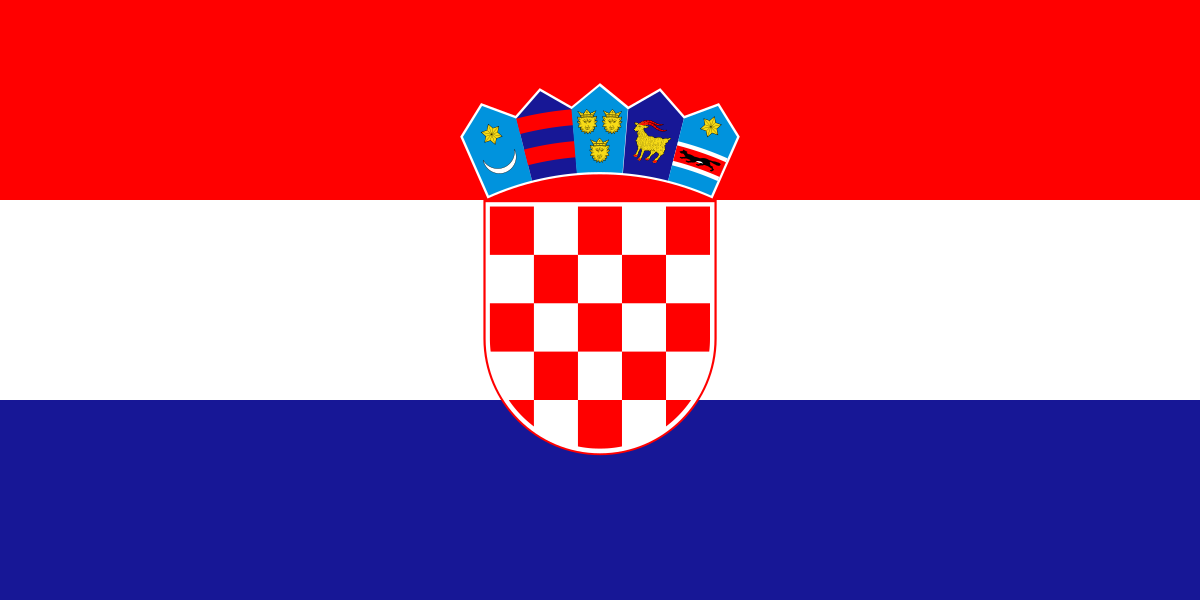
Andrija Hebrang was a Yugoslav communist revolutionary and wartime leader of the Communist Party of Croatia who helped organize resistance to occupation and political institutions in liberated territory. After the war he directed economic reconstruction and a heavy-industry development plan, becoming one of Yugoslavia’s most influential figures after Tito. Tensions over Croatian political autonomy and economic strategy brought him into conflict with the party center. After Yugoslavia’s 1948 break with the Soviet Union, he was accused of links to Soviet intelligence, expelled and arrested, and disappeared from a Belgrade prison in 1949.
Career timeline
1919Joined the Communist Party of Yugoslavia
1925–1928Worked in the Zagreb party organization
1941–1944Political secretary of the Central Committee of the Communist Party of Croatia
1943–1944Member of the Politburo of the Communist Party of Yugoslavia
1944–1946Worked in AVNOJ and administered industry and trade
1946–1948Chairman of the Economic Council and Planning Commission
1948Expelled from the party, placed under house arrest and arrested
1949Disappeared from a Belgrade prison and was recorded as dead
The Marxist macroeconomist who formalized effective demand before Keynes
Kalecki wrote in his 1943 essay: "'Discipline in the factories' and 'political stability' are more appreciated by the business leaders than are profits. Their class instinct tells them that lasting full employment is unsound from their point of view."
Polish Marxist economist who formalized the principle of effective demand before Keynes. He built a distinctive macroeconomics explaining profits, investment, and income distribution through class analysis, and later returned to socialist Poland to develop the theory of growth under planned economy.
Career timeline
1929–1936Researcher, Institute of Research on Business Cycles and Prices, Warsaw
1933Published 'Próba teorii koniunktury' — formalized effective demand ahead of Keynes
1936–1945Emigrated to England; research at LSE, Cambridge, and Oxford Institute of Statistics
1943Published 'Political Aspects of Full Employment' — predicted capitalist class resistance
1946–1954Deputy Director, UN Economic Department, New York; resigned under McCarthyist pressure
1955–1968Economic advisor to Polish Council of Ministers, deputy chairman of planning commission, professor at Warsaw University
1957Elected member of the Polish Academy of Sciences
1968Resigned in protest against antisemitic purges
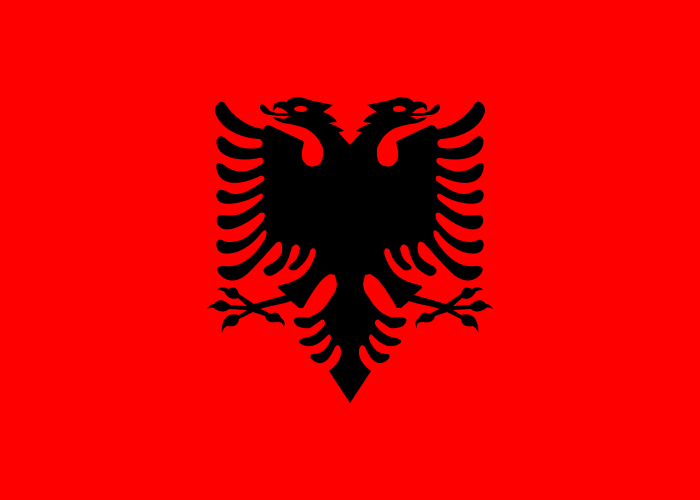
At the Constituent Assembly's session on 11 January 1946, he was elected chair of a 20-member mandate verification commission, closing its first session; at midday of that day, at the second session, the Assembly proclaimed Albania a People's Republic.
Albanian communist activist and diplomat. Born in Faiyum, Egypt, into a national-movement family, he studied in Beirut and at Harvard, served as Albanian consul in New York in 1923-24, and taught at the Comintern school in Moscow. Sent to Albania in 1938, he took part in the party's founding in 1941, served as secretary of the General National Liberation Council in 1943 and of the Constituent Assembly in 1945, was ambassador to Moscow in 1946-47, Deputy Foreign Minister and ambassador to Sofia in 1954-55, and chaired the Party Control and Revision Commission until 1960, when he was purged: eight years of internment, ten years in Burrel prison, released in 1980, dead in 1984.
Career timeline
1923–1924Albanian consul in New York
1920년대 말Taught in the Comintern school's Anglo-American section, Moscow
1938Sent to Albania
1941Participant in the founding of the Communist Party of Albania
1943Secretary of the General National Liberation Council
1945Secretary of the Constituent Assembly
1946–1947Ambassador to Moscow
1954–1955Ambassador to Sofia
1955–1960Chair of the Party Control and Revision Commission
1960Purged: expelled from the party, interned and imprisoned
1969–1980Held in Burrel prison as its oldest prisoner
The undersecretary for leisure and sport who designed the workers' first holidays
'Our simple and human aim is to let the mass of French youth find joy and health in sport, and to organize the leisure of the workers so that they may enjoy the joy of life and the dignity regained', radio address on taking office, 10 June 1936
A lawyer and Socialist deputy who took the post the Blum government created first in the world: undersecretary for leisure and sport. With the railways' 40-per-cent-discount 'popular tickets', a boom in youth hostels and a popular sports certificate, he organized 600,000 first paid holidays in the summer of 1936, defining leisure policy as the restoration of dignity to workers. Volunteering for service in 1939, he was killed by shellfire on the Aisne front on 9 June 1940. Thousands of stadiums and gymnasiums across France carry his name today.
Career timeline
1900–1932From the Nord; lawyer in Paris
1932–1940Socialist deputy
1936.06The world's first undersecretary for leisure and sport
1936600,000 first holidays on the discounted 'popular tickets'
1936–1938Youth hostels; creates the popular sports certificate
1939–1940Volunteers for service; killed on the Aisne front, 9 June 1940
At Posen in October 1943, he told SS officers that standing firm before 100, 500, or 1,000 corpses and staying 'decent' was 'a glorious chapter that has not and will not be spoken of.'
Heinrich Himmler was a central Nazi leader who expanded the SS and police into a bureaucratic apparatus for racial rule and mass murder. He directed the concentration-camp system, extermination policies, and killing formations in occupied Europe, making him one of the principal perpetrators of the Holocaust and the murder of millions of other victims. During the Warsaw Uprising in 1944, he approved and directed the German reprisal that treated the city and its population as targets for destruction, massacre, and deportation. After attempting unauthorized negotiations with the Western Allies as Germany’s defeat became unavoidable, he was dismissed by Hitler, captured by British forces, and died by suicide in custody.
Career timeline
1923Joined the Nazi Party and took part in the Beer Hall Putsch.
1925Joined the Schutzstaffel, or SS.
1929–1945Led the SS as Reichsführer-SS.
1936–1945Served as Chief of German Police, controlling the police and apparatus of political repression.
1943–1945Served concurrently as Reich Minister of the Interior.
1944Directed the destruction of Warsaw and the massacre and deportation of civilians during the uprising.
1945Was dismissed over unauthorized peace contacts, then captured and died by suicide in custody.
A miner's son who built the Popular Front and led the French Communist Party for 34 years
'The French people will never make war against the Soviet Union' — address to the PCF Central Committee, February 1949, as France prepared to join NATO (reported by The New York Times, 23 Feb. 1949)
A coal miner's son who led the French Communist Party for 34 years (1930–1964). He designed the 1936 Popular Front and pioneered the 'French road to socialism' after the war, becoming a forerunner of Eurocommunism.
Career timeline
1912Begins work as a coal miner at age 12
1919–1920Joins the SFIO; helps found the PCF at the Tours Congress
1930–1964PCF general secretary; leads the party for 34 years
1936Architect of the Popular Front; supports Blum's social reforms
1939–1944Deserts the French army, exiled in Moscow; PCF runs the Resistance
1945–1947Minister of state under de Gaulle; deputy prime minister (1946–1947)
1950–1953Stroke; medical treatment in the USSR; Jacques Duclos runs the party
1964Resigns as secretary-general; dies on a Black Sea cruise ship
“Li De”, the only Westerner on the Long March and the Comintern military adviser blamed at Zunyi
Sent to China as a Comintern agent under the name Li De, he was nearly the only foreigner on the Long March, and the Zunyi Conference of 1935 removed him and Bo Gu from command. East Germany revealed only in 1964 that Li De was Otto Braun.
A German Communist from Munich who escaped prison in 1928 and studied at the Frunze Military Academy in the Soviet Union. Sent to Shanghai as Comintern military adviser in 1932, he entered the Jiangxi Soviet in 1933 and with Bo Gu directed a positional defence that lost the fifth encirclement campaign. On the Long March the Zunyi Conference of 1935 condemned his and Bo Gu’s military leadership and elevated Mao. He returned to Moscow in 1939 and after the war lived in East Germany as a translator and lecturer, publishing his memoir A Comintern Agent in China in 1973.