
Marx's son-in-law, author of The Right to Be Lazy, first socialist deputy in the French parliament
"Healthy in body and mind, I end my life before pitiless old age which has taken from me my pleasures and joys one by one." — Suicide letter, 25 November 1911
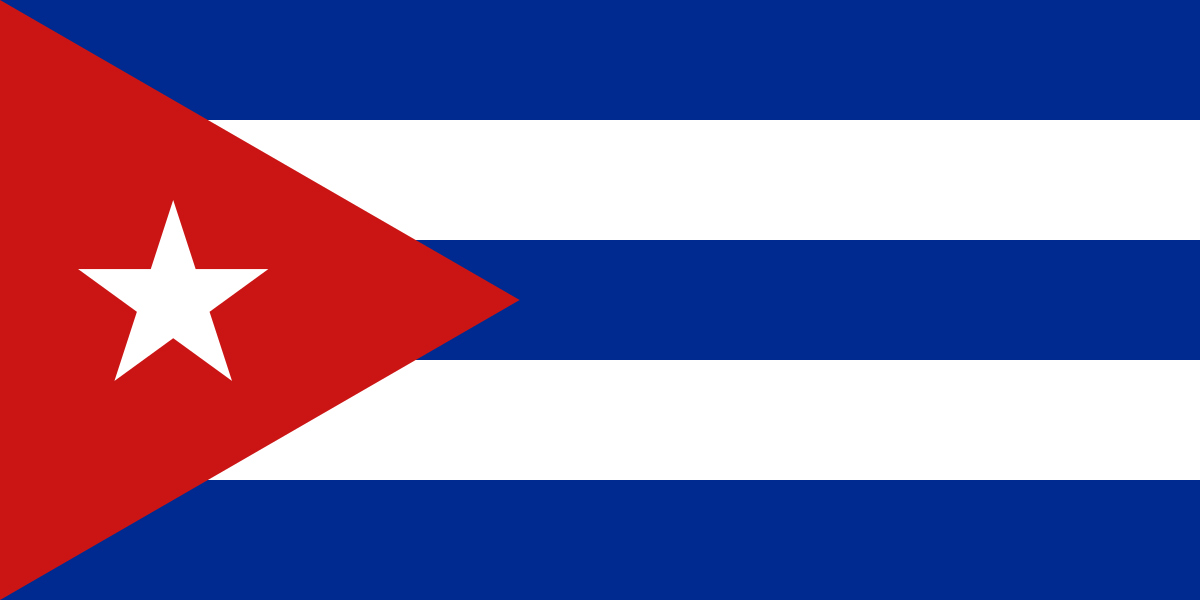
French Marxist theorist born in Cuba. Co-founded the French Workers' Party (POF) with Jules Guesde and systematized economic determinism as a historical method. In his later years, defended revolutionary Marxism against Jean Jaurès's reformism.
Activities and affiliations
Career Timeline
- 1864–1865Studied medicine in Paris; joined French section of First International as a Proudhonian anarchist
- 1866–1868Moved to London, frequented Marx household; General Council member, corresponding secretary for Spain
- 1868Married Laura Marx, Karl Marx's second daughter
- 1871–1872Fled to Madrid after Commune's fall; propagated Marxism via La Emancipación, fought anarchist dominance in Spanish section
- 1880Co-founded French Workers' Party (POF) with Jules Guesde; serialized first draft of The Right to Be Lazy in L'Égalité
- 1882–1891Returned to Paris as POF's leading theorist; led strikes and electoral campaigns, repeatedly imprisoned
- 1891Elected from Lille as first socialist deputy in French parliament — campaigned from prison
- 1890s–1905Defended orthodox Marxism against Jaurès's reformism; published major works on economic determinism, origins of property
- 1908–1911Retired from active politics after Toulouse unity congress; wrote memoirs of Karl Marx
The Right to Be Lazy: A Playful Refusal of the Cult of Work
Lafargue's best-known work, The Right to Be Lazy (Le Droit à la paresse), was serialized in L'Égalité in 1880 and published as a pamphlet in 1883. It directly challenged the labor movement's demand for more wage labor, arguing that genuine emancipation lay not in extending working hours but in radically reducing them. For Lafargue, wage labor was indistinguishable from slavery, and workers demanding the 'right to work' were foolishly asking for more of their own servitude.
He argued that the machine could be humanity's savior only if the time it liberated became leisure. With the technology of his day, he maintained, three to four hours of work per day would suffice; the rest should be devoted to friendship, relaxation, enjoyment of life, and 'laziness.' Opening with Lessing's maxim, 'Let us be lazy in everything, except in loving and drinking, except in being lazy,' the book declares the sanctification of work to be the most bizarre delusion spread by capitalist civilization. The Right to Be Lazy remains one of the most original pamphlets in the Marxist canon and was rediscovered a century later by autonomist thinkers such as Antonio Negri.
Guardian of Orthodox Marxism: Theory and Polemics
Lafargue was more than Marx's son-in-law and popularizer: he was an independent theorist who systematized economic determinism as a historical method. In The Economic Determinism of Karl Marx (1909), he formulated the thesis that the mode of production governs social, political, and intellectual life as a research tool for historical inquiry. In The Evolution of Property from Savagery to Civilization (1890), he traced the transition from communal to private property using anthropological evidence. These works added empirical and historical depth to Marxist theory.
Politically, Lafargue's later years were defined by his struggle against Jean Jaurès's reformism. While Jaurès advocated participation in bourgeois governments and class collaboration, Lafargue insisted on the primacy of class struggle, the merely instrumental character of parliamentarism, and the class nature of the state. At the 1908 Toulouse unity congress, he defended revolutionary Marxism against Jaurès's social-democratic line and upheld his refusal to join any 'bourgeois' government to the end. This stance anchored the revolutionary tradition within the French labor movement and exerted direct and indirect influence on a younger generation of Marxists, including Karl Kautsky, Karl Liebknecht, and Lenin.