CC department head who directed the Soviet chemical industry
"Without the chemical industry, not a single national task can be solved at an optimal level," he declared in his 1973 book, justifying full-spectrum chemicalization as a party line.
A graduate of the Moscow Institute of Chemical Machine Building, Bushuyev rose from Gosplan engineer to a figure who straddled central planning and party supervision of the Soviet chemical industry. As head of the Chemical Industry Department of the CPSU Central Committee from 1965 to 1976, he directed from the party line the Kosygin-era modernization drive: a massive expansion of synthetic rubber, plastics, mineral fertilizers, and petrochemicals. He simultaneously served on the Central Auditing Commission (1966–1981), overseeing party finances and documentation, and was a three-term deputy to the RSFSR Supreme Soviet. His 1973 book The Chemical Industry in Light of the Decisions of the 24th Party Congress became a standard party reference for chemical-industry policy under Brezhnev.
Career timeline
1941Graduated Moscow Institute of Chemical Machine Building
1942–1950sEngineer → senior engineer, State Planning Commission (Gosplan)
1947Joined the VKP(b)
1950s–1965Sector head → deputy department head, Gosplan under the USSR Council of Ministers
1965–1976Head of the Chemical Industry Department, CPSU Central Committee
1966–1981Member of the Central Auditing Commission, CPSU
1967–1980Deputy to the Supreme Soviet of the RSFSR (7th, 8th, 9th convocations)
The quiet gatekeeper who controlled Brezhnev's paper flow
Tsukanov's 'rule of three nails': 'I hang Brezhnev's orders on an imaginary first nail. If he insists, it moves to the second. Only at the third nail do I start making calls — and barely a tenth ever get carried out.'
A metallurgical engineer by training, Tsukanov served as Leonid Brezhnev's senior assistant for nearly two decades and was a pivotal figure in the party apparatus. Having attended the same Dneprodzerzhinsk Metallurgical Institute that Brezhnev graduated from, he joined the Central Committee apparatus in 1958 and effectively ran the General Secretary's secretariat for Brezhnev's entire tenure. He filtered Politburo materials and directives, controlling the information flow that reached the General Secretary, and managed the vast bureaucratic workload through a distinctive pragmatism encapsulated in his 'rule of three nails.' Quiet and unassuming on the surface, he was one of the few people who met Brezhnev daily and wielded enormous behind-the-scenes influence in stagnation-era Soviet politics.
Career timeline
1937–1958Worked at ferrous metallurgy enterprises in Dnepropetrovsk and Chelyabinsk regions; chief engineer at Dzerzhinsky Metallurgical Plant in Dneprodzerzhinsk
1958–1960Apparatus of the CC CPSU
1960–1963Apparatus of the Presidium of the Supreme Soviet of the USSR
1963–1964Assistant to the Secretary of the CC CPSU
1964–1966Assistant to the First Secretary of the CC CPSU (Brezhnev)
1966–1983Assistant to the General Secretary of the CC CPSU (Brezhnev, then briefly Andropov)
1983–1985First Deputy Head, CC CPSU Department for Work with Foreign Cadres
From Stalin's interpreter to UN ambassador, the Soviet diplomat who weathered Cold War crises with wit
Doused in red paint by Maoist protesters in the Security Council chamber, Troyanovsky looked up calmly and said, 'Better red than dead.'
Oleg Troyanovsky was a Soviet diplomat who rose from Stalin's interpreter to Khrushchev's foreign policy adviser, then served as ambassador to Japan, Permanent Representative to the UN, and ambassador to China across four decades at the forefront of Soviet diplomacy. The son of the first Soviet ambassador to the United States, he spent his adolescence in Washington and brought an unusual bicultural fluency to his work, beginning with the 1945 London Conference that established the Nuremberg Tribunal. During his ten years at the UN he navigated the twin crises of the Afghanistan invasion and the KAL 007 shootdown with a composure and wit that earned Western respect: encapsulated by his deadpan retort when doused with red paint by Maoist protesters: 'Better red than dead.'
Career timeline
1941–1944Red Army, Military Institute of Foreign Languages
1944–1947Attaché in London, interpreter for Stalin
The defense industry minister who ran Soviet conventional arms production from late Brezhnev through perestroika
In July 1941, the 22-year-old Finogenov reached Kovrov's Plant No. 2 after a seven-day train ride. He went straight to the shop floor and did not leave the factory for two months. 'They put me on the breech — the most critical part of the ShVAK cannon.'
A wartime arms production administrator who at 22 was assigned to the Degtyaryov plant and led the output of ShVAK aircraft cannons and PTRD anti-tank rifles, later rising to plant director after managing postwar conversion to motorcycle production. As director (1954–1960), he built the serial production system for S-75 surface-to-air missile guidance units and the USSR's first anti-tank guided missile, the Shmel. In 1979 he succeeded Sergei Zverev as Minister of Defense Industry, directing all Soviet artillery, small arms, ammunition, and optics production for a decade that spanned the Afghan war and perestroika. Hero of Socialist Labor (1976), laureate of the Lenin Prize (1982) and two State Prizes (1979, 1989).
Career timeline
1941Assigned as shift master at Plant No. 2 (Degtyaryov) in Kovrov — ShVAK aircraft cannon production
A missile-defence builder who disclosed a Cold War false alarm
His memoirs turned Petrov’s false-alarm judgment from a military secret into a public episode of Cold War history.
Yuri Votintsev was a Soviet artillery officer who moved from combat command in the Second World War into organizing air-defence and missile-and-space defence systems. As the first commander of the missile and space defence forces created in 1967, he joined military command with the construction of a new technical field. In 1983 he was the direct superior who first received Stanislav Petrov’s false-alarm report, and his later memoirs made the episode public, bringing Petrov’s judgment to wider attention. His account also shows the system’s contradiction: Petrov was praised, yet reprimanded over the military diary.
Career timeline
1936–1938Studied at artillery schools in Leningrad and Sumy
1938–1942Instructor and battery commander at artillery schools in Tbilisi and Penza
1943–1945Command and staff service with the 295th Mortar Regiment at the front
1959–1963Commander of the Turkestan and 30th Independent Air Defence Corps
1963–1967Commander of the 12th Independent Air Defence Army
1967–1986First commander of the Missile and Space Defence Forces
1984Awarded the title Hero of Socialist Labour
1993–2005Wrote memoirs and worked in a Moscow veterans’ organization
Stalin's son-in-law who criticized Lysenko, recanted, then built Rostov University over 31 years as rector
Stalin at the Politburo, turning on Yuri Zhdanov: "What, don't you know that our entire agriculture rests on Lysenko?"
Son of Andrei Zhdanov and briefly Stalin's son-in-law, Yuri Zhdanov was appointed head of the CC Science Department at age 28 in 1947, becoming a key science-policy official in late Stalinism. In April 1948 he publicly criticized Lysenko's theories (Stalin summoned him to the Politburo with the rebuke "Don't you know our entire agriculture rests on Lysenko?") and Zhdanov was forced to publish a humiliating recantation in Pravda. He took part in the 1950 antisemitic campaign against Jewish scientists, yet after Stalin's death he rebuilt his career as rector of Rostov State University (1957–1988), transforming it over 31 years into one of the USSR's top universities. An organic chemist with over 800 publications, he discovered acylotropy and chaired the North Caucasus Scientific Center.
Career timeline
1941–1945Instructor and literary propagandist, Main Political Directorate, Red Army
1947–1948Head of the Science Department, Agitprop Directorate, CC VKP(b)
1948–1950Head of the Science Sector, Agitprop Department, CC VKP(b)
1950–1952Head of Science and Higher Education Department, CC VKP(b)/CPSU
1952–1953Head of Natural and Technical Sciences and Higher Education Dept, CC CPSU
1952–1956Member of the CPSU Central Committee
1953–1957Assistant, docent, professor, Rostov State University; Head of Science and Culture, Rostov obkom
Secret planner of the Cuban Missile Crisis deployment and last Chief of Staff of the Warsaw Pact Joint Armed Forces
In the early planning of Operation Anadyr, only five officers on the General Staff were privy to the secret. The plans were handwritten — every page — to deny knowledge of the operation to even a single secretary.
A Soviet General of the Army whose Cold War career ran from the General Staff operations directorate to high coalition command. As a senior operations officer in 1962, he drafted the initial plan for Operation Anadyr, the secret deployment of nuclear missiles to Cuba, and served on the ground during the crisis as the defence minister's personal representative to the Soviet force. He later commanded the Leningrad Military District (1973–1976) and served as Chief of Staff of the Warsaw Pact Joint Armed Forces from 1976 to 1989, the alliance's final peacetime holder of that post. After retirement, he co-authored the joint US–Soviet memoir Operation Anadyr (1994), disclosing the inner workings of the crisis from both sides.
Career timeline
1939–1940Tank platoon commander, 39th Light Tank Brigade; fought in the Winter War
1941–1945Operations officer and General Staff representative on Western, Bryansk, Kalinin, and Southern Fronts
1960–1965Chief and deputy chief of operations, Main Operations Directorate, General Staff
1962Planned Operation Anadyr; deployed to Cuba as representative of the Minister of Defence
1965–1968Commander, 7th Guards Army, Transcaucasus Military District
1973–1976Commander, Leningrad Military District
1976–1989Chief of Staff, Warsaw Pact Joint Armed Forces
1989–1992General Inspectors Group, USSR Ministry of Defence
The ambassador whose 24 years in Washington made him the hidden circuit of Soviet–American diplomacy
On the night of October 27, 1962, a secret meeting with Robert Kennedy. The Soviets would withdraw their missiles from Cuba; in an unpublicized assurance, the Americans would quietly remove their missiles from Turkey.
Soviet ambassador to the United States from 1962 to 1986, 24 years that made him the indispensable circuit of Cold War diplomacy. His secret backchannel with Robert Kennedy resolved the Cuban Missile Crisis, and his extraordinary relationship with Henry Kissinger drove détente and the SALT agreements.
Career timeline
1944Entered Higher Diplomatic School, part of the 'Stalin call-up' into diplomacy
1946Joined Foreign Ministry, served under Molotov and Gromyko
1952–1957Counsellor at the Soviet Embassy in Washington
1957–1959UN Deputy Secretary-General
1960–1962Head of the Foreign Ministry's Americas Department
1962–1986Ambassador to the US — served under six American presidents over 24 years
1986–1988CC Secretary and head of the International Department
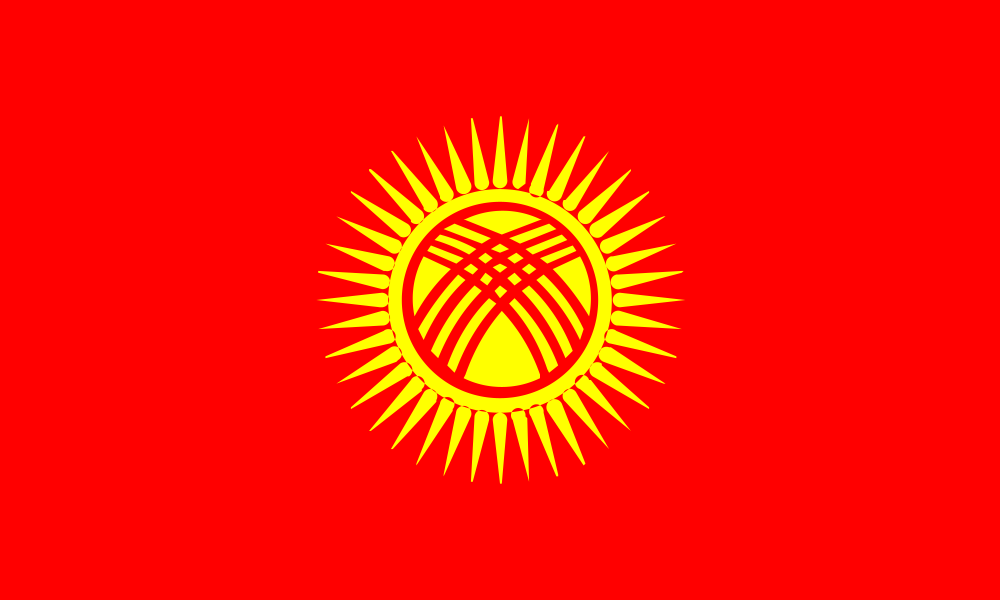
The builder who transformed Kirghizia from an agrarian to an industrial republic across the Khrushchev-Brezhnev era
In his later memoirs, he wrote of the project that was both his greatest legacy and his heaviest burden: "The Toktogul Hydroelectric Station — my pride and my pain."
Born to a poor peasant family and beginning as a schoolteacher, this Kyrgyz politician spent ten years (1945–1955) as an instructor at the CPSU Central Committee in Moscow, gaining the all-Union party apprenticeship that would define his career. As First Secretary of the Communist Party of Kirghizia from 1961 to 1985, he oversaw the construction of 150 large industrial facilities, including the Naryn hydroelectric cascade, Toktogul HPP, and Manas International Airport, and delivered over 510,000 new apartments. Gross industrial output rose fivefold and electricity generation twelvefold, transforming the republic from agrarian to industrial. A full member of the CPSU Central Committee (1961–1986), he also served in the parliament of independent Kyrgyzstan (1993–2005) after retirement.
Career timeline
1937–1939Teacher and head of studies, Kochkor secondary school
1941–1942Deputy head, Propaganda and Agitation Dept., Kochkor District Party Committee
1942–1943Instructor, Propaganda and Agitation Dept., CC CP of Kirghizia
1945–1955Instructor, CPSU Central Committee (Moscow)
1955–1956Editor-in-chief, republican daily Sovettik Kyrgyzstan
1956–1958Head, Propaganda and Agitation Dept., CC CP of Kirghizia
1958–1961First Secretary, Frunze City Party Committee
1959–1961Chairman, Supreme Soviet of the Kirghiz SSR
1961–1985First Secretary, CC CP of Kirghizia
1961–1986Member, CPSU Central Committee
1993–2005Deputy, Jogorku Kenesh (Parliament) of the Kyrgyz Republic
Soviet Procurator General who served from Brezhnev to Gorbachev and personally delivered Sakharov's exile decree
On 22 January 1980, Rekunkov read Sakharov the decree stripping him of the title Hero of Socialist Labour and exiling him to the closed city of Gorky.
Born into a peasant family on the Don, he fought in the Great Patriotic War and was severely wounded before entering the procuracy. Rising through Rostov's regional prosecutor offices, he became First Deputy Procurator General in 1976 and succeeded Rudenko as Procurator General in 1981. Under Andropov he spearheaded high-profile anti-corruption campaigns (the Uzbek cotton case and trade-ministry prosecutions), while in 1980 he had personally read Sakharov the decree stripping his state awards and exiling him to Gorky. After retirement he worked in the department rehabilitating victims of political repression, embodying the procuracy's dual role as guardian of socialist legality and instrument of state coercion.
Career timeline
1945–1946Assistant Prosecutor, Verkhne-Don District, Rostov Oblast
1947–1952Prosecutor, Konstantinovsky then Azov District, Rostov Oblast
1960–1966Prosecutor of Bryansk Oblast
1966–1971Prosecutor of Voronezh Oblast
1971–1976First Deputy Procurator of the RSFSR
1976–1981First Deputy Procurator General of the USSR
1981–1988Procurator General of the USSR
1981–1989Member, CPSU Central Committee
1979–1989Deputy, Supreme Soviet of the USSR
1992–1994Prosecutor, Rehabilitation Dept. for Victims of Political Repression, Russian Federation Procuracy
The Moscow party boss who challenged Brezhnev and was exiled to diplomacy
The moment he told the June 1967 CC Plenum, with Brezhnev seated before him, that 'Moscow's air defence is insufficiently reliable,' his career as Moscow party boss was over.
Nikolai Yegorychev was the First Secretary of the Moscow City Committee of the CPSU from 1962 to 1967, a position of national significance in the party hierarchy. Under his leadership, Moscow saw a housing boom that rehoused over three million residents, and he personally initiated the Tomb of the Unknown Soldier memorial at the Kremlin wall and the restoration of the Triumphal Arch. At the June 1967 CC Plenum, he publicly challenged Brezhnev by warning that Moscow's air defence was dangerously obsolete: a speech made as a member of the 'Komsomol group' aligned with Alexander Shelepin that led to his swift removal. He later served as Soviet ambassador to Denmark (1970–1984) and briefly to Afghanistan (1988) during the Soviet withdrawal.
Career timeline
1954–1956Secretary, Bauman District Committee, Moscow
1956–1960First Secretary, Bauman District Committee, Moscow
Uzbek SSR figure who chaired the Soviet of Nationalities
In a meeting with Crimean Tatar civil rights activists, she openly opposed their return to Crimea, bluntly stating that Uzbekistan needed their labor.
Rising from the Uzbek republic leadership, she chaired the Soviet of Nationalities. Her career shows the link between central power and republic elites under Brezhnev.
Career timeline
1940s–1950sRises through Uzbek Komsomol, party and state administration
1959–1970Chairwoman of the Uzbek SSR Supreme Soviet Presidium
1970–1974Chairwoman of the Soviet of Nationalities, reaching a high post in central federal representation
1974Leaves office amid Uzbek leadership changes and political pressure
after 1974Moves away from the center of official politics
The official who exposed the fabricated Doctors' Plot
The review team's conclusion in 1953 was unequivocal: “The Doctors' Plot was fabricated, the doctors were innocent, and they should be released.”
Nikolai Mesyatsev was a postwar Soviet Komsomol and state official whose career reveals the tension between political direction and factual investigation. In 1953, assigned by Malenkov to review the Doctors' Plot and the Abakumov case, he helped establish quickly that the doctors' case had been fabricated. He later recalled that Stalin himself had ordered a review before his death, a disputed testimony that must be weighed alongside other evidence. He subsequently led Soviet state television and radio, overseeing the construction of the Ostankino center and the expansion of multi-program broadcasting.
Career timeline
1941–1945Investigator, Navy commissariat, NKVD Special Departments and SMERSH
1946–1952Official, Central Committee of the Komsomol
1953State security investigative unit, review of the Doctors' Plot
1955–1959Secretary, Komsomol Central Committee
1962–1964Minister-counsellor in China; deputy head of CPSU international-relations department
1964–1970Chairman, Soviet State Committee for Television and Radio Broadcasting
1970–1972Soviet Ambassador Extraordinary and Plenipotentiary to Australia
1972–1988Senior researcher and head of historical sciences, INION
Military counterintelligence chief of the Brezhnev era
Leading a breakout from encirclement in 1941: "Comrades, I'm from military counterintelligence! We will organize and make a breakout. If someone is scared and wants to surrender, I will shoot him with the power given to me by the Motherland!"
Soviet military counterintelligence leader. Trained as a medical assistant, he joined the Red Army in 1939 and was assigned to state security just before the German invasion, serving in NKVD Special Departments and SMERSH at the front. After the war he built his career in military counterintelligence, chiefly with the Group of Soviet Forces in Germany (GSFG) and the Far Eastern Military District, rising to head the KGB Third Directorate in 1970, commanding the network of Special Departments (osobisty) embedded throughout the Soviet Armed Forces. Removed in 1973 after conflict with KGB deputy chairman Georgy Tsinev, he returned to GSFG as head of its Special Directorate, later serving as security advisor to Gosplan until 1991. He wrote memoirs on the history of military counterintelligence and lived to be 100.
Career timeline
1938–1939Medical worker, North Ural NKVD corrective labour camp
1941–1945NKVD Special Dept. & SMERSH operative, Western/Baltic/Belarusian Fronts
The conservative Second Secretary inside perestroika
At the Plenum of February 6, 1990, Ligachev, pressed to resign, declared: 'Damn it, I want to work!' But he was not removed from the Politburo days later: he lost the CC secretary post and the Politburo seat at the July 1990 congress, taking 776 votes against 3,642 for deputy general secretary.
He was first secretary of Tomsk province from 1965 to 1983, seventeen years in which oil and gas extraction grew and the towns of Strezhevoy and Kedrovy were built. In 1979, when the Ob exposed a mass grave of Great Terror victims at Kolpashevo Yar, the region moved to destroy the remains and the traces of the burial; he denied any involvement. Brought to Moscow on Andropov's initiative in April 1983 as head of the CC organizational-party work department, he became a secretary that December and a full Politburo member in April 1985. As de facto second man in 1985-1988 he backed early reform and drove the anti-alcohol campaign, which he later admitted was a mistaken strategy. In July 1990 he lost the CC secretary post and his Politburo seat.
Career timeline
1983–1985Head of the CC Organizational-Party Work Department
1985–1990Second Secretary and conservative force inside perestroika
Shelepin-network RSFSR interior minister who led Khrushchev-era policing
«I understood at once — they were looking for someone closer. Of course, that's how it was. They needed a personally loyal man…» — on being passed over for the revived all-union MOOP chief post, 1966.
Vadim Tikunov was a Soviet state security and internal affairs official who rose through the Shelepin Komsomol patronage network to become KGB deputy chairman (1959–1961) and RSFSR Minister of Internal Affairs (1961–1966). During Khrushchev's abolition of the all-union MVD, Tikunov effectively ran Russia's police apparatus and secured the introduction of professional police day, free public transport for officers, and, for the first time in Soviet history, rubber truncheons, handcuffs, and tear gas grenades. When Brezhnev revived the union-level MOOP in 1966 and installed his own loyalist Nikolai Shchelokov as its chief, Tikunov was sidelined and subsequently relegated to ambassadorships in Upper Volta and Cameroon, where he died in post at Yaoundé.
Career timeline
1942–1947Komsomol Secretary, Aktobe Regional Committee → Secretary, Estonian Komsomol Central Committee
1947–1952First Secretary, Vladimir Oblast Komsomol → Secretary, Vladimir City & Oblast Party Committees
1952–1959Sector head for state security, Dept. of Administrative Organs, CPSU CC → Deputy Head of Department
1959–1961Deputy Chairman, KGB of the USSR
1961–1966RSFSR Minister of Internal Affairs (Ministry renamed MOOP, Dec 1962)
1967–1969Member, CPSU CC Commission on Travel Abroad
1969–1974Minister-Counsellor, Soviet Embassy in Romania
1974–1978Ambassador Extraordinary and Plenipotentiary to Upper Volta
1978–1980Ambassador Extraordinary and Plenipotentiary to Cameroon
"The war taught me how to live… Everything that was experienced over these last six army years must become the foundation for an interesting, creative, and beautiful life." — From his frontline diary, published posthumously.
Soviet international relations scholar and historian. He served as director of IMEMO, the USSR's premier foreign-policy think tank, from 1966 until his death in 1982. His institute produced the classified analyses that shaped Soviet arms-control negotiating positions, long-range forecasts of Western economies, and the theoretical underpinnings of 'developed socialism' in foreign affairs. A full member of the CPSU Central Committee from 1981, he directly shaped the substance of Soviet détente policy, consistently arguing within the party leadership for the necessity of constructive relations with the West.
Career timeline
1952–1957Consultant, International Department, Kommunist journal
1957–1959Head of International Relations Sector, IMEMO
1959–1961Deputy Director, IMEMO
1961–1966Deputy Editor-in-Chief, Pravda
1966–1982Director, IMEMO
1971–1981Candidate Member, CPSU Central Committee
1981–1982Member, CPSU Central Committee
1975–1982Member, Presidium, USSR Academy of Sciences
Soviet Middle East diplomat who witnessed the 1973 war and the Iranian Revolution from inside
In June 1979, Khomeini summoned Vinogradov and warned him directly: "We are watching what you are doing to the Muslims of Afghanistan. The Soviet Union is hostile to Islam."
A Soviet diplomat who rose from trade postings to become a central figure in Brezhnev-era Middle East diplomacy. As ambassador to Egypt (1970–1974), he managed Moscow's relationship through the transition from Nasser to Sadat and coordinated the Soviet response during the October 1973 war. Transferred to Tehran in 1977, he witnessed the collapse of the Pahlavi monarchy and the Islamic Revolution, navigating tense exchanges with Khomeini over Afghanistan and Soviet regional ambitions. He later served eight years as Foreign Minister of the RSFSR (1982–1990), sustaining the institutional continuity of Soviet diplomacy, and after retirement chaired the Russian committee for Arab-Israeli settlement.
Career timeline
1939–1943Active service, Red Army
1948–1950Head of Department, USSR Trade Mission, UK
1950–1952Deputy Trade Representative, USSR, UK
1952–1956Deputy Chief, Western Countries Trade Directorate, Ministry of Foreign Trade
1956–1962Chief, Western Countries Trade Directorate, Ministry of Foreign Trade
1962–1967Ambassador to Japan
1967–1970Deputy Minister of Foreign Affairs, USSR
1970–1974Ambassador to Egypt (UAR)
1974–1977Ambassador-at-Large, USSR Ministry of Foreign Affairs
1977–1982Ambassador to Iran
1982–1990Minister of Foreign Affairs, RSFSR
1990–1997Lecturer at MGIMO; Chairman, Committee for Middle East Settlement
Longest-serving Warsaw Pact supreme commander, who led its forces for twelve years
In mid-June 1941, in Vladimir-Volynsky near the Polish border, the landlady told the newly commissioned Lieutenant Kulikov: "Pan Lieutenant, they say on the other side that war will begin on the 22nd."
Born to a poor peasant family, he fought as a tank officer from the first day of the Great Patriotic War through to Berlin. Appointed Chief of the General Staff and First Deputy Minister of Defence in 1971, he drove Soviet military modernisation before serving as Supreme Commander of the Warsaw Pact unified forces from 1977 to 1989, the longest tenure in that post, shaping Eastern Bloc military doctrine through the late Cold War. During the 1981 Polish martial-law crisis he opposed direct Soviet military intervention. Awarded Marshal of the Soviet Union, Hero of the Soviet Union, and the Lenin Prize; after retirement he served in the Russian State Duma as a veterans' affairs advocate.
Career timeline
1939Joined Red Army, trained at Grozny Military Infantry School
1941–1945From platoon/company commander to Chief of Staff, 143rd Tank Brigade; fought Moscow to Berlin
1953Graduated Frunze Military Academy; commanded mechanised regiment and divisions
1959Graduated General Staff Academy; Deputy Commander, 5th Guards Tank Army
1964Commander, 6th Combined Arms Army (Leningrad Military District)
1967–1969Commander, Kiev Military District
1969–1971Commander-in-Chief, Group of Soviet Forces in Germany
1971–1977Chief of the General Staff & First Deputy Minister of Defence
1977–1989Supreme Commander, Warsaw Pact Unified Forces & First Deputy Minister of Defence
1999–2003State Duma Deputy (United Russia), Chairman of the Veterans' Affairs Committee
Gorbachev's pen and conscience: architect of New Thinking diplomacy
Diary, 10 November 1989, on the fall of the Berlin Wall: 'The Berlin Wall has collapsed. This entire era in the history of the socialist system is over. That is what Gorbachev has done.' Source: Gorbachev Foundation archive, translated for the National Security Archive.
Born 25 May 1921 in Moscow (Maryina Roshcha), died there on 12 March 2017. He volunteered for the Red Army in July 1941, fought on the Northwestern Front in the liberation of the Baltics, and left military service in 1945. He studied at Moscow State University's history faculty and in 1958–1961 worked on the editorial board of Problems of Peace and Socialism in Prague. He joined the Central Committee's International Department in 1961, served as Gorbachev's foreign policy aide from March 1986 to 1991, and was a People's Deputy of the USSR in 1989–1991. From 1992 he led perestroika documentary projects at the Gorbachev Foundation. Sources differ on his degree year and on the dating of his International Department deputy headship.
Career timeline
1941–1946Red Army: volunteered July 1941; Northwestern Front with the 1st Shock Army, wounded; service to 1945–1946
1938–1950Moscow State University history faculty (1938–1941, resumed 1947–1949, then aspirantura); candidate dissertation defended 1950
1950–1958Lectures in modern history at Moscow State; acting department chair
1958–1961Prague: editorial board of Problems of Peace and Socialism
1961–1986CC International Department: referent under Ponomarev, rising to deputy head (1970–1986 per RU Wikipedia/RGASPI; NSA gives 1972–1985)
1986–1991Gorbachev's foreign policy aide: summit prep, speeches, architect of New Thinking
1992–2011Gorbachev Foundation: projects 'Documentary History of Perestroika' and 'Foreign Policy of Perestroika'; service 1992–2011
At the 1972 Helsinki SALT I talks, he told the American delegation that Soviet missiles with their electronic countermeasures would pass through US ABM defenses 'like a knife through butter.' The Americans signed the treaty soon after.
Minister of the Radio Industry of the USSR from 1974 to 1987, he built the technological foundation of Soviet radio-electronic warfare (REB) and air-defense radar systems. As director of TsNII-108, he oversaw development of the USSR's first wide-range airborne automatic radio reconnaissance station 'Romb-1' and passive-homing anti-radiation missile guidance systems. As minister, he directed electronic countermeasures for penetrating US missile defenses, space-based radio reconnaissance, and the early-warning radar network. He led the 'anti-SDI' program countering Reagan's Strategic Defense Initiative, placing him at the center of Cold War electronic warfare competition.
Career timeline
1944–1945Engineer at Red Army Communications Research Institute (NIIIS); deployed to 3rd Belorussian and Transbaikal Fronts
1945–1950Senior researcher and laboratory chief at TsNII-108
1950–1952Officer in 5th Main Directorate (radio reconnaissance and countermeasures); two missions to North Korea during Korean War
1952–1958Department and sector chief at TsNII-108; developed Romb-1 reconnaissance station and anti-radiation missile guidance
1958–1964Director of TsNII-108, Engineer-Colonel
1964–1968Deputy Chairman of State Committee for Radioelectronics, Deputy Minister of Radio Industry
1968–1974First Deputy Minister of Radio Industry
1974–1987Minister of Radio Industry; promoted to General-Colonel
Longest-serving Pravda editor and gatekeeper of Brezhnev-era print orthodoxy
He said he refused to investigate 'the dirty linen of our history.'
A Marxist philosopher turned journalist, Afanasyev served as editor-in-chief of Pravda from 1976 to 1989, the longest tenure in the paper's history, and for 13 years was the ultimate gatekeeper of Soviet print orthodoxy. Under him Pravda reached its peak circulation of 10.6 million, and as chairman of the USSR Journalists' Union and a Central Committee member he faithfully translated the party line into newsprint. He authored the widely used textbook Fundamentals of Philosophical Knowledge and became a full member of the USSR Academy of Sciences. Dismissed in 1989 after reprinting an Italian newspaper's article on Boris Yeltsin's alleged drinking and being forced to issue an unprecedented apology, his fall marked the collapse of the old editorial order under glasnost.
Career timeline
1940–1953Red Army service, paratroops and SMERSH counterintelligence officer
1953–1960Lecturer and department head, Chelyabinsk Pedagogical Institute
1960–1968Professor, Academy of Social Sciences, CPSU Central Committee
1968–1974Deputy and first deputy editor-in-chief, Pravda
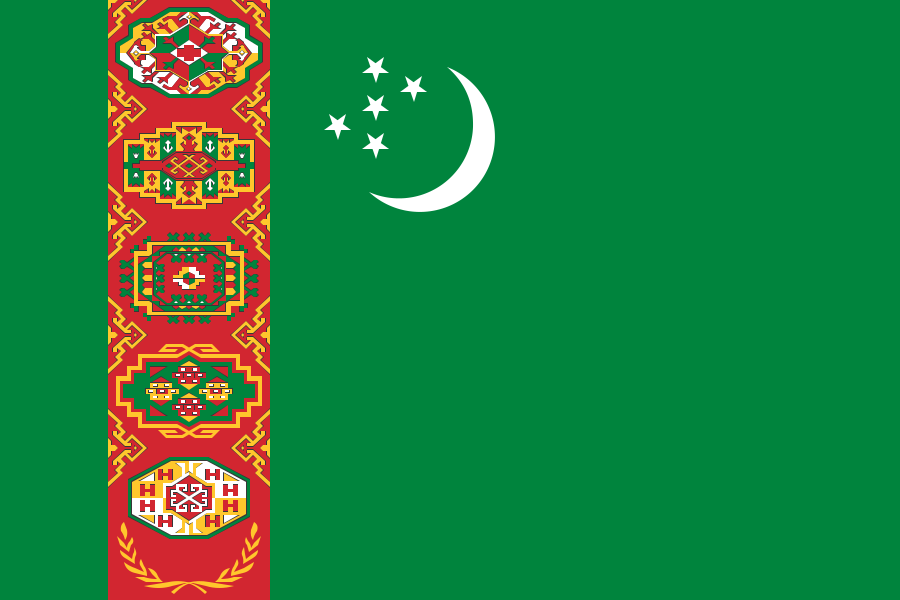
16-year leader of Brezhnev-era Turkmenistan who integrated its cotton and gas economy into the Soviet center
26 February 1943, on the Northwestern Front: a bullet through the leg, three shrapnel wounds to his right arm. That wound ended his war — and pushed him from the schoolroom into the party apparatus, toward the helm of Soviet Turkmenistan.
Born to a peasant family near Chardzhou, he began as a teacher before being drafted in 1941 and fighting as a submachine-gun squad commander on the Northwestern Front, where severe wounds in February 1943 ended his military service. He climbed steadily through the Komsomol and party apparatus, becoming Chairman of the Council of Ministers and Foreign Minister of the Turkmen SSR in 1963, then First Secretary of the Communist Party in December 1969, leading the republic for 16 years. His tenure saw major natural gas development and expanded irrigation agriculture, integrating Turkmenistan deep into the Soviet cotton and energy economy, though regional factionalism and nepotism also intensified. In December 1985, Gorbachev removed him over a cotton-related corruption scandal; he spent his last years writing memoirs and died at his dacha in 1999.
Career timeline
1941Teacher, eight-year school, Chardzhou Oblast
1941–1943Submachine-gun squad commander, Red Army; Northwestern Front; severely wounded and demobilized
1943–1944Head of studies and school director, Chardzhou Oblast
1944–1947Head, Propaganda and Agitation Dept., Chardzhou District Party Committee
1948–1951First Secretary, Chardzhou Oblast Komsomol
1951–1955Secretary for Propaganda and Agitation, Komsomol Central Committee, Turkmen SSR
1959–1962First Secretary, Chardzhou Oblast Party Committee
1962–1963Secretary, Central Committee, CP of Turkmenistan
1963–1969Chairman, Council of Ministers and Minister of Foreign Affairs, Turkmen SSR
1969–1985First Secretary, Central Committee, CP of Turkmenistan
1971–1986Member, CPSU Central Committee (candidate 1966–1971)
KGB First Chief Directorate deputy who ran Soviet foreign intelligence for twelve years
Kabul, December 1979: with Operation Storm-333 underway, newly arrived Soviet ambassador Tabeyev — kept completely in the dark — telephoned Kirpichenko demanding an explanation. Kirpichenko replied that he was too busy to talk, and would report in the morning.
As First Deputy Head of the KGB First Chief Directorate from 1979 to 1991, Kirpichenko was the operational chief of Soviet foreign intelligence throughout the Afghan war and the late Cold War. A top Arabic-section graduate of the Moscow Institute of Oriental Studies, he began his intelligence career as deputy resident in Nasser's Egypt in 1954 and personally witnessed the Suez Crisis, the Yom Kippur War, and Sadat's pivot toward Washington, a turn he warned Moscow about against leadership resistance. In December 1979 he was dispatched to Kabul to direct KGB operations for Storm-333, the overthrow of Hafizullah Amin, keeping even the Soviet ambassador in the dark. After retiring he served as assistant editor-in-chief of the six-volume official history of Russian foreign intelligence, shaping the institutional memory of the service he had led.