Leader who took the SFIO majority into the Comintern at Tours in 1920, founding the French Communist Party, and ran L’Humanité
At the 1920 Tours Congress, he backed SFIO affiliation with the Comintern, led the majority split, and helped found the French Communist Party. Arrested in 1923 for opposing France’s Ruhr occupation, he was cleared by the Senate sitting as a High Court.
Born in Paimpol in Brittany, he joined Guesde’s French Workers’ Party in 1891 and the unified SFIO in 1905, and from 1918 ran L’Humanité for the rest of his life. As his supporters swung towards the October Revolution after the war, he led the vote to join the Comintern at the Tours congress of 1920 and became a founder of the French Communist Party. He was jailed in 1923 for denouncing the French occupation of the Ruhr. A deputy and senator, he remained the party’s elder statesman until his death in 1958.
Career timeline
- 1892Joined the Gironde section of the French Workers’ Party, founded by Jules Guesde and Paul Lafargue.
- 1905Took part in the founding congress of the unified Socialist Party (SFIO) and became its propaganda delegate.
- 1918Elected director of L’Humanité, which he led until his death in 1958.
- 1920At the Tours Congress, supported SFIO affiliation with the Comintern and helped found the French Section of the Communist International (SFIC), predecessor of the French Communist Party.
- 1923Arrested for opposing France’s Ruhr occupation and brought before the Senate sitting as a High Court; it ruled there was no case to answer.
- 1936Elected senator for the Seine, becoming the first senator from the French Communist Party.
French socialist and teachers’ union activist who led the Committee for the Third International
He organised internationalist socialists against the war and served as secretary of the Committee for the Third International during the founding of the French Communist Party.
A teacher, Loriot joined the Socialist Party in 1901 and became active in the teachers’ union. During the First World War he opposed support for the war and backed the Zimmerwald position, serving as secretary of the Committee for the Resumption of International Relations and later the Committee for the Third International. At the Tours Congress in 1920 he joined the leadership of the newly formed French Communist Party.
Career timeline
- 1901Joined the Socialist Party
- 1917Became secretary of the Committee for the Resumption of International Relations
- 1919Secretary of the Committee for the Third International
- 1920Elected to the Executive Committee of the newly formed Communist Party and as international secretary at the Tours Congress
- 1925Active in opposition to the party’s Bolshevisation
- 1926Left the party and joined the revolutionary syndicalist movement
The naval engineer who led the Black Sea mutiny and rose to the Comintern Secretariat
On 19 April 1919, the red flag rose above the battleship Jean Bart in the Black Sea. André Marty, ringleader of the sailors who refused to fight the Bolsheviks, was arrested and sentenced to twenty years at hard labour by a Constantinople court-martial.
A French naval mechanic who in 1919 led the mutiny aboard the battleship Jean Bart in the Black Sea, refusing intervention against the Bolsheviks. He was sentenced to 20 years' hard labour. Pardoned in 1923, he joined the PCF as a deputy and Central Committee member, rising to Comintern Secretary and Presidium member in 1935. As political commissar of the International Brigades in Spain, he organized the Albacete base and earned the epithet 'Butcher of Albacete' for his harsh discipline. Expelled from the PCF in 1952, he remained a central figure in French communism and Comintern work for three decades.
Career timeline
- 1908Enlists in the French Navy as a mechanic
- 1919Leads the Black Sea mutiny aboard the Jean Bart; court-martialed, 20 years' hard labour
- 1923Pardoned after international campaign; joins the PCF
- 1924–1955National Assembly deputy for Seine-et-Oise; PCF Central Committee member
- 1931–1935Active in the Comintern Executive Committee (ECCI)
- 1935–1943Comintern Secretary and Presidium member
- 1936–1938Political Commissar of the International Brigades; organizes from Albacete
- 1939–1943Works for Comintern in Moscow; 1943 liaison with de Gaulle in Algiers
- 1944Returns after Liberation; attempts revolution — vetoed by Stalin
- 1952Marty-Tillon affair: accused as police spy; expelled from the PCF
The PCF's number two for 37 years: a Stalinist who moved between parliament and the underground
'There was opportunism, legalitarianism and parliamentary illusions... If we courageously carry out this self-criticism before the Party, we shall arouse among the masses a state of mind favourable for the fight,' founding Cominform conference, Szklarska Poręba, September 1947
Number two in the French Communist Party leadership for 37 years alongside Maurice Thorez, entering parliament by defeating Léon Blum in Paris's 20th arrondissement. He directed the clandestine PCF throughout the German occupation and served as vice-president of the National Assembly after the war. At the founding Cominform conference in 1947, he publicly admitted that the party's participation in government had been 'parliamentary illusions,' symbolising the PCF's turn to militant opposition against the Marshall Plan. In 1969, he won 21.3% of the vote as the Communist presidential candidate, the party's best-ever result.
Career timeline
- 1915–1917Fights at Verdun, wounded; captured at Chemin des Dames
- 1920–1926Founding PCF member; enters Central Committee and Chamber of Deputies
- 1928–1936Defeats Léon Blum; enters Political Bureau; Chamber vice-president
- 1940–1944Heads the clandestine PCF; directs the Communist Resistance
- 1945–1947Deputy and vice-president; PCF in tripartite government
- 1947–1953Cominform self-criticism; anti-Marshall Plan turn; acting secretary-general
- 1959–1975Senator, Communist group president; 21.3% in 1969 presidential election
- 1975Dies in Montreuil; buried at Père Lachaise
A communist who carried working-class militancy into armed resistance
“They have numbers; united, they will have strength.”
A metalworker and trade-union organizer, Charles Tillon entered the French Communist Party after leading a 1919 naval mutiny and rose through the CGTU and party leadership. In 1940 he called for national liberation joined to working-class unity, then organized and led the communist armed resistance by consolidating the FTP from 1941. After Liberation he served as a minister and deputy in reconstruction, but conflicts with the party leadership removed him from power in 1952 and ended in his expulsion in 1970.
Career timeline
- 1916–1921French Navy mechanic; led the 1919 mutiny aboard Guichen and was imprisoned
- 1921–1931Joined the French Communist Party; led CGTU unions in Ille-et-Vilaine and Nantes
- 1931–1936CGTU national leadership; Communist Party Central Committee member and alternate Politburo member
- 1936–1940Deputy in the Chamber of Deputies; assisted Republican refugees in Spain
- 1940–1944Clandestine Communist leadership; founded and commanded the National Military Committee and FTP
- 1944–1947Minister of Air, Armaments, and Reconstruction; mayor of Aubervilliers and deputy
- 1952–1970Removed from the Communist leadership, rehabilitated in 1957, and expelled in 1970
A miner's son who built the Popular Front and led the French Communist Party for 34 years
'The French people will never make war against the Soviet Union' — address to the PCF Central Committee, February 1949, as France prepared to join NATO (reported by The New York Times, 23 Feb. 1949)
A coal miner's son who led the French Communist Party for 34 years (1930–1964). He designed the 1936 Popular Front and pioneered the 'French road to socialism' after the war, becoming a forerunner of Eurocommunism.
Career timeline
- 1912Begins work as a coal miner at age 12
- 1919–1920Joins the SFIO; helps found the PCF at the Tours Congress
- 1930–1964PCF general secretary; leads the party for 34 years
- 1936Architect of the Popular Front; supports Blum's social reforms
- 1939–1944Deserts the French army, exiled in Moscow; PCF runs the Resistance
- 1945–1947Minister of state under de Gaulle; deputy prime minister (1946–1947)
- 1950–1953Stroke; medical treatment in the USSR; Jacques Duclos runs the party
- 1964Resigns as secretary-general; dies on a Black Sea cruise ship
Communist Resistance leader who directed the Paris uprising
On 21 August 1944, he ordered posters put up across Paris calling for barricades.
Henri Rol-Tanguy was a French communist metalworker and veteran of the International Brigades whose military experience shaped his work in the anti-Nazi Resistance. As commander of the Paris-area French Forces of the Interior in August 1944, he organized and directed the uprising before the Allied entry. His importance lies in combining labour-movement organization with armed resistance to drive the capital’s liberation from within. After the war he remained active in the army and the French Communist Party, publicly defending the Resistance’s independent role.
Career timeline
- 1925Metalworker at Talbot; joined the Young Communists
- 1936Secretary of the Paris-region metalworkers’ CGT
- 1937–1938Political commissar in the International Brigades’ XIV Brigade; fought at the Ebro
- 1941–1942Organizer of armed groups in Paris; part of the FTP’s founding leadership
- 1943Reorganized the Paris FTP and joined the regional FFI staff
- 1944Commander of the Paris-area FFI; directed the Paris uprising
- 1945–1962Lieutenant-colonel in the French Army; held postwar military assignments
- 1962–1987Member of the French Communist Party Central Committee
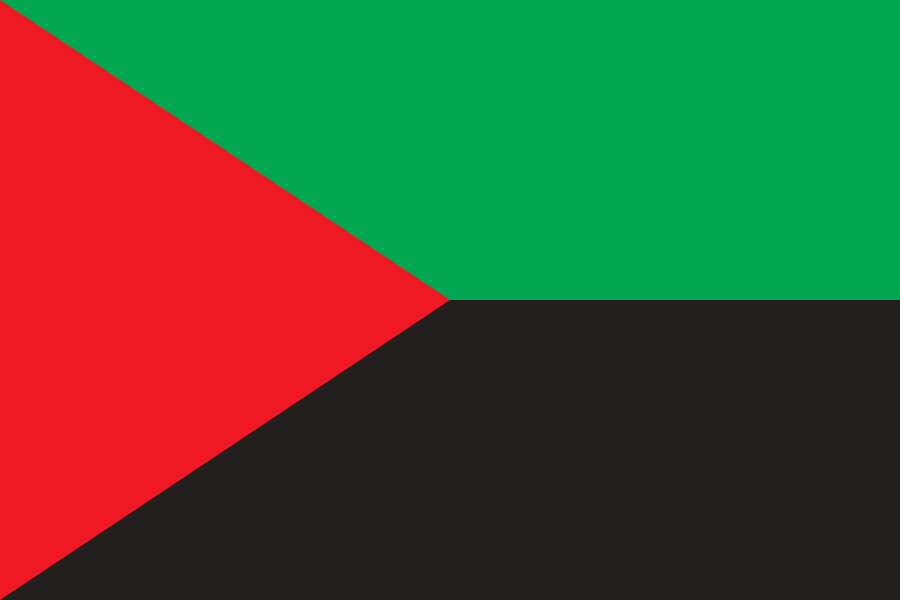
Co-founder of Négritude, pioneering critic of colonialism
"My turn to state an equation: colonization = 'thingification.'" In Discourse on Colonialism (1950) he argued that Europeans had already applied to colonized peoples the methods they later condemned as Nazism, and that Nazism was the natural conclusion of a civilization that justified colonization.
Born in Basse-Pointe, Martinique, the son of a tax inspector, he studied in Paris, where with Léopold Sédar Senghor and Léon Damas he launched the Négritude movement; the journal L'Étudiant noir (founded 1934–1935) first used the term in its present sense in May–June 1935. Frantz Fanon was his student. Elected with Communist Party support in 1945, he was mayor of Fort-de-France for 56 years and deputy for 47, and in 1946 secured the law making Martinique a French département. He broke with the PCF in his Lettre à Maurice Thorez (24 October 1956), citing the Khrushchev report and the repressive policy in the Maghreb; English-language accounts instead attribute the break to the Soviet suppression of the Hungarian Revolution. He founded the Parti Progressiste Martiniquais in 1958 and left politics in 2001.
Career timeline
- 1935Co-founded L'Étudiant noir in Paris; coined the term 'négritude'
- 1939Published Cahier d'un retour au pays natal
- 1941Co-founded Tropiques review with Suzanne Roussi
- 1945Elected PCF deputy to National Assembly and mayor of Fort-de-France
- 1946Secured law departmentalizing Martinique as part of France
- 1950Published Discours sur le colonialisme
- 1956Resigned from PCF via Lettre à Maurice Thorez over Soviet suppression of Hungary
- 1958Founded Parti Progressiste Martiniquais (PPM)
- 1983–1988President of the Regional Council of Martinique
- 1993Retired from National Assembly after 47 years
- 2001Retired as mayor of Fort-de-France after 56 years
A communist pioneer of armed resistance to the Occupation
“We’ve avenged Titi!”
Pierre Georges was a French communist and Resistance fighter whose early anti-fascist experience included service with the International Brigades in the Spanish Civil War. On 21 August 1941 he shot the German naval officer Alfons Moser at Paris’s Barbès metro station, an action that made the French Communist Party’s armed resistance visible while intensifying the occupiers’ hostage executions and repression. Under the names Frédo and later Colonel Fabien, he organised clandestine fighters and maquis units, then led the Colonne Fabien toward the eastern front after the Liberation of Paris. He was killed by a mine explosion in 1944, leaving a legacy that joins the decision to fight the Occupation to the severe reprisals that followed.
Career timeline
- 1936–1939International Brigades fighter in the Spanish Civil War
- 1939–1940Cadre of the French Communist youth movement
- 1940–1941Underground communist organiser in occupied France
- 1941–1942Military commissioner of the Organisation spéciale
- 1942–1943FTP maquis organiser in the Doubs
- 1943–1944FTP maquis commander across eastern and central France
- 1944FTP and FFI commander during and after the Liberation of Paris
- 1944Commander of the Colonne Fabien, killed on the eastern front
- 1941.08.21Shot German naval officer Alfons Moser at Barbès metro station
- 1944.12.27Killed by a mine explosion at Habsheim, Alsace
A young Communist activist executed under occupation
Before his execution, he wrote in his farewell letter, “What I wish with all my heart is that my death may serve some purpose.”
Guy Môquet was a French Communist youth activist from Paris who entered underground activity after his father was imprisoned. Arrested at sixteen in 1940, he passed through French imprisonment and administrative detention before being transferred to the Châteaubriant camp in 1941. The German occupation authorities selected him as a hostage in retaliation for the killing of Karl Hotz in Nantes and executed him on 22 October 1941; his death became a symbol of the cost imposed on young Communists by occupation and collaboration.
Career timeline
- 1924Born in Paris
- late 1930sStudent at Lycée Carnot and activist in the Communist Youth
- 1940.10Arrested by French police and imprisoned at Fresnes
- 1941.01–02Held administratively after acquittal, then transferred through Santé and Clairvaux
- 1941.05Transferred to the Choisel camp at Châteaubriant
- 1941.10.22Executed as a hostage at Châteaubriant