Gulag survivor, world authority on Old Russian literature, moral conscience of late Soviet society
Solovki, autumn 1929. Warned that an arrest squad was coming for him, he hid all night among the woodpiles, listening to execution volleys. At dawn he understood: "Someone else was taken instead of me — I must now live for two."
Philologist and cultural historian from St. Petersburg. Arrested in 1928 for counter-revolutionary activity, he spent four years at Solovki camp. After release, he joined the Pushkin House, becoming the world's foremost authority on Old Russian literature. He led studies of The Tale of Igor's Campaign and edited the 12-volume Monuments of Literature of Ancient Rus'. Elected Academician in 1970, he served as first chairman of the Soviet Cultural Foundation (1986–1993). He never joined the Communist Party, opposed Sakharov's Academy expulsion, and was called 'Russia's conscience' while a People's Deputy during perestroika. In 1998 he became the first recipient of the restored Order of St. Andrew.
Career timeline
1928–1932Arrested for counter-revolutionary activity; Solovki camp and Belbaltlag
1938Research fellow, IRLI (Pushkin House), USSR Academy of Sciences
1947Doctor of Philology
1953Corresponding Member, USSR Academy of Sciences
1970Full Academician, USSR Academy of Sciences
1986–1993Chairman, Soviet (later Russian) Cultural Foundation
The pan-Turkist dissident who became Azerbaijan's first democratically elected president
On a November 1992 visit to Ankara he visited Atatürk's grave at Anıtkabir and wrote in the memorial book that he was a soldier of Mustafa Kemal Atatürk.
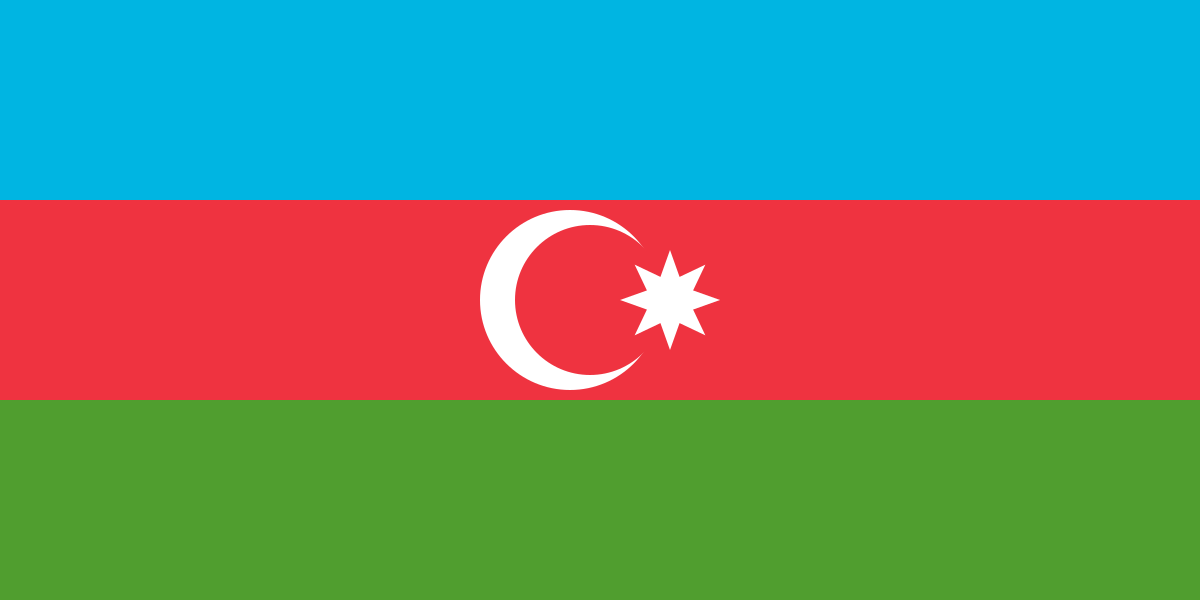
Azerbaijani politician, born 24 June 1938 in Kalaki, Nakhchivan, died 22 August 2000 in Ankara. Trained in Arabic philology at Baku State University, he took a Candidate degree in history in 1969, was known from the 1970s as a Turkist and anti-communist, and was arrested in January 1975 by the State Security Committee, serving until July 1976 at the Qaradagh stone quarry. A founder and chairman of the Popular Front from 1989, he organized a National Defence Council in January 1990 in the crisis that culminated in the anti-Armenian Baku pogrom and Black January. Elected president in June 1992, he was ousted in June 1993 amid Karabakh defeats and Huseynov's revolt; Heydar Aliyev succeeded him. He returned to Baku in 1997 and led the opposition until his death.
Career timeline
1957–1962Entered the Arabic philology department, Faculty of Oriental Studies, Baku State University in 1957; graduation dated 1962 in the Azerbaijani account, conflicting with a 1957 graduation given in an English account
1963–1964Worked as a translator in Egypt
1968–1975Lecturer in the History of Asian and African Countries, Baku State University → arrested January 1975 by the State Security Committee, held until July 1976 at the Qaradagh stone quarry
1976–1992Researcher, then senior researcher and department head, Institute of Manuscripts, Azerbaijan Academy of Sciences, until 16 July 1992
1989–1992Chairman, Azerbaijani Popular Front
1990.01Organized and chaired the National Defence Council in Baku on 12 January 1990
1992–1993President, Republic of Azerbaijan. Elected 7 June 1992, took office 17 June; formally stripped of the office by referendum on 29 August 1993
1997–2000Leader, Azerbaijani Popular Front Party (in opposition). Returned to Baku on 30 October 1997 and led it until his death
Dissident
1939–1989
✕ Death in a suspicious car crash
A poet who joined the struggle for independence to the defense of human rights
On April 9, 1989, he was arrested as an organizer of the Tbilisi independence protest and released 45 days later under public pressure.
Merab Kostava was a musician, poet and dissident who fought for Georgian independence and human rights. With Zviad Gamsakhurdia, he built underground publishing and Helsinki human-rights networks that challenged Soviet repression of national and religious life. After years of imprisonment and exile in Siberia, he returned in 1987 and helped lead the mass independence movement and Tbilisi protests from 1988 onward. He died in a suspicious car crash in 1989 and was later honored by Georgia as a national hero.
Career timeline
1954Co-founded the underground youth group Gorgasliani with Zviad Gamsakhurdia
1956–1958First arrested and detained for dissident activity
1962–1977Teacher in Tbilisi music schools; pursued musical and literary work
1973–1976Founded the Initiative Group for Human Rights and the Georgian Helsinki Group
1977–1987Imprisoned and exiled to Siberia on anti-Soviet propaganda charges
1987–1989Led the independence movement and organized the April 9, 1989 Tbilisi protest
Dissident
1939–1993
✕ Shot dead under disputed circumstances
The nationalist dissident who became Georgia's first democratically elected president
"All my life I was in the opposition and fought against the government. Now I am the government": said in an interview after becoming chairman of the newly elected Supreme Council, 1990.
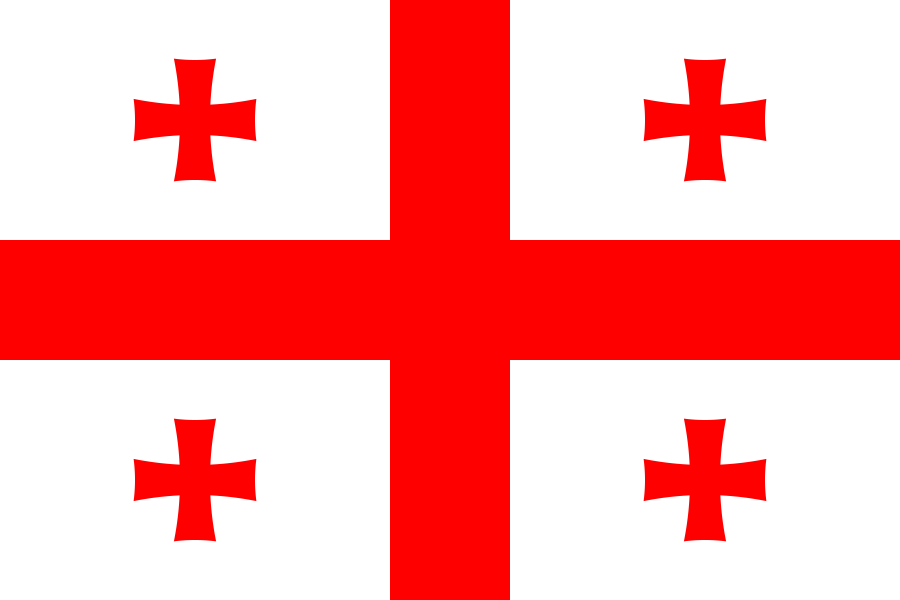
Georgian philologist and dissident, son of the celebrated writer Konstantine Gamsakhurdia. In 1977 he co-founded the Georgian Helsinki Group with Merab Kostava, exposing Soviet human rights abuses to the world, and was repeatedly imprisoned. In April 1989, as co-leader of the Independence Committee, he organized mass peaceful demonstrations and hunger strikes in Tbilisi; the Soviet military's bloody crackdown on them decisively radicalized Georgian opinion toward independence. Leading the Round Table-Free Georgia coalition, he won the first multiparty elections in 1990 and was elected Georgia's first president in May 1991 with 87% of the vote, only to be overthrown in an armed coup seven months later, flee to Chechnya, and die under disputed circumstances in western Georgia in December 1993.
Career timeline
1954Founded the underground youth group Gorgasliani
1963–1977Lecturer in English, Tbilisi State University; researcher, Institute of Literature, Georgian Academy of Sciences
1977–1979Co-founded Georgian Helsinki Group; arrested, imprisoned, released after public recantation
1988–1990Co-chair, Society of St. Ilia the Righteous; co-leader of the Independence Committee
1990–1991Chairman of the Supreme Council of the Republic of Georgia
The dissident architect who walked out of a Soviet prison camp and opened Estonia's political road to independence
On 23 August 1987 at noon, Hirvepark stood empty until the stroke of twelve, when two to five thousand people suddenly filled it. Parek recalled: 'Unbelievable! Something had to be done.'
The daughter of an Estonian officer, she was deported to Siberia at seven and spent four years in exile. Working as an architect, she was arrested in 1983 for anti-Soviet samizdat activity and imprisoned for four years; seven months after her release she co-founded the MRP-AEG and organised the Hirvepark rally of August 1987. That rally became the starting point of the Baltic independence movement, and the following year she was elected chair of the ERSP, Estonia's first non-communist party. After independence she served as interior minister in the first post-Soviet government, resigning in the 1993 Pullapää crisis, and later converted to Catholicism, living at Pirita Convent while leading the drive to build a memorial to the victims of Stalinism.
Career timeline
1963–1983Worked as an architect at design institutes in Tallinn and Tartu
1983–1987Arrested for anti-Soviet agitation, imprisoned in Dubravlag women's political section
1987Co-founded the MRP-AEG, organised the Hirvepark rally
1988–1992Chair of the Estonian National Independence Party (ERSP)
1990–1992Member of the Congress of Estonia
1992Presidential candidate, fourth place with 4.3% of the vote
1992–1993Minister of the Interior of Estonia (Mart Laar cabinet)
1997–Co-founder and head of Caritas Eesti; resident at Pirita Convent
The Estonian dissident who helped break the silence at Hirvepark
At Hirvepark, Madisson called for the secret protocols to be published and their consequences liquidated.
Tiit Madisson was an Estonian dissident and writer who spent 1980–1986 as a political prisoner. After his release, he founded MRP-AEG and helped organise the 1987 Hirvepark meeting, which demanded publication of the Molotov–Ribbentrop Pact's secret protocols and the liquidation of their consequences. The rally became a key moment in the return of public political action in late Soviet Estonia, and the authorities forced him into exile in Sweden. After returning, he took part in Estonia's restoration politics and nationalist organisations; his later writings also drew criticism for Holocaust denial.
Career timeline
mid-1970sOrganiser in Estonia's hippie movement
1980–1986Political prisoner, then exiled internally
1987Founder of MRP-AEG and principal organiser of the Hirvepark meeting
1987–1990Exile in Sweden; contributor to Radio Free Europe
1990–1992Member of the Congress of Estonia and Estonian Committee
1994Presided over the founding congress of the Nationalists' Central League
2002–2005Mayor of Lihula
2009Helped launch the re-establishment of the Estonian National Independence Party
Deputy chairman of the Azerbaijani Popular Front who warned Primakov there would be resistance
Polyanichko told him that at midnight troops would enter the city "whatever the cost." Mammadov replied that the army would meet resistance.
As deputy chairman of the Azerbaijani Popular Front, Etibar Mammadov stood at the forefront of the national independence movement and met with Yevgeny Primakov and Viktor Polyanichko on January 19, 1990, where he was warned that troops would enter Baku. That evening Polyanichko told him the army would go in "whatever the cost"; Mammadov replied there would be resistance, and he later became a key witness to the Kremlin's bloody crackdown on the city. He went on to found the Azerbaijan National Independence Party, finished second in the 1998 presidential election, and remained a durable opposition leader in independent Azerbaijan.
Career timeline
1978–1988Lecturer in history, Baku State University
1988–1991Deputy chairman and board member, Azerbaijani Popular Front
1990.01–11Imprisoned at Lefortovo Prison (arrested after Black January)
1990–2000Deputy, Supreme Soviet of Azerbaijan SSR / National Assembly
1991Member, National Defence Council; co-authored the Constitutional Act on State Independence
1992–2004Founder and chairman, Azerbaijan National Independence Party (NIPA)
Estonian former political prisoner who survived the Soviet camps and co-organized the first open rally of the Baltic independence movement
The Hirvepark demonstration, Ahonen said, 'broke open the path for the expression of opinion,' an historic turn he called 'the icebreaker effect.'
Heiki Ahonen was born in 1956 in Pärnu, Estonia. His grandfather was shot by the NKVD, his father imprisoned in the camps, and his mother deported to Siberia: every member of his family was repressed. Joining the underground resistance in 1977, he distributed samizdat and fed information on Soviet human rights violations to Western journalists; convicted of anti-Soviet agitation in 1983, he served five years in the Perm labour camps. Released in early 1987, he co-organised the Hirvepark rally that August, the first open mass demonstration demanding disclosure of the Nazi-Soviet pact's secret protocols, breaking the dam for the Baltic independence movement; then was forcibly expelled by the KGB, spent a decade in exile, and came home as the founding director of the Museum of Occupations.
Career timeline
1977–1983Underground resistance, samizdat distribution, human rights documentation
1983–1987Five years in Perm labour camps (anti-Soviet agitation)
1987.08Co-founder of MRP-AEG, co-organiser of Hirvepark rally
1988.01Co-founder, Estonian National Independence Party (ERSP)
1988–1989Deputy chairman, Help Center for Estonian Political Prisoners (Stockholm)
1989–1998Director of Estonian service, Radio Free Europe (Munich/Prague)
2003–2012Founding director, Museum of Occupations, Tallinn