Latvian party boss turned Soviet of Nationalities chairman
On 28 May 1988, the Latvian Communist Party Central Committee plenum elected delegates to the 19th All-Union Party Conference. Voss drew more 'against' votes than any other candidate — yet was elected anyway. Protest letters poured into Moscow. Nothing changed.
A Siberian-born son of Latvian parents, he inherited the Latvian Communist Party after the 1959 purge of 'nationalist' cadres and led it as First Secretary for eighteen years as an executor of 'internationalist' orthodoxy. His defining paradox was commanding his ancestral tongue fluently yet never once speaking it in public. In his last years he rose to chair the Soviet of Nationalities, only to be swept aside with the old order by perestroika's national movements.
Career timeline
1940s–1950sRises through the Latvian Communist Party organization
1966–1984First Secretary of the Latvian Communist Party, managing a Baltic republic during stagnation
1984–1989Chairman of the Soviet of Nationalities, a conservative face of late-Soviet federal representation
1988–1989Loses influence amid Baltic national movements and perestroika
Mao’s bodyguard chief whose Zhongnanhai Unit 8341 arrested the Gang of Four, then pushed aside for the “two whatevers”
"A loyal soldier of Chairman Mao to the end": he guarded Mao for decades and had Unit 8341 arrest the Gang of Four in 1976.
From Jiangxi, he guarded Mao after the Long March and from 1949 headed the Central Guard Bureau (Unit 8341), managing the leadership’s security and daily life. Director of the General Office during the Cultural Revolution and trusted by Mao, in October 1976 he used Unit 8341 with Ye Jianying and Hua Guofeng to arrest Jiang Qing and the Gang of Four. Made party vice-chairman in 1977, he backed Hua’s “two whatevers” against Deng Xiaoping, resigned the vice-chairmanship in 1980 and left politics. He died in 2015 at 99.
Career timeline
1949–1977Director of the Central Guard Bureau (Unit 8341)
Afghan communist founder whose overthrow and murder by his protégé Amin triggered the Soviet invasion
Taraki: 'We ask you to render practical and technical assistance with men and armament.' Kosygin: 'This is a very complicated problem.' Taraki: 'While you are taking counsel Herat will fall.' (telephone conversation, 18 March 1979, during the Herat uprising)
Nur Muhammad Taraki was the founding General Secretary of the People's Democratic Party of Afghanistan (PDPA) who became the first Chairman of the Revolutionary Council and Prime Minister of the Democratic Republic of Afghanistan after the Saur Revolution of April 1978. Born to a Pashtun peasant family, he encountered Marxism at night school in Bombay and later wrote the first social-realist novel in Pashto, The Journey of Bang, earning the label 'Afghanistan's Maxim Gorky.' Once in power he imposed radical land reform and secularization that ignited armed uprisings across the countryside, and his repeated pleas for Soviet military intervention were rebuffed by Kosygin and Brezhnev. In September 1979 his protégé Hafizullah Amin overthrew and suffocated him, a killing that became the proximate trigger for the Soviet invasion two months later.
Career timeline
1932–1937Clerk for Pashtun Trading Company in Bombay; encountered Marxism at night school
1940s–1958Writer and journalist; published De Bang Mosaferi, the first Pashto social-realist novel
1952–1953Press attaché, Afghan Embassy in Washington DC
1965Founded PDPA at his Kabul home; elected General Secretary
1967Led Khalq (Masses) faction after PDPA split
1978.04–12Saur Revolution: Chairman of Revolutionary Council and PM; signed 20-Year Soviet Friendship Treaty
1979.03Herat uprising: appealed for Soviet troops; Kosygin and Brezhnev refused
1979.09–10Overthrown by Amin; suffocated with pillows in custody
Writer turned leader who drove Uzbekistan's industrialization and cultural revival for 24 years, later tied to the Cotton Affair
In May 1962, Rashidov flew to Havana at Khrushchev's secret behest, leading a Soviet delegation whose official brief was agricultural and irrigation cooperation. The real mission: to present Fidel Castro with the plan to deploy nuclear missiles on Cuba. That clandestine meeting opened the Cuban Missile Crisis — and a lifelong friendship between Rashidov and Castro.
Born to a poor peasant family, teacher and newspaper editor turned writer, he became First Secretary of the CP of Uzbekistan in 1959 and led the republic for 24 years. He transformed its economy through Tashkent's post-earthquake reconstruction, the Metro, the Muruntau gold mine, and rapid growth in aircraft and tractor manufacturing. His cultural nationalism (Samarkand's 2,500th anniversary, an archaeology institute, heritage preservation) fostered strong Uzbek identity. Brezhnev's patronage brought exceptional autonomy; after his death, Andropov's Cotton Affair probe recast him as a symbol of Brezhnev-era cronyism.
Career timeline
1935–1937Secondary school teacher
1937–1941Reporter and editor, Samarkand regional newspaper Lenin Yoli
1941–1943Junior lieutenant, Red Army; Battle of Moscow, Volkhov Front; severely wounded
1944–1947Secretary, Samarkand Regional Party Committee
1947–1949Executive editor, republican daily Qizil O'zbekiston
1949–1950Chairman, Union of Writers of Uzbekistan
1950–1959Chairman, Presidium of the Supreme Soviet, Uzbek SSR
1959–1983First Secretary, Central Committee, CP of Uzbekistan
Belarus's premier for nearly 20 years who rose to First Secretary and candidate Politburo member, then died of cancer two years later
He seized on the idea of the Minsk Metro and lobbied Moscow relentlessly until he got his way. He laid the first stone himself.
Born into an Old Believer peasant family in Gomel and trained as a teacher of Belarusian language and literature, Kiselyov served nearly twenty years as Chairman of the Byelorussian SSR Council of Ministers (1959–1978), steering the republic's postwar reconstruction and industrialisation as a pragmatic economic manager. He tenaciously lobbied Moscow to secure the Minsk Metro and the Zhlobin steel plant, rose to Deputy Chairman of the USSR Council of Ministers in 1978, then returned to Minsk in 1980 as First Secretary of the Communist Party of Belarus and candidate member of the CPSU Politburo, succeeding Pyotr Masherov. He prioritised stable management over reform but died of cancer barely two years into the role.
Career timeline
1936–1941Teacher of Belarusian language and literature, Yelsk district schools
1941–1944School director, Krasnyanskaya school, Stalingrad region (evacuation)
1944–1952Instructor, Gomel Regional Committee → Head of Agitation and Propaganda, CPB CC
Brezhnev-era official across agriculture and government
At a 1973 Presidium meeting, Brezhnev blindsided Polyansky with a demotion to agriculture minister. Polyansky rose trembling: "No one told me." Brezhnev shot back: "Now we're talking."
A top Soviet official, Politburo member and First Deputy Premier, who authored the 'Polyansky Report' that indicted Khrushchev ahead of his 1964 ouster. Later served as Minister of Agriculture and as ambassador to Japan and Norway.
The party ideology secretary who signed the letter inviting Soviet tanks into his own country
Charged with treason, Biľak denied signing any invitation: "I never wrote to Brezhnev." The letter had been addressed to the CPSU Central Committee, not to Brezhnev personally. A defense that was technically true and entirely beside the point.
A neo-Stalinist of Rusyn origin who rose from tailor to the Presidium of the Czechoslovak Communist Party. In 1968 he was a core member of the conservative 'healthy forces': one of five who signed the invitation letter urging the Warsaw Pact to intervene against the Prague Spring reforms with 'all means at your disposal.' As the KSČ ideology secretary under Husák, he drafted 'Lessons from the Crisis Development' (1970), the doctrinal foundation of normalization that branded the reforms a counter-revolution and justified mass purges, remaining an unreconstructed hardliner until expelled during the Velvet Revolution.
Career timeline
1917Born to a Rusyn family; apprenticed as a tailor
1936–1945Joined communist trade unions; worked as a tailor; Slovak National Uprising
1954–1962Graduated Party Political School; regional secretary in Prešov; commissioner for education and culture
1962–1968Ideology secretary, Central Committee of the Communist Party of Slovakia
1968.01–08General Secretary of Slovak party; joined KSČ Presidium in April; signed Warsaw Pact invitation letter
1968–1988KSČ Presidium member and Central Committee secretary for foreign policy and ideology
1970Authored 'Lessons from the Crisis Development,' the doctrinal charter of normalization
1988.12Removed from Presidium and secretariat; expelled from the party in 1989
Belarus's partisan-hero leader for 15 years who transformed an agrarian republic into an industrial powerhouse - his death a legend
It is not so much about knowing and being able to do things yourself, as about seeing the good in other people. Then you yourself will mean a great deal.
A mathematics and physics teacher, he became a leader of the Belarusian partisan movement during the Great Patriotic War, earning Hero of the Soviet Union in 1944. As First Secretary of the Communist Party of Belarus for 15 years from 1965, he transformed a war-ravaged agrarian republic into a Soviet industrial and scientific powerhouse, spearheading the Minsk Metro, major chemical plants, and the Brest Fortress and Khatyn memorials. A candidate Politburo member (1966-1980) and pragmatic reformist who backed the Kosygin reforms, he was widely tipped to succeed Kosygin as Chairman of the Council of Ministers when he died in a car crash in October 1980.
Career timeline
1939–1941Teacher of mathematics and physics, Rasony secondary school
Romania's leader who combined independent diplomacy with a cult of personality
His 1968 criticism of the invasion publicly exposed fractures within the Eastern European socialist bloc.
Becoming leader of Romania's Communist Party in 1965, he built a nationalist independent line and a powerful cult of personality. He criticized the 1968 Warsaw Pact invasion of Czechoslovakia, but fell with his regime in the 1989 revolution.
The Brezhnev-era republic-builder who led Ukraine for 17 years, linchpin of the Dnepr clan
"What fool invented this word perestroika? Why rebuild the house? We are fine! What is there to rebuild?" — Shcherbitsky on Gorbachev's reforms.
Rising through the party apparatus in the Dneprodzerzhinsk-Dnepropetrovsk industrial belt, he served as First Secretary of the Communist Party of Ukraine from 1972 to 1989 and sat on the CPSU Politburo for 18 years (1971–1989). Sharing Brezhnev's Dnepr network, he oversaw Ukraine's intensive industrialisation and economic expansion for 17 years, multiplying the republic's GDP more than fourfold. Briefly demoted for opposing Khrushchev's decentralisation schemes, he returned to power after Brezhnev's takeover. He drew criticism for the information blackout and the decision to proceed with the Kyiv May Day parade after the 1986 Chernobyl disaster, and in 1989 became the last old-guard republic leader replaced by Gorbachev.
Career timeline
1941–1945Chemical defence officer, Transcaucasian Front, demobilised as captain
1946–1952Party secretary at Dneprodzerzhinsk coke-chemical and metallurgical plants, city committee cadre
1952–1954First Secretary, Dneprodzerzhinsk City Party Committee
1955–1957First Secretary, Dnepropetrovsk Oblast Party Committee
1957–1961Secretary, CC of the Communist Party of Ukraine
1961–1963Chairman, Council of Ministers, Ukrainian SSR
1965–1972Chairman, Council of Ministers, Ukrainian SSR
1972–1989First Secretary, CC of the Communist Party of Ukraine
When Khrushchev appointed him KGB chairman in 1958, he added: "I have one more request: make sure I'm not bugged." Six years later, Shelepin used the KGB to cut Khrushchev's communications and pull him from power.
A Komsomol leader turned KGB chairman, he symbolized a generational reshuffle of the security organs. Later seen as a possible rival to Brezhnev, he was gradually pushed aside.
Career timeline
1952–1958First Secretary of Komsomol, representing the postwar youth-league generation
1958–1961KGB chairman, pushing a younger generation into the security apparatus
1961–1967CC secretary and party-state control chief, forming the Shelepin group
1964Participates in Khrushchev’s removal
1967–1975Gradually sidelined under Brezhnev as a potential rival
The republic first secretary who ruled Moldavia for nearly 20 years as Brezhnev's close ally
Of writer Ion Druță, forced to relocate to Moscow, Bodiul said publicly: 'If he returns home, I'll hang him on the first lamppost.'
He served nearly 20 years as First Secretary of the Communist Party of Moldavia, one of the longest-serving republican party chiefs in Soviet history. A close Brezhnev ally, he transformed agrarian Moldavia with new industries (machine-building, electronics, food processing) and built some of Europe's largest orchards and livestock complexes. Yet he also pursued aggressive Russification: suppressing Romanian, closing churches, and threatening writer Ion Druță with hanging. Elevated to Deputy Chairman of the USSR Council of Ministers in 1980, his 2003 Order of the Republic award provoked eight Moldovan writers to renounce their own medals in protest.
Career timeline
1937–1938Senior agronomist, collective farm
1942–1946Veterinary officer, Red Army (127th Guards Artillery Regt → 59th Guards Rifle Div → 10th Guards Rifle Corps)
1946–1951Agricultural aide and inspector, Moldavian SSR Council of Ministers
1951–1956First Secretary, Chișinău / Volontirovka / Olănești District Party Committees
1956–1959Higher Party School graduate; instructor, CC CPSU Org-Party Work Dept
1959–1961Second Secretary, CC of the Communist Party of Moldavia
1961–1980First Secretary, CC of the Communist Party of Moldavia
1980–1985Deputy Chairman, USSR Council of Ministers
The regime insider who fused political power with scientific prestige
“Together we fought, together we die!”
Elena Ceaușescu was a Romanian communist politician who exercised power alongside her husband, Nicolae Ceaușescu. She rose through the party and state leadership, where propaganda presented her as a symbol of women’s advancement and scientific achievement, while her position reinforced family rule and the personality cult. As the December 1989 uprising spread from Timișoara, she remained part of the regime’s ruling circle, fled with her husband on 22 December, and was captured. After a summary trial, the couple were executed together on 25 December.
Career timeline
1939–1947Communist activist and textile worker
1957–1967Chemical researcher, awarded engineering degree and doctorate
1972Member of the Romanian Communist Party Central Committee
1973–1974Member of the Political Executive Committee and its Permanent Bureau
1975–1989Deputy in the Great National Assembly and senior party-state leader
1980–1989First Deputy Prime Minister of Romania
1989.12Captured in the revolution and executed alongside her husband
From Sichuan’s farm reforms to general secretary, the reformer who opposed martial law in 1989 and died under house arrest
Premier 1980-1987 and general secretary from 1987, in charge of political reform; he lost power over the 1989 Tiananmen Square protests and lived under house arrest until his death
From Henan, he was a provincial cadre in Guangdong until purged in the Cultural Revolution, returned as Sichuan first secretary in 1975 and, with household contracting and enterprise autonomy, earned the saying “If you want to eat, look for Ziyang”. Premier from 1980 and general secretary from 1987, he pushed price reform and plans for political reform. In May 1989 he opposed martial law against the student protests, told students in the square “We have come too late”, and fell; he remained under house arrest in Beijing until his death in 2005. His secretly recorded memoirs were published posthumously in Hong Kong.
Career timeline
1975–1980First Secretary of the Sichuan Party Committee
1980–1987Premier of the State Council
1987–1989General Secretary of the Central Committee
The ambassador whose 24 years in Washington made him the hidden circuit of Soviet–American diplomacy
On the night of October 27, 1962, a secret meeting with Robert Kennedy. The Soviets would withdraw their missiles from Cuba; in an unpublicized assurance, the Americans would quietly remove their missiles from Turkey.
Soviet ambassador to the United States from 1962 to 1986, 24 years that made him the indispensable circuit of Cold War diplomacy. His secret backchannel with Robert Kennedy resolved the Cuban Missile Crisis, and his extraordinary relationship with Henry Kissinger drove détente and the SALT agreements.
Career timeline
1944Entered Higher Diplomatic School, part of the 'Stalin call-up' into diplomacy
1946Joined Foreign Ministry, served under Molotov and Gromyko
1952–1957Counsellor at the Soviet Embassy in Washington
1957–1959UN Deputy Secretary-General
1960–1962Head of the Foreign Ministry's Americas Department
1962–1986Ambassador to the US — served under six American presidents over 24 years
1986–1988CC Secretary and head of the International Department
The builder who transformed Kirghizia from an agrarian to an industrial republic across the Khrushchev-Brezhnev era
In his later memoirs, he wrote of the project that was both his greatest legacy and his heaviest burden: "The Toktogul Hydroelectric Station — my pride and my pain."
Born to a poor peasant family and beginning as a schoolteacher, this Kyrgyz politician spent ten years (1945–1955) as an instructor at the CPSU Central Committee in Moscow, gaining the all-Union party apprenticeship that would define his career. As First Secretary of the Communist Party of Kirghizia from 1961 to 1985, he oversaw the construction of 150 large industrial facilities, including the Naryn hydroelectric cascade, Toktogul HPP, and Manas International Airport, and delivered over 510,000 new apartments. Gross industrial output rose fivefold and electricity generation twelvefold, transforming the republic from agrarian to industrial. A full member of the CPSU Central Committee (1961–1986), he also served in the parliament of independent Kyrgyzstan (1993–2005) after retirement.
Career timeline
1937–1939Teacher and head of studies, Kochkor secondary school
1941–1942Deputy head, Propaganda and Agitation Dept., Kochkor District Party Committee
1942–1943Instructor, Propaganda and Agitation Dept., CC CP of Kirghizia
1945–1955Instructor, CPSU Central Committee (Moscow)
1955–1956Editor-in-chief, republican daily Sovettik Kyrgyzstan
1956–1958Head, Propaganda and Agitation Dept., CC CP of Kirghizia
1958–1961First Secretary, Frunze City Party Committee
1959–1961Chairman, Supreme Soviet of the Kirghiz SSR
1961–1985First Secretary, CC CP of Kirghizia
1961–1986Member, CPSU Central Committee
1993–2005Deputy, Jogorku Kenesh (Parliament) of the Kyrgyz Republic
From US-educated anthropologist to founder of Mozambique's liberation front
“Although I loved university life above all, I decided to devote the rest of my life to the war of liberation of my country, until it receives independence!”
A Mozambican anthropologist who earned his PhD in the United States, he gave up an academic career to fuse rival liberation groups into the Mozambican Liberation Front (FRELIMO). As its first president he launched the 1964 armed struggle and set the movement toward a socialist line, leading it until his assassination in 1969, six years before independence.
Career timeline
1953BA in anthropology and sociology, Oberlin College
1955MA, Northwestern University
1957–1961Research officer, UN Trusteeship Department; field research across Africa
1960PhD in anthropology, Northwestern University, under Melville J. Herskovits
1961–1963Assistant professor, Syracuse University; helped develop East African Studies Program
1962FRELIMO founded; elected first president
1964Launches armed liberation struggle against Portuguese colonial rule (25 September)
1968Second FRELIMO Congress adopts socialist line, protracted war strategy; re-elected president
1969.02.03Assassinated by letter bomb in Dar es Salaam, Tanzania
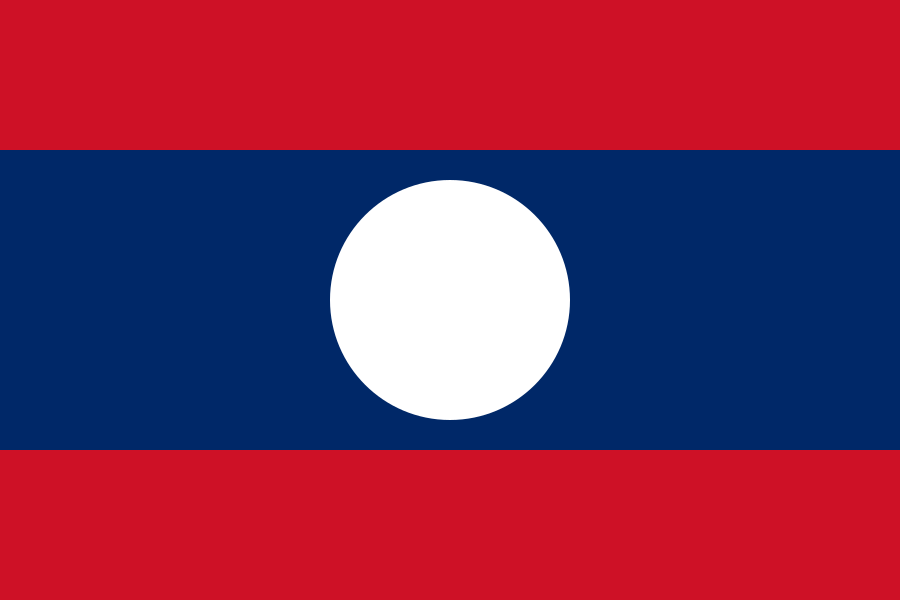
In December 1975 he proclaimed the abolition of the monarchy and the establishment of the Lao People's Democratic Republic before the National Congress of People's Representatives.
Lao People’s Revolutionary Party leader and prime minister after the republic’s establishment in 1975. He maintained close Vietnamese ties and led state reorganization and market-oriented reforms in the 1980s. He became president in 1991.
Career timeline
1942Joined the Indochinese Communist Party
1947Led resistance in northeastern Laos, organized armed forces
1949Founded the Lao People's Liberation Army
1950Minister of Defense of the Resistance Government
1955General Secretary of the Lao People's Revolutionary Party
1975First Prime Minister of the Lao People's Democratic Republic
1986Announced the 'new economic mechanism' (chin thanakan mai) reforms
Soviet Procurator General who served from Brezhnev to Gorbachev and personally delivered Sakharov's exile decree
On 22 January 1980, Rekunkov read Sakharov the decree stripping him of the title Hero of Socialist Labour and exiling him to the closed city of Gorky.
Born into a peasant family on the Don, he fought in the Great Patriotic War and was severely wounded before entering the procuracy. Rising through Rostov's regional prosecutor offices, he became First Deputy Procurator General in 1976 and succeeded Rudenko as Procurator General in 1981. Under Andropov he spearheaded high-profile anti-corruption campaigns (the Uzbek cotton case and trade-ministry prosecutions), while in 1980 he had personally read Sakharov the decree stripping his state awards and exiling him to Gorky. After retirement he worked in the department rehabilitating victims of political repression, embodying the procuracy's dual role as guardian of socialist legality and instrument of state coercion.
Career timeline
1945–1946Assistant Prosecutor, Verkhne-Don District, Rostov Oblast
1947–1952Prosecutor, Konstantinovsky then Azov District, Rostov Oblast
1960–1966Prosecutor of Bryansk Oblast
1966–1971Prosecutor of Voronezh Oblast
1971–1976First Deputy Procurator of the RSFSR
1976–1981First Deputy Procurator General of the USSR
1981–1988Procurator General of the USSR
1981–1989Member, CPSU Central Committee
1979–1989Deputy, Supreme Soviet of the USSR
1992–1994Prosecutor, Rehabilitation Dept. for Victims of Political Repression, Russian Federation Procuracy
"The war taught me how to live… Everything that was experienced over these last six army years must become the foundation for an interesting, creative, and beautiful life." — From his frontline diary, published posthumously.
Soviet international relations scholar and historian. He served as director of IMEMO, the USSR's premier foreign-policy think tank, from 1966 until his death in 1982. His institute produced the classified analyses that shaped Soviet arms-control negotiating positions, long-range forecasts of Western economies, and the theoretical underpinnings of 'developed socialism' in foreign affairs. A full member of the CPSU Central Committee from 1981, he directly shaped the substance of Soviet détente policy, consistently arguing within the party leadership for the necessity of constructive relations with the West.
Career timeline
1952–1957Consultant, International Department, Kommunist journal
1957–1959Head of International Relations Sector, IMEMO
1959–1961Deputy Director, IMEMO
1961–1966Deputy Editor-in-Chief, Pravda
1966–1982Director, IMEMO
1971–1981Candidate Member, CPSU Central Committee
1981–1982Member, CPSU Central Committee
1975–1982Member, Presidium, USSR Academy of Sciences
The KSČ hardliner who signed the letter inviting Soviet intervention to end the Prague Spring
On the morning of 21 August 1968, Dubček was arrested 'in the name of the Workers' and Peasants' Government led by Comrade Indra.' But Indra's cabinet never materialized for a single day, and the invitation letter he signed would remain secret until the 1990s.
A neo-Stalinist politician of the Czechoslovak Communist Party. A core conservative during the 1968 Prague Spring, he was one of five who signed the 'invitation letter' urging the Warsaw Pact to intervene, and was designated head of a Soviet-backed 'workers' and peasants' government' immediately after the invasion. Under Husák he remained in the Presidium and chaired the Federal Assembly, driving the 'normalization' purges until expelled by the Velvet Revolution in 1989; he died the following year.
Career timeline
1937Joined the Communist Party of Czechoslovakia
1945–1956Regional party secretary in Zlín (Gottwaldov)
1960–1962Head of planning, KSČ Central Committee
1962–1963Chairman, State Planning Commission
1963–1968Minister of Transport of Czechoslovakia
1968.08Signed the invitation letter; designated head of 'workers' and peasants' government'
1968–1971Secretary, KSČ Central Committee
1971–1989KSČ Presidium member; Chairman, Federal Assembly
He dreamed of a human face, and was posted to the forestry service
Before dawn on August 21, 1968, Soviet officers burst into Dubček's office. The phone lines were cut, handcuffs went on. 'We will kill, if necessary, a million Czechs, to put an end to your counter-revolution,' an officer said.
The Slovak reform communist who led the Prague Spring. Raised in the USSR from childhood, he abolished censorship in 1968 and pursued 'socialism with a human face', only to be deposed by the Warsaw Pact invasion and spend fifteen years as a forestry clerk. In 1989 he stood beside Havel on the balcony once more.
Career timeline
1925–1938Raised in a worker family in the USSR
1944Fights in the Slovak National Uprising
1963–1968First Secretary of the Slovak party
1968.01First Secretary of Czechoslovakia; the Prague Spring
1968.08Taken to Moscow; forced to sign the protocol
1969–1970Removed; ambassador to Turkey, then the forestry service
1989.12Returns as chairman of the Federal Assembly
Mao’s designated successor — “With you in charge, I am at ease” — who arrested the Gang of Four and was eased out by Deng Xiaoping
On 6 October 1976, a month after Mao died, Hua had the Gang of Four arrested at Zhongnanhai with Ye Jianying and Wang Dongxing, and took the party and Military Commission chairmanships. He then lost power to Deng Xiaoping by 1981.
From Shanxi, he rose as a provincial cadre in Hunan, caught Mao’s attention, and in 1976 became acting premier after Zhou Enlai’s death in January and first vice-chairman and premier after the April Tiananmen incident. After Mao died he arrested the Gang of Four in October with Ye Jianying and Wang Dongxing and took the party and Military Commission chairmanships. He sought legitimacy in the “two whatevers” — uphold every decision Chairman Mao made, follow every instruction he gave — but lost the initiative to Deng Xiaoping in the 1978 debate on the criterion of truth and at the Third Plenum, giving up the premiership and party chairmanship in 1980–1981. He remained on the Central Committee until 2002.
Physician-poet who led Angola's liberation struggle and became its first president
"Our land, our mother / we shall return." Lines from the poem "Havemos de voltar" in the 1974 collection Sacred Hope (Sagrada Esperança).
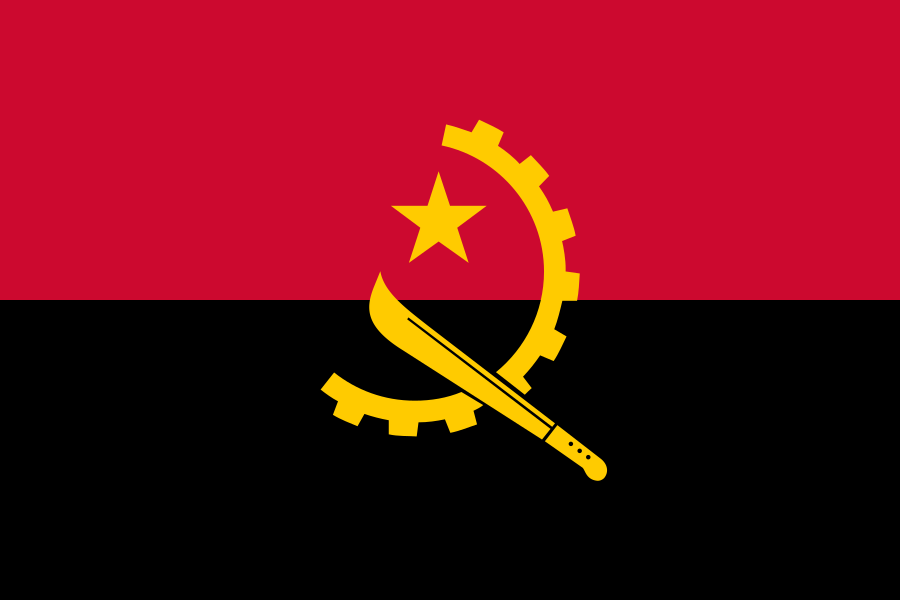
Physician and poet who led Angola's independence struggle. He was president of the MPLA at its founding in December 1956 and, after imprisonment and exile, was elected its effective chairman at the December 1962 conference, leading the independence war until 1974. He became the first president of the People's Republic of Angola on 11 November 1975, building a one-party socialist state in close alignment with the USSR and Cuba while crushing a 1977 coup attempt and carrying out mass purges.
Career timeline
1947Left for Portugal; studied medicine at Coimbra and Lisbon universities while joining anti-colonial student activism
1956Became the MPLA's president at its founding (Viriato da Cruz was secretary-general)
1960–1962Arrested by the PIDE, imprisoned in Lisbon; escaped in 1962 and went into exile in Congo-Léopoldville
1962–1974Elected effective chairman at the MPLA conference; led the independence war and built ties with the USSR, Cuba and Yugoslavia
1975Became first president of the People's Republic of Angola on 11 November; declared a socialist course
1975–1979Defended the state in civil war with Cuban troops and Soviet aid; suppressed Nito Alves's 1977 coup attempt
1977Reorganized the MPLA into the MPLA-Workers' Party, adopting Marxism-Leninism as official doctrine