Founding father of the Republic of China who framed the Three Principles of the People and the first united front
Credited with leading the 1911 revolution that toppled the Qing and founded the Republic of China. In a deathbed testament he dictated himself, he reaffirmed friendship with the Soviet Union.
Born in Guangdong and educated in Hawaii and Hong Kong, he trained as a physician. He founded the Revive China Society in 1894 and the Tongmenghui in Tokyo in 1905 to overthrow the Qing and build a republic; after the 1911 revolution he became provisional president but soon yielded to Yuan Shikai. He formulated the Three Principles of the People (nationalism, democracy, people’s livelihood) and in 1923, after a joint statement with the Soviet envoy Joffe, accepted Soviet aid and Communist members joining the Kuomintang as individuals, opening the first united front. He died of liver cancer in Beijing in 1925; both Nationalists and Communists claimed his legacy.
Career timeline
1905–1912Leader of the Tongmenghui
1912.01–03Provisional President of the Republic of China
Kazakh politician who founded the Alash party and led the Alash Orda government in 1917–1920
Born in Semipalatinsk Oblast in 1866 (some sources say 1870), he graduated from the Omsk Technical School and the Saint Petersburg Forestry Institute and wrote the first biography of Abay Kunanbayev. He joined the Constitutional Democrats (Kadets) in 1905, entered the State Duma in 1906 and, after signing the Vyborg Manifesto, was imprisoned and then lived in exile in Samara until 1917. Appointed the Provisional Government’s commissioner for Turgay Oblast in 1917, he broke with the Kadets over Kazakh autonomy, founded the Alash party and that year was elected head of the Alash Orda government. He sided with the White governments of Siberia until late 1919, then came to terms with Soviet power, worked in publishing in Moscow and was shot in 1937. He was rehabilitated in 1989.
Career timeline
1895–1897Mathematics teacher at the Omsk school for Kazakh children
1906Member of the First State Duma
1908–1917Exile in Samara
1917Provisional Government commissioner for Turgay Oblast
1917–1920Head of the Alash Orda government
1922–1927Literary staff member of the Kazakh section of the Central Publishing House of the Peoples of the USSR
Estonian prime minister who concluded the Treaty of Tartu, publisher of Postimees
As Soviet forces occupied Estonia in June 1940, he urged President Päts to offer at least symbolic armed resistance.
Leader of Estonia's liberal national movement through the newspaper Postimees, he was prime minister in 1919 and 1920 and concluded the Treaty of Tartu. Pushed out for opposing Päts's authoritarian regime in 1934, he was arrested after the Soviet occupation of 1940 and disappeared.
Career timeline
1896Editor and publisher of Postimees, turning it into the organ of the national movement
1906Member of the First Russian State Duma; signed the Vyborg Appeal
1917Member of the Estonian Provincial Assembly (Maapäev)
1919–1920Prime Minister; concluded the Treaty of Tartu
An Endecja theorist who pressed for a Polish nation-state
At Riga, abandoning the demand for Minsk turned Poland’s eastern policy from a federal project toward a nation-state settlement.
Stanisław Grabski was an economist and politician who began in the socialist movement before becoming one of the leading theorists of Poland’s National Democracy, or Endecja. He tied independence and state unity closely to national homogeneity and opposed a federation that would incorporate large Ukrainian and Belarusian populations. During the Minsk and Riga negotiations in 1920, he supported abandoning the demand for Minsk, weakening Piłsudski’s eastern federal project and helping define the Riga settlement as a Polish nation-state. He later served as education minister and held senior positions in the government-in-exile and the postwar state, while distancing himself from Endecja after 1926 and revising parts of his political stance.
Career timeline
1890–1893Socialist activist, workers’ education and clandestine labor organizing
1906–1914National Democrat and adviser on the Polish question in the Russian Duma
1919–1923Deputy in the Polish Sejm and leader of the National Democratic parliamentary and party organizations
1920–1921Polish delegate at the Minsk and Riga peace talks, steering the nation-state line
1923–1925Minister of Religious Denominations and Public Education
1942–1944Chairman of the National Council of Poland in exile
1945–1947Deputy chairman of the State National Council
Tatar lawyer and Duma deputy who headed the national administration of Idel-Ural
Born in 1878 in the village of Tashsu near Kazan, he studied law at the University of Paris in 1901–1906 on Ismail Gasprinsky’s advice. In 1906 he joined the Central Committee of Ittifaq al-Muslimin, and he sat for Kazan province in the Second and Third State Dumas. In 1917 he was on the executive committee of the All-Russian Muslim Council, and on 5 January 1918 he was elected chairman of the Milli Idare, the body of national-cultural autonomy of the Muslims of Inner Russia and Siberia, becoming head of the Idel-Ural State. When the Bolsheviks took Kazan and Ufa provinces he fled to Finland; at the Paris Peace Conference in 1919 he pleaded for the peoples of Idel-Ural, without result. He moved to Turkey in 1925, became a professor of legal history and a member of parliament, and died in Istanbul in 1957.
Career timeline
1901–1906Law studies at the University of Paris
1906Member of the Central Committee of Ittifaq al-Muslimin
1907–1912Member of the Second and Third State Dumas for Kazan province
1917Member of the executive committee of the All-Russian Muslim Council
1918Chairman of the Milli Idare (head of the Idel-Ural State)
1925–1957Professor of legal history in Ankara and Istanbul
1931–1954Member of the Turkish parliament (three terms)
Chairman of the Rada of the Belarusian People’s Republic from 1919 until his death, leading it in exile from Prague
Born in 1879 into the family of a village church deacon in the Grodno Governorate, he graduated from the seminary in Vilnius, worked as a teacher and from 1909 was employed at the Vilnius State Bank. In 1917, as chairman of the Borisov Soviet of Workers’ and Soldiers’ Deputies, he was a delegate to the First All-Belarusian Congress and joined its executive committee. In 1918 he was state controller and then secretary for finance and for trade in the People’s Secretariat, and became one of the leaders of the Socialist Federalist party. He became chairman of the Rada on 13 December 1919, went into exile in 1920 and represented the Rada from Kaunas and Berlin and, from 1923, Prague. In 1921 he organised a conference in Prague that condemned the Peace of Riga, and in 1925 he refused to accept the decision to dissolve the government in exile. He died in Prague in 1928.
Career timeline
1902Graduated from the Vilnius seminary; teacher
1909Employee of the Vilnius State Bank
1917Chairman of the Borisov Soviet of Workers’ and Soldiers’ Deputies
1918State controller, then secretary for finance and for trade in the People’s Secretariat
1918Secretary of the Rada of the Belarusian People’s Republic
1919–1928Chairman of the Rada of the Belarusian People’s Republic
Gallipoli commander who led the national movement and founded the Republic of Turkey as its first president
Born in Salonica, he joined the Young Turk movement and made his name defending Gallipoli in the First World War. After the defeat he landed at Samsun in May 1919 to organise the national movement against occupation, and in 1920 convened the Grand National Assembly in Ankara. With gold and arms from the Bolshevik government he defeated the Greek army, and the Treaty of Lausanne recognised the victory. In these years the ethnic cleansing of Anatolia’s Armenians and Greeks was completed through massacres, deportations and population exchange. He abolished the sultanate in 1922 and in 1923 became the first president of the republic, pursuing secularising reforms and Turkification under one-party rule. He died in 1938.
Career timeline
1915Commander of the 19th Division at Gallipoli
1919Landed at Samsun and organised the national movement
1920Speaker of the Grand National Assembly in Ankara
1921–1922Victories at the Sakarya and Dumlupınar
1923–1938First president of the Republic of Turkey
Eastern Front commander of the Turkish War of Independence who invaded Armenia in 1920 and imposed the Treaty of Alexandropol
Born in Istanbul in 1882, he graduated at the top of his class from the Ottoman Military College and fought at Gallipoli, at Kut and on the Caucasus front in the First World War. Joining Mustafa Kemal’s national movement, he commanded the Eastern Front in the War of Independence. He invaded Armenia in September 1920 and took Kars and Alexandropol; during the campaign his army displaced and massacred tens of thousands of Armenian civilians. He signed the Treaty of Alexandropol in December and the Treaty of Kars in 1921. In 1924 he founded the Progressive Republican Party, the first opposition party, which was closed; elected speaker of the Grand National Assembly in 1946, he died in office in 1948.
Career timeline
1915Commander of the 14th Division at Gallipoli
1918Commander of the 15th Army Corps, Erzurum
1920Invasion of Armenia; signed the Treaty of Alexandropol
1921Signed the Treaty of Kars
1924–1925Founder and leader of the Progressive Republican Party
Historian who headed the government of the Belarusian People’s Republic in exile, moved to Soviet Byelorussia and was executed
Born into a landless noble family in the Disna district of the Vilna Governorate in 1883, he had almost no formal schooling. He was active in the Hramada in 1906–1908, was editorial secretary of Nasha Niva and from 1915 openly advocated independence from both Russia and Poland. In 1918 he joined the Rada as a delegate of the Belarusian Council of Vilnius, and in 1919 he led the Belarusian Socialist Revolutionaries. Appointed prime minister in December 1919, he was soon arrested by the Polish authorities; released the following year, he went to Riga and toured European capitals seeking recognition until he stepped down in 1923. In 1927 he moved to Soviet Byelorussia, where he became director of the State Museum and a member of the Academy of Sciences, but he was arrested in 1930, exiled to Saratov and shot in 1938.
Career timeline
1909Editorial secretary of Nasha Niva
1918Member of the Rada for the Belarusian Council of Vilnius
1918Head of the Belarusian representation in Lithuania
1919–1923Prime minister of the Belarusian People’s Republic
1927–1930Director of the Belarusian State Museum
1928Academician of the Belarusian Academy of Sciences
Journalist and politician who, as vice-president and later president of Sfatul Țării, led the movement for Bessarabia’s union with Romania
Born to poor peasants in Cubolta, Bessarabia, in 1883, he graduated from the Chișinău seminary and entered the University of Yuryev, but as a Socialist Revolutionary had to quit after the 1905 revolution. Sought by the Tsarist authorities after printing the hymn “Deșteaptă-te, române!”, he took refuge in Iași and studied there in 1908–1912. From 1913 he published the newspaper Cuvânt moldovenesc in Chișinău, writing unceasingly for union, and in 1917 he founded the Moldovan National Party. He was elected first vice-president, then president of Sfatul Țării. After 1918 he served as minister for Bessarabia and in other posts and joined the National Peasants’ Party; in 1924 he accused the Romanian government of turning Bessarabia into an “inferno”. Arrested in 1950, he was sentenced in the Soviet Union to 25 years’ hard labour, was held until 1957 and died in 1979.
Career timeline
1908–1912Studies at the Faculty of Letters and Philosophy, University of Iași
1913Launches the newspaper Cuvânt moldovenesc
1917Founds the Moldovan National Party
1917–1918Vice-president, then president of Sfatul Țării
1919–1920Romanian Minister and Secretary of State for Bessarabia
1927Romanian Minister of Public Works
1950–1957Arrest and imprisonment (Sighet, Soviet hard labour, Aiud)
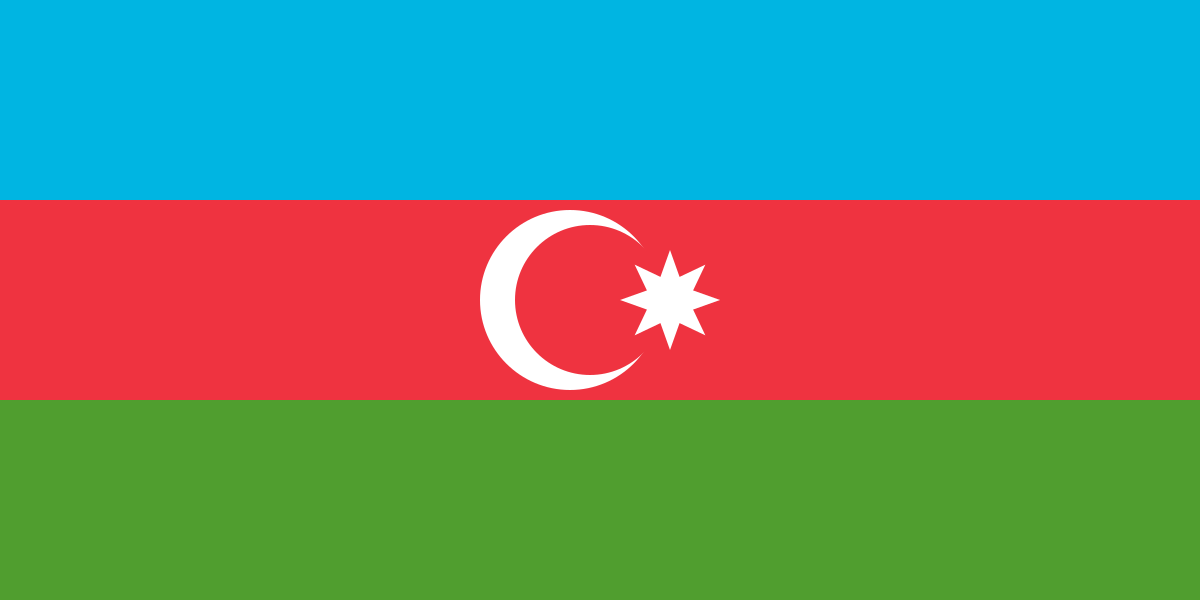
Musavat leader who headed the Azerbaijani National Council that declared the Azerbaijan Democratic Republic in 1918
Born near Baku in 1884, he founded Hummet, a Muslim social-democratic organization, in 1904. He took part in the Iranian Constitutional Revolution in 1909, and after returning to Baku in 1913 he became the chief of Musavat. As head of the Azerbaijani National Council he declared the independence of the Azerbaijan Republic on 28 May 1918. After the republic fell in 1920 he directed resistance until his arrest, but because he had once hidden Joseph Stalin from the police he was released and taken to Moscow. He escaped to Finland in 1922, lived in exile in Turkey, Poland and Romania, and died in Ankara in 1955.
Career timeline
1904Founded Hummet
1909–1911Iranian Constitutional Revolution; co-founded the Democrat Party of Persia
1913Joined Musavat and became its chief
1918Head of the Azerbaijani National Council; declaration of independence
1920Arrested, released and sent to the Commissariat on Nations in Moscow
Officer who negotiated the Treaty of Lausanne and succeeded Atatürk as Turkey’s second president
Born in Smyrna, an Ottoman officer, he won the First and Second Battles of İnönü in the War of Independence as chief of the General Staff and commander of the Western Front. As Turkey’s chief negotiator at Lausanne in 1922–1923 he faced down Curzon and replaced the Treaty of Sèvres with the Treaty of Lausanne. As prime minister for most of Atatürk’s presidency he carried out the secularising reforms; after the Sheikh Said revolt he pushed the Turkification of the Kurds, and he is considered one of those responsible for the Dersim massacre. Elected second president in 1938, he took the title “National Chief” and kept Turkey in armed neutrality in the Second World War. After defeat in the 1950 election he handed over power peacefully. He died in 1973.
First head of the Crimean People’s Republic, the first elected mufti of Crimea and the poet of the Crimean Tatar anthem
Born in 1885 in the village of Büyük Sonaq near Dzhankoy, the son of an imam, he went to Istanbul in 1908 to study law and theology, founded the Young Tatar Writers’ Association and the secret organisation Vatan (Homeland), and returned to Crimea in 1912. In March 1917 he became chairman of the Crimean Muslim Executive Committee and the first mufti of Crimea elected by delegates rather than appointed by the Minister of the Interior. Arrested in June for anti-government agitation, he was freed after a protest bearing 5,000 signatures. He prepared the Qurultay and in December became chairman and director of justice of the Directory of the Crimean People’s Republic, but was arrested by the Bolsheviks in January 1918 and killed without trial by sailors in Sevastopol on 23 February. His poem “Ant etkenmen” became the Crimean Tatar national anthem.
Career timeline
1908–1912Studied law and theology in Istanbul; co-founded Vatan
1913Law faculty of the Psychoneurological Institute, St Petersburg
1917Chairman of the Crimean Muslim Executive Committee; mufti of Crimea
1917–1918Chairman and director of justice of the Directory of the Crimean People’s Republic
Crimean Tatar politician who ran the military and foreign affairs of the Crimean People’s Republic and led the national movement in exile
Born in 1889 into a family of wealthy peasants in Kizil-Tash in the Yalta district, he met Noman Çelebicihan at the law faculty of Istanbul University. After publishing The Oppressed Crimean Tatar Nation in the 20th Century in 1911 he escaped arrest by studying in Paris, and on his return in 1914 he went through cadet school and became an ensign. In 1917 he briefly edited Millet and became director of military and foreign affairs in the Directory set up by the Qurultay. Driven out by the Bolsheviks in January 1918, he fled to Kyiv; under the German occupation he became foreign minister of Sulkiewicz’s Crimean Regional Government and sought recognition of its independence in Berlin. After the German withdrawal he went to Istanbul, founded the newspaper Emel and supported Prometheism. He took the surname Kırımer in 1934 and died in Istanbul in 1960.
Career timeline
1911Published The Oppressed Crimean Tatar Nation in the 20th Century
1914Graduated from cadet school; commissioned as an ensign
1917–1918Director of military and foreign affairs, Directory of the Crimean People’s Republic
1918Foreign minister of the Crimean Regional Government
1918–1960Led the Crimean Tatar émigré movement from Istanbul and Europe
Kazakh nationalist who led the Kokand Autonomy and dreamed of an independent Turkestan
"I cannot accept the offer to lead the Turkestan Legion and refuse further cooperation. All the consequences of my decision, I realize." — Letter to Ribbentrop, 1941
Mustafa Shokay was a Kazakh nationalist political leader who headed the Kokand (Turkestan) Autonomy, the first modern autonomous government in Central Asia after the collapse of the Russian Empire. A graduate of Petrograd University's law faculty, he served as secretary of the Muslim faction in the State Duma and opposed the Tsarist colonial administration's policies in Central Asia. When the Bolsheviks crushed Kokand by force in 1918, he fled to France and spent two decades in exile, propagating the idea of Turkestan independence internationally through journals such as Yash Turkestan. In 1941, the Nazis offered him leadership of the Turkestan Legion, but after witnessing the conditions of Soviet POWs, he refused, and died in Berlin shortly afterward under suspicious circumstances.
Career timeline
1914–1917Secretary, Muslim Faction, Russian State Duma
1917Chairman, Turkestan National Council
1917Member, Turkestan Committee of the Provisional Government
1917–1918Foreign Minister, then Head, Kokand (Turkestan) Autonomy
1918–1919Member, Alash Orda Government
1921–1941Exiled journalist and editor, editor-in-chief of Yash Turkestan
Leader of the Bashkir national movement who proclaimed Bashkir autonomy, commanded the Bashkir Army and took it over to the Soviet side
Born in 1890 in Kuzyanovo, Ufa province, he taught Turkic history at the Qasimiya madrasa in Kazan. In 1917 he joined the Socialist Revolutionaries and was elected to the Constituent Assembly; with Sharif Manatov he organised the Bashkir Central Shuro, proclaimed Bashkir autonomy and became commander of the Bashkir Army. Arrested by the Bolsheviks in February 1918 and freed in April, he fought alongside Dutov and Kolchak, but in February 1919 took his troops over to the Soviet side. He became chairman of the Bashrevkom in 1920, resigned in June in protest at the curtailing of autonomy and led the Basmachi movement in Turkestan. He emigrated in 1923, became a Turkish citizen in 1925, a professor at Istanbul University and a doctor of the University of Vienna, and died in Istanbul in 1970.
Career timeline
1909–1915Teacher at the Qasimiya madrasa in Kazan
1915–1917Bureau supporting the Muslim deputies of the State Duma
1917–1919Deputy chairman of the Bashkir Central Shuro; commander of the Bashkir Army
1919–1920Military commissar and deputy chairman of the Bashrevkom; chairman in 1920
1920–1923Leader of the Basmachi movement in Turkestan
Ukrainian nationalist politician and leader of the OUN-B.
Bandera led Ukrainian nationalist underground activity in eastern Galicia, then part of Poland. A leader in the OUN, he was sentenced to death for organizing the 1934 assassination of Polish interior minister Bronisław Pieracki; the sentence was commuted to life imprisonment. After the OUN split in 1940, he led its radical OUN-B faction, which proclaimed a Ukrainian state in Lviv shortly after Germany invaded the Soviet Union in 1941 and pledged cooperation with Nazi Germany. German authorities detained him and sent him to Sachsenhausen concentration camp; after the war he led the OUN-B émigré organization in West Germany.
Career timeline
1929Joined the Organization of Ukrainian Nationalists (OUN).
1931Became head of propaganda for the OUN.
1933Became head of the OUN's home executive in Poland.
1934Was sentenced to death for organizing the assassination of the Polish interior minister; the sentence was commuted to life imprisonment.
1940Led the OUN-B faction after the OUN split.
1941–1944Arrested by German authorities and imprisoned at Sachsenhausen concentration camp.
1945Became leader of the OUN's foreign organization.
1959Assassinated in Munich by KGB agent Bohdan Stashynsky.
From anti-communist youth leader in 1989 to architect of 'illiberal democracy'
If we are sufficiently resolute, we can force the ruling party to submit itself to free elections. If we do not lose sight of the principles of '56, we can elect a government that will initiate immediate talks regarding the quick withdrawal of Soviet troops.
Viktor Orbán vaulted to national prominence as an anti-communist youth leader with his 1989 speech at Imre Nagy's reburial, demanding free elections and the withdrawal of Soviet troops from Hungary. Elected Hungary's youngest prime minister in 1998, he led the country into NATO; after losing power in 2002, he returned with a constitutional supermajority in 2010 and began systematically consolidating control over the judiciary, media, and electoral system, building what he openly calls an 'illiberal state.' In a landmark 2014 speech at Băile Tușnad, he publicly broke with liberal democracy and named Russia, Turkey, China, and Singapore as his models. His trajectory, from anti-Soviet resistance to author of a hybrid regime that became the longest-serving in Hungarian history, makes him a defining figure of 21st-century authoritarian populism.
Career timeline
1988Co-founded Fidesz (Alliance of Young Democrats)
1989Imre Nagy reburial speech; Fidesz representative at Opposition Round Table talks
1990MP (Pest County); Fidesz parliamentary group leader (until 1993)
1993–2000President of Fidesz
2003–President of Fidesz
1998–2002Prime Minister of Hungary; led NATO accession
2010–2026Prime Minister; constitutional overhaul and 'illiberal democracy' state-building