The left-communist theorist who rejected parliamentarism and analyzed the USSR as state-capitalist
"We do not wish to evangelize, but to ignite, and when the moment arrives the flame will burst forth." — 1912, Karl Marx Circle, Naples
Founder of the Italian Communist Party and a leading left-communist theorist. He championed parliamentary abstentionism and an 'invariant revolutionary program,' debating Lenin directly at the Second Comintern Congress. After his 1930 expulsion, he developed a distinctive analysis of the USSR as state-capitalist.
Career timeline
1910Joins the Italian Socialist Party (PSI)
1912Founds the Karl Marx Circle in Naples, nucleus of the abstentionist left
1920Attends Second Comintern Congress — debates Lenin on parliamentarism
1921Founds the Communist Party of Italy at the Livorno Congress — first General Secretary
1923–1924Arrested by the Mussolini regime; on release declines to reclaim his post
1926Arrested again, exiled to Ustica — reunited with Gramsci
1930Expelled from the party on charges of Trotskyism
1951–1970Active in the International Communist Party — contributes to Battaglia Comunista and Prometeo
Independence activist, linguist, and Yan'an faction leader who served as the first head of state of the DPRK
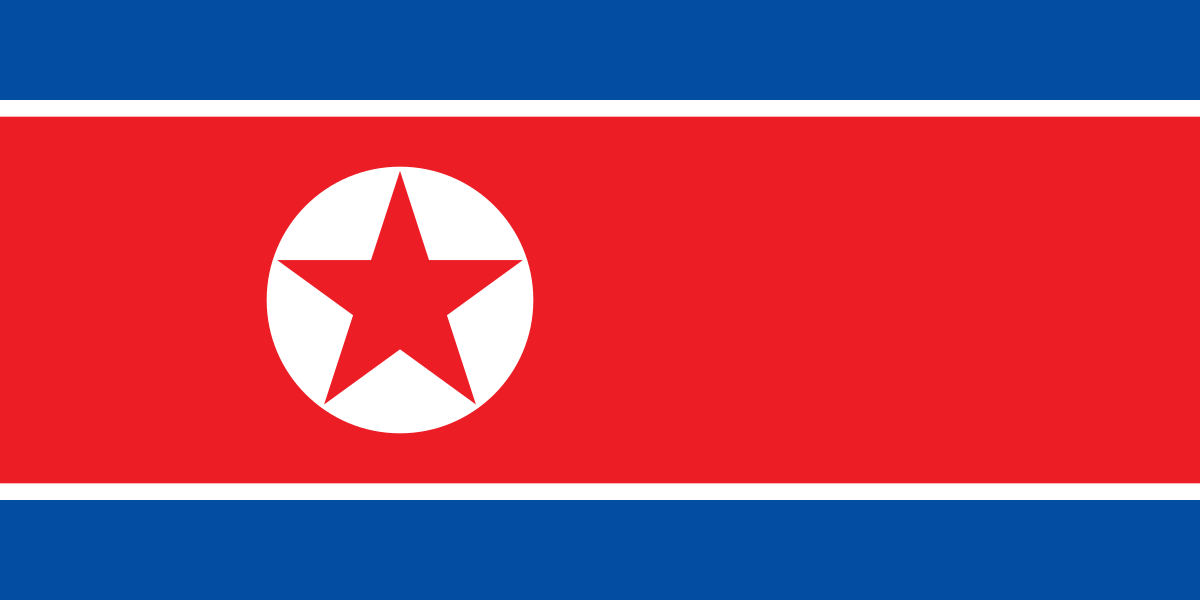
On the day the People's Assembly adopted the new DPRK flag in July 1948, Kim Tu-bong personally lowered the Taegeukgi and raised its replacement. Barely a year earlier, he had been the man passionately explaining the old flag's philosophical meaning to a skeptical Soviet general.
A Hangul linguist trained under Chu Sigyŏng who led the Korean Independence League in Yan'an. Became the DPRK's first head of state in 1948, though real power lay with Kim Il Sung. Purged and vanished in the 1958 August Faction Incident.
Career timeline
1908–1916Studied Hangul under Chu Sigyŏng; helped compile MalMoi dictionary
1919Joined March First Movement, then exiled to Shanghai provisional government
1920–1930년대Combined communist activism with linguistic research in Shanghai
1942–1945Founded Korean Independence League in Yan'an; led the Yan'an faction
1946.2–1946.8Chairman of the New People's Party of Korea
1946.8–1949.6Chairman of the Workers' Party of North Korea Central Committee
1948.9–1957.9Chairman of the SPA Standing Committee — first head of state of the DPRK
1957–1958Dismissed from all posts over August Faction Incident; disappeared
The Peking University librarian who first embraced Marxism in China and nurtured the generation of Mao Zedong
In 'The Victory of Bolshevism' (November 1918): "Look! Every place in the world will see the victorious flag of Bolshevism and hear the triumphal song of Bolshevism. (…) From this day onward, this is no longer a world of the bourgeoisie, of capitalism, of imperialism. It is a world of labor, a world of Bolshevism!"
Pioneer of Chinese Marxism and co-founder of the CCP. As Peking University librarian he introduced Marxism to Mao Zedong and led the May Fourth Movement, championing the Russian Revolution. He architected the United Front and was executed by warlord Zhang Zuolin in 1927.
Career timeline
1907–1913Studied political economy at Beiyang College, Tianjin
1913–1916Studied at Waseda University; led anti-Yuan Shikai protests in Tokyo
1918–1927Peking University chief librarian, history professor, New Youth editor
1919Ideological leader and organizer of the May Fourth Movement
1920Founded Beijing communist cell; linked Voitinsky with Chen Duxiu
1921CCP co-founder at the 1st National Congress
1922–1924United Front architect; KMT Central Executive Committee member
1926–1927Turned to peasant armed revolution; directed CCP underground from Soviet embassy
In 1922, after he called Ordzhonikidze "Stalin's donkey", Ordzhonikidze struck him in the face with his fist. The timing is disputed: one report gives 20 October, while an English-language account places it in November.
Akaki Kabakhidze was a Georgian Old Bolshevik who joined the party in 1904 and belonged to the Society of Old Bolsheviks. Repression records give his birth in 1889 in Ambrolauri, Georgia, nationality Georgian, with residence in Tiflis. In 1922, as a member of the Georgian Communist Party Central Committee, he sided with those opposing Transcaucasian amalgamation, and that year, after calling Sergo Ordzhonikidze "Stalin's donkey", he was struck in the face with the fist. The timing is disputed between October and November accounts. Arrested on 22 December 1936, he was sentenced to death by the Military Collegium of the USSR Supreme Court on 24 June 1937, shot the next day, and rehabilitated on 2 April 1957. Identifying the 1922 figure with the executed man is a source-based inference; a namesake cannot be excluded.
Career timeline
1922년(10월설·11월설)Struck in the face with a fist in the clash with Ordzhonikidze
1922년 12월Figure linked to Lenin's criticism of the nationalities question
1904Joined the party; member of the Society of Old Bolsheviks
1922Member of the Georgian Communist Party Central Committee
1936–1937Arrested (1936), sentenced to death and executed (1937)
In summer 1942, Hitler split Army Group South into Groups A and B to strike at Caucasus oil and the Volga at the same time, a decision that led to the encirclement and destruction of the Sixth Army.
Adolf Hitler (1889–1945) was born in Braunau am Inn, Austria-Hungary, and held Austrian citizenship by descent; he moved to Munich in 1913 and falsely registered as stateless. He joined the German Workers' Party in 1919, led it from 1921, and dictated Mein Kampf in prison after the failed 1923 Munich putsch. Released from Austrian citizenship in 1925, he remained stateless until he acquired German citizenship in 1932. Appointed chancellor on 30 January 1933, he used the Enabling Act of 23 March 1933 to build a dictatorship and became head of state on 2 August 1934 after Hindenburg's death. His regime was responsible for the genocide of about six million Jews and the deliberate killing of an estimated 19.3 million civilians and POWs. He died by suicide in Berlin on 30 April 1945.
Career timeline
1889–1918Born in Austria; served in the German Army during the First World War
1919Joined the German Workers' Party and entered politics
1921Leader of the National Socialist German Workers' Party
1923–1924Failed Munich putsch; dictated Mein Kampf in prison
1933Chancellor of Germany; established Nazi dictatorship
1934–1945Führer and head of state; directed the Second World War
1942Split Army Group South into Groups A and B, directing the Stalingrad and Caucasus offensives
India's first prime minister and co-founder of the Non-Aligned Movement
'Long years ago we made a tryst with destiny, and now the time comes when we shall redeem our pledge… At the stroke of the midnight hour, when the world sleeps, India will awake to life and freedom.' (Independence eve address, 14 August 1947)
A towering leader of the Indian independence movement, he became independent India's first prime minister in 1947 and held the office until his death in 1964. He anchored the new republic in parliamentary democracy, secularism, and planned economic development, while charting a foreign policy of non-alignment that refused subordination to either Cold War bloc. With Tito he issued the 1954 joint statement that first defined 'non-alignment' as a positive, active policy, not passive neutrality, and went on to co-found the Non-Aligned Movement through the 1956 Brioni Declaration and the 1961 Belgrade summit. The Sino-Indian War of 1962 shook his domestic standing, yet he is remembered as the architect of the Indian republic.
Career timeline
1929, 1936–37President, Indian National Congress
1946–1947Interim Prime Minister of India
1947–1964Prime Minister of India
1947–1964Minister of External Affairs (concurrent)
The Bolshevik between revolution and the industrial plan
January 1937, in the dock at the second Moscow trial. The German writer Lion Feuchtwanger recorded: "I shall never forget how Georgy Pyatakov, a gentleman of medium height, middle-aged, with a small bald patch and a reddish, old-fashioned, trembling pointed beard, stood before the microphone and calmly, diligently narrated how he had wrecked the industry entrusted to him. He explained, pointing with an outstretched finger, like a university lecturer — a historian delivering a report on the life and deeds of a long-dead man named Pyatakov, striving to clarify every detail, seized by the single desire that his listeners and students should understand everything correctly."
A Bolshevik revolutionary and the first head of Soviet Ukraine. As a Left Communist, he fiercely opposed Lenin over the Brest-Litovsk Treaty and the national question, and was one of only six Bolsheviks named in Lenin's Testament. Expelled as a Left Oppositionist, he recanted and returned to drive the Five-Year Plans as Deputy Commissar of Heavy Industry, before becoming chief defendant at the second Moscow show trial and being executed in 1937.
Career timeline
1910–1917Joined Bolsheviks, Kiev underground, exile and emigration
1917–1918Kiev chairman, State Bank seizure, Left Communist faction
1918–1920CP(b)U Central Committee secretary, head of Ukraine government, GRU chief
1920–1927Donbas, Gosplan & VSNKh deputy chairman, Left Opposition
1928–1930Readmitted to party, Gosbank chairman, credit reform
1930–1936Deputy & 1st Deputy Commissar of Heavy Industry, Five-Year Plans
1936–1937Arrested, chief defendant at second Moscow trial, executed
Founder of Ukrainian Bolshevism, signatory of the Declaration of the 46
Sentenced to death by Petliura's forces, he escaped wounded at the last moment and hid until the Red Army arrived.
Yakov Drobnis was a Jewish worker-revolutionary who joined the Bolsheviks in 1906 at age sixteen, helped found the Ukrainian Communist Party in 1918 and served on its Central Committee through five convocations. During the Civil War he organized partisan detachments against Petliura and Denikin, chaired the Poltava and Odessa soviets, and served as secretary of the Ukrainian CP Central Committee in 1922. A signatory of the 1923 'Declaration of the 46', the founding document of the Left Opposition, he was expelled in 1927, reinstated in 1930, and executed in 1937 as a defendant at the second Moscow Show Trial.
Career timeline
1906Joined RSDLP (Bolsheviks)
1918–1920Co-founded Ukrainian CP; CC member through five convocations
1920–1922Chairman, Poltava and Odessa soviet executives
1922–1923Secretary, CC of Ukrainian CP
1923Signed 'Declaration of the 46,' joined Left Opposition
Kazakh nationalist who led the Kokand Autonomy and dreamed of an independent Turkestan
"I cannot accept the offer to lead the Turkestan Legion and refuse further cooperation. All the consequences of my decision, I realize." — Letter to Ribbentrop, 1941
Mustafa Shokay was a Kazakh nationalist political leader who headed the Kokand (Turkestan) Autonomy, the first modern autonomous government in Central Asia after the collapse of the Russian Empire. A graduate of Petrograd University's law faculty, he served as secretary of the Muslim faction in the State Duma and opposed the Tsarist colonial administration's policies in Central Asia. When the Bolsheviks crushed Kokand by force in 1918, he fled to France and spent two decades in exile, propagating the idea of Turkestan independence internationally through journals such as Yash Turkestan. In 1941, the Nazis offered him leadership of the Turkestan Legion, but after witnessing the conditions of Soviet POWs, he refused, and died in Berlin shortly afterward under suspicious circumstances.
Career timeline
1914–1917Secretary, Muslim Faction, Russian State Duma
1917Chairman, Turkestan National Council
1917Member, Turkestan Committee of the Provisional Government
1917–1918Foreign Minister, then Head, Kokand (Turkestan) Autonomy
1918–1919Member, Alash Orda Government
1921–1941Exiled journalist and editor, editor-in-chief of Yash Turkestan
A KKE leader who bore both the Resistance's victory and its defeat at the negotiating table
Regarding Siantos as 'an agent of the British', Zachariadis in 1946 delayed his own departure abroad, 'in no case wanting to leave Siantos behind'.
A tobacco worker turned labor organizer, Georgios Siantos became a leading figure of the Greek Communist Party (KKE). When Nikolaos Zachariadis was transferred to Dachau, Siantos served as the party's acting general secretary and led the KKE, National Liberation Front (EAM), and Greek People's Liberation Army (ELAS) through the German occupation. He directed EAM forces during the December 1944 fighting, opposed disarmament, yet ultimately pursued negotiation. In February 1945 he led the EAM delegation that signed the Varkiza Agreement, whose disarmament terms became, amid the subsequent White Terror and renewed civil conflict, the political defeat of the EAM.
Career timeline
1920President of the Karditsa tobacco workers' union
1922Secretary General of the Greek Confederation of Tobacco Workers; joined SEKE
1927Member of the KKE Central Committee and Politburo
1936Member of Parliament for Trikala with the Popular Front
1941Acting General Secretary of the KKE; led the party during the occupation
1944Secretary for Interior and Food in PEEA; directed EAM forces in the December fighting
1945Head of the KKE-EAM delegation negotiating and signing the Varkiza Agreement
Stalin's personally approved CPGB General Secretary who led the party for 25 years
10 May 1920, Port of London. Pollitt convinced dockers not to load the SS Jolly George with munitions bound for Poland, then at war with Soviet Russia. The ship sailed empty on 15 May.
Founding member and General Secretary of the Communist Party of Great Britain for over 25 years, the most significant British communist of the 20th century. He persuaded London dockers to block munitions bound for Poland in the 1920 Hands Off Russia campaign. Appointed General Secretary with Stalin's personal approval, he was the party's secret 'Code Holder' in direct radio contact with Moscow. He supported the International Brigades during the Spanish Civil War and co-authored The British Road to Socialism, committing the CPGB to a parliamentary path. When Khrushchev denounced Stalin in 1956, Pollitt refused to take down Stalin's portrait from his living room.
Career timeline
1920Founding member of the CPGB
1924–1929National Secretary, NMM & British Bureau of Profintern
1929–1939General Secretary, CPGB (first term)
1939–1941Removed as General Secretary; retained in Political Bureau
He took on France, Japan and America in turn to win Vietnam's independence
“Nothing is more precious than independence and freedom.” — wartime radio address, 1966
Vietnamese revolutionary. After three decades of exile, including helping found the French Communist Party and the Communist Party of Vietnam, he led the Viet Minh to declare Vietnam's independence in 1945. He led North Vietnam through wars against France and the United States, becoming the symbol of Vietnamese independence.
Career timeline
1911–1920Wanders the world as sailor and laborer; founding member of the French Communist Party
1925Published French Colonialism on Trial
1927Published the revolutionary training text The Revolutionary Path
1930Founds the Communist Party of Vietnam
1941–1945Founds the Viet Minh against Japanese and French rule
1945.9Declares independence; first President of the DRV
1946–1954First Indochina War; victory at Dien Bien Phu
1955–1969Leads the unification war as North Vietnam's president
The labor organizer who read Trotsky's critique in Moscow and founded the American Trotskyist movement
“They had expelled the heart of their party; Trotsky had won over all the serious young activists, leaving only a dead husk.” — after the Socialist Party expelled the Trotskyists, 1937
A Kansas-born labor organizer of Irish descent, James P. Cannon helped found the Communist Party of America in 1919 and was elected to the Comintern Presidium in 1922. In 1928, after reading a misdirected critique of the Comintern by Trotsky in Moscow, he turned to the Left Opposition, was expelled from the CPA, and co-founded the Communist League of America. He led the landmark 1934 Minneapolis Teamsters strike, and in 1938 founded the Socialist Workers Party, becoming its first National Secretary. Imprisoned for 18 months under the Smith Act for opposing U.S. entry into World War II, he remained a central leader of the Fourth International and shaped the American Trotskyist tradition across four decades.
Career timeline
1908Joins the Socialist Party of America
1911Joins the IWW; organizes throughout the Midwest under 'Big Bill' Haywood
1919Founding member of the Communist Labor Party; District Secretary for KS, MO, NE
1922U.S. delegate to 4th Comintern Congress; elected to ECCI Presidium
1925Founds International Labor Defense; serves as its first national secretary
1928Expelled from CP for Trotskyism; co-founds the Communist League of America
1934Directs the historic Minneapolis Teamsters strike
1938Founds the Socialist Workers Party; elected first National Secretary
1944–1945Imprisoned 18 months under the Smith Act for anti-war stance
1953–1974Steps down as National Secretary, becomes national chairman emeritus; dies in Los Angeles
The brain a prison was meant to stop: theorist of hegemony
“The old is dying and the new cannot be born; in this interregnum a great variety of morbid symptoms appear.” — Prison Notebooks
Italian Marxist philosopher who theorized hegemony: the insight that rule is maintained not by force alone but through consent organized in civil society. From a fascist prison he wrote the Prison Notebooks, laying foundations for Western Marxism.
Career timeline
1919Founds L'Ordine Nuovo; the Turin factory-council movement
1921Among the founders of the Italian Communist Party
1924–1926Party secretary and deputy
1926Arrested — 'we must stop this brain for twenty years'
1929–1935Writes the thirty-three Prison Notebooks
1937Dies days after his release
1948–1951Prison writings first published posthumously in six thematic volumes as Prison Notebooks
The pianist-turned-revolutionary who drove the KPD's ultra-left turn, and became the anti-Stalinist left's perpetual dissident
“Comrade Maslow, who is playing at Leftism and wishes to exercise himself 'hunting Centrists,' has more zeal than sense.” — Lenin, singling him out by name in his 'Letter to the German Communists' (14 August 1921).
Born into a Ukrainian Jewish merchant family, he abandoned a concert-pianist career to study physics under Einstein and Planck, then the First World War radicalized him into the KPD's founding. As Ruth Fischer's lifelong partner he took the party chairmanship in 1924 and drove 'Bolshevisation', a break with the united front and a one-sided crusade against Social Democracy, until Stalin and Thälmann displaced and expelled him in 1926, leaving him a lifelong anti-Stalinist dissident.
Career timeline
1919Founding member of the KPD; agitates among Russian POWs for the Spartacus League
1920–1923KPD Central Committee; leads Berlin left wing with Fischer; foreign-affairs editor, Die Rote Fahne
1924–1925KPD chairman; drives 'Bolshevisation' and the party's ultra-left turn
1924–1926Arrested by German authorities; sentenced to 4 years, released July 1926 due to failing health
1926Expelled from the KPD for opposing Stalin and Thälmann; backs the United Opposition
1928Co-founds the Leninbund with Urbahns and Fischer; soon resigns
1934–1937Works closely with Trotsky; active in the Fourth International movement's International Secretariat
1937–1941Exile in Paris and Cuba; breaks with Trotsky, founds Marxist-Leninist International Group
The CPUSA leader who declared Communism was 20th-century Americanism, and then dissolved his own party
“Communism is twentieth-century Americanism.” — July 4, 1938, beneath the Star-Spangled Banner and the red flag together
A Kansas-born CPUSA leader for 15 years from 1930, Earl Browder proclaimed 'Communism is 20th-century Americanism' and in 1944 dissolved the party into a 'Communist Political Association', a strategy known as 'Browderism.' Expelled in 1946, he broke definitively with the party.
Career timeline
1907Joins Socialist Party of America at age 16
1912Leaves Socialist Party in 1912 split; joins Syndicalist League of North America
1917–1918Arrested for anti-WWI activism under the Espionage Act; serves 2-year sentence
1920Joins the United Communist Party of America
1921Sent to Moscow as U.S. delegate to RILU founding congress
1926–1929Secretary of RILU's Pan-Pacific Trade Union Secretariat, based in Shanghai
1930Becomes Secretary of the CPUSA Political Bureau — de facto party leader
1932–1945General Secretary of the CPUSA Central Committee
1935Elected to the Executive Committee of the Communist International (ECCI)
1936CPUSA candidate for U.S. President
1940Sentenced to 4 years for passport fraud; runs again for president
1942.5Released after 14 months by President Roosevelt's commutation
194412th CPUSA Convention dissolves the party; creates Communist Political Association
1945.713th Convention repudiates Browderism and reconstitutes the CPUSA
1946.2Expelled from the CPUSA
1958Publishes Marx and America, arguing Marxism is inapplicable to U.S. conditions
The Marxist who linked the Russian and Spanish revolutions, founder of the POUM
“The working class has solved the problem of the Church simply by not leaving even one of them standing.” — La Vanguardia, August 1936
Catalan Marxist revolutionary. After serving as CNT General Secretary, he joined Trotsky's Left Opposition in Moscow and later founded the anti-Stalinist POUM. He was also the first to translate Russian literature directly into Catalan.
Career timeline
1911Joined the Catalan federalist Republican Nationalist Federal Union
1914Moved to Barcelona; taught at a secular anarchist school
1917Joined the PSOE briefly, then the CNT; embraced revolutionary syndicalism
1920–1921General Secretary of the CNT
1921–1930Moscow: Profintern and Comintern work; joined the Left Opposition
1930Returned to Spain; founded the Communist Left of Spain (ICE)
1935Merged with Maurín's BOC to found the POUM
1936General Secretary of POUM; Minister of Justice of Catalonia
1937.06Arrested after the May Days; kidnapped and killed by the NKVD
The young oppositionist of the Revolutionary Military Council
On 7 November 1927, the tenth anniversary of the Revolution, Smilga hung portraits of Lenin, Trotsky and Zinoviev from his apartment opposite the Kremlin with a banner reading 'Let's Fulfill Lenin's Testament.' Stalin's supporters broke in and wrecked the apartment; beaten in the street and arrested, he escaped custody later that day.
A Latvian-born Bolshevik revolutionary and economist. He joined the party at fourteen and was elected to the Central Committee at twenty-four in 1917, becoming Lenin's key collaborator during his Finnish hideout. During the October Revolution he transported pro-Bolshevik troops from Finland to Petrograd; in the Civil War he served as a Revolutionary Military Council member on every major front and as head of the Red Army's Political Directorate. A principal leader of the Left Opposition, he led its last public demonstration in November 1927. After renouncing Trotskyism in 1930 he was reinstated, but secretly continued in Ivan Smirnov's underground opposition organisation. He was executed in January 1937.
Career timeline
1917–1921Revolutionary and Civil War party-military leadership
A Bosnian politician who embodied a multi-ethnic resistance coalition
When Ustaša leader Ljubomir Kvaternik came to Cazin in the summer of 1941 seeking his support, Pozderac refused even to grant him a meeting.
Nurija Pozderac was a Bosnian Muslim teacher turned politician from the Cazin region who refused the Ustaša regime's demand to collaborate and stood against its persecution of Serbs and Jews. With his wife Devleta he rescued dozens of Jewish refugees, and as a vice president of AVNOJ elected in 1942 he embodied the partisan movement's multi-ethnic character.
Career timeline
1910s–1930sTeacher in the Cazin region
1935Deputy in the Parliament of the Kingdom of Yugoslavia
1941Rejected Ustaša collaboration and joined the National Liberation Movement
1942President of the Cazin National Liberation Committee
1942Vice president of the AVNOJ Executive Board
1943Participant in the Battles of Neretva and Sutjeska
1944Posthumously awarded the Order of the People’s Liberation
Stalin's most trusted East European proxy, architect of Poland's Stalinist system and guardian of the Oder–Neisse border
On 5 February 1947, atheist communist Bierut took Poland's presidential oath and ended it with the traditional 'Tak mi dopomóż Bóg' — So help me God.
A Polish communist trained in Comintern schools, he joined the PPR leadership in 1943 with Soviet backing and served as Chairman of the State National Council (1944–47), President (1947–52), PZPR General Secretary (1948–56), and Prime Minister (1952–54). He secured the Oder–Neisse border at Potsdam and drove the Six-Year Plan's heavy industrialization, collectivization, and socialist realist cultural policy, presiding over Warsaw's reconstruction. His regime used the Ministry of Public Security to suppress armed opposition and confronted the Catholic Church. He died of a heart attack in Moscow in March 1956, days after Khrushchev's Secret Speech.
Career timeline
1912Joins Polish Socialist Party – Left (PPS-Lewica)
1918Joins the Communist Party of Poland (KPRP/KPP), discontinues activity, and formally functions as a member again from 1921
1925–1930Trained in the secret school of the Communist International (1925–26) and the International Lenin School in Moscow (from November 1927 to 1930); Comintern instructor
1933–1938Arrested by the Sanation regime (December 1933), sentenced to 7 years; amnestied December 1938
1943Joins the PPR Secretariat (23 November); elected Chairman of the State National Council (31 December)
1947–1952President of the Republic of Poland (until the Council of State was chosen on 20 November 1952)
1948–1956General Secretary of the PZPR, First Secretary from 17 March 1954
1952–1954Prime Minister of the People's Republic of Poland (20 November 1952 – 18 March 1954)
1916–1921Lublin food cooperative manager and board member; co-organizer of the leftist Union of Workers' Cooperative Associations; co-founder of the Warsaw Housing Cooperative in 1921
1927–1933Head of the KPP Central Technique; Comintern special missions in Austria, Czechoslovakia and Bulgaria
1944–1949Secret member of the PPR Politburo from August 1944; from 24 February 1949 chaired the PZPR CC Politburo Security Commission supervising the repressive apparatus
Architect of Hungary's Sovietization who built one-party rule through 'salami tactics'
Released on 30 October 1940 and reaching Moscow on 6 November, Rákosi stood beside Stalin atop Lenin's Mausoleum the next day as the October Revolution Day parade crossed Red Square.
General secretary of the Hungarian Communist Party (1945–1948) and then general secretary, later first secretary, of the Hungarian Working People's Party (1948–1956), he ruled Hungary as its de facto leader from 1948 to 1956. Arrested in 1925, he received an 8.5-year sentence in 1926 and a life term in 1935, serving over fifteen years in prison before reaching Moscow in November 1940. After returning in 1945 he dismantled the democratic parties through 'salami tactics' and forced the Social Democrats into a merger to build one-party rule, bearing responsibility for mass imprisonment, forced-labour camps and the Rajk show trial. He handed the premiership to Imre Nagy in 1953 yet obstructed reform as first secretary, was removed on 18 July 1956, expelled from the party in 1962, and died in Gorky on 5 February 1971 after deportation to Krasnodar, Tokmak and Arzamas.
Career timeline
1919People's Commissar of Trade, Hungarian Soviet Republic; commands Red Guard and Red Army
1921–1924Secretary, Executive Committee of the Comintern
1925–1940Imprisoned under the Horthy regime (8.5-year sentence, later life; freed 1940)
1940–1945Leads the Foreign Bureau of the Hungarian Communist Party, Moscow
1945–1948General Secretary, Central Committee of the Hungarian Communist Party
1948–1956First Secretary, Central Committee of the Hungarian Working People's Party (MDP); General Secretary until 1953
1952–1953Chairman of the Council of Ministers, Hungarian People's Republic
1956–1971Forced exile in the USSR (Kirghizia, Arzamas, Gorky)
Yugoslavia's partisan leader who chose non-alignment
The 1948 Cominform split threw Tito's Yugoslavia out of the Soviet bloc and showed that a socialist state could take an independent line, while the dispute was as much a geopolitical struggle in the Balkans as an ideological one.
He was born in Kumrovec to a Croat father, Franjo Broz, and a Slovene mother, Marija, and identified as a Croat like his father and neighbours. Wounded and captured by Russian forces while serving as an Austro-Hungarian Army sergeant major in the First World War, he joined the Communist Party in Omsk in 1920 and led the Communist Party of Yugoslavia as General Secretary from 1939. Appointed commander-in-chief of the Partisans in 1941, he led the national liberation struggle through the Second World War and then headed the Yugoslav federation until his death on 4 May 1980 at Ljubljana Medical Centre. After the 1948 Cominform rift, tens of thousands accused of Stalinism were held in forced labour camps such as Goli Otok, where hundreds died.
Career timeline
1941–1945Leader of the Yugoslav Partisans and national liberation struggle
International communist who founded the JCP, ran the Comintern's Pacific networks, and led the party for 24 years
On his arrival at JCP headquarters in January 1946, one newspaper reported that 'young girls in both kimonos and Western dress gathered like fans awaiting a star at the stage door.'
An international communist who helped found both the CPGB in London (1920) and the JCP in Tokyo (1922), he served on the Comintern Executive Committee and ran intelligence networks against Imperial Japan from the United States and China. From 1940 to 1945 in Yan'an, he led the Japanese People's Emancipation League, converting captured Japanese soldiers into communist forces, and after the war he crafted the JCP's 'lovable party' strategy of peaceful revolution, winning up to 35 Diet seats. As JCP Chairman from 1958 to 1982, he steered the party through the Anpo protests and the Sino-Soviet split, but in 1992 the discovery of his 1939 letter denouncing a comrade to the NKVD led to his expulsion from the party he had founded.
Career timeline
1915Joined Yuaikai (Friendly Society), editor of Labour and Industry
1920Founding member, Communist Party of Great Britain; London delegate
1922Co-founded the Japanese Communist Party; editor of Musansha Shimbun
1931–1940Comintern Executive Committee member; intelligence work in USSR, USA, China
1940–1945Led the Japanese People's Emancipation League in Yan'an; re-educated Japanese POWs
1946–1950Elected to House of Representatives; JCP Central Committee
A Luftwaffe chief who organized Nazi war and plunder
In August 1940, redirecting the air offensive toward London and civilian cities gave the RAF time to recover.
Hermann Göring rose from a First World War fighter ace to a central power-holder in Nazi Germany and commander-in-chief of the Luftwaffe. He helped build dictatorship and the machinery of aggressive war by directing the Prussian police, the creation of the Gestapo, rearmament, and wartime economic mobilization. During the Battle of Britain in 1940, he overestimated the Luftwaffe and was involved in shifting attacks from the RAF's struggling airfields and fighter defences toward British cities, giving Fighter Command time to recover. After the war, the Nuremberg Tribunal condemned him as a major war criminal, and he committed suicide on the eve of his execution.