
 1936–
1936–
A historian who opened the Cold War archives
In 1962, he left a Soviet cruise ship during a stop in Tunis and applied for a U.S. visa.
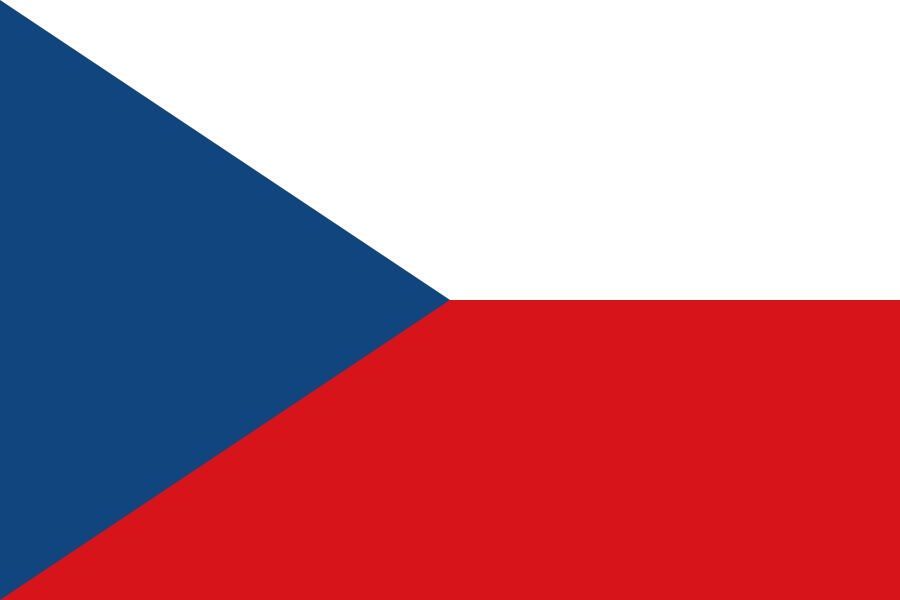
Vojtech Mastny was a Czech-American historian of the Cold War and Soviet foreign policy. Barred from the conventional educational path by his class background, he worked in factories and archives before emigrating to the United States in 1962, an experience that reinforced his attention to fragmentary evidence. He interpreted the Warsaw Pact not simply as a unified military alliance, but through the tension between a politically motivated bargaining instrument and a mechanism of Soviet discipline, testing both views against archival records. As coordinator of the Parallel History Project, he connected documents and testimony from the socialist military sphere to international scholarship.
Activities and affiliations
Career Timeline
- 1936Born in Prague
- 1950년대Worked as a mechanic and studied at a workers' school
- 1950년대 후반–1962Assistant archivist at the National Museum; studied medieval history and archival studies at Charles University
- 1962Emigrated to the United States and studied at Columbia University
- 1970년대–현재Taught history and international relations at Columbia, Illinois, Boston University, Johns Hopkins SAIS and other institutions
- 1996–1998First NATO Manfred Wörner Fellow
- 1990년대–현재Coordinated the Parallel History Project on NATO and the Warsaw Pact
- 2005Published A Cardboard Castle? with Malcolm Byrne
Related historical events
The Parallel History Project and Warsaw Pact Records
Founded in 1999, the Parallel History Project (PHP) linked research institutes, military historians, and archivists across Europe to promote the opening of military records in former Warsaw Pact and NATO countries. As project coordinator, Mastny visited relevant archives, negotiated with NATO and former Warsaw Pact officials, and organized research and collection work. With more than 20 partner institutions, the PHP assembled thousands of pages of Cold War security materials and produced online documentary collections and conferences on military planning, intelligence, and tensions within the blocs. In 2002 it released 350 pages of testimony by nine Polish generals, including Wojciech Jaruzelski, interviewed by Polish military historians in 1999–2001. The material addressed the Polish armed forces’ role in war plans against NATO, including nuclear war, and disputes between Moscow and its allies. The 2005 book A Cardboard Castle?, edited by Mastny and Malcolm Byrne, presented 193 documents collected from member-state archives in English translation and excerpts. Mastny’s introduction analyzed the Warsaw Pact’s evolution from 1955 to 1991 with references to the documents. The PHP also made the original documents available online in full, though the editors identified continuing restrictions on access to Soviet military records as a major gap.