First prime minister of the Mongolian People's Republic, diplomat of the old regime
On 23 September 1924 a constitution-drafting commission chaired by Prime Minister Tserendorj was set up, and on 26 November 1924 the first Great Hural unanimously adopted its 6-chapter, 50-article constitution declaring Mongolia's first republican order.
Born in 1868 at Kherlen Bayan Ulaan as a subject of the Jebtsundamba Khutuktu's Great Shabi, he learned Mongolian, Manchu, Chinese and Russian and worked as a scribe and translator in the Manchu administration in Khüree from 1885 to 1911. After the 1911 independence he entered the Foreign Ministry, serving as deputy foreign minister in 1913-1915 and first-ranked minister in 1915-1919. He signed the 1919 renunciation document under Chinese occupation and became deputy foreign minister in the revolutionary government of 1921. Appointed prime minister in 1923, he headed the 1924 constitution-drafting commission and became the republic's first prime minister. After 1926, as Moscow tightened control, he resisted the abolition of private property and the persecution of the Buddhist Church, and he died of illness in office in 1928; sources give his death as 13 February or 13 November 1928.
Career timeline
1885–1890Scribe in the Manchu administration in Khüree
1890–1904Teacher at the Russian consulate's translator school
1904–1911Chinese-language translator in the Manchu ministry in Khüree (6th rank)
1913–1915Deputy foreign minister of Autonomous Mongolia
1915–1919First-ranked minister of foreign affairs
1923–1928Prime minister of Mongolia, from 1924 of the Mongolian People's Republic
Microbiologist who headed the puppet government chosen by the Soviet embassy in 1940 and requested Latvia’s incorporation into the USSR
Born the son of a tenant on a manor in Mazsalaca, Livonia, he studied at the Tartu Veterinary Institute, took part in the revolution of 1905 and emigrated to Switzerland, working at a tuberculosis institute in Davos. He served as a military veterinarian in the Serbian army in the First World War and as a captain in the veterinary units of the Latvian War of Independence. In 1919 he founded a Microbiology Institute at the University of Latvia, and in 1923 he defended the first doctoral thesis in Latvia; politically he supported social democracy. In June 1940 the Soviet embassy offered him the leadership of the new puppet government; as prime minister, and from 21 July acting president, he requested Latvia’s incorporation into the Soviet Union. He chaired the Latvian SSR Supreme Soviet’s presidium in 1940–1952, joined the Communist Party in 1941 and died in Riga in 1963.
Career timeline
1893–1901Tartu Veterinary Institute
1911Assistant at the tuberculosis institute in Davos
1919Founded the Microbiology Institute at the University of Latvia
1940Puppet prime minister and acting president
1940–1952Chairman of the Latvian SSR Supreme Soviet’s presidium
He built the Soviet government apparatus and studied the religious dissenters of the empire
On the night of October 1917, after the Smolny session, he put Lenin up in his own apartment. He fastened every chain and lock on the front door, loaded two revolvers, and dozed on the sofa listening for sounds — only to catch Lenin tiptoeing past him to the desk, pretending his host was asleep. By grey morning Lenin pulled from his pocket the handwritten draft of the famous Decree on Land and read it aloud. Bonch-Bruevich greeted the household: 'Congratulations on the first day of the Socialist Revolution.'
As Lenin's de facto personal secretary and first Administrator of Affairs of Sovnarkom (1917–20), he laid the foundations of the Soviet administrative apparatus. An ethnographer of Russian religious sectarianism, he was the driving force behind the 1919 law legalising conscientious objection.
Career timeline
1883–1892Entered Konstantinovsky Survey Institute; expelled for student activism; graduated from Kursk surveying school
1895–1903Joined RSDLP; Moscow Workers' Union; emigrated to Switzerland 1896; Iskra collaborator; organised Doukhobor migration to Canada
1903–1905Head of RSDLP Central Committee Expedition in Geneva; co-founded the Party Central Archive
1905–1912Returned to Russia; edited Novaya Zhizn and Nasha Mysl; ran Zhizn i Znanie publishing from 1908; Pravda editorial board 1912
1917.03–10Petrograd Soviet Executive Committee; commandant of Smolny–Tauride district
1917–1920Administrator of Affairs of Sovnarkom — built the Soviet administrative apparatus and executed the government's relocation to Moscow
1919Led drafting of the decree exempting religious conscientious objectors from military service
1920–1929Turned to scholarship and writing; managed the 'Lesnye Polyany' experimental state farm near Moscow
1933–1945Founded and directed the State Literary Museum in Moscow
1945–1955Director of the Museum of the History of Religion and Atheism, USSR Academy of Sciences, Leningrad
Iskra agent across three revolutions, KOMZET chairman who shaped Soviet nationality policy and the Birobidzhan Jewish experiment
On December 30, 1922, he declared open the First All-Union Congress of Soviets — the moment that formalized the birth of the USSR.
An Old Bolshevik who joined the RSDLP in 1898. Born into Polish nobility, he was expelled from Moscow University, studied electrical engineering in Paris, and worked in Belgian factories as a member of the Belgian Workers' Party. An Iskra agent through all three Russian revolutions, he served on the Moscow Military Revolutionary Committee during October 1917 and chaired the Moscow Soviet. As KOMZET chairman he advanced the Birobidzhan Jewish Autonomous Oblast experiment, and as chairman of the Committee of the North he designed administrative and economic policy for northern indigenous peoples. His ashes are interred in the Kremlin Wall.
Career timeline
1898Joined RSDLP; revolutionary work in St. Petersburg
1902–1905Iskra agent, co-organized underground Iskra press in Uman; all three revolutions
1917–1918Moscow VRK member, VTsIK Presidium, Chairman of Mossovet
1921Participated in suppression of Antonov and Kronstadt uprisings
1924–1935Chairman of KOMZET: planned and advanced the Jewish Autonomous Oblast (Birobidzhan)
1924–1935Chairman of the Committee of the North: administrative and economic foundations for northern peoples
1933–1935Chairman of the Committee on Nature Reserves under VTsIK
Labour lawyer turned Communist who was interior commissar and a Red Army commander in the Hungarian Soviet Republic
Born to a Jewish family in Gelse, he became a lawyer and, as legal adviser to the railway workers’ federation, defended the leaders of the national railway strike in 1904. He joined the Social Democratic Party in 1908 and moved steadily left until he became a Communist. In March 1919 he agreed with Béla Kun in prison on introducing the dictatorship of the proletariat; in the Soviet Republic he was commissar for the interior and for trade, then commanded the Red Army’s III Corps in the northern campaign and became commander-in-chief in July. After the fall he emigrated to Austria and led the exiled Communist movement. He died in Cannes in 1928, and his ashes were placed in the Kremlin Wall.
Career timeline
1904Defended the leaders of the railway strike
1908Joined the Social Democratic Party
1919Commissar for the interior and for trade
1919Commander of III Corps; commander-in-chief from July
1919–1928Exile in Austria; leader of the exiled Communist movement
The 'Caucasian Lenin', Marxist theorist of the national question and leader of the Baku Commune
As the Baku Commune crumbled, a comrade's wife urged him to flee first. Shaumyan answered: "What will the workers say to me? It would be a disgrace to flee first."
Pioneer of Armenian Marxism and leader of the Caucasus Bolsheviks. Born to a Tiflis merchant family, he studied at Riga Polytechnic and Berlin University, organizing Armenia's first Marxist circle in 1899. He translated the Communist Manifesto into Armenian, pioneered Armenian Marxist literary criticism, and was elected a candidate CC member at the 1912 Prague Conference. In 1918 he chaired the Baku Council of People's Commissars, the 'Baku Commune', and famously debated Lenin by correspondence on the national question. Captured and shot with the 26 Baku Commissars in September 1918, he became a Bolshevik martyr.
Career timeline
1898Graduated Tiflis Realschule; entered Riga Polytechnic Institute
1899Organized the first Marxist circle in Armenia
1900–1902Joined RSDLP; expelled from Riga Polytechnic; founded the League of Armenian Social Democrats
1902–1905Studied philosophy at Berlin University; translated Communist Manifesto into Armenian; first met Lenin in Geneva
1906–1914Delegate to 4th and 5th RSDLP Congresses; edited Baku underground press; led Caucasus Union Committee
1912Confirmed as candidate member of Bolshevik CC at Prague Conference
1917.03–05First chairman of the Baku Soviet of Workers' Deputies
1917.11–1918.04Chairman of Baku Soviet Executive Committee; appointed Extraordinary Commissar for Caucasus by Lenin
1918.04–07Chairman and Foreign Commissar of Baku Council of People's Commissars — the Baku Commune
1918.09.20Arrested and shot with the 26 Baku Commissars
Trade union leader who commanded the Finnish Red Guards from January to March 1918
Born in Kuopio in 1880, he joined the labour movement while studying law at Helsinki University. He was one of the leading Red Guard organisers in Helsinki during the 1905 general strike and in 1907 became the first chairman of the Finnish Trade Union Federation, losing the post in 1911 over his drinking. One of the most radical voices of 1917, openly calling for armed revolution, he was elected to the five-man committee of the Red Guards and in January 1918, without any military training, succeeded Ali Aaltonen as their commander-in-chief. Removed on 20 March after a series of defeats, he organised the defence of Viipuri with Edvard Gylling and escaped to Petrograd in May. He helped found the exiled Communist Party of Finland and worked in the Karelian Workers’ Commune, but was arrested in the Great Purge and shot in Petrozavodsk in 1937.
Career timeline
1907–1911First chairman of the Finnish Trade Union Federation (SAJ)
1917Commander of the Kymi Paper Mill Red Guard; member of the five-man Red Guard committee
1918Commander-in-chief of the Red Guards; member of the People’s Delegation
1920–1923Several posts in the Karelian Workers’ Commune
1931–1935Head of the revolution research department, Karelian Research Institute
Lenin’s successor as premier, destroyed as the Right Opposition
In November 1917 Rykov resigned from Sovnarkom and the Central Committee alongside Kamenev, Zinoviev and others, objecting that the government had not formed a coalition of all socialist parties. Sources date this to 16 or 17 November; he retracted it a few days later.
Rykov became chairman of Sovnarkom after Lenin's death, leading the Soviet government for six years and embodying the administrative continuity of NEP. During the Civil War he had directed the wartime economy as chairman of VSNKh and overseen Red Army logistics. As premier he stood with Bukharin and Tomsky as the core of the party's 'Right,' championing the worker-peasant alliance, gradual socialist construction through the market, and balanced industrialization. He opposed Stalin's forced collectivization and breakneck industrialization during the 1928-29 grain crisis, was branded the 'Right Opposition' and removed as premier in 1930, arrested in 1937, executed after the third Moscow trial of 1938, and rehabilitated in 1988.
Finnish socialist who was Red Finland’s commissar of finance and later headed the government of Soviet Karelia
Born in Kuopio in 1881, the statistician and economist took his doctorate in 1909 with a thesis on crofting and became the Social Democrats’ agrarian expert. He sat in the Diet for the party from 1908 to 1917, was its vice chairman, and in November 1917 co-wrote “We demand” with Kuusinen. In the civil war he was Commissar of Finance of the People’s Delegation, led the talks for the 1 March treaty with Soviet Russia and signed it, and organised the defence of Viipuri at the end. Escaping to Sweden, he headed the Stockholm bureau of the Communist Party of Finland and in 1920 reported to Lenin on Karelian autonomy. As chairman of the Council of People’s Commissars of Soviet Karelia in 1923–1935 he pursued Finnicisation, was condemned for “nationalist chauvinism” and removed, and was shot in Moscow in 1938.
Career timeline
1905Editor-in-chief of the Marxist journal Sosialistinen aikakausilehti
1908–1917Social Democratic member of the Diet; party vice chairman
1918Commissar of Finance, Finnish People’s Delegation
1918–1920Head of the Stockholm bureau of the Communist Party of Finland
1920–1923Leading the Karelian Workers’ Commune
1923–1935Chairman of the Council of People’s Commissars of the Karelian ASSR
A parliamentarian who carried constitutional politics into the Liberation Movement
He presided over the Second Session of AVNOJ in 1943, where the decision to form New Yugoslavia was taken.
Ivan Ribar was a Croatian lawyer and Yugoslavist whose career connected parliamentary politics in the kingdom with the anti-fascist Liberation Movement. As president of the Constituent Assembly in 1920 and an advocate for communist defendants under dictatorship, he carried a constitutional and oppositional tradition into wartime politics. As chair of AVNOJ and later head of Yugoslavia’s collective state presidency, he gave the new order an institutional face while its political foundations were being remade. The loss of both sons in the war marked the personal cost of that passage between political traditions.
Career timeline
1906Co-founded the Croatian Progressive Democratic Party; began legal practice
1918Member of the central committee of the National Council of Slovenes, Croats and Serbs
1919Vice-president of the Provisional People’s Presidency of the Kingdom of Serbs, Croats and Slovenes
1920–1922President of the Constituent Assembly and National Assembly of the Kingdom of Serbs, Croats and Slovenes
1942–1945Chair of the Anti-Fascist Council for the National Liberation of Yugoslavia (AVNOJ)
1945–1953President of the Presidium of Yugoslavia’s National Assembly, the collective head of state
Founder and head of the Donetsk-Krivoy Rog Soviet Republic, close friend of Stalin and Kirov
March 1902, Moscow. Nineteen-year-old Fyodor raised a homemade red banner — 'Inviolability of the Person! Freedom of Speech! Freedom of Assembly!' — the signal launching the student demonstration. Arrest, prison, expulsion: thus 'Artyom' was born.
An Old Bolshevik from 1901, he rose from Donbas miner and railway worker to organizer of Russian immigrant workers in Australia, and in 1918 founded and led the Donetsk-Krivoy Rog Soviet Republic. A close friend of Stalin and Kirov, he chaired the All-Ukrainian Military Revolutionary Committee and CEC during the Civil War and served as Moscow Party executive secretary. He defended Soviet power against German occupiers and Denikin's White Army, dying at 38 in the 1921 aerowagon derailment. His infant son was adopted and raised by Stalin.
Career timeline
1901–1902Joined RSDLP; led student demonstration at Moscow Technical School, expelled and jailed
1903–1905Underground revolutionary work in Donbas and Kharkov; led December 1905 Kharkov armed uprising
1906–1910Delegate to IV Congress; party work in Perm and Moscow; sentenced to lifetime Siberian exile, escaped
1911–1917Organized Russian workers in Brisbane, Australia; led general strike; published Echo of Australia
1917–1918Elected CC member at VI Congress; founded DKSR, chairman of its Council of People's Commissars
1918–1919Chairman of All-Ukrainian CVRK; chairman of All-Ukrainian CEC
1920Plenipotentiary in Bashkiria; suppressed 'Black Eagle' uprising; executive secretary of Moscow Party Committee
1920–1921Chairman of All-Russian Miners' Union CC; organized International Miners' Union
The "red bourgeois", a landowning lawyer who never joined the party yet served as the communist regime's first prime minister and head of state
In early March 1945 Vyshinsky flew to Bucharest and demanded that King Michael appoint Groza prime minister within two hours, warning that otherwise he could not guarantee Romania's survival as an independent state. The Rădescu government fell and the Groza government took office on 6 March.
Born into an Orthodox priest's family in Hunedoara, Transylvania, he studied law in Budapest, Berlin and Leipzig and became a lawyer and landowner. Starting in the Romanian National Party during the Hungarian parliament years, he twice served as a minister in Averescu's governments in the 1920s, founded the Ploughmen's Front at Deva in 1933 and allied it with the Communist Party through the Țebea agreement of 1935. Deputy prime minister after 23 August 1944, he became prime minister on 6 March 1945 as Soviet deputy foreign commissar Vyshinsky demanded at the palace, and at once decreed a land reform that broke up the great estates. When King Michael demanded his resignation in the summer of 1945 and began the "royal strike" of refusing to sign decrees, Groza held on, trusting Soviet backing. After the rigged election of 1946 and the dissolution of the National Peasant Party in 1947, he forced the king's abdication together with Gheorghiu-Dej on 30 December that year. Prime minister until June 1952, he then became chairman of the Presidium of the Grand National Assembly, the nominal head of state, and kept the post until his death. A wealthy landowner who never joined the Communist Party, he was friendly to the Hungarian minority of Transylvania and famous for the wit with which he called himself a "red bourgeois".
Career timeline
1920–1921Minister in the Averescu government
1926–1927Minister in the second Averescu government
1933Founded the Ploughmen's Front
1935Țebea agreement with the Communist Party
1944–1945Deputy prime minister
1945–1952Prime minister
1947Forced King Michael's abdication on 30 December
1952–1958Chairman of the Presidium of the Grand National Assembly (head of state)
Tatar revolutionary who led the Kazan Muslim Socialist Committee and became the first head of the Soviet Muslim Commissariat
Born in 1885 into a merchant family, in Kazan or in Kazaevo in Perm province according to different records, he took part in the 1905 revolution. After the St Petersburg Polytechnic he moved in 1912 to the law faculty of the Psychoneurological Institute, where he met Mikhail Frunze among others and organised a circle of Muslim students. After the February Revolution he led the Muslim Socialist Committee in Kazan and its newspaper Qızıl Bayraq, became a member of the Kazan Military Revolutionary Committee in October and was elected to the Constituent Assembly. In January 1918, on Lenin’s advice, he became head of the Muslim Commissariat (Muskom) and sent sailors to crush the Trans-Bulak Republic. Appointed extraordinary food commissar for the Volga in July, he was captured and executed after Komuch’s People’s Army took Kazan in August.
Career timeline
1907Entered the economics department of the St Petersburg Polytechnic
1912Law faculty of the Psychoneurological Institute; organised a Muslim student circle
1917Leader of the Kazan Muslim Socialist Committee; member of the Kazan Military Revolutionary Committee
1918Head of the Muslim Commissariat (Muskom)
1918Extraordinary food commissar for the Volga region
A local Soviet official caught in the revolution's backlash
On March 2, 1921, the Kronstadt insurgents arrested and imprisoned him.
Pavel Vasiliev was a Bolshevik local official who led the Kronstadt Soviet at the end of the Russian Civil War. He represented Soviet authority as sailors and workers opposing war communism and party rule turned their demands into an open confrontation. In March 1921 the insurgent forces arrested him alongside Nikolai Kuzmin, making his detention a revealing moment in the tension between revolutionary Soviet democracy and the party’s monopoly of power.
Career timeline
1919–1921Chairman of the Kronstadt Soviet
1919–1921Chairman of the Kronstadt Soviet executive committee
1921.03.01Represented Soviet authority at the Anchor Square assembly
1921.03.02Spoke at the delegate meeting and was arrested by the insurgents
Lenin's periphery-builder who brought Soviet power to Belarus and Armenia
When news of the October Revolution reached Minsk, Myasnikov immediately formed and led a Military Revolutionary Committee, and Soviet power was established there without bloodshed.
An Armenian Bolshevik born to a merchant family in Nakhichevan-on-Don. He joined the RSDLP in 1906 and was administratively exiled to Baku for illegal literature, where Shaumyan influenced him. In 1917 he led the Western Front Bolsheviks in Minsk and played the leading role in establishing Soviet power there. He chaired the Byelorussian SSR Central Executive Committee in February 1919, then from May 1921 headed the Armenian SSR Council of People's Commissars, building Soviet Armenia's state institutions and economy. From 1922 he chaired the Transcaucasian SFSR Union Council and served as first secretary of the Transcaucasian Kraikom. He wrote on Marxist-Leninist theory and Armenian literature. On 22 March 1925 his aircraft caught fire and crashed near Tiflis, killing him alongside Atarbekov and Mogilevsky; the cause of the fire was never established.
Career timeline
1906Joined the RSDLP; exiled to Baku for illegal literature — met Shaumyan
1911–1914Graduated Moscow University law faculty (1911); army service, then assistant barrister writing for Bolshevik press
1914–1917Served on the Western Front in WWI, revolutionary propaganda among soldiers
1917.09–1918.05Chairman of North-Western Regional Party Committee, Minsk VRK chairman, Western Front Commander
1919.01–02First Chairman of the Central Executive Committee and Military Commissar of the Byelorussian SSR
1919–1920Military organiser then secretary of Moscow Party Committee; head of Political Directorate, Western Front
1921–1922Chairman of the Council of People's Commissars and Military Commissar of the Armenian SSR; deputy chairman of ZSFSR
1922–1925Chairman of the Transcaucasian Union Council, first secretary of the Transcaucasian Kraikom — USSR CEC Presidium, Revolutionary Military Council, candidate CC member
1925.03.22Died in a plane fire near Tiflis alongside Atarbekov and Mogilevsky
Hungarian communist who backed Soviet intervention with Kádár in 1956 and became prime minister after the revolution was crushed
Born into a German Catholic family in Seregélyes, he studied law and was taken prisoner on the Eastern Front in 1915 and sent to Tomsk. There he joined the Bolsheviks and commanded an international POW unit; back in Hungary in 1918 he helped found the Hungarian Communist Party and was war commissar of the Slovak Soviet Republic. He lived in the Soviet Union from 1922 to 1936 and, under the name Otto Flatter, commanded the XI International Brigade in the Spanish Civil War. After the war he was Budapest’s chief of police and then a diplomat. In the 1956 revolution he was interior minister under Imre Nagy, but in November he went to Moscow with János Kádár and openly backed Soviet armed intervention. As minister of the armed forces and public security in Kádár’s government he helped organise the security regiments and the Workers’ Militia, and he was prime minister from 1958 to 1961.
Career timeline
1915Captured by the Russians; held in Tomsk
1918Co-founder of the Hungarian Communist Party
1919War commissar of the Slovak Soviet Republic
1936–1939Commander of the XI International Brigade in Spain
1946–1949Budapest chief of police
1956Interior minister under Nagy; minister of the armed forces and public security under Kádár
Worker-poet known as Tsishka Hartny who headed the first Soviet government of Byelorussia
Born into a peasant family in Kapyl in 1887, he worked as a tanner, joined the Hramada in 1904 and wrote for Nasha Niva. From 1913 he worked in Petrograd factories and wrote poetry under the pen name Tsishka Hartny. In 1918, as secretary of the Belarusian National Commissariat, he campaigned for a Belarusian republic against Vilgelm Knorin and Alexander Myasnikov and won the support of Lenin and Stalin. From 1 January to 3 February 1919 he headed the Provisional Workers’ and Peasants’ Government of the Socialist Soviet Republic of Byelorussia. He later ran publishing and cultural institutions and became an academician, but was expelled from the party in 1931, arrested in 1936 and died in 1937 in a psychiatric hospital in Mogilev; some accounts say he took his own life.
Career timeline
1913Worker at the Vulkan plant in Petrograd
1918Secretary of the Belarusian National Commissariat
1919Head of the Provisional Workers’ and Peasants’ Government of the Socialist Soviet Republic of Byelorussia
1920–1931Member of the Central Executive Committee of the BSSR
1928Academician of the Academy of Sciences of the BSSR
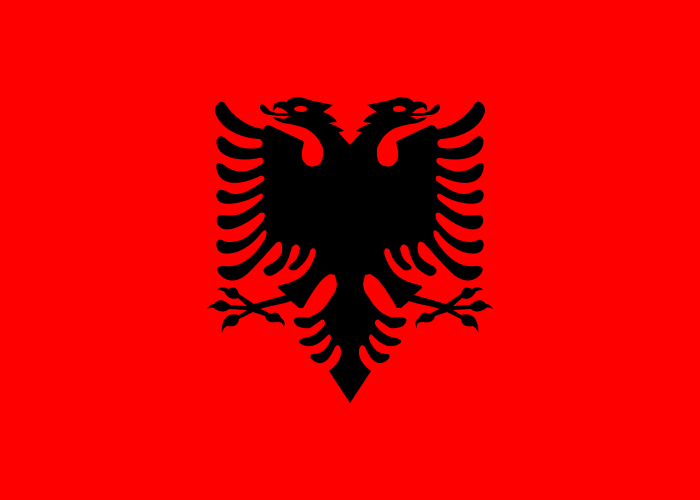
Albanian physician and politician, the people's republic's formal first head of state
The Constituent Assembly opened on 11 January 1946 and proclaimed the people's republic the same day, becoming the People's Assembly on 16 March. Other records give election on 10 or 12 January and departure on 31 July.
Albanian physician and politician. Born on 5 February 1887 in Gjirokastër, Ottoman Empire, he studied medicine in Istanbul, served two weeks in prison over a 1924 attempt on Zogu, backed Fan S. Noli's June Revolution and co-founded the anti-Zogu KONARE in exile in 1925. After the Italian invasion of 1939 he joined the occupation government's Council of State, later regarded it as a mistake, joined the National Liberation Movement and chaired the Anti-Fascist Council at the Congress of Përmet in 1944. In 1946 he became chairman of the Constituent Assembly and served as formal head of state until 1953, though real power lay with Enver Hoxha, first secretary of the Party of Labour.
Career timeline
1914–1920According to Albanian Wikipedia, he served in the Gjirokastër battalion and in Vlorë in 1914 and was sent to Vienna; municipal physician in Ballsh 1915–1918 and physician at Tirana hospital in 1920
1923–1924Municipal physician in Durrës
1924Imprisoned two weeks over an assassination attempt on Zogu; backed Fan S. Noli's June Revolution, fled abroad and was sentenced to death in absentia
1925–1932Helped found the anti-Zogu KONARE and edited its newspaper Liria Kombëtare in Geneva (editor from 1926)
1933–1939Political emigrant in Zante, Greece; returned after the Italian invasion of 1939
1940–1943Member of the occupation government's Council of State, listed until 13 January 1944, joining the Front in August 1943; later joined the National Liberation Movement
1943.09Chairman of the Standing Committee of the National Liberation General Council
1944.05Chairman of the Anti-Fascist National Liberation Council at the Congress of Përmet, in charge of foreign affairs
1944.10–1946Minister of Foreign Affairs in the Anti-Fascist National Liberation Committee chaired by Enver Hoxha (until 9 February or 22 March 1946 according to different sources)
1946–1954Deputy for Gjirokastër (elected in the 2 December 1945 and 28 May 1950 elections)
1946.01–1953Chairman of the Constituent Assembly and then of the Presidium of the People's Assembly as formal head of state (English Wikipedia records the Constituent Assembly chairmanship; ShtetiWeb dates election to 12 January and service to 31 July)
1952–1953His brother Besim Nishani was arrested for propaganda against the people's government (arrested 1 October 1952, eight months in pre-trial detention) and his wife separated from him; a 1953 right-wing press report described her forced eviction and house arrest and his own virtual captivity
1953.07Officially requested to resign citing health on 24 July, with Haxhi Lleshi succeeding on 1 August; other records say Hoxha forced the resignation
Crimean Tatar national communist who pressed Crimean Tatar interests as head of the Crimean ASSR and was executed
Born in 1888 into a merchant family in Bakhchysarai, he worked from the age of 14 at the newspaper Terciman, where Ismail Gasprinsky tutored him. He took part in the 1905 revolution and lived in the Ottoman Empire in 1909–1912. In 1916 he chaired a Crimean Tatar labour union, and in 1917 he was a Qurultay delegate and led the left wing of Milliy Firqa. He joined the Bolsheviks in 1918 and served in the Cheka special department on the Caucasus front in 1919–1920. From December 1920 he called for Crimea to be recognised as a famine region, and in 1921–1924 he was People’s Commissar of the Workers’ and Peasants’ Inspection of the Crimean ASSR. As chairman of the Crimean Central Executive Committee from 1924 he opposed Jewish resettlement, but in 1928 he was executed on charges linked to a murder case; he was rehabilitated in 1990.
Career timeline
1916Chairman of a Crimean Tatar labour union
1917Qurultay delegate; leader of the left wing of Milliy Firqa
1919–1920Cheka special department officer on the Caucasus front
1921–1924People’s Commissar of the Workers’ and Peasants’ Inspection, Crimean ASSR
1922Head of the Crimean emergency troika against banditism
1924–1928Chairman of the Central Executive Committee of the Crimean ASSR
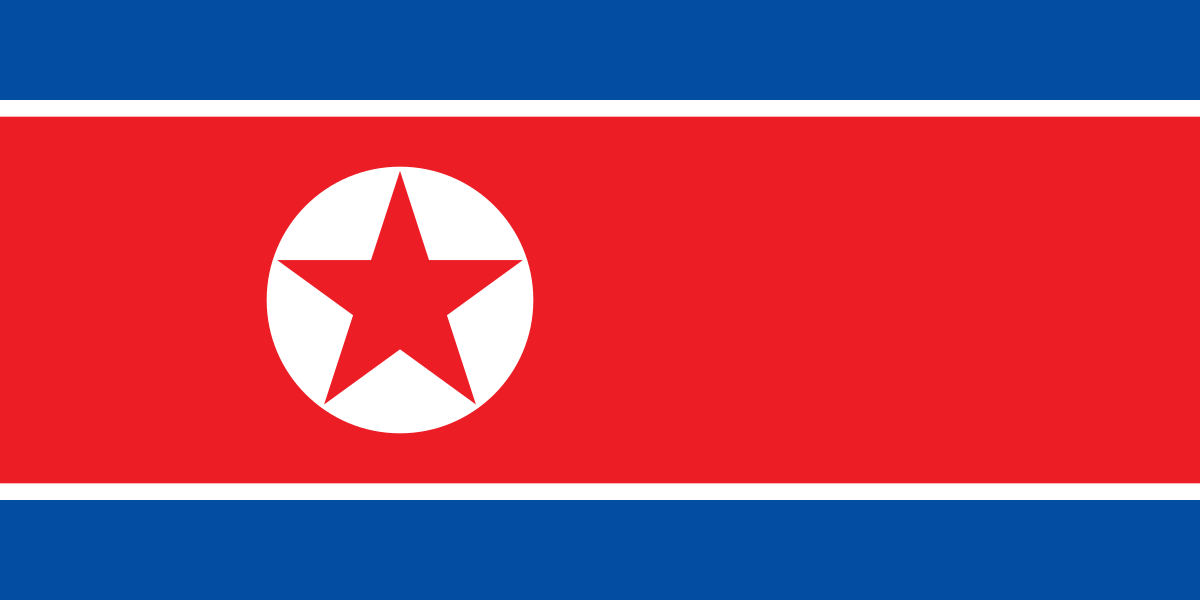
Independence activist, linguist, and Yan'an faction leader who served as the first head of state of the DPRK
On the day the People's Assembly adopted the new DPRK flag in July 1948, Kim Tu-bong personally lowered the Taegeukgi and raised its replacement. Barely a year earlier, he had been the man passionately explaining the old flag's philosophical meaning to a skeptical Soviet general.
A Hangul linguist trained under Chu Sigyŏng who led the Korean Independence League in Yan'an. Became the DPRK's first head of state in 1948, though real power lay with Kim Il Sung. Purged and vanished in the 1958 August Faction Incident.
Career timeline
1908–1916Studied Hangul under Chu Sigyŏng; helped compile MalMoi dictionary
1919Joined March First Movement, then exiled to Shanghai provisional government
1920–1930sCombined communist activism with linguistic research in Shanghai
1942–1945Founded Korean Independence League in Yan'an; led the Yan'an faction
1946.02–08Chairman of the New People's Party of Korea
1946.08–1949.06Chairman of the Workers' Party of North Korea Central Committee
1948.09–1957.09Chairman of the SPA Standing Committee — first head of state of the DPRK
1957–1958Dismissed from all posts over August Faction Incident; disappeared
Worker-Bolshevik premier of the Russian Republic destroyed by the state he helped industrialize
Arrested on 27 June 1937 while still performing his duties — seized during a session of the very Central Committee plenum that had just expelled him.
An Old Bolshevik who joined the party at fourteen as a factory worker, Sulimov rose through the Ural party apparatus to become Chairman of the Council of People's Commissars of the RSFSR (1930–1937), overseeing the republic's industrialization during the first two five-year plans. A member of the Central Committee (1923–1937) and the OrgBuro (1927–1930), he was among the highest-ranking Bolsheviks of worker origin to lead a Soviet government. Arrested during the June 1937 Central Committee Plenum immediately after Vyacheslav Molotov accused him of political disloyalty, he was tried for wrecking, espionage, and participation in an anti-Soviet terrorist organization of the Right, and executed on 27 November 1937. He was posthumously rehabilitated in 1956, and the city of Cherkessk bore his name, Sulimov, from 1934 to 1937.
Career timeline
1905Joined RSDLP(b), began factory work
1918–1919Chairman of Perm City Soviet Executive Committee; Collegium member, Mining-Metallurgical Dept., VSNKh
1919–1920Chairman of Chelyabinsk Gubernia Committee, RKP(b)
1923–1926Chairman of Ural Oblast Executive Committee
1926–1927First Secretary, Ural Oblast Committee, VKP(b)
1927–1930First Deputy People's Commissar of Railways, USSR
1930–1937Chairman, Council of People's Commissars, RSFSR
Poet and doctor whom Zhdanov forced on Estonia as puppet prime minister in June 1940, and who led the petition to join the Soviet Union
Born to a farming family near Viljandi, he studied medicine in Kiev and served as a military physician in the First World War and the Estonian War of Independence. He became a well-known poet and radical socialist under the pen name Johannes Barbarus. After the Soviet occupation of June 1940, Andrei Zhdanov forced President Konstantin Päts to appoint him prime minister of a communist-dominated puppet government, and he headed the delegation that delivered the petition to join the Soviet Union. He then chaired the Estonian SSR Supreme Soviet’s presidium, fled to Soviet Russia when the Germans came in 1941, and after returning in 1944 was investigated by the NKVD over his role in the War of Independence. He died in the presidential residence in Kadriorg, Tallinn, in November 1946, most probably by suicide, though murder has also been suggested.
Career timeline
1910–1914Studied medicine at the University of Kiev
1918–1920Military physician in the Estonian War of Independence
1940Puppet prime minister; led the delegation petitioning to join the USSR
1940–1946Chairman of the Estonian SSR Supreme Soviet’s presidium
The economic administrator who led Ukraine's government for 11 years, caught between Stalin's demands and the famine
In June 1932 Chubar reported to Stalin and Molotov that "tens of thousands of malnourished, starving and swollen people" were dying of famine "in every village", and asked for grain relief. Stalin replied that "Chubar is mistaken ... Ukraine has been given more than it should get".
An economic administrator born to a poor Ukrainian peasant family in Fedorivka, he joined the RSDLP in 1907. From 1923 he chaired the Ukrainian SSR's Council of People's Commissars for eleven years, driving industrialisation and collectivisation, and in June 1932 he reported the famine to Stalin and Molotov and requested emergency grain. He also bore responsibility for enforcing collectivisation and the 1932–33 famine, and in 2010 the Kyiv Court of Appeal ruled him one of the organisers of the Holodomor. A full Politburo member from 1935, he was arrested in 1938 and shot the next year, then rehabilitated in 1955.
Career timeline
1891Born in Fedorivka, Yekaterinoslav gubernia, into a poor peasant family
1907Organised Social Democratic circles in factory districts and joined the RSDLP at 16
1911–1917Factory worker in Kramatorsk, Mariupol, Moscow, Petrograd; underground activism
1917Member of Petrograd Central Council of Factory Committees; commissar to Main Artillery Directorate during October Revolution
1918–1923Chairman of GOMZa, member of VSNKh Presidium; chairman of Organisational Bureau for Restoration of Ukrainian Industry
1921–1923Chairman of Ukrainian VSNKh and Central Coal Industry Administration (one source dates his VSNKh chairmanship to 1920–21; the dating differs between sources)
1923–1934Chairman of Sovnarkom Ukrainian SSR (11 years); led industrialisation and collectivisation
1923–1925Deputy Chairman of USSR Sovnarkom
1934–1938Deputy Chairman of USSR Sovnarkom
1926–1935Candidate member of Politburo CC VKP(b)
1935–1938Full member of Politburo CC VKP(b)
1937–1938People's Commissar for Finance USSR
1938.07.04Arrested on charges of being a 'German intelligence agent' and a member of an anti-Soviet sabotage organisation; removed from the Politburo
1939.02.26Sentenced to death by the Military Collegium of the USSR Supreme Court and shot the same day; rehabilitated in 1955
Bolshevik chairman of the Turkestan Sovnarkom in 1917–1918 who crushed the Kokand Autonomy and attacked Bukhara
Born in Uralsk in 1891, he worked as a railway clerk in Orenburg and Tashkent. He joined the Bolsheviks in 1917, sat on the executive committee of the Tashkent Soviet, was elected to the All-Russian Central Executive Committee at the Second Congress of Soviets and helped organise the armed rising in Tashkent in November. As chairman of the Turkestan Sovnarkom from November 1917 to November 1918 he rejected a coalition, declaring that Muslims could not be admitted to the supreme organ of power, and put down by force the bids for autonomy in Ashgabat and Kokand. In March 1918 he tried with the Young Bukharans to overthrow the Emir of Bukhara and had to retreat. He chaired the Far Eastern Council of the National Economy in 1923–1928, later worked as an architect and died in Moscow in 1940.
Career timeline
1917Member of the Tashkent Soviet executive committee and of the All-Russian Central Executive Committee
1917–1918Chairman of the Turkestan Sovnarkom
1919Delegate to the Eighth Congress of the Russian Communist Party
1923–1928Chairman of the Far Eastern Supreme Council of the National Economy
1929–1933Studied at the Moscow Architectural Institute and the Academy of Architecture