Founding leader of the Wafd whose deportation to Malta in 1919 set off the Egyptian Revolution
Born in a village in the Nile Delta, he studied at al-Azhar and at a law school in Cairo and became a lawyer. Under the British occupation he served as a judge, minister of education (1906–1908) and minister of justice (1910–1912), and in 1913 became vice-president of the Legislative Assembly. In November 1918 he led the Wafd in demanding the end of the protectorate and a seat at the peace negotiations. When the British deported him to Malta in March 1919, the Egyptian Revolution of 1919 broke out. Exiled again to the Seychelles, he was allowed to return in 1923. After the Wafd’s landslide in the 1924 elections he formed the first Wafdist government, but resigned in November after the assassination of Sir Lee Stack, Governor-General of the Sudan, and the British demands that followed. He died in Cairo in 1927.
Career timeline
1906–1908Minister of education
1910–1912Minister of justice
1913Vice-president of the Legislative Assembly
1918Founding leader of the Wafd
1919.03Deported to Malta; Egyptian Revolution of 1919
Pioneer of Korean communism who fused the Bolshevik revolution with national liberation against Japanese rule
On his deathbed he declared: 'I die without seeing the Korean revolution succeed. Comrades, you must establish a Korean Soviet Republic.'
A pioneer of Korean communism who transformed from a Korean Empire army officer into a socialist revolutionary, becoming the first to fuse Marxism with the Korean national liberation struggle. He founded the Korean Socialist Party in 1918, served as prime minister of the Korean Provisional Government where he championed armed resistance, and after breaking with Syngman Rhee led the Korean Communist Party (Shanghai faction) in pursuit of combining national liberation with class revolution.
Career timeline
1895–1902Graduated from Imperial Military Academy; army major and Ganghwa garrison commander
1906–1911Co-founded New People's Association; founded Bochang School; jailed in 105-Man Incident
1913–1917Exiled to Primorsky Krai and Manchuria; established military academy, trained independence forces
1918Founded Korean Socialist Party in Khabarovsk; chairman
1919–1921Prime Minister of the Korean Provisional Government in Shanghai
1921Founded Korean Communist Party (Shanghai faction)
1922–1935Comintern liaison; Far East Korean director of MOPR
Iranian revolutionary who led the Jungle movement of Gilan and proclaimed the Soviet Republic of Gilan in 1920
Born in Rasht in 1880, the son of a Gilani merchant, he joined the Iranian Constitutional Revolution and in 1909 was a junior commander of the constitutionalist force that took Tehran. In 1914–1915 he launched the Jungle movement in the forests of Gilan, demanding provincial autonomy, an end to central government corruption and foreign interference, and land reform. When a Soviet flotilla entered Enzeli in 1920 he agreed to cooperate on condition of non-interference, proclaimed the Soviet Republic of Gilan on 5 June and became its head, but split with the communists over his refusal to redistribute land. He returned as head of government in May 1921, but after the Soviets withdrew their support he was defeated by Reza Khan’s government troops and died of frostbite while fleeing into the Talesh mountains. His severed head was displayed in Rasht.
Career timeline
1909Junior commander in the constitutionalist capture of Tehran
1914–1921Leader of the Jungle movement of Gilan
1920Head of the provisional government of the Soviet Republic of Gilan
1921Again head of the provisional government of the Gilan republic
Kodang Cho Man-sik, the Korean Democratic Party leader removed from the northern political stage in 1946
On 30 December 1945 Cho's party adopted its anti-trusteeship resolution despite pressure from the Soviet military command, and on 5 January 1946 the command confined him to the Koryo Hotel. From this point nationalists disappeared from the northern political stage and the left took the lead.
Cho Man-sik (1883-1950), pen name Kodang, was born in Kangso, South Pyongan Province, and worked as an educator, Presbyterian elder, journalist and politician. He graduated from Meiji University in 1913, taught at Osan School and became its headmaster in 1915, and later headed the Pyongyang YMCA, the Korean Product Promotion Society and the Chosun Ilbo. He pursued anti-Japanese activity on Gandhi's nonviolent line. After liberation he chaired the South Pyongan Committee for the Preparation of Korean Independence and then the South Pyongan People's Political Committee, a left-right coalition that also included the South Pyongan Communist Party. He founded the Korean Democratic Party on 3 November 1945, and on 5 January 1946 the Soviet military command confined him to the Koryo Hotel. No confirmed reports of him remain and his death is reported rather than established.
Career timeline
1913–1915Graduated from Meiji University in 1913, became a teacher at Osan School that year and its headmaster in 1915, working in national education
1920s–1930sGeneral secretary of the Pyongyang YMCA and elder at Sanjonghyon Church; president of the Korean Product Promotion Society, chair of the Sin'ganhoe Pyongyang branch and president of the Chosun Ilbo
1945.08Chaired the South Pyongan Committee for the Preparation of Korean Independence, then the South Pyongan People's Political Committee, a left-right coalition
1945.10–11Land reform and tenancy disputes over the 7:3 system exposed his position; right-wing members left the committee for the South, and on 24 November its name dropped "political", turning it into a left-led body
1945.11.03Founded the Korean Democratic Party and was elected its leader on an anti-trusteeship line
1945.12.30His party's central committee adopted an anti-trusteeship resolution rejecting trusteeship outright
1946.01.05Confined to the Koryo Hotel by the Soviet military command and removed from the political stage
1946.02Choe Yong-gon took over the party, and its first congress on 24 February elected him leader
1948–1950Kept in detention without trial amid failed exchange talks; confirmed reports end and his death is reported and presumed, its date and circumstances not established
From civil-rights lawyer of the March 1st Movement to first Chairman of the DPRK Supreme People's Assembly: a progressive nationalist
When he submitted a motion of non-prosecution during the March 1st Movement trial, the Japanese courtroom erupted in protest — and the scene, reported nationwide, made Ho Hon the symbol of the anti-colonial lawyer.
One of colonial Korea's 'three great civil-rights lawyers,' he defended the 47 national representatives of the March 1st Movement and handled pro bono cases for workers and independence activists. Elected chairman of Singanhoe's Central Executive Committee in 1927, he led the united-front anti-Japanese struggle, and after liberation served as Prime Minister of the People's Republic of Korea and chairman of the South Korean Workers' Party before crossing north, becoming the bridge by which Korea's independence movement passed into socialism.
Career timeline
1907Passed the first Korean Empire bar examination
1919Defended March 1st Movement leaders; President, Korean Bar Association
1927Chairman, Central Executive Committee of Singanhoe
1945Vice Chairman, Preparatory Committee; Prime Minister, People's Republic of Korea
1946Chairman, South Korean Workers' Party
1948Chairman, Supreme People's Assembly; President, Kim Il Sung University
He met Lenin and Sun Yat-sen, then staked everything on left-right unity: the last Korean unificationist before partition
“A revolutionary does not die in bed. I will die in the street.” He said this to his children after surviving multiple assassination attempts. On 19 July 1947, at the Hyehwa-dong rotary, a bullet from the White Shirts Society found him.
In 1918 he founded the New Korean Youth League and sparked the March First Movement through the February 8 Declaration of Independence. He co-founded the Korean Provisional Government, met Lenin and Trotsky in Moscow (1922), and joined the Chinese Nationalist Party at Sun Yat-sen's invitation. In August 1945 he secured peaceful transfer of authority from Japan's governor-general, formed the Committee for Preparation of Korean Independence, and became vice-chair of the People's Republic of Korea. In 1946–47 he led the left-right cooperation movement with Kim Kyu-sik, the last serious attempt at a unified Korea, before being assassinated by a right-wing terrorist. He is officially honored by both South and North Korea.
Career timeline
1918Founded New Korean Youth League in Shanghai; became its leader
1919Led the February 8 Declaration of Independence; Deputy Foreign Minister of the Korean Provisional Government
1920–1922Joined Koryŏ Communist Party (Shanghai faction); met Lenin and Trotsky at the Congress of the Peoples of the East in Moscow
1925–1929Joined Chinese Nationalist Party at Sun Yat-sen's invitation; participated in First United Front
1933–1936President of Chosun JoongAng Ilbo; Chairman of Joseon Sports Council
1944Founded the secret Korean Restoration Brotherhood; built nationwide network
1945.08–09Chairman, Committee for Preparation of Korean Independence; Vice-Chair, People's Republic of Korea
1946–1947Led left-right cooperation movement with Kim Kyu-sik; Chairman, Labor People's Party
The Indian Marxist who debated Lenin on colonial revolution
"You are so young! I expected a grey-bearded wise man from the East." — Lenin's first words to the 27-year-old Indian revolutionary upon meeting him at the Kremlin, 1920.
Bengali Marxist. He debated Lenin on the colonial question at the 1920 Comintern Congress and founded the Mexican Communist Party (the first outside Russia) as well as the CPI. Expelled from the Comintern, he served six years in British prisons before turning to Radical Humanism.
Career timeline
1917Co-founded the Socialist Party of Mexico, soon transformed into the Mexican Communist Party
1919Founded the Mexican Communist Party, the first communist party outside Russia
1920Presented supplementary theses on the colonial question at the 2nd Comintern Congress, debated Lenin
1920Founded the Communist Party of India (Tashkent group) in exile
1922–1929Member of the Comintern Executive Committee and Presidium; secretary of the Chinese Commission
1929Expelled from the Comintern for siding with Bukharin's Right Opposition
1931–1936Arrested by British colonial authorities, imprisoned for 6 years on conspiracy charges
1940–1948Founded the Radical Democratic Party; supported the anti-fascist war effort
1947Published the New Humanism manifesto, articulating his Radical Humanist philosophy
India's first prime minister and co-founder of the Non-Aligned Movement
'Long years ago we made a tryst with destiny, and now the time comes when we shall redeem our pledge… At the stroke of the midnight hour, when the world sleeps, India will awake to life and freedom.' (Independence eve address, 14 August 1947)
A towering leader of the Indian independence movement, he became independent India's first prime minister in 1947 and held the office until his death in 1964. He anchored the new republic in parliamentary democracy, secularism, and planned economic development, while charting a foreign policy of non-alignment that refused subordination to either Cold War bloc. With Tito he issued the 1954 joint statement that first defined 'non-alignment' as a positive, active policy, not passive neutrality, and went on to co-found the Non-Aligned Movement through the 1956 Brioni Declaration and the 1961 Belgrade summit. The Sino-Indian War of 1962 shook his domestic standing, yet he is remembered as the architect of the Indian republic.
Career timeline
1929President, Indian National Congress
1936–1937President, Indian National Congress
1946–1947Interim Prime Minister of India
1947–1964Prime Minister of India
1947–1964Minister of External Affairs (concurrent)
Independence activist, linguist, and Yan'an faction leader who served as the first head of state of the DPRK
On the day the People's Assembly adopted the new DPRK flag in July 1948, Kim Tu-bong personally lowered the Taegeukgi and raised its replacement. Barely a year earlier, he had been the man passionately explaining the old flag's philosophical meaning to a skeptical Soviet general.
A Hangul linguist trained under Chu Sigyŏng who led the Korean Independence League in Yan'an. Became the DPRK's first head of state in 1948, though real power lay with Kim Il Sung. Purged and vanished in the 1958 August Faction Incident.
Career timeline
1908–1916Studied Hangul under Chu Sigyŏng; helped compile MalMoi dictionary
1919Joined March First Movement, then exiled to Shanghai provisional government
1920–1930sCombined communist activism with linguistic research in Shanghai
1942–1945Founded Korean Independence League in Yan'an; led the Yan'an faction
1946.02–08Chairman of the New People's Party of Korea
1946.08–1949.06Chairman of the Workers' Party of North Korea Central Committee
1948.09–1957.09Chairman of the SPA Standing Committee — first head of state of the DPRK
1957–1958Dismissed from all posts over August Faction Incident; disappeared
He took on France, Japan and America in turn to win Vietnam's independence
“Nothing is more precious than independence and freedom.” — wartime radio address, 1966
Vietnamese revolutionary. After three decades of exile, including helping found the French Communist Party and the Communist Party of Vietnam, he led the Viet Minh to declare Vietnam's independence in 1945. He led North Vietnam through wars against France and the United States, becoming the symbol of Vietnamese independence.
Career timeline
1911–1920Wanders the world as sailor and laborer; founding member of the French Communist Party
1925Published French Colonialism on Trial
1927Published the revolutionary training text The Revolutionary Path
1930Founds the Communist Party of Vietnam
1941–1945Founds the Viet Minh against Japanese and French rule
1945.09Declares independence; first President of the DRV
1946–1954First Indochina War; victory at Dien Bien Phu
1955–1969Leads the unification war as North Vietnam's president
Father of Central American communism, Sandino's colonel, martyr of La Matanza
As US planes bombed Sandino's camp, Martí pushed aside his typewriter and declared: "When history cannot be written by the pen, it must be written by the rifle." He then picked up a gun and fired at the planes.
Salvadoran Marxist-Leninist revolutionary and pioneer of Central American communism. In 1930 he co-founded the Communist Party of El Salvador (PCS) and in 1932 led a peasant-indigenous uprising amid the Depression; the Martínez military regime crushed it in the La Matanza massacre and had him executed by firing squad. His name was later adopted by the FMLN guerrilla coalition, making him an enduring symbol of Central American revolution.
Career timeline
1920Led student protest against Meléndez dictatorship; arrested and exiled to Guatemala
1925Co-founded Communist Party of Central America (Guatemala City)
1925–1928SRI representative for El Salvador; organizer, Regional Federation of Salvadoran Workers (FRTS)
1928–1929Sandino's secretary and EDSN colonel; guerrilla war against US Marines in Nicaragua
1930Co-founded Communist Party of El Salvador (PCS)
1931–1932Interim General Secretary of PCS; led peasant-indigenous uprising after Martínez coup
Pan-Latin American anti-imperialist hero who waged guerrilla war against US occupation of Nicaragua
“Let it not be permitted that the hands of traitors or invaders shall profane his remains.” — Sandino, 1927
Nicaraguan revolutionary and guerrilla leader. From 1927 to 1933, he led the Army in Defense of National Sovereignty (EDSN) against the US military occupation, becoming a symbol of anti-imperialist resistance throughout Latin America. Assassinated in 1934 by the US-trained National Guard under Anastasio Somoza, his legacy inspired the Sandinista National Liberation Front (FSLN), founded in 1961, which overthrew the Somoza dictatorship in 1979.
Career timeline
1912Witnessed US intervention and General Zeledón's death — anti-imperialist consciousness formed
1921–1926Exile in Mexico — worked at Standard Oil refinery, exposed to Mexican revolutionary ideas
1926–1927Returned to Nicaragua — raised a militia of gold miners, joined the Constitutionalist War
1927.07Rejected the Espino Negro accord — launched guerrilla war against the US with the San Albino Manifesto
1927–1933Generalissimo of the EDSN — led six-year guerrilla campaign against US Marines
1929–1930Exile in Mexico — joined the EMECU spiritualist commune, sought Pan-American anti-imperialist solidarity
1933Peace accord with President Sacasa after US withdrawal — agreed to disarm
1934.02.21Arrested and executed by the National Guard after presidential palace talks — body never found
Father of the Republic of Indonesia, the Marxist who fused communism with Islam
“If you think you can direct the Indonesian revolution from Moscow, you are no different from the colonialists.” — to Alimin, who came to Manila seeking approval for the 1926 uprising
Chairman of the Indonesian Communist Party and author of 'Towards the Republic of Indonesia.' He argued Marxism and Pan-Islamism must unite, broke with the Comintern, and after 1945 shook the fledgling republic with his demand for uncompromised independence.
Career timeline
1913Graduates from Kweekschool at Fort de Kock; receives high adat title of datuk
1913–1919Studies in the Netherlands; radicalised by the October Revolution and turns to Marxism
1919–1920Teaches children of tea-plantation coolies in Deli, Sumatra; writes 'Land of Paupers'
1921.06Founds 'Sarekat Islam Schools' (Tan Malaka Schools) in Semarang; spreads to Bandung
1921.12Elected chairman of the PKI at the Semarang congress, succeeding Semaun
1922Arrested by Dutch authorities; exiled to the Netherlands; stands as CPN parliamentary candidate
1922–1923Attends the Fourth Comintern Congress in Moscow; advocates communism–Pan-Islamism alliance
1923–1925Comintern Eastern Bureau agent; writes 'Towards the Republic of Indonesia' in Canton
1925–1927Based in Manila; opposes the PKI's 1926 uprising but fails to stop it
1927Founds the Indonesian Republic Party (PARI) in Bangkok, breaking with the Comintern
1927–1942Underground across China, Singapore, and the Philippines under aliases; writes 'Madilog'
1945–1946Returns to Indonesia; founds the Struggle Union (Persatuan Perjuangan); forces Sjahrir cabinet's temporary fall
1946–1948Arrested and imprisoned by Republican government; writes autobiography 'From Jail to Jail'
1949.02.21Captured and executed by Republican forces at Blimbing, East Java
Heroic Corps founder who evolved from anarchist bombings to DPRK cabinet, lone figure spanning the Korean revolutionary spectrum
On first meeting Kim Ik-sang in Beijing, Kim Won-bong told him: 'Freedom is won by our strength and our blood… We must be the first to shed it.' Kim Ik-sang joined the Heroic Corps on the spot and weeks later walked into the Japanese Government-General building in Seoul and threw a bomb.
Anarchist militant who founded the Heroic Corps (Ŭiyŏltan) in 1919 and led a six-year campaign of bombings and assassinations against Japanese colonial authorities. After military training at the Whampoa Academy, he founded the Korean National Revolutionary Party (1935) to build a united front, commanded the Korean Volunteer Corps, and later joined the Provisional Government as Deputy Commander of the Korean Liberation Army and Minister of Military Affairs. Following liberation he pursued left-right cooperation, but after Yeo Un-hyeong's assassination he joined the 1948 North-South talks and remained in the DPRK as State Inspection Commissioner and Minister of Labor until his purge in 1958. His trajectory, from anarchist bombings to united-front politics to DPRK cabinet, makes him the only figure to span the entire Korean revolutionary spectrum.
Career timeline
1919Founded the Heroic Corps, became its leader (Ŭibaek)
1926Enrolled in Whampoa Military Academy, 4th class
1935Founded the Korean National Revolutionary Party
1938Organized the Korean Volunteer Corps, became commander
1944Minister of Military Affairs, Provisional Govt.; Deputy Commander, Korean Liberation Army
Korean revolutionary military leader who fought alongside Kim Il Sung in the Manchurian anti-Japanese guerrillas
Kim Il Sung kept a small safe in his office throughout his life. When Kim Jong Il opened it after his father's death in 1994, he found only one photograph inside — a faded picture of Kim Il Sung with Kim Chaek.
Beginning with the Korean Communist Party and Chinese Communist Party in 1920s Manchuria, he committed himself to armed anti-Japanese struggle and rose to command guerrilla operations in the Northeast Anti-Japanese United Army alongside Kim Il Sung and Choe Yong-gon, the three known as the 'Manchurian partisan troika.' After returning to Korea in 1945, he became Kim Il Sung's closest comrade, leading the creation of the North Korean branch of the Communist Party and orchestrating the campaign to install Kim as paramount leader. When the DPRK was founded in 1948, he became its first Deputy Premier and Minister of Industry, directing postwar industrial reconstruction. He commanded Korean People's Army forces at the front during the Korean War and died of exhaustion in January 1951; the DPRK posthumously named a city, a university, and a steel complex after him.
Career timeline
1927Joined the Korean Communist Party; arrested and imprisoned in the Kando Communist Party incident
1930Joined the Chinese Communist Party; Secretary of the Dongjing District Committee
1933–1940Political commissar of the 3rd Route Army, Northeast Anti-Japanese United Army; Secretary of the North Manchuria Provincial Committee
1942–1945Political commissar, 3rd Battalion, 88th Special Brigade, Soviet Far East
1945–1946Led creation of the North Korean Branch of the Communist Party; first president of Pyongyang Academy
1946–1948Vice-chairman of the North Korean People's Committee; Political Committee member of the Workers' Party of North Korea
1948–1951Deputy Premier and Minister of Industry, concurrently Deputy Minister of National Defence
1950–1951Frontline commander of the Korean People's Army during the Korean War
From Comintern Negro Bureau chief to architect of Pan-African independence, the revolutionary journalist who broke with empire
"Pan-Africanism or Communism?" — rejecting Cold War binaries, his final book insisted African liberation must chart its own course
Trinidad-born Pan-Africanist theorist and journalist. Appointed head of the Profintern's Negro Bureau in Moscow in 1929, he led organising efforts among colonial workers. But he broke with the USSR in 1934 when Soviet diplomacy prioritised alliance with the colonial powers over liberation movements. From London he chaired the International African Service Bureau and organised the 1945 Manchester Pan-African Congress, setting the agenda for postwar decolonisation. As Kwame Nkrumah's closest advisor, he helped shape Ghana's independence and the vision of African unity.
Career timeline
1903Born in Arouca, Trinidad as Malcolm Ivan Meredith Nurse
1924–1927Studies at Fisk and Howard Universities; joins CPUSA (1927)
1929Reports to Comintern in Moscow; appointed head of Profintern's Negro Bureau; elected to Moscow City Soviet
1930Organises ITUCNW in Hamburg; edits monthly The Negro Worker
1933–1934Deported from Germany after Nazi takeover; breaks with Comintern over USSR's shift on colonial policy; expelled February 1934
1934–1945Settles in London; chairs IASB; organises 1945 Manchester Pan-African Congress
1947–1957Advisor to Nkrumah; publishes The Gold Coast Revolution (1953); supports Ghana's independence
1957–1959Moves to Ghana as Nkrumah's advisor on African affairs; dies in London 1959; ashes interred at Christiansborg Castle
The only Korean to complete the Long March, Eighth Route Army artillery commander who led the Korean Volunteer Army and the Yan'an faction
Of some thirty Koreans who set out on the Long March, Mu Chong alone survived to reach Yan'an.
He joined the Chinese Communist Party in 1925 and became the only Korean to complete the Long March, rising to artillery commander of the Eighth Route Army. In northern China he organized the Korean Independence Alliance and the Korean Volunteer Army, serving as its commander-in-chief and emerging as the military leader of the Yan'an faction. After liberation he returned to North Korea, serving as KPA artillery commander and II Corps commander during the Korean War, but lost his power struggle with Kim Il Sung and was purged in December 1950 on charges of battlefield failure and murder. His downfall signalled the elimination of the Yan'an faction.
Career timeline
1925Joined the Chinese Communist Party
1934–1935Participated in the Red Army's Long March
1937–1940Artillery Commander, Eighth Route Army
1942Commander-in-Chief, Korean Volunteer Army
1946Second Secretary, Workers' Party of North Korea
1948Deputy Minister of National Defence, KPA 2nd Command
The longest-serving General Secretary who reunified Vietnam and invaded Cambodia in his 26-year rule
“Our party is the unique and single leader that organised… the entire struggle of the Vietnamese people from the first day of the revolution.” — reunification victory speech, 1976
A Vietnamese communist politician and theorist. A founding member of the Indochina Communist Party in 1930, he endured two French prison terms before earning Ho Chi Minh's trust and taking charge of the southern revolutionary apparatus. In 1956 he authored The Road to the South, providing the theoretical basis for the armed liberation struggle against the Saigon regime, and at the 3rd National Congress in 1960 he was elected First Secretary, becoming the party's supreme leader after Ho's death in 1969. He completed Vietnam's reunification in 1975, ordered the invasion of Cambodia to overthrow the Khmer Rouge in 1978, and held power through the Sino-Vietnamese War (1979) until his death in 1986.
Career timeline
1928–1930Joined Revolutionary Youth League; co-founded Indochina Communist Party
1931–1945Imprisoned twice; freed by August Revolution, gained Ho Chi Minh's trust
1951–1954Headed COSVN, directing southern front of anti-French war
1956Authored The Road to the South — theoretical basis for armed struggle in the South
1960–1969First Secretary, Vietnam Workers' Party — de facto war leader against the US
Architect of Pan-African Marxism who led sub-Saharan Africa's first independence
“We must unite now or perish.” — address to the Conference of African Heads of State, Addis Ababa, 1963
Ghana's independence leader, first prime minister and president. He secured sub-Saharan Africa's first independence in 1957. Through Nkrumaism, synthesizing scientific socialism with African tradition, he forged the intellectual foundation of the pan-African liberation movement.
Career timeline
1935–1945Studies in America — degrees in economics, theology, philosophy and education from Lincoln and Penn
1945Co-organizes the Fifth Pan-African Congress in Manchester
1947Returns to the Gold Coast as General Secretary of the UGCC
1949Founds the Convention People's Party; launches Positive Action campaign
1952–1957Prime Minister of the Gold Coast — negotiates independence
1957Ghana wins independence — sub-Saharan Africa's first; becomes first Prime Minister
1960–1966First President of Ghana — socialist construction and Pan-African diplomacy
1963Co-founds the Organization of African Unity
1962Awarded the Lenin Peace Prize
1965Publishes Neo-Colonialism: The Last Stage of Imperialism
1966.02Deposed by military coup while visiting Beijing
1966–1972Exile in Guinea — honorary co-president; continues theoretical writing
Southern nationalist who joined the revolutionary front, then walked out over fraudulent elections
Denouncing the rigged vote, he declared "the Malagasy people had not elected Ratsiraka for the next seven years."
A Malagasy nationalist politician from the Antandroy people of the south. After organizing the secret Jiny society and surviving imprisonment for his role in the 1947 uprising, he founded MONIMA in 1958 to champion Madagascar's poor southern peasants against Tsiranana's pro-French regime, leading the 1971-72 rotaka protests that drove him from power. Joining Ratsiraka's revolutionary front, he later denounced the 1977 elections as fraudulent and withdrew, becoming the Second Republic's foremost opposition leader.
Career timeline
1943organized the secret society Jiny
1946–1950imprisoned by the colonial administration for Jiny affiliation
1958founded MONIMA (Madagascar for the Malagasy)
1959–1961mayor of Toliara
1971–1972led the rotaka protests that drove President Tsiranana from power
1976–1977joined the FNDR (December 1976), then denounced the 1977 elections as fraudulent and withdrew in June
1982ran against Ratsiraka, denounced fraud, placed under house arrest
1989–1992leading figure in the protests that forced Ratsiraka's resignation and multiparty elections
The history teacher who defeated two empires without ever attending a military academy
As a young history teacher at a Hanoi lycée, he would sketch detailed Napoleonic campaign plans on the blackboard. His students called him 'the General.' Fifteen years later he accepted the French surrender at Dien Bien Phu.
A history teacher with no formal military training who built the Viet Minh army and defeated France at Dien Bien Phu (1954), then the United States in the war that followed. As the first commander of a colonial liberation force to break a modern imperial army in pitched battle, he spent three decades building the People's Army into a mechanised combined-arms force and perfecting a people's war aimed at breaking the enemy's political will.
Career timeline
1941–1945Military commander, Viet Minh
1946–1947Minister of the Interior, DRV
1946–1980Minister of Defence, DRV / SRV
1951–1982Politburo member, Communist Party of Vietnam
1955–1991Deputy Prime Minister
1972Relieved as field commander (replaced by Văn Tiến Dũng); retained Defence portfolio
The founder of North Korea returned from the Soviet Far East
On 14 October 1945, more than 100,000 gathered at Pyongyang's sports ground for a rally honouring the liberating Soviet army. A Soviet general introduced 'the national hero and famous partisan leader, comrade Kim Il Sung.' Onto the podium stepped a 33-year-old — the crowd stared in disbelief, having expected a legendary guerrilla in his fifties.
After guerrilla activity against Japanese rule, he served with the Soviet Far East’s 88th Separate Rifle Brigade in the 1940s and rose to the center of power in northern Korea under Soviet occupation authorities after 1945. Having founded the DPRK in 1948, he concentrated party, state, and military power over decades.
Career timeline
1930sAnti-Japanese guerrilla activity in Manchuria
1942–1945Served with the Soviet 88th Separate Rifle Brigade
1945–1948Built a power base in northern Korea under Soviet occupation
1948–1972Premier and Workers’ Party leader
1961Treaty of Friendship, Cooperation and Mutual Assistance with the USSR
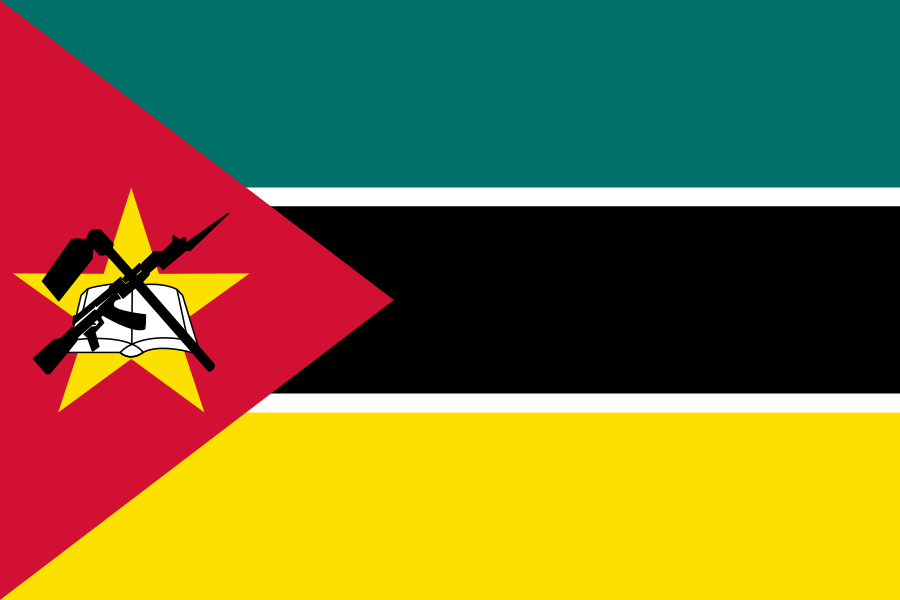
From US-educated anthropologist to founder of Mozambique's liberation front
“Although I loved university life above all, I decided to devote the rest of my life to the war of liberation of my country, until it receives independence!”
A Mozambican anthropologist who earned his PhD in the United States, he gave up an academic career to fuse rival liberation groups into the Mozambican Liberation Front (FRELIMO). As its first president he launched the 1964 armed struggle and set the movement toward a socialist line, leading it until his assassination in 1969, six years before independence.
Career timeline
1953BA in anthropology and sociology, Oberlin College
1955MA, Northwestern University
1957–1961Research officer, UN Trusteeship Department; field research across Africa
1960PhD in anthropology, Northwestern University, under Melville J. Herskovits
1961–1963Assistant professor, Syracuse University; helped develop East African Studies Program
1962FRELIMO founded; elected first president
1964Launches armed liberation struggle against Portuguese colonial rule (25 September)
1968Second FRELIMO Congress adopts socialist line, protracted war strategy; re-elected president
1969.02.03Assassinated by letter bomb in Dar es Salaam, Tanzania
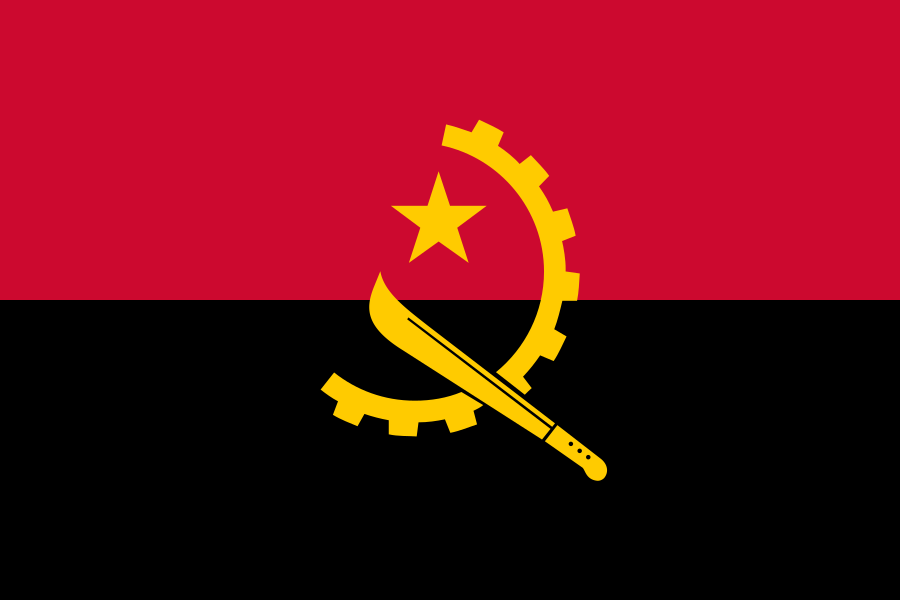
Physician-poet who led Angola's liberation struggle and became its first president
"Our land, our mother / we shall return." Lines from the poem "Havemos de voltar" in the 1974 collection Sacred Hope (Sagrada Esperança).
Physician and poet who led Angola's independence struggle. He was president of the MPLA at its founding in December 1956 and, after imprisonment and exile, was elected its effective chairman at the December 1962 conference, leading the independence war until 1974. He became the first president of the People's Republic of Angola on 11 November 1975, building a one-party socialist state in close alignment with the USSR and Cuba while crushing a 1977 coup attempt and carrying out mass purges.
Career timeline
1947Left for Portugal; studied medicine at Coimbra and Lisbon universities while joining anti-colonial student activism
1956Became the MPLA's president at its founding (Viriato da Cruz was secretary-general)
1960–1962Arrested by the PIDE, imprisoned in Lisbon; escaped in 1962 and went into exile in Congo-Léopoldville
1962–1974Elected effective chairman at the MPLA conference; led the independence war and built ties with the USSR, Cuba and Yugoslavia
1975Became first president of the People's Republic of Angola on 11 November; declared a socialist course
1975–1979Defended the state in civil war with Cuban troops and Soviet aid; suppressed Nito Alves's 1977 coup attempt
1977Reorganized the MPLA into the MPLA-Workers' Party, adopting Marxism-Leninism as official doctrine