The White ataman who ruled Transbaikal under Japanese protection and defied Kolchak
«…in the conditions of the nascent civil war, all softness and humanity must be cast aside»: justifying his White Terror policy in his memoirs About Myself.
Born a Transbaikal Cossack, he was a capable cavalry officer decorated with the Order of St. George in the First World War. In late 1917 he formed the Special Manchurian Detachment (OMO), opening one of the first fronts of the Siberian civil war; with Japanese military and financial backing he seized the Transbaikal region and established the 'Eastern Outskirts' government. He defied Kolchak's authority and built an independent power base, while the mass White Terror carried out under his rule was so brutal that US Army intelligence investigated it as a war crime. After his defeat in 1920 he continued anti-Soviet activities in Manchuria under Japanese patronage until Soviet forces captured him in 1945 and he was hanged.
Career timeline
1908–1911Graduated Orenburg Cossack Military School, commissioned as khorunzhiy
1914–1916Served in WWI, awarded Order of St. George 4th class and St. George's Weapon; promoted to yesaul
1917.12–1918Formed Special Manchurian Detachment (OMO), led anti-Bolshevik uprising in Transbaikal
1918–1919Captured Chita, elected Ataman of Transbaikal Cossack Host; clashed with Kolchak then reconciled
1920.1–10Supreme authority of Russian Eastern Outskirts, formed Far Eastern Army; defeated Oct, fled to Manchuria by plane
1921–1945Exile in Japan and Manchuria, collaborated with Japanese military; BREM chairman (1943–1945)
1945.8–1946.8Captured by Soviet forces, tried and hanged in Moscow
“They will end up putting me ashore with inadequate forces and get me in a serious jam... Then, who will get the blame?”
Major General John P. Lucas was a professional U.S. Army officer who served in both world wars and developed extensive experience in planning and command. At Anzio in 1944, he led VI Corps and chose to consolidate the beachhead rather than immediately exploit the surprise landing, a decision shaped by his doubts about the plan, the force available, and ambiguous orders from higher command. His corps endured the German counterattack, but he was relieved soon afterward, leaving his caution at Anzio as a lasting case in the tension between operational opportunity and force protection.
Career timeline
1911Commissioned in the U.S. Army as a second lieutenant, cavalry
1916Served in the Mexican Punitive Expedition
1918Commanded the 108th Field Signal Battalion, 33rd Infantry Division, and was wounded in France
1932–1936Served in the Personnel Division of the War Department General Staff
1941–1942Commanding general of the 3rd Infantry Division
1943–1944Commanding general of U.S. VI Corps in the Italian campaign and at Anzio
1946–1948Chief of the U.S. Military Advisory Group to the Nationalist Chinese government
1948–1949Deputy commander of the reactivated U.S. Fifth Army
Stalin's artillery chief from Tsaritsyn: Marshal who blocked the T-34, KV-1 and Katyusha
What the hell do we need rocket artillery for? The main thing is the horse-drawn gun.
A Stalin favourite since the Battle of Tsaritsyn, Kulik headed the Red Army's artillery directorate from 1937 to 1941, where his extreme conservatism led him to block the T-34 and KV-1 tanks, Katyusha rockets, and submachine guns, the very weapons that later saved the Soviet Union. His disastrous field commands in the Winter War and against Germany brought court-martial, demotion from Marshal to major-general in 1942, and eventual execution for treason in 1950.
Career timeline
1918–1920Chief of Artillery, 1st Cavalry Army
1926–1929Chief, Main Artillery Directorate (GAU)
1932–1936Commander-Commissar, 3rd Rifle Corps
1937–1941Chief, Main Artillery Directorate (GAU)
1939–1941First Deputy People's Commissar for Defence
1941Commander, 54th Army
1943Commander, 4th Guards Army
1944–1945Deputy Chief, Main Directorate for Formation & Manning
A field commander undone by the collision of orders and reality
After being told that no German field marshal had ever been captured alive, Paulus refused suicide and surrendered.
Friedrich Paulus was a German staff officer and general whose work included planning the invasion of the Soviet Union. As commander of the Sixth Army, he led the advance on Stalingrad, then became trapped between Hitler's order to hold the city and the army's collapse after the Soviet encirclement. He surrendered on 31 January 1943 and, in captivity, became a critic of the Nazi regime who joined anti-Nazi German officers' organizations sponsored by the Soviet Union. In postwar East Germany he researched military history, leaving a legacy shaped both by responsibility for an aggressive war and by his late break with Nazism.
Career timeline
1910Officer candidate, 111th Infantry Regiment of the Imperial German Army
1914–1918Served in the First World War and as a staff officer
1935–1939Chief of staff, Panzer Troop Command, then Tenth Army
1939–1940Chief of staff of the Tenth Army, later redesignated Sixth Army
1940–1941Deputy chief of the German Army General Staff
1942–1943Commander of the Wehrmacht's Sixth Army
1943Generaloberst, promoted to field marshal on 30 January
1954–1957Military-history research and teaching in East Germany
A Finnish general at the boundary of war and diplomacy
In midsummer 1941 Mannerheim entrusted Finland's largest-ever field force, the 100,000-strong Army of Karelia, to Heinrichs for the advance toward the Svir River and Lake Onega.
Erik Heinrichs was a Finnish military commander who worked closely with Mannerheim across battlefield command and general-staff planning. After directing the defence of the Karelian Isthmus in the Winter War, he helped coordinate military cooperation with Germany in 1941 and then led the Army of Karelia in Finland’s offensive. The Weapons Cache Case ended his postwar command career, but he remained active as a military expert, taking part in the 1948 Moscow negotiations and writing a major two-volume biography of Mannerheim.
Career timeline
1915–1918Trained in Germany as a Finnish Jäger and fought on the Eastern Front
1918Commanded the 7th Jäger Battalion in the Finnish Civil War
1931–1938Commander of the 1st Division
1939–1940Commanded III Corps and the Army of the Karelian Isthmus in the Winter War
1940–1941Chief of the General Staff and participant in military talks with Germany in 1941
1941–1942Commander of the Army of Karelia during the offensive in East Karelia
1942–1944Chief of the General Staff, overseeing wartime coordination with German forces
1945Commander-in-Chief of the Finnish Defence Forces, resigning after the Weapons Cache Case
The five-star general who led D-Day and warned America against the military-industrial complex
There is only one thing to do when you go into this kind of thing. It must be a success.
A five-star general who served as Supreme Allied Commander in Europe during World War II, leading the D-Day invasion, and later became the 34th President of the United States. As president he pursued Cold War containment, backing coups in Iran and Guatemala, and in March 1960 authorized the CIA's covert program to overthrow Fidel Castro. After the Bay of Pigs failure, he told Kennedy that 'there is only one thing to do when you go into this kind of thing: it must be a success,' warning that hiding US involvement out of fear of emboldening the Soviets would only make them bolder. His farewell address warned against the 'military-industrial complex,' leaving a lasting caution about the machinery of permanent warfare.
Career timeline
1915Graduated from West Point
1942–1945Supreme Allied Commander, Europe (World War II)
The Left SR figurehead chairman of the MRC, lending a non-Bolshevik face to the Bolshevik insurrection while Trotsky directed operations
On the night of 21 October 1917 Lazimir, as MRC chairman, went with Sadovsky and Mekhonoshin to military district headquarters to claim supreme authority over the garrison; Colonel Polkovnikov refused, saying he did not recognise their commissars and would arrest them if they broke the law.
A feldsher at the Petrograd military hospital who turned to SR agitation among soldiers, Pavel Lazimir rose after the February Revolution to chair the soldiers' section of the Petrograd Soviet. In October 1917 the Bolsheviks installed him, a Left SR, as chairman of the newly created Military Revolutionary Committee to give the body a non-Bolshevik front; the real direction came from Trotsky, while Lazimir himself drafted the MRC's founding statute. He joined the Bolsheviks in 1918 and served on the Revolutionary Military Council of the Southern Front, organizing supply and sanitation, before dying of typhus in 1920 at twenty-nine.
Career timeline
~1911–1917Feldsher at Petrograd military hospital; SR agitation among soldiers
1917.3–10Executive Committee member, Petrograd Soviet; chair of soldiers' section; deputy chair of military department
1917.10First chairman of Petrograd MRC; drafted the MRC statute
1917.11–1918Collegium member, NKVD and Narkomvoen
1918–1920Member, RVS Southern Front; directed supply and sanitation
The 27-year-old White general whose Yakut expedition closed the Civil War
'I do not know my political convictions. I am not a party man. I want good and happiness for the people, I want the Russian people to be a kind, peaceful, but strong and mighty people': diary entry during the Yakut expedition
One of the youngest White generals of the Russian Civil War, he became a major-general at 27 and was nicknamed 'the Siberian Suvorov.' In December 1918 his troops captured Perm, taking 20,000 Red Army prisoners whom he released to their homes, and he went on to command the 1st Siberian Army under Admiral Kolchak. After the White collapse, he lived in exile in Harbin working as a carpenter and cab driver, then in September 1922 led a volunteer druzhina into Yakutia: the last military operation of the Civil War, ending with his surrender at Ayan in June 1923. His death sentence was commuted to ten years, but he was rearrested in the Great Purge and shot in Novosibirsk in 1938.
Career timeline
1910Graduated Pavlovsk Military School, commissioned sub-lieutenant
1914–1917WWI service, rose to lieutenant colonel, awarded Order of St. George 4th class
1918.05–08Led anti-Bolshevik uprising in Tomsk, commanded 1st Middle Siberian Corps
1918.09–12Promoted major-general at 27, captured Perm, nicknamed 'Siberian Suvorov'
1919Promoted lieutenant-general, commander of 1st Siberian Army
1920–1922Harbin exile, worked as carpenter and cab driver
1922.09–1923.06Led Siberian Volunteer Druzhina in Yakut expedition, surrendered at Ayan
1924–1938Death sentence commuted to 10 years, freed 1936, shot 1938 in Great Purge
Ukrainian nationalist leader who commanded the Sich Riflemen and built the UVO and OUN
Rotterdam, 23 May 1938: a Ukrainian-style box of chocolates handed over by his trusted contact Pavel Sudoplatov concealed a time bomb made in Moscow.
A Ukrainian military and political leader from Zashkiv in Austrian Galicia. After captivity in Russia during the First World War, he organized the Sich Riflemen in Kyiv in 1917 and became a leading commander of the Army of the Ukrainian People’s Republic. Following defeat in the independence war, he led the Ukrainian Military Organization (UVO) in exile and united several nationalist groups into the Organization of Ukrainian Nationalists (OUN) in Vienna in 1929, becoming its first leader. He connected émigré organizations across Europe and North America and sought international support for Ukrainian independence, but was assassinated in Rotterdam in 1938 by a bomb delivered by NKVD operative Pavel Sudoplatov, who had infiltrated the OUN. In 1929 he obtained Lithuanian citizenship and a passport, giving his émigré activity a legal basis, while his national and political identity and the aim of his movement remained consistently Ukrainian independence.
Career timeline
1914–1915Served in the Austro-Hungarian army; captured by Russia after the Battle of Makivka
1917–1920Organized and commanded the Sich Riflemen of the Ukrainian People’s Republic
1920–1929Cofounded and led the Ukrainian Military Organization (UVO)
1929–1938Founding leader of the Organization of Ukrainian Nationalists (OUN)
1938.05Assassinated in Rotterdam in Pavel Sudoplatov’s bombing operation
The Iwo Jima commander who understood American power
He told his family that America was a great power and Japan should avoid fighting it if possible.
Tadamichi Kuribayashi was an Imperial Japanese Army officer and diplomat, unusually familiar among senior Japanese commanders with American society, industry, and military power. On Iwo Jima, he rejected a decisive stand at the beaches and organized a defense in depth from tunnels, caves, and concealed positions, turning an impossible strategic situation into a costly battle of attrition. The defense could not prevent Japan's defeat, but it imposed severe costs on the American landing and occupation while reflecting his effort to avoid wasteful banzai charges and indiscriminate self-destruction by his troops.
Career timeline
1914Graduated from the Army Academy, commissioned cavalry lieutenant
1923Graduated from the Army War College, ranked second
1927–1930Assistant military attaché in the United States, studied at Harvard
1931–1933Military attaché in Canada
1941–1943Chief of staff of the 23rd Army, served in the Battle of Hong Kong
1943–1944Commander of the 2nd Imperial Guards Division
1944–1945Commander of the 109th Division and Ogasawara Army Group, led Iwo Jima's defense
1945Killed during the Battle of Iwo Jima, posthumously promoted to general
Hitler's "fireman" who rushed from crisis to crisis on the Eastern Front, the Wehrmacht's most tenacious defensive commander
Driving through a blizzard to confront Hitler in East Prussia, Model glared through his monocle and demanded: "Mein Führer, who commands Ninth Army, you or I?"
Walter Model distinguished himself as a staff officer in the First World War and rose to become the Wehrmacht's finest defensive commander in the Second. As commander of the 9th Army in the Rzhev salient, he repelled repeated major Soviet offensives, earning the nickname "the Lion of Defence" and Hitler's trust as the "fireman" who could be rushed to any crisis. On 27 April 1943, Model was the first senior commander to warn Hitler against Operation Citadel, presenting aerial reconnaissance photographs of the Red Army's deeply prepared defences in the Kursk salient, yet the offensive went ahead and his 9th Army failed to advance even 12 kilometres on the northern face. In the war's final weeks, trapped in the Ruhr Pocket, he dissolved his army group rather than order a mass surrender and shot himself in a forest.
Career timeline
1909Officer cadet, 52nd Infantry Regiment
1917Ordnance officer, Supreme Army Command (OHL)
1935Head of Section 8 (Technical), Army General Staff
1940Commander, 3rd Panzer Division
1942Commander, 9th Army: Rzhev
1943Northern pincer, Operation Citadel
1944Army Group Centre → Army Group B
1945Ruhr Pocket encircled, dissolved army group, suicide
“I order the immediate cessation of resistance. Every hour you keep on fighting prolongs the suffering of the civilians in Berlin and of our wounded.”
Helmuth Weidling was a German general who rose from imperial service to become an artillery officer and corps commander in the Wehrmacht. His command on the Eastern Front implicated him in Nazi Germany’s war of aggression and occupation, and his corps was later examined in connection with the Ozarichi camp crimes. Appointed commander of the Berlin Defence Area on 23 April 1945, he directed the city’s defence under Hitler’s ban on surrender, then negotiated with Vasily Chuikov and ordered the garrison to cease resistance on 2 May. Taken prisoner by the Soviet Union, he received a 25-year sentence for war crimes and died in custody in 1955; Russian prosecutors declared him ineligible for rehabilitation in 1996.
Career timeline
1911–1918Officer in Prussian artillery and Zeppelin units
1919–1938Reichswehr artillery officer and regimental commander
1939–1941Artillery commands in Poland, France and on the Eastern Front
1942–1943Commander of the 86th Infantry Division
1943–1945Commander of the XLI Panzer Corps
1945.04Commander of the LVI Panzer Corps at the Oder front and Berlin
1945.04.23–05.02Commander of the Berlin Defence Area, ordering the garrison’s surrender
1952–1955Imprisoned in the Soviet Union after a war-crimes conviction
A military leader between wartime resistance and anti-communist politics
In November 1942, he committed his forces to the Gorgopotamos operation, where British saboteurs joined Aris Velouchiotis's ELAS fighters.
A former Hellenic Army officer, Napoleon Zervas founded the National Republican Greek League (EDES) in 1941 and led non-communist resistance to the Axis occupation. In 1942 he cooperated with the British Special Operations Executive and ELAS in the destruction of the Gorgopotamos bridge, but soon shifted from republicanism toward loyalty to the monarchy as British support and confrontation with the communist movement became decisive. After liberation, he carried his wartime military authority into right-wing politics and public-order administration during the Greek Civil War.
Career timeline
1910–1914Volunteered for the army, served in the Balkan Wars, and graduated from the NCO school.
1916–1920Joined the Movement of National Defence, served on the Macedonian Front, and rose to major.
1925–1926Served as Athens garrison commander and a battalion commander of the Republican Guard under Pangalos.
1941Founded the National Republican Greek League (EDES) with Venizelist officers.
1942–1944Organized the EOEA, directed armed resistance in Epirus, and took part in Operation Harling.
1946–1947Elected to parliament and served in the Maximos cabinet as minister without portfolio and Minister for Public Order.
1950–1951Served as Minister of Public Works in the cabinets of Sophoklis Venizelos.
The army general who survived Kolyma, took Berlin, and testified to Stalin-era repression
Told of the wartime case in which he had timber shipped out in defiance of a ban to supply pit props for the Donbas mines, Stalin is reported to have said 'Only the grave will correct Gorbatov' and then closed the matter because no personal gain was involved.
Born in 1891 into a peasant family in Pakhotino, Vladimir Governorate, he entered the Imperial Russian Army in 1912 and in World War I won two Crosses of St. George, rising to senior non-commissioned officer. He joined the Red Army in 1919 and in the Civil War commanded a cavalry regiment and a Bashkir cavalry brigade; removed from his post in 1937 and arrested in 1938, he was tortured yet refused to admit guilt. Convicted in May 1939 and sentenced to 15 years at the Kolyma camp, he was released in March 1941, then led the 3rd Army from 1943 to the war's end and became commandant of Berlin in 1945. He later commanded the Airborne Forces and the Baltic Military District and became General of the Army in 1955; his 1964 Novy Mir memoir made him one of the first Soviet state figures to describe the Great Terror in detail.
Career timeline
1912–1817th Chernigov Hussar Regiment, WWI — Crosses of St. George 3rd & 4th class, Medals of St. George
1919–21Joined Red Army; CO 58th Cavalry Regiment, Bashkir Cavalry Brigade — Order of the Red Banner
Trotsky's Carnot: the Red Army's administrative brain, erased by Stalinism
Trotsky wrote in his memoirs: 'I chose Sklyansky as my deputy. I never had any occasion to regret it afterwards. If anyone could be compared with Lazare Carnot of the French Revolution, it is Sklyansky.'
One of the de facto founders of the Red Army and Trotsky's most trusted deputy. A Kiev University medical graduate and Bolshevik since 1913, at just 26 he became Deputy Chairman of the Revolutionary Military Council and Deputy War Commissar, running the Red Army's entire administrative and operational machinery from Moscow while Trotsky roamed the Civil War fronts. Trotsky ranked him with Lazare Carnot, the military organizer of the French Revolution. Dismissed in 1924 during Stalin's rise and demoted to a textile trust, he drowned under suspicious circumstances in Long Lake, New York, the following year. His name was systematically erased from Soviet military history under Stalin.
Career timeline
1913Joins Bolsheviks as a medical student at Kiev University; underground propaganda work
1916–1917Drafted; serves as infantryman then army doctor; rises to leadership of 5th Army revolutionary committees
1917.10Member of Petrograd MRC; presidium member at the Second Congress of Soviets
1917–1918Commissar of General Staff and Supreme Command HQ; demobilization of the old army and salvage of war matériel
1918.3–9Member of the Supreme Military Council of the RSFSR
1918–1924Deputy Chairman of the Revvoensovet & Deputy War Commissar — runs Red Army administration and operations
1924–1925Dismissed from military posts; appointed chairman of Mossukno state textile trust
1925Drowns in Long Lake, New York, during a technical mission to Germany, France, and the USA
Principal architect of the Soviet Air Force and aviation industry
On 2 August 1930 at Voronezh airfield, Baranov ordered the first combat drop of armed paratroopers — "demonstrate the drop of a group of armed parachutists for sabotage actions on 'enemy' territory" — the day considered the birth of the Soviet Airborne Forces (VDV).
One of the main creators of the Soviet Air Force, Baranov commanded the VVS from 1924 to 1931, building its organizational and industrial foundations. From 1932, as Deputy People's Commissar for Heavy Industry and head of the aviation industry under Ordzhonikidze, he drove the expansion of aircraft and engine production that would sustain Soviet air power through World War II. On 2 August 1930 he initiated the first combat paratrooper drop near Voronezh, the founding event of the Soviet Airborne Forces (VDV). He also signed the agreement establishing the secret Lipetsk German aviation school and backed early rocket research through GIRD as well as stratospheric balloon flights. He and his wife died in a plane crash in 1933; his ashes are interred in the Kremlin Wall.
Career timeline
1912Joined RSDLP(b); arrested and exiled from St. Petersburg 1913
1915–1917Mobilized into Imperial Army; arrested for revolutionary agitation, sentenced to 8 years hard labor; freed by February Revolution
1917–1918Chairman, front-line Soviet department, Romanian Front; commander, 4th Donetsk Army
1919–1921Member of RVS, 8th Army / Southern Group Eastern Front / Turkestan Front / 1st & 14th Armies; Kronstadt suppression (Order of the Red Banner)
1921–1922Member of RVS, Turkestan Front; led operations against the Basmachi (Khorezm Military Order)
1923–1924Chief & Commissar, Red Army Armored Forces; deputy chief then acting chief of Air Force
1924–1931Commander, Red Army Air Force (VVS); member of Revolutionary Military Council of the USSR from 1925
1932–1933Deputy People's Commissar for Heavy Industry; Head, Main Directorate of Aviation Industry
Southwestern Front commander who fell in the Kiev encirclement
On 26 June 1941, German Chief of Staff Halder noted: 'The enemy facing Army Group South displays firm and energetic leadership.' Amid the chaos of the Brody tank battle, Kirponos's Southwestern Front held.
Born to a poor Ukrainian peasant family, he was conscripted in 1915 and joined the Bolsheviks in 1918, fighting the Civil War with Shchors's division. After the Frunze Academy he served as commandant of the Kazan Infantry School, then commanded the 70th Rifle Division in the Winter War: outflanking Vyborg across the frozen Gulf of Finland and earning the Hero of the Soviet Union. Appointed commander of the Kiev Special Military District in January 1941, he led the Southwestern Front from the first day of Barbarossa, directing the tank battle at Brody and the defence of Kiev. On 20 September 1941 he was killed by mortar shrapnel trying to break out of the Kiev encirclement, the highest-ranking Soviet commander to die in the catastrophe.
Career timeline
1915–17Conscripted into Imperial Army; NCO, regimental committee chairman
1918–21Joined Red Army; battalion then regimental commander, Shchors's division
1927–34Frunze Military Academy; chief of staff, 44th Rifle Division
1934–39Commandant, Kazan Infantry School
1939–40CO 70th Rifle Division — Winter War, Hero of the Soviet Union
1940.04–06CO 49th Rifle Corps
1940–41 (1월)Commander, Leningrad Military District
1941.01–06Commander, Kiev Special Military District (succeeded Zhukov)
1941.06–09Commander, Southwestern Front — Brody, Uman, Kiev
An air commander who made army cooperation central to Allied air power
Montgomery urged the War Office to retain him: “He is the only airman who is out to win the land battle and has no jealous reactions.”
Trafford Leigh-Mallory was a British air chief marshal whose command style grew from First World War experience in reconnaissance and cooperation with ground forces. During the Battle of Britain, he advocated large fighter formations against the quicker defensive methods of Hugh Dowding and Keith Park, and the dispute became entangled with changes in Fighter Command leadership. As commander-in-chief of the Allied Expeditionary Air Force for Overlord, he coordinated the air plan to delay German reinforcements and disrupt transport, while accepting the grave civilian costs of attacks in France. After Normandy he was appointed to command air forces in Southeast Asia, but died with his wife in a plane crash in the French Alps.
Career timeline
1916Pilot, No. 7 Squadron, Royal Flying Corps
1917–1918Commanding officer, No. 8 Squadron, Royal Flying Corps
1937–1940Air Officer Commanding, No. 12 (Fighter) Group
1940–1942Air Officer Commanding, No. 11 (Fighter) Group
1942–1943Commander-in-Chief, RAF Fighter Command
1943–1944Commander-in-Chief, Allied Expeditionary Air Force, Overlord
1944Designated Air Commander-in-Chief, South East Asia Command
Finnish Jäger lieutenant general who destroyed two Soviet divisions at Suomussalmi with motti tactics
The division was not yet fully formed: Siilasvuo destroyed the Soviet 163rd Division before year's end with an incomplete 9th Division, then encircled the 44th on the Raate Road and cut it into motti, cordwood stacks.
A Jäger officer born in Helsinki, he went to Germany during the First World War for military training in the Prussian Jäger Battalion and fought in the Finnish Civil War as a White company commander. During the Winter War, as a colonel commanding the 9th Division, he encircled and destroyed the Soviet 163rd and 44th Rifle Divisions at Suomussalmi and Raate Road using motti tactics, halting the Soviet drive to cut Finland in half at Oulu. His success earned him promotion to major general and a best-selling book, Suomussalmen taistelut, though he was criticized for claiming all the credit. He commanded III Corps in the Continuation War and led the expulsion of German forces in the Lapland War, receiving the Mannerheim Cross in December 1944; he died at 54.
Career timeline
1915–1918Trained with 27th Prussian Jäger Battalion; fought on Eastern Front
1918White company commander, Finnish Civil War; fought at Tampere and Viipuri
1934–1939Commander, Pohjanmaa Military District; Oulu city councillor
1939–1940Commander, 9th Division; destroyed two Soviet divisions at Suomussalmi and Raate Road
1941–1942Commander, III Corps; northern Finnish-Soviet front
1944Commander, III Corps, Karelian Isthmus; Vuoksi defensive battles
1944–1945Overall commander, Lapland War; expelled German forces from Finland
A legion commander who carried battlefield success into White politics
After capturing Yekaterinburg, Gajda set up his headquarters in the very Ipatiev House where the Romanovs had been murdered by the Bolsheviks less than a week earlier.
Radola Gajda was a Czechoslovak Legion commander who rose to prominence in the First World War and the Russian Civil War, later becoming a general and politician in interwar Czechoslovakia. In 1918 he led the Legion's eastern group, seizing the railway from Novonikolaevsk to Irkutsk and pressing the argument for armed struggle over neutrality. He joined Kolchak's White forces, lost his command, and returned home to serve as acting chief of the general staff before leading the National Fascist Community. His military anti-Bolshevism became fascist politics in Czechoslovakia, while during the Nazi occupation he aided resistance networks.
Career timeline
1910–1911Served in the Austro-Hungarian Army
1915–1916Officer in the Montenegrin Army
1917Company and regimental commander, Czechoslovak Legion
1918Commander, Legion eastern group, directing the capture of Irkutsk and Yekaterinburg
1918–1919Commander of Kolchak's Siberian Army
1922–1926Divisional commander and acting chief of the Czechoslovak General Staff
1927–1939Leader of the National Fascist Community and parliamentarian
The invisible commander who moved the war, the only supply general Stalin toasted as architect of victory
Kremlin victory banquet, May 1945. After all the toasts to the marshals, Stalin refilled his glass and said: 'Now a toast to the true commander and great toiler of the war, without whom there would have been no great victory. To Comrade Khrulev.'
A blacksmith's son who rose from a Petersburg goldsmith's apprentice to General of the Army and founder of the modern Soviet rear services. He created the Red Army's unified logistics system, the Rear (Тыл), on 1 August 1941 and directed it for the entire war, simultaneously serving as People's Commissar of Railways in 1942–43. He visited Stalin's Kremlin office 113 times during the war to coordinate supply directly with the Supreme Commander, and at the victory banquet Stalin raised a toast to 'the true commander and great toiler of the war, without whom there would have been no great victory.' After his death, Nikita Khrushchev opposed a Kremlin wall burial, but the military prevailed and his ashes were placed in the Kremlin Wall Necropolis.
Career timeline
1918–1921Political commissar, 11th Cavalry Division, 1st Cavalry Army; Civil War
1930–1936Head of Central Military Finance Directorate → Chief of Administration, NKO
1939–1941Chief of Supply → Head of Main Intendant Directorate
1941–1951Deputy People's Commissar for Defence → Chief of the Rear Services of the Red Army
1942–1943People's Commissar of Railways
1943Promoted to General of the Army (7 November)
1955–1957Led rehabilitation of 98 purged commanders including Marshal Blyukher
1958–1962Military inspector-adviser, Group of General Inspectors, Ministry of Defence
The cavalryman who closed Stalingrad's southern pincer
In August 1941, taking command of the Bryansk Front, Yeryomenko promised Stalin personally: "I will smash that scoundrel Guderian." The promise failed; Guderian encircled Kiev instead.
Born to a poor Ukrainian peasant family, Yeryomenko rose from a conscript in the First World War to Marshal of the Soviet Union. He fought the Civil War in Budyonny's 1st Cavalry Army and survived the purges as a cavalry officer. At Stalingrad he commanded the Southeastern (later Stalingrad) Front, planning the city's defence with Khrushchev and closing the southern pincer of Operation Uranus to trap Paulus's 6th Army. He led no fewer than eight fronts during the war, ending it at the head of the 4th Ukrainian Front liberating Hungary and Czechoslovakia. Made a Marshal in 1955, his battlefield record far outran his political weight. He was also a diarist: despite a ban on wartime journals, he kept one throughout.
Career timeline
1913–17Conscript, Imperial Army; NCO on Southwest and Romanian Fronts
1918–20Organised Markivka partisan detachment; 1st Cavalry Army in the Civil War
1935Graduated Frunze Military Academy
1938–39Commander 6th Cavalry Corps; led advance into eastern Poland
1941.6–7Acting Cdr Western Front; wounded at Smolensk
1941.8–10Cdr Bryansk Front; encircled in Typhoon, severely wounded
1942.8–1943.1Cdr Stalingrad Front; southern pincer of Operation Uranus
1943–44Cdr Kalinin, 1st Baltic, then 2nd Baltic Front
1944Cdr Separate Coastal Army; liberated Crimea
1945.3–5Cdr 4th Ukrainian Front; liberated Hungary and Czechoslovakia
1945–58Cdr Carpathian, West Siberian, North Caucasus Military Districts
1955Promoted Marshal of the Soviet Union
1958–70Inspector General, Ministry of Defence; wrote memoirs
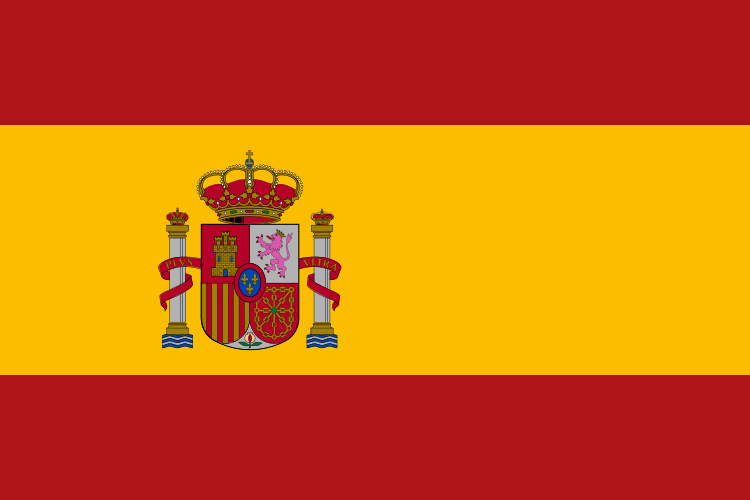
The general who turned the rising into victory and ruled Spain for thirty-six years as Caudillo
The last war communiqué of 1 April 1939, signed in his own hand: “Today, with the Red Army captive and disarmed, the national troops have reached their final military objectives. The war is over.” Thirty-six years of dictatorship began.
A career officer who made his name in the colonial war in Morocco and became the youngest general in Europe at thirty-three. His use of the Army of Africa to crush the Asturian miners in 1934 fixed him in the eyes of the right as the restorer of order, and in July 1936 he joined the rising, flew from the Canaries to Morocco and, with German and Italian transports, ferried the Army of Africa to the mainland. In October he was made commander-in-chief and head of state of the rebel zone, and the Unification Decree of 1937 fused the Falange and the Carlists into a single National Movement under his personal rule. Victory in 1939 was followed by mass execution and imprisonment under the Law of Political Responsibilities, costing tens of thousands of lives. He declared non-belligerence in the Second World War while sending the Blue Division to the Eastern Front, and broke out of postwar isolation with the Pact of Madrid and the Concordat of 1953. The growth that followed the Stabilization Plan of 1959 became another pillar of the regime; he named Juan Carlos his successor in 1969, and with his death in 1975 the regime itself began to come apart.
Career timeline
1892Born into a naval family in Ferrol, Galicia
1907–1910Trained at the Toledo Infantry Academy
1912–1926Fought in the colonial war in Morocco, second-in-command of the Spanish Legion, brigadier general at thirty-three
1928–1931Director of the Zaragoza military academy until the Republic removed him
1934.10Used the Army of Africa to crush the Asturian miners' rising
1935–1936Rose to chief of the general staff, then was posted to the Canary Islands by the Popular Front government
1936.07.18–19Joined the rising, flew to Morocco in the chartered Dragon Rapide and organized the airlift of the Army of Africa
1936.10.01Proclaimed Generalísimo and head of state of the rebel zone at Burgos
1937.04.19Fused the Falange and the Carlists into a single National Movement by decree
1939.04.01Declared the war over and began mass execution and imprisonment under the Law of Political Responsibilities
1940–1943Met Hitler at Hendaye, declared non-belligerence and sent the Blue Division to the Eastern Front
1953–1955Signed the Pact of Madrid with the United States and a Concordat with the Vatican; UN membership in 1955 ended his isolation
1959Abandoned autarky with the Stabilization Plan and entered the years of high growth
1969–1973Named Juan Carlos his successor; in 1973 his prime minister Carrero Blanco was assassinated by ETA
1975.11.20Died in Madrid; buried at the Valley of the Fallen until his exhumation in 2019
The air-defence commander at the heart of the Battle of Britain
Using the picture supplied by radar and the reporting system, he scrambled No. 11 Group's fighters quickly enough to keep the south-east's defence in action.
A New Zealand-born Royal Air Force officer, Park carried experience from First World War artillery and fighter flying into the organisation of air defence. As commander of No. 11 Group in 1940, he directed the fighter defence of London and south-east England, combining radar and reporting networks with rapid, dispersed interceptions against German raids. His decisions balanced the need to preserve fighters and pilots against the accumulating damage to airfields while keeping the southern defence system in action. He later commanded air operations in Malta and the Far East.
Career timeline
1914–1916Served with New Zealand Expeditionary Force artillery at Gallipoli and on the Western Front
1916–1918Served as a fighter pilot with the Royal Flying Corps and RAF, commanding No. 48 Squadron
1938–1940Senior air staff officer at Fighter Command
1940.04–1940.11Air Officer Commanding No. 11 Group, directing south-east air defence in the Battle of Britain
1940–1941Served in Training Command, overseeing fighter training
1941–1942Air Officer Commanding, Egypt
1942–1945Commanded Malta's air defence and later air operations in the Mediterranean, Middle East and India