Agrarian leader who opposed communist rule and was hanged after a show trial
State Department emissary Mark Ethridge called Petkov "the bravest man I've ever known."
A leader of the Bulgarian Agrarian National Union (BZNS), he studied law in Paris after the First World War and returned in 1929 to work as a journalist. He co-founded the anti-fascist Fatherland Front in 1943 but broke from it in 1945 to lead the opposition against the Communists' monopolisation of power, and in the 1946 election his opposition coalition won 101 seats in the Grand National Assembly. Arrested in parliament in June 1947 and sentenced to death in August for a supposed military plot, he was hanged on 23 September, eight days after the Paris peace treaty came into force.
Career timeline
- 1929Returned and worked as a journalist
- 1938Elected to the 24th National Assembly (invalidated that December)
- 1941Leader of BZNS 'Aleksandar Stamboliyski'
- 1943Helped found the Fatherland Front
- 1944Minister without portfolio in the first Fatherland Front government (to Aug 1945)
- 1945Leader of the anti-communist United Opposition
- 1946Member of the 6th Grand National Assembly
The world's first woman foreign minister and head of the Romanian party's "Muscovite faction", brought down by Gheorghiu-Dej's 1952 purge
At the Central Committee plenum of 26 and 27 May 1952 Gheorghiu-Dej denounced Pauker, Luca and Georgescu as an "anti-party faction" and removed Pauker from the Politburo. Dej had returned from Moscow with Stalin's approval, and the Slánský trial was spreading the purge of Jewish communists across Eastern Europe.
Born Hannah Rabinsohn to an Orthodox Jewish family in Vaslui County, she taught Hebrew before joining the Social Democratic Party in 1915 and took part in founding the Romanian Communist Party in 1921. Arrested in 1935, she was sentenced to ten years at the Craiova trial the following year, then sent to Moscow in a 1941 prisoner exchange with the Soviet Union, where she led the exiled Romanian communists under the Comintern. Back in Romania in 1944 she joined the Politburo and the Central Committee Secretariat, and in November 1947 became foreign minister, the first woman in the world to hold such a post. With Vasile Luca and Teohari Georgescu she formed the so-called "Muscovite faction" that contested party control with Gheorghiu-Dej's prison faction, but in May 1952 Dej, with Stalin's approval, had her expelled from the Politburo on the charge of committing both "right" and "left" deviations, and in July she lost the foreign ministry as well. Arrested in February 1953, she was released after Stalin's death, expelled from the party without trial, and spent her last years as a translator at the political publishing house. Time magazine put her on its cover in 1948 as "the most powerful woman alive", yet Robert Levy's research shows that she braked forced collectivization and allowed Jewish emigration to Israel, a more moderate course than Dej's.
Career timeline
- 1915Joined the Social Democratic Party
- 1921Founding member of the Romanian Communist Party
- 1935–1936Arrested; sentenced to ten years at the Craiova trial
- 1941Sent to the USSR in a prisoner exchange; led exiled Romanian communists under the Comintern
- 1944Returned to Romania; Politburo member and Central Committee secretary
- 1947–1952Minister of Foreign Affairs
- 1952Removed from the Politburo and the foreign ministry
- 1953–1954Arrested; released after Stalin's death; expelled from the party
'Il Migliore': the strategist who led Western Europe's largest communist party for forty years
In the 'Yalta memorandum' written on his deathbed, he argued for polycentrism — autonomy from Moscow (1964)
Founder and secretary of the Italian Communist Party. He steered the Comintern Popular Front and, with the 1944 Salerno turn, brought the PCI into the anti-fascist coalition government. On his deathbed, his Yalta memorandum argued for polycentrism, anticipating Eurocommunism.
Career timeline
- 1921Among the founders of the Italian Communist Party
- 1927–1964Party secretary; builds the PCI into Western Europe's largest communist party
- 1935–1939Comintern executive; guides the Popular Front in the Spanish Civil War
- 1944The Salerno turn: into the anti-fascist coalition government
- 1946–1948Constituent Assembly 'father of the constitution'; survives a 1948 assassination attempt
- 1964Dies at Yalta; his memorandum argues for polycentrism
German communist leader who built the GDR and erected the Berlin Wall
At a press conference on 15 June 1961 he declared, 'Nobody intends to build a wall'; two months later, on 13 August, his orders launched the Berlin Wall.
Born in Leipzig in 1893 to a tailor's family and trained as a joiner, he joined the SPD in 1912, passed through the USPD (1917) and the Spartacus League (1919) into the KPD (1920), and sat on the KPD Central Committee from 1923 and in the Reichstag from 1928 to 1933. After the Nazi takeover he fled via Paris and Prague to the Soviet Union to work for the Comintern, and returned on 30 April 1945 leading the 'Ulbricht Group'. He was pivotal in the forced 1946 merger of the KPD and SPD into the SED and became its First Secretary in 1950, the effective leader of East Germany. He backed the suppression of the June 1953 uprising, ordered the Berlin Wall in 1961, and launched the New Economic System in 1963. Forced out on 3 May 1971 'for health reasons' in favour of Erich Honecker, he died of a stroke on 1 August 1973.
Career timeline
- 1912Joins the Social Democratic Party of Germany (SPD)
- 1918Co-founds the Spartacus League and the KPD
- 1923–1933KPD Central Committee member, Reichstag deputy
- 1933–1945Exile in Paris, Prague and Moscow; works for the Comintern
- 1943Helps found the National Committee for a Free Germany
- 1950–1971First Secretary of the SED Central Committee
- 1960–1973Chairman of the GDR State Council
- 1971Forced to resign party leadership under Brezhnev pressure
He rewrote the grammar of revolution for a peasant country
In a letter of 5 January 1930 to Lin Biao, he answered pessimism about the Red Army's prospects by invoking the old Chinese saying that 'a single spark can start a prairie fire.'
Born to a peasant family near Shaoshan, Hunan, he studied in Changsha and was shaped by the 1911 Revolution and by nationalist and anti-imperialist currents. Introduced to Marxism while working as a librarian at Peking University, he took part in the May Fourth Movement of 1919 and in July 1921 attended the Chinese Communist Party's First National Congress in Shanghai as one of thirteen delegates, becoming a founding member. He developed rural base areas, guerrilla warfare and protracted people's war; elected to the leadership at Zunyi in January 1935, he became Chairman of the Military Commission in November 1935 and took the party chairmanship only in 1943. He led land redistribution and industrialisation, intervened in the Korean War in October 1950, suppressed opponents, and presided over the Great Leap Forward of 1958–1962 and the Cultural Revolution launched in 1966.
Career timeline
- 1921At the founding of the Chinese Communist Party
- 1927The Hunan report: revolution as a peasant affair
- 1934–1935The Long March; takes command at Zunyi
- 1937Published the philosophical essays On Practice and On Contradiction
- 1940Published On New Democracy
- 1949Proclaims the People's Republic of China
- 1958–1961The Great Leap Forward and its catastrophic famine
- 1966–1976The Cultural Revolution
The autodidact who rewrote Marxism for the Andes
“Socialism in Latin America must be a heroic creation, neither copy nor imitation.” — Amauta, 1928
Peruvian Marxist thinker. After encountering Gramsci's thought in Italy, he creatively recast Marxism for Andean reality. His Seven Essays reframed the Indian question as a land question, and in 1928 he founded the Peruvian Socialist Party. He died at thirty-five.
Career timeline
- 1919–1923Years in Italy; the factory councils and Gramsci's circle
- 1926Founds the journal Amauta
- 1928The Seven Essays: land and the Indian question in Marxist terms
- 1928–1929Founds the Peruvian Socialist Party and the CGTP
- 1930Dies at thirty-five
First JCP chairman who endured 18 years in imperial prisons
At the 1956 20th Party Congress, Khrushchev asked delegates to rise in memory of Stalin, Gottwald, 'and the little-known Kyuichi Tokuda'—and the entire congress rose.
A founding member of the Japanese Communist Party (1922), he was arrested in 1928 under the Peace Preservation Law and spent 18 years in prison without recanting, emerging in 1945 to rebuild the party as its first secretary-general. When the Cominform condemned the JCP's peaceful-revolution line in 1950, Tokuda swung the party toward armed struggle aligned with Moscow and Beijing; purged from public office, he defected to China and directed the party from his Peking Organization until his death in 1953.
Career timeline
- 1922Co-founded the JCP, Central Committee member
- 1928–1945Arrested under Peace Preservation Law; 18 years in prison (Abashiri, Chiba, Toyotama, Fuchu)
- 1945JCP Secretary-General (first post-war leader)
- 1946–1950House of Representatives member (3 terms, Tokyo 3rd district)
- 1950–1953Defected to China; led 'Peking Organization,' directed armed struggle
Australia's Foreign Minister who led the small and medium powers' fight against the great-power veto at San Francisco
On the emergency subcommittee with Stettinius and Gromyko, Evatt displayed 'an attitude of conciliation' and proposed the draft that on 20 June broke the deadlock over the General Assembly's powers of discussion.
An Australian Labor politician and jurist, Evatt was appointed the youngest-ever High Court justice at 36 and later served as Attorney-General and Minister for External Affairs under the Curtin and Chifley governments. At the 1945 San Francisco Conference he led the small and medium powers' resistance to the Security Council veto, submitting 38 amendments, and sat on the emergency subcommittee with Stettinius and Gromyko that resolved the deadlock over the General Assembly's powers of discussion. As President of the UN General Assembly in 1948 he guided the drafting of the Universal Declaration of Human Rights, and chaired the Ad Hoc Committee on Palestine that paved the way for the partition plan. He became Labor leader in 1951 but the party split over communism and three successive election defeats drove him from politics in 1960.
Career timeline
- 1925–1930MLA for Balmain, New South Wales Legislative Assembly
- 1930–1940Justice of the High Court of Australia
- 1941–1949Attorney-General and Minister for External Affairs
- 1948–1949President of the UN General Assembly
- 1951–1960ALP Leader and Leader of the Opposition
- 1960–1962Chief Justice of New South Wales
He opened the coffin lid, and became the first leader to die in bed
On 18 November 1956, at a reception at the Polish embassy in Moscow, he told Western ambassadors: "Whether you like it or not, history is on our side. We will bury you!" Envoys of twelve NATO nations and Israel walked out.
He rose through the party apparatus in Stalin's shadow, and after Stalin's death won the power struggle of 1953 to become First Secretary. On 25 February 1956 his Secret Speech to a closed session of the 20th Party Congress denounced Stalin's purges and launched de-Stalinization. He crushed the 1956 Hungarian uprising with Soviet troops, and in the 1962 Cuban Missile Crisis withdrew the missiles in exchange for a U.S. pledge not to invade Cuba. His colleagues voted him out on 14 October 1964; in retirement he wrote memoirs, and he died in Moscow on 11 September 1971.
Career timeline
- 1935–38Moscow First Secretary; the Metro
- 1938–49First Secretary of Ukraine
- 1942–43Military council member at Stalingrad
- 1953–64First Secretary of the party
- 1954–56The Virgin Lands; the Secret Speech
- 1957Defeats the Anti-Party Group
- 1961The 22nd Congress; Stalin’s body moved out of the mausoleum
- 1964Voted out; retirement on a pension
A social democrat who moved from municipal politics into state power amid Germany's division
On 30 November 1948, he was elected Lord Mayor of the “provisional democratic magistrate” in Berlin's Soviet sector.
Friedrich Ebert Jr. was a German politician who moved from the Social Democratic Party to the leadership of the Socialist Unity Party, carrying both the symbolism of being the first president's son and the consequences of his own choices. The Nazis detained him in concentration camps for illegal political activity; after the war, he became a central figure in the Soviet zone as social democracy was forcibly fused with communism and the SED consolidated power. On 30 November 1948 he led the extraordinary assembly in the Soviet sector that deposed Berlin's elected magistrate and installed a rival East Berlin magistrate, then combined municipal reconstruction with senior work in East German state institutions.
Career timeline
- 1919–1925Editor of the Social Democratic daily Vorwärts
- 1927–1933Brandenburg an der Havel city councillor
- 1928–1933Member of the Reichstag
- 1946–1949President of the Brandenburg Landtag
- 1946–1979SED Central Committee and Politburo member
- 1948–1967First Lord Mayor of East Berlin
- 1949–1979People's Chamber and Council of State leadership
- 1971–1979Chairman of the SED People's Chamber faction
From baker to General Secretary: the leader who steered Spanish communism through the Popular Front and Civil War
“We are fighting for the Democratic Republic, for a democratic and Parliamentary Republic of a new type, with deep social content.” — Report to the PCE Central Committee, Valencia, 5 March 1937
As General Secretary of the Communist Party of Spain (PCE), José Díaz led the party through the Popular Front strategy, transforming it from a small sect into a mass party central to the Republican war effort. A Sevillian baker who cut his teeth in the anarcho-syndicalist CNT, he joined the PCE in 1927 and rose to General Secretary in 1932. At the 7th Comintern Congress (1935), he stood with Georgi Dimitrov in championing the anti-fascist united front, and during the Civil War he committed the party wholly to military victory under the banner of a “democratic republic of a new type.” Stricken by stomach cancer, he died in Tbilisi in 1942; his decade of leadership laid the foundations of the Spanish communist tradition for generations.
Career timeline
- 1913Joins La Aurora, the Seville bakers' union
- 1917Leads bakers' strike in Seville
- 1920Participates in the CNT general strike
- 1925Arrested in Madrid under Primo de Rivera dictatorship; imprisoned
- 1927Joins PCE; leads the Andalusian party organization
- 1932.34th PCE Congress — elected to Central Committee
- 1932.9Joins Politburo; soon appointed General Secretary
- 19357th Comintern Congress — backs Dimitrov's anti-fascist united front line
- 1936.2Elected to Cortes for Madrid
- 1936–1939Leads PCE through Civil War — prioritizes military victory and Republican unity
- 1938.12Transferred to USSR for stomach cancer treatment; operated in Leningrad
- 1939–1942Comintern Secretariat cadre — oversees Spain, South America, British India
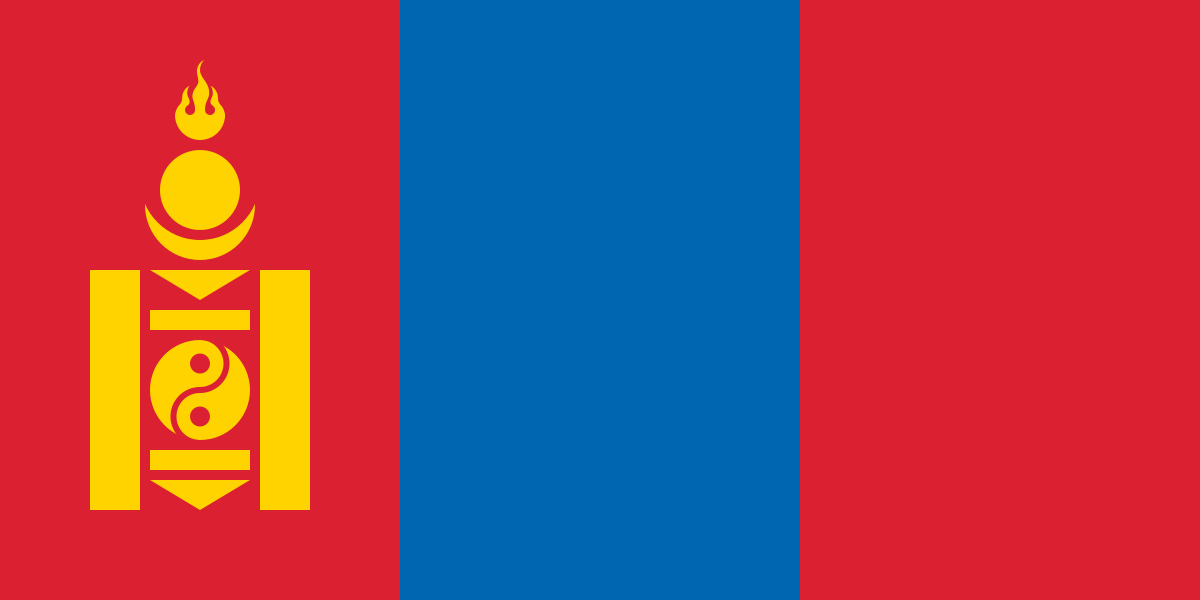
Mongolian revolution and consolidation
In an August 1945 telegram to Stalin he vowed that the friendship of the Mongolian and Soviet peoples would remain indestructible forever.
A military and political participant in Mongolia’s 1921 revolution. He consolidated power through close Soviet ties and directed major purges in the late 1930s. State-building and political and religious repression are inseparable parts of his leadership period.
Career timeline
- 1924–1928Commander-in-chief of the People's Revolutionary Army
- 1928–1930Chairman of the Presidium of the Little Khural
- 1930Foreign minister
- 1935–1939First deputy prime minister
- 1936Named Marshal of the Mongolian People's Republic
- 1939–1952Prime minister / head of government
- 1939Commanded MPR forces at Khalkhin Gol
The Socialist left's tribune who wrote 'Everything is possible', the Popular Front's left frontier
'Everything is possible', the title and the conclusion of his front-page article in Le Populaire as the strikes surged, 27 May 1936
A schoolmaster who became the leader of the Socialist SFIO's left. In 1935 he founded the Revolutionary Left tendency, supporting the Popular Front while arguing for a revolutionary way beyond it, and at the height of the strikes in May 1936 he planted himself at the centre of the argument with 'Everything is possible' in Le Populaire. He ran the premier's press service under Blum without ceasing to radicalize, and when the party expelled him in 1938 he founded the Workers' and Peasants' Socialist Party (PSOP). Exiled in Mexico during the war, he returned to the SFIO afterward and stood on its left and in the anticolonial camp until his death.
Career timeline
- 1895–1914Teacher's family in Seine-et-Marne; trained and worked as a schoolmaster
- 1914–1918The war turns him into an antimilitarist
- 1924–1935SFIO Paris federation; teachers' union activist
- 1935Founds the Revolutionary Left tendency inside the SFIO
- 1936.05Publishes 'Everything is possible'
- 1936–1937Runs the premier's press and information service
- 1938Expelled; founds the Workers' and Peasants' Socialist Party
- 1940–1946Exile in Mexico
- 1946–1958Returns to the SFIO; on its left and in the anticolonial camp
- 1958.06Dies in Paris
First woman to lead a major European communist party, and its sharpest anti-Stalinist apostate
“We are condemned to death, since terror reigns in Leningrad.” — her letter to Maslow, intercepted by Soviet censorship and read aloud at a Comintern special session, sealed her break with Stalin (February 1926).
Co-chair of the KPD (1924–1925), the first woman to lead a major European communist party. Born to a Vienna philosophy professor, she co-founded the Austrian Communist Party in 1918 and then, with Arkadi Maslow, led the KPD's ultra-left in Berlin, providing the theoretical groundwork for the 1923 uprising. A fierce factional warrior who publicly denounced Trotsky at the Fifth Comintern Congress, she was expelled in 1926 after refusing to submit to Stalin and spent the rest of her life as an anti-Stalinist left intellectual. Her dramatic trajectory took her from Comintern leadership to US intelligence cooperation in exile, and finally back toward communism in her final years.
Career timeline
- 1918Co-founds the Austrian Communist Party (KPÖ); member no. 1
- 1919–1921Moves to Berlin, joins the KPD
- 1921–1923Berlin district leader; with Maslow develops the left-wing 'theory of the offensive'
- 1924–1925KPD co-chair; Reichstag and Prussian Landtag deputy; candidate member of the Comintern Executive
- 1924Leads the German delegation to the Fifth Comintern Congress; publicly denounces Trotsky
- 1925–1926Detained in Moscow; refuses Stalin's demand to submit to the party line
- 1926Expelled from the KPD for supporting the United Opposition
- 1928Briefly joins the Leninbund, soon departs
- 1933–1941Exile in Paris; cooperates with Trotsky, founds the Gruppe Internationale
- 1941–1955Exile in the US; publishes Stalin and German Communism (1948)
- 1947Testifies before HUAC against her brothers Gerhart and Hanns Eisler
- 1955–1961Returns to Paris; publishes From Lenin to Mao (1956), renouncing anti-communism
“¡No pasarán!”: the voice of anti-fascism that refused to let Franco's armies pass
“If we let the fascists continue the crimes they are committing in Spain, aggressive fascism will fall upon other peoples of Europe too. The Spanish people prefer to die on their feet than live on their knees.” — Paris solidarity rally, 3 September 1936
The iconic leader of the Spanish Communist Party (PCE), whose cry of "¡No pasarán!" during the Civil War became the universal rallying cry of anti-fascism. She resisted the Franco dictatorship from exile and publicly opposed the 1968 Soviet invasion of Czechoslovakia.
Career timeline
- 1917Joins the Spanish Socialist Workers' Party (PSOE)
- 1918First article in El Minero Vizcaíno; adopts pen name 'Pasionaria'
- 1922Co-founds the unified Communist Party of Spain (PCE)
- 1930Elected to the PCE Central Committee
- 1933Founding president of the Union of Anti-Fascist Women
- 19357th Comintern Congress — elected candidate member of the ECCI
- 1936.2Elected to the Cortes for Asturias
- 1936.7Radio address “¡No pasarán!” — calls for the defence of Madrid against the fascist armies
- 1937Elected Vice-President of the Cortes
- 1939–1942Soviet exile — continues Comintern work
- 1941–1963Directs short-wave Radio España Independiente (Radio Pirenaica)
- 1942–1960General Secretary of the PCE
- 1945Co-founds the Women's International Democratic Federation; Vice-President
- 1960–1989Chair of the PCE
- 1968Publicly opposes the Soviet intervention in Czechoslovakia
- 1977Returns to Spain after Franco's death; re-elected to the Cortes after 41 years
The communist leader who turned Czechoslovakia into a people's democracy through the February 1948 coup
We are the party of the Czechoslovak proletariat and our supreme chief of staff is indeed Moscow. We go to Moscow to learn from the Russian Bolsheviks how to wring your necks. That grin will be wiped off your faces! Maiden speech in the Czechoslovak National Assembly, 21 December 1929
Born into a poor Moravian peasant household, he helped found the Communist Party of Czechoslovakia (KSČ) in 1921 and became its general secretary in 1929, leading it until his death. A Comintern secretary from 1935 to 1943, he helped shape the Popular Front line, and in May 1945 he returned to Prague as deputy prime minister and National Front chairman. After the KSČ won 38 per cent in the 1946 elections he became prime minister, and following the February 1948 coup he was elected Czechoslovakia's first Communist president on 14 June 1948. As president he drove nationalisation and agricultural collectivisation and instigated the trials of Milada Horáková, executed in 1950, and of Rudolf Slánský and Vlado Clementis, executed in 1952; he died on 14 March 1953.
Career timeline
- 1921Co-founds the Communist Party of Czechoslovakia (KSČ)
- 1929–1945General Secretary of the KSČ Central Committee
- 1935–1943Secretary of the Comintern
- 1938–1945Exile in Moscow; leads Czechoslovak communist resistance
- 1945–1946Deputy Prime Minister of Czechoslovakia
- 1946–1948Prime Minister of Czechoslovakia
- 1948–1953President of Czechoslovakia
A revolutionary who pursued workers' unity across communist divisions
After his arrest in 1936, Maurín remained in prison throughout the war, leaving the POUM under Andreu Nin's leadership in his absence.
Joaquín Maurín was a Spanish communist politician and labor activist who sought a mass revolutionary politics rooted in Catalonia. He led the Workers' and Peasants' Bloc while breaking with the Communist Party's Stalinist line, then co-founded the POUM with Andreu Nin in 1935 and became its first general secretary. Trapped in the insurgent zone when the military uprising began in 1936, he was arrested and spent the Civil War in prison, leaving Nin to lead the party in his absence. After his release and exile, he worked in New York as a writer and news-agency organizer, documenting the experience of the Spanish revolution.
Career timeline
- 1914–1920Taught in Lleida and joined the CNT
- 1920–1922Lleida CNT secretary and editor of Lucha Social
- 1921–1922Provisional secretary of the CNT national executive
- 1924–1930Organizer of the Catalan-Balearic Communist Federation
- 1931–1935General secretary of the Workers' and Peasants' Bloc
- 1935–1936Co-founder and first general secretary of the POUM
- 1936Popular Front deputy for Barcelona
- 1949–1973Founder of the American Literary Agency and writer in New York
CPGB founding member, chief theoretician for half a century, and pioneer of Marxist historiography on India
After Khrushchev's 1956 Secret Speech, Dutt told the CPGB Political Bureau: 'On Stalin's sun there were, unsurprisingly, some spots.' The Soviet system, he added, had 'demonstrated the ability of a socialist society to recognise and correct its mistakes.'
Founding member of the Communist Party of Great Britain and its chief theoretician for half a century, a Marxist historian and journalist. His Fascism and Social Revolution (1934) analysed fascism as an extreme form of monopoly-capitalist crisis, his India Today (1940) pioneered Marxist historiography on India, and he served as CPGB General Secretary in 1939–1941, replacing Harry Pollitt over the party's anti-war line at the outbreak of World War II.
Career timeline
- 1920Founding member, CPGB
- 1921–1974Founded and edited Labour Monthly (53 years)
- 1923–1965Member, CPGB Executive Committee
- 1924Alternate member, ECCI Presidium
- 1925–1935Comintern representative (Belgium & Sweden); supervised Communist Party of India
- 1936–1938Editor, Daily Worker
- 1939–1941General Secretary, CPGB
- 1943–1965Vice-chairman then Vice-president, CPGB
The PCF's number two for 37 years: a Stalinist who moved between parliament and the underground
'There was opportunism, legalitarianism and parliamentary illusions... If we courageously carry out this self-criticism before the Party, we shall arouse among the masses a state of mind favourable for the fight,' founding Cominform conference, Szklarska Poręba, September 1947
Number two in the French Communist Party leadership for 37 years alongside Maurice Thorez, entering parliament by defeating Léon Blum in Paris's 20th arrondissement. He directed the clandestine PCF throughout the German occupation and served as vice-president of the National Assembly after the war. At the founding Cominform conference in 1947, he publicly admitted that the party's participation in government had been 'parliamentary illusions,' symbolising the PCF's turn to militant opposition against the Marshall Plan. In 1969, he won 21.3% of the vote as the Communist presidential candidate, the party's best-ever result.
Career timeline
- 1915–1917Fights at Verdun, wounded; captured at Chemin des Dames
- 1920–1926Founding PCF member; enters Central Committee and Chamber of Deputies
- 1928–1936Defeats Léon Blum; enters Political Bureau; Chamber vice-president
- 1940–1944Heads the clandestine PCF; directs the Communist Resistance
- 1945–1947Deputy and vice-president; PCF in tripartite government
- 1947–1953Cominform self-criticism; anti-Marshall Plan turn; acting secretary-general
- 1959–1975Senator, Communist group president; 21.3% in 1969 presidential election
- 1975Dies in Montreuil; buried at Père Lachaise
Father of the Republic of Indonesia, the Marxist who fused communism with Islam
“If you think you can direct the Indonesian revolution from Moscow, you are no different from the colonialists.” — to Alimin, who came to Manila seeking approval for the 1926 uprising
Chairman of the Indonesian Communist Party and author of 'Towards the Republic of Indonesia.' He argued Marxism and Pan-Islamism must unite, broke with the Comintern, and after 1945 shook the fledgling republic with his demand for uncompromised independence.
Career timeline
- 1913Graduates from Kweekschool at Fort de Kock; receives high adat title of datuk
- 1913–1919Studies in the Netherlands; radicalised by the October Revolution and turns to Marxism
- 1919–1920Teaches children of tea-plantation coolies in Deli, Sumatra; writes 'Land of Paupers'
- 1921.6Founds 'Sarekat Islam Schools' (Tan Malaka Schools) in Semarang; spreads to Bandung
- 1921.12Elected chairman of the PKI at the Semarang congress, succeeding Semaun
- 1922Arrested by Dutch authorities; exiled to the Netherlands; stands as CPN parliamentary candidate
- 1922–1923Attends the Fourth Comintern Congress in Moscow; advocates communism–Pan-Islamism alliance
- 1923–1925Comintern Eastern Bureau agent; writes 'Towards the Republic of Indonesia' in Canton
- 1925–1927Based in Manila; opposes the PKI's 1926 uprising but fails to stop it
- 1927Founds the Indonesian Republic Party (PARI) in Bangkok, breaking with the Comintern
- 1927–1942Underground across China, Singapore, and the Philippines under aliases; writes 'Madilog'
- 1945–1946Returns to Indonesia; founds the Struggle Union (Persatuan Perjuangan); forces Sjahrir cabinet's temporary fall
- 1946–1948Arrested and imprisoned by Republican government; writes autobiography 'From Jail to Jail'
- 1949.2.21Captured and executed by Republican forces at Blimbing, East Java
Bulgaria's number two, who ran the repression and fell to a Stalinist purge
At the trial he withdrew his pre-trial confession and in his final statement tried to say it had been extracted under torture.
A leader of the Bulgarian Communist Party and, from his underground years, the second man to Georgi Dimitrov, later a Politburo member and deputy prime minister. From the Fatherland Front government of September 1944 he ran the party's central committee secretariat and pressed for maximum use of the death penalty, yet as economic chief he clashed with Stalin over Soviet purchase prices for Bulgarian tobacco. Arrested in 1949 and tried for British espionage and collusion with Tito, he was the only defendant in an Eastern European show trial to retract his confession in court, was hanged on 16 December, and was rehabilitated in 1956.
Career timeline
- 1920Joined the Bulgarian Communist Party
- 1924Sentenced to eight years for distributing communist press
- 1931Central Committee member, editor of party papers
- 1937Politburo member and Central Committee secretary
- 1942Sentenced to life while organising underground resistance
- 1945–48First secretary of the Central Committee
- 1946–49Deputy prime minister and minister of electrification, in charge of economic policy
- 1949Removed, arrested, tried and hanged
A British diplomat of war and decolonisation
At the 1945 San Francisco Conference, the foreign ministers of the four sponsoring Allied powers took turns chairing the plenary sessions, with Eden among them.
Anthony Eden was a British Conservative statesman whose First World War service reinforced his commitment to the League of Nations and collective security. He served three times as foreign secretary amid the rise of Nazi Germany and Fascist Italy, and during the Second World War acted as Winston Churchill’s principal diplomatic lieutenant in negotiations with the Soviet Union and the other Allies over the postwar order. Representing Britain at Yalta and at the 1945 San Francisco Conference, he helped shape the emerging international institutions, yet as prime minister he pursued the Suez invasion, exposing both the limits of British imperial power and Britain’s dependence on the United States.
Career timeline
- 1915–1919British Army officer, Western Front
- 1923–1957MP for Warwick and Leamington
- 1931–1934Under-Secretary for Foreign Affairs
- 1935–1938Foreign Secretary
- 1940–1945Foreign Secretary and War Cabinet minister
- 1945British representative at Yalta and the San Francisco Conference
- 1951–1955Foreign Secretary
- 1955–1957Prime Minister of the United Kingdom and Conservative Party leader
Chair of the founding congress who split with Mao on the Long March and defected to the Nationalists
At the 1935 Long March reunion he insisted on turning south to Sichuan rather than north to Shaanxi. Losing over 75% of his 80,000 troops discredited him in his army and Comintern.
A Peking University student leader in May Fourth, he chaired the party’s founding congress in 1921. After years of labour organising he went to the Eyuwan Soviet in 1931 and became political leader of the Fourth Front Army, which met Mao’s Central Red Army in Sichuan on the Long March in 1935. Clashing with Mao over marching north or west, he set up a rival “centre” and turned south, lost much of his army, and rejoined at Yan’an in 1936. Criticised in 1937, he fled to the Nationalist zone in 1938 and was expelled; he later wrote his memoirs in Hong Kong and Canada and died in Toronto.
Career timeline
- 1921Chairman of the First Party Congress
- 1931–1935Leader of the Eyuwan Soviet and the Fourth Front Army
First ethnic Uzbek to head the CP of Uzbekistan, who drove collectivization and cotton monoculture before the Great Purge destroyed him
"I am now a stripped, human-like beast." Recorded as Ikramov's last word at the Third Moscow Trial in March 1938, though other sources give the variant "you have turned me into an animal," so the exact wording is not settled.
Born in September 1898 in Tashkent into an Uzbek peasant family. He joined the Bolsheviks in February 1918, led party organs in Turkestan during the Civil War, and was secretary of the CC of the CP of Turkestan in 1921–1922. After studying at Sverdlov Communist University from 1922, he sat on the Orgburo that founded the CP of Uzbekistan in 1924–1925. From 1929 he was First Secretary, the first ethnic Uzbek in the post, and drove forced collectivization, making Uzbekistan the USSR's main cotton supplier. Elected to the all-Union Central Committee in 1934, he was dismissed in 1937, arrested on 20 September 1937, sentenced to death at the Third Moscow Trial in March 1938 and shot. Fully rehabilitated and restored to the party in June 1957.
Career timeline
- 1918–1920Teacher and inspector, Namangan education; head of rural work, Fergana oblast committee
- 1920–1921Deputy chairman Namangan revkom, chairman Muslim Bureau, executive secretary Fergana and Syrdarya oblast committees
- 1921–1922Head of organization department and secretary, CC CP of Turkestan
- 1922–1924Studied at Sverdlov Communist University, Moscow
- 1924–1929Orgburo for founding CP Uzbekistan; secretary Tashkent oblast; CC second secretary; editor of Kommunist
- 1929–1937First Secretary, CC CP Uzbekistan — drove collectivization and cotton monoculture
- 1934–1937Member, CC VKP(b) — sole ethnic-minority member
- 1937–1938Dismissed and arrested; sentenced to death at Third Moscow Trial; executed