Mars-dreaming GIRD co-founder and designer of the Soviet Union's first liquid-fueled rocket
His lifelong motto was 'Forward to Mars!'; he died of typhus in March 1933 and never saw the GIRD-X, the Soviet Union's first liquid-fueled rocket that he designed, fly six months later.
A Soviet rocket engineer and spaceflight theorist of Baltic German descent. In 1931 he co-founded the Group for the Study of Reactive Motion (GIRD) in Moscow with Sergei Korolev, and as head of Brigade No. 1 designed the GIRD-X, the first liquid-fueled rocket launched in the Soviet Union. He proposed pioneering concepts including space greenhouses, solar sails, winged rockets, and atmospheric braking, and pursued interplanetary flight his whole life under the motto 'Forward to Mars!'
Career timeline
1914Graduated, Riga Polytechnic Institute
1915–1919Engineer, Provodnik rubber plant, Moscow
1919–1926Engineer, Motor aircraft plant
1926–1930Engineer, Central Design Bureau of Aviation
A pilot who earned four St. George Crosses in the air fighting of the First World War went over to the revolution and in 1920 personally led the storming of the citadel of Old Bukhara.
Georgy Zinoviev was a military officer who moved from service as a pilot in the First World War to command in the revolutionary Red Army. In the 1919 counteroffensive on the Eastern Front, he led the Turkestan Army through the Buguruslan, Belebey and Ufa operations, helping turn back Kolchak's advance. After the Civil War, he helped institutionalize the early Soviet armed forces through senior posts in military education and engineering administration.
Career timeline
1915–1917Pilot, 6th Corps Aviation Detachment, 2nd Army, Western Front
1917Chairman, soldiers' committee of the 3rd Siberian Rifle Corps
1918Commander, Smolensk garrison
1918–1919Commander, Orenburg, Aktyubinsk and Orsk-Aktyubinsk sectors
1919Commander, Turkestan Army
1919–1920Commander, 1st Army
1920–1921Member, Revolutionary Military Council of the Turkestan Front
1932–1934Head and commissar, Military Engineering Academy
A revolutionary who consistently pursued the intra-party left line, from Left Communism to the United Opposition
In February 1918, as chairman of the Moscow Regional Bureau, he led the resolution opposing Lenin's course of accepting the Brest-Litovsk Treaty.
Having joined the Bolsheviks in 1905 and endured six years in tsarist prisons and exile, he led the Left Communists against the Brest-Litovsk Treaty as chairman of the Moscow Regional Bureau in 1918. During the Civil War he served on the Revolutionary Military Council of the 5th Army and chaired the Ufa Revolutionary Committee, then adhered to every major intra-party left opposition: the Democratic Centralists (Decists), the Declaration of the 46 (1923), and the United Opposition (1926–27). Expelled and exiled in 1927, he returned to work as head of the Economic Research Sector of the RSFSR People's Commissariat of Finance, but was arrested and shot in 1936.
Career timeline
1905Joined RSDLP, Bolshevik faction
1917Chairman, Moscow Regional Bureau of RSDLP(b)
1918Member, Revolutionary Military Council, 5th Army
First People's Commissar for Agriculture in the Soviet coalition, co-author of the Law on the Socialization of Land
'What emerged was not a law on the socialization of land, but on the nationalization of land.' — on the Bolshevik-amended land law passed by the Third Congress of Soviets, January 1918
A Left Socialist Revolutionary leader who served as the first People's Commissar for Agriculture in the Soviet coalition government (November 1917–March 1918), co-authoring the landmark Law on the Socialization of Land with Ivan Mayorov. He resigned in protest against the Brest-Litovsk Treaty but refused to join the July 1918 Left SR uprising, instead founding the Party of Revolutionary Communists and joining the Bolshevik Party that November. A key architect of revolutionary agrarian reform who navigated the SR–Bolshevik coalition and later served on the Revolutionary Military Council of the Southern Front during the Civil War.
Career timeline
1906Joined the SR Party; expelled from Kharkov University for political activity
1909–1916Exiled abroad; studied in Paris, joined the Left SR group
1917Leader of Kazan Left SRs, chair of Kazan Gubernia Soviet of Peasant Deputies; SR Central Committee member; delegate to Second Congress of Soviets, VTsIK member
1917.11–1918.3People's Commissar for Agriculture of the RSFSR; co-authored the Law on the Socialization of Land with Mayorov
1918.5–7Chair of Kazan Gubernia Soviet Executive Committee; refused to support the Left SR uprising
1918.7–11Founded and led the Party of Revolutionary Communists; joined RCP(b) in November
1919–1920Member of the RVS of the Southern Front; chair of the Special Food Commission
1921–1935Administrative and economic work in Narkomat of Communications, Moskust, and other bodies
Imperial staff officer who rose to the top of the Red Army command
"Kork is my pride. Just as every front has one commander who plays first violin — that violin on the Western Front is Kork" — Commander-in-Chief Sergey Kamenev to Tukhachevsky, direct line, 1920
Born to an Estonian peasant family, Kork graduated with distinction from the Imperial General Staff Academy and became an elite staff officer. Volunteering for the Red Army in 1918, he commanded the 15th Army in the defence of Petrograd and the Polish-Soviet War, then led the 6th Army to destroy Wrangel's White forces in the Perekop-Chongar operation. After the Civil War he rose to command the Moscow Military District and head the Frunze Military Academy, reaching the rank of Komandarm 2nd rank (the highest Red Army rank below Marshal) and also served as Soviet military attaché in Germany. Arrested in the 1937 Tukhachevsky case, he was shot and posthumously rehabilitated in 1957.
Career timeline
1908–1914Officer, 98th Yuryevsky Infantry Regiment; graduated Nikolaev General Staff Academy (1st class)
1914–1917WWI: staff officer, 20th Corps, 3rd Siberian Corps, 10th Army; aviation staff officer, Western Front (Captain, General Staff)
1918.06Volunteered for the Red Army; Operations Department, Vseroglavshtab
1919.02–05Chief of Staff, Estonian Red Army
1919.06–08Assistant Commander, 7th Army — defence of Petrograd against Yudenich
1919.08–1920.10Commander, 15th Army — Polish-Soviet War
1920.10–1921.05Commander, 6th Army — Perekop-Chongar operation, final defeat of Wrangel
1921–1922Commander, Kharkov Military District; Assistant Commander, Armed Forces of Ukraine and Crimea
1922–1923Commander, Turkestan Front — operations against Basmachi rebels
1924–1927Commander, Western Military District → Red Banner Caucasus Army → Belorussian Military District
1927–1928Commander, Leningrad Military District
1928–1929Soviet military attaché in Germany; trained at Reichswehr facilities
1929.05–11Chief, Red Army Supply Directorate
1929–1935Commander, Moscow Military District
1935–1937Head and Commissar, Frunze Military Academy (Komandarm 2nd rank)
First People's Commissar of Posts and Telegraphs who later built Rostselmash, flagship of Soviet agricultural machinery
In June 1918 at Novorossiysk, as Commissar of the Black Sea Fleet, he ordered the fleet scuttled rather than surrendered to the Germans, instructing sailors: "Moscow will radio orders to sail to Sevastopol for diplomatic reasons — do not count that radio as an order."
Nikolai Glebov-Avilov was a Bolshevik revolutionary from 1904 who ran underground printshops during the 1905 Revolution. After October 1917 he became the first People's Commissar of Posts and Telegraphs in the inaugural Sovnarkom, then served as VTsSPS secretary and chairman of the Petrograd Trade Union Council, emerging as a central figure in Bolshevik trade union politics. At the Fourteenth Party Congress in 1925 he led the Leningrad Opposition alongside Grigory Zinoviev and was removed; he later became first director of Rostselmash (1929–1936), building the Soviet Union's flagship agricultural machinery plant. Arrested in the Great Purge, he was executed in 1937 and rehabilitated in 1956.
Career timeline
1899–1904Printshop worker in Kaluga, joined Bolsheviks
1905–1907Underground revolutionary work in Kaluga, Moscow, Urals
1912–1914Party school in Bologna, contributor to Pravda
1917.3–10Secretary of Petrograd Central Bureau of Trade Unions, trade union MRC representative
1917.11–12First People's Commissar of Posts and Telegraphs (first Sovnarkom)
1918–1921Commissar of Black Sea Fleet, VTsSPS presidium, Ukrainian People's Commissar of Labor
1923–1926Chairman of Leningrad Trade Union Council, Opposition leader at XIV Congress
Leader of the 'Democratic Centralists' who demanded inner-party workers' democracy
'To call such an economy socialist means committing a crime before the working class and discrediting the ideas of communism.' From 'The Agony of Petty-Bourgeois Dictatorship', written December 1931, published 1932
Born into a Russian peasant family in the village of Mostaushka, Tula Governorate, he worked as a house painter from the age of 15, joined the revolutionary movement in 1905 and became a Bolshevik in 1912. After the October Revolution he served as chairman of the Moscow Provincial Executive Committee and of the Kharkov provincial revkom, deputy chairman of VSNKh, secretary of VTsIK and chairman of the Small Sovnarkom. In the early 1920s he led the 'Democratic Centralists' demanding inner-party democracy, was expelled at the 15th Party Congress in 1927 and exiled, and later became a key theoretician of the Left Opposition. In December 1931 he wrote 'The Agony of Petty-Bourgeois Dictatorship', analysing the Soviet system as a 'deformed state capitalism'; he was executed in Moscow on 28 September 1937.
Career timeline
1905–1916Organized construction workers in Moscow; founded a builders' union
1917–1919Chairman of the Moscow Provincial Executive Committee
1920Chairman of Kharkov Provincial Revkom and Executive Committee
1920–1921Leader of the 'Democratic Centralists'; fought for inner-party democratization
1921–1923Deputy Chairman of VSNKh; Secretary of VTsIK
1923–1925Chairman of the Small Sovnarkom; Chairman of VTsSPS
1926–1927Led the Group of 15; advanced the 'state capitalism' thesis
1927–1937Expelled from the party, exiled, wrote 'The Agony of Petty-Bourgeois Dictatorship', arrested and shot
From Moscow uprising artillery commander to Left Communist and Democratic Centralist
Building socialism in pre-industrial Russia alone was 'a side turning off the main highway of European socialism' — foredoomed to failure.
A Moscow law student and Bolshevik from 1907, he formed a Marxist theorists' trio with Nikolai Bukharin and Valerian Osinsky. In October 1917 he commanded the heavy artillery that secured Bolshevik victory in Moscow, and served as People's Commissar of Trade and Industry in early 1918. A Left Communist opponent of Brest-Litovsk, he spent the next decade in successive oppositions (Democratic Centralist, signatory of the Declaration of 46, and United Opposition ally of Trotsky, Zinoviev, and Kamenev) consistently pressing for party democracy. From 1921–1927 he sat on the Gosplan Presidium, chaired the Vesenkha financial commission, served on the Council of Labor and Defense, and edited Pravda. He regarded Russian socialism in isolation as 'a side turning off the main highway of European socialism, foredoomed to failure,' and after expulsion declared the revolution dead under Stalin.
Career timeline
1907Joined the Bolsheviks
1909–1914Law student at Moscow University, agitator for Moscow Committee
1914–1917Warrant officer, artillery, Russian Imperial Army, Western Front
1917Editor of Sotsial-Demokrat, member of Moscow Military Revolutionary Committee, commanded heavy artillery
1918.02–1918.04People's Commissar of Trade and Industry, RSFSR
1918–1921Left Communist, leader of the Military Opposition, worked in Vesenkha (VSNKh)
1920–1923Leader of the Democratic Centralists ('Decists')
1921–1927Presidium of Gosplan, board of Council of Labor and Defense, chair of Vesenkha financial commission, board of Central Statistical Administration
1923Signed the Declaration of 46
1924–1926Editorial board member of Pravda and Ekonomicheskaya Zhizn
1926–1927Formed the 'Group of 15' with Sapronov, joined the United Opposition
1927.12Expelled at 15th Party Congress, sentenced to 3 years exile in the Urals
1930–1937Repeated imprisonment and exile, transferred to Moscow from Suzdal special prison
1937.05.26Sentenced to death by Military Collegium, shot same day
Latvian Bolshevik who denounced NKVD case fabrication in court
In the trial record cited by Khrushchev in 1956, Rudzutak asked to report NKVD fabrication and coerced confessions to the Central Committee.
Latvian Bolshevik and trade-union leader. Born to peasant farmhands, he joined the party in 1905 and was sentenced to hard labour in 1909, released in 1917. He served as People's Commissar of Railways, a full Politburo member and head of the Central Control Commission; arrested in May 1937, he denied guilt in court and denounced NKVD case fabrication. Shot on 29 July 1938, he was rehabilitated when the 1955 review established the case was falsified.
Career timeline
1905–1909Underground Bolshevik organiser in Riga and Vindava; arrested, 10 years' hard labour
1917Secretary of All-Russian Textile Workers' Union; Moscow Trade Union Council presidium
1918–1920Chairman of Moscow Sovnarkhoz; member of VSNKh Presidium
1920–1921Chairman of Turkestan SNK; member of Turkestan Front RVS
1924–1930People's Commissar for Railways USSR
1926–1932Full member of Politburo CC VKP(b)
1931–1934Chairman of CCC + People's Commissar of RKI USSR
1937.5.25Arrested as 'Latvian nationalist anti-Soviet' conspirator; denounced NKVD fabrications in court
1938.7.29Sentenced to death by Military Collegium; shot same day
The Siberian food chief whose name is one letter away from a Politburo member
His surname is Koganovich, while the Politburo member Lazar Kaganovich spelled his Kaganovich. That one letter is why the initial-less "Kaganovich" in the list of the 46 is so often misread.
Born in Kostroma, he joined the RSDLP in 1905 and was arrested several times before the revolution. He took part in establishing Soviet power in Kostroma in 1917 and worked in food procurement during the civil war. From April 1920 he chaired the Siberian Food Committee and sat on the Siberian Revolutionary Committee with a deciding vote. In 1927 he joined the Left Opposition and signed the platform of the 83. He was arrested on 20 June 1937, sentenced to death by the Supreme Court on 17 March 1938, shot the same day, and rehabilitated on 10 July 1958. Annotated editions of the Declaration of 46 identify him as the initial-less "Kaganovich" in the list of signatories. He is not Lazar Kaganovich, who at the time headed the organizational-instruction department of the Central Committee.
Career timeline
1905Joined the RSDLP
1917Took part in establishing Soviet power in Kostroma
First chairman of VSNKh; theorist of the Left Communists and of Democratic Centralism
Sent in November 1917 to break the sabotage of State Bank officials, he became the bank's first manager and obtained the keys to its vaults and cash for the Sovnarkom, moving to the chairmanship of VSNKh on 23 December.
Born in Kursk province into a small-landed noble family, he studied law at Moscow University and joined the Bolsheviks in 1907. Appointed a commissioner of the State Bank in November 1917 after the October Revolution, he secured the keys to its vaults and its funds, and in December became the first chairman of the Supreme Economic Council (VSNKh). A theoretical leader of the Left Communist group that opposed the Treaty of Brest-Litovsk in 1918, he co-led the Democratic Centralism group in 1920-21, which demanded open discussion and the representation of minority views in the party. He later served as deputy chairman of Gosplan and head of the Central Statistical Administration, was arrested in 1937, executed on 1 September 1938 and rehabilitated in 1957.
Career timeline
1907Joins the Bolsheviks; party work in Moscow, Tver, Kharkov
1911Graduates from Moscow University, law faculty
1917.12–1918.3First chairman of VSNKh and first manager of the State Bank
1918Left Communist; co-authors platform against Brest-Litovsk Treaty
1920–21Co-leader of the Democratic Centralism group
1921–23Deputy People's Commissar for Agriculture
1923–24USSR plenipotentiary to Sweden
1925Member of the Gosplan Presidium
1926–28Head of the Central Statistical Administration of the USSR
1929–30Deputy chairman of VSNKh USSR
1932–37Deputy chairman of Gosplan and chairman of the state commission for determining yield and gross harvest
1932Full member, USSR Academy of Sciences
1935Full member, VASKhNIL
1935–37Director, Institute of the History of Science and Technology
Stalin's famine envoy and terror executor called the 'hangman of Ukraine', executed in 1939
His letter in Pravda on 28 December 1935 called for installing New Year trees in schools, children's homes, Pioneer palaces, clubs and theatres, restoring the banned yolka; the first officially organised Soviet yolka followed in Kharkiv on 30 December 1935.
Born into a weaver's family in Ivanovo-Voznesensk, he joined the Russian Social-Democratic Labour Party in 1904 and was arrested in 1908, spending four years in Vladimir Central Prison before deportation to the Irkutsk region. During the October Revolution he helped bring Irkutsk under Bolshevik control and took part in creating the Far Eastern Republic; transferred to Ukraine in 1923, he became secretary of the Ukrainian Central Committee in 1925. Some 100,000 CP(b)U members were expelled in the 1933-34 purge, and he was widely known as the 'hangman of Ukraine'; moved to Kuibyshev as first secretary in 1937, he expanded the Great Terror there until his arrest on 21 February 1938, his execution after a fabricated confession, and his rehabilitation in 1955.
Career timeline
1904–1917Underground Bolshevik in Ivanovo-Voznesensk and Irkutsk; participated in 1905 Ivanovo strike, multiple arrests and Siberian exile
1917–1922Deputy chairman of Irkutsk Soviet, chairman of Revolutionary Tribunal, Centrosibir member, military commissar in Far Eastern Republic
1924–1930Secretary of Kiev and Kharkov party committees, Secretary of CC CP(b)U
1930–1933Secretary of CC VKP(b), head of Organizational-Instructional Department
1932.11–12Stalin's special plenipotentiary to Lower Volga and Ukraine for grain requisitions during the famine
1933–1937Second Secretary CC CP(b)U — real power behind Kosior; directed mass purges and Russification, expelled ~100,000 from the party
1934–1938Candidate member of Politburo CC VKP(b)
1937–1939Demoted to First Secretary of Kuibyshev Oblast; arrested Feb 1938, shot 26 Feb 1939
The geneticist who built the world's largest seed bank and stood against Lysenko
“We shall go into the pyre, we shall burn, but we shall not retreat from our convictions.” — Leningrad, 1939, as Lysenko's persecution reached its peak.
Russian and Soviet geneticist and botanist. He discovered the law of homologous series in hereditary variation, developed the theory of centers of origin of cultivated plants, and built the world's largest seed collection: over 250,000 samples gathered across some 180 expeditions worldwide. As the first president of the All-Union Academy of Agricultural Sciences (VASKhNIL) and longtime director of the Institute of Plant Industry (VIR), he led Soviet agricultural science, until his open opposition to Lysenko's pseudoscience provoked his arrest on fabricated charges in 1940. He died of dystrophy in Saratov prison in 1943 and was posthumously rehabilitated in 1955.
Career timeline
1917–1920Professor at Saratov University, plant immunity research
1920Discovery of the law of homologous series in variation
1920–1940Director, All-Union Institute of Plant Industry (VIR)
1926Published theory of centers of origin of cultivated plants
1929–1935President, All-Union Academy of Agricultural Sciences (VASKhNIL)
1930–1940Director, Institute of Genetics, USSR Academy of Sciences
1931–1940President, All-Union Geographical Society
1935–1940Vice-president of VASKhNIL, openly opposed Lysenko's doctrines
Japanese general who directed Okinawa's war of attrition
Even after defeat was clear, he rejected a surrender appeal and ordered his remaining forces to fight to the end.
Mitsuru Ushijima was an Imperial Japanese Army officer who commanded formations in the war against China and the Pacific War. Sent to Okinawa in 1944, he led the 32nd Army in a defense-in-depth and war of attrition in the south rather than a beach battle, while its system also mobilized civilians for labor and combat. His May 1945 withdrawal from Shuri prolonged resistance but drew refugees into the battlefield and increased civilian losses; he rejected surrender and killed himself in June.
Career timeline
1908Graduated from Army Academy, 20th class; infantry second lieutenant
1916Graduated from Army Staff College, 28th class
1918–1919Staff of the Siberian Intervention force, transport and deployment
1937–1939Commander, 36th Infantry Brigade, China campaigns
1939–1941Commander, 11th Division, stationed at Hulin, Manchukuo
1942–1944Commandant, Imperial Japanese Army Academy
1944–1945Commanding general, 32nd Army, Okinawa defense
A Bolshevik praktik who pushed the movement's radical edge
“Until power has been transferred to the Soviets, there is no hope for an early end to the war.”
Sergei Bagdatev was a Bolshevik praktik who joined the party in 1903 and continued underground organizing through tsarist repression and exile. In April 1917, he issued a leaflet in the Petrograd Committee's name calling for the Provisional Government's removal, contrary to party decisions, and was disciplined for violating party discipline. His premature slogan, alongside his insistence on Soviet power, captures the revolution's tension between an urgent political aim and the practical work of winning a mass audience.
Career timeline
1903Joined the Russian Social Democratic Labour Party
1908Member of the Petersburg Committee and its executive commission
1917Petrograd Committee praktik; issued the April demonstration leaflet
1917Took part in the June and July demonstrations; arrested by the Provisional Government
1918–1925Party work in Moscow and Transcaucasia
1926–1939Deputy chair of the Irrigation Committee under the USSR Council of People's Commissars; chaired Rezino-trest and other bodies
Kremlin cardiologist who became the first victim of Stalin's Doctors' Plot
He suffered twenty-nine heart attacks in custody, ten of them during interrogations in Ryumin's office.
Born into a prosperous Jewish merchant family in Minsk and educated in medicine in Germany, Etinger was a pioneering Soviet cardiologist. As a longtime consultant to the Kremlin medical administration, he treated Soviet and international communist leaders including Kirov, Ordzhonikidze, Dimitrov, and Togliatti, and was a pioneer in electrocardiographic diagnosis; in 1950 he was discussed as a possible Nobel Prize candidate. Arrested in November 1950 as the first victim of the Doctors' Plot, he was tortured by MGB investigator Ryumin and died in Lefortovo Prison in March 1951; Ryumin then used his death as the lever to accuse Minister Abakumov of covering up a conspiracy, expanding the case into a full-scale antisemitic campaign.
Career timeline
1913M.D., University of Berlin
1914–1917Military doctor, Imperial Russian Army field hospital
1918–1920Chief of a major military hospital, Red Army
1922–1932Assistant, then privat-docent, Internal Medicine, 1st Moscow University
1929–1950Consultant, Kremlin Medical Administration
1932–1949Chair of Internal Medicine, Pediatric Faculty, 2nd Moscow Medical Institute
1950–1951Arrested by MGB, died under torture in Lefortovo Prison
The general who represented Germany's surrender in Italy
On 29 April 1945 at Caserta, his representatives signed the surrender instrument for the German forces in Italy.
Born into a Prussian military family, Heinrich von Vietinghoff became a senior commander after serving in the Imperial Army and the Reichswehr. He took part in the invasions of Poland and the Soviet Union, and from 1943 commanded German defensive operations in occupied Italy. In April 1945 he negotiated with the Allies at Caserta and represented the German forces in the surrender arrangements, making him a central participant in ending the German war in Italy. After captivity, he joined West German rearmament discussions.
Career timeline
1906–1918Officer in the Prussian Army; served in the First World War
1919–1935Officer of the Reichswehr; served in the Army Ministry and corps staff
1938–1939Commander of the 5th Panzer Division
1940–1942Commander of the XLVI Panzer Corps in the Balkans and on the Eastern Front
1942–1943Commander-in-chief of the Ninth and Fifteenth Armies
1943–1944Commander-in-chief of the Tenth Army in Italy, defending the Gustav and Gothic Lines
1944–1945Commander-in-chief of Army Group C and the Southwest theatre
1945Represented the German forces in the Caserta surrender arrangements
The Indian Marxist who debated Lenin on colonial revolution
"You are so young! I expected a grey-bearded wise man from the East." — Lenin's first words to the 27-year-old Indian revolutionary upon meeting him at the Kremlin, 1920.
Bengali Marxist. He debated Lenin on the colonial question at the 1920 Comintern Congress and founded the Mexican Communist Party (the first outside Russia) as well as the CPI. Expelled from the Comintern, he served six years in British prisons before turning to Radical Humanism.
Career timeline
1917Co-founded the Socialist Party of Mexico, soon transformed into the Mexican Communist Party
1919Founded the Mexican Communist Party, the first communist party outside Russia
1920Presented supplementary theses on the colonial question at the 2nd Comintern Congress, debated Lenin
1920Founded the Communist Party of India (Tashkent group) in exile
1922–1929Member of the Comintern Executive Committee and Presidium; secretary of the Chinese Commission
1929Expelled from the Comintern for siding with Bukharin's Right Opposition
1931–1936Arrested by British colonial authorities, imprisoned for 6 years on conspiracy charges
1940–1948Founded the Radical Democratic Party; supported the anti-fascist war effort
1947Published the New Humanism manifesto, articulating his Radical Humanist philosophy
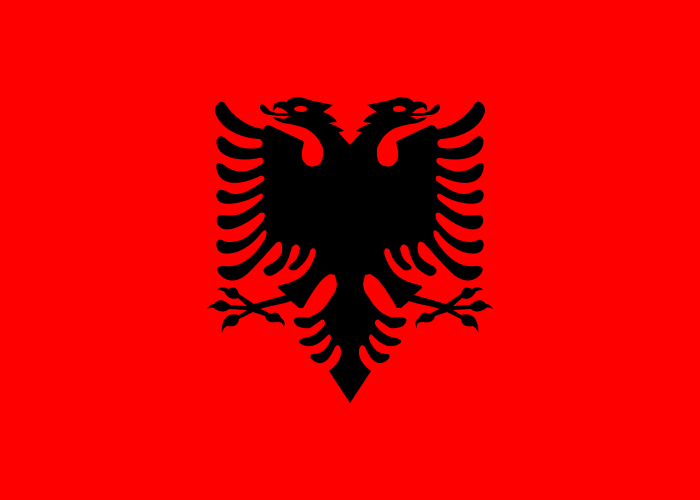
Albanian physician and politician, the people's republic's formal first head of state
The Constituent Assembly opened on 11 January 1946 and proclaimed the people's republic the same day, becoming the People's Assembly on 16 March. Other records give election on 10 or 12 January and departure on 31 July.
Albanian physician and politician. Born on 5 February 1887 in Gjirokastër, Ottoman Empire, he studied medicine in Istanbul, served two weeks in prison over a 1924 attempt on Zogu, backed Fan S. Noli's June Revolution and co-founded the anti-Zogu KONARE in exile in 1925. After the Italian invasion of 1939 he joined the occupation government's Council of State, later regarded it as a mistake, joined the National Liberation Movement and chaired the Anti-Fascist Council at the Congress of Përmet in 1944. In 1946 he became chairman of the Constituent Assembly and served as formal head of state until 1953, though real power lay with Enver Hoxha, first secretary of the Party of Labour.
Career timeline
1914–1920According to Albanian Wikipedia, he served in the Gjirokastër battalion and in Vlorë in 1914 and was sent to Vienna; municipal physician in Ballsh 1915–1918 and physician at Tirana hospital in 1920
1923–1924Municipal physician in Durrës
1924Imprisoned two weeks over an assassination attempt on Zogu; backed Fan S. Noli's June Revolution, fled abroad and was sentenced to death in absentia
1925–1932Helped found the anti-Zogu KONARE and edited its newspaper Liria Kombëtare in Geneva (editor from 1926)
1933–1939Political emigrant in Zante, Greece; returned after the Italian invasion of 1939
1940–1943Member of the occupation government's Council of State, listed until 13 January 1944, joining the Front in August 1943; later joined the National Liberation Movement
1943.9Chairman of the Standing Committee of the National Liberation General Council
1944.5Chairman of the Anti-Fascist National Liberation Council at the Congress of Përmet, in charge of foreign affairs
1944.10–1946Minister of Foreign Affairs in the Anti-Fascist National Liberation Committee chaired by Enver Hoxha (until 9 February or 22 March 1946 according to different sources)
1946–1954Deputy for Gjirokastër (elected in the 2 December 1945 and 28 May 1950 elections)
1946.1–1953Chairman of the Constituent Assembly and then of the Presidium of the People's Assembly as formal head of state (English Wikipedia records the Constituent Assembly chairmanship; ShtetiWeb dates election to 12 January and service to 31 July)
1952–1953His brother Besim Nishani was arrested for propaganda against the people's government (arrested 1 October 1952, eight months in pre-trial detention) and his wife separated from him; a 1953 right-wing press report described her forced eviction and house arrest and his own virtual captivity
1953.7Officially requested to resign citing health on 24 July, with Haxhi Lleshi succeeding on 1 August; other records say Hoxha forced the resignation
A diplomat of empire who became the defeated state's signatory
On September 2, 1945, aboard USS Missouri, he signed the Instrument of Surrender for the Emperor and the Japanese government.
Mamoru Shigemitsu was a Japanese imperial diplomat and politician who carried out state diplomacy while warning against the military's expansion. After losing his right leg in the 1932 Shanghai bombing, he returned to public life and in 1945 signed the Instrument of Surrender for the Emperor and Japanese government as foreign minister. Convicted at the Tokyo Trial and sentenced to seven years for aggressive war and related failures concerning prisoners of war, he was paroled in 1950 and later returned as foreign minister and deputy prime minister, helping steer Japan back into international diplomacy.
Career timeline
1911Entered the Ministry of Foreign Affairs
1928–1930Consul-General in Shanghai
1930–1933Minister to the Republic of China
1936–1938Ambassador to the Soviet Union
1938–1941Ambassador to the United Kingdom
1943–1945Foreign Minister and Minister of Greater East Asia
1945Japanese signatory of the Instrument of Surrender
1954–1956Deputy Prime Minister and Foreign Minister
Revolutionary who went from Left SR leader to architect of Soviet chemical warfare
In July 1918, Left SR Central Committee member Fishman personally manufactured the two bombs used to assassinate German ambassador Wilhelm von Mirbach and handed them to his comrades.
An SR militant who escaped Siberian exile to study explosives and poison-gas chemistry at the University of Naples, Fishman returned in 1917, became a Left SR Central Committee member, and personally manufactured the bombs for the 1918 assassination of German ambassador Mirbach. After joining the Bolsheviks in 1920, he was appointed the first head of the Red Army's Military-Chemical Directorate (VOKhIMU) in 1925, laying the foundations of the Soviet chemical and biological weapons program; his 1928 report to Voroshilov argued for the offensive use of bacteriological warfare. Arrested in 1937 and sentenced to ten years, he developed a new gas mask model at the NKVD Special Technical Bureau; he was rehabilitated in 1955 with the rank of major general of technical troops.
Career timeline
1904Joined the Socialist Revolutionary Party
1905Petrograd Soviet deputy; led Okhta Powder Factory combat druzhina
1917Left SR Central Committee member; took part in the October Revolution
1918Left SR combat druzhina chief; manufactured bombs for Mirbach assassination
1921–1925Red Army intelligence officer; military attaché in Italy and Germany
1925–1937Head of Red Army VOKhIMU; director of Institute of Chemical Defence
1937–1947Arrested, 10-year sentence; developed gas mask at NKVD Special Technical Bureau
1955Rehabilitated; promoted to major general of technical troops
The deputy who founded the Jeunesses Patriotes, holding a street force and a seat in the Chamber at once
He kept a parliamentary seat and a paramilitary organisation at the same time, on the principle that the street belonged to his side too. The Jeunesses Patriotes were among the columns that reached the Concorde on the night of 6 February 1934, and several of the fifteen dead were their members
A First World War veteran turned deputy who founded the Jeunesses Patriotes in 1924 against the incoming Cartel des Gauches and built it into a paramilitary body tens of thousands strong. Equipped with blue raincoats and berets, it broke up Communist meetings and fought for the streets, while its leader kept his seat inside parliament: a doubleness characteristic of the French leagues. On 6 February 1934 the Jeunesses Patriotes formed one of the main columns on the Place de la Concorde, and some of the dead came from its ranks. He voted full powers to Pétain in 1940, presided over the Paris municipal council under the occupation, and was detained and then released after the liberation.
Career timeline
1887–1918Born in Paris; serves in the First World War
1919–1940Deputy in the Chamber
1924Founds the Jeunesses Patriotes
1925–1936Commands a paramilitary league tens of thousands strong
1934.02.06The Jeunesses Patriotes form one of the main columns on the Concorde
1940.07Votes full powers to Pétain
1943–1944Presides over the Paris municipal council under the occupation
1944–1945Detained after the liberation, then released
The Soviet Union's greatest partisan commander, who raided all the way to the Carpathians
"The flames lit up the slopes of the Carpathians… it was as bright as day at night, and the roar of burning oil drowned out even the engines of the German planes that never gave us rest." — Kovpak recalling the 1943 Bytkiv oilfield raid.
A Soviet partisan commander from Ukraine. He organized a unit at Putivl in 1941 and led it on daring raids thousands of kilometers behind German lines, all the way to the Carpathians, earning the title Hero of the Soviet Union twice.
Career timeline
1908–1912Service in the Russian Imperial Army, 186th Aslanduz Infantry Regiment
1914–1917WWI service as scout and NCO, George Cross III & IV class
1918–1919Commander, Kotelva Red Partisan Detachment
1919–1926Red Army supply and military commissar roles
1926–1939Director of military cooperatives, head of Putivl road department
1940–1941Chairman, Putivl City Executive Committee
1941–1943Commander, Sumy Partisan Unit; promoted to General-Major (1943)
1944–1947Member, Supreme Court of the Ukrainian SSR
1947–1967Deputy Chairman, Presidium of the Supreme Soviet of the Ukrainian SSR
The general who defended Guadalcanal and the Marine Corps
In his 1946 Senate testimony, he argued that Congress should decide the Marine Corps' future: “The bended knee is not a tradition of our Corps.”
Alexander Vandegrift was a United States Marine Corps general whose Pacific War command combined amphibious assault with determined defense. In August 1942 he led the 1st Marine Division ashore at Guadalcanal, organized the defense around Henderson Field, and held the beachhead through sustained Japanese air, land, and naval pressure, making the campaign the first major U.S. ground offensive of the war. As Commandant after the war, he defended the Marine Corps' independent role against proposals to absorb it into the Army, appealing to Congress in his 1946 Senate testimony.
Career timeline
1909Commissioned second lieutenant, U.S. Marine Corps
1912–1914Served in expeditions in Cuba, Nicaragua, and Mexico
1915–1923Served in the occupation of Haiti and its constabulary
1942Commanded 1st Marine Division in the Guadalcanal landing and defense
1943Commanded I Marine Amphibious Corps at Bougainville
1944–194718th Commandant of the U.S. Marine Corps
1945First active-duty Marine promoted to four-star general