East Germany: from Soviet military administration to the German Democratic Republic
From the Soviet military government of 1945 to the founding of the German Democratic Republic in October 1949, through what procedures did power gather in the Socialist Unity Party, and why was this state founded later than the other people’s democracies?
SMAD was set up at Karlshorst in June 1945, and the Ulbricht Group, back from Moscow at the end of April, organised Berlin’s administration. Parties were licensed on 10 June, and the KPD, SPD, CDU and LDP formed an antifascist bloc bound by unanimity. The Soviets took reparations through dismantling and Soviet joint-stock companies, and more than 150,000 people passed through the special camps. The land reform of September 1945 redistributed estates over 100 hectares, and the Saxony referendum of June 1946 approved industrial expropriation. In April 1946 the KPD and SPD were merged under pressure into the SED, which in the October elections won a majority in no state and only 19.8 per cent in Berlin. From 1947 the German Economic Commission and the People’s Congress movement built the framework of a state, and in 1948–49 the SED became a “party of a new type”. The GDR was founded on 7 October 1949.
1945: military government in Karlshorst and the Ulbricht Group
The Potsdam Agreement assigned central Germany, from the Oder–Neisse line to the boundary of the western zones, to the Soviet zone of occupation. The area consisted mostly of the old Prussian heartland; after Prussia was dissolved in 1947 it was divided into five states: Brandenburg, Mecklenburg, Saxony, Saxony-Anhalt and Thuringia. Berlin remained under four-power control. The zone was governed by the Soviet Military Administration in Germany (SMAD), created by Order No. 1 of the Soviet supreme commander on 9 June 1945. Its headquarters were at Karlshorst in south-eastern Berlin, and it answered directly to the Council of People’s Commissars (from 1946 the Council of Ministers), that is, to Stalin. Each state had its own SMA branch, with local military commandants below. 1 2 3
SMAD was headed by Georgy Zhukov from June 1945 until spring 1946, then by Vasily Sokolovsky until March 1949, and finally by Vasily Chuikov; each was at the same time commander-in-chief of the Soviet forces in Germany. Yet SMAD did not make Soviet policy alone. The political adviser Vladimir Semyonov and the head of the Propaganda Administration, Sergei Tiulpanov, had their own lines to the Foreign Ministry and the party apparatus in Moscow, and the security services operated independently of the military government. Order No. 17 of 27 July began the creation of German Central Administrations; by autumn there were eleven, for transport, industry, agriculture, finance, education, justice and other fields. They were “auxiliary organs” of SMAD, and some of them passed directly into the ministries of the GDR in 1949. 3 2 4)
The leadership of the Communist Party of Germany (KPD) returned with the Red Army. On 25 April 1945 Wilhelm Pieck and Georgi Dimitrov set out the tasks of the returning cadres in Moscow, and on 30 April the ten-strong “Ulbricht Group” under Walter Ulbricht flew into Germany. Separate groups were sent to Saxony under Anton Ackermann and to Mecklenburg under Gustav Sobottka. The Ulbricht Group began work on 2 May at Bruchmühle, 30 kilometres east of Berlin, and organised administrations in all 20 Berlin districts: Social Democrats or non-party professionals were to be district mayors, while Communists took the personnel and education departments. On 12 May the district administrators and city council were appointed exactly as Ulbricht had listed them. Wolfgang Leonhard, the group’s youngest member, reported in his 1955 memoir Ulbricht’s remark: “It must look democratic, but we must have everything in hand.” 5
On 4 June Ulbricht, Ackermann and Sobottka met Stalin in Moscow together with Pieck and Andrei Zhdanov. Stalin told them to build a nationwide party open to farmers and intellectuals as well as workers, and to work for a unified Germany. On 10 June SMAD Order No. 2 permitted antifascist parties and organisations, and the next day the KPD was the first to publish a founding appeal in Berlin. Written by Ackermann, it declared that it would be wrong to force the Soviet system on Germany and set as its aim the completion of the bourgeois-democratic transformation begun in 1848 and “an anti-fascist, democratic republic with all democratic rights and freedoms for the people.” The SPD followed on 15 June and the Christian Democratic Union (CDU) on 26 June; the Liberal Democratic Party (LDP) was licensed on 10 July on condition that it join the “bloc”. On 14 July the four parties, at the KPD’s initiative, formed the “united front of anti-fascist democratic parties”. Its decisions had to be unanimous, which ruled out from the start any coalition without or against the KPD. 5 6 1
The costs of occupation: dismantling, reparations and the special camps
The Potsdam Conference failed to settle reparations, leaving each occupying power to take them from its own zone. The Soviet Union demanded $10 billion, and when it became clear by December 1947 that the Western governments would not agree, it sought to extract that sum from its own zone. Removals before 2 August 1945 were not counted as reparations; according to Soviet Foreign Ministry data, trophy battalions removed 1.28 million tons of materials and 3.6 million tons of equipment. Estimates of dismantling differ. German research counts about 3,400 plants dismantled by 1952, around 30 per cent of the 1944 industrial capacity, including four-fifths of the vehicle industry, three-quarters of iron production and, by 1947, 48 per cent of the railway network. Naimark estimates that through removals and deliveries from current production the Soviets reached their $10 billion goal by around 1950, at the cost of perhaps a third of eastern Germany’s industrial base. 1 7) 8
SMAD Order No. 167 of 5 June 1946 converted some 200 large enterprises earmarked for dismantling into Soviet joint-stock companies (SAG), switching from removing plants to taking reparations from current production. They employed 300,000 people and in 1947 accounted for 20 per cent of the zone’s industrial output. Wismut AG, founded by a decision of the Soviet Council of Ministers in May 1947 and registered at Aue in Saxony that July, was of key importance to the Soviet atomic weapons programme and was run directly by the Soviets, separately from the SAGs. Within SMAD the joint-stock companies were overseen from May 1947 by Bogdan Kobulov as deputy. Reparations ended only on 1 January 1954, after the uprising of June 1953. 9 3
NKVD Order No. 00315 of 18 April 1945 provided for interning “spies, saboteurs, terrorists and active NSDAP members” without trial. Ten special camps were set up in the zone, some, like Buchenwald and Sachsenhausen, on the sites of former Nazi concentration camps. On 4 July 1945 Beria appointed Ivan Serov as the NKVD plenipotentiary for the Soviet forces in Germany. Official Soviet figures record 157,837 detainees, 122,671 of them Germans, of whom at least 43,035 died; other estimates put the real number of German prisoners some 30,000 higher. The share of Nazi Party members among inmates fell steadily over time, while Social Democrats, young people and returning prisoners of war were taken in. The camps were placed under the Gulag in August 1948 and handed to the East German government in early 1950. 10 11 8
Naimark wrote that mass rape by Red Army soldiers continued from the moment they reached German soil until well after the end of hostilities. He supported German researchers’ estimate that as many as two million women may have been victims, and found that SMAD officers and German Communist leaders knew of it but were unable or unwilling to stop it. His conclusion was that rape, plunder, dismantling, uranium mining and the special camps turned the zone’s population against the Soviets and the German Communists. 8
Land reform and the Saxony referendum
In early August 1945 the KPD newspaper Deutsche Volkszeitung launched a campaign to hand the land of the “Junkers” to the peasants, and between 3 and 11 September the state and provincial administrations issued nearly identical land reform ordinances, beginning in the Province of Saxony. Estates of more than 100 hectares, and the land of people classed as war criminals or Nazi activists, were confiscated without compensation. A total of 7,160 large estates and 4,537 smaller farms were expropriated; together with state land and forests, 3.298 million hectares, about 35 per cent of the farmland of the time, was redistributed. Recipients included 183,261 new farmers, 91,155 expellees from the east and 82,483 land-poor peasants. By 1948, 43.3 per cent of the new farms had gone to expellees. 12
The great landowners lost more than their land. Their houses and property were confiscated, they were expelled from their home districts, and many were interned in special camps regardless of their political record. Antifascism and breaking the economic power of the big landowners were common ground for all four parties, and Otto Grotewohl defended the reform before SPD officials on 14 September. But Andreas Hermes, chairman of the CDU, who demanded compensation, was forced by SMAD to resign. The average new farm was under 10 hectares. The first agricultural production cooperatives were founded only in 1952, and collectivisation was completed in 1960. 12 13)
In industry SMAD moved first. Order No. 124 of 30 October 1945 placed the property of many companies and industrialists under sequestration, and an order of May 1946 transferred control of the sequestered property to the state and provincial administrations. Hermann Matern of the Saxon KPD proposed putting expropriation to a popular vote, and in March Ulbricht signalled SMAD’s approval. The 4,700 enterprises sequestered in Saxony were sorted into lists for expropriation, return and retention by SMAD; on polling day 1,861 enterprises on the expropriation list were put to the vote. The campaign avoided the words “socialism” and “nationalisation” and spoke instead of “punishing war criminals” and “people’s ownership”. 14
The Saxony referendum of 30 June 1946 passed with 77.6 per cent in favour on a turnout of 93.7 per cent. The 14,228 people named as Nazi activists had no vote, and the popular initiative required by law was bypassed by decree, but the vote itself is considered to have been conducted properly. It was the only referendum held in the Soviet zone; the other four states carried out the same expropriations by decree without a vote. Confiscated enterprises that did not go to the Soviet joint-stock companies became “people’s enterprises”; the industry confiscated by the occupation authority amounted to about 60 per cent of the zone’s industrial output. 14 1
April 1946: the founding of the Socialist Unity Party
In summer 1945 there were voices for unity in both workers’ parties. Some Social Democrats blamed the Nazi seizure of power on the split in the labour movement, and the SPD Central Committee in Berlin under Otto Grotewohl initially favoured a merger. At that point it was SMAD and the KPD that held back, expecting the Communists to become the strongest party on their own. The calculation changed in November 1945. After the Communists won only 17 per cent in Hungary and 5.4 per cent in Austria, Stalin and Ulbricht, seeing the “Austrian danger”, launched a forced unity campaign that same month. By then, repression by SMAD had made Social Democrats more reluctant to merge. 15 16
In early 1946 Social Democrats opposed to the merger were arrested or threatened in every state of the zone. In early February Grotewohl told Christopher Steel of the British military government that Social Democrats were “being tickled by Russian bayonets” and that men who had assured him four days earlier that they would resist were now begging him to get it over with. In 1961 Erich Ollenhauer of the West German SPD estimated that at least 20,000 Social Democrats had been disciplined, imprisoned or even killed between December 1945 and April 1946. The British historian Gareth Pritchard considers the figure possibly exaggerated but holds that fear of arrest was widespread and that hundreds if not thousands fled west. Kurt Schumacher, who led the SPD in the western zones, opposed the merger. 15 17
Berlin, under four-power control, was different. On 31 March the Berlin SPD held a membership ballot, but the Soviets banned it in their sector, so it took place only in the western sectors. Of 32,547 eligible members 23,755 voted; 19,529, or 82 per cent, rejected an immediate merger, while 62 per cent supported an alliance between the two parties. The opponents set up an independent Berlin SPD on 7 April. On 21–22 April the unification congress in the Admiralspalast in the Soviet sector unanimously founded the Socialist Unity Party of Germany (SED). Pieck and Grotewohl became co-chairmen, Ulbricht and Max Fechner their deputies, and every body was staffed equally from both parties. In April 1946 the KPD had 624,000 members and at the end of March the SPD had 695,400, but the new party counted 1,297,600, because tens of thousands of Social Democrats never registered in it. 15
On 7 March 1946 the Free German Youth (FDJ) was formally founded with Erich Honecker as its chairman. It presented itself as a non-political, united youth organisation active in all four zones, but in practice it was the SED’s youth wing. In the same year the Social Democrat Gustav Dahrendorf called the founding of the SED a “forced merger”. The absorption of the Social Democratic parties across the region is covered in The People’s Democracies of Eastern Europe; the Soviet zone was the first case. 18 15
The October 1946 elections and the taming of the bloc parties
State elections were held in the five states on 20 October 1946, the only state elections in the area before 1990 that had the appearance of being free, universal and secret. The conditions were uneven. After the merger the SPD was not allowed to run separately; the Communist newspaper was printed in 350,000 copies, the other parties’ papers in 250,000 each. Tiulpanov secretly instructed regional SMAD offices “not formally to prohibit” local groups of the bourgeois parties but to find “various formal pretexts” to keep their number limited, and in the preceding municipal elections the CDU and LDP were able to field lists in only 20 per cent of communities. Even so, the SED became the largest party but won an absolute majority in no state; in Saxony-Anhalt and Brandenburg a CDU–LDP coalition would have been arithmetically possible. 19 15
The Greater Berlin city council election held the same day gave a clearer verdict. On a turnout of 92.3 per cent the SPD won 48.7 per cent, the CDU 22.2, the SED 19.8 and the LDP 9.3. It was the only all-Berlin election before 1990. When the council elected Ernst Reuter mayor in 1947, the Soviet authorities refused to confirm him. SMAD and the SED were disappointed by the results and thereafter replaced competitive party lists with single “unity lists” put to a yes-or-no vote. 20 19
The two bourgeois parties in the bloc lost their leaders one after another. Jakob Kaiser, who had succeeded Hermes at the head of the CDU, favoured the nationalisation of heavy industry and the land distribution proposed by the Communists, but because of his criticism of the Communists he was removed by SMAD in December 1947 together with Ernst Lemmer; the immediate trigger was the CDU’s refusal to take part in the SED-led German People’s Congress. His successor Otto Nuschke was more pliant. The LDP joined the congress against the wishes of most of its state associations. The Democratic Farmers’ Party and the National Democratic Party, founded in April and May 1948, also joined the bloc. 13) 21 6
1947–1949: the Economic Commission, the People’s Congresses and the “party of a new type”
The skeleton of a state appeared first in economic administration. SMAD Order No. 138 created the German Economic Commission (DWK) on 11 June 1947 to coordinate the central administrations for industry, trade, transport, agriculture and fuel and the delivery of reparations. After the American and British zones merged into the Bizone in January 1947 and the London foreign ministers’ conference broke down in December, Sokolovsky’s Order No. 32 of 12 February 1948 empowered the DWK to issue binding orders to all German organs in the zone. Heinrich Rau became its chairman, with Bruno Leuschner and Fritz Selbmann as deputies, all SED members. On 27 November its membership rose from 38 to 101. The DWK became a government in all but name, and in October 1949 its apparatus passed to the provisional government of the GDR. 22 3
The political channel was the People’s Congress movement. Launched at the SED’s initiative on 26 November 1947, it convened the First German People’s Congress “for Unity and a Just Peace” in Berlin on 6–7 December, timed to the London foreign ministers’ conference. Its roughly 2,000 delegates were nominated by parties and mass organisations rather than elected; since most mass-organisation delegates were SED members, Erich Gniffke estimated that 62 per cent of participants belonged to the SED. The Second Congress, on 17–18 March 1948, the centenary of the March Revolution of 1848, gathered 1,898 delegates, 512 from the western zones. It rejected the Marshall Plan, called a petition campaign for German unity and elected a 400-member German People’s Council. The council’s constitutional committee, chaired by Grotewohl, worked from an SED draft of November 1946 and formally adopted a draft constitution on 19 March 1949. 21 23 22
Meanwhile the SED itself was transformed. The 13th session of the party executive on 15–16 September 1948 and the First Party Conference in January 1949 resolved to turn the SED into a Leninist “party of a new type”. It formally adopted Marxism–Leninism and democratic centralism and declared that “tolerating factions and groupings is incompatible with its Marxist–Leninist character.” Parity between former Social Democrats and Communists had effectively ended by 1949, and between 1948 and 1951 outspoken former Social Democrats were purged and imprisoned. Naimark identifies Tiulpanov as the Soviet official who shaped the SED into “a party of a new type”; by 1946 his office was running politics in the zone. 24 15 8
The elections to the Third People’s Congress on 15–16 May 1949 asked voters to approve or reject a single statement: “I am for the unity of Germany and a just peace treaty. I agree to the following list of candidates.” More than four million of some 13.5 million eligible voters marked no; the official approval rate was about 66 per cent, and even that figure is doubtful because roughly a million blank ballots were counted as yes votes. Meeting in Berlin on 29–30 May, just after the West German Basic Law had been promulgated, the Third Congress, with 1,400 delegates from the zone and 610 from the western zones, adopted the draft constitution with one vote against and elected the Second People’s Council. 21
October 1949: a state that came late
The constitution was ready, but the Soviet Union was in no hurry to found a state. On 16 September 1949, the day after Konrad Adenauer was elected West German chancellor, an SED delegation including Pieck, Grotewohl and Ulbricht travelled to Moscow for secret consultations. They presented their proposals for founding the GDR but had to wait ten days for Stalin’s written approval of the detailed timetable worked out with Soviet officials, and never met him in person. On their return the planned elections were postponed to mid-1950, to the annoyance of the CDU and LDP, who had hoped for a good result. 25
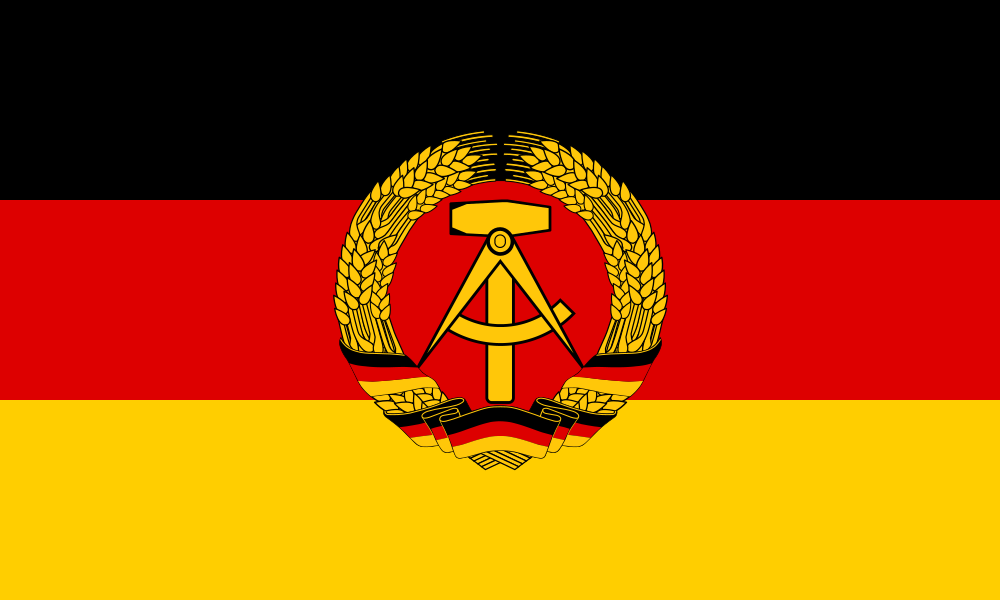
On 7 October the People’s Council held its last session in the building of the German Economic Commission, reconstituted itself as the Provisional People’s Chamber, put the constitution into force and charged Grotewohl with forming a government. The constitution’s articles and the procedure of the following days are described in detail in The Berlin Blockade and Airlift. On the evening of 10 October Pieck, Grotewohl and Ulbricht went to Chuikov’s headquarters in Karlshorst, where the German surrender had been signed on 8 May 1945, and Chuikov handed over administrative functions to the new government; SMAD became the Soviet Control Commission. On the 11th Pieck was elected president, and that night officially 200,000 FDJ members marched along Unter den Linden while Honecker read the “oath of youth” to the republic. On the 12th Grotewohl presented a government of SED and bloc-party ministers. 25 3
Its neighbours had had governments of their own since 1945; why did the Soviet zone, with only auxiliary bodies such as the Economic Commission, not become a state until October 1949? The zone was not an independent country but part of a Germany whose future the four powers were to decide together, and the Soviet Union had reparations, the Ruhr’s industry and a say over all of Germany at stake. Stalin had told the German Communists in June 1945 to work for a unified Germany, and even after the GDR was founded he kept the option of a reunified Germany open for some time; the SED proclaimed the “building of socialism” only in July 1952, after the talks on unity had stalled. On 10 March of that year Stalin sent the Western powers a note proposing a neutral, unified Germany. The sequence of state-building points the same way: the Western London conference, the Basic Law and the West German government came first, and each East German step followed. 5 26 27 25 21 22
Interpretations: a plan, or an unwanted child?
Official East German historiography described the founding of the SED as a “voluntary union” born of the working class’s desire for unity and rejected the “legend of the forced merger”. Some West German historians, too, rejected the term “forced merger” as too one-sided, and in 2007 Helga Grebing wrote that it did not capture the complexity of the process. Heinrich August Winkler, on the other hand, wrote in 2002 that the term came close to the truth, and Ilko-Sascha Kowalczuk concluded that the merger came about only through the pressure the Soviet authorities exerted on leading Social Democrats. Steffen Kachel’s local study of Thuringia, with its long tradition of SPD–KPD cooperation, found genuine support for unity there until the Stalinisation of 1948. The monographs written since the Russian archives opened broadly agree that the merger was neither the result of democratic decision-making nor centred on genuinely German interests. 15
The first study to draw extensively on Soviet records was Norman Naimark’s The Russians in Germany (1995). Naimark argued that the Soviets did not occupy Germany with “specific long-range goals” or a detailed plan; the occupation was shaped by a mixture of opportunism, principle, “Bolshevik predisposition” and conflict with the West. The Soviets wanted hegemony over all of Germany, the elimination of Nazism, a “democratic” and “antifascist” German state, reparations and popular support, but the army’s behaviour, the independent actions of several Soviet agencies and an unwillingness to tolerate spontaneity made the last goal impossible. The GDR, he concluded, was born with feet of clay. The Sovietisation of 1947–1948 appears in his account less as the execution of a plan than as the result of economic hardship, the unpopularity of the Soviets and the SED, and the deepening East–West split. 8
Wilfried Loth went further in Stalin’s Unwanted Child: Why Moscow Did Not Want the GDR (1994). Drawing on Pieck’s notes, he argued that Stalin had not sought a separate socialist state and had seriously favoured a unified democratic Germany. It was Tiulpanov and Ulbricht who pushed for a separate state on their own initiative, “objectively” against Stalin’s intentions; as Stalin put it on 2 August 1948, the West forced the Soviet Union to install a government in its zone, and only after Adenauer became chancellor did Stalin assent to the GDR. The book set off a fierce and lasting controversy. Winkler called Loth’s views more or less “bizarre”, and critics noted that Pieck jotted down only key words, leaving much room for interpretation, and that Moscow’s criticism of Tiulpanov could be read differently. Peter Ruggenthaler, working from the Molotov papers, concluded that the 1952 Stalin Note was meant to destabilise West Germany’s integration with the West. 28 29
At the other end stands Gerhard Wettig, whose verdict is that “Stalin controlled everything.” He argued that the “people’s democracy” Stalin promised after 1945 did not contradict a plan of thorough Sovietisation, and that the West simply failed to grasp the Bolshevik concept of democracy. For him Soviet German policy was a series of tactical shifts and propaganda campaigns designed to secure the Sovietisation of the eastern zone while extending influence in western Germany. The debate arranges the same facts, Stalin’s call for a unified Germany in June 1945, the forced merger of 1946 and the late founding of 1949, in different ways. What is disputed is less what happened than what Stalin wanted. 30 28
Consequences
By October 1949 East Germany had an SED-led system of bloc parties, elections reduced to a yes-or-no vote on a single list, a property order reshaped by land reform and expropriation, a central administration inherited from the Economic Commission, and an occupation authority renamed the Soviet Control Commission. The Soviet joint-stock companies and reparations lasted until 1953, and the special camps were handed to the GDR in 1950. In March 1952 Stalin proposed a neutral, unified Germany, a proposal whose sincerity is still debated, and in July the SED proclaimed the “building of socialism”; its burdens led to the uprising of June 1953.
Timeline & Map
- 11945.04.30
 Return of the Ulbricht Group
Ten KPD cadres under Ulbricht flew in from Moscow and on 2 May began rebuilding Berlin’s administration from Bruchmühle.
- 21945.06.10SMAD Order No. 2
The Soviet Military Administration, set up the day before, permitted antifascist parties and organisations.
- 1945.06.11KPD founding appeal
The KPD declared it wrong to impose the Soviet system on Germany and called for an antifascist democratic republic.
- 1945.07.14Antifascist bloc formed
The KPD, SPD, CDU and LDP formed a united front whose decisions had to be unanimous.
- 1945.09.03Land reform begins
Beginning in the Province of Saxony, ordinances confiscating estates over 100 hectares without compensation followed until the 11th.
- 1946.03.31
 Berlin SPD ballot
In a ballot held only in the western sectors, 82 per cent rejected an immediate merger.
- 31946.04.22SED founded
The unification congress in the Admiralspalast merged the KPD and SPD and elected Pieck and Grotewohl co-chairmen.
- 41946.06.30Saxony referendum
Expropriation of the enterprises of war criminals and Nazis was approved by 77.6 per cent on a 93.7 per cent turnout.
- 1946.10.20State and Berlin elections
The SED won a majority in no state and came third in Berlin with 19.8 per cent.
- 1947.06.11German Economic Commission
Created by SMAD Order No. 138, the commission received the power to issue orders in February 1948 and became a de facto government.
- 1947.12.06First People’s Congress
Some 2,000 delegates nominated under SED leadership met in Berlin to demand German unity and a peace treaty.
- 1948.03.18People’s Council elected
The Second People’s Congress elected the 400-member People’s Council, whose constitutional committee Grotewohl chaired.
- 1949.01“Party of a new type”
The SED’s First Party Conference adopted Marxism–Leninism and democratic centralism and banned factions.
- 1949.05.15Single-list vote
In the vote for the Third People’s Congress the official approval rate was about 66 per cent, with more than four million voting no.
- 51949.10.07GDR founded
The People’s Council reconstituted itself as the Provisional People’s Chamber and put the constitution into force.
- 61949.10.10From SMAD to Control Commission
At Karlshorst Chuikov handed administrative functions to the new government, and SMAD became the Soviet Control Commission.
Related people 24
Leadership3
Returned from Moscow in April 1945 to organise Berlin’s administration and became SED deputy chairman in 1946.
KPD chairman; SED co-chairman; first presidentWilhelm Pieck1876–1960Became SED co-chairman in April 1946 and was elected president of the GDR on 11 October 1949.
Soviet leaderJoseph Stalin1878–1953Told the German Communist leaders on 4 June 1945 to work for a unified Germany and gave written approval for the GDR in September 1949.
Implementers & commanders8
Headed SMAD and the Soviet forces in Germany from June 1945 to spring 1946.
Supreme chief of SMADVasily Sokolovsky1897–1968Headed SMAD from 1946 to March 1949 and gave the Economic Commission power to issue orders in February 1948.
Last supreme chief of SMADVasily Chuikov1900–1982Handed administrative functions to the GDR government at Karlshorst on 10 October 1949 and headed the Soviet Control Commission.
Political adviser to SMADVladimir Semyonov1911–1992As SMAD’s political adviser from 1946 to 1949 he had a direct line to the Foreign Ministry in Moscow.
NKVD plenipotentiary in GermanyIvan Serov1905–1990Appointed on 4 July 1945, he was responsible for the special camps.
People’s Commissar for Internal AffairsLavrentiy Beria1899–1953Issued Order No. 00315 of 18 April 1945 providing for internment without trial.
SMAD deputy chief for the Soviet joint-stock companiesBogdan Kobulov1904–1953Oversaw the Soviet joint-stock companies within SMAD from May 1947 to 1949.
Head of the SMAD Propaganda AdministrationSergei Tiulpanov1901–1984Secretly instructed SMAD offices to limit the bourgeois parties’ local groups on formal pretexts; Naimark identifies him as the Soviet official who shaped the SED into “a party of a new type”.
Participants9
Led the zone’s SPD into the merger, chaired the People’s Council’s constitutional committee and formed the government in 1949.
Official of the CPSU International Information DepartmentGeorgi Dimitrov1882–1949Set out the tasks of the returning German Communist cadres with Pieck on 25 April 1945.
Soviet Politburo memberAndrei Zhdanov1896–1948Attended Stalin’s meeting with the German Communist leaders on 4 June 1945.
Chairman of the Free German YouthErich Honecker1912–1994Founded the FDJ in March 1946 and read the “oath of youth” on 11 October 1949.
First West German chancellorKonrad Adenauer1876–1967The day after his election as chancellor on 15 September 1949, an SED delegation went to Moscow to arrange the founding of the GDR.
Leader of the KPD group sent to SaxonyAnton Ackermann1905–1973Wrote the KPD appeal of 11 June 1945, which set “an anti-fascist, democratic republic” rather than the Soviet system as the aim.
Saxon KPD leaderHermann Matern1893–1971Proposed putting the expropriation to a popular vote.
Deputy chairman of the SEDMax Fechner1892–1973A Social Democrat, he became deputy chairman of the merged party alongside Ulbricht.
CDU leaderOtto Nuschke1883–1957Kaiser’s more pliant successor.
Opposition & resistance3
Elected mayor by the city council in 1947, but the Soviet authorities refused to confirm him.
SPD leader in the western zonesKurt Schumacher1895–1952Opposed the merger of the Communists and Social Democrats.
CDU leader in the Soviet zoneJakob Kaiser1888–1961Removed by SMAD with Ernst Lemmer in December 1947 for criticising the Communists.
Related terms
Sources: reference 1reference 2reference 3reference 4reference 5reference 6reference 7reference 8reference 9reference 10reference 11reference 12reference 13reference 14reference 15reference 16reference 17reference 18reference 19reference 20reference 21reference 22reference 23reference 24reference 25reference 26reference 27reference 28reference 29reference 30
← Historical events