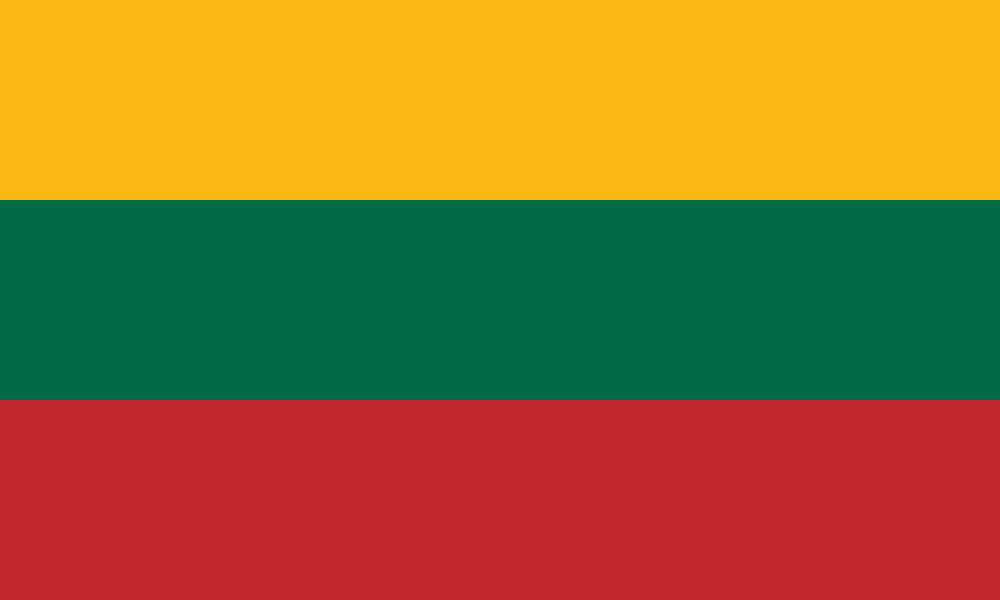
Lithuania's first president who led the declaration of independence, later leader of the 1926 coup
Before leaving the presidential palace he declared, "I do not want to make Lithuania a bolshevik country with my own hands."
Chairman of the Lithuanian Council, he signed the 1918 declaration of independence and as first president from 1919 led the governments that fought the Red Army, Bermondt's troops and the Poles. He built an authoritarian regime after the 1926 coup and, fleeing the Soviet occupation of 1940, died in a fire in the United States in 1944.
Career timeline
1902Graduated in law from St. Petersburg University; journalist and national activist in Vilnius
1917Chairman of the Council of Lithuania
1918Signed the Act of Independence (16 February)
1919First President of Lithuania
1925Chairman of the Lithuanian Nationalist Union
1926Led the December coup; returned as president and ruled with authoritarian powers
Lithuania's first prime minister, later leader of the far-right Iron Wolf
Dissolving the Seimas in 1928, he quipped that he had promised to hold elections but had made no promise about the year.
Prime minister and foreign minister of Lithuania's first cabinet in November 1918, he later fought the Vilnius question in Paris and at the League of Nations. Prime minister again after the 1926 coup, he led the far-right Iron Wolf, broke with Smetona and died in a Soviet prison in 1942.
Career timeline
1910Master's degree in history and philology, St. Petersburg University
1916Professor at Perm University; joined the Party of National Progress
1918First prime minister and foreign minister (Nov); head delegate to the Paris Peace Conference
1918–1920Foreign minister in successive cabinets
1926Member of the Third Seimas; prime minister and foreign minister after the December coup
1928Border treaty with Germany; de facto leader of the far-right Iron Wolf
1929Ousted by President Smetona and exiled
1934–1938Imprisoned after the failed coup; exiled to France in 1938
Ukrainian nationalist leader who commanded the Sich Riflemen and built the UVO and OUN
Rotterdam, 23 May 1938: a Ukrainian-style box of chocolates handed over by his trusted contact Pavel Sudoplatov concealed a time bomb made in Moscow.
A Ukrainian military and political leader from Zashkiv in Austrian Galicia. After captivity in Russia during the First World War, he organized the Sich Riflemen in Kyiv in 1917 and became a leading commander of the Army of the Ukrainian People’s Republic. Following defeat in the independence war, he led the Ukrainian Military Organization (UVO) in exile and united several nationalist groups into the Organization of Ukrainian Nationalists (OUN) in Vienna in 1929, becoming its first leader. He connected émigré organizations across Europe and North America and sought international support for Ukrainian independence, but was assassinated in Rotterdam in 1938 by a bomb delivered by NKVD operative Pavel Sudoplatov, who had infiltrated the OUN. In 1929 he obtained Lithuanian citizenship and a passport, giving his émigré activity a legal basis, while his national and political identity and the aim of his movement remained consistently Ukrainian independence.
Career timeline
1914–1915Served in the Austro-Hungarian army; captured by Russia after the Battle of Makivka
1917–1920Organized and commanded the Sich Riflemen of the Ukrainian People’s Republic
1920–1929Cofounded and led the Ukrainian Military Organization (UVO)
1929–1938Founding leader of the Organization of Ukrainian Nationalists (OUN)
1938.05Assassinated in Rotterdam in Pavel Sudoplatov’s bombing operation
The communist who split his party from Moscow and became independent Lithuania's first president
When Gorbachev flew to Vilnius in January 1990 to press him to reverse the party's split, he did not yield: the congress had decided, and not even he had the authority to undo it.
A manager of the Soviet Lithuanian economy, Brazauskas became first secretary of the Lithuanian Communist Party in 1988 with Sajudis's backing, and in December 1989 led the party's decision to split from the CPSU, the first ruling party of a union republic to break with Moscow. After independence he won the first direct presidential election in 1993, showing that a former communist could come to power by ballot, managed relations with Russia while opening the road to NATO and the EU, and served as prime minister from 2001 to 2006.
Career timeline
1965–1967Minister of Construction Materials Industry, Lithuanian SSR
1967–1977First Deputy Chairman, Gosplan, Lithuanian SSR
1977–1987Secretary, Central Committee, Communist Party of Lithuania
1988–1989First Secretary, Central Committee, Communist Party of Lithuania
1989–1990First Secretary, Independent CPL (split from CPSU)
1990Chairman, Presidium of Supreme Soviet, Lithuanian SSR
1993–1998President of the Republic of Lithuania
2001–2006Prime Minister of the Republic of Lithuania
The musicologist who led the first nation out of the Soviet Union
On the night of 11 March 1990, when the act restoring independence passed without a vote against, he declared from the chair that Lithuania was once more an independent state: the first republic to walk out of the USSR, and the Kremlin's first notice of secession.
A Lithuanian musicologist and the leading authority on the painter-composer Ciurlionis, Landsbergis joined the founding of the reform movement Sajudis in 1988 and became its chairman. On 11 March 1990, as chairman of the Lithuanian Supreme Council, he carried the act restoring independence, becoming head of the first republic to declare its departure from the USSR. He held that independence through Moscow's economic blockade and the bloody suppression attempt of January 1991, and later served as speaker of the Seimas and a member of the European Parliament, the patriarch of the Lithuanian right.
Career timeline
1955Graduated from the Lithuanian Conservatory (now Lithuanian Academy of Music and Theatre)
1978–1990Professor at the Lithuanian Conservatory and Vilnius Pedagogical University
1988–1990Chairman of the Sąjūdis Seimas Council
1989–1990People's Deputy of the USSR Congress of People's Deputies
1990–1992Chairman of the Supreme Council of Lithuania (head of state)
1993–2003Chairman of the Homeland Union (Conservative Party)
The Sąjūdis philosopher who launched the 2-million-signature campaign demanding Red Army withdrawal
After a long while of hesitation, I made up my mind to see 'what makes socialism.' After a few years it was absolutely clear.
Lithuanian philosopher and politician who taught philosophy at Vilnius University and edited the cultural journal Kultūros barai. He joined the Lithuanian Communist Party in 1973 but broke with it during perestroika; as a founding member of Sąjūdis (1988), he became the movement's theorist and launched a 2-million-signature campaign demanding the withdrawal of the Red Army from Lithuania. He was a central figure in the trilateral planning of the Baltic Way with the Estonian and Latvian popular fronts, and served as deputy prime minister (1990–1991) in the Landsbergis-Prunskienė cabinet. After independence he founded the Lithuanian Centre Union, served in the Seimas (1992–2000), and opposed EU membership as a surrender of sovereignty.
Career timeline
1957–1962Studied philosophy, Vilnius University
1965–1968Editor, Kultūros barai journal
1973–1989Lecturer in philosophy, Vilnius University
1988–1990Founding member and council member, Sąjūdis
1989–1990People's Deputy, USSR Congress of People's Deputies
1990–1991Deputy Prime Minister of the Republic of Lithuania
She tried to negotiate independence through pragmatism; her resignation removed the last obstacle to the military option
She wept before her cabinet. "It seems we have failed to achieve anything. We are doomed."
Lithuania's first post-independence prime minister (1990–1991), she led the country through the most dramatic ten months of the Soviet collapse. A founding member of Sąjūdis, she rose from deputy prime minister of the Lithuanian SSR to prime minister, and as the 'Amber Lady' (a name the Western press coined after her meetings with Bush, Thatcher, and Kohl) she gave the newborn republic a diplomatic presence. Unlike the uncompromising parliamentary chairman Vytautas Landsbergis, she was a pragmatist who sought negotiated exit, but on 8 January 1991 Gorbachev refused her request for a guarantee of no military action; she resigned the next day. Five days later Soviet forces killed 14 civilians in Vilnius. She narrowly lost the 2004 presidential runoff to Valdas Adamkus and later served as agriculture minister.
Career timeline
1965–1986Instructor and docent in industrial economics, Vilnius University
1986–1988Deputy director, Agricultural Economics Research Institute, Lithuanian SSR
1989–1990Deputy chair, Council of Ministers, Lithuanian SSR
1990.03–1991.01Prime Minister of the Republic of Lithuania
Economist-statesman of restored independence, Lithuania's shortest-serving premier
On the night of 12–13 January 1991, hearing that buildings in Vilnius were being assaulted, he withdrew with his family to Druskininkai to hide; when he returned to Vilnius on 13 January, Gediminas Vagnorius had already been put in charge of the government.
Albertas Šimėnas was born on 17 February 1950 in Papilių village, Anykščiai district. He studied economics and mathematics at Vilnius University, took a candidate's degree in economics in 1981, worked at a research institute under the State Planning Committee, and lectured afterwards. Elected to the Supreme Council in 1990, he signed the 11 March Act, led the government from 10 to 13 January 1991, and later served as economy minister, as a Seimas member in 1996–2000, and as an executive of Lithuanian Railways.
Career timeline
1950Born in Papiliai, Lithuania
1972–1984Economist and researcher at state planning institutes
1984–1989Lecturer in economics at Vilnius Civil Engineering Institute, associate professor from 1989
1990–1992Member of the Supreme Council, signatory of the 11 March Act
1991Prime Minister of Lithuania (10–13 January)
1991–1992Minister of Economy
1996–2000Member of the Seimas, chair of its Economics Committee
2000–2017Development director (until 2006) and deputy director-general (2006–2017) at Lithuanian Railways
Lithuanian political scientist of Baltic politics and international relations
In his 2007 article "Bloody Sunday", he re-examined Gorbachev's claims of innocence about the January 1991 events in Vilnius and Riga. He concluded that Gorbachev most likely did not order the deaths of innocent people, but embraced the solution that led to that outcome.
Ainius Lasas is a Lithuanian political scientist who studies Baltic politics and international relations. He graduated from LCC International University in 1999, earned a master's diploma in journalism from Vilnius University, and took a PhD in international relations at the University of Washington. After working as a journalist with a national radio and television broadcaster, he was a senior research fellow at the University of Oxford and taught at the University of Bath before returning to Lithuania as dean of the Faculty of Social Sciences, Arts and Humanities at Kaunas University of Technology. His research spans political psychology, including threat perception, historical memory and conspiracy theories, and political culture, including informal business-state relations.
Career timeline
2000년대Lithuanian political scientist
2007Author of “Bloody Sunday” in the Journal of Baltic Studies
2008Co-author on Baltic Sea regional security cooperation
2000년대~현재Research on Baltic politics and international relations
1999Graduated from LCC International University (BA, English Language and Literature)
2000년대Master's diploma in journalism, Vilnius University; PhD in international relations, University of Washington
2010European Union and NATO Expansion: Central and Eastern Europe (Palgrave Macmillan)