A legion commander who carried battlefield success into White politics
Radola Gajda was a Czechoslovak Legion commander who rose to prominence in the First World War and the Russian Civil War, later becoming a general and politician in interwar Czechoslovakia. In 1918 he led the Legion's eastern group, seizing the railway from Novonikolaevsk to Irkutsk and pressing the argument for armed struggle over neutrality. He joined Kolchak's White forces, lost his command, and returned home to serve as acting chief of the general staff before leading the National Fascist Community. His military anti-Bolshevism became fascist politics in Czechoslovakia, while during the Nazi occupation he aided resistance networks.
Career timeline
1910–1911Served in the Austro-Hungarian Army
1915–1916Officer in the Montenegrin Army
1917Company and regimental commander, Czechoslovak Legion
1918Commander, Legion eastern group, directing the capture of Irkutsk and Yekaterinburg
1918–1919Commander of Kolchak's Siberian Army
1922–1926Divisional commander and acting chief of the Czechoslovak General Staff
1927–1939Leader of the National Fascist Community and parliamentarian
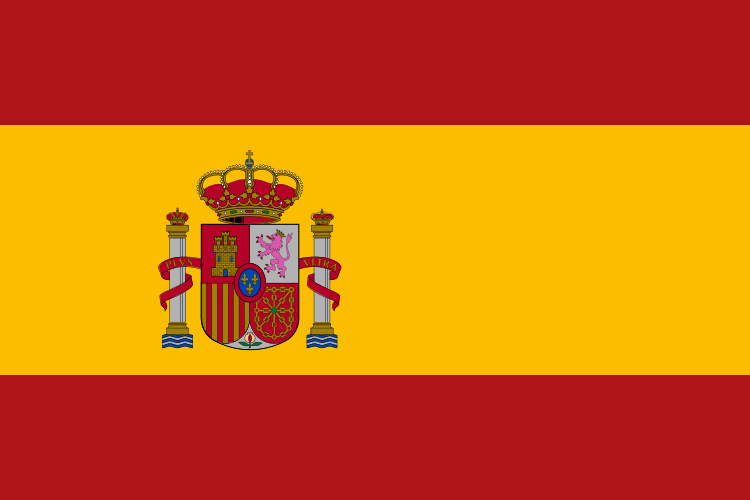
The general who turned the rising into victory and ruled Spain for thirty-six years as Caudillo
The last war communiqué of 1 April 1939, signed in his own hand: “Today, with the Red Army captive and disarmed, the national troops have reached their final military objectives. The war is over.” Thirty-six years of dictatorship began.
A career officer who made his name in the colonial war in Morocco and became the youngest general in Europe at thirty-three. His use of the Army of Africa to crush the Asturian miners in 1934 fixed him in the eyes of the right as the restorer of order, and in July 1936 he joined the rising, flew from the Canaries to Morocco and, with German and Italian transports, ferried the Army of Africa to the mainland. In October he was made commander-in-chief and head of state of the rebel zone, and the Unification Decree of 1937 fused the Falange and the Carlists into a single National Movement under his personal rule. Victory in 1939 was followed by mass execution and imprisonment under the Law of Political Responsibilities, costing tens of thousands of lives. He declared non-belligerence in the Second World War while sending the Blue Division to the Eastern Front, and broke out of postwar isolation with the Pact of Madrid and the Concordat of 1953. The growth that followed the Stabilization Plan of 1959 became another pillar of the regime; he named Juan Carlos his successor in 1969, and with his death in 1975 the regime itself began to come apart.
Career timeline
1892Born into a naval family in Ferrol, Galicia
1907–1910Trained at the Toledo Infantry Academy
1912–1926Fought in the colonial war in Morocco, second-in-command of the Spanish Legion, brigadier general at thirty-three
1928–1931Director of the Zaragoza military academy until the Republic removed him
1934.10Used the Army of Africa to crush the Asturian miners' rising
1935–1936Rose to chief of the general staff, then was posted to the Canary Islands by the Popular Front government
1936.07.18–19Joined the rising, flew to Morocco in the chartered Dragon Rapide and organized the airlift of the Army of Africa
1936.10.01Proclaimed Generalísimo and head of state of the rebel zone at Burgos
1937.04.19Fused the Falange and the Carlists into a single National Movement by decree
1939.04.01Declared the war over and began mass execution and imprisonment under the Law of Political Responsibilities
1940–1943Met Hitler at Hendaye, declared non-belligerence and sent the Blue Division to the Eastern Front
1953–1955Signed the Pact of Madrid with the United States and a Concordat with the Vatican; UN membership in 1955 ended his isolation
1959Abandoned autarky with the Stabilization Plan and entered the years of high growth
1969–1973Named Juan Carlos his successor; in 1973 his prime minister Carrero Blanco was assassinated by ETA
1975.11.20Died in Madrid; buried at the Valley of the Fallen until his exhumation in 2019
A U.S. general whose offensive command was bound to racial prejudice
“Don't let a bunch of Chinese laundrymen stop you.”
Edward Almond was a United States Army general who served in two world wars and Korea, leaving a record that combines an aggressive command style with racial prejudice. In World War II he commanded the largely African American 92nd Infantry Division, then blamed its combat performance on the soldiers' race and opposed using Black troops in combat. In Korea, as Douglas MacArthur's chief of staff, he was placed in command of X Corps after the Inchon landing force was formed, contributing to the capture of Inchon and Seoul. His wide dispersal of forces in the northeast and underestimation of Chinese strength helped deepen X Corps' crisis in late 1950.
Career timeline
1915Graduated from Virginia Military Institute
1918Commanded the 12th Machine Gun Battalion, 4th Division, in France
1942–1945Commanding general, 92nd Infantry Division, in the Italian campaign
1946–1949Personnel chief, then chief of staff, Far East Command in Tokyo
1950–1951Commanding general, X Corps, directing Inchon and northeast operations
1951–1953Commandant, U.S. Army War College; retired in 1953
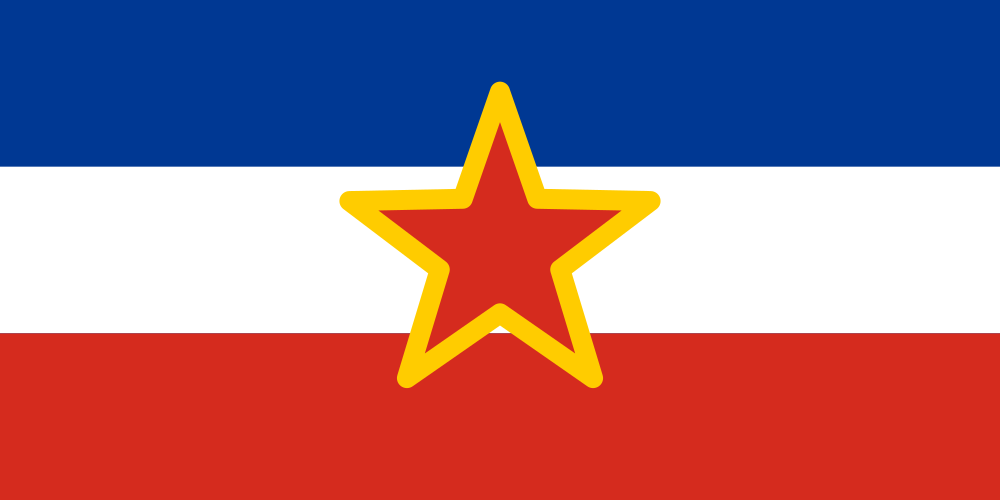
A Serbian nationalist commander who sought to restore the monarchy
In 1941 he rejected Tito's call for a general uprising as premature, and the two resistance movements soon turned their struggle into armed conflict.
Draža Mihailović was a Royal Yugoslav Army officer who led the Chetnik movement, seeking to restore the monarchy and a Serbian nationalist order after the Second World War. He built an organization at Ravna Gora in 1941, but chose to prepare for postwar power and avoid a general uprising rather than follow Tito's Partisans into sustained open resistance, bringing the movements into conflict. Parts of the Chetnik organization and Mihailović's command network collaborated with Axis and collaborationist forces, a choice that weakened the movement in multi-ethnic Yugoslavia and contributed to the Allies shifting support to the Partisans. Captured after the war, he was executed for treason and war crimes, while Serbia's Supreme Court overturned the verdict in 2015 as politically motivated.
Career timeline
1912–1913Serbian Army cadet, Balkan Wars
1914–1918Serbian Army officer, First World War
1935–1936Military attaché in Bulgaria
1936–1939Military attaché in Czechoslovakia, staff officer
1941Deputy chief of staff, Yugoslav Second Army
1941–1945Commander of the Chetnik Detachments of the Yugoslav Army
A Luftwaffe chief who organized Nazi war and plunder
In August 1940, redirecting the air offensive toward London and civilian cities gave the RAF time to recover.
Hermann Göring rose from a First World War fighter ace to a central power-holder in Nazi Germany and commander-in-chief of the Luftwaffe. He helped build dictatorship and the machinery of aggressive war by directing the Prussian police, the creation of the Gestapo, rearmament, and wartime economic mobilization. During the Battle of Britain in 1940, he overestimated the Luftwaffe and was involved in shifting attacks from the RAF's struggling airfields and fighter defences toward British cities, giving Fighter Command time to recover. After the war, the Nuremberg Tribunal condemned him as a major war criminal, and he committed suicide on the eve of his execution.
The British general who commanded the Battle of Athens
On 1 December 1944, Scobie ordered ELAS to disarm.
Ronald Scobie was a British Army general who served in both world wars and commanded forces at Tobruk, Malta, and later III Corps. After Greece was liberated in 1944, he became the military commander who embodied Britain's intervention in the country's contested transition. His 1 December order for ELAS to disarm helped precipitate the Dekemvriana, and he directed British operations during the fighting in Athens.
Career timeline
1914–1918Royal Engineers officer, serving on the Western Front
1920–1924Officer of a cadet company at the Royal Military Academy, Woolwich
1939Deputy Director of Mobilisation at the War Office
1941Commander of the 70th Infantry Division and commandant of Tobruk fortress
1942General Officer Commanding the Troops in Malta
1943–1944Chief of the General Staff, Middle East, then commander of III Corps
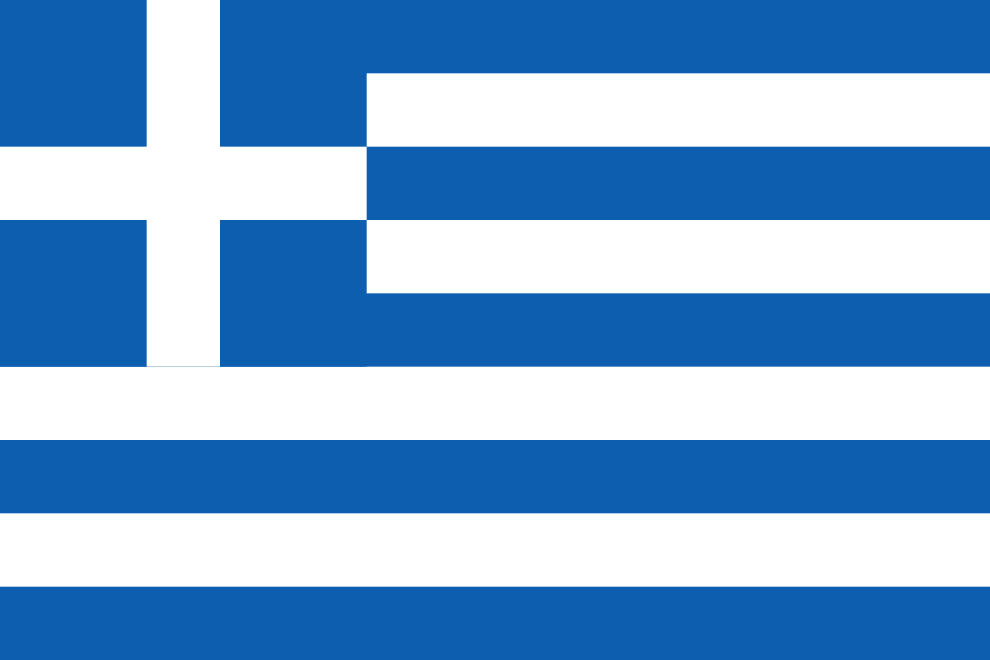
Architect of the dictatorship's security apparatus
In 1940, the police deployed a counterfeit KKE leadership and forged Rizospastis to confuse the party's members.
A former Greek Army officer, Konstantinos Maniadakis was a central official of Ioannis Metaxas's 4th of August dictatorship, organizing its security state and anti-communist repression. He combined the Asfaleia's intelligence network with torture and island exile to break the KKE's public activity and disable much of its leadership. In 1940, the police created a counterfeit KKE leadership and forged edition of Rizospastis to confuse party members. After liberation, he converted anti-communism into political capital and served as a parliamentarian, while his responsibility under the dictatorship went largely unaccounted for.
Career timeline
1916Graduated from the Military Academy as an engineering second lieutenant
1919–1922Served in the Asia Minor campaign
1923Discharged after participating in the Leonardopoulos–Gargalidis coup attempt
1929Resigned from the army as a lieutenant colonel
1936–1941Deputy Minister of Public Security under Metaxas, organizing the security system
1941Deputy Minister of Public Security and Minister of the Interior under Koryzis and Tsouderos
1941–1949Supervisor of Greek diplomatic missions in Argentina and Latin America
A Marine commander whose caution helped save a surrounded division
“Retreat, hell! We're just attacking in another direction.”
Oliver P. Smith was a U.S. Marine general who served in World War II and the Korean War, known for expertise in amphibious operations and a cautious command style. As commander of the 1st Marine Division, he led the Inchon landing and the advance to Seoul in 1950, then directed the division’s breakout from Chinese encirclement at the Chosin Reservoir. Against speed-first orders from MacArthur and Almond, he prepared supply lines and an airfield, choices that helped preserve his force and sustain the operation.
Career timeline
1917Commissioned second lieutenant, U.S. Marine Corps
1934–1936Studied at the École Supérieure de Guerre in France
1944Commanded 5th Marines in the New Britain operation
1944–1945Assistant division commander, 1st Marine Division, Peleliu and Okinawa operations
1950–1951Commanding general, 1st Marine Division, Inchon, Seoul and Chosin operations
1953–1955Commanding general, Fleet Marine Force, Atlantic
The German general who surrendered Paris rather than destroy it
On 25 August 1944, he signed the capitulation of the German garrison in Paris.
Dietrich von Choltitz was a German professional officer who served in both world wars and carried out Nazi Germany’s war on the Eastern and Western Fronts. As military governor of Paris in August 1944, he did not execute Hitler’s order to destroy the city and surrendered the garrison to French forces, helping make the liberation of Paris possible. British recordings made after his capture also preserve his admission of responsibility for the liquidation of Jews in Crimea, so his refusal in Paris does not erase his wider responsibility for the war.
Career timeline
1914–1918Officer, Royal Saxon Army 107th Infantry Regiment, Western Front
1919–1939Reichswehr officer, commander of III Battalion, 16th Infantry Regiment
1939–1940Commander, 16th Air Landing Infantry Regiment, Poland and the Netherlands campaigns
1941–1942Commander, 16th Infantry Regiment, Crimea and Siege of Sevastopol
1943Commander, 11th Panzer Division and XLVIII Panzer Corps, Eastern Front
1944Commander, LXXVI Panzer Corps and LXXXIV Army Corps, Italy and Normandy
1944Commander of Greater Paris and military governor, surrendered on 25 August
1944–1947Interned at Trent Park and a US prisoner-of-war camp
An underground commander who grasped Tempest's political conditions
When the Home Army was established in 1942, he became commander of the unified underground force.
Stefan Rowecki was a Polish professional officer and the first commander of the Home Army, who helped turn scattered resistance groups under German occupation into a unified underground force. He developed plans for a rising under the contradictory conditions of German retreat and an advancing Soviet army, and advanced the general-uprising concept after the Home Army was formed in 1942. Arrested by the Gestapo in 1943, he rejected German offers of anti-Soviet cooperation and was murdered at Sachsenhausen shortly after the Warsaw Uprising began.
Career timeline
1914–1917Officer in the 1st and 5th Infantry Regiments of the Polish Legions in World War I
1919–1920Polish Army staff officer in the Polish–Soviet War
1923–1926Head of the scientific section at the Military Institute and founder-editor of Przegląd Wojskowy
1930–1935Commander of the 55th Poznań Infantry Regiment
1939–1940Commander of the Warsaw Armoured Motorized Brigade and senior leader of SZP-ZWZ
1940–1942Commander of the Union of Armed Struggle, preparing its transformation into the Home Army
1942–1943First commander of the Home Army, developing plans for a general rising and Operation Tempest
1943–1944Arrested by the Gestapo and imprisoned at Sachsenhausen
Mannerheim's secret envoy to Berlin who brokered the German-Finnish military pact that led to the Continuation War
When Himmler asked him to lead Finnish armed resistance after the 1944 ceasefire, Talvela replied he would do so only 'on the orders of Marshal Mannerheim.'
A product of the Jäger movement, Talvela rose to prominence during the Winter War when his Group Talvela destroyed two Soviet divisions at Tolvajärvi, securing Finland's first major victory. In the autumn of 1940, Mannerheim dispatched him as a personal envoy to Berlin, where he negotiated secret military coordination between the Finnish and German general staffs: the diplomatic bridge that brought Finland into the Continuation War alongside the Wehrmacht. After the war he worked as a businessman and served on the Helsinki city council; the second recipient of the Mannerheim Cross, he was promoted to general of the infantry in 1966.
Career timeline
1916Jäger volunteer, 27th Royal Prussian Jäger Battalion
1918Battalion commander (Whites), Finnish Civil War; major
1919–1922C-in-C, Aunus expedition; battalion commander, Viena expedition
1926–1927Commander, Savo Jäger Regiment
1939.12–1940.04Commander Group Talvela (Tolvajärvi victory), then III Corps; major general
1940.09Mannerheim's personal envoy to Berlin; negotiated German-Finnish military coordination
1941.06–1942.01Commander, VI Corps, Army of Karelia; Mannerheim Cross (3 Aug 1941)
1942–1944Finnish army representative at German High Command; lt. general; commanded Aunus Group 1944
The Saint-Denis Communist who demanded the popular front first and ended a fascist
In April 1934 he sent an open letter to the Comintern demanding immediate joint action with the Socialists. In June he was expelled; in July the party signed the very pact he had demanded
A metalworker from Saint-Denis who became a deputy at twenty-six and rose to the executive committee of the Comintern as one of the French Communist Party's young leaders. He was jailed for agitation against the Rif war, sent to China as a Comintern envoy in 1927, and elected mayor of Saint-Denis in 1931. Immediately after the February 1934 crisis he demanded, publicly and ahead of the party line, immediate joint action with the Socialists; he refused a summons to Moscow and was expelled on 27 June. A month later the party signed the very pact of unity of action he had called for, and he was already outside it. In 1936 he founded the Parti Populaire Français and moved toward fascism; in 1941 he helped create the Légion des Volontaires Français against Bolshevism and fought on the Eastern Front in German uniform; he was killed in Germany in February 1945 when Allied aircraft strafed his car.
Career timeline
1898Born to a working-class family at Bresles in the Oise
1915–1922Metalworker at Saint-Denis; joins the Communist youth movement
1923–1924Leads the Communist Youth International; elected deputy in 1924
1925Jailed for agitation against the Rif war
1927Sent to China as a Comintern envoy
1931–1937Mayor of Saint-Denis
1934.02–06Publicly demands joint action with the Socialists, refuses a summons to Moscow, expelled on 27 June
1936Founds the Parti Populaire Français
1941–1944Helps found the anti-Bolshevik French volunteer legion; serves on the Eastern Front in German uniform
1945.02Killed in Germany when Allied aircraft strafe his car
At Posen in October 1943, he told SS officers that standing firm before 100, 500, or 1,000 corpses and staying 'decent' was 'a glorious chapter that has not and will not be spoken of.'
Heinrich Himmler was a central Nazi leader who expanded the SS and police into a bureaucratic apparatus for racial rule and mass murder. He directed the concentration-camp system, extermination policies, and killing formations in occupied Europe, making him one of the principal perpetrators of the Holocaust and the murder of millions of other victims. During the Warsaw Uprising in 1944, he approved and directed the German reprisal that treated the city and its population as targets for destruction, massacre, and deportation. After attempting unauthorized negotiations with the Western Allies as Germany’s defeat became unavoidable, he was dismissed by Hitler, captured by British forces, and died by suicide in custody.
Career timeline
1923Joined the Nazi Party and took part in the Beer Hall Putsch.
1925Joined the Schutzstaffel, or SS.
1929–1945Led the SS as Reichsführer-SS.
1936–1945Served as Chief of German Police, controlling the police and apparatus of political repression.
1943–1945Served concurrently as Reich Minister of the Interior.
1944Directed the destruction of Warsaw and the massacre and deportation of civilians during the uprising.
1945Was dismissed over unauthorized peace contacts, then captured and died by suicide in custody.
A senior Nazi SS coordinator who became a late-war negotiating envoy
On 8 March 1945, Wolff met Allen Dulles in Switzerland to discuss terms for the surrender of German forces in northern Italy.
Karl Wolff was a senior Nazi SS officer who served as Heinrich Himmler’s chief of staff and stood close to the regime’s central decisions and crimes. As the highest SS and police leader in occupied Italy, he oversaw a system marked by the deportation of Jews, forced labor, and repression of the resistance, responsibilities not erased by his later negotiations. In 1945 he conducted the secret Operation Sunrise talks with OSS chief Allen Dulles in Switzerland, helping secure the early surrender of German forces in northern Italy, though his influence and motives were limited. After the war he was convicted for facilitating mass murder.
Career timeline
1917–1920Officer candidate in the Imperial German Army’s 115th Infantry Regiment, serving on the Western Front
1931Joined the Nazi Party and the SS
1935–1943Chief of the Reichsführer-SS Personal Staff
1943–1944Highest SS and Police Leader in Italy
1944–1945Plenipotentiary General of the German Wehrmacht in Italy
1945German negotiating representative in Operation Sunrise, involved in the surrender in northern Italy
1964–1969Convicted by a Munich court for facilitating the murder of 300,000 Jews and sentenced to 15 years, released in 1969
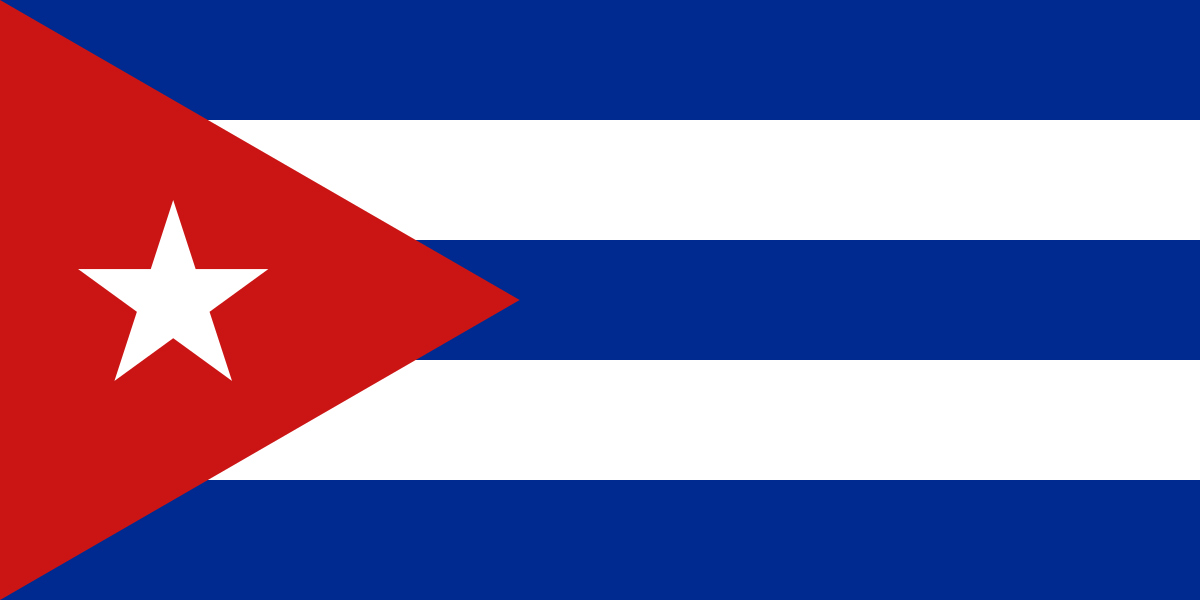
A Cuban ruler who shifted between electoral legitimacy and military power
On January 1, 1959, as rebel forces advanced, Batista resigned and fled Cuba.
Fulgencio Batista was a soldier and politician from a poor rural background who shaped Cuban politics after the Sergeants’ Revolt of 1933. Elected president under the new constitution in 1940, he pursued social reforms and supported the Allies, but returned to power through a coup when electoral defeat appeared likely in 1952. His second rule suspended constitutional liberties and became an authoritarian order tied to U.S. capital and organized crime in Havana, while inequality and repression helped broaden armed resistance. Overthrown by the Cuban Revolution in 1959, his exile was one of the starting points for the subsequent escalation of U.S.–Cuban hostility.
Career timeline
1921Private, Cuban Army
1923–1933Sergeant stenographer, Rural Guard
1933–1940Chief of Staff of the Cuban Army, de facto ruler
The Kwantung Army staff officer whose Border Defense Guide sparked the Nomonhan Incident
After the war, General Ryukichi Tanaka testified that 'the most determined single protagonist in favor of war with the United States was Tsuji Masanobu.'
An operations staff officer of the Kwantung Army, Masanobu Tsuji drafted the 'Border Defense Guide' that touched off the 1939 Nomonhan Incident, pushing the border war with the Soviet Union forward by gekokujō, insubordination from below. After the defeat, his encounter with Soviet firepower turned him against war with the USSR, yet he became the most forceful advocate of war against the United States. A planner of the Malayan campaign and an instigator of the Bataan Death March and Sook Ching massacres, he evaded a war-crimes trial, returned to Japan, and was re-elected to the Diet.
Career timeline
1934Active in the Tōseiha (Control Faction), helped block the Kōdōha coup
1937–1939Kwantung Army operations staff officer
1939.04Authored the 'Border Defense Guide', instigating the Nomonhan Incident
1941General Staff Operations Section, advocate of war against the United States
1941–1942Planned the Malayan campaign; Sook Ching massacres after Singapore's fall
The SS general who commanded the repression of the Warsaw Uprising
In a report during the Warsaw Uprising, Reinefarth wrote: “We have more prisoners than ammunition to kill them.”
Heinz Reinefarth was a lawyer who joined the Nazi Party and the SS before becoming a commander in Germany's occupation war. During the Warsaw Uprising in 1944, he led a battle group combining combat, police, and security units, playing a central role in the command structure of the 5 August assault on Wola and the mass killing of civilians. Despite Polish demands for his extradition, he escaped prosecution and conviction after the war and served as a mayor and state legislator in West Germany. His career links command responsibility for war crimes with postwar impunity in a single life.
Career timeline
1927Completed his law training in Jena and began working in the legal profession.
1932Joined the Nazi Party and the SS.
1942Served as SS general inspector of civil administration in the Protectorate of Bohemia and Moravia.
1944Became Higher SS and Police Leader in Wartheland.
1944-08Commanded Kampfgruppe Reinefarth in the suppression of the Warsaw Uprising.
1945Commanded the fortress of Küstrin and was captured by U.S. forces.
1951–1964Served as mayor of Westerland.
1962–1967Served in the Schleswig-Holstein Landtag.
The Air Force general who firebombed Japan and urged nuclear war on his adversaries
When Clay asked whether he could haul coal into Berlin, LeMay answered, 'We can haul anything.'
The architect of America's strategic bombing of Japan, whose March 1945 fire raid on Tokyo began the incineration of 66 cities. As commander of US Air Forces in Europe in 1948, he answered Lucius Clay's call during the Berlin Blockade with 'We can haul anything,' setting in motion the first phase of the Airlift. He then rebuilt Strategic Air Command into an all-jet nuclear force and, as Air Force Chief of Staff, pressed for bombing Cuba's missile sites in 1962. In retirement he ran as George Wallace's running mate in 1968.
Career timeline
1942Commander, 305th Bomb Group, European theater
1944–1945Led XXI Bomber Command, firebombing Japanese cities
1947–1948Commander, USAF Europe; launched the Berlin Airlift
Standing before Mussolini at Gran Sasso, Skorzeny became the face of a victory whose command credit belonged elsewhere.
Born in Vienna, Skorzeny became a Waffen-SS officer who directed sabotage and commando operations for Nazi Germany. In the 1943 Gran Sasso raid, he helped locate Benito Mussolini and led an SS detachment at the landing site, but the operation as a whole was planned and commanded by the airborne officers Harald Mors and Kurt Student. Nazi propaganda presented him as Mussolini's liberator, while he also took part in the overthrow of Hungary's government and the Ardennes deception operation. Acquitted at a postwar war-crimes trial, he later lived in Spain amid far-right networks.
Career timeline
1932Joined the Austrian Nazi organisation
1938Served with the SS during the Anschluss
1943Led the RSHA sabotage and commando section
1943Led an SS detachment in the Gran Sasso raid
1944Took part in Operation Panzerfaust in Hungary
1944Commanded Operation Greif in the Ardennes
1947Acquitted at the Dachau military trial
1953Military adviser to Egyptian president Gamal Abdel Nasser
The Mongoose architect whose six-phase Cuba overthrow plan convinced the Soviets invasion was coming
When McNamara asked what the 'x-factor' on his metrics list was, Lansdale replied: 'The feelings of the common rural Vietnamese people.' McNamara erased it and said he couldn't measure it.
A U.S. Air Force major general who turned advertising into a doctrine of psychological warfare, Lansdale first made his name helping crush the Hukbalahap rebellion in the Philippines by weaponizing local folklore, then ran the Saigon Military Mission as a close confidant of Ngô Đình Diệm. In February 1962 he submitted to President Kennedy the six-phase Cuba Project, a schedule that aimed for open revolt and overthrow of the Castro government by the first two weeks of October. The document became a crucial piece of Soviet intelligence: it convinced Moscow that a U.S. invasion of Cuba was imminent and helped trigger the missile crisis. Forced to retire in 1963 after refusing to abandon Diệm, Lansdale was later recognized as a founding figure of modern counterinsurgency and psychological operations.
Career timeline
1941–1947Served in Army Military Intelligence and OSS; promoted to major
1947–1950Transferred to USAF as captain; instructor at Strategic Intelligence School
“I was skin and bones coming out of five years of imprisonment.”
Béla Király was a Hungarian officer whose career crossed the Second World War, the construction of postwar socialism, and the 1956 Revolution. Sentenced to death by the postwar regime and later commuted and released, he became the highest-ranking military commander of the Hungarian armed forces that resisted the Soviet intervention. In exile he became a historian and teacher in the United States, while his memoirs and writings on the Tito–Stalin split argued that Stalin had prepared to invade Yugoslavia. Archive-based scholarship later disputed or qualified that claim, making Király both an important witness to 1956 and a contested author of Cold War memory.
Career timeline
1935Graduated from Ludovika Military Academy, commissioned second lieutenant
1942–1945Hungarian Army staff officer, Eastern Front service
1949–1951Commander of infantry in the Hungarian People's Army, major general
1951–1956Imprisoned in a political trial, sentence commuted from death to life
1956Commander-in-chief of the National Guard, military commander of Budapest
1957–1966Exile in the United States, earned a history PhD at Columbia University
1964–1982Professor of military history at Brooklyn College
The Nazi Gestapo chief who made Lyon a center of terror
At his 1987 Lyon trial, he denied the Izieu roundup and said: “I fought the Resistance. It was war.”
Klaus Barbie was an SS and Sicherheitsdienst officer who commanded the Gestapo in occupied Lyon, organizing systematic persecution of the French Resistance and Jews. He arrested and tortured Jean Moulin at Caluire and was responsible for deporting 44 Jewish children and their teachers from Izieu to Auschwitz. After the war, U.S. intelligence used him in anti-communist operations and helped him escape to Bolivia, where he avoided justice for decades before his 1987 Lyon trial and life sentence for crimes against humanity. His case exposes both the continuity of Nazi criminal networks and the impunity produced by Cold War anti-communism.
Career timeline
1935Joined the SS and began service in the Sicherheitsdienst
1940–1941SD service in Amsterdam, targeting Jews and communists
1942Assigned to Dijon for security work in occupied France
1942–1944Head of the Lyon Gestapo, repressing the Resistance and deporting Jews
1947–1951Agent of the U.S. Army Counterintelligence Corps
1951–1983Lived in Bolivia as Klaus Altmann
1987Lyon trial, convicted of crimes against humanity and sentenced to life
A general whose colonial military career met failure at the war’s outbreak
At dawn on 28 June 1950, the Han River bridges were destroyed on his order.
Chae Byeong-deok was a general who moved from an officer career in the Imperial Japanese Army into the founding and expansion of the South Korean armed forces after liberation. When the Korean War began in June 1950, he was Army Chief of Staff and failed to organize adequate forward readiness and command, while bearing responsibility for the order that led to the premature destruction of the Han River bridges during the retreat from Seoul. Dismissed soon after the outbreak, he was sent to the southern front and killed in action at the Battle of Hadong in July.
Career timeline
1937Graduated from the Imperial Japanese Army Academy and commissioned as an artillery officer
1940–1945Instructor at the Japanese Army Ordnance School and manager of an army arsenal
1946Graduated from the Military English School and became commander of the 1st Regiment of the South Korean Constabulary
1948Chief of Staff of the National Defense Bureau and Joint Chiefs of Staff of the Ministry of National Defense
1949Second Chief of Staff of the Republic of Korea Army
1950.04–06.30Fourth Army Chief of Staff and Commander-in-Chief of the armed forces
1950.06.30–07.27Commander of the South Gyeongsang Province Defence Command; killed at the Battle of Hadong
The Cold War's leading conservative interpreter of Russian history who framed October as a coup
What occurred in October 1917 was a classical modern coup d'état accomplished without mass support... a surreptitious seizure of the nerve centres of the modern state, carried out under false slogans.
Polish-born American historian who became the intellectual architect of the 'totalitarian school' of Soviet studies. His magisterial two-volume history argued that the October Revolution was a coup by a tiny band of power-hungry intellectuals, not a popular uprising, and that Bolshevik rule was repressive and authoritarian from its inception. As head of Team B (1976) and Reagan's NSC Director of Soviet Affairs (1981–82), he translated his scholarship into policy, helping to shape the hard-line turn that many credit with hastening the Soviet collapse.
Career timeline
1958–1996Professor of Russian History, Harvard University
1968–1973Director, Russian Research Center, Harvard
1976Head of Team B, CIA competitive analysis of Soviet strategic capabilities
1981–1982Director of East European and Soviet Affairs, NSC, Reagan administration
1990Published The Russian Revolution
1994Published Russia Under the Bolshevik Regime
1997Published Three Whys of the Russian Revolution