Khrushchev’s theoretician who became “Shepilov who joined them”
June 1957 Presidium. Khrushchev cut off Shepilov's criticism: "How long did you study?" Shepilov: "Gymnasium, secondary school, three years at the Institute of Red Professors, four years of university." "I studied two winters with a priest — for a sack of potatoes." "Then why do you claim to know everything?!"
An economist who led the USSR's first political economy textbook, a rare intellectual in the party. Exempt from service, he volunteered in 1941 and finished the war as a major general. Rising through Agitprop and Pravda, he became a key Khrushchev theoretician, crafting the ideological language of de-Stalinization. As foreign minister in 1956 he opened Third World diplomacy during Suez. But he joined the Anti-Party Group the next year and fell under the mocking tag 'Shepilov who joined them.' He spent decades in obscurity in Kyrgyzstan and the state archive; his memoir The Unjoined brought posthumous reappraisal.
Career timeline
1926Graduates from Moscow State University law faculty; works in the Yakutsk prosecution service
1931–1933Studies at the Institute of Red Professors; works on agrarian and Marxist economics
1937–1941Scientific secretary at the Academy of Sciences Institute of Economics; teaches and researches economics
1941–1946Wartime political officer, ending the war as a major general
1946–1949Works in military propaganda and the party Propaganda and Agitation apparatus
1949–1952Heads the Central Committee Propaganda Department in late Stalinism
1952–1956Editor-in-chief of Pravda and party theoretician from late Stalin to early Khrushchev
1955–1956Central Committee secretary and theoretician for Khrushchev’s line
1956–1957Foreign minister during the Suez crisis and the opening to the Third World
1957Falls after joining the Anti-Party Group
1957–1960Sent to the Kyrgyz Academy of Sciences Institute of Economics
1960–1982Works in the Soviet state archive, politically sidelined
Soviet Union
Soviet communism
1922–1999
○ Natural causes
16-year leader of Brezhnev-era Turkmenistan who integrated its cotton and gas economy into the Soviet center
26 February 1943, on the Northwestern Front: a bullet through the leg, three shrapnel wounds to his right arm. That wound ended his war — and pushed him from the schoolroom into the party apparatus, toward the helm of Soviet Turkmenistan.
Born to a peasant family near Chardzhou, he began as a teacher before being drafted in 1941 and fighting as a submachine-gun squad commander on the Northwestern Front, where severe wounds in February 1943 ended his military service. He climbed steadily through the Komsomol and party apparatus, becoming Chairman of the Council of Ministers and Foreign Minister of the Turkmen SSR in 1963, then First Secretary of the Communist Party in December 1969, leading the republic for 16 years. His tenure saw major natural gas development and expanded irrigation agriculture, integrating Turkmenistan deep into the Soviet cotton and energy economy, though regional factionalism and nepotism also intensified. In December 1985, Gorbachev removed him over a cotton-related corruption scandal; he spent his last years writing memoirs and died at his dacha in 1999.
Career timeline
1941Teacher, eight-year school, Chardzhou Oblast
1941–1943Submachine-gun squad commander, Red Army; Northwestern Front; severely wounded and demobilized
1943–1944Head of studies and school director, Chardzhou Oblast
1944–1947Head, Propaganda and Agitation Dept., Chardzhou District Party Committee
1948–1951First Secretary, Chardzhou Oblast Komsomol
1951–1955Secretary for Propaganda and Agitation, Komsomol Central Committee, Turkmen SSR
1959–1962First Secretary, Chardzhou Oblast Party Committee
1962–1963Secretary, Central Committee, CP of Turkmenistan
1963–1969Chairman, Council of Ministers and Minister of Foreign Affairs, Turkmen SSR
1969–1985First Secretary, Central Committee, CP of Turkmenistan
1971–1986Member, CPSU Central Committee (candidate 1966–1971)
Soviet Union
Soviet communism
1940–2006
○ Natural causes
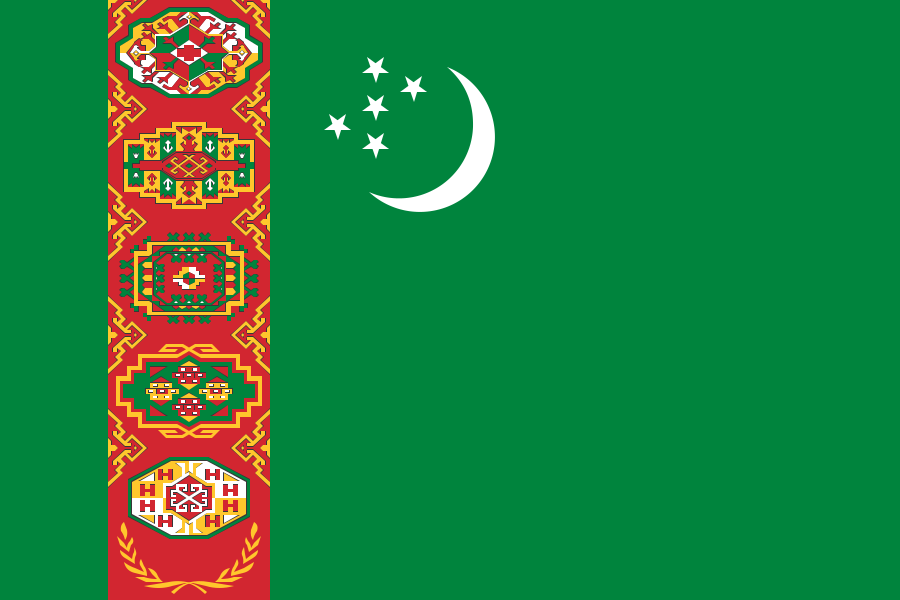
A Turkmen leader who turned late-Soviet rule into personal rule over an independent state
At the 1991 9+1 meetings, he weighed a reworked union against preserving Turkmenistan’s autonomy.
Saparmurat Niyazov was the Soviet-era party and government leader who became independent Turkmenistan’s first president. He led the Turkmen delegation in the 9+1 meetings during the 1991 New Union Treaty process, while the republic’s guarded autonomy limited his role in the negotiations themselves. After independence he invoked neutrality and state sovereignty while concentrating power in the presidency and using the Ruhnama and an extensive personality cult to organize public life. His rule remains a case of post-Soviet state formation fused with authoritarian consolidation.
Career timeline
1962Joined the Communist Party of the Soviet Union
1970–1980Cadre in the Communist Party of Turkmenistan Central Committee
1980–1984First Secretary of the Ashgabat City Party Committee
1985Chairman of the Council of Ministers of the Turkmen SSR
1985–1991First Secretary of the Communist Party of Turkmenistan
1990–1991Chairman of the Supreme Soviet of the Turkmen SSR
1990–2006President of Turkmenistan
1991Head of Turkmenistan’s delegation at the 9+1 New Union Treaty meetings