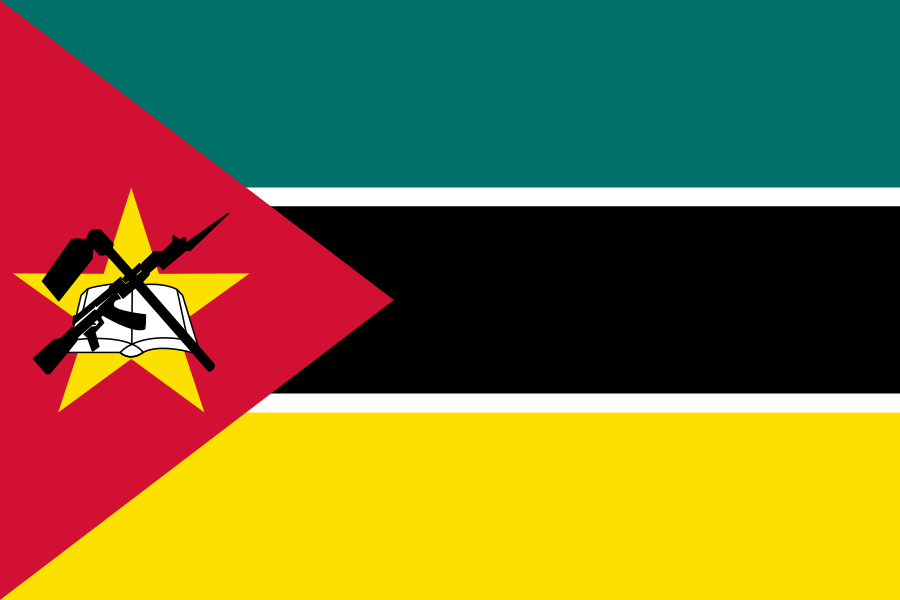
The Marxist revolutionary who overthrew Portuguese colonial rule and led Mozambique to independence
“The liberation of Africa is the liberation of the continent, or it is nothing.”
Mozambique's independence leader and first president. As FRELIMO chairman, he waged armed struggle to end Portuguese colonial rule and built a socialist state. A crucial ally of liberation movements against Rhodesia and South African apartheid.
Activities and affiliations
Career Timeline
- 1963Exiled to Tanzania, joins FRELIMO; guerrilla training in Algeria
- 1966FRELIMO Secretary for Defense
- 1968Commander-in-chief of the Mozambican liberation army
- 1970Becomes FRELIMO President; adopts Marxism-Leninism as party ideology
- 1974Negotiates independence with Portugal's new government — Lusaka Accord
- 1975–1986First President of the People's Republic of Mozambique
- 1984Signs the Nkomati non-aggression pact with South Africa
- 1986.10Killed in plane crash at Mbuzini, South Africa, returning from Zambia
Related historical events
Formation: From Peasant's Son to Revolutionary Commander
Samora Machel was born on 29 September 1933 in the village of Madragoa (today Chilembene), Gaza Province, Portuguese Mozambique, into a peasant family of the Shangaan people. His grandfather had been an active collaborator of Emperor Gungunhana of the Nguni Empire. His father, like most Black Mozambicans under Portuguese rule, was classified as 'Indígena' (native): forced to accept lower crop prices than white farmers, compelled to grow labour-intensive cotton instead of food crops, and forbidden to brand his cattle to prevent theft. Despite these barriers, by 1940 his father was a successful farmer who owned four plows and 400 head of cattle.
Machel completed the fourth grade at a Catholic mission school. Though he never finished secondary education, he earned a certificate that qualified him to train as a nurse anywhere in the Portuguese territories. In 1954 he began nursing studies at the Miguel Bombarda Hospital in Lourenço Marques (now Maputo), later working there as a nursing aide while continuing his education at night school. At the hospital, he began protesting against the fact that Black nurses were paid less than whites doing the same work, the seed of his anti-colonial consciousness.
His political awakening was shaped by concrete experience. He saw fertile lands around his community on the Limpopo River appropriated by the provincial government and handed to white settlers. Relatives went to work in South African mines, and one of his brothers was killed in a mining accident. When his protests against hospital discrimination drew the attention of the Portuguese secret police (PIDE), a white anti-fascist pharmaceutical representative, João Ferreira, warned him: 'You are being watched.'
In 1963 Machel slipped across the border, making his way to Dar es Salaam, Tanzania, to join FRELIMO under Eduardo Mondlane. He transited Swaziland, South Africa, and Botswana, where, in a striking episode, a senior ANC official J.B. Marks bumped an ANC recruit off a plane to make room for the young Mozambican. In Tanzania, Machel volunteered for military service and was sent with the second group of FRELIMO guerrillas for training in Algeria. On his return, he established FRELIMO's first training camp at Kongwa.
After the independence war began in September 1964, Machel distinguished himself as a guerrilla commander in the grueling conditions of Niassa's eastern region. Following the death of first FRELIMO army commander Filipe Magaia in October 1966, Machel became FRELIMO Secretary for Defense, and in 1968 Commander-in-Chief of the Mozambican liberation army. When Mondlane was assassinated by a parcel bomb in 1969, Machel formed a three-person leadership with Uria Simango and Marcelino dos Santos. In 1970 he was elected FRELIMO President and formally adopted Marxism-Leninism as party ideology.
Personal Life: Two Marriages, Revolutionary Love and Loss
Machel's personal life was inseparable from the revolution. In the late 1950s, while working as a nurse on Inhaca Island, he met Sorita Tchaiakomo and lived with her; they had three children: Joscelina (1958), Idelson (1959), and Olívia (1961). After the family returned to the mainland, Machel also began a relationship with fellow nurse Irene Buque, who gave birth to their daughter Ornila in February 1963, three weeks before he left Mozambique to join FRELIMO. Neither relationship was formalized as marriage, and Machel later expressed remorse for his treatment of both women.
Machel's first marriage was to Josina Abiatar Muthemba, a militant of the anti-colonial student organization NESAM who reached Tanzania in 1965 after her second escape attempt. She became one of the earliest recruits to the Women's Detachment of the guerrilla army and campaigned vigorously for women's full inclusion in the liberation struggle. Married at Tunduru in southern Tanzania in May 1969, their son Samora Jr. ('Samito') was born that November. As head of Social Affairs, Josina was responsible for war orphans and the welfare of children in the liberated zones, but her health deteriorated steadily. A diagnostic trip to the Soviet Union proved fruitless; suffering from what was likely leukemia or pancreatic cancer, she died on 7 April 1971 at age twenty-five. Machel was devastated.
His second wife, Graça Simbine, graduated in modern languages from Lisbon University before joining FRELIMO in 1973, working as a teacher in the liberated zones of Cabo Delgado and at the FRELIMO school in Tanzania. She became Minister for Education and Culture after independence and married Machel in September 1975, three months after independence. They had a daughter, Josina (1976), and a son, Malengane (1978); Machel's five older children joined them in the presidential household.
After Machel's death in 1986, Graça Machel became an internationally recognized advocate for children's and women's rights, and in 1998 she married Nelson Mandela, President of South Africa, making her the only woman in modern history to have served as First Lady of two countries. Machel's son Samora Machel Jr. has chaired the board of Montepuez Ruby Mining since 2011. The trajectory of the Machel family encapsulates, in one lineage, the story of southern African liberation across a century.
Mondlane and Machel: Founder and Commander — The Two Faces of FRELIMO
Without Eduardo Mondlane, there would have been no Samora Machel, and vice versa. An anthropologist with a PhD from Northwestern University who had taught at Syracuse, Mondlane founded FRELIMO in 1962 by merging three exiled independence groups. He was the intellectual with international reach and the diplomatic skill to navigate between the West, the Soviet Union, and Africa. If Mondlane provided the ideological framework, a unified national liberation movement transcending ethnicity, race, and region, Machel was the military leader who turned that framework into armed struggle.
Machel had already been politicized through NESAM, the student organization Mondlane had founded, and he joined FRELIMO in Tanzania in 1963. Mondlane sent him for guerrilla training in Algeria; on his return, Machel established FRELIMO's first training camp at Kongwa. Their relationship was complementary: while Mondlane fought the diplomatic war at the UN and in Western capitals, Machel commanded combat in the forests of Niassa.
The Second Congress of July 1968 was the decisive moment that revealed their political alignment. The majority faction, led by Mondlane and Machel, joined by Marcelino dos Santos and Joaquim Chissano, carried the line that the struggle must aim not merely at independence but at socialist social transformation. Uria Simango and Lázaro Nkavandame, who opposed this vision as 'narrow nationalism' in reverse, were defeated. Machel emerged from this congress as Mondlane's firm ideological ally.
On 3 February 1969, Mondlane was assassinated by a parcel bomb in Dar es Salaam. The Portuguese secret police PIDE was blamed, but the case remains clouded. FRELIMO was thrown into crisis. Deputy president Simango claimed the succession, but the Central Committee instead constituted a triumvirate of Machel, Simango, and dos Santos. When Simango published a pamphlet titled 'Gloomy Situation in FRELIMO' attacking the leadership, he was swiftly expelled. In May 1970, Machel was formally elected President of FRELIMO.
Machel inherited Mondlane's legacy, and decisively transformed it. Mondlane's FRELIMO had been a national front of 'all patriotic strata'; Machel's FRELIMO, at its Third Congress in 1977, redefined itself as a Marxist-Leninist vanguard party based on the 'worker-peasant alliance.' It was both the flowering of the seed Mondlane had planted and a far more radical fruit than the seed had originally promised. Machel always honored Mondlane as 'the father of our revolution,' and in 1975 the University of Lourenço Marques was renamed Eduardo Mondlane University: a permanent testament to the founder whose death had cleared the path for the commander.
Nyerere and Tanzania: Rear Base of Liberation, Mentor of Revolution
No personal or political relationship shaped Samora Machel's life as a revolutionary more decisively than that with Julius Nyerere. In 1963, evading the Portuguese secret police PIDE, Machel fled across the border to Dar es Salaam, Tanzania, joining FRELIMO, which Eduardo Mondlane had already founded and headquartered there. From the moment of Tanganyika's independence in 1961, Nyerere had positioned himself as patron of African liberation movements, hosting the OAU Liberation Committee in Dar es Salaam and providing territory, materiel, and diplomatic backing to FRELIMO and other southern African liberation organizations.
When Machel returned from guerrilla training in Algeria, it was at Kongwa, Tanzania, that he established FRELIMO's first training camp. For over a decade until Mozambique's independence in 1975, Tanzania served as FRELIMO's rear base, diplomatic window, refugee haven, and logistics corridor. Nyerere was more than a sponsor. His Ujamaa socialism, emphasizing collective agriculture, self-reliance, and moral political community, differed theoretically from the Marxism-Leninism Machel would later adopt, yet both shared a vision of abolishing 'the exploitation of man by man' and forging a 'New Man.'
On 22 May 1975, one month before Mozambique's independence, Machel was awarded the Kilimanjaro Medal First Order by Nyerere at a mass rally in Dar es Salaam. Nyerere hailed him as 'a true fighter for African liberation,' while Machel publicly acknowledged that without Tanzania's support, FRELIMO's victory would have been impossible. After independence, the two leaders became the twin pillars of the Frontline States, coordinating political and military support for Zimbabwe's liberation (1980) and the anti-apartheid struggle in South Africa.
Yet tensions existed. Nyerere's Ujamaa was a reformist socialism rooted in traditional community, while Machel's FRELIMO declared itself a Marxist-Leninist vanguard party at its Third Congress in 1977, embracing class struggle and state-led industrialization. When Tanzania intervened militarily to overthrow Idi Amin's regime in Uganda (1979), Machel withheld public support, disappointing Nyerere. Still, after Machel's death in 1986, Nyerere reflected: 'He was my son.' To this day, Dar es Salaam's central thoroughfare bears the name Samora Avenue: a monument to the comradeship of two revolutionaries and the transnational solidarity of Africa's liberation movements.
Armed Struggle and Socialist State-Building
Machel's revolutionary practice unfolded along two axes: armed struggle and state-building. FRELIMO launched its first offensive in September 1964, and Machel, as commander-in-chief of the Mozambican liberation army from 1968, directed the guerrilla war. This was never a purely military operation: in the liberated zones, FRELIMO established collective agriculture, popular education, and healthcare systems, putting into practice the dual task of 'building the new society within the struggle itself.' After becoming FRELIMO president in 1970, Machel formally adopted Marxism-Leninism as party ideology and articulated national liberation as 'an extension of the class struggle.'
Following Portugal's Carnation Revolution, the Lusaka Accord confirmed independence, and the People's Republic of Mozambique was proclaimed on 25 June 1975. Machel's government nationalized land, banks, and major industries while launching nationwide literacy campaigns and expanding basic healthcare. Within five years, literacy rates rose sharply, and vaccination and primary-care networks reached the countryside. Yet the mass exodus of Portuguese settlers stripped the country of skilled professionals, and a civil war (1977–1992) with RENAMO insurgents, backed by Rhodesia and later South Africa, eroded economic gains. Machel urged that 'production is combat in the trenches,' pressing economic reconstruction even during wartime. In 1984 he signed the Nkomati Accord with South Africa to relieve pressure, but Pretoria never halted its support for RENAMO.
Lusophone African Solidarity: One Language, One Enemy, One Struggle
Machel's revolutionary vision was shaped within the framework of Lusophone solidarity: a common front of all African peoples fighting Portuguese colonialism. Founded in Casablanca in 1961, CONCP (Conference of Nationalist Organizations of the Portuguese Colonies) united FRELIMO, Angola's MPLA, Guinea-Bissau's PAIGC, and São Tomé's CLSTP under a single political platform. Machel repeatedly insisted this solidarity was not diplomatic rhetoric but an existential necessity against 'one language, one enemy, one system of exploitation.'
His relationship with PAIGC's Amílcar Cabral was especially profound. In 1963, as FRELIMO prepared for armed struggle, Cabral personally lectured Machel and other early FRELIMO cadres in Dar es Salaam on the political principles of guerrilla warfare. When Cabral was assassinated by the Portuguese secret police in 1973, Machel declared his death 'a loss for the entire Lusophone revolution' and pledged unconditional support to PAIGC.
Machel's internationalism found its most dramatic expression in support for Angola's MPLA. Around Angola's independence in 1975, when MPLA faced a three-front war against FNLA, UNITA, and a South African-Zairean coalition, Machel provided two decisive forms of aid. First, he opened Mozambican airspace and the airports of Maputo and Beira as transit corridors for Soviet and Cuban supplies and troops bound for Angola. Second, he dispatched Mozambican military units to fight alongside MPLA-Cuban forces on Angola's southern front against the South African Defence Force's armored columns. These decisions came at a time when newly independent Mozambique itself faced attacks from Rhodesia and the emerging RENAMO insurgency.
On 18 October 1986, the day before his death, Machel was still leading the Frontline States' effort, at the Mbala summit in Zambia, to build a united front against Mobutu's support for UNITA. For him, Lusophone solidarity was never diplomatic posture; it was an ontological commitment he upheld even at the cost of his vulnerable young nation's own security.
Josina Machel and the Women's Detachment: The Other Face of Revolution
Samora Machel's first wife, Josina Abiathar Muthemba Machel (1945–1971), was a revolutionary leader in her own right. Born in Inhambane province into a family of anti-colonial activists, she was arrested by the PIDE at age 18 after two attempts to cross the border and join FRELIMO; an international solidarity campaign secured her release. Arriving in Tanzania in 1965, she became a founding figure of the Women's Detachment (Destacamento Feminino), formally established by the FRELIMO Central Committee on 4 March 1967.
The Detachment began with 25 young peasant women from Cabo Delgado and Niassa. Though some within FRELIMO initially resisted, arguing that a woman's place was in the kitchen, they received political and military training at Nachingwea and fought in the defense of liberated zones, ambushes, and mining operations alongside men. They also played vital civilian roles: political education, refugee relief, and running orphanages. In her essay 'The Role of Women in the Revolution,' Josina wrote: "The colonialists wanted to make us passive, but we knew we were Mozambicans and could never be Portuguese."
Married to Machel in May 1969, Josina refused to leave the field. As head of Social Affairs in the Defense Department and head of the Women's Section in External Affairs, she organized orphanages across the liberated zones and helped develop the Tunduru Educational Centre. In December 1970 she began a grueling march through Niassa province to organize orphanages and Women's Detachment activities; her health collapsed, and she died in Dar es Salaam on 7 April 1971, aged 25. At the end, she told those beside her: "I leave behind two preoccupations: the Revolution and my family."
Her death shook FRELIMO. Samora wrote a poem for her, and 7 April, the date of her passing, was declared Mozambican National Women's Day. The Detachment's legacy was institutionalized in 1973 as the Organization of Mozambican Women (OMM), which became central to women's mobilization after independence. Mozambique's high rate of female parliamentary representation (over 40% today) rests on this revolutionary foundation, a living trace of what Josina Machel and the women of the Detachment began.
Revolutionary Thought: The New Man, Women's Liberation, and Anti-Racism
Machel was not only a leader of armed struggle but also an original Marxist-Leninist thinker whose speeches and writings provided a theoretical foundation for post-colonial socialist construction.
The centerpiece of his thought was the concept of the 'New Man' (Homem Novo). At the Second Conference of the Department of Education and Culture in 1970, Machel declared: "When we took up arms to defeat the old order, we felt the obscure need to create a new society, strong, healthy and prosperous, in which men free from all exploitation would cooperate for the progress of all." The New Man was a revolutionary human type who would overcome the residues of colonialism and traditional superstition to internalize a scientific worldview and a collective consciousness. He insisted that "the Revolution's main objective is to destroy the system of the exploitation of man by man, the construction of a new society which will free human potentialities and reconcile work and nature."
For Machel, women's liberation was never a secondary task. At the first congress of the Organization of Mozambican Women (OMM) in 1973, he argued: "The liberation of women is not an act of charity. It is not the result of a humanitarian or compassionate position. It is a fundamental necessity for the Revolution, a guarantee of its continuity, and a condition for its success." He noted that women are the most oppressed. "Exploited even by him who is exploited himself, beaten by him who is tortured, humiliated by him who is trod underfoot by the boss," he insisted, and the Revolution could not succeed without liberating them.
A third pillar of Machel's thought was his uncompromising anti-racism. Alert to the danger of the national liberation war degenerating into racial conflict, he repeatedly stressed: "Our enemy has no colour, no race, no country. Nor does our friend. We do not define friend or enemy in terms of skin colour. We are not struggling against a colour but against a system — the system of exploitation of man by man." This provided the theoretical basis for FRELIMO's acceptance of white Mozambicans of Portuguese origin as comrades and its rejection of a neocolonial independence in which a Black elite would simply replace white rulers.
His collected speeches, 'Samora Machel: An African Revolutionary' (1986), remain a major text of African Marxism, and his Lenin Peace Prize (1975–76) reflected international recognition of his stature as a revolutionary thinker.
Soviet Bloc Relations: Between Alliance and Autonomy
Machel's Marxist-Leninist state-building was inseparable from close cooperation with the Soviet Union and the Eastern Bloc. During the liberation struggle, both the USSR and China supplied FRELIMO with small arms, fuel, and training; in 1971 alone, China delivered over 10,000 tonnes of weaponry. That same year, Machel attended the 24th Congress of the CPSU and toured the Soviet Union, Bulgaria, Romania, and East Germany, though Moscow initially viewed him warily as "pro-Chinese."
Upon Mozambique's independence in 1975, the USSR immediately recognized the People's Republic, and in March 1977 Machel signed a 20-year Treaty of Friendship and Cooperation, only the third such pact the Soviet Union made in sub-Saharan Africa. Thousands of Soviet, Cuban, and East German military advisers soon arrived to restructure the Mozambican army and provide presidential security. Cuban pilots flew Soviet-supplied MiG-17 fighters based in Mozambique, and after the 1981 South African commando raid on ANC targets in Matola, Soviet warships entered the ports of Maputo and Beira as a warning against further attacks. East Germany dispatched specialists in health and education, and Mozambique gained COMECON observer status, though full membership was refused despite East German sponsorship.
Yet Machel firmly resisted becoming anyone's client. Deputy FRELIMO President Marcelino dos Santos declared: "We did not fight for fifteen years to free ourselves to become the pawn of yet another foreign power." Machel rebuffed Soviet pressure to establish a naval base in the Bazaruto Archipelago and maintained diplomatic and economic ties with Portugal, France, Britain, and other Western states. In 1983 he visited Portugal to sign a cooperation agreement, and in 1985 he met President Reagan at the White House, where, according to Secretary of State George Shultz, the two men discovered a rapport and "both liked each other."
The USSR awarded Machel the Lenin Peace Prize (1975–76) and the Order of People's Friendship (1980). Yet by the mid-1980s, as Soviet support dwindled and the RENAMO insurgency intensified, Machel began pivoting toward the West and the IMF. The plane in which he died was a Soviet-built Tu-134A, piloted by a Soviet crew: an irony that encapsulates the complex, and ultimately tragic, entanglement of Machel's revolution with the Soviet bloc.
From Carnation Revolution to Independence: The Politics of the 1974–1975 Transfer of Power
On 25 April 1974, the Carnation Revolution, a near-bloodless military coup by left-wing Portuguese officers, toppled the Marcelo Caetano dictatorship and brought Mozambique's liberation struggle to an irreversible turning point. The Armed Forces Movement (MFA) that led the coup declared an end to the colonial wars, but the revolution's first president, General António de Spínola, clung to a vision of a Lusophone commonwealth and proposed a referendum on independence. Machel dismissed this with the memorable retort: "You don't ask a slave if he wants to be free, particularly when he is already in revolt, and much less if you happen to be a slave-owner."
Initial talks in Lusaka in June 1974 collapsed. Machel judged that Portuguese Foreign Minister Mário Soares had no real power to negotiate independence, and dispatched his close adviser Aquino de Bragança to Lisbon to determine who actually held authority. Bragança's answer was decisive: FRELIMO should be talking not to Soares but to the military intellectuals of the MFA, particularly Colonel Ernesto Melo Antunes, whose influence was rising as Spínola's waned.
Machel refused to grant the Portuguese the ceasefire they wanted. Instead, FRELIMO escalated: it reopened the front in Zambezia province and stepped up operations across the war zone. After the collapse of the Caetano government, rank-and-file Portuguese soldiers saw no point in fighting and stayed in their barracks; resistance was minimal. Machel's strategy was explicit: the war would continue until there was an unconditional commitment to Mozambican independence.
As Spínola's influence faded and the MFA took charge of negotiations, progress followed. On 7 September 1974, Machel and the Portuguese government signed the Lusaka Accord. Portugal recognized FRELIMO as the sole legitimate representative of the Mozambican people, set 25 June 1975 as independence day, and agreed to transfer full power directly to FRELIMO, without referendum or elections. Immediately after the signing, armed white settlers launched a short-lived revolt, which was crushed within a day by Portuguese and FRELIMO troops acting jointly.
A transitional government was formed, headed by FRELIMO's Joaquim Chissano as Prime Minister, while Machel continued to direct FRELIMO from Tanzania. In late May 1975, weeks before independence, he embarked on a triumphant journey "from the Rovuma to the Maputo," the rivers marking Mozambique's northern and southern borders, addressing mass rallies in every major population center. At the beach resort of Tofo in Inhambane Province, the FRELIMO Central Committee convened mid-journey to draft Mozambique's first constitution. It established a one-party socialist state in which FRELIMO was constitutionally the leading force in society and the party president would automatically be president of the republic.
On 25 June 1975, at Maputo's Machava Stadium, Machel proclaimed "the total and complete independence of Mozambique and its constitution into the People's Republic of Mozambique," a state of People's Democracy that would "destroy the sequels of colonialism and annihilate the system of exploitation of man by man." Ten years of armed struggle, one year of intense diplomacy, and the collapse of Portuguese fascism had converged in a single day.
The Nachingwea Trials: Internal Purge in the Name of Revolution (1975)
Between March and May 1975, just months before Mozambican independence (25 June 1975), events unfolding at FRELIMO's political-military training camp at Nachingwea in southern Tanzania decisively shaped the character of the post-independence state. In so-called 'popular trials' presided over by Machel and Marcelino dos Santos, internal opposition figures, including former FRELIMO Vice-President Uria Simango, FRELIMO founding Deputy General Secretary Paulo Gumane, and the poet-politician Joana Simeão, were forced to make public confessions before thousands of FRELIMO fighters.
Simango had briefly succeeded Eduardo Mondlane as FRELIMO president after the latter's 1969 assassination but was sidelined in a power struggle with Machel and dos Santos and subsequently expelled. When he returned to Mozambique after Portugal's 1974 Carnation Revolution, Simango founded the National Coalition Party (PCN) and called for multi-party elections. FRELIMO, committed to one-party rule, outlawed all opposition. At Nachingwea, Simango and his colleagues were compelled to read aloud twenty-page confessions in which they admitted to being agents of the Portuguese secret police (PIDE), conspirators in Mondlane's murder, and counter-revolutionary plotters.
Machel staged the trials as a ritual of revolutionary purification. In a collective interview in March 1975, he explained: 'We arrested them! We do not kill! They are teachers of the negative: they teach us what we must not build.' The defendants were made to beg for 're-education' before being taken into custody. Even at the time, the credibility of these confessions was widely questioned; today they are regarded as unreliable even within sections of Mozambique's current leadership.
The defendants of the Nachingwea trials were secretly executed at some point between 1977 and 1980. Simango's wife Celina is believed to have been executed separately sometime after 1981. The location of their bodies and precise dates of death have never been disclosed. In 1995, then-Security Minister Sérgio Vieira confirmed before the Mozambican parliament that 'the traitors were executed.' In 2005, dos Santos reaffirmed that they were 'traitors against the Mozambican people.'
The Nachingwea trials and subsequent executions expose a core contradiction of Machel's regime: a government that waged a legitimate struggle against colonial rule and racial oppression simultaneously eliminated internal political pluralism through violence and laid the foundations of one-party dictatorship. Tanzania's Julius Nyerere and Zambia's Kenneth Kaunda reportedly received Machel's personal assurance that Simango and the others would not be executed; the breaking of that promise cast a shadow over Machel's international standing as well.
The Great Portuguese Exodus: The 24/20 Order and the Departure of the Settlers (1975)
Immediately after independence on 25 June 1975, Machel's government embarked on radical measures to dismantle the colonial legacy and assert national sovereignty. The most dramatic was the so-called '24/20 Order,' announced on 18 August 1975 by Interior Minister Armando Guebuza: Portuguese nationals were to either adopt Mozambican citizenship or leave the country within 24 hours, taking only 20 kilograms of personal luggage. It was a categorical assertion of sovereignty directed at a settler community that had relied on racially structured colonial privilege.
The Portuguese exodus had already begun (tens of thousands had left after the Carnation Revolution in 1974). But the 24/20 Order triggered a stampede. By the end of 1975, roughly 250,000 Portuguese residents had fled Mozambique. They had monopolized nearly every skilled and managerial position that ran the colonial economy: hospitals, schools, factories, farms, banks, and public administration. Their sudden departure vaporized Mozambique's skilled workforce overnight. Abandoned homes and businesses were nationalized, but lacking personnel to operate them, most fell into disuse and rapid decay.
For Machel, this was a deliberate rupture with the structural legacy of colonialism. He insisted that "we must liquidate the lifestyle of the exploiters," and while FRELIMO stated it wanted Portuguese who accepted Mozambican citizenship to stay, it would not tolerate a neocolonial order in which a Black elite simply replaced white rulers. But the price was severe: over 90% of the country's doctors left, collapsing the very healthcare system in which Machel had trained; the vacuum of teachers, engineers, and administrators turned the euphoria of independence into administrative paralysis and economic crisis. This void became a fatal fissure when the RENAMO insurgency erupted in 1977, plunging the country into a civil war whose wounds are still felt today.
25 June 1975 — The Midnight Proclamation: "A Luta Continua!"
At midnight on 25 June 1975, 100,000 people packed the Machava Stadium in Lourenço Marques (now Maputo). On a rainy night, the Portuguese flag was lowered by an unsmiling Portuguese sailor, folded by an airman, and entrusted to a soldier. Then three FRELIMO soldiers in starched fatigues ran up the new flag of the People's Republic of Mozambique. As tribal dancers beat animal-skin drums and a 21-gun salute boomed, Samora Machel embraced Portuguese Prime Minister Vasco Gonçalves. Thus ended 477 years of Portuguese colonial presence.
Machel read a six-page proclamation declaring the birth of a Marxist one-party state in which FRELIMO would be supreme over government, army, and the promised National Assembly. "On behalf of all Mozambicans," he declared, "the FRELIMO Central Committee solemnly proclaims the total and complete independence of Mozambique and its constitution as the People's Republic of Mozambique." Finishing the proclamation, Machel shouted in Portuguese, "A luta continua!" (The struggle continues!). A phrase that would become FRELIMO's enduring watchword, symbolizing the spirit of nation-building and anti-colonial solidarity that defined the post-independence years. Celebration erupted: FRELIMO soldiers fired Kalashnikovs and machine guns into the air, and car horns blared through the wet streets.
The scene at Machava Stadium stands as one of the most dramatic moments in Africa's decolonization history. Machel's embrace of the Portuguese prime minister at the very instant of independence symbolized his anti-racist credo: 'Our enemy has no colour, no race, no country.' Outside the stadium, statues of colonial heroes like Vasco da Gama and Lourenço Marques had been toppled from their pedestals and lay in a junkyard. The new government initially planned to rename the capital Can Phumo, after a local Shangaan chief, before settling on Maputo. White settlers were given 90 days to accept Mozambican citizenship or leave; most of the roughly 220,000 whites departed with a single suitcase and 150 escudos. The independence proclamation was the victory of armed struggle, and, as Machel insisted, the beginning of another war against underdevelopment, where 'production is combat in the trenches.'
Social Transformation: Nationalizations, Literacy, and the Health Revolution
The domestic reforms launched by Machel's government immediately after independence sought to radically restructure the extreme inequalities left by Portuguese colonialism. On 24 July 1975, one month after independence, all educational and health institutions were nationalized, and a free National Health Service (SNS) and a national education system were established. This was followed by the full nationalization of land, the nationalization of rented housing (February 1976), and state control of banks and major industries. 'Landlords? What do we want landlords for in our country?' Machel asked at the rally announcing the housing measure. Black Mozambicans moved en masse into city-centre apartments abandoned by Portuguese landlords, fundamentally altering the racial geography of Mozambican cities.
In education, Machel's government dramatically reduced the colonial-era illiteracy rate, which had exceeded 90%. Under the slogan 'literacy is a revolutionary act,' national literacy campaigns mobilized students, teachers, and soldiers as a mass movement, reaching roughly two million people with basic reading and writing instruction by the early 1980s. School enrollment rose from about 700,000 at independence to over 1.4 million within five years. In healthcare, a parallel transformation unfolded: massive vaccination campaigns against tetanus, smallpox, measles, and tuberculosis reached millions across the country, while primary-care networks and health posts were built in rural areas. In a country with barely 80 doctors nationwide, FRELIMO established a public-health system centered on health-worker training and preventive medicine. Infant mortality began to decline significantly in a country where life expectancy at independence was under 40 years.
The aldeias comunais (communal villages) were the signature experiment of Machel's vision of a 'New Society' (Sociedade Nova). Aimed at regrouping dispersed rural populations to provide schools, health posts, clean water, and cooperative agriculture, the program sought to fuse rural modernization with socialist relations of production. Machel insisted that 'production is combat in the trenches,' integrating economic reconstruction with military defense. Yet the mass exodus of some 200,000 Portuguese settler technicians and professionals created severe gaps in economic management, and RENAMO insurgents deliberately targeted schools and health posts, eroding the rural transformation. Despite this, the rapid gains in literacy, vaccination coverage, and urban housing equality stand as one of the most ambitious experiments in socialist construction in twentieth-century Africa.
Machel the Orator: Revolutionary Communication Through Direct Dialogue with the Masses
Samora Machel is widely regarded as one of the most compelling popular orators among 20th-century African revolutionaries. At independence, Mozambique had no television, no independent press, and only limited radio broadcasting and Portuguese-language newspapers. In this environment, FRELIMO relied on mass meetings and public speeches as its central means of political communication, and Machel stood at the centre of that practice.
In late May 1975, Machel crossed the Tanzanian border and embarked on a month-long 'Triumphal Journey' down the entire length of Mozambique. From the northern liberated zones to Maputo in the south, he addressed crowds of tens of thousands in football stadiums, public squares, and village halls. On 14 June 1975, just days before independence, Machel spoke for two hours to some 40,000 people in a Beira football stadium. Beira had been a centre of white settler resistance where FRELIMO had had no public presence during the liberation struggle: the speech itself was a political breakthrough. Machel anatomised the structures of colonial racism, exposed class relations, and outlined the new society to be built after independence.
Machel's oratorical style was never a textbook Marxist lecture. Instead of academic theory, he deployed concrete experience, metaphor, satire, humour, and sometimes fierce rebuke. He would repeatedly ask the crowd, 'Do you hear? Do you hear?', call them 'blockheads,' and conjure colonial experiences through Ronga terms for forced labour (xibalo) and mine recruitment (Nwandzeguele). According to the analysis of Colin Darch and David Hedges, this was not mere rhetoric but a form of 'political theatre' that directly appealed to the collective memory of his audience.
On 13 June 1978, Machel visited the 'First of May' Communal Village in the Limpopo Valley and delivered what became known as his rice harvest speech. Faced with hundreds of hectares of unharvested rice (the result of failed mechanised state farm policies), Machel reminded the crowd of the sacrifices of the liberation struggle and commanded: 'Everybody to the rice harvest!' Cabinet ministers were not exempt. Machel himself led a procession of senior officials into the fields, scythe in hand. In the end, over 30,000 people were mobilised and the harvest was dramatically completed.
Through his speeches, Machel sought not merely to transmit information but to generate political consciousness and collective action. His speeches were largely improvised, delivered without scripts, and built around a dynamic rapport with the audience. In his 'open presidencies' (presidência aberta), nationwide tours in which he governed through direct encounters with peasants, workers, and residents rather than through bureaucratic reports, Machel functioned as a revolutionary educator and mass agitator, not simply an administrator. His practice also represented a linguistic intervention, elevating colloquial Portuguese and local-language expressions into the register of political discourse.
Culture as a Weapon: Cinema, Posters, and Revolutionary Art
The first cultural act of Machel's government was the creation of the National Institute of Cinema (INC). At independence in 1975, Mozambique had no national television network, so film newsreels were the only means of reaching the population through visual media. The INC produced a weekly ten-minute newsreel called Kuxa Kanema ('Birth of Cinema' in the local language), which was screened in the country's relatively few cinemas and distributed to rural areas via mobile units provided by the Soviet Union. Instructors from Brazil and Cuba were flown in to teach filmmaking skills to Mozambicans who had no prior experience with cinema.
Machel had a keen awareness of the power of the image. The INC was not merely a propaganda organ but a cultural instrument to preserve the record of the liberation struggle and to construct a new socialist national identity. Ruy Guerra's 'Mueda, Memory and Massacre' (1979), the documentaries of Licínio Azevedo, and the numerous short films produced by the INC worked through the colonial past and projected onto the screen the 'New Man' forged by the revolution. Jean-Luc Godard visited Mozambique in 1978 with a 'crazy' proposal to put cameras into the hands of the peasants and create an independent television network; the government declined: Mozambique wanted to build its own film language.
The National Culture Meeting, held in Maputo in July 1977, established the theoretical foundations for a Marxist-Leninist cultural policy. Organized by Graça Machel, the minister of education and culture, the meeting debated fundamental questions: 'What is culture?' and 'What is the role of culture in the revolutionary process?' Drawing on historical materialism, delegates defined culture as a reflection of the mode of production and class relations, rejecting both uncritical veneration of tradition and indiscriminate rejection of foreign culture. Machel declared culture 'a weapon of grand valor in revolutionary education' and 'an instrument of ideological struggle.'
This cultural policy was equally visible in poster art. FRELIMO mobilized Mozambican and international artists to produce hundreds of political posters. The image of the revolutionary gripping a hammer, an African hoe, and a rifle, the slogan 'A Luta Continua!', and bold graphics on the themes of labor, education, and women's liberation defined the visual culture of newly independent Mozambique. Choral singing and traditional dance were also recast with revolutionary content and deployed as instruments of nation-building. As early as the liberation war, FRELIMO required combatants to learn the songs and dances of regions other than their own, cultivating a 'Mozambican' consciousness that transcended ethnic identity.
This cultural experiment was cut short by the intensification of the civil war and Machel's death. In the 1980s, RENAMO attacks destroyed many cinemas, and mobile screenings in rural areas ceased as roads became unsafe. After Machel's death, the INC was effectively dismantled, and by the 1990s television had replaced the film newsreel. Yet the visual archive produced by the INC remains the most vivid legacy of Mozambique's independence revolution and has been rediscovered through Margarida Cardoso's documentary 'Kuxa Kanema: The Birth of Cinema' (2003).
Religion and the State: From Catholic Seminary to State Atheism
Samora Machel's relationship with religion traced a complex arc from colonial Mozambique's Catholic Church to post-revolutionary state atheism. As a child, he attended Catholic mission school and later spent four years at a Catholic seminary. His father, who returned from South African mine work to become a leader of an Afro-Christian sect, raised him in a Christian milieu. Yet under colonialism, the Catholic Church was intimately tied to the Portuguese state: after 1926 it received government subsidies and privileged status, serving as an instrument of colonial rule through Portuguese-language education and cultural assimilation of the 'natives.'
Immediately after independence in 1975, Machel's government nationalized all health and education institutions on 24 July. The Catholic Church lost its privileged position in these sectors overnight. Church-owned schools and hospitals were taken over by the state, and religious instruction was removed from public curricula. Machel declared at one meeting: 'The Catholic Church was the church of the colonial fascist regime.'
With FRELIMO's transformation into a Marxist-Leninist party at its Third Congress in 1977, state atheism became more systematic. Church buildings were closed, confiscated, or repurposed; missionaries were expelled; and public religious practice was curtailed. Machel's religious policy was more than simple atheism. It combined the liquidation of an institutional church complicit in colonialism with an ideological campaign, grounded in the Marxist 'New Man' concept, that defined religion as 'superstition' and an enemy of the scientific worldview. At the same time, private belief was never fully outlawed, and some Protestant churches sought accommodation with the regime.
As the civil war intensified in the 1980s, Machel's religious policy gradually softened. Dialogue with the churches resumed in 1982. And, in a striking irony, the 1992 Rome peace accord that ended the post-Machel civil war was mediated by the Catholic lay Community of Sant'Egidio. Machel's religious policy remains a dramatic case study in the tensions produced when revolutionary state-building collides with traditional faith communities.
The Health Revolution: A Nurse-Turned-President and Medicine for All
Machel declared during the liberation war that "our health posts are far more than centres for dispensing medicine — a patient's stay should serve to heighten his awareness of national unity." In July 1975, immediately after independence, all health services were nationalized and private medical practice was abolished. The colonial system, where wards were segregated by race and ability to pay, was dismantled, but only 85 of the country's 550 doctors remained; the departing physicians sabotaged equipment as they fled.
Machel treated health as a political question. In October 1976, FRELIMO intervened directly in Maputo's Central Hospital, installing a "Commission of Restructuring" and organizing democratic workers' councils (conselhos de base) on every ward. Machel denounced the hospital as "a center of humiliation, theft, immorality, indiscipline — a center of political, ideological and material corruption." He ordered a fundamental transformation of decision-making and worker-patient relations. Soon cleaning women were chairing ward meetings, and patients' mothers were helping wash diapers and attending nutrition classes: scenes unimaginable under colonial rule.
The greatest achievements came in preventive medicine. By August 1977, a mass vaccination campaign against tetanus, smallpox, measles, and tuberculosis had reached four million people (over a third of the population) and by the end of 1978 over 90% of the population was covered, a feat verified and acclaimed by the World Health Organization. The health budget tripled from 4.1% of national spending in 1974 to 12.8% in 1977, reaching US $3.70 per capita, or 3.5% of GNP.
To fill the void left by the departing doctors, FRELIMO trained "agentes polivalentes" (multi-purpose health mobilizers), modeled on China's barefoot doctors, in six-month courses, with villages electing their own candidates. Three medical technician training schools upgraded experienced nurses into "medical technicians" capable of diagnosis and prescribing. A pyramid system was designed: 500 rural health centers feeding into 120 district hospitals, 10 provincial hospitals, and the central referral hospital. In the capital, 11 neighborhood health centers halved the pediatric outpatient load at Central Hospital. On the pharmaceutical front, the 13,000 drugs sold in colonial times were slashed to a national formulary of 600, listed by generic name only, with standard treatment regimens introduced for common illnesses. Though death rates from malaria, diarrhea and respiratory infections remained high into the 1990s, the construction of a public-health foundation, non-existent under colonialism, within a single decade stands as one of the most tangible legacies of Machel's revolution.
Revolutionary Discipline and Reeducation: SNASP, Reeducation Camps, and Political Purges
Machel's revolutionary state built a powerful security apparatus and social control system under the mission of eradicating colonial residues and creating the 'New Man.' The National Service for Popular Security (SNASP), established in 1975 and headed by Machel's longtime comrade General Jacinto Veloso (a white Mozambican and former Portuguese Air Force pilot who had joined FRELIMO in 1963), conducted wide-ranging surveillance and detention of dissidents, political rivals, and 'anti-social elements.'
The Machel government introduced 'reeducation centers' where petty criminals, political opponents, prostitutes, and drug users were imprisoned, often without trial. Conditions were harsh; historian Benedito Machava estimates that over a thousand inmates may have died from starvation, disease, punishment, or execution. Influenced by both Christianity and Maoism, Machel adopted what scholars describe as a 'salvationist stance,' believing that reeducation would enforce his vision of social and moral purity.
Yet the system also included reintegration. In 1979–80, three reeducation centers closed, leading to the reintegration of 2,600 former inmates (including hundreds of 'political offenders') into society. In an October 1981 speech, Machel himself acknowledged and criticized the practice of lengthy arbitrary detentions.
The most controversial episode was the 1975 show trial at the Nachingwea military camp, where former FRELIMO opposition leaders, including Paulo Gumane and Uria Simango, were pressured into confessing to 'counter-revolutionary conspiracy.' They are presumed to have been executed in the following years. A 1995 investigative report alleged that Simango and his wife were burned alive by soldiers in 1977 (or 1983). That same year, former Security Minister Sérgio Vieira confirmed in parliament that 'the traitors were executed,' but FRELIMO has never disclosed the circumstances.
As the civil war intensified in the early 1980s, the government extended the death penalty to economic crimes and introduced corporal punishment. These authoritarian measures, though largely dormant within a year, inflicted lasting damage on FRELIMO's progressive image. These tensions reveal the fundamental contradiction Machel faced between revolutionary ideals and the imperatives of power.
Frontline Internationalism: Mozambique as a Base Against Apartheid
Machel's internationalism was not rhetoric but national practice. From independence onward, Mozambique provided territory and military support to liberation movements fighting white-minority regimes in South Africa and Rhodesia. The ANC's armed wing Umkhonto we Sizwe, Zimbabwe's ZANU-ZANLA, Namibia's SWAPO, and South Africa's PAC all operated from bases on Mozambican soil.
In March 1976, Machel's government fully implemented UN sanctions against Ian Smith's Rhodesia and closed the border. The economic cost was staggering: transit trade routes and power-grid imports via Rhodesia were severed, and by Zimbabwean independence in 1980, Mozambique's losses ran into billions of dollars. Machel's response: "We do not calculate independence in terms of dollars."
As a central leader of the Frontline States, Machel worked with Tanzania's Nyerere, Zambia's Kaunda, Botswana's Khama, and Zimbabwe's Mugabe to coordinate political and military support for regional liberation. At the 1979 Lancaster House talks on Zimbabwean independence, Machel persuaded Mugabe to accept the settlement and, relying on his own intelligence teams, was certain ZANU would win any free election, which it did, taking 57 of 80 Black-reserved seats.
The price of this internationalist practice was enormous. To sever Mozambique's support for the ANC, South Africa and Rhodesia created and armed the RENAMO insurgency, triggering a 16-year civil war (1977–1992). In 1981, South African commandos killed 12 ANC members in Matola. Undeterred, Machel embraced ANC president Oliver Tambo at a Maputo rally and declared: "Let the South Africans come, but let them be clear that the war will end in Pretoria!" The 1984 Nkomati Accord, in which Mozambique expelled some ANC members in exchange for South Africa halting RENAMO support, was never honored by Pretoria. And to this day, many believe Machel was killed because he refused to fully abandon the anti-apartheid cause.
The Zimbabwe Liberation War: From the Rhodesian Front to Lancaster House
For Machel, the liberation of Zimbabwe was not merely a neighbor's independence but a strategic imperative for Mozambique's own revolutionary survival. From the independence war period, FRELIMO had allowed ZANLA (Zimbabwe African National Liberation Army) guerrillas to operate from Mozambican territory in Tete province, infiltrating northern Rhodesia. In March 1976, Machel's government fully implemented UN sanctions against Ian Smith's white-minority regime and closed the 1,200-kilometer border. The severing of transit trade routes and power lines through Rhodesia cost Mozambique hundreds of millions of dollars annually, but Machel refused to back down: "We do not calculate independence in dollars."
When Robert Mugabe, released from a Rhodesian prison in 1975, arrived in Mozambique, Machel was initially suspicious. Distrusting Mugabe's rise through what appeared to be an internal ZANU coup, Machel effectively rusticated him to Quelimane as an English teacher. Machel went further, sponsoring the Zimbabwean People's Army (ZIPA) as an alternative to the divided nationalist factions, only to discover that ZIPA's core fighters were ZANLA guerrillas whose loyalty remained with Mugabe.
Machel pursued a dual military-diplomatic strategy. He sent Mozambican units into Zimbabwe to fight alongside ZANLA while simultaneously pressing the British Conservative government to assume its responsibilities as the colonial power. At the 1979 Lancaster House conference in London, Machel's British-trained advisor Fernando Honwana served as a key consultant to the ZANU delegation. Machel persuaded Mugabe to accept an agreement that failed to resolve the land question, confident, based on his own intelligence assessments, that ZANU would win any free election. In the event, ZANU took 57 of the 80 seats reserved for Black Zimbabweans.
On his first state visit to an independent Zimbabwe in 1980, Machel delivered a famous warning about the dangers of ethnic division: 'To ensure national unity, there must be no Shonas in Zimbabwe, there must be no Ndebeles in Zimbabwe, there must be Zimbabweans. Some people are proud of their tribalism. But we call tribalists reactionary agents of the enemy.' The speech remains widely cited as a precise diagnosis of the central challenge of post-colonial African nation-building.
The Third Congress: From Liberation Front to Marxist-Leninist Vanguard Party (1977)
In February 1977, FRELIMO convened its Third Congress in Maputo, executing a historic transformation from a liberation front into a Marxist-Leninist vanguard party. Machel delivered the Central Committee report calling for 'iron organization and discipline,' driving the party's ideological and organizational restructuring.
The Congress redefined FRELIMO as the 'vanguard party of the worker-peasant alliance' and adopted the official name 'Partido FRELIMO.' The Central Committee was expanded to over 200 members, and Marxism-Leninism was formally adopted as party ideology. This was no mere rebranding: it marked a strategic pivot from national liberation toward socialist construction centered on class struggle.
The Congress confirmed the nationalization of land, banks, education, healthcare, and rented housing, and set the development of productive forces through a planned economy and state farms as its central task. Machel declared that 'production is combat in the trenches,' placing economic construction at the heart of revolutionary practice. 'Dynamizing groups' (grupos dinamizadores) were installed in workplaces and villages to institutionalize the organic link between party and masses.
The Congress codified women's liberation as a fundamental necessity of the revolution and formalized the Organization of Mozambican Women (OMM) as a party mass organization. Nationwide literacy campaigns and basic healthcare expansion accelerated immediately, achieving a 90% vaccination rate and dramatic literacy gains within five years.
Yet the Congress's radical agricultural policy (large-scale state farms and communal village collectivization) generated peasant resistance and declining productivity, and was partially reversed at the Fourth Congress in 1984. Even so, the Third Congress remains the clearest moment when the Mozambican revolution sought to go beyond national independence toward socialism, and it definitively shaped both Machel's thought and FRELIMO's political identity.
The People's Democracy Experiment: The 1977 Elections and the Theory and Practice of FRELIMO's One-Party State
In February 1977, at its Third Congress, FRELIMO declared itself a Marxist-Leninist vanguard party. Later that year, Machel presided over Mozambique's first nationwide elections since independence, a unique experiment in what he called 'people's democracy,' distinct from both Western multiparty systems and Soviet-style nominal elections.
The electoral process began at the grassroots. From September 25, 1977, deputies were elected to local, district, and provincial people's assemblies, culminating in elections for the 210-seat National People's Assembly (parliament) held December 1–4. Candidates were presented exclusively by FRELIMO, but the mass population could directly intervene in the selection process. At public assemblies, candidate lists were subjected to popular scrutiny: anyone exposed as a former PIDE (secret police) informer during the colonial period, as a wife-beater, or as a habitual drunkard could be struck from the list.
This was the institutional embodiment of a principle Machel repeatedly stressed: the revolution must be built by the people and for the people. For Machel, the one-party system was not dictatorship but a transitional mechanism for overcoming colonialism and building national unity. He argued that popular pressure within the party, through open debate, criticism and self-criticism, and constant communication via grassroots party cells, would provide the political dynamism that multiparty elections supplied in other systems.
In April 1978, Machel reshuffled the 18-member Council of Ministers to reflect the electoral outcome, and the newly constituted National People's Assembly held its first session on December 23. The electoral framework endured until Machel's death in 1986, maintaining a rhythm of regular elections and limited popular participation even under single-party rule.
Yet a fundamental tension lay at the heart of this 'people's democracy.' With opposition parties and independent media banned, the popular veto over candidates functioned more as a filter for individual moral defects than as a mechanism for producing genuine political alternatives. Operating alongside SNASP (the secret police) and the reeducation camps that suppressed political dissent, Machel's people's democracy experiment became a concentrated expression of the contradiction between revolutionary ideals and the realities of power.
The Battle for Bread: State Farms, Communal Villages, and the 1978 Rice Harvest Mobilization
Immediately after independence, Machel's government nationalized farms abandoned by Portuguese settlers and, with Soviet and East German technical aid, made large-scale mechanized state farms the centerpiece of agrarian policy. But the results were disappointing: hundreds of tractors and harvesters were deployed without sufficient experience, and the mismatch between imported machinery, local soils, and grain varieties soon became apparent.
In June 1978, the policy was dramatically tested. Visiting the 'First of May' Communal Village in the Limpopo Valley, Machel saw hundreds of hectares of rice left unharvested by the state farm system and was furious. He issued an on-the-spot mobilization order across Gaza Province: "Yesterday, from the Rovuma to the Maputo, our struggle was against the foreign occupier. We did not expel the colonialist in order to be lazy. Do you hear? Do you hear?"
Machel ordered everyone, peasants, students, civil servants, to take up curved scythes and join the rice harvest, then himself led a procession of ministers into the fields. Over 30,000 people were ultimately mobilized, and the crop was saved. The following month, FRELIMO's Central Committee reprimanded the 'technologists' and sacked Agriculture Minister Joaquim de Carvalho for scorning popular initiatives. Machel's speech was famous for its bluntness: he called his listeners 'blockheads,' reminded them of the forced labor (xibalo) and mine deaths of the colonial era, and demanded: "Have you already forgotten?"
Through this experience, Machel came to recognize that the choice of agricultural technique was not a technical question but a political one. In the years that followed, FRELIMO pivoted toward more popular, participatory approaches. Tens of thousands of communal villages (aldeias comunais) were established across the country, aiming to provide collective access to health posts, schools, and clean water while transitioning rural producers toward cooperative farming. In some cases, however, relocation was compulsory, especially after the devastating floods of 1977, and the communal villages became prime targets for RENAMO attacks, making them casualties of the civil war. Still, the aldeias comunais remain the enduring symbol of Machel's rural socialist vision: an ambitious attempt to transform scattered subsistence peasants into collective producers, and premodern hamlets into modern communities.
The RENAMO Civil War: An Impossible Choice
Throughout Machel's presidency, Mozambique was consumed by civil war. The Rhodesian Central Intelligence Organisation (CIO) created the Mozambican National Resistance (RENAMO) in 1976. Once independent Mozambique enforced UN sanctions against Rhodesia and provided rear bases to ZANLA, the Zimbabwean liberation movement, Ian Smith's regime needed a proxy to topple the FRELIMO government. After Zimbabwe's independence in 1980, South African military intelligence took over sponsorship of RENAMO. For apartheid Pretoria, Machel's Mozambique was the forward base of the ANC's armed struggle, and RENAMO was the instrument of retaliation.
RENAMO initially drew its ranks from traditional chiefs resentful of FRELIMO's centralization, remnants of the Portuguese secret police (PIDE), and figures defeated in FRELIMO's internal power struggles. But it soon grew into a full-scale insurgency trained and armed by Rhodesian and South African special forces. Its tactics focused on destroying social infrastructure: villages, schools, health posts, railways, and power lines were systematically attacked. Tens of thousands of civilians were abducted or killed; child soldiers were used by both sides.
Machel fought a war on two fronts: a grinding counterinsurgency against RENAMO in the north and center, and an impossible diplomatic negotiation with South Africa. The 1984 Nkomati non-aggression pact epitomized his dilemma: Mozambique expelled ANC members in exchange for Pretoria halting RENAMO support, but South Africa never honored its side. A popular saying spread: "Nkomati is the accord of Ngomadi, the folk trickster who always lies." By August 1984 the civil war had spread to all ten provinces, and most transport routes were severed. Compounding the crisis were repeated droughts, the failure of collective agriculture policies, and the mass exodus of Portuguese skilled labor, which together produced famine.
Machel held firm to FRELIMO's socialist course through the war, insisting that "production is combat in the trenches," but he was unable to defeat RENAMO militarily by the time of his death. When he died at Mbuzini in 1986, the civil war was already entering its tenth year; the true end would not come until the Rome Peace Accords of 1992, six more years away. Total deaths from the war exceeded one million, with five million displaced.
SADCC and Regional Economic Liberation: A Common Front Against Dependence on South Africa (1980)
On 1 April 1980, Machel joined the leaders of eight other nations in Lusaka, Zambia, to sign the Lusaka Declaration. Subtitled 'Southern Africa: Towards Economic Liberation,' it formally established the Southern African Development Coordination Conference (SADCC), the forerunner of today's 16-member Southern African Development Community (SADC). In his founding address, Machel spoke of 'our common identity and common determination,' arguing that 'to increase our cooperation among States of the region signifies reducing dependency on South Africa and, consequently, on imperialism.'
SADCC was born of a sober recognition: the majority-ruled states of Southern Africa, having won political independence, remained economically captive to apartheid South Africa. Transport networks, trade routes, and power grids centred on South Africa, creating a contradiction between the political cause of anti-apartheid struggle and the economic realities of dependence. Machel saw regional cooperation as the only way to break this structural subordination. Under SADCC's sectoral division of labour (each member state leading a specific economic area to avoid duplication), Mozambique took responsibility for transport and communications, rehabilitating the ports of Beira and Maputo and building alternative logistics corridors for landlocked neighbours.
SADCC was more than an economic consultative body: it was a political project to weaken the economic foundations of the apartheid regime. Even after the 1984 Nkomati Accord, in which Machel gambled (expelling some ANC members in return for an end to South African support for RENAMO that never materialised), he held fast to the long-term vision of regional economic independence through SADCC. The Lusaka Declaration he signed remains the foundational moment of Southern African regional integration.
Diplomacy with the West: From Hostility to Pragmatic Engagement
Machel's diplomacy toward the West traced a complex arc from post-independence hostility to gradual pragmatism. At independence in 1975, relations with the United States were frigid. Machel resented Washington's past support for Portugal's colonial regime and its backing for anti-MPLA forces in Angola; he took three months to approve the State Department's request to open an embassy in Maputo. Congress, led by Senator Jesse Helms, banned development aid to Mozambique, while Machel's government forbade U.S. Marine security guards at the embassy.
Yet relations thawed after the United States responded swiftly with food and medical aid to two humanitarian crises, a drought and then floods, that struck Mozambique in 1976–77. At the same time, Machel was growing disillusioned with his 'natural allies' in the Soviet bloc. Bulgarian agricultural advisers produced meager results, and Soviet shrimp trawlers were devastating Mozambican fishing grounds. By 1978, Machel was telling the U.S. ambassador directly: 'You Americans know how to produce food. Nobody is as good at this as you are.'
The Rhodesian question opened space for pragmatic cooperation. Mozambique's 1976 border closure to enforce UN sanctions against the Ian Smith regime convinced Washington that Maputo was an indispensable partner on the path to Zimbabwean independence. Under the Carter administration, UN Ambassador Andrew Young actively cultivated a dialogue with Machel.
In October 1983, Machel made a state visit to Portugal, signing a Treaty of Friendship and Cooperation. Overcoming the wounds of 500 years of colonial rule to normalize relations with the former metropole was a defining gesture of Machel's pragmatism. That same year he also visited the Netherlands, Belgium, France, and the United Kingdom, diversifying Mozambique's economic and diplomatic ties with Western Europe.
The defining moment came in September 1985, when Machel met President Ronald Reagan at the White House. The encounter between a Marxist revolutionary who publicly denounced imperialism and a conservative anti-communist president seemed incongruous, yet Machel won Reagan over with humor, telling anti-Soviet jokes from his visits to Moscow. Secretary of State George Shultz recalled: 'Both liked each other.' After the meeting, U.S. aid to Mozambique increased and negotiations with the IMF accelerated. Machel's Western diplomacy was an attempt to secure pragmatic breathing room for survival without abandoning revolutionary identity, a strategy left unfinished by his sudden death.
The Fourth Congress and the Economic Pivot: From Socialism to Pragmatism (1983–1986)
The Fourth FRELIMO Congress in April 1983 was the most decisive political turning point of Machel's presidency. Where the 1977 Third Congress had proclaimed the transition to a Marxist-Leninist vanguard party, the Fourth Congress chose survival over ideological orthodoxy in the face of economic collapse. Machel publicly acknowledged the failure of large-scale state farm projects and declared that "resources must be allocated with priority to small-scale projects which have an immediate effect on people's living standards." It was a significant retreat from the centralized socialist model pursued for a decade.
Internationally, the fissures ran deep. Worsening terms of trade from the late 1970s, RENAMO's destruction of economic infrastructure, and South Africa's strangulation of transport routes combined to slash exports by 60% between 1981 and 1984. In January 1984, Mozambique declared a default on £145 million in debts and entered negotiations to reschedule £510 million due in 1984–86. Scandinavian donors made accommodation with the IMF a condition of further loans. Machel, who had long resisted joining the IMF, having watched it impose austerity on Tanzania and Zimbabwe, now had no choice. Mozambique joined the IMF and World Bank in 1984.
That same year, Machel's government enacted a foreign investment law permitting direct foreign capital and legalized private enterprise. In September 1985, he met President Ronald Reagan at the White House. The spectacle of a revolutionary leader once known as a loyal Soviet-bloc ally on the Cold War's front line pivoting toward free markets and diplomatic rapprochement sent shockwaves internationally. Machel justified the turn not as an abandonment of ideals but as a recognition of reality, telling confidants: "We must learn from our own mistakes."
But economic pragmatism was not granted enough time. South Africa continued supporting RENAMO despite the Nkomati Accord, and the war intensified. When Machel died in 1986, the reforms he had initiated remained incomplete. His successor, Joaquim Chissano, launched the Economic Rehabilitation Program (PRE) in 1987, a full-scale structural adjustment built on the path Machel had reluctantly opened.
Famine and the Pragmatic Turn: Natural Disaster, War, and the Pivot Toward the West (1983–1986)
In the early 1980s, Mozambique faced the worst humanitarian crisis in its history. Drought from 1981 to 1984 devastated agricultural production, while RENAMO insurgents systematically destroyed transport routes, grain stores, and health posts, blocking the distribution of relief supplies. In 1983 alone, an estimated one-third of Mozambique's population lacked sufficient food, and as many as 100,000 people starved to death. Two million displaced persons crowded into more than 100 resettlement camps strung along the coastline. Time magazine called it an 'ordeal of blood and hunger.'
Machel responded to the crisis on two fronts. Externally, he issued an emergency appeal in 1983, requesting international aid through the Department for the Prevention of Natural Disasters and Relief (DPCCN). The United States, despite a congressional ban on development assistance, promptly supplied humanitarian food aid; Sweden, the Netherlands, and the Nordic countries also provided large-scale relief. U.S. Ambassador Willard DePree recorded an episode in which Machel, noting the failure of Bulgarian state-farm advisers, asked: 'You Americans know how to produce food. Why don't you come here and help us?'
Domestically, Machel used the crisis as a pivot to fundamentally revise Mozambique's socialist economic line. At the Fourth FRELIMO Congress in April 1983, he publicly admitted the failure of state farms and shifted toward encouraging private agricultural production. The following year, Mozambique joined the IMF and World Bank. In 1985, Machel met President Ronald Reagan at the White House to seek economic aid and normalize diplomatic relations, a dramatic move for a revolutionary who, just a few years earlier, had routinely denounced the United States as imperialist. Secretary of State George Shultz recalled that the two leaders 'both liked each other.'
Yet this pragmatic turn was fraught with contradiction. The Nkomati Accord with South Africa (1984), which required Mozambique to expel ANC members, failed to halt Pretoria's support for RENAMO, and civil war and hunger continued to ravage the country until Machel's final days. Caught between ideological camps and choosing survival over dogma, Machel left behind the tragic portrait of a revolutionary forced to subordinate conviction to necessity.
Operação Produção: Driving the Urban 'Parasites' to the Countryside — The 1983 Forced Relocation Campaign
At its Fourth Congress in April 1983, FRELIMO reaffirmed its commitment to Marxism while admitting economic failures. Among the boldest measures adopted was Operação Produção (Operation Production). At a May 1983 Maputo rally, Machel declared: "We want this city to be a clean city, a productive city, and not a city of parasites," announcing a campaign to forcibly relocate urban residents who lacked proof of employment and legal residence.
Launched in June 1983, the operation unfolded on a massive scale. In Maputo alone, 40 courts worked around the clock to process cases. Neighborhood committees identified and denounced the unemployed and alleged 'anti-social elements,' who were then subjected to swift screening and dispatched to remote rural areas, including Niassa province in the far north. By October 1983, the New York Times reported that at least 30,000 people had been forcibly moved from Maputo and other cities, with a far larger number believed to have fled voluntarily to avoid arrest. Deputy Interior Minister Teodato Hunguana acknowledged that cases regarded as "clear enough" were never sent to the courts at all.
Machel insisted the operation differed fundamentally from South Africa's 'influx control' system. "We are involving the people in the process," he argued. "It's the people who are doing it. In South Africa, it's the police." Yet defining unemployment and urban poverty as individual moral failings to be resolved through forced labor exposed the contradictions between revolutionary ideals and reality. With a collapsed rural economy, devastated by civil war and drought, sending city dwellers to farm was of limited practical effect, and many of those relocated soon abandoned the countryside and returned to the cities.
Operação Produção stands as a defining example of the Machel government's authoritarian mode of governance: its tendency to approach social problems through the lens of security and discipline, and to attribute regime failures to the 'parasitic' character of individuals rather than structural contradictions. At the same time, it was a desperate measure born of the impossible constraints facing a revolutionary state beset by civil war, sanctions, the exodus of skilled professionals, and economic collapse.
The Non-Aligned Movement and Third World Solidarity: The Last Speech at Harare
Machel actively employed the Non-Aligned Movement (NAM) as a diplomatic front for Africa's liberation struggles. Mozambique joined NAM immediately after independence in 1975, and Machel established himself as a leading voice at its summits, pressing for international action against South African apartheid and neocolonialism.
The high point of his NAM engagement came at the Eighth NAM Summit in Harare, Zimbabwe, in September 1986, his last major international speech, delivered just six weeks before his death. There he declared: "There is no such thing as 'democratic' apartheid. There is no 'human' apartheid. Apartheid, like colonialism, cannot be reformed. Apartheid, like colonialism, must be eradicated." He urged NAM member states to intensify sanctions against South Africa and to recognize the ANC's armed struggle as legitimate self-defense.
Machel understood the NAM as an autonomous space, subordinate to neither the Soviet nor the Western bloc. While Mozambique maintained close military and economic ties with the USSR, it upheld non-aligned principles alongside Yugoslavia, India, and Algeria within the movement; Machel himself practiced multi-vector diplomacy, notably meeting President Reagan at the White House in 1985. His final NAM speech was not mere rhetoric: Mozambique, long under South Africa's economic dominance, had become a direct target of Pretoria's retaliation for hosting ANC bases, and his anti-apartheid stance was a matter of national survival.
After his death, the 1987 NAM Foreign Ministers' meeting honored Machel's legacy and reaffirmed the struggle until the abolition of apartheid. In a eulogy that same October, Burkina Faso's Thomas Sankara recalled: "Finally, we met him again at the last Non-Aligned Summit in Harare where we had numerous exchanges. Samora Machel knew he was being targeted by imperialism."
The Mbuzini Crash: A Death Shrouded in Suspicion
On the night of 19 October 1986, the Soviet-built Tupolev Tu-134A carrying President Samora Machel crashed into the Lebombo Mountains at Mbuzini, South Africa, while returning from Lusaka, Zambia, to Maputo. Machel and 33 others, his entourage and the Soviet crew, were killed; only nine survived.
The crash occurred at the height of Mozambique's confrontation with apartheid South Africa over its support for RENAMO rebels. Two weeks earlier, South African Defence Minister Magnus Malan had publicly warned that Machel would "clash head-on with South Africa." Before departing, Machel told his inner circle he had received intelligence that South Africa wanted to eliminate him and gave instructions for what to do if he failed to return.
The South African-led Margo Commission (1987) officially blamed the Soviet crew for pilot error. But the USSR and Mozambique withdrew from the inquiry, charging that Maputo's VOR navigation beacon had been switched off and a decoy beacon, allegedly placed by South African military intelligence near the crash site, had lured the aircraft off course. South African police prioritized collecting documents over rescuing survivors, and Maputo was only notified nine hours after the crash.
In 1998, investigators for South Africa's Truth and Reconciliation Commission obtained a sworn statement from an apartheid military intelligence agent implicating the regime in setting up the false beacon, but the TRC ran out of time to complete its inquiry. President Thabo Mbeki reopened the investigation in 2006, noting that the crash "still requires a satisfactory explanation." A further probe was launched under President Jacob Zuma in 2012. Machel's death remains one of post-colonial Africa's most contested cold cases; a memorial service is held at Mbuzini each year.
Funeral and Posthumous Legacy: The Revolutionary Remembered, the National Symbol
Machel's state funeral took place in Maputo on 28 October 1986. More than 100,000 citizens gathered in Independence Square, joined by over 400 foreign delegates from more than 100 countries. In a 53-minute eulogy, Marcelino dos Santos declared: "You fell in the struggle against apartheid." Among the mourners were Zimbabwe's Mugabe, Kenya's Moi, PLO chairman Arafat, Soviet First Deputy Premier Aliyev, ANC president Oliver Tambo, US presidential envoy Maureen Reagan, and Jesse Jackson. South Africa was not invited; Pretoria even barred Winnie Mandela from attending.
Machel's coffin, borne on a gun carriage towed by an armored personnel carrier, traveled five kilometers from Independence Square through central Maputo to the Square of Heroes (Praça dos Heróis). A 21-gun salute and a bugler's taps accompanied his interment in a star-shaped marble crypt, alongside his first wife Josina Machel. All commerce and public offices ceased; the procession passed crowds five to ten deep, many weeping.
After his death, Machel was cemented as a national symbol. Maputo's main thoroughfare was named Avenida Samora Machel, and his portrait appeared repeatedly on Mozambican currency (the 5,000-metical note in 1991, the 20-metical note in 2011, and others). On 19 October 2011, the 25th anniversary of the crash, a 9-meter, 4.8-ton bronze equestrian statue was unveiled at the center of Maputo's Independence Square. Built by North Korea's Mansudae Overseas Projects, it was erected on the very spot once occupied by a statue of Portuguese colonial governor Mouzinho de Albuquerque, dramatizing the rupture with the colonial past. At the Mbuzini crash site in South Africa, a monument designed by Mozambican architect José Forjaz was inaugurated in 1999 by Nelson Mandela and President Joaquim Chissano. Inscribed with the Mozambican revolutionary slogan "Aluta Continua" (The Struggle Continues), it has become an annual pilgrimage site.
Machel's legacy continued to resonate in Mozambican politics. FRELIMO deployed his image as 'the symbol of national unity,' and his widow Graça Machel later married Nelson Mandela, symbolically linking the liberation movements of two nations. The TRC investigation (1998), Mbeki's reopening (2006), and Zuma's renewed probe (2012) demonstrated that establishing the truth of Machel's death remained not merely a historical question but a live political agenda. The Soviet Union, too, issued a commemorative stamp in 1986, formalizing his international stature as a revolutionary.