Japanese communist founder who shook Plekhanov's hand and shaped Comintern East Asia strategy
Amsterdam, 1904. When the chair announced that the vice-chairs were the delegates of the two warring powers — Plekhanov and Katayama — the two rose and clasped hands in silence. The hall answered with a standing ovation.
Father of Japanese communism. Born in Okayama, he studied in the United States and founded Japan's first trade union and Social Democratic Party. As a Comintern Executive Committee member he shaped anti-imperialist strategy for East Asia, and was buried in the Kremlin Wall.
Career timeline
1884–1896Studied in US; Grinnell College and Yale Divinity; became Christian and socialist
1896–1901Returned; founded Iron Workers' Union, Labour World, Social Democratic Party
1904Amsterdam Second International; anti-war handshake with Plekhanov
1911–1912Led Tokyo streetcar strike; 9 months imprisonment
1914–1921Exiled to US; joined CPUSA; communist groups among Japanese workers
1921–1922Via Mexico to Soviet Russia; led founding of Japanese Communist Party
1922–1933ECCI member and Presidium; anti-imperialist and anti-war congresses
French socialist and teachers’ union activist who led the Committee for the Third International
He organised internationalist socialists against the war and served as secretary of the Committee for the Third International during the founding of the French Communist Party.
A teacher, Loriot joined the Socialist Party in 1901 and became active in the teachers’ union. During the First World War he opposed support for the war and backed the Zimmerwald position, serving as secretary of the Committee for the Resumption of International Relations and later the Committee for the Third International. At the Tours Congress in 1920 he joined the leadership of the newly formed French Communist Party.
Career timeline
1901Joined the Socialist Party
1917Became secretary of the Committee for the Resumption of International Relations
1919Secretary of the Committee for the Third International
1920Elected to the Executive Committee of the newly formed Communist Party and as international secretary at the Tours Congress
1925Active in opposition to the party’s Bolshevisation
1926Left the party and joined the revolutionary syndicalist movement
Co-founder of Bulgarian communism, from the Comintern to head of state
On 22 September 1923, Kolarov and Dimitrov launched the anti-fascist armed uprising. Crushed, they led the survivors across the Yugoslav border — sentenced to death in absentia, beginning 22 years of exile.
Co-founder of the Bulgarian Communist Party and Comintern General Secretary (1922–24). He personally directed the failed September 1923 uprising, spent 22 years in Soviet exile as the Krestintern's agrarian theorist, then returned to lead Bulgaria's Stalinization as head of state and prime minister.
Career timeline
1897Joined Bulgarian Workers' Social Democratic Party
1904–1919Head of Tesniak organization, Plovdiv
1905–1923Member of the Central Committee
1913–1923Member of the National Assembly
1919–1923Secretary of the CC, Bulgarian Communist Party
1922–1924General Secretary, ECCI (Comintern)
1923Co-leader of the September anti-fascist uprising
From syndicalism through the Comintern to the Fourth International: a French internationalist across a century of revolution
Lenin described Rosmer as "a man who knows how to keep his mouth shut in five or six languages." — quoted in Philippe Robrieux's internal history of the French Communist Party
American-born French revolutionary syndicalist and a key figure in the Comintern leadership. With Pierre Monatte he published La Vie ouvrière and organised anti-war internationalism; he spent seventeen months in Moscow helping found the Red International of Labour Unions (Profintern). A Political Bureau member of the French Communist Party, he was expelled in 1924 for defending Trotsky, thereafter committing to the Left Opposition and Trotskyism. In 1938 he hosted the founding conference of the Fourth International at his home in Périgny. In his later years he signed the Manifesto of 121 against the Algerian War and wrote the classic memoir Lenin's Moscow.
Career timeline
1909–1914Co-editor of the CGT journal *La Vie ouvrière* with Pierre Monatte; leading figure in revolutionary syndicalism
1915–1918Organised French participation in the Zimmerwald Conference; sustained anti-war activity throughout WWI as an internationalist
1919–1920Active in the Committee for Adhesion to the Third International; sent to Moscow, elected to the ECCI during a seventeen-month stay
1921Helped found the Red International of Labour Unions (Profintern) at its inaugural congress; served on the provisional council with Lozovsky and Tom Mann
1922–1924Political Bureau member of the French Communist Party and general secretary of *L'Humanité*; core leader of the party's Left current
1924.10Expelled from the PCF alongside Boris Souvarine and Pierre Monatte for opposing the anti-Trotsky campaign
1929–1931Co-founded the Communist League, France's first Trotskyist organisation; resigned in 1931 over tactical differences
1938.09Hosted the founding conference of the Fourth International at his home in Périgny, held clandestinely under threat of GPU assassinations
1939Visited Trotsky in Mexico; served on the Dewey Commission and acted as guardian to Trotsky's grandson Sieva
1940–1947Stranded in the United States by WWII; returned to France in 1947
1953Published *Lenin's Moscow* (*Moscou sous Lénine*), with a preface by Albert Camus
1960Signed the Manifesto of 121, supporting those who refused to fight in the Algerian War
The Comintern's first secretary, who taught Mussolini and branded him traitor
"I had never seen a more wretched human being" — on first meeting Mussolini in Lausanne
Russian-born Italian socialist. First secretary of the Comintern, she taught Mussolini Marxism and publicly denounced him as a traitor when he embraced fascism. She broke with Bolshevism in 1922 and led Italy's maximalist socialist faction.
Career timeline
1897Left Russia for Brussels; earned a doctorate in philosophy and literature at the New University
1900Joined the Italian Socialist Party (PSI); organised immigrant textile workers
1912–1914PSI Central Committee member and Avanti! editor; worked alongside Mussolini
1915–1916Participated in the Zimmerwald and Kienthal anti-war conferences
1917Returned to Russia and joined the Bolshevik Party
1919–1920First secretary of the Comintern; organised the 1st and 2nd Congresses
1922–1930Broke with Bolshevism; returned to Italy to lead the PSI maximalist faction
1930–1945Led the PSIm (Maximalist Socialist Party); anti-fascist work in Swiss, French, and US exile
Comintern
Communism
1882–1949
○ Natural causes; some details unconfirmed
From Leipzig defendant to Comintern General Secretary
"I am defending myself, an accused Communist. I am defending my political honor, my honor as a revolutionary. I am defending my Communist ideology, my ideals." Spoken in the Leipzig courtroom in 1933, the words were meant to defend the content and significance of his whole life.
A printer and trade unionist who led the failed 1923 uprising, he became an international symbol by defying the Nazis at the Leipzig Reichstag fire trial. Elected Comintern General Secretary in 1935, after the 7th World Congress, he headed the CPSU Central Committee's International Information Department after the Comintern was dissolved in 1943. During the Great Purge he took part in the destruction of the Polish Communist Party's leadership and in reprisals against old Bulgarian comrades, while also intervening to save some. He returned to Bulgaria in 1945 and became Prime Minister the next year; his Bulgarian-Yugoslav federation plans were undone by the Stalin-Tito split. He died near Moscow in 1949.
Swiss communist who organised Lenin’s sealed-train journey in 1917 and sat on the Comintern’s founding presidium
He organised Lenin’s party’s passage through Germany in 1917 and represented the Swiss communists at the Comintern’s founding congress in 1919.
From St. Gallen, he worked on the left of the Swiss Social Democrats and joined the Zimmerwald movement. After the February Revolution of 1917 he was the chief organiser of the sealed-train journey that took Lenin’s party from Switzerland across Germany back to Russia. At the Comintern’s founding congress in 1919 he represented the Swiss communists and sat on the presidium, and he helped found the Communist Party of Switzerland. A member of the National Council from 1917 to 1922, he later moved to the Soviet Union, was arrested in the purges in 1938 and was shot in a camp in 1942; he was rehabilitated in 1956.
Career timeline
1917Organised Lenin’s party’s return from Switzerland to Russia via Germany.
1919Represented the Swiss communists at the Comintern’s founding congress.
1923Began working for International Workers’ Aid and chaired an agricultural cooperative in the Soviet Volga region.
1938Arrested in the Soviet Union and sentenced to hard labour.
The Dutch revolutionary who planted communist seeds in Indonesia and China, then fought both Stalinism and Nazism
On the night of 12 April 1942 at Amersfoort camp, bound and facing the firing squad, Sneevliet refused a blindfold and together with seven comrades sang 'The Internationale.' He asked the executioners to untie his hands; they refused.
Dutch revolutionary. In the East Indies he co-founded the ISDV, forerunner of the Indonesian Communist Party; as Comintern envoy he brokered the founding of the Chinese Communist Party and the First United Front. He fought both Stalinism and Nazism before his execution in 1942.
Career timeline
1902–1911Dutch railway & tram union (NV) officer; chairman in 1911
1912Joined the Social Democratic Party (SDP); wrote for De Nieuwe Tijd
1914–1918Dutch East Indies — co-founded ISDV, organized railway union, expelled
1920PKI delegate to 2nd Comintern Congress; elected to ECCI
1921–1923Comintern representative in China — CCP founding, Sun Yat-sen meeting, First United Front
1924–1927CPN Central Committee, NAS secretary; broke with Stalinism
1929–1938Founded and led RSAP; International Bureau of Revolutionary Socialist Unity
1933–1937Dutch MP — elected from prison for supporting naval mutiny
1940–1942Organized MLL-Front, published Spartakus, February 1941 strike, arrested & executed
Sun Yat-sen's political advisor, architect of the First United Front, and the Comintern's global emissary
When American KMT supporters warned Sun Yat-sen, asking 'Do you know that Borodin is a pseudonym? Do you know his real name — Gruzenberg?', Sun replied: 'I know. Lafayette.'
Sun Yat-sen's political advisor and the Comintern's global emissary who engineered the First United Front between the KMT and the Chinese Communist Party. Born into a Jewish family, he joined the Bund at sixteen and the Bolsheviks in 1903, then after the 1905 Revolution emigrated to Chicago, where he ran a school for exiled Russian revolutionaries. In 1919 he became the first Soviet consul in Mexico and helped found the Mexican Communist Party. From 1923 in Guangzhou, he reorganized the Kuomintang into a Leninist vanguard party and established the Whampoa Military Academy. The United Front he built gave the CCP a foothold in mass politics, but it collapsed when Chiang Kai-shek purged the communists in 1927.
Career timeline
1903Joins the RSDLP; Bolshevik
1905–1907Revolutionary work in Riga; delegate to the 4th Party Congress in Stockholm
1907–1918Exile in the United States; runs an immigrant school in Chicago
1919First Soviet consul in Mexico; helps found the Mexican Communist Party
1919–1922Comintern agent touring Europe and the Americas
1923–1927Sun Yat-sen's political advisor; KMT reorganization, First United Front, Whampoa Academy
1932–1949Editor-in-chief of Moscow News and the Soviet Information Bureau
1949–1951Arrested in anti-cosmopolitan campaign; dies in Lefortovo prison
The Indian Marxist who debated Lenin on colonial revolution
"You are so young! I expected a grey-bearded wise man from the East." — Lenin's first words to the 27-year-old Indian revolutionary upon meeting him at the Kremlin, 1920.
Bengali Marxist. He debated Lenin on the colonial question at the 1920 Comintern Congress and founded the Mexican Communist Party (the first outside Russia) as well as the CPI. Expelled from the Comintern, he served six years in British prisons before turning to Radical Humanism.
Career timeline
1917Co-founded the Socialist Party of Mexico, soon transformed into the Mexican Communist Party
1919Founded the Mexican Communist Party, the first communist party outside Russia
1920Presented supplementary theses on the colonial question at the 2nd Comintern Congress, debated Lenin
1920Founded the Communist Party of India (Tashkent group) in exile
1922–1929Member of the Comintern Executive Committee and Presidium; secretary of the Chinese Commission
1929Expelled from the Comintern for siding with Bukharin's Right Opposition
1931–1936Arrested by British colonial authorities, imprisoned for 6 years on conspiracy charges
1940–1948Founded the Radical Democratic Party; supported the anti-fascist war effort
1947Published the New Humanism manifesto, articulating his Radical Humanist philosophy
The 'Red Millionaire' who exposed Nazi terror through publishing, the Comintern's greatest propagandist, who broke with Stalin
"Stalin, you are a traitor!" — Münzenberg's response to the 1939 Molotov–Ribbentrop Pact
The Comintern's most brilliant mass-propagandist. He founded Workers International Relief, co-founded the League Against Imperialism, and his Brown Book (1933) exposed the Reichstag fire as a Nazi frame-up. He broke with Stalin and died under mysterious circumstances.
Career timeline
1915–1919Secretary, Intl. Union of Socialist Youth Organizations
1919–1921First Secretary, Young Communist International
1921–1937Founder & leader, Workers International Relief (IAH/Mezhrabpom)
1924–1933Reichstag deputy for Hesse-Nassau (KPD)
1927–1935Co-founder & leader, League Against Imperialism
The Comintern's first envoy who midwifed the Chinese Communist Party
In 1920 Shanghai, discussing party-building with Chen Duxiu, he diagnosed: "The new-thought movement in China is surging but too complex — Anarchism, syndicalism, Social Democracy, guild socialism, a chaos without a mainstream. People write articles and speak empty words but take absolutely no practical action. This can never propel the Chinese revolution forward."
The Comintern's first envoy to China, who in 1920 worked with Li Dazhao and Chen Duxiu to lay the foundation for the Chinese Communist Party. After his recall, he became a founder of Soviet sinology in Moscow.
Career timeline
1913–1918Emigrated to US and Canada; joined Socialist Party of America
1918Joined RCP(b) in Vladivostok
1919–1920Captured by Whites, exiled to Sakhalin; escaped via prisoner uprising
1920–1927ECCI Far Eastern Dept head & China representative; assisted CCP founding
1926Chairman, Comintern Far Eastern Bureau in Shanghai
1927–1929Economic work in Irkutsk
1929–1934Oriental studies in Moscow; Profintern Pacific Secretariat secretary
1934–1953Professor, Moscow State University; Academy of Sciences researcher; sinology publications
“Li De”, the only Westerner on the Long March and the Comintern military adviser blamed at Zunyi
Sent to China as a Comintern agent under the name Li De, he was nearly the only foreigner on the Long March, and the Zunyi Conference of 1935 removed him and Bo Gu from command. East Germany revealed only in 1964 that Li De was Otto Braun.
A German Communist from Munich who escaped prison in 1928 and studied at the Frunze Military Academy in the Soviet Union. Sent to Shanghai as Comintern military adviser in 1932, he entered the Jiangxi Soviet in 1933 and with Bo Gu directed a positional defence that lost the fifth encirclement campaign. On the Long March the Zunyi Conference of 1935 condemned his and Bo Gu’s military leadership and elevated Mao. He returned to Moscow in 1939 and after the war lived in East Germany as a translator and lecturer, publishing his memoir A Comintern Agent in China in 1973.
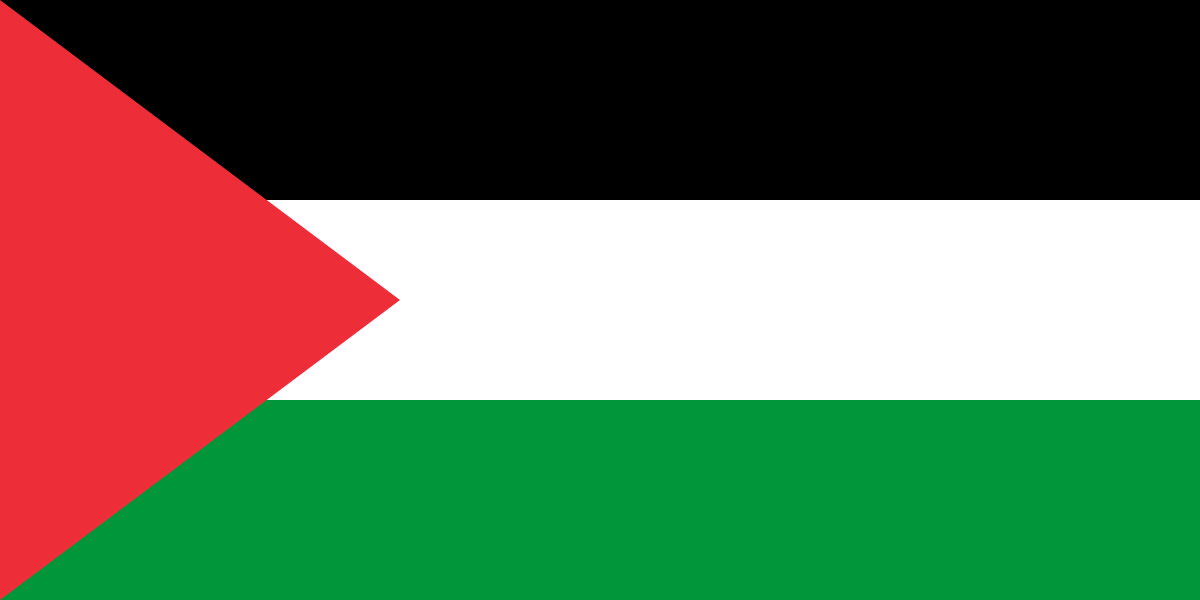
Palestinian activist linking anti-colonialism and anti-fascism
In Spain in 1936 he addressed Moroccan soldiers serving Franco, confronting the tension between anti-fascist solidarity and colonial rule in North Africa.
Palestinian communist activist, writer, and translator. Raised in Jerusalem and educated in Moscow, he went to Spain in 1936 to support the Republic. His propaganda work among Moroccan soldiers serving Franco linked anti-fascism in Spain with Arab liberation. He later worked in journalism and literary translation. His memoirs provide an Arab participant’s perspective on the Spanish Civil War.
Career timeline
1924Worked in the British Mandate Department of Posts and Telegraphs in Jerusalem, where Jewish workers introduced him to communism, and he joined the Palestine Communist Party.
1925–1928Sent by the Palestine Communist Party leadership to the Communist University of the Toilers of the East (KUTV) in Moscow, where he married a Ukrainian communist.
1930Elected a member of the Palestine Communist Party Central Committee at its Seventh Congress in Jerusalem and helped edit its clandestine newspaper, ilal-amam.
1931–1933Arrested by the British authorities and sentenced to two years, served in the Jerusalem, Jaffa and Acre prisons; kept under police surveillance for six months after his release.
1933–1936Sent by the Comintern to Paris to edit the Arabic monthly al-Sharq al-Arabi, which the French authorities shut down in early summer 1936.
1935–1936Studied the Soviet experience of the national question in Tashkent, then was sent by the Comintern to Spain in August 1936 to conduct propaganda among Moroccan troops fighting for Franco.
1937–1939Moved to Syria and Lebanon, active in communist circles in Damascus and Beirut and writing for the party press; expelled from the Syro-Lebanese Communist Party for criticising the German-Soviet Nonaggression Pact of August 1939.
1939–1948Returned to Jerusalem to work for the British-run Near East Broadcasting Service and turned to literature, publishing Pushkin (1945) and Chekov (1947) in Cairo.
1948–1976Moved with the radio station to Limassol, Cyprus, after the 1948 Nakba, living there until 1950, then continued in Beirut as a journalist, translator and literary critic.
1976–1979Moved to Athens, where one of his daughters lived; he died there in 1979 and was buried in the city.