Founder of Hungary's secret police, and its prisoner
From 1945, Gábor Péter led Hungary’s political police, preparing and conducting show trials. Arrested in 1953, he was sentenced to life imprisonment the following year, then released under an individual amnesty in 1959.
Born into a Jewish tailor's family in Újfehértó, he joined the Hungarian Communist Party in 1931. He headed the Budapest political police in 1945 and led the state security service (ÁVO, then ÁVH) in 1945–52, directing purges and torture including the Rajk trial. In early 1953 Rákosi, imitating the Soviet "anti-Zionist" purge, had him arrested. In June 1953 Beria pressed for his case to be reviewed, but in 1954 a court martial sentenced him to life as a Zionist spy. Released under an individual amnesty in 1959, he worked as a librarian.
Career timeline
late 1920sBecame active in the labor movement.
1931Joined the Hungarian Communist Party.
1943Joined the leadership of the communist Peace Party.
1945Became head of the Political Security Department at the Budapest headquarters of the Hungarian State Police.
1945–1952Led the ÁVO and ÁVH secret-police organizations and played a prominent role in preparing and conducting show trials.
1952Was dismissed from his post and expelled from the Hungarian Working People's Party.
1953Was arrested on January 3.
1954Was sentenced to life imprisonment by the Military Supreme Court.
1957His sentence was commuted to 14 years.
1959Released under an individual amnesty and worked as a librarian until retirement.
An international lawyer who worked the UN’s procedures
On June 25, 1950, he reported on Korea and steered the Security Council’s procedure toward a vote on the resolution.
Ernest A. Gross was an international lawyer and U.S. diplomat whose work joined legal counsel, postwar administration, and representation of American policy at the United Nations. When the Korean War began in June 1950, he led the U.S. delegation and managed the Council’s procedures and voting so that Resolution 82 could be adopted. The result was a diplomatic success made possible by the Soviet delegate’s absence, but it also exposed the tension between collective security and great-power rivalry. He later practiced international law, assisting the Tibetan government in exile and challenging South Africa’s apartheid policy.
Career timeline
1931–1933Legal adviser, U.S. Department of State
1940–1943Associate counsel, National Labor Relations Board
1943–1945Chief, economic section, Civil Affairs Division, U.S. Army General Staff
1945–1949Legal adviser and deputy to the Assistant Secretary for Occupied Areas, U.S. Department of State
1949Assistant Secretary of State for Legislative Affairs
1949–1953Deputy U.S. representative to the UN, acting head of delegation in 1949–1950
Ho Chi Minh's closest lieutenant and Vietnam's longest-serving prime minister, governing for 32 years
In the late 1970s, Phạm Văn Đồng told a visitor: 'Waging a war is simple, but running a country is very difficult.'
A graduate of Ho Chi Minh's revolutionary training course in Guangzhou (1926), Phạm Văn Đồng spent his life on the front line of Vietnam's independence struggle. As head of the North Vietnamese delegation at the Geneva Conference (1954), he signed the accords that ended the First Indochina War; throughout the Vietnam War he served as North Vietnam's public face, leading diplomatic and press engagement with the world. As prime minister from 1955 to 1987 (32 years, the longest tenure in Vietnamese history) he directed the war effort, reunification, and postwar socialist construction, though his adherence to wartime command economics in peacetime deepened the country's economic crisis. A revolutionary whom Ho Chi Minh called 'my other self,' he was, alongside Võ Nguyên Giáp and Lê Duẩn, one of the architects of modern Vietnam.
Career timeline
1926Completed revolutionary training under Ho Chi Minh in Guangzhou; joined Vietnamese Revolutionary Youth League
1929–1936Arrested by French colonial authorities; imprisoned on Poulo Condore for 7 years
1940Fled to China with Võ Nguyên Giáp; joined Indochinese Communist Party
1945–1946First Finance Minister of the Democratic Republic of Vietnam
1949–1954Deputy Prime Minister and Foreign Minister; led DRV delegation at Geneva Conference
1955–1987Prime Minister of North Vietnam and reunified Vietnam (32 years)
A phenomenologist who turned care for truth into civic action
On 3 March 1977, he endured a lengthy State Security interrogation after being summoned under the pretext of speaking as a Charter 77 spokesperson.
Jan Patočka was a Czech philosopher who studied with Husserl and Heidegger, developed phenomenology and a philosophy of history, and examined Europe’s crisis through the idea of care for the soul. After refusing Communist Party membership, he was repeatedly excluded from university teaching and publication, yet continued his work through writing and apartment seminars. In 1977 he became, with Václav Havel and Jiří Hájek, one of the first spokespeople for Charter 77, which invoked the Helsinki Final Act and demanded civil rights. After repeated interrogations by the State Security service, his health deteriorated and he died on 13 March.
Career timeline
1925–1931Studied philosophy, Slavic philology and Romance philology at Charles University in Prague; received a doctorate in philosophy
1933Studied phenomenology with Edmund Husserl and Martin Heidegger at the University of Freiburg
1936–1939Completed his habilitation at Charles University and edited the philosophical journal Česká mysl
1945–1950Taught philosophy at Charles University and Masaryk University after the war, leaving academia after refusing Communist Party membership
1964–1972Worked at the Czechoslovak Academy of Sciences’ Institute of Philosophy, returned as a Charles University professor in 1968, and was forced to retire in 1972
1973–1976Taught philosophy in apartment seminars and developed Plato and Europe and Heretical Essays in the Philosophy of History
1977Served with Václav Havel and Jiří Hájek as one of the first spokespeople for Charter 77
French resistance veteran and official who concluded the 6 March 1946 preliminary agreement with Ho Chi Minh
On 6 March 1946, he reached an agreement with Ho Chi Minh that allowed French troops to enter Hanoi without fighting.
Born Jean Roger, he led the Normandy section of the Alliance resistance intelligence network during the Second World War. After the war, appointed French Republic commissioner for Tonkin and northern Annam, he negotiated with Ho Chi Minh; their 6 March 1946 agreement enabled French troops to enter Hanoi without fighting.
Career timeline
1907Born in Le Vésinet, France.
1940–1944Led the Normandy section of the Alliance resistance network.
1945–1946French Republic commissioner for Tonkin and northern Annam; negotiated with Ho Chi Minh.
1946Signed the preliminary agreement on 6 March.
1954Appointed French government delegate to North Vietnam.
1962–1966Served as minister for veterans and war victims.
French prime minister who promised a ceasefire within four months after Điện Biên Phủ and concluded the 1954 Geneva Accords
As prime minister in 1954, Pierre Mendès France negotiated directly with the Viet Minh at Geneva, securing the July armistice that ended the fighting in Indochina, while also initiating talks on Tunisian autonomy.
A Radical Party lawyer and economist of Jewish descent, he joined the Free French during the war. An early critic of the Indochina War, he became prime minister on 17 June 1954, after the fall of Điện Biên Phủ, promising to resign if he failed to secure a ceasefire within four months, and kept the promise with the Geneva Accords of 21 July. In eight months in office he conceded autonomy to Tunisia, and the Algerian War broke out that November; he also laid the groundwork for military co-operation with Israel and the French nuclear programme.
Career timeline
1932Elected Radical deputy for Louviers in the Eure département.
1938Served as undersecretary of state for finance in Léon Blum’s government.
1943–1945Served Free France as commissioner for finance and then minister of national economy; he resigned in April 1945 after Charles de Gaulle rejected his austerity program.
1954–1955As prime minister, negotiated an end to the Indochina War and opened talks on Tunisian autonomy. He opposed the European Defence Community and left office after his government lost a confidence vote in February 1955.
The longest-serving General Secretary who reunified Vietnam and invaded Cambodia in his 26-year rule
“Our party is the unique and single leader that organised… the entire struggle of the Vietnamese people from the first day of the revolution.” — reunification victory speech, 1976
A Vietnamese communist politician and theorist. A founding member of the Indochina Communist Party in 1930, he endured two French prison terms before earning Ho Chi Minh's trust and taking charge of the southern revolutionary apparatus. In 1956 he authored The Road to the South, providing the theoretical basis for the armed liberation struggle against the Saigon regime, and at the 3rd National Congress in 1960 he was elected First Secretary, becoming the party's supreme leader after Ho's death in 1969. He completed Vietnam's reunification in 1975, ordered the invasion of Cambodia to overthrow the Khmer Rouge in 1978, and held power through the Sino-Vietnamese War (1979) until his death in 1986.
Career timeline
1928–1930Joined Revolutionary Youth League; co-founded Indochina Communist Party
1931–1945Imprisoned twice; freed by August Revolution, gained Ho Chi Minh's trust
1951–1954Headed COSVN, directing southern front of anti-French war
1956Authored The Road to the South — theoretical basis for armed struggle in the South
1960–1969First Secretary, Vietnam Workers' Party — de facto war leader against the US
Vietnam's chief theoretician, demoted for the land reform disaster and returned to launch Đổi Mới
His revolutionary name 'Trường Chinh' — 'Long March' — was a deliberate homage to Mao Zedong's epic retreat, marking him from the start as the party's pro-Chinese theoretician.
Vietnamese communist revolutionary and chief theoretician. He joined the Revolutionary Youth League in 1928 and helped found the Indochina Communist Party, becoming its General Secretary in 1940 and leading the party through the August Revolution of 1945 and the anti-French war. He was the architect of the 1953–1956 land reform campaign, whose violent excesses forced his demotion. Yet he returned to power as Chairman of the National Assembly (1960–1981) and President (1981–1987). After Lê Duẩn's death in 1986, he again became General Secretary and, in his final act, steered the party toward the Đổi Mới reforms that reshaped Vietnam.
Career timeline
1928–1930Joined Revolutionary Youth League; co-founded Indochina Communist Party
1930–1936Arrested by French colonial authorities, sentenced to 12 years; released 1936
1940–1945General Secretary, ICP — led the August Revolution
1946–1947Published The August Revolution (1946) and The Resistance Will Win (1947)
1951–1956First Secretary, Workers' Party — led land reform; dismissed after its failure
1960–1981Chairman, National Assembly Standing Committee
1981–1987President of Vietnam
1986.07–12General Secretary again — launched the Đổi Mới reforms
East Germany's 'Master of Fear': the Stasi chief who ruled state security for 32 years
“All this blithering over to execute or not to execute, for the death penalty or against — all rot, Comrades. Execute! And, when necessary, without a court judgment.” — to senior Stasi officers, 1982
A communist militant from Berlin's Wedding district, Mielke fled to the USSR after the 1931 killing of two Berlin policemen and was trained by the NKVD. After the Spanish Civil War he returned in 1945 to help build the GDR's state security apparatus, leading the Stasi from 1957 to 1989 and expanding it into a 90,000-strong surveillance network. The Stasi controlled all of East German society while training armed groups across the Third World and Western Europe, extending socialist-bloc security architecture. He fell with the regime in 1989 and was convicted after reunification for the 1931 murders.
Career timeline
1925Joined the KPD
1931Fled to USSR after Bülowplatz police murders
1936–1939Served in International Brigades, Spain (Captain)
1945Returned to Berlin, Police Inspector Lichtenberg
1950Deputy Minister of State Security, State Secretary
1957–1989Minister for State Security (Stasi chief)
A Cold War strategist who moved between nuclear buildup and arms control
During the 1982 Geneva talks, he took a “walk in the woods” with Yuli Kvitsinsky to explore a compromise.
Paul Nitze was an American diplomatic and defense official who shaped Cold War strategy and nuclear policy. As the principal author of NSC-68, he framed the long confrontation with the Soviet Union as a problem requiring military expansion, yet he also saw painstaking negotiation as necessary to manage the dangers of nuclear weapons. After participating in SALT, he led the Reagan administration’s INF negotiations and pursued a pragmatic line that treated credible deterrence and arms reduction as compatible rather than mutually exclusive. His legacy therefore joins the architecture of the arms race to the search for a negotiable order.
Career timeline
1944–1946Vice Chairman, U.S. Strategic Bombing Survey
1950–1953Director of Policy Planning, U.S. Department of State
1961–1963Assistant Secretary of Defense for International Security Affairs
1963–1967Secretary of the Navy
1967–1969Deputy Secretary of Defense
1969–1973U.S. delegation to SALT I
1981–1984Chief U.S. negotiator for the INF talks
1984–1989Special Advisor to the President and Secretary of State on Arms Control
Yugoslav partisan-diplomat whom Stalin named a British spy to break off correspondence
Stalin wrote in his March 27, 1948 letter: 'We do not understand why the British spy Velebit continues to remain in the Yugoslav Ministry of Foreign Affairs as the First Deputy Minister.'
A Yugoslav lawyer turned Partisan general and diplomat who served as the Partisans' liaison to Allied military missions during the war and as First Deputy Foreign Minister afterward, negotiating with the Western powers. In his March 27, 1948 letter Stalin singled out Velebit as a 'British spy' and used his continued presence in the foreign ministry as justification for breaking off frank diplomatic correspondence, making the accusation one of the triggers of the Tito-Stalin split. Forced to resign, he was later rehabilitated, serving as ambassador to Rome and London and as Executive Secretary of the UN Economic Commission for Europe, embodying Yugoslavia's independent course through the Cold War.
Career timeline
1933PhD in law, University of Zagreb
1939Met Tito in Istanbul, joined the KPJ
1942–1943Liaison to Allied military missions, Partisan Supreme Command
1945–1948First Deputy Foreign Minister of Yugoslavia
1951–1952Yugoslav Ambassador to Italy
1952–1956Yugoslav Ambassador to the United Kingdom
1960–1967Executive Secretary, UN Economic Commission for Europe
Principal organizer of the Workers' Party of Korea and leader of its early Soviet faction
At the Second Party Congress in March 1948, Ho Ka-i took the podium unannounced and rebuked officials who had apologized without admitting wrongdoing: "An apology that does not own the mistake is empty words" — setting a new standard of party discipline.
A Soviet Korean revolutionary dispatched to Pyongyang in 1945 by the Soviet occupation authorities, he became the principal organizer in the founding of the Workers' Party of Korea. As first secretary and second vice-chairman of the Central Committee, he pursued a Soviet-style elite cadre party and, during the Korean War, led a sweeping purge that expelled over 450,000 of the party's 600,000 members. His clash with Kim Il Sung over whether to build a mass party or a vanguard party led to his removal in 1951, making him the emblematic figure of the Soviet faction's rise and fall in the early DPRK.
Career timeline
1930Joined the CPSU(B)
1932Secretary of the Far Eastern Komsomol committee
1937Purged from the Party; deported to Central Asia with other Soviet Koreans
1939Reinstated in the Party; resumed cadre work in Uzbekistan
1946Member of the Political Committee and head of the Organization Department, Workers' Party of North Korea
1948Vice-chairman of the Workers' Party of North Korea and chairman of the Inspection Committee
1949First Secretary and Second Vice-chairman of the Workers' Party of Korea Central Committee
1951Dismissed after confrontation with Kim Il Sung; demoted to Deputy Premier
The Smallholders' general secretary whose Soviet abduction triggered his party's destruction
Arrested, he declared: "I took no part in the conspiracy, I feel no guilt in it; had I done so I would have betrayed my life's work."
A peasant politician of peasant stock who, with only four years of elementary schooling, joined the Smallholders in 1933 and rose by 1945 to general secretary of post-war Hungary's largest party. As agriculture minister in the Tildy and Nagy governments he drove the break-up of the great estates and the land reform, and defended his party's independence against Rákosi's salami tactics. When parliament refused to lift his immunity in February 1947, Soviet forces arrested him on fabricated espionage charges and carried him off to the gulag, and the abduction became the trigger for Ferenc Nagy's resignation and the dismantling of the Smallholders. He returned in 1955, served as agriculture minister in Imre Nagy's revolutionary government in 1956, and after the suppression cooperated with the Kádár regime until his death in 1959.
Career timeline
1933–1944Joined the Smallholders (FKGP); Baranya organiser; anti-Nazi resistance
1944–1945Political state secretary of the interior in the provisional government
1945–1946Minister of agriculture
1945.08–1947General secretary of the Smallholders' Party
1947–1955Abducted by the Soviets; 20-year sentence; gulag then Moscow prison
1955–1956Handed over to Hungary; released April 1956
1956.10–11Agriculture minister and state minister in Nagy's revolutionary government
1957–1959Cooperated with the Kádár regime; MP in 1958
Prague Spring interior minister whose security reforms were undermined by KGB subversion and internal betrayal
On the day of the invasion, Pavel's dismissed deputy Šalgovič helped the KGB arrest Dubček, and the Interior Ministry slipped from its minister's hands.
A Czechoslovak communist who fought in the Spanish Civil War and commanded the People's Militia during the 1948 coup, Pavel became deputy interior minister and participated in the regime's repressions. Arrested in 1951, he was tortured and sentenced to 25 years in the Slánský trial, then acquitted in 1955. Returning as interior minister during the 1968 Prague Spring, he pushed to reform the StB and exposed six KGB liaison agents in his ministry, but his deputy Viliam Šalgovič collaborated with the KGB to arrest Dubček during the invasion, collapsing Pavel's reforms.
Career timeline
1932Joined Communist Party of Czechoslovakia
1935Studied at International Lenin School, Moscow
1937–1939Fought in Spanish Civil War; commanded Dimitrov Battalion
1947Chief Secretary, Defense and Security Dept, KSČ Central Committee
1948Chief of Staff, People's Militia; Deputy Interior Minister
1951–1955Arrested, tortured; sentenced to 25 years (1953); acquitted and released (1955)
1968.04–08Minister of Interior of Czechoslovakia
1968–1973Forced to resign; expelled from KSČ; died under StB surveillance
A Cold War president caught between reform and war
In July 1968, he announced that the United States and the Soviet Union had agreed to begin talks on limiting strategic weapons.
Lyndon B. Johnson was a president whose congressional mastery joined an ambitious program of domestic reform to a strategy of Cold War containment. He expanded the Great Society through civil-rights and voting-rights laws, Medicare, education, and anti-poverty programs, while the escalation of the Vietnam War became the defining responsibility that overshadowed those achievements. He also pursued arms control within continued rivalry, using the 1967 Glassboro summit and the July 1968 agreement to begin strategic-arms discussions to open a path that later led to SALT. In his final year he combined peace efforts in Vietnam with arms-control diplomacy, but the agreements were completed by his successor.
Career timeline
1937–1949U.S. Representative from Texas's 10th district
First elected Marxist head of state; pursued the peaceful 'Chilean road to socialism' (copper, land, cybernetics) until the 1973 coup
“I am not going to resign! Placed in a historic transition, I will pay for loyalty to the people with my life.” — last radio address, La Moneda, 11 September 1973
The world's first democratically elected Marxist head of state. His 'Chilean road to socialism', nationalizing copper, redistributing land, and building the Cybersyn cybernetic planning system, was cut short by the 1973 military coup.
Career timeline
1932Medical degree, University of Chile
1933Co-founded the Socialist Party; arrested, six months imprisoned
1938–1942Minister of Health, Popular Front — first healthcare access for the poor
1945–1970Senator; President of the Senate (1966–1969)
1952Presidential candidate — defeated
1958FRAP presidential candidate — defeated
1964FRAP presidential candidate — defeated
1970Elected president (36.6%) leading Popular Unity; inaugurated 24 October
1970–1973Copper nationalization, land reform, Cybersyn — the 'Chilean road'
1973.09.11Military coup — final radio address from La Moneda; took his own life
The first communist interior minister, builder of the Securitate, purged in 1952 alongside Pauker and Luca for "shielding" them
The May 1952 plenum charged Georgescu with a "conciliatory attitude" toward the right deviation and pushed him out of the Politburo and the interior ministry. The man who had built the Securitate was arrested by that same Securitate the following February.
Born to a working-class family in Chitila near Bucharest, he worked as a typographer, joined the Romanian Communist Party in 1929 and was active in the printers' union. Arrested in 1941 and sentenced to ten years, he served alongside Gheorghiu-Dej in the Caransebeș prison and, released in August 1944, became a secretary of the Central Committee. As interior minister in the Groza government from March 1945 until 1952 he controlled the police and security organs, directing the rigging of the 1946 election, the arrest and trial of Maniu and the National Peasant leadership in 1947, the founding of the Securitate in 1948 and the suppression of armed resistance. Inside the party he stood close to Ana Pauker and Vasile Luca and counted as the third figure of the "Muscovite faction"; at the May 1952 plenum he was removed from the Politburo and the interior ministry for a "conciliatory attitude" toward the right deviation. Arrested in February 1953, he was released without trial in 1956, expelled from the party and put in charge of a printing plant. He was rehabilitated in 1968 when the Ceaușescu leadership reviewed the purges of the Dej era, and died in Bucharest in 1976.
Career timeline
1929Joined the Romanian Communist Party; active in the printers' union
1941–1944Arrested; sentenced to ten years; imprisoned at Caransebeș
1944Released; secretary of the Central Committee
1945–1952Minister of Internal Affairs
1948Oversaw the founding of the Securitate
1952Removed from the Politburo and the interior ministry
1953–1956Arrested; released without trial; expelled from the party
The only Prague Spring leader who refused to sign the Moscow Protocol
In Moscow, standing before Brezhnev, Kriegel said: 'Send me to Siberia or shoot me dead. I will not sign.'
Czechoslovak communist politician and physician. He served as a doctor with the International Brigades in the Spanish Civil War, then rose to become a KSČ Presidium member and chairman of the National Front during the 1968 Prague Spring, where he was among the most radical reformers. Arrested with Dubček on 21 August and deported to Moscow, he was the only one of twenty-six Czechoslovak politicians who refused to sign the Moscow Protocol. Expelled from the party and stripped of his medical license, he became a dissident and was among the first to sign Charter 77 in 1977.
Career timeline
1931Joins the KSČ
1936–1939International Brigades doctor, Spanish Civil War
1940–1945Military doctor, China-Burma front
1949–1952Deputy Minister of Health
1964–1968National Assembly deputy → KSČ CC member
1968.04–08National Front chairman & KSČ Presidium member
1968.08Refuses to sign the Moscow Protocol
1969–1977Expelled from party; first Charter 77 signatory
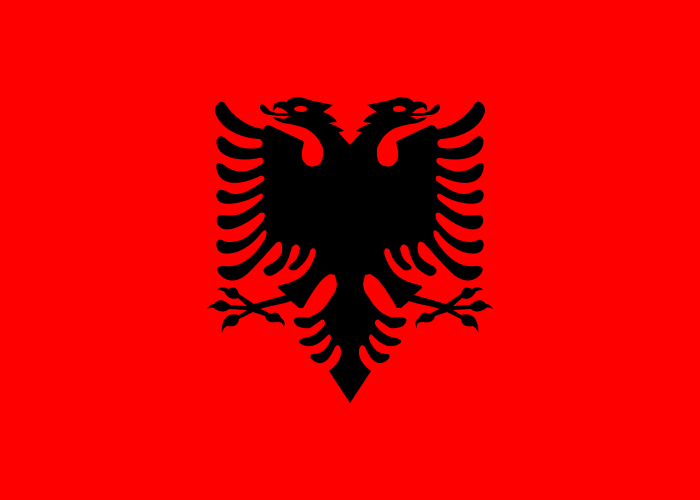
Albania's leader who made isolation and self-reliance state policy
The 1961 rupture with the USSR showed how far a small socialist state could take an ideological break.
He led Albania's communists and anti-occupation resistance, founding the postwar people's republic. He broke diplomatic relations with the USSR in 1961 and later with China, pursuing an independent Stalinist line.
Career timeline
1944–1985First secretary of the Party of Labour and leader of Albania
The Mongoose architect whose six-phase Cuba overthrow plan convinced the Soviets invasion was coming
When McNamara asked what the 'x-factor' on his metrics list was, Lansdale replied: 'The feelings of the common rural Vietnamese people.' McNamara erased it and said he couldn't measure it.
A U.S. Air Force major general who turned advertising into a doctrine of psychological warfare, Lansdale first made his name helping crush the Hukbalahap rebellion in the Philippines by weaponizing local folklore, then ran the Saigon Military Mission as a close confidant of Ngô Đình Diệm. In February 1962 he submitted to President Kennedy the six-phase Cuba Project, a schedule that aimed for open revolt and overthrow of the Castro government by the first two weeks of October. The document became a crucial piece of Soviet intelligence: it convinced Moscow that a U.S. invasion of Cuba was imminent and helped trigger the missile crisis. Forced to retire in 1963 after refusing to abandon Diệm, Lansdale was later recognized as a founding figure of modern counterinsurgency and psychological operations.
Career timeline
1941–1947Served in Army Military Intelligence and OSS; promoted to major
1947–1950Transferred to USAF as captain; instructor at Strategic Intelligence School
Interior minister who built the ÁVH secret police, then fell as the first major victim of Stalinist show trials in Eastern Europe
At his show trial, responding to the prosecutor's demand for the death penalty: 'I fully agree with your statements, Mr. Prosecutor, and want to state in advance that I will consider the verdict of the court justified' (September 1949)
A Hungarian Communist politician who served as Minister of Interior (1946–1948), founding the ÁVH secret police and directing the early purges that built the Rákosi regime. He had fought in the Spanish Civil War as political commissar of the Hungarian battalion of the International Brigades and organized the underground resistance during World War II. Seen by Rákosi as a rival, he was demoted to Foreign Minister and then arrested in 1949 on fabricated charges of Titoism, becoming the first major victim of the Stalinist show trials in Eastern Europe. His rehabilitation and reburial on 6 October 1956 before 100,000 mourners became a demonstration against the regime and a key precursor to the Hungarian Revolution three weeks later.
Career timeline
1931Joined the illegal Hungarian Communist Party (KMP) and communist youth league (KIMSZ)
1935Led building-workers' strike; arrested and deported
1937–1939Political commissar and party secretary, Hungarian battalion, International Brigades; severely wounded at the Battle of the Ebro
1941–1944Returned to Hungary; underground resistance, CC secretary, co-led the Hungarian Front
1946.03–1948.08Minister of Interior — founded ÁVH state security, directed early show trials and purges
1948.08–1949.05Minister of Foreign Affairs
1949.09–10Show trial on charges of Titoist espionage; sentenced to death and executed
1956Rehabilitated; state reburial on 6 October drew 100,000 mourners, precursor to the Hungarian Revolution
Officer who founded the Union of Lithuanian Freedom Fighters in 1949 and led the partisan resistance as its chairman
Born in Palanga, he graduated from the War School of Kaunas in 1929 as an artillery officer and studied at the School of Applied Artillery in Fontainebleau, France, in 1936–1938. In the deportations of June 1941 his sister’s whole family was sent to Siberia; under the German occupation he retired rather than serve the Nazis. In 1944 he joined the Lithuanian Territorial Defense Force, and when the Red Army returned he joined the Lithuanian Liberty Army and the partisans, rising to the leadership. In February 1949 he founded the Union of Lithuanian Freedom Fighters and became its chairman, working to unify the partisan units and give their struggle a legal framework. Paralysed by a cerebral haemorrhage in December 1951, he was arrested on 30 May 1953, interrogated in Moscow by Beria and executed in Butyrka prison in 1954. In 2009 he was officially named the fourth President of Lithuania.
Career timeline
1929Graduated from the War School of Kaunas; artillery officer
1936–1938School of Applied Artillery, Fontainebleau
1944Lithuanian Territorial Defense Force, then the partisans
1949Chairman of the Union of Lithuanian Freedom Fighters
A diplomat who widened room for negotiation amid East-West tension
On 2 October 1957 he presented to the UN General Assembly his plan for a nuclear-free zone comprising Czechoslovakia, Poland, East and West Germany; it was never adopted.
Adam Rapacki was born on 24 December 1909 in Lemberg, Austria-Hungary (now Lviv), and raised in Warsaw. A Polish socialist politician, economist and diplomat, he translated the security demands of the socialist bloc into the language of international negotiation. He proposed a nuclear-free zone in Central Europe in 1957 and called for a European security conference in 1964, helping shape an agenda that fed into the Helsinki process. He was also a Communist politician who served in the PZPR leadership and government, and was nominated for the 1966 Nobel Peace Prize. Regarded as a leader of the party's liberalising wing, he opposed the persecution of people of Jewish origin and was removed as foreign minister in December 1968; he died in Warsaw on 10 October 1970.
Career timeline
1931Joined the Union of Independent Socialist Youth
1939–1945Educational and political activity in German prisoner-of-war camps
1947–1950Polish Minister of Shipping
1950–1956Minister of Higher Education and Science, later Higher Education
1956–1968Polish Minister of Foreign Affairs
1964Proposed convening a European security conference
1968Withdrew from political life after the March events
1948–1968PZPR Politburo member (deputy member 1954–56)
1968.12Removed as foreign minister for opposing anti-Jewish measures
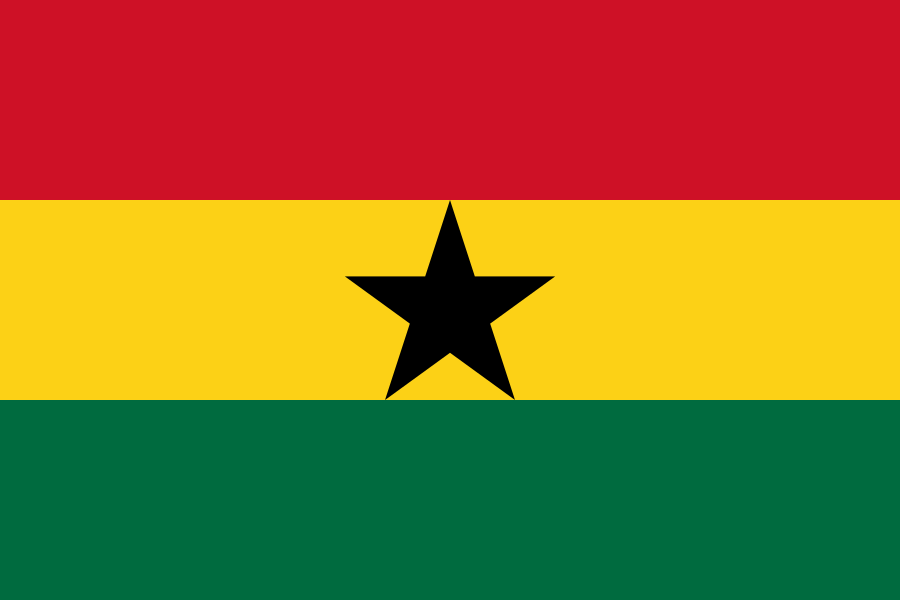
Architect of Pan-African Marxism who led sub-Saharan Africa's first independence
“We must unite now or perish.” — address to the Conference of African Heads of State, Addis Ababa, 1963
Ghana's independence leader, first prime minister and president. He secured sub-Saharan Africa's first independence in 1957. Through Nkrumaism, synthesizing scientific socialism with African tradition, he forged the intellectual foundation of the pan-African liberation movement.
Career timeline
1935–1945Studies in America — degrees in economics, theology, philosophy and education from Lincoln and Penn
1945Co-organizes the Fifth Pan-African Congress in Manchester
1947Returns to the Gold Coast as General Secretary of the UGCC
1949Founds the Convention People's Party; launches Positive Action campaign
1952–1957Prime Minister of the Gold Coast — negotiates independence
1957Ghana wins independence — sub-Saharan Africa's first; becomes first Prime Minister
1960–1966First President of Ghana — socialist construction and Pan-African diplomacy
1963Co-founds the Organization of African Unity
1962Awarded the Lenin Peace Prize
1965Publishes Neo-Colonialism: The Last Stage of Imperialism
1966.02Deposed by military coup while visiting Beijing
1966–1972Exile in Guinea — honorary co-president; continues theoretical writing