Pastor and writer who headed Latvia's pro-German government of 1919
"Not clever speeches or treaties but force decides a nation's fate," he declared at his 1924 treason trial.
A leading Latvian novelist and Lutheran pastor, he headed the pro-German government backed by von der Goltz after the Liepāja coup of 1919. His regime fell after Cēsis, he fled to Germany and, returning in 1924, was tried for treason and expelled.
Career timeline
1890–1899Studied theology at the University of Dorpat (Tartu)
1903–1906Edited and published the journal Austrums in Cēsis
1906–1918Lutheran pastor in the Matīši, Kalsnava and Vietalva parishes
1917Co-founded the Latvian Farmers' Union, member of its board
1919.05–06Prime Minister of the pro-German provisional government
1924Convicted of treason, then expelled by presidential pardon
1926–1930Pastor of a German congregation in Altstadt, East Prussia
Last president of the Third Republic, who signed the 1940 transfer of power
After Paul Reynaud's cabinet fell on 16 June 1940, he appointed Philippe Pétain to head the government; Pétain requested an armistice the next day. He signed the Constitutional Law on 10 July, and Pétain became head of state the day after.
A French centre-right republican politician trained as a mining engineer, he entered the Chamber of Deputies in 1900 at 29 for Meurthe-et-Moselle and presided that department's general council for 26 years from 1906. He was Minister for the Colonies in 1911–1914, briefly Minister of War in 1913 and Minister for the Blockade and Liberated Regions in 1917–1919, entered the Senate in 1920 and became its president in 1931. Elected last president of the Third Republic in 1932 after Paul Doumer's assassination, he was re-elected in 1939 but had little executive room under Third Republic practice. On 16 June 1940 he appointed Pétain to head the government; on 10 July he signed the Constitutional Law carried 569 to 80, and on 11 July Pétain became head of state. He never resigned and was seized by German forces in 1943. He died in Paris on 6 March 1950, aged 78.
Career timeline
1896–1901Mining engineer, Vesoul and Nancy
1900–1920Deputy, Briey
1911–1914Minister for the Colonies, briefly Minister of War in 1913
1917–1919Minister for the Blockade and Liberated Regions
1920–1931Senator, then Vice-President and President of the Senate
1932–1940President of France, last president of the Third Republic
1940Promulgated the 10 July Constitutional Law, transferring power without resigning
France's first Socialist prime minister, who left behind paid holidays and the 40-hour week
'I rarely left my desk while in power; but whenever I went out and crossed the Paris suburbs and saw the roads covered with processions of jalopies, motorcycles and tandems, with working-class couples in matching pullovers, I had the feeling that, despite everything, I had brought a kind of clearing, a break in the clouds, into difficult and obscure lives', statement at the Riom trial, March 1942
A literary critic drawn into politics by the Dreyfus affair, he kept the Socialist SFIO's 'old house' standing at the 1920 Congress of Tours when the majority left to found the Communist Party. As prime minister of the 1936 Popular Front government he brokered the Matignon Agreements and enacted two weeks of paid holidays and the 40-hour week, becoming France's first Socialist and first Jewish head of government and a target of the far right. One of the eighty parliamentarians who voted against full powers for Pétain in 1940, he turned Vichy's Riom trial into a platform for defending the Popular Front, survived internment near Buchenwald, and briefly headed a caretaker government in late 1946.
Career timeline
1894–1906Conseil d'État jurist and literary critic; the Dreyfus affair draws him to Jaurès and socialism
1914–1919Chef de cabinet to a Socialist minister in the war government; elected deputy in 1919
1920.12At the Congress of Tours, keeps 'the old house' as the majority founds the Communist Party
1921–1936Rebuilds the SFIO; political director of Le Populaire; parliamentary leader
1936.02Beaten nearly to death by the royalist Camelots du Roi
1936.06–1937.06Prime minister of the Popular Front: Matignon Agreements, paid holidays, the 40-hour week
1938.03–04Second Blum government collapses within a month against the Senate
1940.07One of the eighty who vote against full powers for Pétain at Vichy
1942–1945Defends the Popular Front at the Riom trial; interned in a special camp near Buchenwald
1946.12–1947.01Heads the caretaker government; postwar reconstruction and the Blum-Byrnes loan agreement
Microbiologist who headed the puppet government chosen by the Soviet embassy in 1940 and requested Latvia’s incorporation into the USSR
Born the son of a tenant on a manor in Mazsalaca, Livonia, he studied at the Tartu Veterinary Institute, took part in the revolution of 1905 and emigrated to Switzerland, working at a tuberculosis institute in Davos. He served as a military veterinarian in the Serbian army in the First World War and as a captain in the veterinary units of the Latvian War of Independence. In 1919 he founded a Microbiology Institute at the University of Latvia, and in 1923 he defended the first doctoral thesis in Latvia; politically he supported social democracy. In June 1940 the Soviet embassy offered him the leadership of the new puppet government; as prime minister, and from 21 July acting president, he requested Latvia’s incorporation into the Soviet Union. He chaired the Latvian SSR Supreme Soviet’s presidium in 1940–1952, joined the Communist Party in 1941 and died in Riga in 1963.
Career timeline
1893–1901Tartu Veterinary Institute
1911Assistant at the tuberculosis institute in Davos
1919Founded the Microbiology Institute at the University of Latvia
1940Puppet prime minister and acting president
1940–1952Chairman of the Latvian SSR Supreme Soviet’s presidium
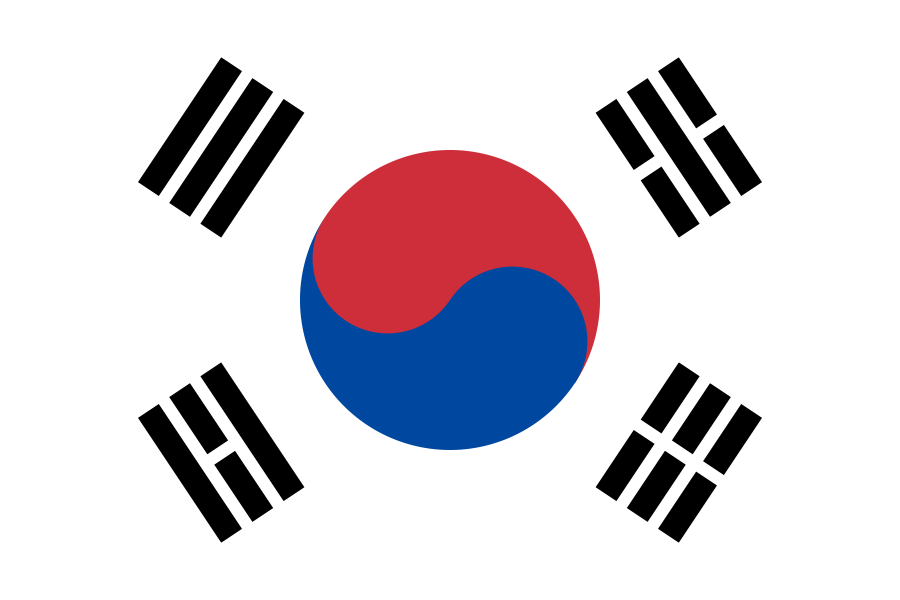
Pioneer of Korean communism who fused the Bolshevik revolution with national liberation against Japanese rule
On his deathbed he declared: 'I die without seeing the Korean revolution succeed. Comrades, you must establish a Korean Soviet Republic.'
A pioneer of Korean communism who transformed from a Korean Empire army officer into a socialist revolutionary, becoming the first to fuse Marxism with the Korean national liberation struggle. He founded the Korean Socialist Party in 1918, served as prime minister of the Korean Provisional Government where he championed armed resistance, and after breaking with Syngman Rhee led the Korean Communist Party (Shanghai faction) in pursuit of combining national liberation with class revolution.
Career timeline
1895–1902Graduated from Imperial Military Academy; army major and Ganghwa garrison commander
1906–1911Co-founded New People's Association; founded Bochang School; jailed in 105-Man Incident
1913–1917Exiled to Primorsky Krai and Manchuria; established military academy, trained independence forces
1918Founded Korean Socialist Party in Khabarovsk; chairman
1919–1921Prime Minister of the Korean Provisional Government in Shanghai
1921Founded Korean Communist Party (Shanghai faction)
1922–1935Comintern liaison; Far East Korean director of MOPR
A president shaped by agrarian reform and wartime compromise
“May the hand that is forced to sign such a monstrous treaty wither.”
Kyösti Kallio was a leader of Finland’s Agrarian League who pursued land reform and parliamentary politics. Four-time prime minister and several-time parliamentary speaker, he championed the 1922 settlement law known as Lex Kallio, which helped tenant farmers acquire land. As president during the Winter War, he resisted territorial concessions but ultimately had to accept the Moscow Peace Treaty in March 1940. His reported curse on the hand forced to sign the treaty became an enduring historical irony when his right arm was paralysed that summer; he resigned as his health failed and died later that year.
Career timeline
1904–1906Representative of the Peasant Estate in the Diet of Finland
1907–1937Member of Parliament; leader of the Agrarian League
1917–1922Minister responsible for agriculture in the independence Senate and governments
1922Advanced the land-settlement reform known as Lex Kallio
1922–1924Prime Minister of Finland
1925–1926Prime Minister of Finland
1929–1930Prime Minister of Finland
1936–1937Prime Minister of Finland
1920–1936Speaker of the Parliament of Finland across several sessions
1937–1940President of Finland during the Winter War and the Moscow Peace Treaty
From Balkan revolutionary to head of Soviet Ukraine: the diplomat who became an opposition theorist
"Our misfortune is that we held responsible posts and power turned our heads." Final plea at the 1938 Moscow trial
A pan-European revolutionary of Bulgarian ethnic origin who also held Romanian citizenship, Rakovsky founded the Balkan Social Democratic Federation. As chairman of the Ukrainian Council of People's Commissars from 1919 to 1923 he helped build the Ukrainian Soviet state, and he later served as Soviet ambassador to Britain and France. A Left Opposition theoretician who challenged Stalin's nationalities policy and party bureaucratisation, he was expelled in 1927, admitted his errors to Stalin in 1934 and was readmitted in 1935. Sentenced to 20 years at the Third Moscow Trial in 1938, he was shot at Oryol on 11 September 1941 and rehabilitated on 4 February 1988.
Career timeline
1890–1896Medical studies in Geneva, Berlin, Montpellier; active in European socialist movements
1910Revived Romanian Social Democratic Party; founded Balkan Social Democratic Federation, first secretary
1919–1923Chairman of Sovnarkom of Ukraine; People's Commissar of Foreign and Internal Affairs
1919–1927Member of the Central Committee of the RCP(b); Orgburo member (1919–1920)
1923–1927Plenipotentiary representative of the USSR to Britain (1923–1925) and France (1925–1927)
1927–1935Left Opposition leader; expelled from party, exiled to Astrakhan, Saratov, Barnaul
1934–1937Admitted his errors to Stalin in 1934, readmitted to the party in November 1935; head of scientific institutes administration at RSFSR Health Commissariat
1937–1941Expelled again in 1936, arrested January 1937, Third Moscow Trial 20-year sentence; shot at Oryol on 11 September 1941
Printer and Social Democratic leader who headed the six-day “trade-union government” after the fall of the Soviet Republic
Born in Ravazd in Győr County, the son of a butcher, he became a typesetter, led the printers’ union and the consumer co-operative movement, and joined the Social Democratic leadership in 1909. He was labour and welfare minister in the Berinkey government in 1919 and resigned his party posts in opposition to the merger with the Communists and the proclamation of the dictatorship of the proletariat. When the council government resigned on 1 August 1919 he became prime minister, abolished the Soviet Republic and revoked its decrees, but on 6 August he was ousted by István Friedrich with Romanian backing. He then helped rebuild the Social Democratic Party and sat in parliament from 1922 to 1931.
Career timeline
1900–1918Editor of the printers’ weekly Typographia
1909Social Democratic Party leadership
1919Labour and welfare minister in the Berinkey government
1919Prime minister of the “trade-union government”
The last hetman of Ukraine, installed under German occupation in 1918
On 29 April 1918 in Kyiv, the All-Ukrainian Congress of Landowners rose and unanimously acclaimed Pavlo Skoropadskyi as Hetman of Ukraine with shouts of 'Long live the Hetman!'
A Ukrainian aristocrat and tsarist lieutenant general who commanded a corps in the First World War. In April 1918, backed by the German army that occupied Ukraine after the Treaty of Brest-Litovsk, he overthrew the socialist Central Rada in a coup and was proclaimed Hetman of the Ukrainian State. During his eight-month rule he founded the Ukrainian Academy of Sciences, established universities, and built diplomatic ties, but his pro-landlord agrarian policy and the German occupiers' forced grain requisitions provoked widespread peasant resistance. When Germany collapsed in November 1918, Symon Petliura's Anti-Hetman Uprising drove him from power; he abdicated in December and spent the rest of his life in German exile, refusing to collaborate with the Nazis.
Career timeline
1893Commissioned as an officer in the Chevalier Guard regiment
1904–1905Commanded Cossack units in the Russo-Japanese War, decorated for bravery
1912Promoted to major general, aide-de-camp to Nicholas II
1914–1916Commanded cavalry divisions in WWI, promoted to lieutenant general
1917Commander of 34th Army Corps, Ukrainised it into the 1st Ukrainian Corps
1917.10Elected Otaman of the Free Cossacks
1918.04–12Hetman of the Ukrainian State
1919–1945Exile in Germany, led the Hetmanite movement
A reformist politician who organized compromises between fascism's fall and the monarchy
In June 1943, he secretly urged the king to dismiss Mussolini, appoint Badoglio, and break Italy's alliance with Germany.
Ivanoe Bonomi was a politician who moved from reformist socialism into the center of Italian liberal parliamentary politics. His record during fascism's rise included insufficient resistance and support for Mussolini's government, a compromise that later shaped criticism of his leadership. From 1942 he reconnected anti-Fascist forces, secretly urging King Victor Emmanuel III in 1943 to dismiss Mussolini and appoint Pietro Badoglio, then chairing the six-party Committee of National Liberation. He subsequently managed the difficult transition among the monarchy, the resistance, and the Allies, helping carry Italy toward postwar parliamentary institutions.
Career timeline
1893Joined the Italian Socialist Workers' Party
1909Elected to the Chamber of Deputies as a Socialist
1912Helped found the Italian Reformist Socialist Party
1916–1919Minister of Public Works in the Boselli and Orlando cabinets
1921–1922Prime Minister of the Kingdom of Italy
1942–1943Organized an underground anti-Fascist paper and opposition contacts
1943–1944Chair of the Committee of National Liberation
1944–1945Prime Minister of Italy during the liberation
1948–1951First President of the Senate of the Republic
Soviet Union
Soviet communism
1873–1955
○ Natural causes
He built the Soviet government apparatus and studied the religious dissenters of the empire
On the night of October 1917, after the Smolny session, he put Lenin up in his own apartment. He fastened every chain and lock on the front door, loaded two revolvers, and dozed on the sofa listening for sounds — only to catch Lenin tiptoeing past him to the desk, pretending his host was asleep. By grey morning Lenin pulled from his pocket the handwritten draft of the famous Decree on Land and read it aloud. Bonch-Bruevich greeted the household: 'Congratulations on the first day of the Socialist Revolution.'
As Lenin's de facto personal secretary and first Administrator of Affairs of Sovnarkom (1917–20), he laid the foundations of the Soviet administrative apparatus. An ethnographer of Russian religious sectarianism, he was the driving force behind the 1919 law legalising conscientious objection.
Career timeline
1883–1892Entered Konstantinovsky Survey Institute; expelled for student activism; graduated from Kursk surveying school
1895–1903Joined RSDLP; Moscow Workers' Union; emigrated to Switzerland 1896; Iskra collaborator; organised Doukhobor migration to Canada
1903–1905Head of RSDLP Central Committee Expedition in Geneva; co-founded the Party Central Archive
1905–1912Returned to Russia; edited Novaya Zhizn and Nasha Mysl; ran Zhizn i Znanie publishing from 1908; Pravda editorial board 1912
1917.03–10Petrograd Soviet Executive Committee; commandant of Smolny–Tauride district
1917–1920Administrator of Affairs of Sovnarkom — built the Soviet administrative apparatus and executed the government's relocation to Moscow
1919Led drafting of the decree exempting religious conscientious objectors from military service
1920–1929Turned to scholarship and writing; managed the 'Lesnye Polyany' experimental state farm near Moscow
1933–1945Founded and directed the State Literary Museum in Moscow
1945–1955Director of the Museum of the History of Religion and Atheism, USSR Academy of Sciences, Leningrad
Finnish labour leader who became the world’s first Social Democratic head of government and then joined the Red government
Born in Kannus in Central Ostrobothnia in 1873, he emigrated to America at 17, worked in the mines and joined the radical Western Federation of Miners. Back in Finland from 1900, he entered Parliament for the Social Democrats in 1907, chaired the Finnish Trade Union Federation in 1912–1917 and was Speaker in 1913. In 1917 he became vice-chairman of the Senate’s economic department, the world’s first social democratic prime minister. In the civil war he was commissar for supply in the People’s Delegation, signed the 1 March treaty with Soviet Russia and fled to Russia after the defeat. In 1919–1920 he advised the British-organised Murmansk Legion, for which the Communist Party of Finland sentenced him to death. From 1922 to 1949 he edited the social democratic paper Raivaaja in the United States, and the 1944 Lex Tokoi cleared him of the civil war charges.
Career timeline
1907–1918Social Democratic member of the Parliament of Finland
1912–1917Chairman of the Finnish Trade Union Federation
1913Speaker of the Parliament of Finland
1917Vice-chairman of the Senate’s economic department (head of government)
1918Commissar for supply, Finnish People’s Delegation
Soviet Union
Soviet communism
1874–1935
○ Natural causes
Iskra agent across three revolutions, KOMZET chairman who shaped Soviet nationality policy and the Birobidzhan Jewish experiment
On December 30, 1922, he declared open the First All-Union Congress of Soviets — the moment that formalized the birth of the USSR.
An Old Bolshevik who joined the RSDLP in 1898. Born into Polish nobility, he was expelled from Moscow University, studied electrical engineering in Paris, and worked in Belgian factories as a member of the Belgian Workers' Party. An Iskra agent through all three Russian revolutions, he served on the Moscow Military Revolutionary Committee during October 1917 and chaired the Moscow Soviet. As KOMZET chairman he advanced the Birobidzhan Jewish Autonomous Oblast experiment, and as chairman of the Committee of the North he designed administrative and economic policy for northern indigenous peoples. His ashes are interred in the Kremlin Wall.
Career timeline
1898Joined RSDLP; revolutionary work in St. Petersburg
1902–1905Iskra agent, co-organized underground Iskra press in Uman; all three revolutions
1917–1918Moscow VRK member, VTsIK Presidium, Chairman of Mossovet
1921Participated in suppression of Antonov and Kronstadt uprisings
1924–1935Chairman of KOMZET: planned and advanced the Jewish Autonomous Oblast (Birobidzhan)
1924–1935Chairman of the Committee of the North: administrative and economic foundations for northern peoples
1933–1935Chairman of the Committee on Nature Reserves under VTsIK
Lithuania's first president who led the declaration of independence, later leader of the 1926 coup
Before leaving the presidential palace he declared, "I do not want to make Lithuania a bolshevik country with my own hands."
Chairman of the Lithuanian Council, he signed the 1918 declaration of independence and as first president from 1919 led the governments that fought the Red Army, Bermondt's troops and the Poles. He built an authoritarian regime after the 1926 coup and, fleeing the Soviet occupation of 1940, died in a fire in the United States in 1944.
Career timeline
1902Graduated in law from St. Petersburg University; journalist and national activist in Vilnius
1917Chairman of the Council of Lithuania
1918Signed the Act of Independence (16 February)
1919First President of Lithuania
1925Chairman of the Lithuanian Nationalist Union
1926Led the December coup; returned as president and ruled with authoritarian powers
Dashnak foreign minister and prime minister of the First Republic of Armenia who signed the treaties of Batum and Alexandropol
Born in Tbilisi in 1874 to a prominent Armenian family of noble origins, he trained as a doctor, was mayor of Tbilisi from 1910 to 1917 and in 1914 organized the Armenian volunteer detachments. He joined the Dashnaktsutyun in 1917. As foreign minister of the Republic of Armenia he signed the Treaty of Batum in June 1918, and he was prime minister from May 1919 until he resigned after the May Uprising of 1920. On 3 December 1920 a delegation led by him signed the Treaty of Alexandropol with Kâzım Karabekir, but power had already passed to the Soviet authorities and the treaty is held to be invalid. He went into exile in Paris and died there in 1945.
Career timeline
1910–1917Mayor of Tbilisi
1917Joined the Dashnaktsutyun
1918Foreign minister of Armenia; signed the Treaty of Batum
Greek Catholic priest who became president of Carpatho-Ukraine when it declared independence in March 1939
The son of a Greek Catholic priest in Carpathian Ruthenia, then part of Austria-Hungary, he studied at the Ungvár school of theology and at Budapest University and was ordained. In 1918 he became head of the Subcarpathian National Council, which in 1919 asked for the region to join Czechoslovakia. In 1925 he was elected to the parliament in Prague as leader of the Ruthenian National Christian Party, and in October 1938 he was appointed head of the government of the Subcarpathian Autonomous Region. On 15 March 1939 he became president of Carpatho-Ukraine, but the next day Hungary occupied and annexed the region; he fled to Prague and spent the war as a professor at the Ukrainian Free University. Arrested by the NKVD when the Soviet army took Prague in May 1945, he was taken to Moscow and died in Butyrka prison in July.
Career timeline
1900–1917Professor of mathematics, teachers’ institute
1918–1919Head, Subcarpathian National Council
1925Deputy in Prague (Ruthenian National Christian Party)
1938–1939Head of the Subcarpathian autonomous government
Transylvanian aristocrat who, as prime minister in 1921–1931, consolidated the Horthy regime with a restricted franchise and a League loan
Scion of an old Transylvanian noble family, he entered parliament as a liberal in 1901. He joined the counter-revolution in Szeged in 1919 and became prime minister in April 1921, after King Charles’s first return attempt. He founded the Unity Party, secured its victories by restoring the open ballot in the countryside with the Franchise Act of 1922, concluded a pact with the Social Democrats, and stabilised the economy through League of Nations membership and a loan. He resigned in the Depression in 1931 and in 1941 opposed war with the Soviet Union. Arrested by the Soviets in 1945, he died in a Moscow prison in 1946.
Career timeline
1901Enters parliament as a liberal
1919Joins the Szeged counter-revolution
1921–1931Prime minister
1921Bethlen–Peyer Pact
1922Founds the Unity Party; Franchise Act
1924League of Nations loan
1945–1946Arrested by the Soviets; dies in a Moscow prison
Head of Estonia's government in the independence war, later dictator of the 'era of silence'
"The greatest thing we have accomplished is the creation of the Estonian state," he said in his June 1940 Victory Day speech under Soviet pressure.
Led Estonia's declaration of independence in February 1918 and held the country together as head of the provisional government in the first winter of the independence war. In 1934 he built the authoritarian 'era of silence' with Laidoner; deported by the Soviets in 1940, he died in custody in 1956.
Career timeline
1905Became deputy mayor of Tallinn
1917Chairman of the provisional government of the Autonomous Governorate
1918Salvation Committee member; led the independence declaration as head of the provisional government
1921–1924Served twice as State Elder (de facto premier)
1934Self-coup with Laidoner establishing authoritarian rule
Master of famine relief and the 31st president, broken by the Great Depression
'Twenty million people are starving. Whatever their politics, they shall be fed!', Hoover's reply when asked whether feeding Russia would not help Bolshevism.
A mining engineer who made a vast fortune, Hoover built his public fame on famine relief across two world wars before becoming the 31st president of the United States in 1929. During the First World War he headed the Commission for Relief in Belgium and the U.S. Food Administration ('food czar') in feeding millions, and after the war he refashioned the American Relief Administration (ARA) into a private body directing relief across Eastern Europe and Russia. When famine struck the Volga in 1921 he answered Gorky's appeal at once and personally drove the Riga agreement, securing the ARA's autonomy in distribution and Soviet gold payments and feeding more than ten million people a day at the operation's peak. He struggled as president amid the Great Depression but remained active in retirement, chairing reform commissions for the Truman and Eisenhower administrations.
Career timeline
1874Born into a Quaker family in West Branch, Iowa
1895Graduated from Stanford; made a fortune as a mining engineer in China, Australia and beyond
1914–1919Chairman of the Commission for Relief in Belgium, feeding occupied Belgium
1917–1919Director of the U.S. Food Administration, celebrated as the 'food czar'
1919–1923Director of the American Relief Administration, leading relief in Eastern Europe and Russia
1921.08.20Conclusion of the Riga agreement, setting the terms of Volga famine relief
1921–1928Secretary of Commerce
1929–193331st president; lost reelection amid the Great Depression
Britain's wartime prime minister who divided Europe with Stalin on a half-sheet of paper
Churchill's memoir account of the October 1944 Moscow meeting: 'I wrote on a half-sheet: Romania, Russia 90%… I pushed this across to Stalin. He took his blue pencil, made a large tick, and passed it back.' Soviet authorities denied in 1958 that Stalin accepted such a proposal.
A British statesman, army officer and writer, Churchill was born in 1874 at Blenheim Palace into the wealthy aristocratic Spencer family, of mixed English and American parentage. After army service in India, Sudan and the Boer War he entered Parliament in 1900. As a Liberal minister he was President of the Board of Trade, Home Secretary, and First Lord of the Admiralty, where he oversaw the failed Gallipoli campaign; in 1924–1929 he was Chancellor of the Exchequer. Prime minister from May 1940, he led Britain through the Second World War, warned in 1946 of an 'iron curtain', and held office again in 1951–1955. An imperialist, anti-communist and opponent of Indian self-government, he remains a contested figure; he died in 1965.
Labour lawyer turned Communist who was interior commissar and a Red Army commander in the Hungarian Soviet Republic
Born to a Jewish family in Gelse, he became a lawyer and, as legal adviser to the railway workers’ federation, defended the leaders of the national railway strike in 1904. He joined the Social Democratic Party in 1908 and moved steadily left until he became a Communist. In March 1919 he agreed with Béla Kun in prison on introducing the dictatorship of the proletariat; in the Soviet Republic he was commissar for the interior and for trade, then commanded the Red Army’s III Corps in the northern campaign and became commander-in-chief in July. After the fall he emigrated to Austria and led the exiled Communist movement. He died in Cannes in 1928, and his ashes were placed in the Kremlin Wall.
Career timeline
1904Defended the leaders of the railway strike
1908Joined the Social Democratic Party
1919Commissar for the interior and for trade
1919Commander of III Corps; commander-in-chief from July
1919–1928Exile in Austria; leader of the exiled Communist movement
Social scientist who led the Radical Party and served as minister of nationalities in the Károlyi government
Born to a Jewish doctor’s family in Nagykároly, he saw the family change its name to Jászi and convert to Calvinism in 1881. In 1900 he co-founded the social-science review Huszadik Század (Twentieth Century) and became its leading editor for two decades, arguing for universal secret suffrage and land reform. In June 1914 he founded the National Civic Radical Party. After the Aster Revolution of October 1918 he became minister of nationalities in the Károlyi government and tried to keep the minorities within Hungary by offering them maximum autonomy, but failed and resigned in December. Unable to tolerate the Soviet Republic’s denial of freedom of thought and conscience, he emigrated on 1 May 1919. In 1925 he joined the faculty of Oberlin College in the United States as a history professor, wrote The Dissolution of the Habsburg Monarchy (1929) and died in Oberlin in 1957.
Career timeline
1900Co-founded Huszadik Század
1914Founded the National Civic Radical Party
1918Minister of nationalities in the Károlyi government
1919Emigrated
1925–1957Professor at Oberlin College, United States
First president of South Korea who demanded unification by force and refused to sign the armistice
In a July 1950 letter to Truman: 'I pray… that we can turn to the offensive, break through the hard crust of enemy forces and start the victorious march north.'
Syngman Rhee was a Korean independence activist imprisoned during the late Joseon period for his activities with the Independence Club; after his release he earned a PhD in political science at Princeton, and in 1919 became the first president of the Korean Provisional Government. In 1948 he was elected the first president of the Republic of Korea, building a fiercely anti-communist state under the National Security Law and publicly demanding the forcible reunification of the peninsula by marching north across the 38th parallel. During the Korean War he refused any armistice short of unification, and in 1953 he unilaterally released 27,000 anti-communist prisoners of war, nearly derailing the ceasefire talks; he never signed the armistice. Forced to resign by the April Revolution in 1960 after a rigged election, he died in exile in Hawaii.
Career timeline
1896–1898Independence Club and Hyeopseong Club activist; editor of Maeil Sinmun
1899–1904Imprisoned at Hanseong Prison; wrote The Spirit of Independence
1905–1910Studied in the US; PhD in political science, Princeton
1919–1925First President, Korean Provisional Government
1948Speaker of Constituent Assembly; elected first President of ROK
1948–19601st–3rd President; extended rule through constitutional amendments
1960–1965Resigned after April Revolution; exiled in Hawaii
A Social Democratic politician of the Weimar Republic who served twice as chancellor.
Müller joined the Social Democratic Party in 1893 and rose to its leadership. As foreign minister from 1919 to 1920, he signed the Treaty of Versailles for Germany. His first chancellorship in 1920 combined the suppression of left-wing uprisings with reforms expanding disability employment, primary education, unemployment benefits and workers’ social protection. He returned as chancellor in 1928 to lead a grand coalition, which collapsed amid the Great Depression and disputes over financing unemployment insurance; he resigned in 1930.
Career timeline
1893Joined the Social Democratic Party of Germany.
1916Elected to the Reichstag of the German Empire.
1919–1920Served as foreign minister and signed the Treaty of Versailles.
1920Served as chancellor.
1928–1930Served as chancellor of the grand coalition.