“Will we fire on the workers? I personally do not want to go.”
Timofey Kirpichnikov was a junior leader in the Imperial Russian Army who used his front-line experience and influence among soldiers to judge orders for himself. After the suppression of demonstrations on 26 February 1917, he persuaded his men not to fire on workers and led the Volhynian Regiment’s mutiny the next morning, helping set off the Petrograd garrison’s wider defection. Celebrated by the Provisional Government as a revolutionary hero and awarded the Cross of St George, he opposed the Bolsheviks after October and was ultimately executed within the White movement.
Career timeline
1914–1916Served on the Austrian Front in the First World War and was wounded
1916–1917Senior non-commissioned officer of the Volhynian Regiment training detachment in Petrograd reserve units
1917.02.27Led the training detachment’s refusal of orders and the Petrograd garrison mutiny
1917.04Celebrated by the Provisional Government and elected to the Petrograd Soviet
1917.04–05Organized a soldiers’ demonstration supporting the Provisional Government and was promoted to sub-ensign and ensign
1917.10–1918Moved south against the Bolsheviks and was executed within the White movement
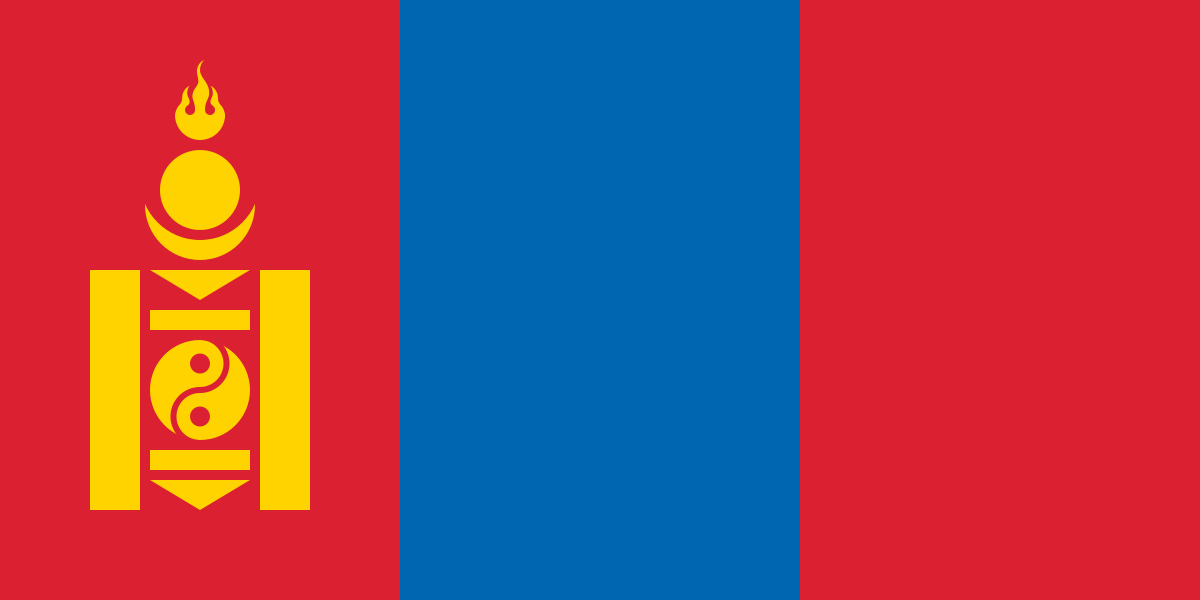
Mongolia
Communism
1893–1923
Unconfirmed: poison or illness
Military leader of Mongolia's 1921 revolution, posthumously canonized as its 'father'
Appointed commander-in-chief of the people's partisans in February 1921, he took Kyakhta in March and entered Khüree on July 6; on July 11 he became minister of the army in the new government. Mongolian-language records date that appointment to July 1922.
A Mongolian revolutionary and founding member of the Mongolian People's Party, he led the people's partisans that entered Khüree (now Ulaanbaatar) in 1921. Of a poor arat family, he worked as a typesetter and a relay-station rider, and joined Urga's underground anti-Chinese group in 1919. He went to Soviet Russia in 1920, was confirmed commander-in-chief at Kyakhta in 1921, became minister of the army that July and met Lenin in Moscow in November. The cause of his death is unconfirmed, and his posthumous canonization is itself a central dispute.
Career timeline
1919–1920Joined Urga's underground anti-Chinese group
1920–1921Traveled to Soviet Russia on party missions
1921Commander-in-chief of the people's partisans; took Kyakhta and entered Khüree
1921–1923Minister of the army and commander-in-chief
“I am convinced that all that is needed in order to achieve what I want is bravery and self-confidence. I told myself that I shall either be a general at thirty, or that I shall not be alive by then.” Declaration as a Guards second lieutenant, 1914.
Mikhail Nikolayevich Tukhachevsky was born on 4 (16) February 1893 at Alexandrovskoye in Smolensk gubernia, the son of an impoverished nobleman and a peasant woman, and joined the Red Army in March 1918. In the First World War he served with the 1st Guards Division, was wounded and decorated five times, was taken prisoner in February 1915, and after escapes returned to Russia in 1917. In the Civil War he commanded the 1st Army and the 5th Army against Kolchak, and in 1921 he directed the suppression of the Kronstadt revolt and the Tambov peasant rising, ordering the use of chemical weapons alongside artillery and aviation. Chief of Staff in 1925-1928 and one of the first five Marshals of the Soviet Union from 1935, he was sentenced to death in a closed trial on 11 June 1937 and shot that night, and was rehabilitated in 1957.
Career timeline
1918–1920Army commander at twenty-five; Western Front in the Polish war
1921Commands the suppression of Kronstadt and Tambov
1925–1928Chief of Staff
1931–1937Modernization: mechanized corps, airborne troops, deep operations
A Serbian nationalist commander who sought to restore the monarchy
In 1941 he rejected Tito's call for a general uprising as premature, and the two resistance movements soon turned their struggle into armed conflict.
Draža Mihailović was a Royal Yugoslav Army officer who led the Chetnik movement, seeking to restore the monarchy and a Serbian nationalist order after the Second World War. He built an organization at Ravna Gora in 1941, but chose to prepare for postwar power and avoid a general uprising rather than follow Tito's Partisans into sustained open resistance, bringing the movements into conflict. Parts of the Chetnik organization and Mihailović's command network collaborated with Axis and collaborationist forces, a choice that weakened the movement in multi-ethnic Yugoslavia and contributed to the Allies shifting support to the Partisans. Captured after the war, he was executed for treason and war crimes, while Serbia's Supreme Court overturned the verdict in 2015 as politically motivated.
Career timeline
1912–1913Serbian Army cadet, Balkan Wars
1914–1918Serbian Army officer, First World War
1935–1936Military attaché in Bulgaria
1936–1939Military attaché in Czechoslovakia, staff officer
1941Deputy chief of staff, Yugoslav Second Army
1941–1945Commander of the Chetnik Detachments of the Yugoslav Army
A Luftwaffe chief who organized Nazi war and plunder
In August 1940, redirecting the air offensive toward London and civilian cities gave the RAF time to recover.
Hermann Göring rose from a First World War fighter ace to a central power-holder in Nazi Germany and commander-in-chief of the Luftwaffe. He helped build dictatorship and the machinery of aggressive war by directing the Prussian police, the creation of the Gestapo, rearmament, and wartime economic mobilization. During the Battle of Britain in 1940, he overestimated the Luftwaffe and was involved in shifting attacks from the RAF's struggling airfields and fighter defences toward British cities, giving Fighter Command time to recover. After the war, the Nuremberg Tribunal condemned him as a major war criminal, and he committed suicide on the eve of his execution.
First East German Minister for State Security, purged in 1953 after trying to replace Ulbricht
Born in Gelsenkirchen to a gendarmerie sergeant’s family, he trained as a teacher and was a military leader of the Red Ruhr Army during the Kapp Putsch of 1920. As a GRU agent and Comintern military adviser he co-organised the Guangzhou Uprising in China, and in the Spanish Civil War, as “Gomez”, he led the International Brigades. He returned to Germany in 1947, joined the SED, and in 1950 became the first Minister for State Security and a Politburo member, building up the Stasi. After the uprising of June 1953 he moved to replace Ulbricht with Herrnstadt, but once Ulbricht had Khrushchev’s backing he lost his ministry and all his posts in July and was expelled from the party. He worked as a translator, died in East Berlin in 1958 and was rehabilitated after 1990.
Career timeline
1920Red Ruhr Army leader during the Kapp Putsch
1927–1930Comintern military adviser in China
1936–1938International Brigades commander in Spain (“Gomez”)
1950–1953GDR Minister for State Security; Politburo member
1953Stripped of all posts and expelled from the SED
The Republican general who overthrew Negrín to negotiate peace with Franco, and got only unconditional surrender
On the night of 5 March 1939, Casado went before a radio microphone, declared the Negrín government was preparing a Communist dictatorship and that only his National Defence Council could deliver an honourable peace. In Madrid, street fighting began at once.
A cavalry officer of the Spanish Republican Army who stayed loyal after the rising of July 1936, rose through operations and training posts to command of the Army of the Centre, and became convinced the war was already lost. On 5 March 1939 he staged a coup in Madrid, overthrew the Negrín government and set up a National Defence Council under General Miaja, claiming to forestall a Communist takeover while seeking a negotiated peace with Franco. Franco demanded unconditional surrender, the talks collapsed, and Casado escaped aboard a British warship, living in exile in Britain and Venezuela before returning to Spain in 1961.
Career timeline
1893Born in Nava de la Asunción, Segovia
1907–1911Graduated from the Cavalry Academy in Valladolid, commissioned as segundo teniente
1920–1935Served as a cavalry officer, completed staff training, fought in Morocco, commanded the presidential guard
1936–1937Head of operations, director of the staff school, organized mixed brigades, inspector general of cavalry
1938.05Appointed commander of the Army of the Centre, promoted to colonel
1939.03.05–12Led the coup against the Negrín government, served as defence councillor in the National Defence Council
1939–1961Lived in exile in Britain and Venezuela, worked as a BBC commentator and for Nestlé
1961–1968Returned to Spain, tried and acquitted of military rebellion, died of a heart attack in Madrid
The British general who commanded the Battle of Athens
On 1 December 1944, Scobie ordered ELAS to disarm.
Ronald Scobie was a British Army general who served in both world wars and commanded forces at Tobruk, Malta, and later III Corps. After Greece was liberated in 1944, he became the military commander who embodied Britain's intervention in the country's contested transition. His 1 December order for ELAS to disarm helped precipitate the Dekemvriana, and he directed British operations during the fighting in Athens.
Career timeline
1914–1918Royal Engineers officer, serving on the Western Front
1920–1924Officer of a cadet company at the Royal Military Academy, Woolwich
1939Deputy Director of Mobilisation at the War Office
1941Commander of the 70th Infantry Division and commandant of Tobruk fortress
1942General Officer Commanding the Troops in Malta
1943–1944Chief of the General Staff, Middle East, then commander of III Corps
The RAF commander who turned Fighter Command from defence toward offence
As Dowding's successor, he rebuilt Fighter Command while seeking to confront the Luftwaffe on the offensive.
William Sholto Douglas was a senior Royal Air Force commander whose career spanned two world wars. During the Battle of Britain he supported the use of massed fighter formations, and as Hugh Dowding's successor at Fighter Command he rebuilt its strength after the battle while seeking to regain the initiative from the German Luftwaffe. This shift widened Fighter Command's mission from air defence toward offensive sweeps over France, although the Circus operations achieved only limited results. After the war he commanded British forces in the occupation zone in Germany and later chaired British European Airways.
Career timeline
1914Second lieutenant, Royal Field Artillery
1915–1919Pilot and squadron commander, Royal Flying Corps
1936–1938Director of Staff Duties, Air Ministry
1938–1940Assistant Chief and Deputy Chief of the Air Staff
On 3 September 1943, beneath an olive tree at Cassibile, he signed the armistice on Italy’s behalf.
Giuseppe Castellano was an Italian army general and staff officer whose career began in the First World War. After taking part in the political-military move that removed Mussolini in July 1943, he became Badoglio’s envoy to negotiate with the Allies. He signed the Cassibile armistice on Italy’s behalf, ending the kingdom’s hostilities with the Allies but exposing the asymmetry of the terms and the confusion of Italy’s command. After the war he commanded forces in Sicily and published memoirs defending his account of the transition.
Career timeline
1915–1918First World War, artillery captain
1941–1942Yugoslavia campaign, promoted to brigadier general
1942Army General Staff, aide to Vittorio Ambrosio
1943High Command, head of planning and operations
1943.07Involved in the plan to arrest Mussolini
1943.08–09Badoglio government envoy, negotiated and signed the armistice with the Allies
1944.10–1946.06Commander of the Aosta Internal Security Division in Sicily
A Marine commander whose caution helped save a surrounded division
“Retreat, hell! We're just attacking in another direction.”
Oliver P. Smith was a U.S. Marine general who served in World War II and the Korean War, known for expertise in amphibious operations and a cautious command style. As commander of the 1st Marine Division, he led the Inchon landing and the advance to Seoul in 1950, then directed the division’s breakout from Chinese encirclement at the Chosin Reservoir. Against speed-first orders from MacArthur and Almond, he prepared supply lines and an airfield, choices that helped preserve his force and sustain the operation.
Career timeline
1917Commissioned second lieutenant, U.S. Marine Corps
1934–1936Studied at the École Supérieure de Guerre in France
1944Commanded 5th Marines in the New Britain operation
1944–1945Assistant division commander, 1st Marine Division, Peleliu and Okinawa operations
1950–1951Commanding general, 1st Marine Division, Inchon, Seoul and Chosin operations
1953–1955Commanding general, Fleet Marine Force, Atlantic
The U.S. Army commander who led the Normandy campaign
Testifying before Congress on 15 May 1951, Bradley rebuked the call for a wider war: 'this strategy would involve us in the wrong war, at the wrong place, at the wrong time, and with the wrong enemy.'
Omar Bradley was a senior U.S. Army commander of the Second World War, leading forces from North Africa and Sicily through the Normandy landings and the advance into western Europe. The existing headquarters associated with his First U.S. Army Group was repurposed as a fictitious command in the Allied deception plan, while Bradley commanded the real First Army and later the Twelfth Army Group. After the war, he became Army Chief of Staff and the first Chairman of the Joint Chiefs of Staff, helping shape U.S. military policy during the opening of the Korean War.
Career timeline
1915Second lieutenant, U.S. Army Infantry
1941Commandant, U.S. Army Infantry School
1943Commander, II Corps, North Africa and Sicily
1944Commander, First Army, Normandy landings
1944–1945Commander, Twelfth Army Group, western Europe
1948–1949Chief of Staff of the U.S. Army
1949–1953First Chairman of the Joint Chiefs of Staff
Baltic Landeswehr strike-troop commander who led the Liepāja coup and fell at Riga
In the assault on Riga he led a small detachment across the Daugava bridge toward the citadel holding hundreds of anti-Bolshevik prisoners; he fell in the charge, but his men reached the citadel and freed them.
A Baltic German baron from Courland who fought as a Bavarian uhlan officer in the First World War, he became a staff officer and strike-troop commander of the Baltic Landeswehr in 1919. On 16 April he led the Liepāja coup against the Ulmanis government, and on 22 May he was killed at twenty-five in the attack that retook Riga from the Red Army.
Career timeline
1913Read law at Heidelberg University
1914Volunteered for the 2nd Bavarian Uhlan Regiment; served on the Western and Eastern fronts
1915Promoted to lieutenant
1917Company commander, 18th Bavarian Infantry Regiment, Western front
1919.01Took command of the Baltische Landeswehr shock troops
1919.04Led the coup that toppled the Ulmanis government at Liepāja
Moldovan nobleman turned Bolshevik revolutionary who established Soviet power in the Far East
Standing alone and unarmed before the cadets of Russky Island, Lazo declared: 'For this Russian land on which I now stand, we will die but give it to no one!'
A Moldovan boyar by birth and an Imperial Russian Army officer, Lazo joined the 1917 Revolution and became the Bolshevik military leader who established Soviet power across Siberia and the Russian Far East. He seized control of Krasnoyarsk for the Soviet, commanded the Transbaikal Front against Grigory Semyonov's White forces, and after underground work and partisan warfare in Primorye, organized the January 1920 Vladivostok uprising that ended Kolchak's rule in the Far East. Captured by Japanese troops in April 1920, he was burned alive in a locomotive firebox alongside his comrades, becoming one of the most commemorated martyrs of the Soviet Civil War.
“Father of Soviet operational art”: architect of deep operations doctrine
“In military affairs, literally nothing failed to interest him. Triandafillov was invariably full of cheer, energy, and creative enthusiasm.” — Marshal Aleksandr Vasilevsky, The Cause of My Whole Life (1975)
A Pontic Greek born in Kars Oblast, he rose from tsarist staff-captain to Deputy Chief of the Red Army Staff. His two seminal works (1926, 1929) established 'operational art' as a distinct domain between strategy and tactics and laid the theoretical foundations for deep operations doctrine. His vision shaped the Red Army's interwar doctrinal reforms and became the doctrinal basis for Soviet victory in WWII. Killed in an air crash on duty in 1931 at thirty-seven, his ashes rest in the Kremlin Wall.
Career timeline
1914–1917Conscripted; Moscow Praporshchik School; company and battalion commander, 6th Finnish Rifle Regt; staff-captain
1917–1918Elected by soldiers as regimental then 7th Army commander; outlawed by Kerensky and Petlyura
1918–1923Joined Red Army; brigade commander in Civil War; graduated Military Academy with distinction
1924–1928Head of First (Operational) Dept, then Operational Directorate, Red Army Staff — Frunze's pick
1926The Scale of Operations of Modern Armies — foundational text of operational art
1928–1931Deputy Chief of Staff, Red Army (commanded 2nd Rifle Corps 1929–30)
1929The Nature of the Operations of Modern Armies — definitive deep operations theory
1931Killed in air crash on duty; ashes interred in Kremlin Wall
The Red Army's political chief who backed the purges, then shot himself as they closed in
Every year his father came from Kiev asking for his old leather boots. Gamarnik always refused: "If working people saw those boots, they'd say: his son serves in the army and steals — where else would the old man get such boots?"
A revolutionary who led the Bolshevik underground in Civil War Ukraine and directed the industrialization of the Soviet Far East. For eight years from 1929 he built and led the Red Army's political commissar system as head of the Political Directorate, while giving political backing to Tukhachevsky's modernization of the army around mechanization and air power. He publicly supported the purge of Bukharin's 'Right Opposition' at the 1929 Central Committee plenum, but when he himself was accused in the 'military-fascist conspiracy' and dismissed in May 1937, he shot himself rather than await arrest. Rehabilitated in 1955.
Career timeline
1916Joined RSDLP(b); conducted propaganda at the Kiev Arsenal factory
1917–1918Chairman of the Kiev Bolshevik committee; member of the Kiev Military Revolutionary Committee
1919–1920Chairman of Odessa Gubkom; member of the RVS, Southern Group, 12th Army
1920–1923Chairman of Kiev Gubernia Revkom and Executive Committee
1923–1928Chairman of Dalrevkom; First Secretary, Far Eastern Kraikom
1928–1929First Secretary, CP(b) of Belarus
1929–1937Head of the Red Army Political Directorate; First Deputy People's Commissar for Defense
1937Notified of dismissal on 30 May; shot himself the next day
Soviet Union
Soviet communism
1894–1948
○ Kidney disease
Twice Hero who drove the 3rd Guards Tank Army from Stalingrad to Prague
During the Kursk battle, German aircraft strafed Rybalko's car. His driver was killed, his adjutant gravely wounded, and the car plunged into a ditch. Rybalko emerged unscathed, switched vehicles, and carried on commanding.
Starting as a private, he commanded the 3rd Guards Tank Army from Kursk to Prague and was twice made Hero of the Soviet Union. Wounded five times in World War I and the Civil War, he led the postwar reorganization of Soviet armor as its commander before dying of illness at 53.
Career timeline
1914–1917Private, 82nd Infantry Division; siege of Przemyśl, Brusilov Offensive; wounded
1917–1922Red Guard partisan commander, regiment commander, brigade commissar; five wounds in the Civil War
1931–1934Graduated Frunze Military Academy; military advisor in Xinjiang, China (1934–1935)
1937–1939Soviet military attaché in Poland
1940Soviet military attaché in China
1942–1943Commander, 5th Tank Army then 3rd Tank Army; Ostrogozhsk-Rossosh success; lieutenant-general
1943–1945Commands 3rd Guards Tank Army — Kursk, Dnieper, Kiev, Lvov, Vistula-Oder, Berlin, Prague
1943Awarded Hero of the Soviet Union
1945Awarded Hero of the Soviet Union a second time
1947–1948Commander of Armored and Mechanized Forces of the Soviet Army
The marshal who liberated the Balkans and prized soldiers' lives above glory
"Marshal Tolbukhin regarded war not as craft but as exact science. He fused Western rationality with Eastern intuition, winning by skill, not numbers." — Boris Slutsky
A peasant-born officer who distinguished himself commanding the 57th Army at Stalingrad and led the 3rd and 4th Ukrainian Fronts to liberate the Balkans. Meticulous in planning and sparing of his men's lives, he was the only Marshal of the Soviet Union awarded the Hero title posthumously.
Career timeline
1914–1917Volunteered for Imperial Army; staff-captain; Orders of St. Anna and St. Stanislaus
1918–1922Joined Red Army; chief of staff, 56th Rifle Div.; Polish-Soviet war, Kronstadt, Karelia
1938–1941Chief of staff, Transcaucasian MD; planned 1941 Anglo-Soviet invasion of Iran
1942–1943Cdr 57th Army at Stalingrad — defence and counter-offensive; then 68th Army
Soviet Union
Soviet communism
1894–1953
○ Natural causes
Mordvin carpenter's son who rose to Army General and led the Manchurian offensive
On November 7, 1941, with German forces closing on Moscow, Purkayev was appointed commander of the Revolution Day military parade in Kuibyshev — a show of force before the entire diplomatic corps, meant to demonstrate to allies and potential enemies alike that the Soviet Union was still standing.
A Mordvin by ethnicity, Purkayev rose from tsarist praporshchik to Army General in the Red Army. During the Second World War he commanded the Kalinin Front through the grueling Rzhev battles, then took over the Far Eastern Front in 1943, leading the 2nd Far Eastern Front in the Manchurian Strategic Offensive of August 1945, the final major Soviet campaign of the war. He was removed from Kalinin Front command after 76 soldiers died of starvation due to supply failures in early 1943, a blemish on an otherwise distinguished career. Postwar he served as commander of the Far Eastern Military District.
Career timeline
1915Volunteered for Imperial Russian Army; graduated Saratov Praporshchik School
1918Joined Red Army; company and battalion commander
1936Commander, 1st Motorised Rifle Division
1938–1939Chief of Staff, Belorussian Military District
1939–1940Soviet military attaché in Berlin
1940–1941Chief of Staff, Kiev Special MD → Southwestern Front
1941–1942Commander, 60th Army, then 3rd Shock Army
1942–1943Commander, Kalinin Front
1943–1945Commander, Far Eastern Front → 2nd Far Eastern Front; led Sungari offensive
1945–1947Commander, Far Eastern Military District
1947–1952Chief of Staff & 1st Deputy Commander, Far Eastern Forces
The tank army commander who first entered Berlin, sidelined after Stalin's death
"On the fronts fighting the enemies of our Soviet State, my son, three brothers, and sister perished" — from his 1956 retirement petition, as Khrushchev pushed him out
One of the most accomplished field commanders of the Soviet armored forces. A Putilov factory worker who rose through the Red Army via World War I and the Civil War, he was arrested and imprisoned in 1938 before being reinstated in 1939. As commander of the 2nd Guards Tank Army, he led the decisive breakthrough at Korsun–Shevchenkovsky, Uman–Botoșani, Lublin–Brest, the Vistula–Oder, East Pomeranian, and Berlin offensives; his army was the first Soviet formation to fight its way into Berlin in April 1945. Post-war, as Chief Commander of Armored and Mechanized Forces (1948–1953), he directed the entire Soviet tank arm, but after Stalin's death he was demoted by Khrushchev and retired in 1956 due to deteriorating health. Twice Hero of the Soviet Union and Marshal of Tank Forces.
Career timeline
1915–1918Volunteered for Imperial Russian Army, rose to junior lieutenant
1918–1930Platoon, company, and battalion commander in the Red Army; Polish–Soviet War and Tambov suppression
1930–1938Regiment and mechanized brigade commander; arrested and imprisoned 1938
1940–1943Reinstated; tank division, then mechanized/tank corps commander at Stalingrad and Kursk
1943–1947Commander, 2nd (Guards) Tank Army; first Soviet army into Berlin
1948–1953Chief Commander, Armored and Mechanized Forces of the Soviet Army
1953–1956Demoted by Khrushchev; 7th Mechanized Army commander, then head of Armored Forces Academy
Soviet Union
Soviet communism
1894–1965
○ Natural causes
The Vesyegonsk chronicler of Soviet power whose book Lenin called 'remarkable'
Lenin wrote in Pravda (1919) that Todorsky's account of local Soviet work contained 'fine and absolutely true words' that should be 'carved in stone and displayed in every Economic Council and factory.'
A Soviet military educator whose chronicle of local Soviet construction, A Year — with Rifle and Plough (1918), earned Lenin's high praise. Headed the Zhukovsky Air Force Academy; arrested in the Great Terror and imprisoned 15 years, he was rehabilitated in 1955 and wrote a biography of Marshal Tukhachevsky.
Career timeline
1914–1917Imperial Army officer, WWI, rose to captain, six combat decorations
1918Editor of Vesyegonsk uyezd newspaper & party agitprop head; published A Year — with Rifle and Plough
1919–1921Red Army division commander; led suppression of Dagestan uprising
1923–1924Commander, Fergana Region forces, Turkestan Front; anti-Basmachi operations
1927–1933Commander, 5th Rifle Corps; training visit to Reichswehr
1933–1936Chief & commissar, Zhukovsky Air Force Academy; Komkor (1935)
1936–1938Head, Higher Military Educational Institutions Administration
1955–1965Rehabilitated, promoted lieutenant-general, retired; wrote memoirs & Tukhachevsky biography
The German general who surrendered Paris rather than destroy it
On 25 August 1944, he signed the capitulation of the German garrison in Paris.
Dietrich von Choltitz was a German professional officer who served in both world wars and carried out Nazi Germany’s war on the Eastern and Western Fronts. As military governor of Paris in August 1944, he did not execute Hitler’s order to destroy the city and surrendered the garrison to French forces, helping make the liberation of Paris possible. British recordings made after his capture also preserve his admission of responsibility for the liquidation of Jews in Crimea, so his refusal in Paris does not erase his wider responsibility for the war.
Career timeline
1914–1918Officer, Royal Saxon Army 107th Infantry Regiment, Western Front
1919–1939Reichswehr officer, commander of III Battalion, 16th Infantry Regiment
1939–1940Commander, 16th Air Landing Infantry Regiment, Poland and the Netherlands campaigns
1941–1942Commander, 16th Infantry Regiment, Crimea and Siege of Sevastopol
1943Commander, 11th Panzer Division and XLVIII Panzer Corps, Eastern Front
1944Commander, LXXVI Panzer Corps and LXXXIV Army Corps, Italy and Normandy
1944Commander of Greater Paris and military governor, surrendered on 25 August
1944–1947Interned at Trent Park and a US prisoner-of-war camp
In January 1939, Rojo told Negrín that the front had ceased to exist.
Vicente Rojo was a professional officer who remained loyal to the Spanish Republic, joining military expertise to a deeply held Catholic faith. He organized the defense of Madrid and planned operations at Jarama, Guadalajara, Brunete and the Ebro, becoming the Republican People's Army's central staff officer. After retreating to France in 1939, he refused Negrín's order to return and chose to care for refugee soldiers, then lived in exile in Argentina and Bolivia. He returned to Spain in 1957, was prosecuted for military rebellion by Franco's regime, and was soon pardoned without serving his suspended sentence.
Career timeline
1914Graduated from the Infantry Academy at Toledo, second lieutenant
1922–1932Instructor and education administrator at the Toledo Infantry Academy
1936Served on the Republican General Staff, promoted lieutenant colonel
1936–1937Chief of staff of the Madrid Defense Forces
1937–1939Chief of the Republican central staff, directing the People's Army's expansion and major operations
1939Exiled to France, promoted lieutenant general, refused the order to return
1943–1956Professor at a Bolivian military school
1957Returned to Spain, prosecuted for military rebellion and pardoned
Soviet Union
Soviet communism
1894–1967
○ Natural causes
The Soviet Navy's scholar-admiral who lost a leg at Tuapse and still fought two wars to the end
Stalin said of him: "A real admiral of the fleet, Comrade Isakov. Clever — no leg, but a head on his shoulders."
Of Armenian origin, Isakov was one of only three Admirals of the Fleet of the Soviet Union (1955). As First Deputy Commissar and Chief of the Main Naval Staff, he shaped Soviet naval doctrine and in the Second World War coordinated fleet-ground operations in the Baltic and Black Sea, building the 'Road of Life' across Lake Ladoga. Wounded at Tuapse in 1942, his left leg was amputated; he returned to duty through victory. After the war he authored over 150 works (including the Stalin Prize-winning Maritime Atlas) and became a Corresponding Member of the Academy of Sciences and a Writers' Union member.
Career timeline
1917Graduated as midshipman, served on destroyer Izyaslav, Baltic Fleet
1918Took part in the Ice Cruise of the Baltic Fleet
1922–1928Held staff posts in the Black Sea Fleet, rising to Chief of Staff
1937–1938Commander of the Baltic Fleet
1938–1939Deputy People's Commissar of the Navy and Head of the Naval Academy
1939–1946First Deputy People's Commissar of the Navy
1940–1942Chief of the Main Naval Staff
1942Deputy Commander, North Caucasus Front; leg amputated after severe wound at Tuapse
1946–1947Chief of the Main Navy Staff
1947–1950Deputy Commander-in-Chief of the Navy
1955Promoted to Admiral of the Fleet of the Soviet Union
1958Elected Corresponding Member, USSR Academy of Sciences