“Freedom is always the freedom of the one who thinks differently”
On 14 January 1919, the day after the Spartacist uprising fell, Luxemburg's final article appeared in Die Rote Fahne. To the victors' cry of 'Order prevails in Berlin!' she answered: 'I was, I am, I shall be!' Arrested that night, murdered the next day.
Polish-born German revolutionary, and the Bolsheviks' sharpest comradely critic. From prison she defended the Russian Revolution while warning against the dissolution of the Constituent Assembly and the suppression of the press. Murdered by Freikorps troops during the January 1919 Berlin rising.
Career timeline
1893Co-founds the Polish social democracy
1898–1914Theorist of the SPD left; the revisionism dispute
1899Published Reform or Revolution
1906The Mass Strike
1913Published The Accumulation of Capital
1915–1918Jailed for anti-war work; writes on the Russian Revolution from prison
1918.12Co-founds the German Communist Party
1919.01Murdered by Freikorps troops in the January rising
An Endecja theorist who pressed for a Polish nation-state
At Riga, abandoning the demand for Minsk turned Poland’s eastern policy from a federal project toward a nation-state settlement.
Stanisław Grabski was an economist and politician who began in the socialist movement before becoming one of the leading theorists of Poland’s National Democracy, or Endecja. He tied independence and state unity closely to national homogeneity and opposed a federation that would incorporate large Ukrainian and Belarusian populations. During the Minsk and Riga negotiations in 1920, he supported abandoning the demand for Minsk, weakening Piłsudski’s eastern federal project and helping define the Riga settlement as a Polish nation-state. He later served as education minister and held senior positions in the government-in-exile and the postwar state, while distancing himself from Endecja after 1926 and revising parts of his political stance.
Career timeline
1890–1893Socialist activist, workers’ education and clandestine labor organizing
1906–1914National Democrat and adviser on the Polish question in the Russian Duma
1919–1923Deputy in the Polish Sejm and leader of the National Democratic parliamentary and party organizations
1920–1921Polish delegate at the Minsk and Riga peace talks, steering the nation-state line
1923–1925Minister of Religious Denominations and Public Education
1942–1944Chairman of the National Council of Poland in exile
1945–1947Deputy chairman of the State National Council
Architect of Ukrainization: the cultural revolutionary who turned the gun on himself
In the spring of 1918, after the Brest crisis, Stalin told Ukraine's leaders to stop "playing at government and republic"; Skrypnyk's Ukrainian TsIK answered by telegram: "the source of its actions is not this or that commissar, but the will of the working masses of Ukraine."
Born on 13 (25) January 1872 in the village of Yasynuvata, Bakhmut uezd, Yekaterinoslav gubernia, the son of a railway telegrapher and a zemstvo midwife. A party member from 1897, he was sent to Ukraine on Lenin's orders in December 1917 and chaired the People's Secretariat, the first Soviet Ukrainian government, then headed the Cheka department against counter-revolution in 1918–1919. From 1927 to February 1933 he was People's Commissar of Education of the Ukrainian SSR, and in 1932 he opposed high grain-procurement targets.
Career timeline
1897–1900Began activity in social-democratic circles; self-taught in Marxist literature
1900–1917Entered Petersburg Technological Institute; worked on Iskra, Pravda and other party organs; arrested 15 times, exiled 7 times, escaped 6 times
1917.03–12Secretary of the Petrograd Central Council of Factory Committees; member of the Military Revolutionary Committee during the October uprising
1917.12–1918.04Dispatched to Ukraine on Lenin's orders; chairman of the People's Secretariat, the first Soviet Ukrainian government
1918.07–1919.01Member of the All-Russian Cheka collegium and head of its department for the struggle against counter-revolution; head of its secret-political department, December 1918–January 1919
1919.01–05People's Commissar of State Control and chairman of the Supreme Socialist Inspection of the Ukrainian SSR
1927–1933.02People's Commissar of Education of Ukraine; directed Ukrainization policy, orthographic reform, Academy of Sciences, and the Ukrainian Soviet Encyclopedia
1933.02–07Demoted to Deputy Chairman of Sovnarkom of Ukraine and Chairman of Gosplan
Soviet Union
Soviet communism
1872–1959
○ Natural causes
Early architect of electrification and planning
December 23, 1920, Petrograd. Krzhizhanovsky presents the GOELRO plan. Lenin rises and calls it 'the Party's second programme.' On the vast map behind them, thirty red lights blink — the power stations of the future.
One of Lenin's oldest comrades: they founded the League of Struggle together in 1893, shared arrest and exile. In Butyrka prison he wrote the Russian lyrics of the revolutionary anthem 'Warszawianka.' As lead architect of the GOELRO electrification plan and first chairman of Gosplan, he directed the world's first comprehensive national development plan, the methodological prototype for every Soviet five-year plan. As vice-president of the Academy of Sciences he founded the Energy Institute and laid the scientific basis for the unified energy system. Sidelined in the late 1930s for criticising Stalin, he escaped the purges and was rehabilitated as a Hero of Socialist Labour in 1957.
Career timeline
1890s–1917Old comrade of Lenin, combining underground politics with electrical-engineering expertise
1920Central figure in drafting the GOELRO electrification plan
1921–1923Early Gosplan chairman, establishing the technocratic language of planning
1925–1930Early Gosplan chairman, establishing the technocratic language of planning
1930sSupports electrification through Academy and energy-research institutions
1959Dies as an early Bolshevik technocrat who survived into the post-Stalin era
The 'Rook' who flew across borders building the Iskra network, and the revolution's first martyr
He was handsome, a fine fellow with a guitar — even in exile he played, composed epigrams on the spot, drew caricatures. So the historian Vladlen Loginov recalled Bauman.
A Volga German veterinary surgeon turned Bolshevik, he ran Lenin's Iskra illegal distribution network inside Russia. Killed by a monarchist during the October 1905 demonstrations, his funeral drew 100,000 mourners and turned into a show of revolutionary force.
Career timeline
1895Graduates Kazan Veterinary Institute; works in Saratov province
1896–1897Member, St. Petersburg Union of Struggle for the Liberation of the Working Class
1897–1899Arrested; 22 months solitary in Peter and Paul Fortress; exiled to Vyatka
1900Works with Lenin in Switzerland to launch Iskra; heads illegal transport into Russia
1901–1903Moscow Committee; arrested in Kiev, escapes ('Escape of the Eleven'); delegate to 2nd RSDLP Congress — Bolshevik
1903–1904Leads Moscow Bolshevik organization & Northern Bureau of CC; arrested, 16 months in Taganka Prison
1905.10Released from prison; killed days later by a monarchist during a street demonstration
The worker-organizer Iskra trusted most: archetype of the Bolshevik worker
In 1902 he sawed through his prison bars in Alexandrovsk, escaped, and made his way to London — knowing not a word of any foreign language — to discuss the tasks ahead with the Iskra editorial board.
A worker-revolutionary forged in Lenin's Marxist circle. As an Iskra agent, he built the Orekhovo-Bogorodsk organization, the first to recognize Iskra as its central organ, and endured repeated arrests, exile, and prison escapes. He led the 1905 Chita armed uprising and was shot the following year while escorting arms for Irkutsk workers.
From Balkan revolutionary to head of Soviet Ukraine: the diplomat who became an opposition theorist
"Our misfortune is that we held responsible posts and power turned our heads." Final plea at the 1938 Moscow trial
A pan-European revolutionary of Bulgarian ethnic origin who also held Romanian citizenship, Rakovsky founded the Balkan Social Democratic Federation. As chairman of the Ukrainian Council of People's Commissars from 1919 to 1923 he helped build the Ukrainian Soviet state, and he later served as Soviet ambassador to Britain and France. A Left Opposition theoretician who challenged Stalin's nationalities policy and party bureaucratisation, he was expelled in 1927, admitted his errors to Stalin in 1934 and was readmitted in 1935. Sentenced to 20 years at the Third Moscow Trial in 1938, he was shot at Oryol on 11 September 1941 and rehabilitated on 4 February 1988.
Career timeline
1890–1896Medical studies in Geneva, Berlin, Montpellier; active in European socialist movements
1910Revived Romanian Social Democratic Party; founded Balkan Social Democratic Federation, first secretary
1919–1923Chairman of Sovnarkom of Ukraine; People's Commissar of Foreign and Internal Affairs
1919–1927Member of the Central Committee of the RCP(b); Orgburo member (1919–1920)
1923–1927Plenipotentiary representative of the USSR to Britain (1923–1925) and France (1925–1927)
1927–1935Left Opposition leader; expelled from party, exiled to Astrakhan, Saratov, Barnaul
1934–1937Admitted his errors to Stalin in 1934, readmitted to the party in November 1935; head of scientific institutes administration at RSFSR Health Commissariat
1937–1941Expelled again in 1936, arrested January 1937, Third Moscow Trial 20-year sentence; shot at Oryol on 11 September 1941
First Soviet editor of Izvestia, architect of the Soviet constitution
His Izvestia editorials were nicknamed steklyashki ("little Steklovs"), and Lenin sent him a handwritten note: "Comrade Steklov! I've read your editorial. This is how one should write, and more of it!" Steklov framed the note and hung it on his office wall.
Bolshevik journalist and historian from Odessa. After the February Revolution he became editor of the Petrograd Soviet's Izvestia and held the post until 1925. He co-drafted the 1918 RSFSR and 1924 USSR constitutions and served on the VTsIK Presidium. With Gorky he co-edited Novaya Zhizn and initiated the monthly Novy Mir. He left a vast body of work on socialist thought including major biographies of Bakunin and Chernyshevsky. Arrested in 1938, he died in Saratov prison in 1941 and was rehabilitated in 1956.
Career timeline
1888–1893Organised a workers' circle in Odessa; joined the Social Democratic movement
1894–1899Arrested and exiled to Sredne-Kolymsk, Yakutsk, for 10 years
1901–1903Worked on Iskra; joined the Bolsheviks after the 2nd RSDLP Congress
1905–1910Took part in the Petersburg Soviet, arrested; advised the Duma SD faction
1911Taught at the Longjumeau party school; wrote for European SD press
1917–1925Editor-in-chief of Izvestia; member of the VTsIK Presidium
1918–1924Co-drafted the 1918 RSFSR Constitution and the 1924 USSR Constitution
1920–1930Produced major works on socialist thought including biographies of Bakunin and Chernyshevsky
1925Initiated the monthly literary journal Novy Mir
1929–1938Deputy chair of the Academic Committee under the USSR Central Executive Committee
Finnish labour leader who became the world’s first Social Democratic head of government and then joined the Red government
Born in Kannus in Central Ostrobothnia in 1873, he emigrated to America at 17, worked in the mines and joined the radical Western Federation of Miners. Back in Finland from 1900, he entered Parliament for the Social Democrats in 1907, chaired the Finnish Trade Union Federation in 1912–1917 and was Speaker in 1913. In 1917 he became vice-chairman of the Senate’s economic department, the world’s first social democratic prime minister. In the civil war he was commissar for supply in the People’s Delegation, signed the 1 March treaty with Soviet Russia and fled to Russia after the defeat. In 1919–1920 he advised the British-organised Murmansk Legion, for which the Communist Party of Finland sentenced him to death. From 1922 to 1949 he edited the social democratic paper Raivaaja in the United States, and the 1944 Lex Tokoi cleared him of the civil war charges.
Career timeline
1907–1918Social Democratic member of the Parliament of Finland
1912–1917Chairman of the Finnish Trade Union Federation
1913Speaker of the Parliament of Finland
1917Vice-chairman of the Senate’s economic department (head of government)
1918Commissar for supply, Finnish People’s Delegation
When Maria Essen helped pick her underground alias, she said: "I'd call you 'Categorical Imperative,' but it's too long — let's settle for 'Absolute.'" Stasova became exactly that: the courier who never failed a mission.
An Old Bolshevik who joined the RSDLP at its founding in 1898, she served as an underground Iskra courier handling forged documents and arms smuggling, earning the party pseudonym 'Absolute.' From 1917 she systematized records, communications and meeting work as Central Committee technical secretary and chairwoman of the Secretariat, then led the Comintern's German desk and chaired the International Red Aid (MOPR). She was one of the very few women to serve on the Bolshevik Central Committee and helped lay the organizational foundations of the party apparatus.
Career timeline
1917–1918Central Committee technical secretary: records and communications for the legalized party
1919Chairwoman of the Central Committee Secretariat
Bolshevik leader of Ivanovo-Voznesensk who built the first soviet alongside Frunze during the 1905 general strike
In May 1905 Balashov turned his apartment into the general-strike headquarters, directing seventy-two days of struggle by seventy thousand weavers; the workers of the Kompaniya factory elected him to Russia's first citywide soviet.
Born into a peasant family, Balashov worked as a weaver from the age of twelve and joined the RSDLP in 1898, becoming a core organizer of the Ivanovo-Voznesensk committee. In 1905, alongside Mikhail Frunze and Fyodor Afanasyev, he led the seventy-two-day general strike that produced Russia's first citywide soviet of workers' deputies; after Afanasyev was murdered by the Black Hundreds, Balashov took over as chairman of the party committee. Arrested in 1908, he spent nine years in Siberian exile until returning in March 1917 to reclaim the chairmanship and serve in the Cheka. Worn down by years of persecution and imprisonment, he took his own life in 1925.
Career timeline
1898Joined the Ivanovo-Voznesensk RSDLP committee
1905Led the general strike with Frunze and Afanasyev; elected to the first soviet
1905–1908Chairman of Ivanovo-Voznesensk RSDLP; party work in Bryansk and Moscow
1908–1917Arrested and exiled to Siberia
1917–1918Ivanovo Bolshevik chairman and Cheka; fought in the Civil War
1919–1925Party and Soviet posts in Kharkov, Poltava, and Moscow
Architect of the Red Army's political apparatus, Old Bolshevik who opposed Trotsky's military line
Odessa, 1905: as the Potemkin mutiny rocked the city, Gusev wrote to Lenin — seize power now and form a Provisional Revolutionary Government.
An Old Bolshevik who joined Lenin's League of Struggle in 1896 and helped found the Bolshevik faction at the II RSDLP Congress. As secretary of the Petersburg committee during the 1905 Revolution, he led the capital's Bolsheviks. During the Civil War he was, alongside Mikhail Frunze, the leading theorist of the 'Military Opposition' against Trotsky's military policy. As head of PUR he consolidated the political commissar system in the Red Army. Later served in the Central Control Commission and Comintern as a key institution-builder loyal to Stalin's line.
Career timeline
1896Joined Lenin's League of Struggle for the Emancipation of the Working Class
1903Delegate to the II RSDLP Congress; sides with the Bolshevik faction
1904–1905Secretary of the Petersburg Bolshevik committee during the 1905 Revolution
1917Secretary of the Petrograd Military Revolutionary Committee
1918–1920Member of RMCs of the Eastern, Southern, and Caucasus fronts
1921–1922Head of the Political Administration (PUR) of the Red Army
1925–1926Head of the Central Committee Press Department
1928–1933Head of the Comintern Central European Secretariat; ECCI Presidium member
Creator of biomechanics, the architect of theatre who staged revolution on stage
During his 1930 Berlin tour, the émigré actor Mikhail Chekhov (nephew of Anton Chekhov) warned Meyerhold not to return to the Soviet Union. Meyerhold answered quietly: 'From my gymnasium years I have carried the revolution in my soul, always in its most extreme, maximalist forms. I know you are right, and my end will be as you say. But I will return to the Soviet Union.' When Chekhov asked why, Meyerhold replied: 'Out of honesty.'
Director, actor, and pedagogue who reshaped Russian and Soviet theatre. He forged an original acting system through Constructivist staging and biomechanics, joined the Bolshevik Party in 1918, and proclaimed a 'Theatrical October'. At GosTiM he staged radical productions of Mayakovsky, Gogol, and Crommelynck, and collaborated with Eisenstein and Shostakovich, leaving a deep mark on European theatre. After his theatre was shut down in 1938, he was arrested in 1939 and executed the following year.
Career timeline
1898–1902Actor at the Moscow Art Theatre — premiered Treplev in The Seagull and Tuzenbach in Three Sisters
1906–1907Chief director at Komissarzhevskaya Theatre — launched the 'conditional theatre' era with Blok's The Fairground Booth
1908–1917Director at the Alexandrinsky and Mariinsky Theatres — Lermontov's Masquerade, Molière's Don Juan, Gluck's Orfeo ed Euridice
1918Joined the Bolshevik Party; premiered Mayakovsky's Mystery-Bouffe in Petrograd
1920–1938Artistic director of GosTiM (State Meyerhold Theatre) — peak of biomechanics and Constructivist staging
1920–1921Head of the Theatre Department (TEO) of Narkompros — shaped Soviet theatre policy under Lunacharsky
1923Awarded People's Artist of the Republic
1922–1924Artistic director of the Theatre of Revolution — premiered Faiko's Lake Lyul
1926–1930Staged Gogol's The Government Inspector and Mayakovsky's The Bedbug and The Bathhouse — collaborations with Shostakovich and Rodchenko
1938–1939After GosTiM's closure, worked on Rigoletto as chief director at the Stanislavsky Opera Theatre
Old Bolshevik who watched over the Party's books for a quarter-century
From 16 to 30 March 1919, a physician and Old Bolshevik filled the void left by Sverdlov's sudden death, serving as acting head of the Soviet state. Only two weeks, but a critical bridge in the revolution's early succession.
An Old Bolshevik who joined the Party in 1895. After underground work (co-founding the Moscow Workers' Union and fighting in the December 1905 uprising) he served as acting head of the Soviet state for two weeks after Yakov Sverdlov's death in March 1919. He later served as Ukrainian deputy premier and Gosplan chair, RSFSR People's Commissar of Public Healthcare, and from 1927 until his death in 1951 chaired the Central Auditing Commission for 24 years, overseeing Party accounts and discipline. A Stalin loyalist who survived the purges, he lived with the paradox that his own son-in-law Martemyan Ryutin was expelled and destroyed.
Career timeline
1895Co-founded Moscow Workers' Union · joined RSDLP
1896–1905Arrest, exile, emigration; joined Emancipation of Labor; Iskra collaborator; medical degree Berlin/Kazan
1905–1907Moscow Party committee & soviet deputy; December uprising; re-arrested, fled to France
1917–1919Moscow Party 'pentarchy' for October; VRK; VTsIK presidium; acting VTsIK chairman Mar 1919
A revolutionary who turned to Japanese literature and philosophy
He described his intellectual turn as having moved “through Shakespeare from Marx to Christ.”
Alexander Vannovsky was an early organizer of Russian social democracy who later became a scholar of Japanese literature and philosophy. Representing Moscow’s Union of Struggle for the Emancipation of the Working Class, he attended the founding congress of the Russian Social Democratic Labour Party and later organized underground printing and military-technical work. After leaving the party in 1912, he reflected on revolutionary ideals and their consequences through Christian thought while studying Russian literature and Japanese mythology in Japan.
Career timeline
1896Student at the Moscow Technical School; joined the revolutionary movement
1898Delegate to the First Congress of the RSDLP, representing Moscow’s Union of Struggle for the Emancipation of the Working Class
1898–1900Arrested and exiled to Solvychegodsk
1903–1905Organized the Volya social-democratic group and underground presses in Rybinsk and Yaroslavl
1905–1906Took part in the Kiev sapper uprising and Moscow December uprising; worked in Moscow’s military-technical bureau
1910s–1960sTaught Russian literature at Waseda University in Japan; studied Japanese mythology and Shakespeare
Founder of Rabotnitsa and organizer of Russia's first International Women's Day
On the eve of Rabotnitsa's first issue in February 1914, police raided the editorial office and arrested the entire board, Samoilova included. The publication permit had been a trap. But Anna Yelizarova, who arrived late and escaped the sweep, got the first issue out on 23 February — International Women's Day.
Daughter of an Irkutsk priest, she studied philosophy at the Bestuzhev Courses. In Paris in 1902 she met Lenin and joined Iskra, then spent a decade as an underground propagandist, arrested three times. As Pravda's editorial secretary, the letters from working women moved her to organize Russia's first International Women's Day in 1913. In 1914 she co-founded Rabotnitsa, the first Marxist newspaper for working women; she revived it after the February Revolution. She headed Zhenotdel in Ukraine, served on Kommunistka's board, and led the political department of the Volga agit-steamer Red Star before dying of cholera in Astrakhan in 1921.
Career timeline
1896Enrolled at the Bestuzhev Courses in Petersburg, studied philosophy
1897–1901Active in the student movement; first arrest and expulsion in 1901
1902–1903Studied in Paris; met Lenin and joined Iskra
1903–1912Joined RSDLP; underground propagandist — arrested three times across Tver, Odessa, Rostov, Lugansk
1907Delegate to the 5th RSDLP Congress in London
1912–1914Editorial secretary of Pravda
1913.02Organized Russia's first International Women's Day meeting; hundreds of working women attended
1914.02Launched Rabotnitsa with Inessa Armand — arrested on the eve of the first issue
1917Revived Rabotnitsa after the February Revolution; organized the First Conference of Women Workers
1918.01Co-organized the First All-Russian Congress of Working Women
1919–1920Head of Zhenotdel for the CP(b)U in Ukraine; delegate to 8th Party Congress
1920–1921Editorial board of Kommunistka; political commissar of the Volga agit-steamer Red Star
Father of the Chilean labour movement and pioneer of Latin American communism
"Reading is one of the best means of emancipation for the working classes. That is why we urge you to read much." — Recabarren's constant refrain at workers' gatherings throughout Chile.
A lifelong organizer and theorist who dedicated himself to building Chile's labour movement and socialist party. Witnessing the brutal conditions of nitrate miners, he joined the Democratic Party but broke with its reformism in 1912 to found the Socialist Workers' Party (POS). Despite repeated imprisonment and exile, he launched and edited workers' newspapers, toured the country raising class consciousness, and in 1922 affiliated the party to the Comintern, transforming it into the Communist Party of Chile. Beset by internal party conflicts and failing health, he took his own life in 1924, but the organizational, educational, and press foundations he laid became cornerstones of the Chilean and Latin American revolutionary tradition.
Career timeline
1894Joined the Chilean Democratic Party
1906Elected deputy for Tocopilla (denied seat)
1908–1909Exile in Argentina and Europe
1912Founded Socialist Workers' Party (POS) and El Despertar newspaper
1918Co-founded Communist Party of Argentina, first national directorate
1921Elected deputy for Antofagasta
1922Transformed POS into Communist Party (PCCh), attended 4th Comintern Congress
Vyborg Bolshevik organizer who turned the Women's Day protest into the February Revolution
On 28 February, hearing of the Provisional Government's formation, Kayurov shouted to the soldiers: "Comrades! Has the workers' blood been flowing in the streets of Petrograd for three days merely to exchange one landlord for another?"
A metalworker who joined the RSDLP in 1898, Kayurov was a Bolshevik organizer in Petrograd's Vyborg district who, on 23 February 1917, defied the party committee's caution and transformed the women textile workers' International Women's Day strike into a revolutionary general strike. On 27 February he led an armed detachment that raided arsenals for rifles, freed revolutionaries from prisons, and attacked police stations: the moment the street protest became an armed uprising. After heading the 5th Army's political department in the Civil War, he worked in economic administration until 1932, when he and his son founded the Union of Marxist-Leninists with Ryutin's platform, an open challenge to Stalin; he died in Kazakh exile in 1936.
Career timeline
1898Joined the RSDLP, Bolshevik faction
1905Took part in Sormovo December armed uprising
1912–1917Underground party work, Vyborg district, Petrograd
1917.02Led February Revolution actions; chairman, Vyborg District Soviet
1917.07Hid Lenin in his apartment
1918–1920Head of Political Dept, 5th Army (Eastern Front)
1921–1922Special commissioner, Sibrevkom; chair, Siberian Party Purge Commission
1932Founded Union of Marxist-Leninists; arrested, 3 years exile
1935–1936Re-arrested, 3 years Kazakh exile; died in exile
A physician of the Left Opposition who shares a name with the first president of Russia
He has no connection to Boris Yeltsin, the first president of Russia. Even the Russian spellings differ: Eltsin for him, Yeltsin for the president.
He was born in 1876 in Zvenigorodka, Kiev Governorate (some sources give 1875). He joined the RSDLP in 1897 and completed medical studies at Novorossiysk University in Odessa the following year, working thereafter as a physician. Exiled to Ufa Governorate in 1910 for revolutionary activity, he worked as a sanitary doctor in Belebey and attached himself to the Bolsheviks. After the revolution he served in local soviets and on various commissions, and from 1923 he belonged to the Left Opposition and signed the Declaration of 46. Expelled from the party in 1927, he was exiled to Ust-Vym early the next year and held in the Suzdal political isolator in 1929. Arrested again in 1936 and exiled to Siberia, he was one of the organizers of a hunger strike by political prisoners in Magadan that year. He was shot in 1937 and rehabilitated on 23 November 1956. His son Viktor Borisovich Eltsin was also active in the opposition.
Career timeline
1897Joined the RSDLP
1898Graduated in medicine, Novorossiysk University, Odessa
1910Exiled to Ufa Governorate; sanitary doctor in Belebey
1923Joined the Left Opposition, signed the Declaration of 46
1927Expelled from the party
1928–1929Exiled to Ust-Vym, then held in the Suzdal political isolator
1936Arrested again, exiled to Siberia, organized a hunger strike of political prisoners in Magadan
The 'Demon' Underground and the Only Woman Vice-Chair of Sovnarkom
In the Bolshevik underground she took the codename 'Demon' (Демон) — by one account, from Lermontov's poem used as a cipher book. The name stuck for life as an emblem of her fierce revolutionary persona.
An Iskra agent and Bolshevik organiser co-opted to the Central Committee in 1903, she helped lead the 1905 and 1917 Moscow uprisings. During the Civil War she served as political commissar of the 8th and 13th Armies and became the first woman awarded the Order of the Red Banner. Her role organising the Red Terror as Crimean party secretary in 1920–21 remains fiercely debated. In 1939 she became Deputy Chair of Sovnarkom (the only woman to hold that post) and was one of the very few Old Bolshevik women to survive the Stalin-era purges, dying in 1947.
Career timeline
1896Joined the RSDLP; began Social Democratic activity in Kiev
1901Iskra agent in Odessa and Yekaterinoslav
1903–1904Co-opted to the CC; member of the Bolshevik Bureau of Committees of the Majority
1905Secretary of the Moscow Committee; helped lead the December uprising
1917Secretary of the first legal Moscow Bolshevik Committee; led October uprising in Rogozhsko-Simonovsky district
1918–1920Political commissar of 8th and 13th Armies; Luhansk defence; first woman to receive the Order of the Red Banner
1920–1921Responsible Secretary of the Crimean Party Committee; member of the Crimean Revolutionary Committee — organised the Red Terror
1924–1934Member of the Central Control Commission; NKPS collegium; district party secretary in Perm and Moscow
1939–1940Chairman of the Commission of Soviet Control
1939–1943Deputy Chair of the USSR Council of People's Commissars — the only woman in the post
1943–1947Deputy Chair of the Party Control Commission
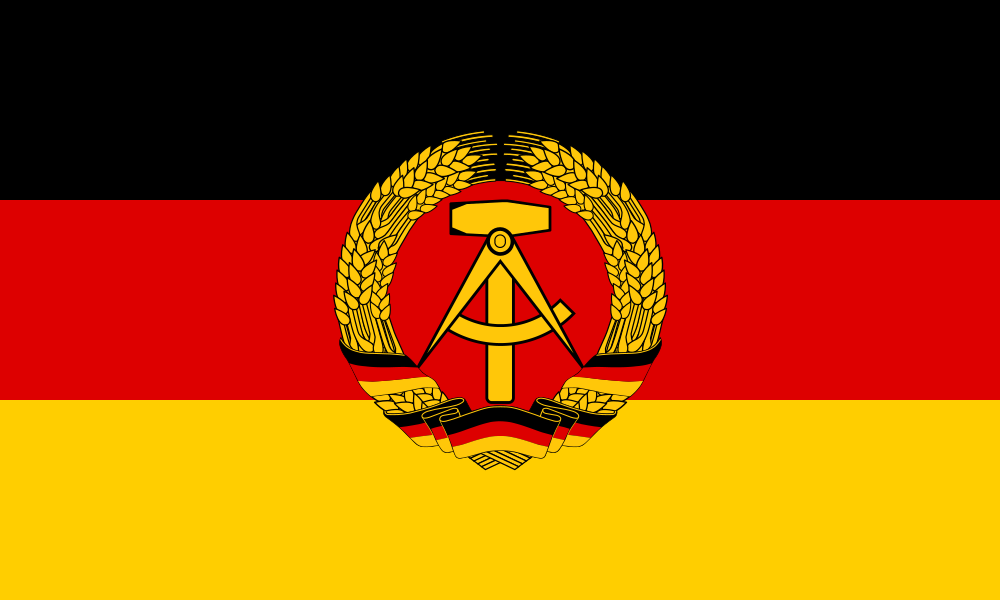
From the Spartacus League to GDR head of state, the sole founding member who lived the full arc of German communism
On the night of 15 January 1919, Pieck was arrested alongside Luxemburg and Liebknecht and taken to the Eden Hotel. He became the sole survivor — the last to witness his comrades alive.
A coachman's son turned carpenter, he joined the SPD in 1895 and was radicalized under Rosa Luxemburg's influence. Court-martialed for anti-war agitation, he co-founded the Spartacus League and the KPD. Arrested with Luxemburg and Liebknecht in January 1919, he alone survived. He served on the ECCI (1921) and its Presidium (1931), then led the KPD in Moscow exile as Comintern secretary. Returning after the war, he drove the SPD-KPD merger that created the SED and became the first President of the GDR in 1949, holding that office until his death.
Career timeline
1895Joins the Social Democratic Party of Germany (SPD)
1915Conscripted; court-martialed for anti-war agitation; flees to Amsterdam
1918–1919Co-founds Spartacus League and KPD; Central Committee member
1921ECCI member; elected to the Prussian Landtag
1928–1933Reichstag deputy
1931Elected to the ECCI Presidium
1934–1946KPD chairman (exile leadership)
1935–1943Secretary of the Comintern
1943Co-founds the National Committee for a Free Germany
1946–1950Co-chairman of the Socialist Unity Party (SED)
1949–1960President of the German Democratic Republic
The Tsentralka sailor whose killing ignited the Potemkin mutiny; his Odessa funeral became a mass revolutionary demonstration
'To delay means to fail the revolution. At this moment, everywhere, workers and peasants are striking out. We must join the common fight.'
Born into a Ukrainian peasant family in Volhynia, he was conscripted into the Black Sea Fleet in 1898 and became an artillery non-commissioned officer on the battleship Potemkin. He joined the RSDLP in 1903, helped found the Sevastopol Sailors' Tsentralka (Central Committee), and hid a red flag aboard ship as he prepared the fleet-wide uprising. On 27 June 1905, confronting officers over maggot-infested meat, he was mortally wounded by Chief Officer Giliarovsky's rifle; two days later his funeral in Odessa swelled into a mass political demonstration that the Potemkin answered by shelling the city.
Career timeline
1898Conscripted into the Black Sea Fleet
1900Graduates mine-artillery school; assigned as gunner, battleship Potemkin
1903Joins RSDLP; helps found the Sevastopol Sailors' Tsentralka
1905.06.27Mortally wounded by Chief Officer Giliarovsky during the Potemkin mutiny; dies aboard
The poet-bomber who stayed his hand seeing the Grand Duchess and children: the 'ethical terrorist' behind Camus' Les Justes
At his trial: "I am not a defendant, I am your prisoner. We are two warring camps. Learn to look the advancing revolution right in the face."
A Socialist-Revolutionary Combat Organization member and poet, who assassinated Tsar Nicholas II's uncle Grand Duke Sergei Alexandrovich with a bomb in the Moscow Kremlin on 4 February 1905. Two days earlier, seeing the Grand Duke's wife and young nephews in the carriage, he had refused his throw: an act that earned him the name 'ethical terrorist' and later inspired Albert Camus' play Les Justes. He had cut his teeth in the Petersburg Union of Struggle, broken with the Social Democrats over their rejection of direct action, and joined the SR Combat Organization under Evno Azef, taking part in the surveillance for the Plehve assassination. At his trial he told the court to 'learn to look the advancing revolution right in the face'; he was hanged at Schlisselburg at twenty-seven.
Career timeline
1897–1899Studied at Moscow and St. Petersburg Universities; joined Petersburg Union of Struggle for the Liberation of the Working Class (1898)
1899Exiled to Ekaterinoslav for leading a student strike
1902Arrested in Berlin carrying revolutionary literature, handed over to Russia, exiled to Yaroslavl
1903Joined the SR Combat Organization in Geneva under Evno Azef
1904Participated in surveillance for the assassination of Interior Minister Plehve
1905.02.04Assassinated Grand Duke Sergei Alexandrovich with a bomb in the Moscow Kremlin
1905.04.05Delivered denunciation of tsarism at Senate special tribunal; sentenced to death
A non-party workers' lawyer elected the first chairman of the Petersburg Soviet in 1905
Khrustalev shone with a double light, of the party and of the masses, but both lights were reflected, someone else's.
A non-party workers' lawyer, he was elected the first chairman of the Petersburg Soviet at the height of the 1905 Revolution. His independence helped him command workers' trust, but effective political direction was seized by Social Democrats led by Trotsky and Parvus. After escaping Siberian exile in 1907 he lived as an émigré, returned to Russia as a war patriot, and in 1918 led the self-declared 'Pereyaslav Republic' against the Bolsheviks before being executed by the local revkom the following year.
Career timeline
1905.10–11First chairman, Petersburg Soviet; elected unanimously on 14 Oct
1905.11–1906Arrested; sentenced to Siberian exile
1907Escaped Siberia; London Party Congress, then emigration
1909–1914Left RSDLP; syndicalism and publishing in Paris
1915–1917Arrested on return; 3 years' katorga; freed by February Revolution