'Grandmother of the Russian Revolution' who endured 44 years of prison and exile; co-founder of the Socialist Revolutionary Party
"Mr. Kennan, we may die in exile, and our children may die in exile, and our children's children may die in exile, but something will come of it at last" — to George Kennan in Siberia, 1885.
Born into the nobility, she helped free her family's serfs in 1861, then joined the 1874 'Going to the People' movement. At the 1878 Trial of the 193 she became the first woman sentenced to katorga for a political crime, enduring 22 years in prison and Siberian exile that brought international fame through George Kennan's writings. Released in 1896, she co-founded the Socialist Revolutionary Party with Grigory Gershuni and led creation of its Combat Organization, then raised funds on a 1904 U.S. tour where she was dubbed 'Babushka.' After the February Revolution she returned as the symbolic elder of the Provisional Government and chaired the Pre-Parliament, but opposed the Bolshevik takeover and backed the White cause. Exiled in 1918, she died in Czechoslovakia.
Career timeline
1861Helped free serfs on family estate; opened school, library, and cooperative bank for peasants
1873–1874Formed radical commune in Kiev; joined 'Going to the People,' propagandizing in villages with false passports
1874–1878Arrested; held in St. Petersburg House of Preliminary Detention; convicted at Trial of the 193 — first woman sentenced to katorga (5 years, Kara mines)
1878–1896Served katorga at Kara, exiled to Barguzin and Selenginsk; recaptured after 1881 escape, 4 more years katorga; 22 years imprisonment/exile; interviewed by George Kennan
1896–1901Released under Nicholas II coronation amnesty; with Grigory Gershuni revived populist movement in Minsk, laid groundwork for SR Party
1901–1903Co-founded Socialist Revolutionary Party; toured Russia illegally with Gershuni building organization; led creation of SR Combat Organization
1903–1905Fled to Geneva; attended 1904 Amsterdam Congress of the Second International; toured U.S. raising ~$10,000; nicknamed 'Babushka'
1905–1910Returned to Russia for the 1905 Revolution; betrayed by Yevno Azef in 1908, arrested and held in Peter and Paul Fortress
1910–1917Sentenced to Siberian exile for life; 1913 escape attempt failed 7 miles from Irkutsk; solitary confinement in Yakutsk; U.S. protests secured return to Irkutsk
1917Returned to Petrograd after February Revolution, welcomed by Kerensky; chaired Pre-Parliament as oldest member; opposed Bolshevik takeover, appealed for Czechoslovak Legion intervention
1918–1934Exiled via Vladivostok and Japan to U.S.; lobbied for White intervention; settled in Czechoslovakia via Paris; organized Carpatho-Russian Labor Party; died near Prague
Five-time Socialist Party presidential candidate and pioneer of industrial railroad unionism
At his 1918 sentencing he declared: "While there is a lower class, I am in it, while there is a criminal element, I am of it, and while there is a soul in prison, I am not free."
The most iconic figure of American socialism and a pioneer of industrial unionism. After leading the American Railway Union through the Pullman Strike of 1894, he embraced Marxism in prison and helped found the Socialist Party of America (1901) and the IWW (1905). He ran for president five times, winning 6.0% in 1912, and from an Atlanta prison cell in 1920 he won over 914,000 votes, the high-water mark of American socialist electoral politics.
Career timeline
1875Joined Brotherhood of Locomotive Firemen
1880–1893BLF Grand Secretary-Treasurer & magazine editor
1885Indiana State Representative (Democrat)
1893–1897Founder & president, American Railway Union
1901Co-founder, Socialist Party of America
1905Founding member, Industrial Workers of the World
1900–1920Socialist Party presidential candidate (5 campaigns)
German trade-union leader who signed the 1918 agreement with Stinnes and met the Kapp Putsch of 1920 with a general strike
Born in Marienburg, he grew up in an orphanage and became a wood turner. He joined the Social Democrats in 1885, chaired the General Commission of the German Trade Unions from 1890, and sat in the Reichstag in 1893–1898 and 1903–1920. In 1913 he became the first President of the International Federation of Trade Unions. He led the SPD’s right wing, and in the First World War supported the civil truce and the renunciation of strikes. On 15 November 1918 he signed an agreement with Hugo Stinnes under which employers for the first time accepted the unions as workers’ representatives, with the eight-hour day and works councils, while the unions rejected the radical socialists’ demands. In 1919 he became chairman of the new General German Trade Union Federation (ADGB), and in March 1920 he organised the general strike against the Kapp Putsch. He died in Berlin later that year.
Career timeline
1885Joined the SPD
1890Chairman of the General Commission of the German Trade Unions
1893Elected to the Reichstag
1913First President of the International Federation of Trade Unions
Journalist who overthrew the Bavarian monarchy in Munich in November 1918, proclaimed the People’s State and was assassinated the next year
He organized the November 1918 Bavarian Revolution, overthrew the monarchy and proclaimed the People’s State; he was assassinated in February 1919 while on his way to resign.
Born to a Jewish merchant family in Berlin, he was a theatre critic and editor of the SPD’s Vorwärts before moving to Munich. He joined the USPD against the war and was jailed for leading the munitions strike of January 1918. On 7 November he led demonstrators from a rally on the Theresienwiese round the barracks, and the next day proclaimed the People’s State of Bavaria and became premier. His publication of documents on German war guilt earned him the right’s hatred. Heavily defeated in the January 1919 election, he was assassinated by Count Arco-Valley on 21 February on his way to resign.
Career timeline
1890–1895Contributing editor of the Frankfurter Zeitung.
1898Joined the Social Democratic Party of Germany (SPD).
1900–1905Edited Vorwärts.
1907–1910Chief editor of the Fränkische Tagespost in Nuremberg.
1917Joined the Independent Social Democratic Party of Germany (USPD).
1918Convicted of treason for inciting a munitions workers’ strike, he was imprisoned at Stadelheim and released in October under a general amnesty.
1918–1919Served as the first republican premier of the People’s State of Bavaria.
He raised the workers' flag and the republic's on a single staff
Too wounded to stand, he was shot tied to a chair — Kilmainham Gaol, 12 May 1916
A socialist revolutionary who fused Marxism with Irish national liberation. He founded the Irish Citizen Army, commanded the Dublin Brigade in the 1916 Easter Rising, and was executed by the British after its suppression.
Career timeline
1896Founds the Irish Socialist Republican Party
1903–1910IWW organizer in America
1910–1914Leads the ITGWU through the 1913 Dublin Lockout
1910Published Labour in Irish History
1913Founds the Irish Citizen Army
1915Published The Re-Conquest of Ireland
1916.04Easter Rising — Dublin commandant, signatory of the Proclamation
The Okhrana's paid informant who led the revolution's terrorist vanguard
In June 1902, Azef reported to the Okhrana that he had donated 500 rubles to terrorist operations, writing that it was 'necessary to strengthen my position in the party.' He was keeping books for both sides at once.
As head of the Socialist Revolutionary Party's Combat Organization, he orchestrated the assassinations of Interior Minister Plehve (1904) and Grand Duke Sergei Alexandrovich (1905), reaching the apex of revolutionary terror, while simultaneously working as a paid informant for the Okhrana from 1893 onward, delivering dozens of comrades to arrest and execution. He succeeded Gershuni and commanded Boris Savinkov as his deputy, reshaping the Combat Organization into a centralized, disciplined elite unit; the trust he earned through successful assassinations became the currency of his betrayals. Exposed by Vladimir Burtsev in 1908, he fled to Germany, leaving the SR Party devastated, and remains the darkest point of contact between the revolutionary movement and the Tsarist secret police.
Career timeline
1893–1899Studied electrical engineering in Germany; began informing for the Okhrana
1899Returned to Russia, joined Socialist Revolutionary circles
1901–1902Co-founded the unified SR Party; joined Combat Organization as Gershuni's deputy
1903–1908Head of the SR Combat Organization
1904Organized assassination of Interior Minister Plehve
1905Organized assassination of Grand Duke Sergei Alexandrovich
1906Ordered the assassination of Father Gapon
1908Exposed by Burtsev; fled to Germany
1909–1918Lived in Berlin under the alias Alexander Neumayr
Social Democratic chancellor whose government accepted the Treaty of Versailles under an Allied ultimatum
Born in Darkehmen in the Province of Prussia, he worked as a lawyer’s clerk, co-founded the office employees’ union and was second chairman of the General Commission of Trade Unions from 1908 to 1918. Elected to the Reichstag for the SPD in 1912, he became labour secretary in Max von Baden’s cabinet in October 1918. When Scheidemann resigned in protest at the Treaty of Versailles in June 1919, Bauer, until then a vocal critic of the treaty, succeeded him and got it through the National Assembly. His government carried out tax reform and extended social insurance, but was forced out in March 1920 over the negotiations conducted with the Kapp putschists. He was later vice-chancellor and treasury minister, and the Barmat corruption scandal cost him his seat in 1925. He died in Berlin in 1944.
Career timeline
1908–1918Second chairman of the General Commission of Trade Unions
Finnish labour leader who became the world’s first Social Democratic head of government and then joined the Red government
Born in Kannus in Central Ostrobothnia in 1873, he emigrated to America at 17, worked in the mines and joined the radical Western Federation of Miners. Back in Finland from 1900, he entered Parliament for the Social Democrats in 1907, chaired the Finnish Trade Union Federation in 1912–1917 and was Speaker in 1913. In 1917 he became vice-chairman of the Senate’s economic department, the world’s first social democratic prime minister. In the civil war he was commissar for supply in the People’s Delegation, signed the 1 March treaty with Soviet Russia and fled to Russia after the defeat. In 1919–1920 he advised the British-organised Murmansk Legion, for which the Communist Party of Finland sentenced him to death. From 1922 to 1949 he edited the social democratic paper Raivaaja in the United States, and the 1944 Lex Tokoi cleared him of the civil war charges.
Career timeline
1907–1918Social Democratic member of the Parliament of Finland
1912–1917Chairman of the Finnish Trade Union Federation
1913Speaker of the Parliament of Finland
1917Vice-chairman of the Senate’s economic department (head of government)
1918Commissar for supply, Finnish People’s Delegation
The poet-bomber who stayed his hand seeing the Grand Duchess and children: the 'ethical terrorist' behind Camus' Les Justes
At his trial: "I am not a defendant, I am your prisoner. We are two warring camps. Learn to look the advancing revolution right in the face."
A Socialist-Revolutionary Combat Organization member and poet, who assassinated Tsar Nicholas II's uncle Grand Duke Sergei Alexandrovich with a bomb in the Moscow Kremlin on 4 February 1905. Two days earlier, seeing the Grand Duke's wife and young nephews in the carriage, he had refused his throw: an act that earned him the name 'ethical terrorist' and later inspired Albert Camus' play Les Justes. He had cut his teeth in the Petersburg Union of Struggle, broken with the Social Democrats over their rejection of direct action, and joined the SR Combat Organization under Evno Azef, taking part in the surveillance for the Plehve assassination. At his trial he told the court to 'learn to look the advancing revolution right in the face'; he was hanged at Schlisselburg at twenty-seven.
Career timeline
1897–1899Studied at Moscow and St. Petersburg Universities; joined Petersburg Union of Struggle for the Liberation of the Working Class (1898)
1899Exiled to Ekaterinoslav for leading a student strike
1902Arrested in Berlin carrying revolutionary literature, handed over to Russia, exiled to Yaroslavl
1903Joined the SR Combat Organization in Geneva under Evno Azef
1904Participated in surveillance for the assassination of Interior Minister Plehve
1905.02.04Assassinated Grand Duke Sergei Alexandrovich with a bomb in the Moscow Kremlin
1905.04.05Delivered denunciation of tsarism at Senate special tribunal; sentenced to death
Veterinarian who chaired the First All-Belarusian Congress and, as chairman of the Rada, presided over the declaration of independence
Born in Zadzvieja in the Minsk Governorate in 1879, he graduated from the veterinary school in Warsaw in 1903 and worked as a veterinarian and as a teacher at the agricultural college in Marjina Horka. He served in the Russo-Japanese War and was active in the Belarusian Socialist Hramada. Elected chairman of the First All-Belarusian Congress in December 1917, he was arrested when it was dispersed. In February 1918 he was a Belarusian delegate at the Brest-Litovsk peace talks; as chairman of the Rada from March he presided over the session of 24–25 March that proclaimed independence, and from July to November he headed the People’s Secretariat. In the 1920s he worked in agriculture in Soviet Byelorussia; arrested in 1930 in the case of the “Union of Liberation of Belarus”, he passed through exile and the Gulag, and his fate after his release in 1943 is unknown.
Career timeline
1907–1911Veterinarian in the Minsk Governorate; teacher at the Marjina Horka agricultural college
1917Chairman of the First All-Belarusian Congress
1918Member of the Belarusian delegation at the Brest-Litovsk peace talks
1918Chairman of the Rada of the Belarusian People’s Republic
1918Chairman of the People’s Secretariat and secretary for foreign affairs
1925–1929Docent at the Belarusian Agricultural Academy
The syndicalist who led the CGT for 31 years, signed the Matignon Agreements and won the Nobel Peace Prize
'The labour movement has never won a greater victory', radio address just after the conclusion of the Matignon Agreements, June 1936
A match-factory worker who became secretary-general of the CGT at thirty in 1909 and led it until 1940, the public face of French trade unionism. Starting as a revolutionary syndicalist, he moved to reformism when he accepted the union sacrée in 1914, helped draft the labour clauses of the Versailles Treaty and co-found the International Labour Organization. He led the reunified CGT into the Matignon Agreements in 1936, was interned under Vichy and deported to Germany, and after the war became founding president of Force Ouvrière, the 1948 breakaway from the communist-led CGT, receiving the Nobel Peace Prize in 1951.
Career timeline
1895–1906Match-factory worker at Aubervilliers; sacked for striking against the white phosphorus that blinded his father
1909–1940Secretary-general of the CGT
1914.08Abandons the antiwar general strike for the union sacrée; speaks at Jaurès's funeral
1919–1921Helps draft the Versailles labour clauses and found the ILO; the CGT's revolutionary wing splits off as the CGTU
1936.03–06Leads the reunified CGT into the Matignon Agreements; membership soars from one to four million
1940–1945CGT dissolved by Vichy; house arrest, then deported to Germany in 1943
1947–1948Breaks with the communist-led CGT; founding president of Force Ouvrière
1947–1954President of the French Economic Council; Nobel Peace Prize, 1951
A pragmatic statesman who carried trade-union power into postwar diplomacy
At the 1946 Moscow conference, after Molotov’s repeated attacks, Bevin rose and shouted, “I've had enough of this I 'ave!”
Ernest Bevin was a Labour politician and trade-union organizer who rose from poverty to lead Britain’s largest union. His wartime management of labour shaped a postwar diplomacy that treated reconstruction as a question of organized work and state capacity. As Foreign Secretary, he and Georges Bidault organized the European response to Marshall’s Harvard speech, linking British security and western European cooperation to American aid and an Atlantic alliance. His firm anti-communism and defence of imperial interests also show how the postwar international order combined reconstruction with continuing forms of power.
Career timeline
1910Secretary, Bristol branch of the Dock, Wharf, Riverside and General Labourers’ Union
1914National organiser, Dock, Wharf, Riverside and General Labourers’ Union
1922–1940General Secretary, Transport and General Workers’ Union
1940–1945Minister of Labour and National Service, wartime coalition government
1945–1951Secretary of State for Foreign Affairs, Attlee government
1947Organized the CEEC with Georges Bidault and led Britain’s response to Marshall aid
Swiss socialist who organised the Zimmerwald anti-war conference of 1915 and chaired the International Socialist Commission
In 1918 he founded and chaired the Olten Action Committee and led the general strike. A military tribunal sentenced him to six months in prison for urging soldiers to refuse orders to fire on strikers.
A printer who became a young leader of the Swiss Social Democratic left, he opposed the war. With the Italian Socialist Party he prepared an anti-war conference independent of the International Socialist Bureau, organised the Zimmerwald conference of September 1915 and chaired the movement’s International Socialist Commission from 1915 to 1917. He had to step down in 1917 over the Grimm–Hoffmann affair, an attempt to broker a German–Russian peace with the Swiss foreign minister. He led the Swiss general strike of November 1918, was jailed, and later served in the Bern cantonal government and the federal parliament.
Career timeline
1906–1909Worked as a local labour secretary in Basel.
1911–1955Served in the National Council, with a brief interruption in 1919–1920.
1915–1917Chaired the International Socialist Commission of the Zimmerwald movement.
1918–1938Served in the government of the city of Bern.
1938–1946Served in the cantonal government of Bern.
Combat commander of the Moscow uprising and founding leader of the Maximalist SRs
His last words on the way to the gallows in Taganka Prison: "Tell mother that I died calmly."
One of the founding leaders of the Union of Socialists-Revolutionaries-Maximalists (SSRM), the radical left faction that split from the PSR in 1906. During the December 1905 Moscow armed uprising he commanded a combat druzhina on the Kazan Railway and fought at Chistye Prudy and Presnya, leading the spectacular expropriation of 875,000 rubles from the Moscow Mutual Credit Society in March 1906. A Moscow University natural-sciences student arrested in 1904, he was freed by the October Manifesto amnesty and immediately returned to armed struggle; rejecting the PSR's two-stage revolution, he demanded immediate full socialization and a 'Toilers' Republic'. Wounded resisting arrest in August 1906, he was tried by field court martial and hanged at Taganka Prison at the age of 24.
Career timeline
1903–1904Entered Moscow University natural sciences faculty; joined the PSR
1904Arrested for agitation in Moscow; sentenced to 7 years
1905.10Freed under the October Manifesto amnesty
1905.12Moscow uprising — commanded Kazan Railway druzhina; fought at Chistye Prudy and Presnya
1906.03Led Moscow Mutual Credit Society expropriation (875,000 rubles)
1906Co-founded Union of Socialists-Revolutionaries-Maximalists (SSRM)
1906.08–09Wounded resisting arrest near Aquarium Garden; court-martialed and hanged at Taganka Prison
Founder of the Hramada who, as prime minister of the Belarusian People’s Republic, sought its recognition at the Paris Peace Conference
Born into an impoverished noble family in Šiauliai in 1884, he founded the Belarusian Revolutionary Hramada (later the Belarusian Socialist Hramada) with his brother Ivan and others in 1903. In Vilnius he brought out the first Belarusian newspapers, Nasha Niva among them, and under German occupation in 1915 he led the clandestine Belarusian People’s Committee. As president of the Belarusian Council of Vilnius he took part in the declaration of independence in 1918, and in October he became prime minister and then foreign minister. In 1919 he led the delegation to the Paris Peace Conference and negotiated a union with Poland, but with no result he resigned in February 1920. He devoted himself to publishing and education in Western Belarus until the Soviet authorities arrested him in 1939, and he died in 1942 while being transferred to a prison camp.
Career timeline
1903Co-founder of the Belarusian Revolutionary Hramada
1915Head of the clandestine Belarusian People’s Committee in Vilnius
1918President of the Belarusian Council of Vilnius
1918–1920Prime minister and foreign minister of the Belarusian People’s Republic
1921President of the Belarusian National Committee in Vilnius
1921–1939Director of the Belarusian Museum in Vilnius
The man whose name became the rebellion: SR leader of the Tambov 'Antonovshchina,' the largest peasant uprising against Bolshevik rule
'Power was not torn from the hands of the tsarist executioners to be handed over to a handful of executioner-communists' — from a leaflet distributed during the uprising
A Socialist Revolutionary militant who served a twenty-year katorga sentence in the Schlisselburg Fortress under the Tsar for armed expropriations. Freed by the February Revolution, he became chief of the Kirsanov district militia, but the Bolsheviks' grain requisitioning and local repression drove him underground in 1918. In August 1920 he seized leadership of the Tambov peasant uprising, building a partisan army of roughly twenty regiments and an alternative government based on Unions of the Working Peasantry: the revolt was so identified with him that it became known as the 'Antonovshchina.' He was killed in a firefight with GPU forces alongside his brother Dmitri in June 1922.
Career timeline
1905Joined the SR Party; participated in armed expropriations
The SR activist who shot Lenin, believing him a 'traitor to the revolution'
At her Cheka interrogation: 'Today I shot Lenin. I did it on my own. I consider him a traitor to the Revolution. I favoured the Constituent Assembly and am still for it.'
Born into a Jewish teacher's family in Volhynia, Fanny Kaplan took up anarchism at 15 and was arrested at 16 for a bomb plot against the governor of Kiev, earning a life sentence to Siberian hard labour. During eleven years in prison she went blind and partially recovered, and under Maria Spiridonova's influence joined the Socialist Revolutionary Party. Freed by the February Revolution of 1917, she came to see Lenin as a traitor to the revolution after the Bolsheviks dissolved the Constituent Assembly, and on 30 August 1918 fired three shots at him outside Moscow's Michelson factory. The attempt, along with the same-day assassination of Moisei Uritsky, triggered the Red Terror; Kaplan was shot in the Kremlin four days later.
Career timeline
1906Arrested in Kiev for a bomb plot targeting Governor Sukhomlinov
1907–1917Served life sentence at Maltsev and Akatuy prisons, Nerchinsk katorga; went blind and partially recovered
1917Released under Provisional Government amnesty after February Revolution; resumed SR activity
1918.08.30Fired three shots from a Browning pistol at Lenin outside Moscow's Michelson factory, wounding him seriously
1918.09.03Shot in the Kremlin by Pavel Malkov after Cheka interrogation
SPD organiser in the Soviet zone who signed the merger with the KPD, then left the SED in 1948 and fled west
The son of a shipyard worker in Elbing, he joined the SPD in 1913 and became a white-collar union official in Brunswick, where he worked closely with Otto Grotewohl. Under the Nazis he belonged to a Social Democratic resistance circle and was imprisoned with Grotewohl in 1938. In May 1945 he and Grotewohl rebuilt the SPD in Berlin; he sat on its Central Committee and was the first SPD signatory of the agreement with the KPD and of the unity declaration. Elected to the SED Central Secretariat in 1946, he was isolated as the party was Stalinised and in September 1948 was relieved of all functions. In October he wrote a letter of resignation warning that the “party of a new type” would lead to a totalitarian dictatorship, and fled to the West. He died in 1964.
Career timeline
1913Joined the SPD
1938Imprisoned with Grotewohl
1945Member of the SPD Central Committee
1946Member of the SED Central Secretariat
1948Relieved of all functions, left the SED and fled west
Exiled SPD functionary who succeeded Schumacher as SPD leader and leader of the West German opposition
Born in Magdeburg, the son of a bricklayer, he joined the SPD in 1918 and led the Socialist Workers’ Youth. In May 1933 he went into exile in Prague with the party executive, helped form the exiled SPD (Sopade), and by way of Paris and Lisbon spent the war in London. Returning in February 1946, he worked in Kurt Schumacher’s office in Hanover and that year became his deputy, running the party organisation and its international contacts. After Schumacher’s death in 1952 he became party chairman, parliamentary leader and leader of the opposition. He lost to Adenauer as candidate for chancellor in 1953 and 1957, and backed the 1959 Godesberg Programme, with which the SPD broke with Marxism. He died in Bonn in 1963.
Career timeline
1918Joined the SPD
1928Chairman of the Socialist Workers’ Youth
1933Exile in Prague; member of the exiled SPD executive
1946SPD deputy chairman
1952–1963SPD chairman and leader of the opposition
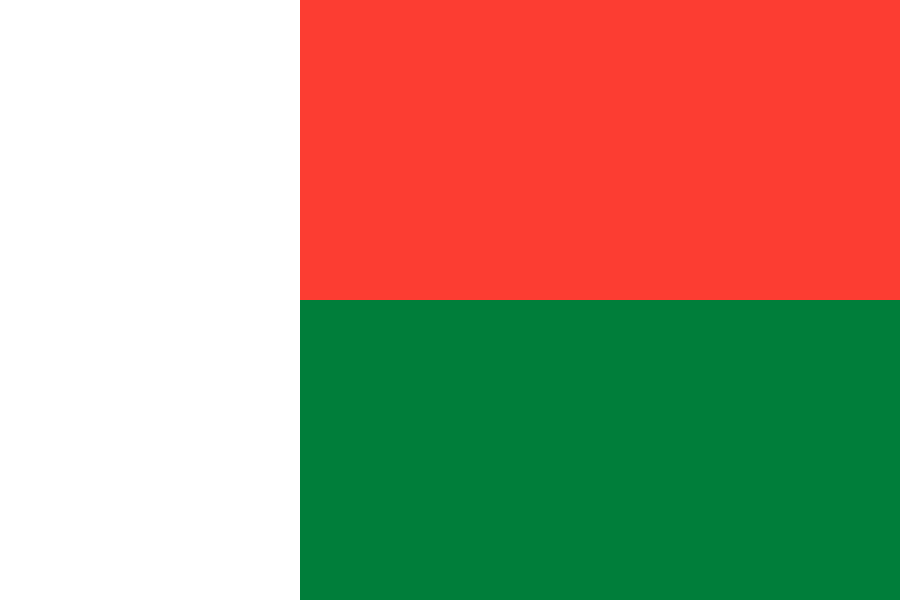
Malagasy feminist socialist leader of the 1972 student movement
From 24 April 1972 she advanced abolition of the 1960 Cooperation Agreement and Malgachisation as a 'second independence', which the 1972-1975 military government did not implement. Ranjanoro calls it a 'third independence', and the FAEM general secretaryship is disputed.
A feminist socialist born and raised in Madagascar, from a petit bourgeois family in which politics was considered a man's preserve. The Student Christian Movement (SCM-MPIKRIMA) exposed her to socialist ideas and politicised her. In 1972, a third-year student of Malagasy literature and language, she led the nationwide movement that began on 24 April as general secretary of the FAEM student federation, demanding abolition of the 1960 Cooperation Agreement and Malgachisation as a 'second independence'; on the night of 12 May she was arrested and detained on Nosy Lava. In Nairobi she led the WSCF 'Liberation' programme; in 1975 family life took her first to Geneva, and she returned to Nairobi in 1978 before moving to Canada after her husband's arrest and release. From 1991 in the UK, she headed UNIFEM's Africa section and retired in 2010.
Career timeline
1972Third-year student of Malagasy literature and language; FAEM general secretary and strike committee member
1972Arrested on the night of 12 May and detained on Nosy Lava
after 1972Programme officer at the WSCF Regional Office for Africa in Nairobi leading the 'Liberation' programme; commissioner of the World Council of Churches Programme to Combat Racism; founder and West Africa portfolio head at the Agency for Cooperation and Research for Development
1975–1991Via Geneva to Nairobi again in 1978; women's studies and French teaching in Canada before moving to the UK
2010Retired as Head of the Africa section at UNIFEM; since then an independent expert consultant