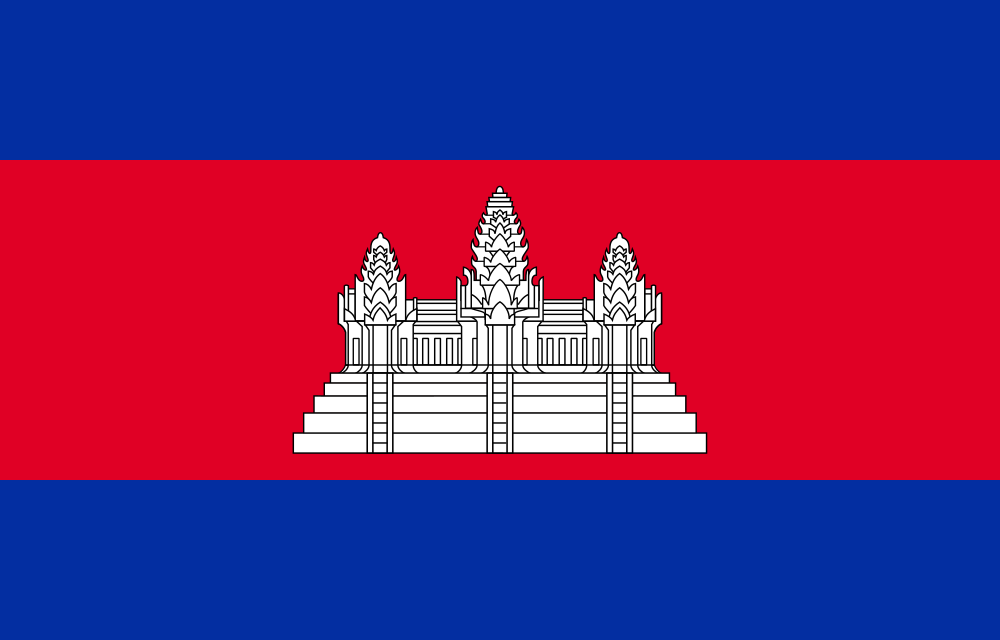
Convicted of genocide against the Cham and Vietnamese in November 2018, he died on 4 August 2019 while serving his sentence and his appeal was pending; the Supreme Court Chamber found no legal grounds to annul the judgment and let the trial findings stand.
Cambodian revolutionary and chief ideologist of the Communist Party of Kampuchea (Khmer Rouge), serving as its Deputy Secretary. Known as 'Brother Number Two' to Pol Pot, he chaired the People's Representative Assembly and briefly served as acting Prime Minister of Democratic Kampuchea. Convicted of crimes against humanity in 2014, he was given a life sentence on 16 November 2018 for genocide against the Vietnamese and Cham and grave breaches of the Geneva Conventions.
Career timeline
1960–1998Deputy Secretary and chief ideologist of the Communist Party of Kampuchea
1970Played a major role in negotiating North Vietnamese entry into Cambodia
1976–1979Chairman of the People's Representative Assembly of Democratic Kampuchea and briefly acting Prime Minister
1998Surrendered to Cambodian government forces in December
2007Arrested on 19 September
2014Sentenced to life for crimes against humanity in Case 002/01 on 7 August, upheld on appeal on 23 November 2016
2018Convicted in Case 002/02 on 16 November of genocide against the Cham and Vietnamese, with the life sentences merged into one
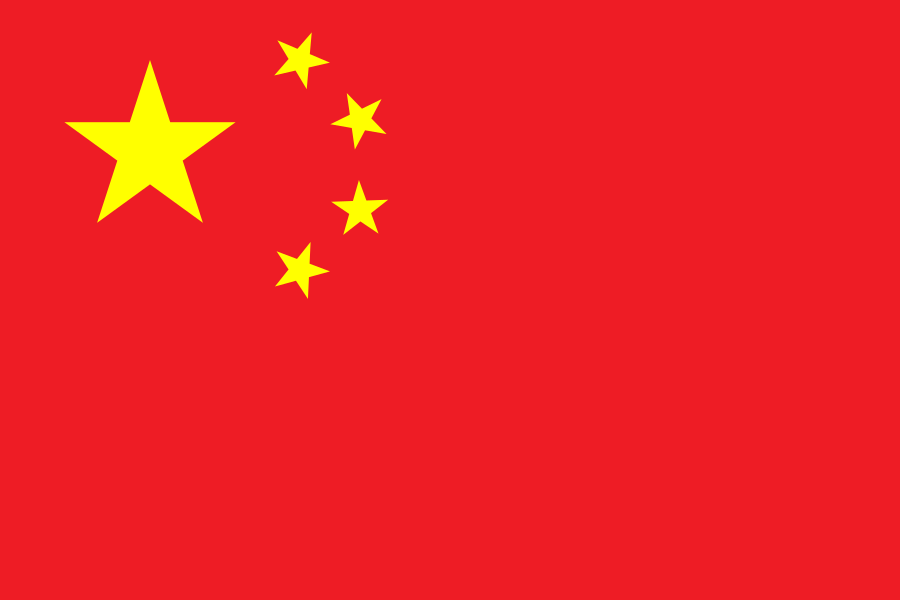
The “core” plucked from Shanghai in 1989 who led post-Tiananmen China into the market economy and the “Three Represents”
The compromise leader plucked from Shanghai after the 1989 Tiananmen crackdown, he became the "core" of the third generation and steered the party toward a market economy.
An electrical engineer from Jiangsu who trained at a Soviet car plant, he became mayor of Shanghai in 1985 and its party secretary in 1987. In 1989 he closed the liberal World Economic Herald and defused the Shanghai protests without major bloodshed, and in June was chosen to replace Zhao Ziyang as general secretary. After Deng Xiaoping’s southern tour in 1992 he made the “socialist market economy” the party’s goal and oversaw state-enterprise reform, WTO accession and the return of Hong Kong. Stepping down as general secretary in 2002 and Military Commission chairman in 2004, he left the “Three Represents”, which opened the party to private entrepreneurs. He died of leukaemia in 2022.
Career timeline
1989–2002General Secretary of the Central Committee
1993–2003President of the People’s Republic of China
A Belarusian party leader who combined agricultural development with late-Soviet reform
He called himself a “progressive conservative” who restrained innovation pursued merely for its own sake.
An agricultural specialist by training, Yefrem Sokolov rose through local administration and party work to become a practical leader of Soviet Belarus. He expanded the Brest region's productive infrastructure through large livestock complexes and road construction, receiving the title Hero of Socialist Labour in 1986. During perestroika he called for clearer ownership rules and wider republican economic authority, and ordered the publication of maps showing radioactive contamination in Belarus after the Chernobyl disaster, while describing himself as a progressive conservative wary of innovation for its own sake. He left the republican party leadership in 1990 and briefly served on the CPSU Politburo that year.
Career timeline
1944–1950Served in the Red Army's 5th Separate Reserve Sapper Regiment
1956–1958Agronomist and agricultural inspector in Brest Region
1958–1961Second secretary of the Ivanovo district party committee
1961–1965First secretary of the Urlyut yub district party committee and other posts in the Kazakh SSR
1969–1977Deputy head and head of the agricultural department of the Communist Party of Belarus Central Committee
1977–1987First secretary of the Brest Regional Party Committee
1987–1990First secretary of the Communist Party of Belarus Central Committee
1990Member of the CPSU Central Committee Politburo
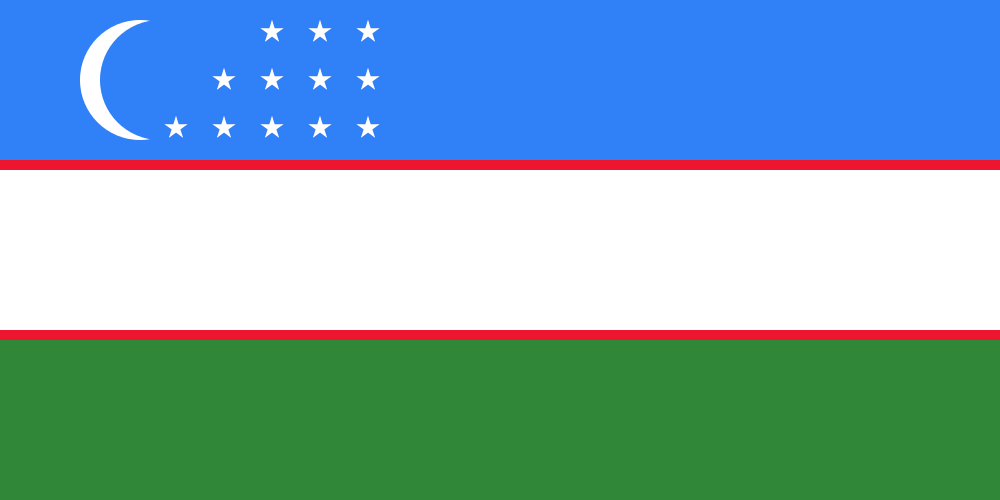
His name 'Rafiq' means 'comrade' in Arabic. When Gorbachev elevated him to chairman of the Soviet of Nationalities, Ukrainian Komsomol leader Valeriy Tsybukh dubbed him 'Gorbachev's personal Rafiq.'
Born the son of a farm laborer, he rose through the Tashkent city party and the republic foreign ministry to become First Secretary of the Uzbek Communist Party in 1988. Tasked with stabilizing the republic after the Rashidov cotton scandal, he earned Gorbachev's confidence and was elevated the following year to chairman of the Soviet of Nationalities. An Uzbek who reached the highest federal tier, he presided over the multinational Union's final parliament as the state itself dissolved around him.
Career timeline
1950s–1970sRises through Uzbek republic diplomatic and party administration
1986–1988First Secretary of the Uzbek Communist Party after Rashidov, managing the post-scandal republic
1989–1991Chairman of the Soviet of Nationalities, the last representative line during the Union’s collapse
1991His office disappears amid the August coup and dissolution of the Union
after 1991Lives in Russia after 1991 as a late-Soviet republic elite figure
The unknown Russian party functionary whose appointment to Kazakhstan ignited the Zheltoksan uprising
On 16 December 1986, the 5th Plenum of the Central Committee of the Communist Party of Kazakhstan in Almaty lasted just eighteen minutes. When Moscow's envoy Razumovsky announced Kunaev's dismissal and Kolbin's appointment, the hall fell into heavy silence.
Gennady Kolbin was a textbook Brezhnev-era party apparatchik who spent his career in the CPSU apparatus, but his 1986 appointment by Gorbachev as First Secretary of the Communist Party of Kazakhstan placed him unexpectedly at a historical watershed. An ethnic Russian from Nizhny Tagil with no prior connection to Kazakhstan, his installation (replacing the Kazakh Dinmukhamed Kunaev at an 18-minute plenum) triggered the Zheltoksan (December) uprising, when thousands of young Kazakhs poured into the streets of Alma-Ata in what became the first mass anti-Moscow protest of the perestroika era. After three turbulent years he was replaced by Nursultan Nazarbayev, recalled to Moscow to chair the Party Control Committee, and retired in 1990. He died of a heart attack on the Moscow Metro in 1998 and lay unidentified for five days.
Career timeline
1959–1962Second/First Secretary, Lenin District Committee, Nizhny Tagil
1962–1970Second/First Secretary, Nizhny Tagil City Committee
At the Čierna nad Tisou talks, watching Katushev argue the Soviet case, Czechoslovak National Assembly President Josef Smrkovský observed that he did so "with the toughness of two Molotovs put together."
A mechanical engineer from the Gorky Automobile Plant who rose rapidly under Brezhnev's patronage, becoming the youngest CC Secretary in 1968 at age 40. During the Prague Spring he handled Soviet negotiating work with the Czechoslovak leadership and went on to oversee relations with the entire socialist bloc. His sudden demotion to Deputy Premier in 1977 marked the end of his inner-circle career; after serving as ambassador to Cuba, he returned under Gorbachev as Minister of Foreign Economic Relations, managing the practical work of opening the Soviet economy. After the USSR's collapse he lived out a quiet retirement as a commercial bank executive.
Career timeline
1960sRises through Gorky regional and party economic-management work
1968–1977CC secretary handling industrial and economic coordination
1977–1982Deputy chairman of the Council of Ministers, involved in economic administration
1982–1985Works on Comecon and foreign-economic cooperation
1988–1991Minister of Foreign Economic Relations, managing trade and joint-venture opening during perestroika
Catholic intellectual of Solidarity who became the Eastern Bloc's first non-communist prime minister
We split away the history of our recent past with a thick line. We will be responsible only for what we have done to help extract Poland from her current predicament, from now on.
A Polish Catholic lay intellectual, he founded and edited the independent monthly Więź in 1958 and served in parliament from 1961 to 1971 as part of the Znak Catholic deputies' circle, practicing conscientious opposition within the system. He led Solidarity's board of experts during the Gdańsk strike of 1980, became the first editor of Tygodnik Solidarność, was interned for a year under martial law, and emerged as a key architect of the 1989 Round Table negotiations. On 24 August 1989 he was appointed prime minister, the first non-communist head of government in the Eastern Bloc in over forty years, and launched radical market reforms through the Balcerowicz Plan while declaring a 'thick line' separating the new government from the past. After losing the 1990 presidential election to Lech Wałęsa, he founded the Democratic Union and led it through the post-communist transition.
Career timeline
1958–1981Founds and edits the Więź monthly
1961–1971Sejm deputy, Znak Catholic circle
1980Heads Solidarity board of experts, Gdańsk strike
Architect of Khrushchev's reforms and pioneer of Soviet political science
"I was sure I could fly. Climbed a fence, spread my arms, flew… fell and dislocated my arm. It became the symbol of my life." — on defying authority
The theorist who established political science as an independent discipline in the USSR. He inserted the 'all-people's state' thesis into the 1961 Party Program and bridged reform communism from the thaw through perestroika.
Career timeline
1947Graduated Tashkent Juridical Institute
1951Candidate of Juridical Sciences, Institute of Law, USSR Academy of Sciences
1952–1960Scientific secretary, Presidium of the USSR Academy of Sciences, then editorial staff of Kommunist
1960–1964Head of consultant group, CC CPSU (under Andropov); co-author of 1961 Party Program and Moral Code
1964Doctor of Philosophical Sciences: 'The State and Communism'
1965–1967Political observer at Pravda with independent editorial voice
1967–1977Dismissed for anti-censorship article; banned from publishing 10 years, foreign travel 7 years
1969–1971Deputy Director, Institute of Sociological Research, USSR Academy of Sciences
1971–1989Head of Philosophy Department, Institute of Social Sciences, CC CPSU
1982–1991Political observer, then editor-in-chief (1990–1991) of Literaturnaya Gazeta
1989–1991People's Deputy from Soviet Peace Fund; member, Supreme Soviet Committee for International Affairs
The only Lithuanian to sit in the CPSU Politburo and the last pro-Moscow party leader, imprisoned for the January Events
In 2000, President Adamkus offered him a pardon; he refused: 'I am not guilty before the motherland.'
Born in Alytus, Lithuania, he worked as a labourer from 1942 before rising through the Communist Party apparatus to become, after the CPL split in 1989, the first secretary of the pro-Moscow Lithuanian Communist Party (CPSU platform). In opposition to the March 1990 declaration of independence, he appealed to Gorbachev for military intervention and led the National Salvation Committee, which provided the political cover for the Soviet assault on the Vilnius television tower in January 1991. Fourteen civilians died in the operation; he was arrested in Minsk in 1994 and sentenced in 1999 to twelve years for anti-state organization and complicity in murder. He refused a presidential pardon, declaring himself not guilty before his homeland, and was released on 13 January 2006.
Career timeline
1942–1944Carpenter and machinist in Udmurtia
1944–1955Komsomol and party work; graduated Vilnius Pedagogical Institute
1963–1976Senior researcher, Institute of Party History; professor, Vilnius Engineering-Building Institute
1976–1990Professor of scientific communism, Vilnius Pedagogical Institute
1990–1991First Secretary, CC, CPL (CPSU platform)
1990–1991Member, Politburo, CPSU Central Committee
1991–1994Fled to Belarus
1994–2006Arrested, sentenced to 12 years; released January 2006
A party leader who lost power while seeking compromise
In October 1981, the Central Committee removed Kania and elected Wojciech Jaruzelski as First Secretary.
Stanisław Kania was a leader of the Polish United Workers' Party who tried to manage the widening breach between party control and social demands. After the strikes of August 1980 and the rise of Solidarity, he pursued dialogue with the union and the Catholic Church, while distrust within the party and the economic crisis narrowed the room for compromise. Under pressure from the Soviet leadership, he left the post of First Secretary in October 1981, succeeded by Wojciech Jaruzelski. Tried over responsibility for the introduction of martial law, he was acquitted in 2012.
Career timeline
1945Joined the Polish Workers' Party
1948Delegate to the founding congress of the Polish United Workers' Party
1968–1971Head of the PZPR Central Committee Administrative Department
1971–1980Secretary of the PZPR Central Committee
1975–1981Member of the PZPR Politburo
1980–1981First Secretary of the PZPR Central Committee
The internationalist icon who traded a stethoscope for a rifle
“Create two, three, many Vietnams.” — Message to the Tricontinental, 1967
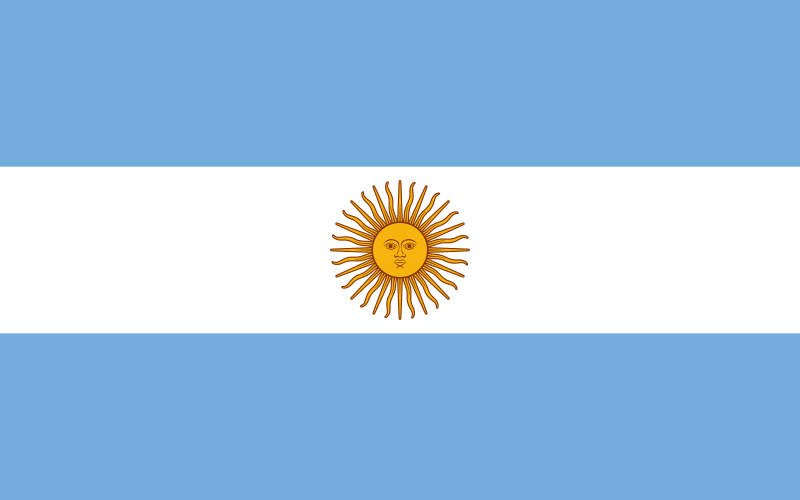
Argentine Marxist revolutionary. As a guerrilla comandante of the Cuban Revolution, he played a key role in overthrowing the Batista regime in 1959. He then devoted himself to the international revolutionary struggle, leading guerrilla campaigns in the Congo and Bolivia, where he was captured and executed in 1967.
Career timeline
1948–1953Medical student; the journeys across Latin America
1955Meets Castro in Mexico; joins the 26th of July Movement
1956–1959Guerrilla comandante; takes Santa Clara
1959–1965President of the National Bank; Minister of Industry
1960Published Guerrilla Warfare
1965–1967Guerrilla campaigns in the Congo and Bolivia
The premier who declared martial law in May 1989, called “the butcher of Beijing”; Zhou Enlai’s ward
An engineer who became premier in 1987, declared martial law in Beijing on 20 May 1989, and was the government official held responsible for the military crackdown of 3-4 June.
From Sichuan, he was raised under the protection of Zhou Enlai and his wife after the Nationalists executed his father in 1931. Trained in hydroelectric engineering at the Moscow Power Institute, he rose through the electricity ministry and succeeded Zhao Ziyang as premier in 1987. After the televised dialogue with student representatives collapsed on 18 May 1989 he declared martial law in Beijing on 20 May and was the government’s responsible official for the crackdown of 4 June. As premier he pushed through the Three Gorges Dam, and he chaired the National People’s Congress Standing Committee from 1998 to 2003. He died in 2019.
The agronomist who pushed a sovereignty declaration through the Soviet system and led Estonia out of the empire
Lukyanov warned him of a ten-year sentence for 'anti-constitutional activity.' Rüütel stood his ground: 'We will convene the Supreme Council and put the Declaration of Independence to a vote,' inadvertently saying 'Independence' instead of 'Sovereignty,' as he later recalled.
An agricultural economist from the Estonian island of Saaremaa, Rüütel rose through the Soviet system: rector of the Estonian Agricultural Academy, Communist Party functionary, and finally chairman of the Presidium of the Estonian SSR Supreme Soviet in 1983. On 16 November 1988, defying Moscow's threat of imprisonment, he pushed the Estonian sovereignty declaration through the legislature, opening the first crack in the Soviet edifice; in 1990, as chairman of the Supreme Council, he declared Soviet rule illegal and initiated the transition to restored independence. After independence he was elected president in 2001 and served until 2006, steering Estonia into NATO and the European Union.
Career timeline
1949–1950Senior agronomist, Saaremaa Executive Committee agricultural department
1955–1957Teacher, Tartu School of Agricultural Mechanization
1957–1963Senior zootechnician and director, experimental farm of the Veterinary and Animal Husbandry Research Institute
1963–1969Director, Tartu Reference State Farm
1969–1977Rector, Estonian Academy of Agriculture
1977–1979Secretary for agriculture, Central Committee of the Communist Party of Estonia
1979–1983First Deputy Chairman, Council of Ministers of the Estonian SSR
1983–1990Chairman, Presidium of the Supreme Soviet of the Estonian SSR
1990–1992Chairman, Supreme Council of the Republic of Estonia
Khalq strongman who engineered the Saur Revolution and fell to Soviet guns three months after seizing power
Amin ordered his adjutant to warn the Soviet advisers of the attack. The adjutant replied, 'It is the Soviets who are shooting.' Amin snatched an ashtray and hurled it at him, shouting, 'You're lying! That cannot be!'
Amin was the de facto number two of the PDPA's Khalq faction and the military architect of the April 1978 Saur Revolution. Drawn to Marxism while studying in the United States, he returned to Afghanistan and built a network of officers that made the coup possible, then climbed from deputy premier through foreign and defense ministries to become the regime's true strongman. In September 1979 he deposed and executed his mentor Nur Muhammad Taraki and seized the party leadership and all top state posts, but his brutal purges and the spreading insurgency convinced the Kremlin he was uncontrollable. On 27 December 1979 KGB special forces stormed the Tajbeg Palace and killed him, opening the Soviet-Afghan War.
Career timeline
1957–1965Studies at Columbia and Wisconsin, drawn to Marxism
1966Joins PDPA, sides with Khalq faction
1969Elected sole Khalq MP
1973–1978Party military organizer, builds officer network
1978.04Directs the Saur Revolution
1978–1979DPM → FM → PM → concurrent Defense Minister
1979.09Deposes Taraki, becomes General Secretary and head of state
1979.12.27Killed by Soviet special forces in Operation Storm-333
Gorbachev's agriculture successor who became his last internal critic
At a January 1989 Politburo session he snapped at Gorbachev: "I'm sick of these reorganizations of agriculture. If farming doesn't get priority, the program will fail. Isn't this clear to the Council of Ministers, the Politburo, and to you, Mikhail Sergeyevich?"»
An agronomist who served twelve years as First Secretary of the Mari ASSR, he inherited Gorbachev's agriculture portfolio as Central Committee Secretary in 1985. He fleshed out the farm revival program conceived under Andropov and backed Gosagroprom, the merger of six agricultural ministries. But he turned sharply critical when bureaucratic consolidation failed to fix production. After repeated Politburo confrontations with Gorbachev, he was removed from both the Politburo and Secretariat in September 1989 at age sixty.
Career timeline
1950–1958Chief agronomist at MTS, agricultural school instructor, Krasnoyarsk party organs
1961–1967Second Secretary, Tatar Oblast Committee
1967–1979First Secretary, Mari Oblast Committee
1979–1983Chairman of Soyuzselkhozkhimiya · Deputy Minister of Agriculture USSR
1983–1985Minister of Agriculture RSFSR
1985–1989Secretary of the Central Committee for Agriculture
The Parcham leader installed by the Soviet invasion who presided over seven years of war but never won legitimacy
"The Soviet comrades love me boundlessly, and for the sake of my personal safety, they don't obey even my own orders": the puppet president's confession to a friend about his gilded imprisonment.
Babrak Karmal was a founding member of the People's Democratic Party of Afghanistan (PDPA) and leader of its Parcham (Banner) faction, serving as deputy prime minister after the 1978 Saur Revolution before being purged by the Khalq faction and exiled as ambassador to Czechoslovakia. Dismissed from that post and hunted by an Afghan hit squad, he spent months hiding in a remote forest lodge under the protection of the Czechoslovak secret police until the Soviet invasion of December 1979 installed him as president. During his rule he attempted to broaden the regime's base through amnesties, a new tricolor flag, and a constitutional framework, but was widely dismissed as a Soviet puppet as the war against the mujahideen bogged down. In 1986 Mikhail Gorbachev engineered his removal; he spent his final decade in Moscow exile, dying of liver cancer in 1996.
Career timeline
1965Co-founded the PDPA, led the Parcham faction
1965–1973Member of Parliament
1978.04–06Deputy Chairman, Revolutionary Council
1978.07–09Ambassador to Czechoslovakia
1979.12–1986.11Chairman, Revolutionary Council; PDPA General Secretary
1979.12–1981.06Chairman of the Council of Ministers
The philosopher who gave perestroika its humanist foundations: from defending genetics to founding the science of Man
"I criticize the very concept of 'Party science.' Politics concerns only the philosophical interpretation of science, not the evaluation of science itself" — Genetics and Dialectics, 1968
A Marxist philosopher who dismantled Lysenkoism on philosophical grounds. As Gorbachev's advisor, he placed 'authentic humanism' at the core of perestroika and pioneered bioethics and the interdisciplinary study of Man. Served as Pravda editor-in-chief and Politburo member.
Career timeline
1953Graduated Philosophy Faculty, Moscow State University (silver medal)
1958Kandidat in philosophy — Determinism and Teleology
1965–1968Assistant to CPSU Central Committee Secretary for Ideology
1966Doctor of Philosophical Sciences — Problems of Biological Methodology
1968–1977Editor-in-chief, Voprosy Filosofii; publishes Genetics and Dialectics
1976Corresponding member of the USSR Academy of Sciences
1987Full Academician of the USSR Academy of Sciences
1986–1987Editor-in-chief, Kommunist; host of 'Philosophical Conversations' on Central TV
1987–1989Science, education and culture advisor to General Secretary Gorbachev
1989–1991Editor-in-chief, Pravda
1989–1990Secretary, CPSU Central Committee
1990–1991Member of Politburo, CPSU Central Committee
1991–1999Founding director, Institute of Man, Russian Academy of Sciences
The Arabist premier who turned his plane around over the Atlantic
"The first demonstration to the world that Russia cannot be spoken to from a position of strength" — Russian analysts on Primakov's Atlantic turnaround, March 1999
The USSR's leading Arabist and a pragmatist who spanned intelligence, diplomacy, and high politics. After serving as Pravda's Middle East correspondent, he directed IMEMO and the Institute of Oriental Studies, and became a candidate Politburo member in 1989. As head of the KGB First Chief Directorate in 1991 he founded Russia's SVR foreign intelligence service. As Foreign Minister he championed a multipolar 'Primakov Doctrine,' and as Prime Minister in 1999 he famously turned his plane back over the Atlantic upon learning of NATO's bombing of Yugoslavia.
Career timeline
1953–1962State Radio Arabic desk; researcher, IMEMO
1962–1970Pravda Middle East correspondent, based in Cairo
1970–1977Deputy director, IMEMO; secret Middle East missions
1977–1985Director, Institute of Oriental Studies, USSR Academy of Sciences
1985–1989Director, IMEMO; Academician, USSR Academy of Sciences
1989–1990Candidate Politburo member; Chairman, Soviet of the Union
1991Head, PGU KGB → Central Intelligence Service → SVR director
1996–1998Foreign Minister of Russia; Primakov Doctrine
1998–1999Prime Minister of Russia; Atlantic turnaround
Ideologue of Angolan liberation, MPLA founding member
In the 27 May 1977 Fractionism conflict, the Nitista faction's Thirteen Theses in my Defence accused Lara of being a 'social democrat' and leading the MPLA's alleged turn right. Responsibility for the ensuing mass purge is attributed to Lara and Iko Carreira under Neto's authority.
Full name Lúcio Rodrigo Leite Barreto de Lara, known by the war name Tchiweka; an Angolan revolutionary and physicist-mathematician, and a founding member and leader of the MPLA. He joined the Angolan Communist Party in 1955 and signed the MPLA's founding manifesto of December 1956, becoming its main ideologue and the figure credited with its Marxist-Leninist orientation. He was secretary of organisation and cadres from 1962 and secretary-general in 1964-65, promulgated the constitution and swore in Agostinho Neto as first president in November 1975, served as acting president of Angola from 10 to 20 September 1979 after Neto's death, and left public life in 2003 for health reasons. Historians and witnesses attribute responsibility for the mass purge that followed the 27 May 1977 Fractionism conflict to Lara and Iko Carreira under Neto's authority.
Career timeline
1949–1958Studied mathematics at the University of Lisbon, graduating in 1952, then entered the University of Coimbra in 1954 for physical chemistry, abandoning the course in 1958.
1955–1956Joined the Angolan Communist Party, active alongside the Portuguese Communist Party, and was a founding signatory of the December 1956 MPLA manifesto.
1959Fled PIDE political police pursuit from Lisbon, passing through West and East Germany, Italy, Tunisia and Morocco, and arranged the MPLA's first international office in Conakry.
1962–1965Elected secretary of organisation and cadres and Central Committee member at the first national conference in December 1962; secretary-general in 1964-65 and effective number two of the party from 1964.
1974–1975Led the first MPLA delegation into Luanda on 8 November 1974; promulgated the Constitution on 10 November 1975 and swore in Agostinho Neto as the country's first president.
1977–1985Re-elected to the MPLA Central Committee on 10 December 1977 as the second-ranking Political Bureau member after Neto and party vice-president, responsible for organisation and ideology; in 1985 José Eduardo dos Santos removed him from the Political Bureau, leaving him on the Central Committee.
1979Acting president of Angola from 10 to 20 September 1979 after Neto's death; convened the 2nd MPLA Congress on 11 September and worked for the election of José Eduardo dos Santos on 20 September.
1975–2003Was a member of the Angolan parliament from independence until 2003, resigning his legislative mandate in November 2003 for health reasons; the Ministry of Defence retired him as an army general in 2004, though he refused to use the rank.
The last ideology secretary who dismantled ideology opened the spetskhran and abolished party orthodoxy
In autumn 1988 he obtained Solzhenitsyn's works through the KGB. He admired One Day in the Life but dismissed Gulag Archipelago as mere polemic — then opened the spetskhran and returned Solzhenitsyn's published books to the open shelves.
A peasant's son from Yaroslavl, Medvedev earned a doctorate in economics from Leningrad University, rose through the propaganda and science departments, and became CC secretary in 1986 and Politburo member with the ideology portfolio in 1988. He repealed Zhdanov's 1946 crackdown on the journals Zvezda and Leningrad, abolished subscription limits on periodicals, and returned forbidden books, including works by Solzhenitsyn and Trotsky, from the spetskhran to open library shelves. He replaced CPSU history and scientific communism courses with 20th-century socio-political history and served on the commission re-examining Stalin-era repressions. A core Gorbachev intimate, he left all posts with the Soviet collapse and spent his remaining decades as a researcher at the Gorbachev Foundation.
Career timeline
1951–1968Graduates Leningrad University economics; professor, doctorate
1968–1970Secretary, Leningrad city party committee
1970–1978Deputy head, CC Propaganda Department
1978–1983Rector, CC Academy of Social Sciences
1983–1986Head, CC Science and Education Department
1986–1990CC Secretary, then Ideological Commission chair and Politburo member
1990–1991Member, USSR Presidential Council
1992–2025Researcher, Gorbachev Foundation and RAS Institute of Economics
Hungary's last old-guard party chief, caught between reform and retreat and overtaken by both
"If not, anarchy, chaos and — let there be no illusion — white terror will prevail" (29 Nov 1988)
Born to a working-class family in Miskolc, he joined the party at 14 and climbed steadily through the agitprop and regional apparatus to succeed János Kádár as General Secretary of the Hungarian Socialist Workers' Party in May 1988. Championing 'model change' (gradual reform within the communist framework), he soon revealed his limits: his November 1988 speech warning of 'white terror' showed a leader who misread the tempo of transformation entirely. The following year he was sidelined by the radical reform faction of Miklós Németh; after the party reconstituted as the Hungarian Socialist Party, he led its rump hardline successor but failed to win any seat in the 1990 election.
Career timeline
1945Joined Hungarian Communist Party at age 14
1954–1956Head of Agitprop, Borsod county party committee
1974–1979Head of HSWP Central Committee Agitprop Department
1984–1987First Secretary, Budapest Party Committee
1985–1989Member, HSWP Politburo
1987.06–1988.11Chairman of the Council of Ministers (Prime Minister)
1988.05–1989.10HSWP General Secretary, succeeded Kádár
1989.12–1990Acting chairman of refounded HSWP; lost 1990 election
A reform communist who sought to democratize socialism
Recalling a 1967 visit in which he laid his reform plans before his old roommate Gorbachev, Mlynář said: 'It seemed to me he understood very well what I was talking about.'
Zdeněk Mlynář was a Czechoslovak Communist politician and lawyer who sought to join socialism to democratic control and active citizenship. During the Prague Spring of 1968, he served as a Central Committee secretary, worked in Alexander Dubček's reform leadership, and helped shape the political and legal team that drafted the Action Programme. After the Warsaw Pact invasion he signed the Moscow Protocols, then confronted the limits of reform and the reality of occupation by resigning his posts and later leaving the party. He signed Charter 77 and emigrated to Austria, where he became a political scientist and an important interpreter of the Prague Spring.
Career timeline
1950–1955Studied law at Moscow State University
1955–1956Worked at the General Prosecutor's Office in Prague
1956–1968Researcher at the Czechoslovak Academy of Sciences Institute of State and Law
1967–1968Worked on political-system reform and the Action Programme
1968Central Committee secretary and Presidium member, Communist Party of Czechoslovakia
1970Expelled from the Communist Party; researched entomology at the National Museum
1977–1997After signing Charter 77, emigrated to Austria and taught political science at the University of Innsbruck
Brezhnev's foreign-affairs speechwriter who put détente into prose, then became its sharpest television commentator
At a party someone asked, 'Have you read Brezhnev's latest speech?' Bovin replied, 'What do you mean, read it? I wrote it.' The next day he was transferred to Izvestia.
The principal architect of Brezhnev-era foreign policy rhetoric, Bovin led the CPSU Central Committee International Department's consulting group (1963–1972) and personally drafted the prose of détente, peaceful coexistence, and arms control. His formulations became Brezhnev's official maxims. His skeptical stance on the 1968 Warsaw Pact intervention in Czechoslovakia led to his transfer from the Party apparatus to Izvestia, where over twenty years as political commentator and host of the weekly TV programme International Panorama he became the Soviet Union's most trusted voice on world affairs. Appointed the USSR's first ambassador to Israel in December 1991, he served one week as a Soviet envoy before continuing as Russia's ambassador until 1997.
Career timeline
1953–1956People's Judge, Khadyzhensk (youngest judge in the USSR)
1959–1963Scientific consultant, philosophy section, Kommunist journal
1963–1972Head of consultants, International Department, CC CPSU; Brezhnev speechwriter
1968Adviser to Soviet delegation at Čierna nad Tisou negotiations with Czechoslovakia
1970–1982Brezhnev speechwriter (continued unofficially after 1972 transfer)
1972–1991Political commentator, Izvestia; host of TV programme International Panorama
1981–1986Member, CPSU Central Auditing Commission
1991.12Soviet Ambassador to Israel (one week, then Russian Ambassador)
1991–1997Ambassador of the Russian Federation to Israel
1997–2000Returned to Izvestia as political commentator; TV and radio host
The chancellor who seized the initiative on the German question with a ten-point unification plan days before Malta
On 28 November 1989, Kohl rose in the Bundestag without having told his allies, or even his own foreign minister. President Bush received Kohl's letter summarizing the Ten-Point Plan just as the chancellor was already speaking in Bonn.
A Christian Democratic Union (CDU) politician who served sixteen years as chancellor of West Germany and reunified Germany, leading both European integration and German reunification. On 28 November 1989, without consulting his allies, he presented a 'Ten-Point Plan' for German unity to the Bundestag; days later, at the Malta summit, the German question dominated the proceedings on his terms. The following year, on 3 October 1990, Germany was reunified; together with French president François Mitterrand, Kohl drove the Maastricht Treaty and the introduction of the euro. He achieved reunification by extending the West German system into the former East, and after his long tenure ended with electoral defeat in 1998, he resigned as CDU honorary chairman amid a party donations scandal.
Career timeline
1959Elected to the Landtag of Rhineland-Palatinate (youngest member)
1969–1976Minister-President of Rhineland-Palatinate
1973–1998Chairman of the Christian Democratic Union (CDU)
1976–1982Leader of the CDU/CSU opposition in the Bundestag
1982–1998Chancellor of the Federal Republic of Germany
1989.11.28Presented the Ten-Point Plan for German unity to the Bundestag
1990.10.03Presided over German reunification
1998Defeated in federal elections; resigned as CDU chairman