Founder of the MFM, the left party of the 1972 student-revolution generation
As the MFM was at last admitted to the front, Ratsiraka declared, 'There is no longer any reason to exclude the MFM.'
A sociology professor at Madagascar's agricultural college, Rakotonirina entered politics through Monja Jaona's MONIMA and helped organize the May 1972 protests that brought down the Tsiranana regime. In December 1972 he founded the Maoist left party MFM (Militants for Power to the Little People), which championed the poor, peasants and slave-descendants; after Ratsiraka dissolved the party and placed him under house arrest in 1976, he brought the MFM into the FNDR the following year and as head of the CSR's economic commission managed the nationalized enterprises. He later turned to liberalism, led the 1991 pro-democracy movement, and in 2009 was arrested as the prime minister named by the exiled president.
Career timeline
1966Joined MONIMA
1968Head of MONIMA's Antananarivo section
1972Founded the MFM (27 December)
1977–1989CSR member, head of the economic commission
1989Second in presidential election (~20%)
1991–1993Co-president of the transitional recovery committee
1993–1998Member of the National Assembly (Manandriana)
Founder and chief ideologue of the Yemeni Socialist Party, he was South Yemen's de facto leader from 1978 to 1980 and died in the 1986 civil war.
A South Yemeni revolutionary leader central to the Yemeni Socialist Party’s formation in 1978. He left power in 1980 and stayed in the USSR, then returned and opposed Ali Nasir Muhammad. He died during the armed party conflict in 1986.
Career timeline
1963Co-founded the NLF and led its underground fedayeen in Aden
1967Minister of Culture, National Guidance and Yemeni Unity
1969NLF Central Committee Secretary-General, de facto leader
1971Chairman of the Presidium of the Supreme People's Council (head of state)
1978Founded the Yemeni Socialist Party, its first General Secretary
1979Signed the Treaty of Friendship and Cooperation with the USSR
1980Resigned all posts citing health, then moved to Moscow
1985Returned and rejoined the YSP Central Committee as Secretary
Before leaving he declared 'I have made too many concessions already. I will not make any more'; two months later the Aden civil war erupted.
After serving as South Yemen’s prime minister, he became party and state leader in 1980. He favored pragmatic adjustments in foreign relations and economic management, while conflict with Ismail’s faction intensified. He lost power after the 1986 Aden fighting and fled to North Yemen.
Career timeline
1969–1977Minister of Defense
1971–1985Prime Minister of the People's Democratic Republic of Yemen (South Yemen)
1978Chairman of the Presidential Council
1980–1986General Secretary of the Yemeni Socialist Party and Chairman of the Presidium of the Supreme People's Council
1986Ousted, fled to North Yemen
1994Mobilized his supporters on the Sana'a side in the civil war
Ethiopian Marxist leader of MEISON and drafter of the Derg's national-democratic program
His August 1977 arrest and subsequent disappearance mark the Derg's turn from the EPRP onto its own former MEISON collaborators. His death around 1979 is reported by several sources but unconfirmed in date and circumstance.
Ethiopian Marxist politician who led and chaired the All-Ethiopia Socialist Movement (MEISON). Born in Arjo, Welega (Oromia); he studied in France in the early 1960s, taking a Marxism closer to the Soviet model, and after the revolution began he returned and co-founded the Progressive Book Store with Negede Gobeze. In December 1975 the Derg secretly created the Provisional Office for Mass Organizational Affairs (POMOA) and made him chairman; he drafted the Program for the National Democratic Revolution, announced by Mengistu on 20 April 1976. He was captured outside Addis Ababa on 26 August 1977 and held in the Old Gebbi, and Human Rights Watch records that he disappeared after several months in prison. His reported death around 1979 remains unconfirmed in date and circumstance. Also known as Haile Fida Kuma, he is remembered as the 'Father of Qubee Afaan Oromo'.
Career timeline
1968Helped found MEISON at the 8th ESUE congress and organized and led the Oromo students' study group in Europe
1973Published the Oromo grammar Hirmaata Dubbi Afaan Oromoo in Paris, written in qubee
1974–1975Returned to Ethiopia and co-founded the Progressive Book Store with Negede Gobeze
1975.12Appointed chairman of the Derg's secretly created Provisional Office for Mass Organizational Affairs (POMOA)
1976.04Drafted the Program of National Democratic Revolution, whose adoption Mengistu announced on 20 April
1977.08Went underground with the MEISON leadership, was captured on 26 August and detained in the Old Gebbi
Sentenced to death by Ali Nasir Muhammad in the January 1986 clashes, he survived and rose to General Secretary of the Yemeni Socialist Party.
A South Yemeni revolutionary who led the People's Democratic Republic of Yemen through its final years as General Secretary of the Yemeni Socialist Party. An ally of Abdul Fattah Ismail, he survived the January 1986 fighting in Aden, and after Ali Nasir Muhammad's forces were defeated he took over the party and state. He became the first vice-president of unified Yemen in 1990, but resigned in 1993 and proclaimed the short-lived Democratic Republic of Yemen during the 1994 civil war; in exile he led the southern independence movement al-Hirak.
Career timeline
1963Joined the NLF and founded its local committee in Mukalla
1967–1969Minister of Defense
1978Elected Politburo member and Central Committee secretary at the YSP founding congress
1986–1990General Secretary of the YSP, South Yemen's last leader
1990–1993Vice-president of unified Yemen
1994President of the Democratic Republic of Yemen (21 May to 7 July), exiled to Oman after its failure
2009–Leader of the southern independence movement, al-Hirak
"Peace and stability in the SADC region are essential preconditions for our economic development and integration"
A FRELIMO leader and post-independence foreign minister, he succeeded Machel as president in 1986. He pursued the 1987 Economic Rehabilitation Program and later multiparty transition. The 1992 peace agreement marked a major turning point in ending war and rebuilding the economy.
Career timeline
1962Co-founded FRELIMO
1974Played a key role in negotiating the Lusaka Accord
1975Appointed Minister of Foreign Affairs
1986Became President and FRELIMO leader after Machel's death
The Georgian First Secretary who asked Moscow for troops, then resigned after 21 died
Patiashvili later recalled: 'Gorbachev phoned and said, in a tone that left no room for argument: The square must be cleared immediately, and the army will handle it. I understood he knew about the plan and supported it.'
He succeeded Shevardnadze as First Secretary of the Georgian Communist Party in 1985, but dismantled most of his predecessor's reform experiments and drove the opposition underground. In April 1989, facing independence protests sparked by the Abkhaz autonomy dispute, he asked Moscow to send troops and on 8 April convened the republic's Defence Council, which decided to disperse the demonstrators by force. Before dawn the next day, Soviet troops armed with sapper shovels and poison gas descended on unarmed civilians, killing 21; Patiashvili accepted responsibility and resigned within two weeks. He remained in Georgian politics, twice ran for president against Shevardnadze, and supported the 2003 Rose Revolution, though he later criticized Saakashvili.
Career timeline
1965–1973Komsomol posts in Georgia, rising to First Secretary
1973–1974First Secretary, Gori District Party Committee
1974–1985Secretary for Agriculture, CP of Georgia
1985–1989.04First Secretary, CP of Georgia
1989–1991Director, scientific-production association and research institute
1995Presidential candidate, runner-up to Shevardnadze
2000Presidential candidate, runner-up to Shevardnadze
Dissident
1939–1993
✕ Shot dead under disputed circumstances
The nationalist dissident who became Georgia's first democratically elected president
"All my life I was in the opposition and fought against the government. Now I am the government": said in an interview after becoming chairman of the newly elected Supreme Council, 1990.
Georgian philologist and dissident, son of the celebrated writer Konstantine Gamsakhurdia. In 1977 he co-founded the Georgian Helsinki Group with Merab Kostava, exposing Soviet human rights abuses to the world, and was repeatedly imprisoned. In April 1989, as co-leader of the Independence Committee, he organized mass peaceful demonstrations and hunger strikes in Tbilisi; the Soviet military's bloody crackdown on them decisively radicalized Georgian opinion toward independence. Leading the Round Table-Free Georgia coalition, he won the first multiparty elections in 1990 and was elected Georgia's first president in May 1991 with 87% of the vote, only to be overthrown in an armed coup seven months later, flee to Chechnya, and die under disputed circumstances in western Georgia in December 1993.
Career timeline
1954Founded the underground youth group Gorgasliani
1963–1977Lecturer in English, Tbilisi State University; researcher, Institute of Literature, Georgian Academy of Sciences
1977–1979Co-founded Georgian Helsinki Group; arrested, imprisoned, released after public recantation
1988–1990Co-chair, Society of St. Ilia the Righteous; co-leader of the Independence Committee
1990–1991Chairman of the Supreme Council of the Republic of Georgia
The Sąjūdis philosopher who launched the 2-million-signature campaign demanding Red Army withdrawal
After a long while of hesitation, I made up my mind to see 'what makes socialism.' After a few years it was absolutely clear.
Lithuanian philosopher and politician who taught philosophy at Vilnius University and edited the cultural journal Kultūros barai. He joined the Lithuanian Communist Party in 1973 but broke with it during perestroika; as a founding member of Sąjūdis (1988), he became the movement's theorist and launched a 2-million-signature campaign demanding the withdrawal of the Red Army from Lithuania. He was a central figure in the trilateral planning of the Baltic Way with the Estonian and Latvian popular fronts, and served as deputy prime minister (1990–1991) in the Landsbergis-Prunskienė cabinet. After independence he founded the Lithuanian Centre Union, served in the Seimas (1992–2000), and opposed EU membership as a surrender of sovereignty.
Career timeline
1957–1962Studied philosophy, Vilnius University
1965–1968Editor, Kultūros barai journal
1973–1989Lecturer in philosophy, Vilnius University
1988–1990Founding member and council member, Sąjūdis
1989–1990People's Deputy, USSR Congress of People's Deputies
1990–1991Deputy Prime Minister of the Republic of Lithuania
A Moscow party organizer at the Soviet Union's end
His life, he later recalled, was divided into a before and after the Communist Party ban.
Yuri Prokofyev was a Soviet party cadre who rose through Moscow's party and administrative organizations. As first secretary of the Moscow City Party Committee, he worked at the point where reform collided with the party's disintegration, and joined the Politburo in 1990. He was involved in the activity of the State Committee on the State of Emergency in 1991 without being a member, then turned to memoir writing and technology enterprises after the Soviet Union and the Communist Party were banned.
Career timeline
1957Pioneer leader at a Moscow school
1960Joined the Communist Party of the Soviet Union
1968Cadre in the Moscow City Party Committee's organizational work
1977–1985Secretary and first secretary of the Kuibyshev District Party Committee in Moscow
1986–1988Secretary of the Moscow City Executive Committee
1988–1989Secretary and second secretary of the Moscow City Party Committee
1989–1991First secretary of the Moscow City Party Committee
1990–1991Member of the CPSU Central Committee and Politburo
Kazakhstan's thirty-year ruler, defender of the union to its last day
On 8 December 1991 Yeltsin's side telephoned from the Belovezha forest urging him to join; he did not turn his plane. Eight days later his Kazakhstan became the last republic to declare independence, and the union's formal death certificate, the Alma-Ata Protocol, was signed in his capital.
Starting as a blast-furnace worker, Nazarbayev rose through the Kazakh premiership and party first secretaryship to become president of Kazakhstan in 1990, and at Novo-Ogaryovo was the strongest advocate of the new union treaty. Absent from the Belovezha Accords, his Kazakhstan became the last republic to declare independence from the USSR. Ruling for nearly thirty years thereafter, he laid the foundations of the new state through nuclear renunciation, the transfer of the capital and pragmatic multi-vector diplomacy, while leaving behind the charges of authoritarian rule, a personality cult and dynastic corruption. He kept real power after leaving the presidency in 2019, until the unrest of January 2022 ended his era completely.
Career timeline
1960–1969Worker at the Karaganda Metallurgical Combine (blast furnace, casting machines, dispatcher, gasman). Joined CPSU in 1962. Graduated from the Higher Technical School at the Karaganda Metallurgical Combine in 1967.
1969–1973Party and Komsomol work in Temirtau.
1973–1978Secretary of the Party Committee, Karaganda Metallurgical Combine — effectively second-in-command at the 30,000-worker enterprise.
1978–1979Secretary, then Second Secretary, Karaganda Regional Party Committee.
1979–1984Secretary of the Central Committee of the Communist Party of Kazakhstan (industry, transport, communications).
1984–1989Chairman of the Council of Ministers of the Kazakh SSR (Prime Minister). At 44, the youngest head of government of any Soviet republic.
1989–1991First Secretary of the Central Committee of the Communist Party of Kazakhstan. Concurrently President of the Kazakh SSR from 1990. Member of the CPSU Politburo, 1990–1991.
1990–2019President of Kazakhstan (first elected April 1990 as President of the Kazakh SSR; first president after independence, December 1991). Re-elected 1991, 1999, 2005, 2011, 2015. Resigned March 2019.
A politician who moved from Soviet party leadership to Moldova's presidency
In the 1996 runoff, backed by left and centrist forces, he defeated Mircea Snegur to win the presidency.
Pyotr Luchinsky rose through the party apparatus of the Moldavian Soviet republic and became a link between late Soviet republican politics and the making of the independent Moldovan state. He became first secretary of the Communist Party of Moldova's Central Committee in 1989 and served on the CPSU Politburo from 1990 to 1991. After independence, he was ambassador to Russia and speaker of parliament before winning the 1996 presidential election and serving as Moldova's second president from 1997 to 2001. His career shows how Soviet institutional continuity and the adjustment of a new state's sovereignty and foreign orientation could converge in one politician.
Career timeline
1960–1971Instructor, department head, secretary and first secretary of the Moldavian Leninist Komsomol Central Committee
1971–1976Secretary of the Communist Party of Moldova Central Committee and member of its Politburo
1976–1978First secretary of the Communist Party's Chișinău City Committee
1978–1986Deputy chief of a department of the CPSU Central Committee
1986–1989Second secretary of the Communist Party of Tajikistan Central Committee
1989–1990First secretary of the Communist Party of Moldova Central Committee
1990–1991Secretary of the CPSU Central Committee and member of its Politburo
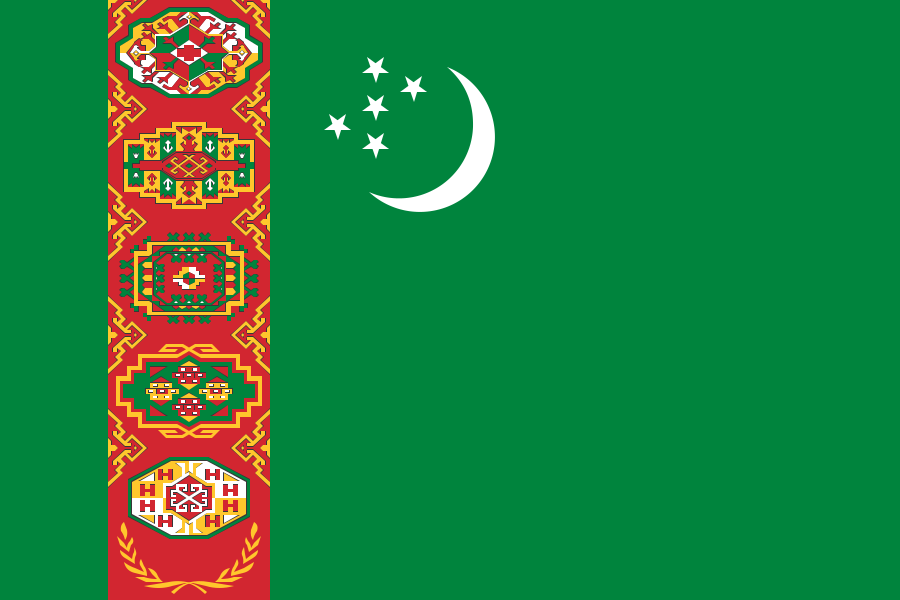
A Turkmen leader who turned late-Soviet rule into personal rule over an independent state
At the 1991 9+1 meetings, he weighed a reworked union against preserving Turkmenistan’s autonomy.
Saparmurat Niyazov was the Soviet-era party and government leader who became independent Turkmenistan’s first president. He led the Turkmen delegation in the 9+1 meetings during the 1991 New Union Treaty process, while the republic’s guarded autonomy limited his role in the negotiations themselves. After independence he invoked neutrality and state sovereignty while concentrating power in the presidency and using the Ruhnama and an extensive personality cult to organize public life. His rule remains a case of post-Soviet state formation fused with authoritarian consolidation.
Career timeline
1962Joined the Communist Party of the Soviet Union
1970–1980Cadre in the Communist Party of Turkmenistan Central Committee
1980–1984First Secretary of the Ashgabat City Party Committee
1985Chairman of the Council of Ministers of the Turkmen SSR
1985–1991First Secretary of the Communist Party of Turkmenistan
1990–1991Chairman of the Supreme Soviet of the Turkmen SSR
1990–2006President of Turkmenistan
1991Head of Turkmenistan’s delegation at the 9+1 New Union Treaty meetings
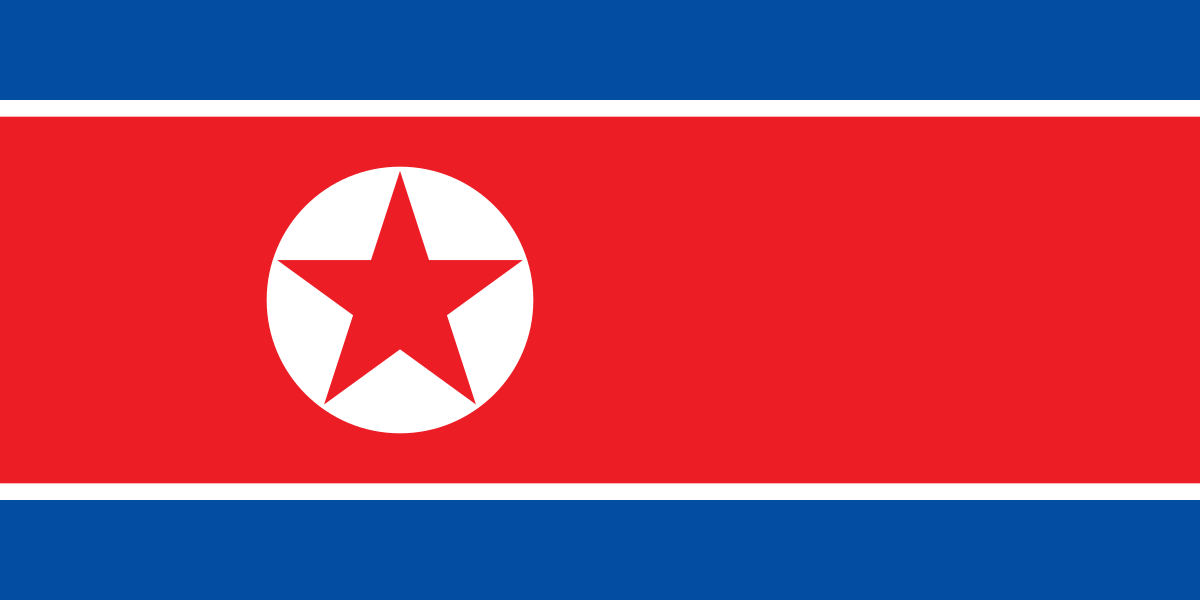
The successor between a Soviet birth record and the Paektu myth
One sentence at the 25 April 1992 military parade: "Glory to the heroic soldiers of the Korean People's Army!" — his only recorded public utterance in 17 years of rule.
Consolidated as successor from the 1970s, he inherited power after Kim Il Sung's death in 1994 and led the DPRK for 17 years through post-Soviet isolation, economic crisis, and the nuclear confrontation with the United States.
Career timeline
1941 or 1942Divergent Soviet and DPRK birth narratives
1964–1974Rose through the Workers’ Party Central Committee
1980Consolidated as successor at the Sixth Party Congress
1991–1994Supreme Commander and prepared succession to state power
The dissident architect who walked out of a Soviet prison camp and opened Estonia's political road to independence
On 23 August 1987 at noon, Hirvepark stood empty until the stroke of twelve, when two to five thousand people suddenly filled it. Parek recalled: 'Unbelievable! Something had to be done.'
The daughter of an Estonian officer, she was deported to Siberia at seven and spent four years in exile. Working as an architect, she was arrested in 1983 for anti-Soviet samizdat activity and imprisoned for four years; seven months after her release she co-founded the MRP-AEG and organised the Hirvepark rally of August 1987. That rally became the starting point of the Baltic independence movement, and the following year she was elected chair of the ERSP, Estonia's first non-communist party. After independence she served as interior minister in the first post-Soviet government, resigning in the 1993 Pullapää crisis, and later converted to Catholicism, living at Pirita Convent while leading the drive to build a memorial to the victims of Stalinism.
Career timeline
1963–1983Worked as an architect at design institutes in Tallinn and Tartu
1983–1987Arrested for anti-Soviet agitation, imprisoned in Dubravlag women's political section
1987Co-founded the MRP-AEG, organised the Hirvepark rally
1988–1992Chair of the Estonian National Independence Party (ERSP)
1990–1992Member of the Congress of Estonia
1992Presidential candidate, fourth place with 4.3% of the vote
1992–1993Minister of the Interior of Estonia (Mart Laar cabinet)
1997–Co-founder and head of Caritas Eesti; resident at Pirita Convent
An Estonian communist leader who chose to preserve the Soviet Union
In 1991, as Estonian independence approached, he joined the Politburo while backing the Soviet Union.
Lembit Annus was a Moscow-aligned Estonian communist leader who stood at the centre of the late Soviet conflict over national independence and preserving the Union. From December 1990 until the party was banned in August 1991, he was First Secretary of the Communist Party of Estonia on the CPSU platform, and in 1991 he joined the CPSU Politburo. After the party's dissolution, he remained active in communist politics as a Pravda correspondent and Tallinn municipal councillor.
Career timeline
1941Born in Kohtla-Järve, Estonian SSR
1963Joined the Communist Party of the Soviet Union
1983–1989Editor-in-chief of Eesti Kommunist
1990First Secretary of the Kalinin District Committee of the Communist Party of Estonia
1990–1991First Secretary of the Communist Party of Estonia on the CPSU platform
1991Member of the CPSU Politburo
1991–1999Estonia correspondent for Pravda and Tallinn City Council member
In his diploma performance as Hitler, Gubenko poured all his hatred for the man who killed his parents into the role. Lyubimov saw it and immediately brought him to the Taganka Theatre.
An actor and film director who rose from war orphan to People's Artist of the RSFSR. He was the first working arts professional to become Soviet Minister of Culture (1989–1991) since Anatoly Lunacharsky. After the USSR collapsed, he entered left-wing politics, serving as chair of the Duma's Culture Committee and deputy speaker of the Moscow City Duma, where he defended Soviet cultural heritage. Following the Taganka Theatre split, he founded and led the Sodruzhestvo Aktyorov Taganki until his death in 2020.
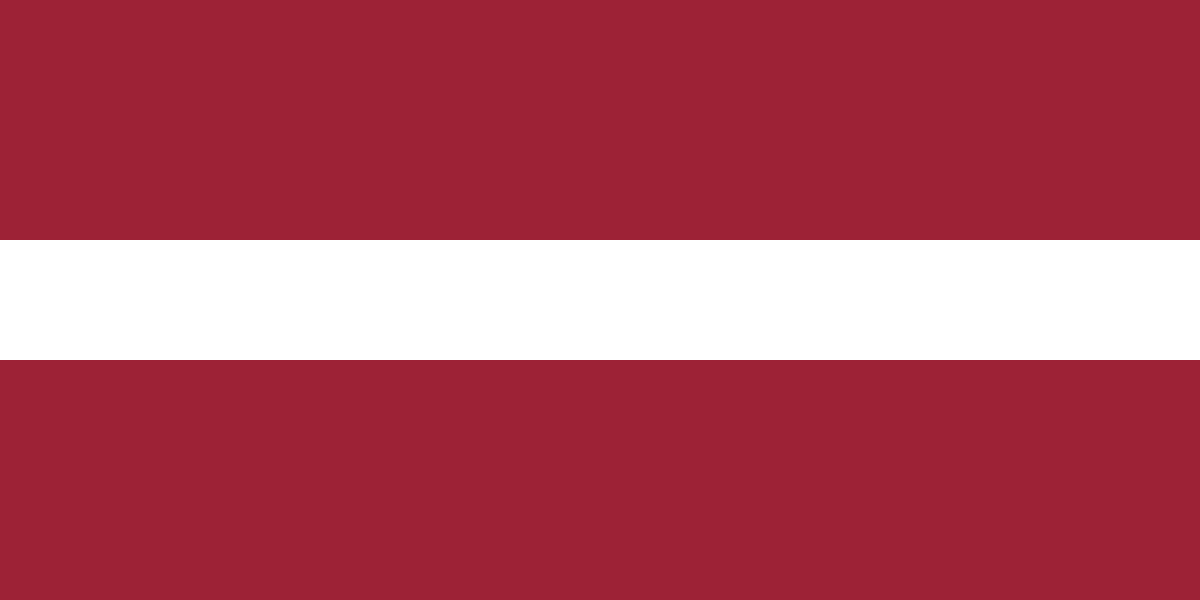
The Communist Party secretary who led Latvia's Supreme Council through the restoration of independence
On 14 January 1991, General Kuzmin's ultimatum to the chairman of the Supreme Council was simple: repeal the laws Latvia had adopted, or the army would act. Gorbunovs did not repeal them, and a week later flew to Moscow to face Gorbachev.
A farmer's son from Pilda in eastern Latvia, he graduated from construction college, Riga Polytechnical Institute, and the Moscow Academy of Social Sciences, then rose through the Latvian Communist Party apparatus to become Central Committee secretary for ideology. He broke with the party's hard line in 1988 by backing the Latvian Popular Front, and as Chairman of the Supreme Council presided over the 4 May 1990 session that declared the Soviet Union an occupying power and began the transition to restored independence. During the January 1991 Barricades he stood firm against General Kuzmin's ultimatum, then flew to Moscow on 21 January to confront Gorbachev directly.
Career timeline
1959–1965Technician at Nīkrāce state farm, employee at Riga Agricultural Engineering Institute, Soviet Army service
1970–1974Senior lecturer at Riga Polytechnical Institute, Kirov district Komsomol first secretary
1974–1988Various posts in the Latvian Communist Party Central Committee, rising to secretary for ideology
1988–1990Chairman of the Presidium of the Supreme Soviet of the Latvian SSR
1990–1993Chairman of the Supreme Council of the Republic of Latvia, acting head of state after independence
1993–1995Speaker of the 5th Saeima
1995–2002Deputy Prime Minister, Minister for Environmental Protection and Regional Development, Minister for Transport
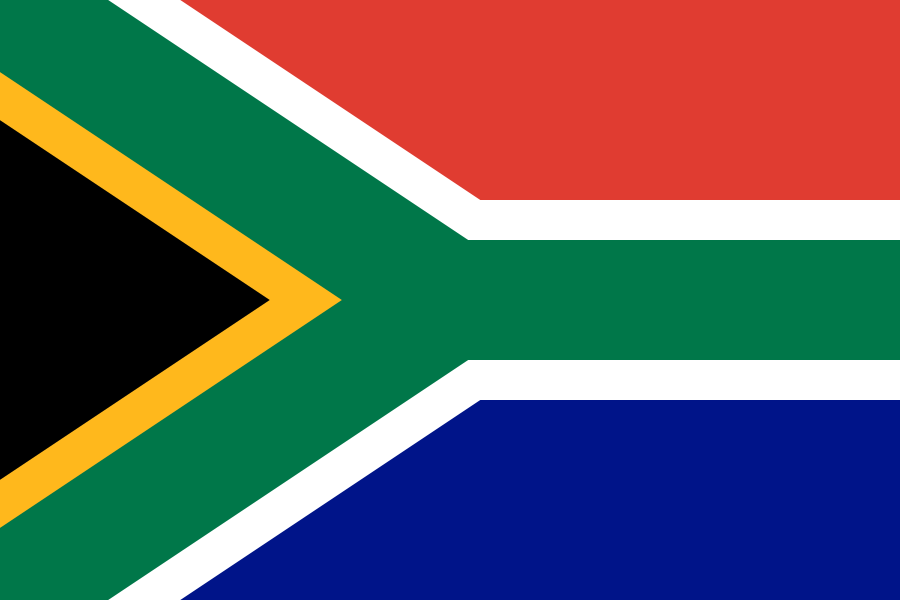
The SACP leader who kept the revolutionary flame alive after laying down arms
“We are negotiating to create better conditions for socialism. I am a communist.” — Interview shortly before his assassination, 1993
General Secretary of the South African Communist Party and Chief of Staff of Umkhonto we Sizwe, he led the left wing of the liberation movement from armed struggle through the turn to negotiations. His assassination by a far-right immigrant in 1993 nearly derailed South Africa's democratic transition, but instead galvanized the final agreement on the 1994 elections.
Career timeline
1957Joined ANC Youth League at age 15
1959–1961Studied English, Latin and classics at Fort Hare University
1961Joined the South African Communist Party
1962Joined Umkhonto we Sizwe (MK)
1963Arrested; fled to Lesotho; adopted the name Chris
1967–1969Zimbabwean War of Liberation: joint MK-ZIPRA operations
1969Co-signed the 'Hani Memorandum' criticizing ANC/MK leadership
1974Elected to ANC National Executive Committee
1982MK Chief of Staff; directed guerrilla operations from Lusaka
1990Returned permanently to South Africa after ANC unbanning
1991.12Elected SACP General Secretary, succeeding Joe Slovo
1993.04.10Shot dead outside his Boksburg home by a far-right immigrant
Yemeni socialist politician and advocate of unity and pluralism
On 28 December 2002 he was shot dead in Sanaa minutes after addressing the Islah party's conference; he was deputy secretary-general of the Yemeni Socialist Party.
Born in 1942 in the village of Kuhal in Yemen's Ibb province, he studied Islamic law in Dhamar and Sanaa and took part in the defence of Sanaa during the seventy-day siege. He helped found the Yemeni Revolutionary Democratic Party in 1968, was imprisoned for three years after the events of August 1968 in Sanaa, moved to Aden in 1971 and was elected to the Politburo in 1972. A founder of the Yemeni Socialist Party in 1978, he served as minister of culture and tourism in unified Yemen and became a leading advocate of human rights, political pluralism and the opposition coalition.
Career timeline
1960Joined the Arab Nationalists' Movement
1968Co-founder and Central Committee member, Yemeni Revolutionary Democratic Party
1972Elected to the Politburo of the Yemeni Socialist Party
1978Founding member of the Yemeni Socialist Party
1993Minister of culture and tourism of unified Yemen
2002Deputy secretary-general of the Yemeni Socialist Party
Took over as president after Neto's death in 1979 and remained in office until 2017. He led the first round of the 1992 multiparty election, but no runoff was held, and the civil war ended after Savimbi's death in 2002.
He succeeded Neto as Angolan president in 1979. Educated in the USSR, he had served as planning minister. He led the MPLA state amid civil war and oil dependence and favored a pragmatic approach recognizing a role for private enterprise.
Career timeline
1961Joined the MPLA amid colonial repression; went into exile in Congo-Brazzaville
1975First minister of foreign affairs after independence
1978First deputy prime minister and minister of planning
1979Elected MPLA president; became president of Angola
1980President of the one-party People's Assembly
1992Elected president in multiparty election, defeating Savimbi
The engineer who became the first person in Soviet history to run against a sitting General Secretary
At the First Congress in May 1989, he stood before the microphone and offered himself as a candidate against Gorbachev. 'To set a precedent,' he said. By 1,415 to 689, the assembly voted to keep his name off the ballot.
Born in Oryol in 1943, Obolensky was a geophysical engineer who spent twenty years at the Polar Geophysical Institute on the Kola Peninsula, where in 1987 he founded the first informal reform group in the region, the Voluntary Society for Assistance to Perestroika. Elected a People's Deputy of the USSR in 1989, he made history at the First Congress by putting forward his own candidacy for Chairman of the Supreme Soviet against Mikhail Gorbachev: the first alternative candidacy against a sitting General Secretary in Soviet history. After the August 1991 coup attempt, he was elected chairman of the parliamentary commission investigating it, and he opposed the dissolution of the USSR, regarding the Belovezha Accords as unconstitutional.
Career timeline
1960–1965Lathe operator in Oryol; Soviet Army service in East Germany
1971Graduated Leningrad Mining Institute, geophysical engineering
1971–1992Engineer and design engineer, Polar Geophysical Institute, Kola Science Centre
1987–1989Founded and chaired the Voluntary Society for Assistance to Perestroika (DOSP) in Apatity
1989–1992People's Deputy of the USSR (Leningrad Rural District No. 20)
1990–1994Co-chairman, later chairman, Social Democratic Party of Russia (SDPR)
1991Chairman, Parliamentary Commission investigating the August coup attempt
1993–1996President and editor-in-chief, TeleRadioCorporation Vostok, Oryol
Our country will not be totally independent until our people are free of the yoke of poverty.
A military leader of the Congolese Labour Party who became president in 1979 after serving as defense minister. He led the one-party state and oil-financed development. The 1991 National Conference and multiparty transition changed the power structure of his first presidency.
Career timeline
1968Took part in the coup that brought Ngouabi to power; founding member of the National Revolution Council
1973Director of State Security
1975Minister of Defense and Security (aged 32)
1977First vice-president of the PCT Military Committee
1979President of the People's Republic of Congo
1986–1987Chairman of the Organization of African Unity
1997Returned to power in the Second Civil War; sworn in as president
2002Won the presidency under the new constitution (89.4%)
Scientist-president who moved from reformist promise to prolonged rule
At the Supreme Soviet session on 26 August 1991, Akayev declared the draft Union Treaty 'unacceptable' and demanded a confederal revision.
A physicist and former president of Kyrgyzstan's Academy of Sciences, Akayev was elected the republic's first president in 1990 as an outsider to the senior party apparatus. Amid late-Soviet ethnic conflict and demands for sovereignty, he promoted pluralism and market reform, then quickly condemned the 1991 coup attempt and led Kyrgyzstan toward independence. At the Novo-Ogaryovo negotiations he put republican sovereignty first, calling the August treaty draft unacceptable and demanding a revision closer to confederation. His later rule brought extended presidential terms, family-centered politics and corruption allegations, ending in his overthrow during the 2005 popular protests.
Career timeline
1967–1988Researcher and professor, Frunze Polytechnic Institute; head of computer engineering
1987–1989Vice-president, Academy of Sciences of the Kirghiz SSR
1989–1990President, Academy of Sciences of the Kirghiz SSR
1990.10–1991.08President of the Kirghiz SSR
1991.08–2005.03President of Kyrgyzstan
1991.08.26At the Supreme Soviet, opposed the New Union Treaty draft and demanded a confederal revision
2005–presentProfessor and researcher at Moscow State University, based in Russia