Agrarian leader who opposed communist rule and was hanged after a show trial
State Department emissary Mark Ethridge called Petkov "the bravest man I've ever known."
A leader of the Bulgarian Agrarian National Union (BZNS), he studied law in Paris after the First World War and returned in 1929 to work as a journalist. He co-founded the anti-fascist Fatherland Front in 1943 but broke from it in 1945 to lead the opposition against the Communists' monopolisation of power, and in the 1946 election his opposition coalition won 101 seats in the Grand National Assembly. Arrested in parliament in June 1947 and sentenced to death in August for a supposed military plot, he was hanged on 23 September, eight days after the Paris peace treaty came into force.
Career timeline
1929Returned and worked as a journalist
1938Elected to the 24th National Assembly (invalidated that December)
1941Leader of BZNS 'Aleksandar Stamboliyski'
1943Helped found the Fatherland Front
1944Minister without portfolio in the first Fatherland Front government (to Aug 1945)
1945Leader of the anti-communist United Opposition
The only Prague Spring leader who refused to sign the Moscow Protocol
In Moscow, standing before Brezhnev, Kriegel said: 'Send me to Siberia or shoot me dead. I will not sign.'
Czechoslovak communist politician and physician. He served as a doctor with the International Brigades in the Spanish Civil War, then rose to become a KSČ Presidium member and chairman of the National Front during the 1968 Prague Spring, where he was among the most radical reformers. Arrested with Dubček on 21 August and deported to Moscow, he was the only one of twenty-six Czechoslovak politicians who refused to sign the Moscow Protocol. Expelled from the party and stripped of his medical license, he became a dissident and was among the first to sign Charter 77 in 1977.
Career timeline
1931Joins the KSČ
1936–1939International Brigades doctor, Spanish Civil War
1940–1945Military doctor, China-Burma front
1949–1952Deputy Minister of Health
1964–1968National Assembly deputy → KSČ CC member
1968.04–08National Front chairman & KSČ Presidium member
1968.08Refuses to sign the Moscow Protocol
1969–1977Expelled from party; first Charter 77 signatory
Yugoslav dissident who attacked Western communist parties at the Cominform and later dissected the communist system in The New Class
I traveled the entire road of communism: from a youthful revolutionary, to a zealous Stalinist, to complete disillusionment.
A Montenegrin-born Yugoslav communist leader and one of Tito's closest comrades in the Partisan struggle and postwar state-building. At the founding conference of the Cominform in 1947, he joined Edvard Kardelj in delivering the sharpest criticism of the French and Italian Communist Parties for their 'parliamentary opportunism,' and his memoirs remain a key source on the conference's internal dynamics. After raising demands for democratization within the party and denouncing bureaucratic privilege, he was stripped of all positions in 1954; his book The New Class, smuggled out of prison, argued that communist party officials had become a new exploitative ruling class, sparking an international sensation. He spent over three decades in prison and under surveillance, becoming the first prominent dissident in communist Eastern Europe.
Career timeline
1932–1936KPJ activist, arrested and imprisoned
1937–1939Member of KPJ Central Committee and Politburo
1941–1945Led Partisan uprising in Montenegro, headed propaganda for Supreme Staff
1945–1953Vice President of Yugoslavia, President of the Federal Assembly
1953–1954Published critiques of one-party rule in Borba, expelled from the party
1956–1966Imprisoned twice for dissident writings; published The New Class and Conversations with Stalin abroad
1966–1995Lived under surveillance in Belgrade, continued writing until his death
Catholic intellectual of Solidarity who became the Eastern Bloc's first non-communist prime minister
We split away the history of our recent past with a thick line. We will be responsible only for what we have done to help extract Poland from her current predicament, from now on.
A Polish Catholic lay intellectual, he founded and edited the independent monthly Więź in 1958 and served in parliament from 1961 to 1971 as part of the Znak Catholic deputies' circle, practicing conscientious opposition within the system. He led Solidarity's board of experts during the Gdańsk strike of 1980, became the first editor of Tygodnik Solidarność, was interned for a year under martial law, and emerged as a key architect of the 1989 Round Table negotiations. On 24 August 1989 he was appointed prime minister, the first non-communist head of government in the Eastern Bloc in over forty years, and launched radical market reforms through the Balcerowicz Plan while declaring a 'thick line' separating the new government from the past. After losing the 1990 presidential election to Lech Wałęsa, he founded the Democratic Union and led it through the post-communist transition.
Career timeline
1958–1981Founds and edits the Więź monthly
1961–1971Sejm deputy, Znak Catholic circle
1980Heads Solidarity board of experts, Gdańsk strike
A reform communist who sought to democratize socialism
Recalling a 1967 visit in which he laid his reform plans before his old roommate Gorbachev, Mlynář said: 'It seemed to me he understood very well what I was talking about.'
Zdeněk Mlynář was a Czechoslovak Communist politician and lawyer who sought to join socialism to democratic control and active citizenship. During the Prague Spring of 1968, he served as a Central Committee secretary, worked in Alexander Dubček's reform leadership, and helped shape the political and legal team that drafted the Action Programme. After the Warsaw Pact invasion he signed the Moscow Protocols, then confronted the limits of reform and the reality of occupation by resigning his posts and later leaving the party. He signed Charter 77 and emigrated to Austria, where he became a political scientist and an important interpreter of the Prague Spring.
Career timeline
1950–1955Studied law at Moscow State University
1955–1956Worked at the General Prosecutor's Office in Prague
1956–1968Researcher at the Czechoslovak Academy of Sciences Institute of State and Law
1967–1968Worked on political-system reform and the Action Programme
1968Central Committee secretary and Presidium member, Communist Party of Czechoslovakia
1970Expelled from the Communist Party; researched entomology at the National Museum
1977–1997After signing Charter 77, emigrated to Austria and taught political science at the University of Innsbruck
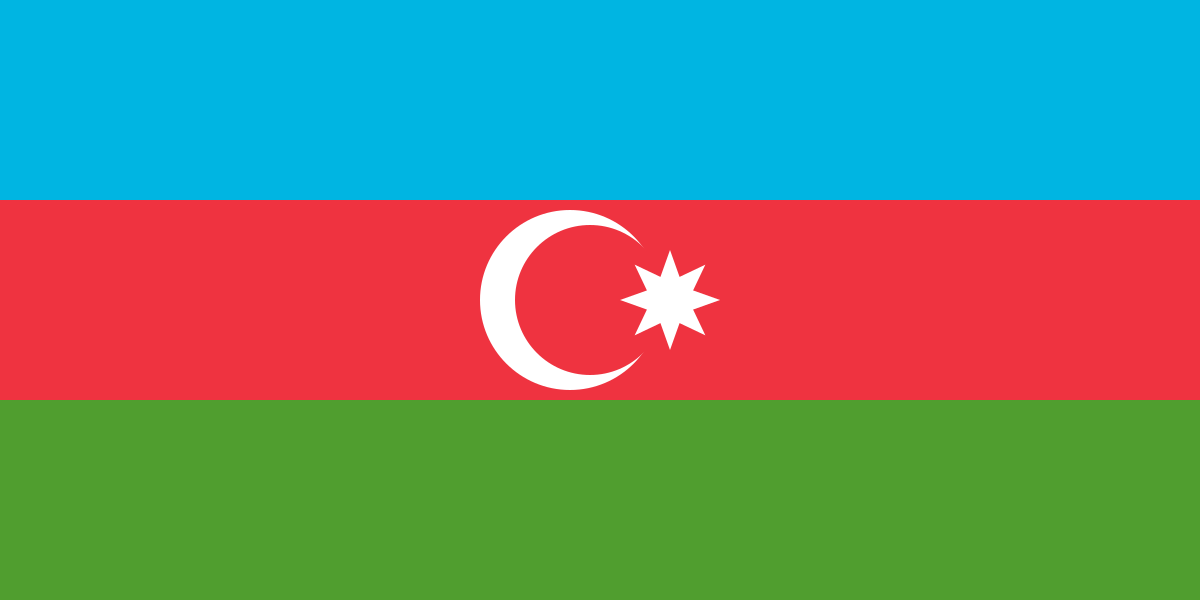
The pan-Turkist dissident who became Azerbaijan's first democratically elected president
On a November 1992 visit to Ankara he visited Atatürk's grave at Anıtkabir and wrote in the memorial book that he was a soldier of Mustafa Kemal Atatürk.
Azerbaijani politician, born 24 June 1938 in Kalaki, Nakhchivan, died 22 August 2000 in Ankara. Trained in Arabic philology at Baku State University, he took a Candidate degree in history in 1969, was known from the 1970s as a Turkist and anti-communist, and was arrested in January 1975 by the State Security Committee, serving until July 1976 at the Qaradagh stone quarry. A founder and chairman of the Popular Front from 1989, he organized a National Defence Council in January 1990 in the crisis that culminated in the anti-Armenian Baku pogrom and Black January. Elected president in June 1992, he was ousted in June 1993 amid Karabakh defeats and Huseynov's revolt; Heydar Aliyev succeeded him. He returned to Baku in 1997 and led the opposition until his death.
Career timeline
1957–1962Entered the Arabic philology department, Faculty of Oriental Studies, Baku State University in 1957; graduation dated 1962 in the Azerbaijani account, conflicting with a 1957 graduation given in an English account
1963–1964Worked as a translator in Egypt
1968–1975Lecturer in the History of Asian and African Countries, Baku State University → arrested January 1975 by the State Security Committee, held until July 1976 at the Qaradagh stone quarry
1976–1992Researcher, then senior researcher and department head, Institute of Manuscripts, Azerbaijan Academy of Sciences, until 16 July 1992
1989–1992Chairman, Azerbaijani Popular Front
1990.01Organized and chaired the National Defence Council in Baku on 12 January 1990
1992–1993President, Republic of Azerbaijan. Elected 7 June 1992, took office 17 June; formally stripped of the office by referendum on 29 August 1993
1997–2000Leader, Azerbaijani Popular Front Party (in opposition). Returned to Baku on 30 October 1997 and led it until his death
Dissident
1939–1993
✕ Shot dead under disputed circumstances
The nationalist dissident who became Georgia's first democratically elected president
"All my life I was in the opposition and fought against the government. Now I am the government": said in an interview after becoming chairman of the newly elected Supreme Council, 1990.
Georgian philologist and dissident, son of the celebrated writer Konstantine Gamsakhurdia. In 1977 he co-founded the Georgian Helsinki Group with Merab Kostava, exposing Soviet human rights abuses to the world, and was repeatedly imprisoned. In April 1989, as co-leader of the Independence Committee, he organized mass peaceful demonstrations and hunger strikes in Tbilisi; the Soviet military's bloody crackdown on them decisively radicalized Georgian opinion toward independence. Leading the Round Table-Free Georgia coalition, he won the first multiparty elections in 1990 and was elected Georgia's first president in May 1991 with 87% of the vote, only to be overthrown in an armed coup seven months later, flee to Chechnya, and die under disputed circumstances in western Georgia in December 1993.
Career timeline
1954Founded the underground youth group Gorgasliani
1963–1977Lecturer in English, Tbilisi State University; researcher, Institute of Literature, Georgian Academy of Sciences
1977–1979Co-founded Georgian Helsinki Group; arrested, imprisoned, released after public recantation
1988–1990Co-chair, Society of St. Ilia the Righteous; co-leader of the Independence Committee
1990–1991Chairman of the Supreme Council of the Republic of Georgia
The dissident architect who walked out of a Soviet prison camp and opened Estonia's political road to independence
On 23 August 1987 at noon, Hirvepark stood empty until the stroke of twelve, when two to five thousand people suddenly filled it. Parek recalled: 'Unbelievable! Something had to be done.'
The daughter of an Estonian officer, she was deported to Siberia at seven and spent four years in exile. Working as an architect, she was arrested in 1983 for anti-Soviet samizdat activity and imprisoned for four years; seven months after her release she co-founded the MRP-AEG and organised the Hirvepark rally of August 1987. That rally became the starting point of the Baltic independence movement, and the following year she was elected chair of the ERSP, Estonia's first non-communist party. After independence she served as interior minister in the first post-Soviet government, resigning in the 1993 Pullapää crisis, and later converted to Catholicism, living at Pirita Convent while leading the drive to build a memorial to the victims of Stalinism.
Career timeline
1963–1983Worked as an architect at design institutes in Tallinn and Tartu
1983–1987Arrested for anti-Soviet agitation, imprisoned in Dubravlag women's political section
1987Co-founded the MRP-AEG, organised the Hirvepark rally
1988–1992Chair of the Estonian National Independence Party (ERSP)
1990–1992Member of the Congress of Estonia
1992Presidential candidate, fourth place with 4.3% of the vote
1992–1993Minister of the Interior of Estonia (Mart Laar cabinet)
1997–Co-founder and head of Caritas Eesti; resident at Pirita Convent
A peasant leader who carried Rural Solidarity into pluralist politics
On 19 March 1981 in Bydgoszcz, he was beaten and taken to hospital during the crackdown on the farmers’ demand to legalize Rural Solidarity.
Roman Bartoszcze was a Polish farmer and opposition leader who carried the struggle to legalize an independent farmers' union into the agrarian politics of the post-communist era. He led the 1981 Bydgoszcz occupation that secured Rural Solidarity's registration and was interned under martial law, then became the first leader of the revived Polish People's Party and ran for president in 1990, before losing the party leadership in 1991 and founding a smaller conservative peasant party.
Career timeline
1969Chair of a local branch of the Union of Rural Youth
1980Leader in the Rural Solidarity movement
1981Leader of the national strike committee of Rural Solidarity
The Reformed pastor whose attempted eviction in Timișoara sparked the Romanian Revolution
The crowd forgot the initial reason for their resistance, and in general terms they opposed the regime itself.
A Hungarian Reformed pastor from Cluj, he openly criticised Ceaușescu's systematisation programme (the planned destruction of rural villages) and denounced human rights abuses in a secretly recorded interview with Hungarian television, making himself a target of the Securitate. On 16 December 1989, when parishioners gathered at his Timișoara parsonage to block his forced eviction, the protest swelled into an anti-regime uprising that became the direct trigger of the Romanian Revolution. After the revolution he was elected bishop of the Reformed Diocese of Királyhágómellék in Oradea, dedicated himself to rebuilding the church and Hungarian-language education, and served as a Member of the European Parliament from 2007 to 2019.
Career timeline
1975Graduated Protestant Theological Institute of Cluj; ordained Reformed pastor
1981–1982Contributed to underground journal Ellenpontok; first Securitate harassment
1986Appointed assistant pastor of the Reformed Church in Timișoara
1988–1989Openly criticised systematisation; secret TV interview made him a Securitate target
1989.12.16Protest against his eviction swelled into the Romanian Revolution
1990Elected bishop of the Reformed Diocese of Királyhágómellék in Oradea
2007–2019Member of the European Parliament (Vice-President 2010–2012)
Deputy chairman of the Azerbaijani Popular Front who warned Primakov there would be resistance
Polyanichko told him that at midnight troops would enter the city "whatever the cost." Mammadov replied that the army would meet resistance.
As deputy chairman of the Azerbaijani Popular Front, Etibar Mammadov stood at the forefront of the national independence movement and met with Yevgeny Primakov and Viktor Polyanichko on January 19, 1990, where he was warned that troops would enter Baku. That evening Polyanichko told him the army would go in "whatever the cost"; Mammadov replied there would be resistance, and he later became a key witness to the Kremlin's bloody crackdown on the city. He went on to found the Azerbaijan National Independence Party, finished second in the 1998 presidential election, and remained a durable opposition leader in independent Azerbaijan.
Career timeline
1978–1988Lecturer in history, Baku State University
1988–1991Deputy chairman and board member, Azerbaijani Popular Front
1990.01–11Imprisoned at Lefortovo Prison (arrested after Black January)
1990–2000Deputy, Supreme Soviet of Azerbaijan SSR / National Assembly
1991Member, National Defence Council; co-authored the Constitutional Act on State Independence
1992–2004Founder and chairman, Azerbaijan National Independence Party (NIPA)