Prisoners called him 'The Stone Guest' (Kamenny Gost'). With his low, cold voice and stony face, no one could withstand his interrogations.
Beria's closest investigative chief, Vlodzimirsky handled the most sensitive political cases of the late Stalin era. As head of the NKVD Investigative Unit (1939) and NKGB Investigative Unit for Especially Important Cases (1943), he directed the case against the Red Army air force command and the interrogation of director Meyerhold, gaining a reputation for extreme brutality. Sidelined in 1946, he spent six years in clerical posts before Beria restored him in 1953 to head MVD special investigations and reverse the Doctors' Plot. Arrested with Beria's circle, he was shot that December; in 2000 a Russian military court refused even posthumous rehabilitation.
Career timeline
1938–1939Deputy head, then head of the Investigative Unit of the GUGB, NKVD
1940–1941Head of the 3rd Department, GUGB NKVD; deputy head of investigation
1941–1943Head of the Investigative Unit, NKVD
1943–1946Head of the Investigative Unit for Especially Important Cases, NKGB and MGB
1946–1947Head of the MGB Directorate for Gorky Region, then discharged to the reserve
1947–1953Department head in the Main Directorate of Soviet Property Abroad
1953Head of the Investigative Unit for Especially Important Cases, MVD
The interrogator of Yezhov: the hand that kept the record as the machine devoured its own master
In 1939 Yezhov — the 'bloody dwarf' whose very name had made the whole country tremble — sat down on the far side of an interrogation record. The hand writing it was Esaulov's.
An NKVD investigator who made his name extracting the confession of the fallen Nikolai Yezhov on Beria's interrogation line. Born to a worker's family in Vyatka and orphaned at ten, he carried out Beria's 'special assignments' alongside Boris Rodos, rose to head the secretariat of the MGB Special Council, and died of natural causes in 1954, escaping the reckoning of the Khrushchev era.
Career timeline
1932–1937Officer, then district chief, in GPU/NKVD organs of the Vyatka–Gorky region
1937–1939Graduated the GUGB Central School; operative in the secret-political and counterintelligence departments
1939–1940Senior investigator, then deputy head, NKVD Investigative Unit — interrogated Yezhov
1940–1941Head of the Investigative Unit of the GUGB NKVD
1941–1944Head of the Investigative Unit, NKVD 3rd Directorate; head of the 11th section, NKGB 2nd Directorate
1944–1947Deputy people's commissar, later deputy minister, of state security of the Byelorussian SSR; major-general from 1945
1947–1952Head of the secretariat of the MGB Special Council; retired January 1952
At Tbilisi executions, Savitsky and fellow NKVD officers 'pounced like chained dogs on bound prisoners, beating them with pistol grips' — a 1954 eyewitness account.
An NKVD officer born in Tashkent, Savitsky was the son of a tsarist colonel who organized White Guard detachments against Soviet power. He joined the Georgian NKVD in 1931 and rose rapidly under the patronage of Bogdan Kobulov, personally participating in the torture of detainees and fabrication of cases in the 4th department during the Great Terror. He became Kobulov's personal secretary and a key operative in Beria's faction, later serving in the NKGB secretariat and the administration of Soviet property abroad. Though he only attained the rank of colonel, he was arrested days after Beria's fall in 1953 and shot in 1955.
Career timeline
1931–1939Operative, then section head and assistant head of the 4th department, NKVD of the Georgian SSR
1941–1943Deputy section chief, 4th directorate, NKVD
1943–1945Personal secretary to Bogdan Kobulov
1945–1953Deputy chief of the NKGB secretariat; later assistant in the Main Administration of Soviet Property Abroad
1953Assistant to Bogdan Kobulov, first deputy minister of internal affairs
He drove the Mingrelian affair and then fell himself
As Gagra NKVD chief, he made beatings routine in interrogations, declaring: "Whoever does not beat is himself an enemy of the people!"
Rukhadze rose through Georgia's security organs, and by 1937, as head of the NKVD in Gagra, Abkhazia, he directed mass arrests using "simplified investigation" methods. During the war he served as head of the Special Department of the Transcaucasian Front and chief of SMERSH counter-intelligence before becoming Georgia's state security minister in 1948. In that post he became the driving figure behind the fabricated "Mingrelian affair," aimed at Beria's clients. Yet he fell himself: arrested in November 1952, months before Stalin's death, he was tried in 1955, ironically, as a member of Beria's group, and shot.
Career timeline
1937–1938Head of the Gagra district NKVD department, Abkhazia
1939–1941Chief of the investigation section, NKVD of the Georgian SSR
1941–1943Deputy People's Commissar of Internal Affairs, Georgian SSR; head of the Special Department of the Transcaucasian Front
1943–1945Head of SMERSH counter-intelligence, Transcaucasian Front and Military District
The Great Purge's chief interrogator: NKVD Investigation Deputy Chief who broke Politburo members, generals, and writers
Khrushchev, Secret Speech to the 20th Congress (25 February 1956): "Recently we interrogated the investigator Rodos... He is a worthless person, with a chicken's outlook, literally a degenerate in moral terms. And it was such a person who determined the fate of prominent Party figures."
State Security Colonel who, as NKVD Investigation Unit deputy chief during the Great Purge, personally tortured Politburo members Kosior and Chubar, among other high-ranking figures, into false confessions. Denounced by name in Khrushchev's 1956 Secret Speech and executed.
Career timeline
1931Secretary, Berislav District OGPU
1932Assistant Commissioner, Znamensky District OGPU
German communist who drafted the KPD’s 1945 appeal and argued for a “special German road to socialism”
The son of a hosier from Thalheim in Saxony, he joined the KPD in 1926 and attended the International Lenin School in Moscow. After underground work and exile under the Nazis he directed a political school of the International Brigades in the Spanish Civil War, and in Moscow ran the “Free Germany” radio station. In 1945 he led the KPD group sent to Saxony and drafted the party’s appeal of 11 June 1945. In 1946 he argued that socialism could be built in Germany without a preceding dictatorship of the proletariat, a “special German road to socialism” he had to recant after Tito’s break with Stalin in 1948. He served as deputy foreign minister and first head of the GDR’s foreign intelligence service, and in 1953 was stripped of all posts for supporting Zaisser. Gravely ill with cancer, he took his own life in 1973.
Career timeline
1926Joined the KPD
1935KPD Central Committee member and Politburo candidate
1945Head of the KPD group in Saxony; drafted the 11 June appeal
Soviet foreign intelligence chief who directed operations under ambassadorial cover in China and the United States
In May 1941, his Chongqing station cabled Moscow the German High Command's plan for the invasion of the USSR, obtained from the German military attaché: about a month and a half before the attack and on its main axis.
Born in 1905 in Samara to a worker's family, he volunteered for the Red Army in 1920, joined the Party in 1927, and served in the Far Eastern border troops. Assigned to the NKVD in 1938, he headed its 3rd Special Department, then from 1939 to 1944 served as ambassador and chief intelligence resident in Chongqing, running up to twelve stations; in May 1941 he cabled Moscow the German plan for the invasion of the USSR, obtained from the German military attaché. Ambassador and chief resident in Washington from 1947 to 1952, he headed foreign intelligence of the MVD in 1953 and of the KGB First Chief Directorate from 1954 to 1955, and died in 1974.
Career timeline
1920–1922Volunteered for the Red Army; after discharge for malaria worked as a fitter on the Samara railway
1927–1935Served in the Far Eastern border troops, rising from outpost commander's assistant to border-sector commander
1935–1938Graduated from the Frunze Military Academy; assigned to the NKVD
1938–1939Head of the NKVD 3rd Special Department (confirmed 23 December 1938); took part in the arrest of Yezhov
1939–1944Soviet plenipotentiary to China and chief intelligence resident (Chongqing)
1944–1947First deputy head of the CC International Information Department
1947Chief secretary of the Committee of Information, Council of Ministers
1947–1952Ambassador to the United States and chief intelligence resident (Washington)
1952–1953Ambassador to the People's Republic of China (Beijing)
1953–1954Head of the MVD Second Chief Directorate (foreign intelligence)
1954–1955Head of the KGB First Chief Directorate (foreign intelligence), 17 March 1954 – 23 June 1955
1955–1959Chairman of the CC Commission on Travel Abroad
1959–1973Head of the CC department for diplomatic and foreign-economic, later foreign, cadres, until March 1973
Stalin entrusted the preparation and safety of his 2-5 August 1943 front-line inspection entirely to Serov, who spent three days with him; this was the farthest Stalin travelled from the capital in wartime. Stalin told not even the Politburo. Serov recorded the trip in his diary.
Born in 1905 to a peasant family in Vologda Governorate; the standard personnel reference records him as Russian and gives his birth as 25-26 August and death as 1 July. Entering the NKVD central apparatus in 1939, he served as commissar then deputy commissar in Ukraine, carrying out the annexation of western Ukraine and the 1944 North Caucasus deportations. He took part in the capture of Berlin and witnessed Germany's capitulation, helped arrest Beria in 1953, and became the KGB's first chairman, opening the mass rehabilitation of Stalin-era victims. He directed the suppression of the 1956 Hungarian Uprising and was removed in 1963 over the Penkovsky affair, losing his rank and Hero title; he was expelled from the party in 1965.
Career timeline
1939–1941Involved in annexation and deportation work in western Ukraine and the Baltic region
1941–1945Performs NKVD security and rear-area control work during the war
1953–1954Participates in security reorganization after Beria’s fall
1954–1958First KGB chairman, reshaping security organs during de-Stalinization
1958–1963Heads the GRU and later falls after the Penkovsky affair
"Before the war, intelligence was completely liquidated... When I joined the scientific-technical intelligence department, I found three people. All novices. And in all countries at the start of the war we had no more than five or six people."
A chemical engineer turned intelligence officer who built the institutional foundations of Soviet scientific-technical espionage. In 1940, noticing the sudden silence on nuclear physics in Western scientific journals, he drafted the NKVD's first atomic intelligence directive; posted to New York as deputy resident, he ran the agent network, including Klaus Fuchs and Julius Rosenberg, that penetrated the Manhattan Project and delivered secrets that shaved years off Igor Kurchatov's bomb program.
In 1937 Khazan opened an investigative file on the 17th-century Georgian national hero Giorgi Saakadze with the resolution 'Investigate, identify connections, and arrest' — because a prisoner had mentioned his name.
Born to a Jewish family in Odessa, Khazan was dismissed from the OGPU Higher School in 1933 and posted to the NKVD of Georgia, where as an SPO investigator under Beria and Goglidze he became notorious for fabricating cases and torturing detainees. During the Great Terror he sent even colleagues to execution. Arrested in February 1938, he was released on Beria's orders and merely discharged. He later served in the NKVD central apparatus during the war and, in grim irony, published a 1948 book titled On the Moral Character of the Soviet Person. After Beria's fall he was tried at Tbilisi and shot in November 1955.
Career timeline
1928–1933Operative, Odessa GPU regional department; student at the Higher School of the OGPU
1933–1937Operative, then section head, NKVD of the Georgian SSR
1937–1938Head of the 1st section and assistant head of the Secret-Political Department, NKVD of the Georgian SSR
1938Arrested, released after two months and discharged
The Berlin rezident who piped Nazi disinformation to Moscow
In Berlin, Kobulov's prized agent 'Lycéist' was in fact a double agent run by the Gestapo. His reports bypassed NKVD intelligence analysts and went straight through Beria to Stalin's desk, reinforcing the conviction that there was "no risk of a German invasion" in 1941.
The younger brother of Bogdan Kobulov, Amayak rose through the NKVD on the patronage of his brother and Beria. In 1938, at thirty-two, he became acting NKVD chief of Ukraine; the following year he was posted to Berlin as NKVD rezident despite speaking no German and having no operational training. His prize agent 'Lycéist' was in fact a German plant, and through 1940–41 Nazi disinformation flowed through Kobulov into Moscow. He spent the war as security chief of Uzbekistan, then ran the POW administration and served as deputy head of the Gulag. Arrested after Beria's fall in 1953, he was shot in 1955.
Career timeline
1937–1938Head of the Gagra city NKVD department, then of the NKVD of the Abkhaz ASSR
1938–1939Acting People's Commissar of Internal Affairs, Ukrainian SSR
1939–1941Counsellor of the Soviet embassy in Berlin; legal NKVD rezident
1941–1945People's Commissar of State Security, then of Internal Affairs, Uzbek SSR
1945–1951Deputy, then first deputy head of the Main Directorate for POWs and Internees
1951–1953Head of the POW directorate and first deputy head of the Gulag
SS officer who ran the deportation of Europe’s Jews to the death camps and in 1944 oversaw that of Hungary’s Jews to Auschwitz
Born to a Calvinist family in Solingen, Germany, he grew up in Austria, where the family moved in 1914, and joined the Nazi Party and the SS in 1932. In 1938 he was posted to Vienna to organise Jewish emigration from Austria. Head of RSHA Sub-Department IV B4 from December 1939, he attended the Wannsee Conference in January 1942 and prepared its minutes, after which he and his staff were responsible for deporting Jews to the extermination camps. After Germany occupied Hungary in March 1944 he oversaw the deportation of Hungary’s Jews; by the time the transports stopped in July, 437,000 of its 725,000 Jews had been deported. Captured by US forces after the war, he escaped from a detention camp and reached Argentina in 1950, but in 1960 Israel’s Mossad abducted him; tried in Jerusalem, he was hanged in 1962.
Career timeline
1932Joined the Austrian Nazi Party and the SS
1933–1938Jewish affairs, SS Security Service
1938–1939Central Agency for Jewish Emigration, Vienna
1939–1945Head of RSHA Sub-Department IV B4
1944Oversaw the deportation of Hungary’s Jews
1950–1960In hiding in Argentina
1960–1962Abducted by Mossad, tried in Jerusalem, executed
Khrushchev's civilian interior minister who tried and failed to dismantle the informant system
In 1959 Dudorov signed an order to phase out the militsiya's informant and agent-provocateur system — a nearly unique attempt in Soviet police history. It was blocked almost immediately and buried when he was dismissed the following year.
A civilian interior minister appointed by Khrushchev to displace the Stalin-era NKVD veterans, serving as head of the MVD from 1956 to 1960. A chemical engineer by training, he rose through construction and industrial bureaucracy before leading the CPSU Central Committee's Construction Department in 1954. As minister, he attempted to reorganize the Gulag into smaller correctional colonies and, in 1959, sought to phase out agent-provocateur and informant methods in the militsiya, an effort that failed. His tenure coincided with the rapid decline of the MVD's standing after the KGB split, and he left office when the all-union MVD was abolished in 1960.
Career timeline
1922–1929Apprentice then master at the Kalinin Crystal Factory, Moscow
1929–1934Student at Moscow Chemical-Technological Institute (Mendeleev Institute)
1934–1937Head of the Triplex shop at the Avtosteklo factory, Moscow
1937–1949Production, party committee, and administrative posts in the heavy industry and construction materials commissariats
1950–1952Head of Construction Department, Moscow City Party Committee; then Deputy Chairman of Moscow City Executive Committee
1954–1956Head of Construction Department, CPSU Central Committee
1956–1960USSR Minister of Internal Affairs (MVD): Gulag reorganisation, attempt to abolish militsiya informant system
1960–1972General Commissioner for the 1967 World Exhibition; then head of Glavmospromstroymaterialy
First minister of public security and chief of the general staff, purged on the eve of the Cultural Revolution as Lin Biao’s target
Mao trusted him as his closest security chief, saying "if the sky falls, Luo the Tall will prop it up." First minister of public security from 1949, he built the police apparatus for a decade, then led the general staff until his purge in late 1965.
From Sichuan and Whampoa’s sixth class, he served in Red Army political and security work and ran the Anti-Japanese Military and Political University. As first minister of public security from 1949 he built the police system and the campaign to suppress counter-revolutionaries, and after Peng Dehuai’s fall in 1959 he managed the army as chief of the general staff. Putting training before politics, he was denounced by Lin Biao at the end of 1965 for plotting to seize military power, fell, and injured his legs in a suicide attempt in 1966. Rehabilitated in 1977 as secretary-general of the Military Commission, he died after surgery in West Germany the next year.
Founder of Hungary's secret police, and its prisoner
From 1945, Gábor Péter led Hungary’s political police, preparing and conducting show trials. Arrested in 1953, he was sentenced to life imprisonment the following year, then released under an individual amnesty in 1959.
Born into a Jewish tailor's family in Újfehértó, he joined the Hungarian Communist Party in 1931. He headed the Budapest political police in 1945 and led the state security service (ÁVO, then ÁVH) in 1945–52, directing purges and torture including the Rajk trial. In early 1953 Rákosi, imitating the Soviet "anti-Zionist" purge, had him arrested. In June 1953 Beria pressed for his case to be reviewed, but in 1954 a court martial sentenced him to life as a Zionist spy. Released under an individual amnesty in 1959, he worked as a librarian.
Career timeline
late 1920sBecame active in the labor movement.
1931Joined the Hungarian Communist Party.
1943Joined the leadership of the communist Peace Party.
1945Became head of the Political Security Department at the Budapest headquarters of the Hungarian State Police.
1945–1952Led the ÁVO and ÁVH secret-police organizations and played a prominent role in preparing and conducting show trials.
1952Was dismissed from his post and expelled from the Hungarian Working People's Party.
1953Was arrested on January 3.
1954Was sentenced to life imprisonment by the Military Supreme Court.
1957His sentence was commuted to 14 years.
1959Released under an individual amnesty and worked as a librarian until retirement.
After his death sentence he wrote: "Shoot me with five explosive bullets — a single ordinary bullet won't kill me." The torturer who had mocked his victims' pain trembled before his own.
Colonel in the Soviet MGB, notorious as the most brutal interrogator in the history of the state security organs. Entered NKVD during the Great Purge (1937-38), beat Marshal Blyukher to death under interrogation, and interrogated Isaac Babel and Vsevolod Meyerhold. Severed General Grigory Shtern's right eye with an electric cable during questioning. Arrested in 1951 in connection with the Doctors' Plot, executed by shooting in 1955.
Career timeline
1925Joined Komsomol, worked as newspaper reporter in Kiev
1929Transferred to Moscow, worked for Moskovski Komsomolets
1935Recruited into NKVD
1938NKVD interrogator — tortured Blyukher, Kosarev; interrogated Babel and Meyerhold
1941Deputy head of NKGB Investigation Department
1951Arrested in connection with Doctors' Plot
1955Sentenced to death and executed by firing squad
NKVD major-general who led Tula's wartime defence and fell from grace
In the autumn of 1941, at age 34, Sukhodolsky joined Zhavoronkov and Chmutov on the three-man Tula City Defence Committee. With Red Army units withdrawn, the worker regiments and partisan detachments he organised held Guderian's panzers at bay for forty-five days.
A Soviet state security officer who headed the NKVD directorate for Tula Oblast at the decisive moment when German forces approached Moscow in 1941. As a member of the Tula City Defence Committee, he organised worker battalions and partisan detachments, built defensive lines, and neutralised Abwehr intelligence networks behind the front. After the war he served as MGB chief for Voronezh Oblast and later as a senior Soviet adviser to the Bulgarian interior ministry. In 1957 he was expelled from the party and stripped of his major-general's rank over his role in handling the 'KPM' anti-Stalinist youth group case in Voronezh in 1950, and was never rehabilitated.
Career timeline
1924–1931Worker at Tula Arms Factory; completed workers' faculty evening division
1931–1935Studied at Moscow Aviation Institute, transferred to Tula Mechanical Institute; graduated as mechanical engineer
1935–1938Engineer and senior designer at Plant No. 173, Tula
1938–1939Graduated NKVD Central School; operative, 8th Section, 1st Directorate GUGB NKVD
1939–1940Deputy Chief, 1st Department, Main Economic Directorate (GEMU) NKVD USSR
1940–1941Deputy Chief, Economic Department, NKVD/NKGB Estonian SSR
1941.04–07Chief, NKGB Tula Oblast
1941–1943Chief, NKVD Tula Oblast; member, Tula City Defence Committee
1943–1946Chief, NKGB/MGB Tula Oblast
1946–1951Chief, MGB Voronezh Oblast
1951–1955Senior Adviser, MGB/MVD/KGB to Bulgarian Ministry of Internal Affairs
The man who rebuilt foreign intelligence from the wreckage of the Yezhovshchina and stole the atomic bomb
"In the pre-war years we managed to staff about 40 residencies abroad and send more than 200 intelligence officers to them, as well as deploy many career Chekists to illegal work. This immediately showed in the results." — Pavel Fitin, memoirs, on rebuilding foreign intelligence from the wreckage of the Yezhovshchina in just two years
Pavel Mikhailovich Fitin was the youngest-ever chief of Soviet foreign intelligence, appointed at age 31 in 1939. He rebuilt agent networks shattered by the Yezhovshchina, restoring 40 residencies within two years, and in 1941 obtained the British MAUD Committee nuclear report, launching Operation Enormoz, which penetrated the Manhattan Project and cut years off the Soviet atomic bomb timeline. During the war he sent Stalin over 100 invasion warnings, acquired Kursk battle plans, and directed partisan support. Removed in 1946, he later served as Minister of State Security of the Kazakh SSR but was fired without pension in the 1953 post-Beria purge.
Career timeline
1932–1938Editor, deputy editor-in-chief at Selkhozgiz publishing house after graduating from Timiryazev Agricultural Academy
1938.08–11NKVD School of Special Purpose, trainee in 5th Dept → head of 9th Section → deputy dept head
1939–1946Chief of Soviet foreign intelligence: head of 5th Dept GUGB NKVD → 1st Directorate NKGB/NKVD/MGB
1946–1947Deputy MGB Plenipotentiary, Soviet Military Administration in Germany
1947–1951Deputy head of MGB for Sverdlovsk Oblast, overseeing closed nuclear cities
1951–1953Minister of State Security, Kazakh SSR — responsible for Semipalatinsk test site
1953.03–07Head of MVD for Sverdlovsk Oblast
1954–1963Controller posts, then director of photo combine for Union of Soviet Friendship Societies
The last NKVD People's Commissar, the longest-serving MVD minister, killed by a train
Kruglov, who headed the internal-affairs apparatus for eleven postwar years before dismissal, dispossession, and party expulsion, died on the tracks near the Pravda platform in 1977, with sources split between 6 June and 6 July and among accident, suicide, and heart attack.
Born into a poor peasant and smith family, Kruglov worked as a shepherd before studying oriental studies and entered the state security apparatus after Beria's arrival in 1938. Appointed People's Commissar of Internal Affairs in December 1945 and Minister of Internal Affairs in March 1946, he ran the Gulag at its greatest scale and was among the principal officials who organized the 1944–1945 deportation of Chechens and Ingush. After Beria's arrest in June 1953 he returned as MVD Minister and initiated the KGB's creation, but he was removed in early 1956, stripped of his general's pension in 1959, and expelled from the party in 1960. He died on the tracks near the Pravda platform in 1977, but sources split between 6 June and 6 July for the date and among accident, suicide, and heart attack for the cause, none of them settled.
Career timeline
1937–1938Responsible organiser in ORPO of the Central Committee; then special plenipotentiary in NKVD
1939–1941Deputy People's Commissar for Cadres and head of NKVD Personnel Directorate
1941–1945First Deputy People's Commissar of NKVD: defensive works, military council duties
1945.12–1946.03Last NKVD People's Commissar for Internal Affairs
1946–1953MVD Minister: Gulag at peak, atomic infrastructure, ethnic deportations
1953.03–06Beria's First Deputy; then helped prepare Beria's arrest
1953.06–1956.01Reappointed MVD Minister; initiated the creation of the KGB
1956–1977Demotion and retirement, loss of pension and apartment, party expulsion, death by train in 1977 (cause unresolved)
A party cadre elevated into the security apparatus
In 1953, as First Deputy Minister, he sat on the Special Judicial Presence judging his former minister.
Konstantin Lunev was a party cadre from a textile-working background who moved from postwar Moscow party administration into the senior security apparatus. After Beria’s arrest in 1953, he became First Deputy Minister of Internal Affairs and represented the ministry on the Special Judicial Presence that tried its former chief. The role showed the MVD being subordinated to the Party’s political decision while also revealing a system in which party cadres were placed atop coercive institutions. Lunev later served as First Deputy Chairman of the KGB and acting head of the Kazakh KGB, retiring through illness in 1960.
Career timeline
1922–1937Textile worker, trade-union and industrial administrator
1941–1946Moscow regional party instructor and city first secretary
1946–1953Moscow party official and administrative department head
1953.06–07Head of the MVD Ninth Directorate
1953–1954First Deputy Minister of Internal Affairs and member of the Beria Special Judicial Presence
1954–1959First Deputy Chairman of the KGB
1958–1959Acting KGB chairman and chairman of the Kazakh KGB
1961–1969Deputy director of an energy-engineering research institute, then pensioner
An interrogator convicted of falsifying cases and torturing prisoners
Even after Stalin's death he did not escape punishment: in 1958 the USSR Supreme Court sentenced him to fifteen years for falsifying cases and torturing prisoners, and he served the term to the last day.
Born in Brest-Litovsk to a Russified family of French descent, he joined the OGPU in 1931. As an NKVD interrogator during the Great Terror he handled the cases of Deputy Foreign Commissar Krestinsky, the Comintern officials Pyatnitsky and Knorin, and the Estonian communist Anvelt, beating confessions out of them. In wartime he led operational departments, served on missions to Tuva, Mongolia and Xinjiang, and rose to lieutenant-general in 1945. Dismissed in 1955 and stripped of his rank, he was arrested in 1957 and sentenced in 1958 to fifteen years for falsifying cases and torturing prisoners. He served the full term, was released in 1972, and died in Moscow in 1990, unrehabilitated.
Career timeline
1931–1937OGPU and NKVD counterintelligence officer
1937–1940NKVD interrogator; assistant head in counterintelligence
1940–1941Head of an investigative department; assignment in Greece
1942–1946Wartime operational chief; missions to Tuva, Mongolia and Xinjiang
"Generals are never traitors" — Tsinev's reply when the first warning arrived about Dmitri Polyakov, the CIA mole inside Soviet military intelligence who would evade capture for twenty more years.
A metallurgical engineer who earned Brezhnev's trust in Dnepropetrovsk party circles, he spent fifteen years as deputy chairman of the KGB serving as Brezhnev's personal pair of eyes, reporting on Chairman Andropov's every move directly to the General Secretary. He rose to the rank of General of the Army and Hero of Socialist Labor, but was widely disliked for his scheming and authoritarian manner.
Career timeline
1925–1939Worker, foreman, and engineer at Dnepropetrovsk metallurgical plants
1939–1941Party official in Dnepropetrovsk, working under Brezhnev
1941–1945Political commissar: deputy chief, Kalinin Front political directorate → chief, 57th Army political section
1945–1951Aide and deputy high commissioner, Soviet element of the Allied Commission for Austria
1953–1958Chief of Special Sections, Soviet Forces in Germany (MVD/KGB)
1966–1967Head, 3rd KGB Directorate (military counterintelligence)
1967–1970Head, 2nd KGB Chief Directorate (counterintelligence)
1970–1982Deputy Chairman of the KGB, overseeing military counterintelligence and investigations
1982–1985First Deputy Chairman of the KGB
1985–1992Inspector, Group of General Inspectors, Ministry of Defence
Stalin’s spymaster who eliminated Trotsky, then spent fifteen years in Stalin’s prisons
Beria was not in the least interested in whether the people we recommended were guilty or innocent. He asked one single question: 'Are you sure we need them?' — Special Tasks
Born the son of a miller in Melitopol, he joined the Red Army at twelve and survived the lawless chaos of the Civil War before rising through the GPU as a covert operative. In 1938 he assassinated OUN leader Yevhen Konovalets in Rotterdam on Stalin's personal order, and in 1940 he and Naum Eitingon ran Operation Duck, eliminating Leon Trotsky. During the German-Soviet war, as head of the 4th Directorate he directed partisan and sabotage warfare behind enemy lines and oversaw atomic espionage (Group S). Arrested in 1953 as Beria's 'accomplice,' he served fifteen years in prison, then wrote historical novels under a pseudonym and was fully rehabilitated in 1992 after the USSR collapsed. His memoir Special Tasks is the first insider account of the Soviet intelligence services' most secret operations.
Career timeline
1919–1921Red Army boy soldier; captured, escaped, homeless in Odessa
1921–1932GPU and OGPU intelligence officer in Ukraine
1933–1938INO OGPU/NKVD — infiltrated OUN in Berlin, covert operations abroad
1938Assassinated Konovalets in Rotterdam; acting head of NKVD foreign intelligence (Nov–Dec)
1939–1941Deputy head of foreign intelligence; Operation Duck — Trotsky assassination
1941–1946Head of 4th NKVD Directorate — partisan/sabotage warfare; atomic intelligence Group S
1946–1953Post-war sabotage ops against NATO; deputy head of MVD First Chief Directorate (1953)
1953–1968Arrested as Beria accomplice; 15-year sentence served in Vladimir Prison
1968–1996Released, wrote novels under pseudonym; fully rehabilitated 1992, published Special Tasks
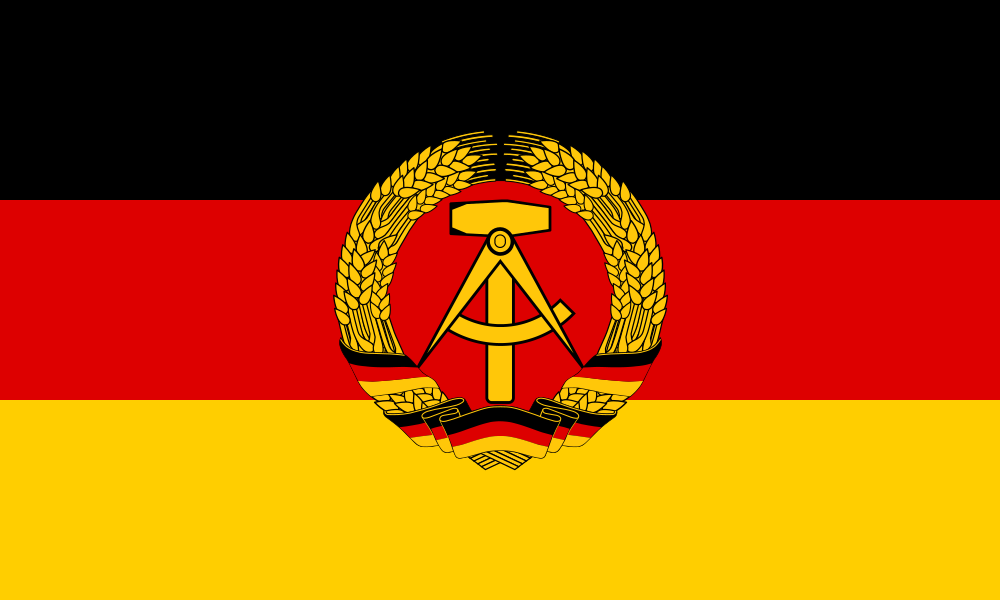
East Germany's 'Master of Fear': the Stasi chief who ruled state security for 32 years
“All this blithering over to execute or not to execute, for the death penalty or against — all rot, Comrades. Execute! And, when necessary, without a court judgment.” — to senior Stasi officers, 1982
A communist militant from Berlin's Wedding district, Mielke fled to the USSR after the 1931 killing of two Berlin policemen and was trained by the NKVD. After the Spanish Civil War he returned in 1945 to help build the GDR's state security apparatus, leading the Stasi from 1957 to 1989 and expanding it into a 90,000-strong surveillance network. The Stasi controlled all of East German society while training armed groups across the Third World and Western Europe, extending socialist-bloc security architecture. He fell with the regime in 1989 and was convicted after reunification for the 1931 murders.
Career timeline
1925Joined the KPD
1931Fled to USSR after Bülowplatz police murders
1936–1939Served in International Brigades, Spain (Captain)
1945Returned to Berlin, Police Inspector Lichtenberg
1950Deputy Minister of State Security, State Secretary
1957–1989Minister for State Security (Stasi chief)