A Georgian party official at the edge of Soviet collapse
“The law should be enforced, but it should be enforced without victims.”
Givi Gumbaridze was a Communist Party official who rose from archival and party-organizational work to the top leadership of the Georgian Soviet Socialist Republic. A former state-security chief, he governed as national mobilization intensified and party rule collided with popular demands. After the bloody Tbilisi crackdown of 1989, he called for both accountability and order, but could not reverse the crisis of Soviet authority.
Career timeline
1966–1967Served in the Soviet Army
1968–1972Researcher in Georgia’s central state archives and aide in the republic’s Supreme Soviet apparatus
1977–1983Official in the Georgian Communist Party Central Committee’s administrative-organs department
1983–1985First Secretary of the Zestafoni District Party Committee
1988First Secretary of the Tbilisi City Party Committee
1988–1989Chairman of the Georgian SSR Committee for State Security
1989–1990First Secretary of the Communist Party of Georgia
1990–1991Member of the CPSU Politburo
1989–1990Chairman of the Presidium of the Supreme Soviet of the Georgian SSR
The Sumgait party boss handed a flag and photographed at the head of the mob
Left isolated by the crowd, the republic flag thrust into his hands, Muslimzade walked where the mob led him; the scene was filmed and sent to the Party Central Committee.
A Komsomol careerist who rose to first secretary of the Sumgait city party committee, he was the party official who faced the crowd at the outset of the February 1988 Sumgait pogrom and, in attempting to calm it, found himself handed an Azerbaijan SSR flag and photographed leading the march. Muslimzade later maintained that he was steering the column away from the Armenian district toward the sea, but the tail of the procession splintered into groups that fanned out into Armenian neighbourhoods. Dismissed from all posts and expelled from the party days after the pogrom, he became both a scapegoat for the violence and an enduring symbol of the party's loss of control.
Career timeline
1971–1974Instructor, Press Department, Ministry of Communications, Azerbaijan SSR; secretary, 26 Baku Commissars District Committee, Komsomol
1974–1978Head of Komsomol Organisations Dept, CC Komsomol of Azerbaijan; Chairman, Committee of Youth Organisations; instructor, Organisational-Party Work Dept, CC CP Azerbaijan
1978–1985First Secretary, Central Committee of the Lenin Komsomol of Azerbaijan
1985–1988First Secretary, Sumgait City Committee, Communist Party of Azerbaijan
1989–1991Vice-President, Azerbaijan Association of Joint Ventures and International Unions
1991People's Deputy, Supreme Council of the Republic of Azerbaijan
A party cadre who moved from army organization to the late Soviet Politburo
In April 1991, while responsible secretary of the All-Army Party Committee, he joined the late Soviet Politburo.
Mikhail Semyonovich Surkov was a Soviet party organizer and politician whose career developed within the armed forces' political apparatus. After working in party-control posts in the army, he entered the Politburo shortly before the Soviet Union's dissolution, embodying the late system's reliance on institutional cadres amid crisis. He later carried that experience into the Communist Party of the Russian Federation, the State Duma, and the Accounts Chamber.
Career timeline
1960Began working as an apprentice fitter
1965–1977Served in the Soviet armed forces and graduated from the Lenin Military-Political Academy
1988–1990Head of the political department of a combined-arms army
1990–1991Secretary of the All-Army Party Committee and responsible secretary of the party commission under the Main Political Directorate
1991Member of the CPSU Central Committee and Politburo member
1995–1999State Duma deputy and deputy chair of the Defence Committee for the Communist faction
2000–2007Auditor of the Accounts Chamber of the Russian Federation
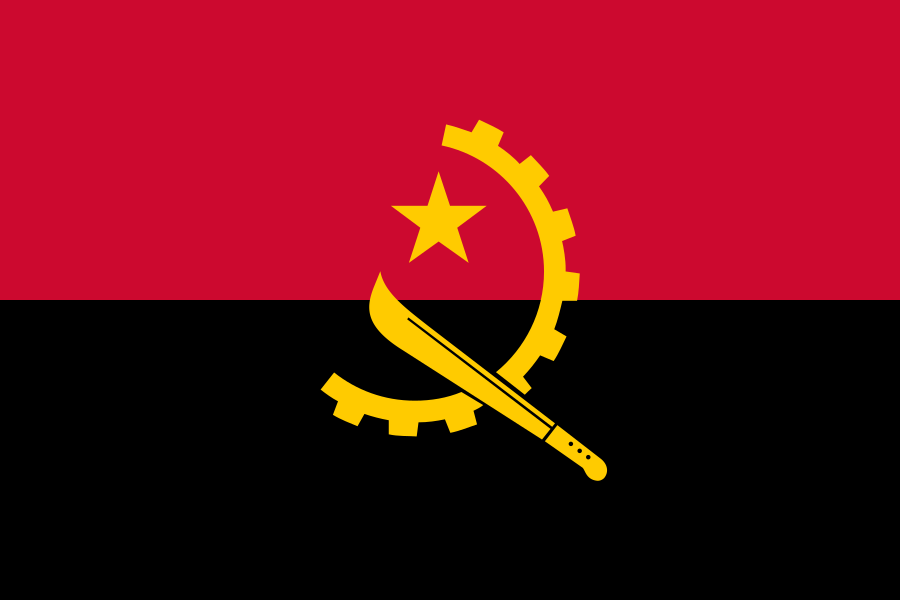
The radical MPLA interior minister who sought Soviet backing only to die in a failed coup
At the 1977 Central Committee he declared, 'As for me, I am the revolution incarnate,' demanding the immediate resignation of the leadership.
Nito Alves was the first interior minister of Angola and leader of the radical 'Nitista' faction within the MPLA. A guerrilla commander in the Dembos region during the independence war, he won the interior ministry at independence and used it to plant loyalists throughout the new state apparatus. In March 1976 he led Angola's delegation to the 25th Congress of the Soviet Communist Party, presenting himself as head of the 'purely Marxist-Leninist wing' to win Soviet backing, which pushed Neto's leadership to adopt Marxism-Leninism formally. After the failed coup of May 1977 he was captured and shot by firing squad.
Career timeline
1967Commander of the Centre of Revolutionary Instruction
1971Supreme regional commander in Dembos
1974Returned to Luanda; built 'People's Power' mass organizations
1975.11Appointed Minister of the Interior
1976.03Led the delegation to the 25th CPSU Congress
1976.10Dismissed; Ministry of the Interior abolished
1977.05Expelled from MPLA; abortive coup of 27 May
1977.07Arrested (7th), executed by firing squad (14th)
Soviet airborne forces commander and deputy defence minister in the August 1991 coup
On 19 August 1991, during the GKChP coup, Achalov coordinated the entry of airborne troops into Moscow and was tasked with blockading the Ostankino television centre.
Born on 13 November 1945 in the village of Atamash, Atninsky District, Tatar ASSR, and died in Moscow on 23 June 2011. He graduated from the Kazan Tank School (1966) and the Armoured Forces Academy (1973), commanded the 7th Guards Airborne Division (1978), the 8th Guards Army (1985–1987) and the Leningrad Military District as chief of staff (1987–1989), and became a major-general in 1980. He commanded the Soviet Airborne Forces from January 1989 to December 1990 and was Deputy Minister of Defence of the USSR from December 1990 to September 1991, becoming colonel-general in 1989. Named in the GKChP indictment among the deputy defence ministers who joined the conspiracy at the 17 August 1991 meeting, he sided with the Supreme Soviet in the 1993 crisis, was appointed Defence Minister by Alexander Rutskoy, arrested and amnestied in February 1994.
Career timeline
1966–1973Tank platoon and company commander, 8th Guards Army (GSFG)
1973–1975Deputy commander, 243rd Training Self-Propelled Artillery Regiment, 44th Training Airborne Division
In Revolution from Above, Kotz argued that the USSR's ruling party-state elite itself dismantled the Soviet system in pursuit of greater wealth and power.
David M. Kotz is an American economist whose work examines institutional change and political economy. With Fred Weir, he interpreted the Soviet demise not simply as economic collapse and popular revolt, but as a process in which the party-state elite dismantled the system in pursuit of greater wealth and power. Their book Revolution from Above links Soviet stagnation, perestroika, the formation of a pro-capitalist coalition, and Russia's subsequent political economy.
Career timeline
1978Coauthor of Bank Control of Large Corporations in the U.S.
1994Coeditor of Social Structures of Accumulation
1997Published Revolution from Above with Fred Weir
2007Published Russia's Path from Gorbachev to Putin with Fred Weir
2015Published The Rise and Fall of Neoliberal Capitalism
2021Professor Emeritus of Economics, University of Massachusetts Amherst
In April 1991, he joined the Soviet Union's final Politburo as Kyrgyzstan's representative.
Amanbayev was an agricultural specialist who rose through the Kyrgyz Communist Party's regional and central apparatus. In 1991, as the Soviet Union moved toward dissolution, he became first secretary of the Communist Party of Kyrgyzstan and a member of the CPSU Politburo, but both positions ended within months as the Union collapsed. He later served in the government of independent Kyrgyzstan, embodying institutional continuity between the late Soviet party apparatus and the new state.
Career timeline
1966Graduated from the Kyrgyz Agricultural Institute
1971–1973Director of the Osh state breeding station; first secretary of the Alay district party committee
1981–1985Secretary of the Osh regional committee of the Communist Party of Kyrgyzstan
1985–1988Secretary of the Central Committee of the Communist Party of Kyrgyzstan
1988–1991First secretary of the Issyk-Kul regional committee
1990–1991Chair of the Issyk-Kul regional Soviet; People's Deputy of the USSR
1991First secretary of the Communist Party of Kyrgyzstan; member of the CPSU Politburo
1993–1995Deputy prime minister of the Kyrgyz Republic
The last communist president of Afghanistan, who outlasted the Soviet withdrawal by three years before the Taliban tortured and hanged him
"I didn't want to be president, you talked me into it, insisted on it, and promised support. Now you are throwing me and the Republic of Afghanistan to its fate." To Shevardnadze, autumn 1991
A Pashtun doctor who joined the PDPA's Parcham faction as a student, Najibullah rose through six brutal years at the helm of KHAD, the Afghan secret police, where his ruthless efficiency drew the attention of Yuri Andropov and the KGB. Installed by Moscow as party leader in 1986, he launched a 'National Reconciliation' that restored Islam, introduced multi-party politics, and erased communist symbols from the constitution, yet the war ground on; he opposed the Soviet withdrawal, pleading with Shevardnadze to leave volunteers to defend the Kabul highway, but after February 1989 held power alone for three more years. When Soviet dissolution ended aid and General Dostum defected, his government collapsed in 1992; he sheltered in the UN compound in Kabul, until Taliban fighters dragged him out in September 1996, tortured and castrated him, and hung his corpse from a traffic pole.
Career timeline
1965Joined PDPA Parcham faction
1977PDPA Central Committee member
1978Ambassador to Iran, soon dismissed; exile in Eastern Europe
The airborne commander who held the coup's key and handed it to Yeltsin
'With a single airborne regiment I could restore order in two hours': Grachev's boast on the eve of the First Chechen War proved the prelude to disaster.
Pavel Grachev was an airborne general who earned the Hero of the Soviet Union title in Afghanistan for achieving objectives with minimal losses, rising to command all Soviet Airborne Forces in December 1990. On the first day of the August 1991 coup he obeyed Defence Minister Yazov's order and brought the 106th Guards Airborne Division into Moscow, but the next day he opposed the planned storming of the White House, switched his allegiance to Yeltsin, and sent troops to defend the parliament: the pivot that broke the coup's military spine. After the Soviet collapse he became Russia's first defence minister, backed Yeltsin during the 1993 constitutional crisis, and presided over the disastrous First Chechen War, leaving office in 1996 amid corruption allegations and the derisive nickname 'Pasha-Mercedes.'
Career timeline
1965–1969Ryazan Higher Airborne Command School (gold medal)
He recalled interpreting as searching for the threads connecting two languages.
Pavel Palazhchenko is an interpreter and writer whose work documents the decisive conversational spaces of late Soviet diplomacy. As the English interpreter for Mikhail Gorbachev and Eduard Shevardnadze, he took part in the US-Soviet summits at Geneva, Reykjavik, Malta and elsewhere. His memoir records not only leaders’ words but also the working processes of arms-control negotiations and the growth of trust, offering a Soviet-side account of the peaceful end of the Cold War. He later continued as an international-relations analyst and press official at the Gorbachev Foundation.
Career timeline
1966–1972Studied translation and interpreting at the Maurice Thorez Moscow Institute of Foreign Languages
1972–1974Completed the UN interpreter courses, then taught and interpreted at his institute
1974–1979Worked in the Russian section of the UN Secretariat interpretation service
1980–1985Worked in the USSR Foreign Ministry’s interpretation and US-Canada departments
1985–1991Chief English interpreter for Gorbachev and Shevardnadze, participating in US-Soviet summits
1991Worked in the office of the President of the USSR
1992–presentInternational-relations and press official and analyst at the Gorbachev Foundation
1997Published My Years with Gorbachev and Shevardnadze: The Memoir of a Soviet Interpreter
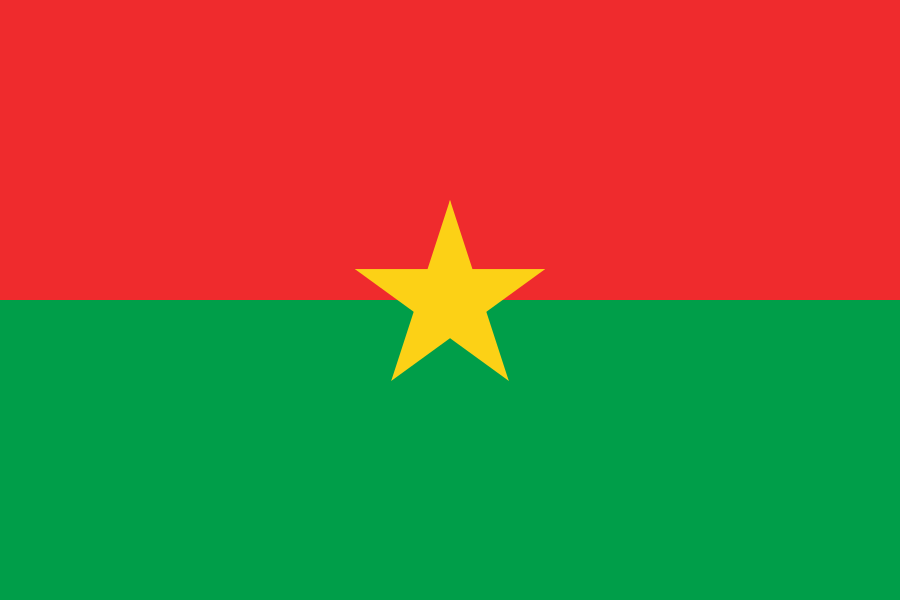
The 'African Che' who traded the state Mercedes fleet for Renault 5s
“While revolutionaries as individuals can be murdered, you cannot kill ideas.” — speech a week before his assassination, 1987
A Marxist pan-Africanist revolutionary of Burkina Faso. Taking power at thirty-three in 1983, he renamed the country 'land of upright people' and drove mass vaccination, literacy and women's-rights campaigns. He rejected IMF structural adjustment and was assassinated in the 1987 coup of his comrade Blaise Compaoré.
Career timeline
1983Takes power at thirty-three; the National Council of the Revolution
1983–1987Vaccination, literacy, reforestation and women's-rights campaigns
1984Renames the country Burkina Faso, 'land of upright people'
1987.07The Addis Ababa speech: Africa must repudiate its debt
1987.10Assassinated in the coup of his comrade Compaoré
1987Delivered Women’s Liberation and the African Freedom Struggle on International Women’s Day
Full cavalier of the Order of Labour Glory, collective-farm mechanizer
Viktor Baklanov arrived from his native Siberian village at the Gigant collective farm in Ukraine as an eighteen-year-old mechanizer in 1967, and over 37 years on the same farm earned all three classes of the Order of Labour Glory to become a full cavalier.
Soviet agricultural worker and state figure who spent his career as a mechanizer at the Gigant collective farm in Dnepropetrovsk Oblast, distinguishing himself in all-Union and republic-level harvest competitions. He became a full cavalier of the Order of Labour Glory, 3rd class (1975), 2nd class (1982), and 1st class (1987), and was elected a People's Deputy of the USSR (1989–1991) on the collective-farm quota during perestroika.
Career timeline
1967–2004Mechanizer, Gigant collective farm, Dnepropetrovsk Oblast
1987–1989Deputy, Supreme Soviet of the USSR (11th convocation)
1989–1991People's Deputy of the USSR (Union of Collective Farms quota)
The last Gosplan chairman who presided over the dissolution of Soviet planning
On the end of the planned economy: "We proposed a mechanism to bring the vulnerable closer to public goods through the market. But nobody wanted to listen."
The last steward of Soviet central planning, he managed the transition from plan to market as First Deputy Prime Minister and inaugural Minister of Economy and Forecasting under the Pavlov government, when Gosplan was reorganized into the new ministry in May 1991. After the USSR's dissolution, he transformed into a successful post-Soviet industrial entrepreneur, founding the Avtotor auto assembly group.
Career timeline
1969–1974Engineer at VAZ construction site → Komsomol official in Tolyatti
1976–1982Deputy head then head of planning and economic department, VAZ
1982–1985Deputy general director for economics and planning, KAMAZ
1985–1988Department head at State Committee for Labor → Council of Ministers apparatus
1989–1991Chairman, USSR State Committee for Labor and Social Questions
1991.03–05Deputy Prime Minister of the USSR
1991.05–11First Deputy PM and Minister of Economy and Forecasting (Gosplan successor)
after 1991Founded International Privatization Fund → Chairman of Avtotor Holding
The airborne deputy commander who, sent against the White House, switched sides and helped break the August coup
On the night of 20 August 1991, with Grachev's consent, Lebed returned to the White House and secretly told the defenders: 'The assault will begin at 2:00 AM.'
Born into poverty in Novocherkassk, the son of a carpenter who had spent years in the Gulag, he witnessed the Novocherkassk massacre at age twelve and became a Soviet airborne forces general. He served as a battalion commander in Afghanistan and was appointed deputy commander of the Airborne Forces for combat training in February 1991. On the first day of the August coup he led Tula paratroopers to surround the White House on Pavel Grachev's orders, but switched to Yeltsin's side the next day and secretly informed the defenders of the planned 2:00 AM assault, a defection that helped break the coup. After retiring from the army he placed third in the 1996 presidential election, negotiated an end to the First Chechen War as Secretary of the Security Council, and was governor of Krasnoyarsk Krai when he died in a helicopter crash.
Career timeline
1969–1981Cadet → training officer (platoon & company commander), Ryazan Higher Airborne Command School
1981–1982Commander, 1st Battalion, 345th Separate Airborne Regiment, Afghanistan
The first legal Soviet millionaire, whose 90,000-ruble party dues payment forced the cooperative law to be amended twice
The party organizer wrapped both arms around the stacks of cash, stared with wild eyes, and with a trembling hand wrote in the party card: 'Salary for January 1989: three million rubles.' The average monthly wage at the time was 200 rubles.
The first legal millionaire of the USSR and founder of the Tekhnika cooperative. In January 1989 he paid himself a salary of 3 million rubles, and when his deputy's party dues of 90,000 rubles were broadcast on the programme Vzglyad, a national scandal erupted that forced the government to amend the cooperative law twice. He later served as a People's Deputy and State Duma deputy, becoming an emblematic figure of early Russian capitalism.
Career timeline
1972Graduated from Moscow Mining Institute
1984–1986Chief engineer, Moskapstroyproekt
1987Founded the Tekhnika cooperative
1989First legal Soviet millionaire; Vice-president, Union of United Cooperatives of the USSR
1990–1991People's Deputy of the RSFSR
1994–1996Deputy, State Duma of the Russian Federation (1st convocation)
2003–2017Chairman of the Board, Institute of Innovations
Leader of the Soyuz faction who nearly turned a parliamentary session into a constitutional coup
On 17 June 1991, as the concluding speaker of the session, Alksnis told the Supreme Soviet that the Union Treaty was unconstitutional and that deputies must back Pavlov's Cabinet because it 'works for the USSR, for the preservation of this state.'
A Soviet Air Force colonel of Latvian descent who became the most visible hardliner in the USSR Congress of People's Deputies. As co-chairman of the Soyuz faction, he demanded martial law, called for Gorbachev's ouster, and on 17 June 1991 urged an immediate vote on Pavlov's emergency-powers resolution, drawing the accusation that he was staging a constitutional coup. After the Soviet collapse he served two terms in the Russian Duma, was beaten by riot police defending the anti-Yeltsin parliament in 1993, and spent his last decades as an unreconstructed Soviet patriot.
Career timeline
1973–1992Soviet Air Force service (senior engineer-inspector, Baltic MD Air Force HQ)
1989–1991People's Deputy of the USSR (Riga district No. 294)
1990–1991Deputy of the Supreme Soviet of the Latvian SSR
1990–1991Co-chairman of the Soyuz faction
2000–2007Deputy, Russian State Duma (3rd and 4th convocations)
2013–2015Head of Tuchkovo urban settlement, Moscow Oblast
Angolan doctor and revolutionary killed in the 1977 Nitista purge
After the events of 27 May 1977 she fled with her partner, was captured three weeks later, convicted at a secret trial and died in custody; sources give differing dates for the killing.
Born in Angola, she was a doctor and revolutionary. She joined the Portuguese Communist Party and led its Communist Students' League (UEC) alongside Zita Seabra, and at the time of the 1974 Carnation Revolution she was in Moscow attending a Komsomol congress as the UEC's delegate. Returning to Angola in 1975, she joined the pro-Soviet orthodox wing around Nito Alves and José Van-Dúnem. Arrested after the events of 27 May 1977, she was convicted at a secret trial and died in custody; sources give conflicting dates for her death.
Career timeline
1974.04Attended a Komsomol congress in Moscow as UEC delegate
1975Returned to Angola; joined the pro-Soviet orthodox MPLA wing
1976–1977Ran the Committee of Revolutionary Intellectuals under the Department of Mass Organization (DOM) at Nito Alves's direction
1976–1977Supervisor-general of MPLA youth and mass organizations in Luanda
The first victim of Chernobyl, standing in the pump hall when the reactor exploded, his body never recovered
Seconds before the explosion, he called a fellow pump operator: "I need to recharge the lower feed for 22… Okay, come on. So it's shortened, one sec…" Those were his last words.
Born in Kropyvnia, Kyiv Oblast, he began working at the Chernobyl Nuclear Power Plant in 1973 and became a senior operator of the main circulation pumps (GCN) in the reactor shop of Unit 4. On the night of 26 April 1986, during a safety test, he was in the northern GCN pump hall when two explosions ripped through the reactor building; he was killed instantly, buried under the debris. His body was never recovered and is presumed entombed inside the Sarcophagus; a memorial plaque marks the dividing wall between Units 3 and 4.
Career timeline
1973Joined Chernobyl NPP as engineer of boilers, later senior engineer (thermal and underground communications workshop)
1978Main circulation pump (GCN) operator, later senior operator of Group 7, Unit 4
1984Awarded Order of Labor Glory, 3rd class
1986.04.26Killed in the Unit 4 explosion during a safety test, stationed in the northern GCN pump hall
1986.12Posthumously awarded Order of the Badge of Honor
2008Posthumously awarded Order For Courage, 3rd class (Ukraine)
The Cricova winery chief who testified to the vineyard destruction of Gorbachev's anti-alcohol campaign
'On weekends they forced us out with axes to chop the vines,' he recalled, and those who tried to protect the vineyards got 14–15 years in prison.
A Moldovan winemaker and industrial manager, he led the Cricova wine combine as director general for 29 years, from 1987 to 2016. As chief engineer during Gorbachev's anti-alcohol campaign, he testified that workers were forced to chop vines with axes on weekends and that those who tried to protect the vineyards received 14–15 years in prison, providing the most vivid ground-level account of the vineyard destruction.
Career timeline
1973Technologist, Sîngerei winery
1974–1975Director, Drăgănești winery
1975–1978Komsomol, Lazovsky (Sîngerei) district committee
1978–1983Administrative manager, CC of Moldovan Komsomol
An Estonian legal scholar who challenged the Soviet official narrative in the language of law
On the Yakovlev commission, he argued that the Estonian Soviet Socialist Republic was legally null and void.
Igor Gräzin is an Estonian legal scholar and politician whose work has ranged across legal theory, philosophy of law, and comparative jurisprudence. Elected to the Congress of People's Deputies of the Soviet Union in 1989, he served on the Yakovlev commission examining the secret protocols and the legal meaning of the Baltic states' incorporation. His intervention brought legal expertise into the political struggle over sovereignty and historical memory during the Soviet Union's final crisis.
Career timeline
1952Born in Tartu
1975Graduated in law from Tartu State University
1979–1987Researched law at Soviet state and law institutions and earned a doctorate
1988–1989Headed the law department of the Estonian Academy of Sciences Institute of Philosophy, Sociology and Law
1989–1991Member of the Congress of People's Deputies and the Yakovlev commission
1990–2000Professor and researcher at the University of Notre Dame
Soviet nuclear engineer and Unit 4 shift supervisor who directed the response and died of radiation exposure
"I did everything correctly. I don't understand why it happened."
A Soviet nuclear engineer born in Novosibirsk, he graduated from the Moscow Power Engineering Institute in 1976, joined the Chernobyl nuclear power plant in September 1979 and became shift supervisor of Reactor Unit 4 on 10 July 1984. During the safety test on the night of 26 April 1986 he gave the order to shut down the reactor and the AZ-5 button was pressed at 01:23:39, though witness testimony differs on who physically pressed it. He remained at Unit 4 until about 8 a.m., calling the fire brigade and ambulance and having feedwater valves opened by hand, and absorbed a lethal dose of over 15 Gy. He died of acute radiation syndrome in Moscow Hospital No. 6 on 11 May 1986, aged 33, with some English-language sources recording 10 May; he was posthumously awarded the 3rd-degree Order For Courage in 2008.
Career timeline
1976Graduated from Moscow Power Engineering Institute (automation of heat and power processes)
1979–1984Chernobyl NPP: senior turbine management engineer, shift supervisor of the turbine hall
1984–1986Shift supervisor, Chernobyl Reactor Unit 4
1986.04.26Ordered AZ-5 shutdown during Unit 4 safety test; led on-site response for 8 hours after the explosion
2008Posthumously awarded the Order For Courage, 3rd degree, by the President of Ukraine
The Tamanskaya Division battalion chief of staff who turned ten tanks to defend the White House during the August coup
I decided that whatever order I was given, I wouldn't shoot anyone.
A Soviet Army major serving as chief of staff of a tank battalion in the Guards Tamanskaya Motor Rifle Division. On 19 August 1991, he led ten tanks to the Kalinin Bridge near the White House under GKChP orders, but after meeting Vice President Alexander Rutskoi, he turned his tanks around to defend the Russian parliament. The tank from his battalion, No. 110, was the one Boris Yeltsin climbed to deliver his historic speech, an image that became the symbol of the coup's defeat. After the coup he was ostracized within the division, left the army in 2000, and spent the 1990s scraping by on security and funeral-agent jobs.
Career timeline
c. 1991Chief of Staff, Tank Battalion, Tamanskaya Guards Motor Rifle Division (Major)
1991.08.19Defected with ten tanks to Yeltsin's side, defended the White House
1991–1992Remained in Tamanskaya Division (promoted to Lieutenant Colonel by Shaposhnikov, 1992)
1992–2000Served in Timiryazevsky District Military Commissariat
2000Retired as Lieutenant Colonel
2000s–Various security and funeral-sector jobs; deputy security chief at a Moscow-area factory
The 25-year-old senior reactor control engineer who pressed the AZ-5 button at Chernobyl's Unit 4
While studying control-rod documentation, Toptunov told his friend Sasha Korol that 'in certain circumstances, the rods could accelerate rather than slow the reaction': three months later, that insight became reality under his own finger on the AZ-5 button.
Leonid Toptunov was the Senior Reactor Control Engineer (SIUR) at Chernobyl's Unit 4, a 25-year-old technician at the control panel during the night of the 26 April 1986 disaster. Only three months into independent duty and facing his first shutdown, he pressed the AZ-5 emergency shutdown button under pressure from deputy chief engineer Anatoly Dyatlov, but a design flaw in the RBMK control rods caused a reactivity surge that triggered the explosion; he returned to the control room afterward to manually open water supply valves, absorbing a lethal 1,300 rem before dying in a Moscow hospital on 14 May.
Career timeline
1960Born in Mykolaivka, Sumy Oblast, Ukrainian SSR
1983Graduated from Obninsk Institute for Nuclear Power Engineering
1983–1986Chernobyl Nuclear Power Plant: unit control engineer, then Senior Reactor Control Engineer (SIUR), Unit 4
1986.04.26Pressed AZ-5 scram button during Unit 4 safety test on night shift; received lethal radiation dose
1986.05.14Died of acute radiation syndrome at Moscow Hospital No. 6; buried at Mitinskoe Cemetery
The first firefighter at Chernobyl, who climbed onto the roof of Unit 3 without being told of the radioactive danger
'Everything turned out okay. We will live until we're a hundred'... from a letter to his wife, written from his Moscow hospital bed as radiation destroyed his body.
Volodymyr Pravyk was a Soviet firefighter and lieutenant in the MVD who commanded the Third Watch of Chernobyl Nuclear Power Plant's Fire Brigade No. 2 (ВПЧ-2). When Reactor 4 exploded on 26 April 1986, his unit was first to respond: within two minutes Pravyk was on the scene, and at 01:56 he led a team onto the roof of Unit 3 to prevent the fire from spreading to the still-operational reactor, working in fields later estimated at over 6,000 roentgens per hour. He received the highest confirmed radiation dose of any Chernobyl victim, 1,520 REM (nearly triple a lethal dose), and died of acute radiation syndrome in Moscow on 11 May 1986, never having been told of the radioactive danger.
Career timeline
1979–1982Graduated from Cherkasy Fire-Technical Academy
1982Commissioned as lieutenant in MVD Fire Service
1982–1986Commander of Third Watch, Militarized Fire Brigade No. 2 (ВПЧ-2), Chernobyl NPP
1986.04.26First responder to Chernobyl disaster; fought fires on Unit 3 roof
1986.05.11Died of acute radiation syndrome in Moscow