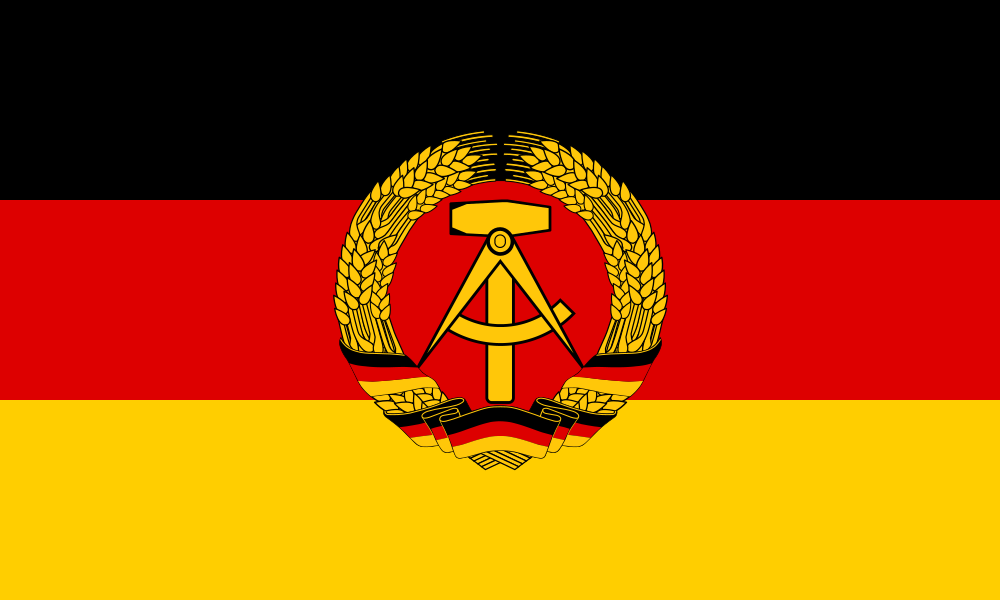

The last communist leader of East Germany, who succeeded Honecker, opened the Wall, and fell in 50 days
On 9 November 1989, Krenz read the travel regulation draft to the Central Committee, handed the note to Schabowski saying "Here, explain this to the journalists," and hours later the Berlin Wall was open.
Designated as Erich Honecker's successor, Egon Krenz was the last communist leader of East Germany, becoming SED General Secretary after Honecker was ousted in October 1989. Just three weeks into his tenure, he approved the draft travel regulations, read them to the Central Committee on 9 November, and handed the note to Günter Schabowski for announcement at a press conference; that night the Berlin Wall was opened. He promised reforms but never gained public trust, and resigned all his posts by early December. After reunification, he was convicted of manslaughter for the border deaths and served nearly four years of a six-and-a-half-year sentence.
Activities and affiliations
Career Timeline
- 1955Joined the Socialist Unity Party (SED)
- 1971–1974Chairman of the Ernst Thälmann Pioneer Organisation
- 1974–1983First Secretary of the FDJ Central Council
- 1983–1989SED Politburo member, CC Secretary for Security, Youth and Sport
- 1984–1989Deputy Chairman of the State Council
- 1989.10–12SED General Secretary
- 1989.10–12Chairman of the State Council and National Defence Council
- 1997Sentenced to 6.5 years for border deaths
Related historical events
From youth-organisation cadre to the party's number two (1953-1984)
Krenz's political career began in the youth movement. After finishing the tenth grade of secondary school in Damgarten on Rügen in 1953, he joined the Free German Youth (FDJ) that same year; he abandoned an apprenticeship as a metalworker at the Rostock diesel engine works and instead studied at the Diesterweg teacher-training institute in Putbus on Rügen from 1953 to 1957, qualifying as a primary-school teacher. He joined the Socialist Unity Party (SED) in 1955 and served in the National People's Army from 1957 to 1959, where he also held FDJ functions at divisional level. After his discharge he became FDJ secretary for the Rügen district in 1959 and first secretary of the Rostock regional FDJ leadership in 1960; in 1961 he was made a secretary of the FDJ Central Council with responsibility for the youth league's work at universities and technical colleges. From 1964 to 1967 he studied at the party college of the CPSU Central Committee in Moscow, graduating as a social scientist; until 1974 he was then a secretary of the FDJ Central Council responsible for agitation and propaganda and for FDJ work in schools.
In 1971 he became chairman of the FDJ's Ernst Thälmann Pioneer Organisation, holding the post until 1974, and in the same year entered the Volkskammer, East Germany's legislature (1971-1990), as well as its presidium (1971-1981). He joined the SED Central Committee in 1973 and led the entire youth organisation as first secretary of the FDJ Central Council from 1974 to 1983. After serving as a candidate member of the Politburo from 1976, he was elected to full Politburo membership and as Central Committee secretary for security, youth, sport, and state and legal affairs in 1983, the same post Honecker had held before becoming General Secretary. He sat on the Council of State from 1981 to 1984, and his appointment as its deputy chairman in 1984 made him the number-two man behind Erich Honecker, widely seen as heir apparent. He was the youngest member of the Politburo.