He built the Soviet government apparatus and studied the religious dissenters of the empire
On the night of October 1917, after the Smolny session, he put Lenin up in his own apartment. He fastened every chain and lock on the front door, loaded two revolvers, and dozed on the sofa listening for sounds — only to catch Lenin tiptoeing past him to the desk, pretending his host was asleep. By grey morning Lenin pulled from his pocket the handwritten draft of the famous Decree on Land and read it aloud. Bonch-Bruevich greeted the household: 'Congratulations on the first day of the Socialist Revolution.'
As Lenin's de facto personal secretary and first Administrator of Affairs of Sovnarkom (1917–20), he laid the foundations of the Soviet administrative apparatus. An ethnographer of Russian religious sectarianism, he was the driving force behind the 1919 law legalising conscientious objection.
Career timeline
1883–1892Entered Konstantinovsky Survey Institute; expelled for student activism; graduated from Kursk surveying school
1895–1903Joined RSDLP; Moscow Workers' Union; emigrated to Switzerland 1896; Iskra collaborator; organised Doukhobor migration to Canada
1903–1905Head of RSDLP Central Committee Expedition in Geneva; co-founded the Party Central Archive
1905–1912Returned to Russia; edited Novaya Zhizn and Nasha Mysl; ran Zhizn i Znanie publishing from 1908; Pravda editorial board 1912
1917.3–10Petrograd Soviet Executive Committee; commandant of Smolny–Tauride district
1917–1920Administrator of Affairs of Sovnarkom — built the Soviet administrative apparatus and executed the government's relocation to Moscow
1919Led drafting of the decree exempting religious conscientious objectors from military service
1920–1929Turned to scholarship and writing; managed the 'Lesnye Polyany' experimental state farm near Moscow
1933–1945Founded and directed the State Literary Museum in Moscow
1945–1955Director of the Museum of the History of Religion and Atheism, USSR Academy of Sciences, Leningrad
Lenin’s successor as premier, destroyed as the Right Opposition
In November 1917 Rykov resigned from Sovnarkom and the Central Committee alongside Kamenev, Zinoviev and others, objecting that the government had not formed a coalition of all socialist parties. Sources date this to 16 or 17 November; he retracted it a few days later.
Rykov became chairman of Sovnarkom after Lenin's death, leading the Soviet government for six years and embodying the administrative continuity of NEP. During the Civil War he had directed the wartime economy as chairman of VSNKh and overseen Red Army logistics. As premier he stood with Bukharin and Tomsky as the core of the party's 'Right,' championing the worker-peasant alliance, gradual socialist construction through the market, and balanced industrialization. He opposed Stalin's forced collectivization and breakneck industrialization during the 1928-29 grain crisis, was branded the 'Right Opposition' and removed as premier in 1930, arrested in 1937, executed after the third Moscow trial of 1938, and rehabilitated in 1988.
A local Soviet official caught in the revolution's backlash
On March 2, 1921, the Kronstadt insurgents arrested and imprisoned him.
Pavel Vasiliev was a Bolshevik local official who led the Kronstadt Soviet at the end of the Russian Civil War. He represented Soviet authority as sailors and workers opposing war communism and party rule turned their demands into an open confrontation. In March 1921 the insurgent forces arrested him alongside Nikolai Kuzmin, making his detention a revealing moment in the tension between revolutionary Soviet democracy and the party’s monopoly of power.
Career timeline
1919–1921Chairman of the Kronstadt Soviet
1919–1921Chairman of the Kronstadt Soviet executive committee
1921.3.1Represented Soviet authority at the Anchor Square assembly
1921.3.2Spoke at the delegate meeting and was arrested by the insurgents
Lenin's periphery-builder who brought Soviet power to Belarus and Armenia
When news of the October Revolution reached Minsk, Myasnikov immediately formed and led a Military Revolutionary Committee, and Soviet power was established there without bloodshed.
An Armenian Bolshevik born to a merchant family in Nakhichevan-on-Don. He joined the RSDLP in 1906 and was administratively exiled to Baku for illegal literature, where Shaumyan influenced him. In 1917 he led the Western Front Bolsheviks in Minsk and played the leading role in establishing Soviet power there. He chaired the Byelorussian SSR Central Executive Committee in February 1919, then from May 1921 headed the Armenian SSR Council of People's Commissars, building Soviet Armenia's state institutions and economy. From 1922 he chaired the Transcaucasian SFSR Union Council and served as first secretary of the Transcaucasian Kraikom. He wrote on Marxist-Leninist theory and Armenian literature. On 22 March 1925 his aircraft caught fire and crashed near Tiflis, killing him alongside Atarbekov and Mogilevsky; the cause of the fire was never established.
Career timeline
1906Joined the RSDLP; exiled to Baku for illegal literature — met Shaumyan
1911–1914Graduated Moscow University law faculty (1911); army service, then assistant barrister writing for Bolshevik press
1914–1917Served on the Western Front in WWI, revolutionary propaganda among soldiers
1917.9–1918.5Chairman of North-Western Regional Party Committee, Minsk VRK chairman, Western Front Commander
1919.1–2First Chairman of the Central Executive Committee and Military Commissar of the Byelorussian SSR
1919–1920Military organiser then secretary of Moscow Party Committee; head of Political Directorate, Western Front
1921–1922Chairman of the Council of People's Commissars and Military Commissar of the Armenian SSR; deputy chairman of ZSFSR
1922–1925Chairman of the Transcaucasian Union Council, first secretary of the Transcaucasian Kraikom — USSR CEC Presidium, Revolutionary Military Council, candidate CC member
1925.3.22Died in a plane fire near Tiflis alongside Atarbekov and Mogilevsky
Worker-Bolshevik premier of the Russian Republic destroyed by the state he helped industrialize
Arrested on 27 June 1937 while still performing his duties — seized during a session of the very Central Committee plenum that had just expelled him.
An Old Bolshevik who joined the party at fourteen as a factory worker, Sulimov rose through the Ural party apparatus to become Chairman of the Council of People's Commissars of the RSFSR (1930–1937), overseeing the republic's industrialization during the first two five-year plans. A member of the Central Committee (1923–1937) and the OrgBuro (1927–1930), he was among the highest-ranking Bolsheviks of worker origin to lead a Soviet government. Arrested during the June 1937 Central Committee Plenum immediately after Vyacheslav Molotov accused him of political disloyalty, he was tried for wrecking, espionage, and participation in an anti-Soviet terrorist organization of the Right, and executed on 27 November 1937. He was posthumously rehabilitated in 1956, and the city of Cherkessk bore his name, Sulimov, from 1934 to 1937.
Career timeline
1905Joined RSDLP(b), began factory work
1918–1919Chairman of Perm City Soviet Executive Committee; Collegium member, Mining-Metallurgical Dept., VSNKh
1919–1920Chairman of Chelyabinsk Gubernia Committee, RKP(b)
1923–1926Chairman of Ural Oblast Executive Committee
1926–1927First Secretary, Ural Oblast Committee, VKP(b)
1927–1930First Deputy People's Commissar of Railways, USSR
1930–1937Chairman, Council of People's Commissars, RSFSR
The economic administrator who led Ukraine's government for 11 years, caught between Stalin's demands and the famine
In June 1932 Chubar reported to Stalin and Molotov that "tens of thousands of malnourished, starving and swollen people" were dying of famine "in every village", and asked for grain relief. Stalin replied that "Chubar is mistaken ... Ukraine has been given more than it should get".
An economic administrator born to a poor Ukrainian peasant family in Fedorivka, he joined the RSDLP in 1907. From 1923 he chaired the Ukrainian SSR's Council of People's Commissars for eleven years, driving industrialisation and collectivisation, and in June 1932 he reported the famine to Stalin and Molotov and requested emergency grain. He also bore responsibility for enforcing collectivisation and the 1932–33 famine, and in 2010 the Kyiv Court of Appeal ruled him one of the organisers of the Holodomor. A full Politburo member from 1935, he was arrested in 1938 and shot the next year, then rehabilitated in 1955.
Career timeline
1891, 1907Born in Fedorivka, Yekaterinoslav gubernia, into a poor peasant family; organised Social Democratic circles in factory districts and joined the RSDLP at 16
1911–1917Factory worker in Kramatorsk, Mariupol, Moscow, Petrograd; underground activism
1917Member of Petrograd Central Council of Factory Committees; commissar to Main Artillery Directorate during October Revolution
1918–1923Chairman of GOMZa, member of VSNKh Presidium; chairman of Organisational Bureau for Restoration of Ukrainian Industry
1921–1923Chairman of Ukrainian VSNKh and Central Coal Industry Administration (one source dates his VSNKh chairmanship to 1920–21; the dating differs between sources)
1923–1934Chairman of Sovnarkom Ukrainian SSR (11 years); led industrialisation and collectivisation
1923–1925, 1934–1938Deputy Chairman of USSR Sovnarkom
1926–1935Candidate member of Politburo CC VKP(b)
1935–1938Full member of Politburo CC VKP(b)
1937–1938People's Commissar for Finance USSR
1938.7.4Arrested on charges of being a 'German intelligence agent' and a member of an anti-Soviet sabotage organisation; removed from the Politburo
1939.2.26Sentenced to death by the Military Collegium of the USSR Supreme Court and shot the same day; rehabilitated in 1955
Architect of Soviet science administration, from Lenin's personal secretary to Academy permanent secretary
When State Bank director Shipov was arrested and brought to Smolny, Gorbunov was "obliged, as a mark of special courtesy and greatly to my annoyance, to let him have my bed while I slept on chairs."
Nikolai Gorbunov was a Bolshevik technocrat who built the early administrative apparatus of the Soviet government as Secretary of Sovnarkom and Lenin's personal secretary from November 1917. As rector of the Bauman Moscow State Technical University (1923–1929) and permanent secretary of the USSR Academy of Sciences (1935–1937), he was a pivotal link in science administration, actively backing Nikolai Vavilov's plant explorations and the creation of VASKhNIL. He led the Pamir expedition (1932–1935), organizing the 1933 first ascent of Stalin Peak, the USSR's highest summit, and joined climber Yevgeny Abalakov in the final assault. Arrested in 1938 in the 'climbers' case' during the Great Purge, he was executed and rehabilitated in 1954.
Career timeline
1917–1920Secretary of Sovnarkom RSFSR, personal secretary to Lenin
The decade-long head of Byelorussia's government who signed the Academy purge, then stood in the same dock
On 21 June 1937, during interrogation in a fifth-floor room of the Minsk NKVD, Goloded — accused as a 'Polish spy' — threw himself from the window; the official cause was suicide, but unofficial accounts claim he was beaten to death and the jump staged.
Born a peasant who herded cattle from age seven, he joined the Bolsheviks in 1918 and from 1927 chaired the Byelorussian government for a decade, leading the industrialization and collectivization that turned the republic from an agrarian into an industrial land, for which he received the Order of Lenin in 1935. Yet he who had personally signed the resolution expelling the republic's academicians fell victim to the same terror: arrested in 1937 as a 'Polish spy,' he died after throwing himself from a fifth-floor NKVD window in Minsk.
Career timeline
1911–1915Track repairman, locksmith, and electromechanic at the Dubovaya Balka mine, Krivoy Rog
1917Revolutionary agitation in soldiers' committees, Southwestern Front
1918–1921Joined RCP(b); organised Red Guard unit fighting German and UNR troops; Soviet work in Novozybkov district
1921–1924Chairman of Gorki District Executive Committee; chairman of anti-banditry troika
1925–1927Second Secretary, Central Committee of the CP(b) of Belarus
1927–1937Chairman, Council of People's Commissars of the BSSR; led industrialisation and collectivisation
1930Candidate member, CC VKP(b); signed resolution expelling six academicians from the Belarusian Academy of Sciences
1937.6.14Arrested in Moscow, transferred to Minsk; died 21 June during NKVD interrogation
1956Posthumously rehabilitated and reinstated in the Party
Khrushchev's loyal executor: a peasant-born apparatchik who twice led Soviet Ukraine's government
'Silence was his trump card. He'd wait for Khrushchev to propose something, then say: "Yes, yes, of course, that's exactly right."' — William Taubman
Soviet party and state leader who twice headed the Ukrainian SSR government (1938–1939, 1947–1954) and served 15 years as Chairman of its Supreme Soviet Presidium (1954–1969). Born to a poor peasant family, he joined the Bolsheviks in 1918 and organized Red partisans. In the 1930s he formed a lasting patron-client bond with Nikita Khrushchev in Moscow's Bauman district, riding that connection to the chairmanship of the Ukrainian Council of People's Commissars during the Great Purge. He organized partisan resistance under German occupation and led postwar reconstruction. Remembered as a classic yes-man whose silence was his trump card.
Career timeline
1918–1920Red partisan organizer & Red Army political worker
1921–1928Secretary, Shostka, Chernigov & Pervomaisk party committees
1931–1937Bauman District Soviet chair → 2nd Sec. Moscow Oblast → 1st Sec. Western Oblast
1938Acting 1st Secretary, Dnipropetrovsk Oblast Committee
1938–1939Chairman, Council of People's Commissars, Ukrainian SSR
1939–1947Secretary, CC CP(b)U (wartime partisan organizer)
1947–1954Chairman, Council of Ministers, Ukrainian SSR (second term)
1954–1969Chairman, Presidium of Supreme Soviet, Ukrainian SSR
The weaver who became wartime premier of the Russian republic
On 10 October 1941 Stalin named Khokhlov to the Western Front Military Council alongside Zhukov and Bulganin: 'Block the road to Tula and Moscow as long as possible.' The three names appear together on every order of the Battle of Moscow.
Born to a peasant family in Gubino near Moscow, he started work as a weaver at ten, then in 1918 raised a detachment of 125 fellow villagers and joined the Red Army, fighting in the Civil War on the Eastern Front before being badly wounded. After the Leningrad Financial Academy he rose through the Moscow Oblast soviet and the Central Union of Consumer Societies (Tsentrosouz), becoming Chairman of the RSFSR Council of People's Commissars in 1940. When the Great Patriotic War broke out he served on the Western Front Military Council, directing troop and supply transportation during the Battle of Moscow and earning a lieutenant-general's rank: the only RSFSR premier to hold a front-line generalship. After the war he returned to Tsentrosouz to rebuild the rural cooperative network shattered by war, then headed the State Trade Inspectorate from 1955 until retirement in 1965.
Career timeline
1937–1938Chairman, Moscow Oblast Executive Committee
1938–1940Chairman of the Presidium, Tsentrosouz USSR & RSFSR
1940–1943Chairman, RSFSR Council of People's Commissars
1941–1944Member, Western Front Military Council (Battle of Moscow, liberation of Smolensk)
1944–1945Member, 3rd Belorussian Front Military Council (East Prussian offensive)
1945–1954Chairman of the Board, Tsentrosouz USSR
1955–1965Head, State Trade Inspectorate (USSR & RSFSR Ministries of Trade)
On the Western Front in 1941, German bombers flying in formation toward Moscow made Bulganin frantic: 'Why aren't we shooting them down?' Zhukov looked up from his map: 'Calm yourself, Nikolai Alexandrovich. If we shoot here they will bomb our own positions; let the rear units deal with them.'
A Chekist-turned-administrator, Bulganin rose through Moscow city administration, the MELZ electric-lamp plant and the RSFSR premiership to Stalin's trust. From 1938 he was a deputy chairman of the Council of People's Commissars and twice headed the Gosbank board, and during the war he served on the military councils of the Western, 2nd Baltic and 1st Belorussian fronts. Made a Marshal in November 1947 so that the parade reviewer's rank would not fall below the parade commander's, he was valued not as a strategist but as a reliable executor. After Stalin's death he took Defence, then in 1955 the premiership, forming the 'B&K' duo with Khrushchev and touring Yugoslavia, India and Britain. In the 1957 Anti-Party Group crisis he vacillated between the camps; in 1958 he lost both the premiership and the marshal's rank. He died in Moscow in 1975.
Career timeline
1918–1937Served in the Cheka, then in the Moscow electrical trust and as MELZ plant director, before chairing the Moscow City Soviet executive committee
1944–1947Wartime administrator in the State Defense Committee and military administration
1947–1949Minister of the Armed Forces, involved in postwar military reorganization
1953–1955Minister of Defence, the military-administrative figure in the post-Stalin collective leadership
1955–1958Chairman of the Council of Ministers, governing with Khrushchev after Malenkov
1957–1958Vacillated between the camps in the Anti-Party Group crisis and lost the premiership after its defeat
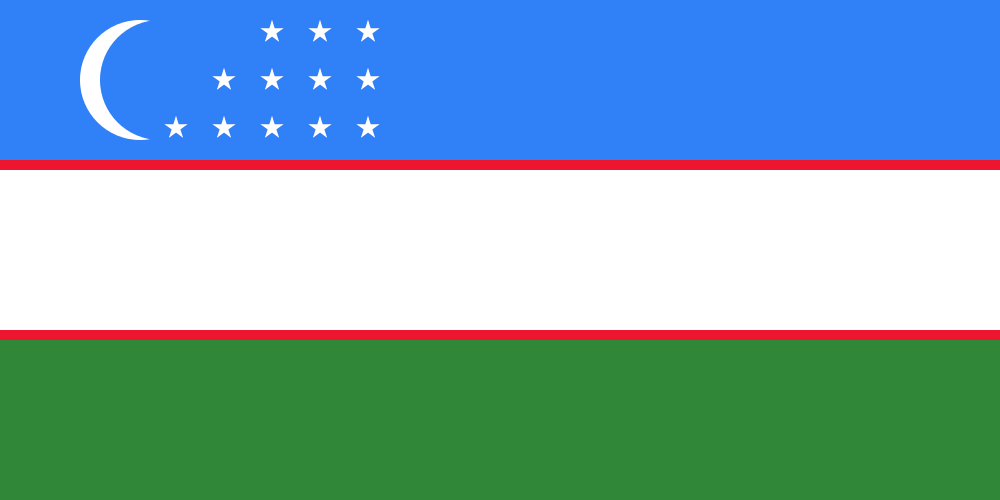
Son of a Bukharan merchant who rose from the Jadid reform movement to become the first head of government of Soviet Uzbekistan
Russian diplomat Alexander Barmine recalled: "Fayzulla Khodzhayev, called the 'Lenin of the Uzbeks,' was small, wiry, and full of consuming energy, in spite of the malaria which often gave his face a greenish tinge. He enjoyed life, and could laugh gaily beneath a crushing load of work. He knew his people, was a great orator, and was much loved."
Born to a wealthy merchant family in Bukhara, Khodzhayev was sent to Moscow at age 11 and confronted the gap between traditional society and modern Europe. He joined the Jadid movement in 1916, co-founded the Young Bukharan Party, and after a failed 1918 coup against the Emir, fled to Tashkent under a death sentence. In 1920 he became Chairman of the Council of People's Nazirs of the Bukharan PSR, and in 1924 the first Chairman of the Council of People's Commissars of the Uzbek SSR, leading Central Asia's national delimitation and integration into the USSR. He opposed Stalin's cotton monoculture drive, lost influence, and was arrested in 1937, sentenced to death at the Third Moscow Trial.
Career timeline
1916Joined the Jadid movement, co-founded the Young Bukharan Party, member of its underground Central Committee
1918Failed coup against the Emir; fled to Tashkent; sentenced to death in absentia
1919–1920Organized the Bureau of Revolutionary Young Bukharans in Tashkent; edited Uchqun
1920–1924Chairman, Council of People's Nazirs, Bukharan People's Soviet Republic
1924–1937Chairman, Council of People's Commissars of the Uzbek SSR (first)
1925–1937Chairman of the CEC of the USSR from the Uzbek SSR
1937–1938Dismissed and arrested; sentenced to death at the Third Moscow Trial; executed 15 March 1938
Wartime RSFSR acting premier who oversaw civilian evacuation amid the Moscow panic
In May 1942, with German forces deep inside Soviet territory, Pamfilov became Acting Chairman of the RSFSR Sovnarkom. Until his death of heart failure less than a year later, he administered the entire Russian republic behind the front.
The son of an accountant who joined the Party as a teenager, Pamfilov rose through civil war and Kronstadt service to become a Soviet administrator. After managing Moscow's housing trust and serving as RSFSR People's Commissar of Public Utilities, he became deputy chairman of the USSR Evacuation Council in 1941, where prioritising party families over civilians contributed to the Moscow panic. In May 1942 he became Acting Chairman of the RSFSR Council of People's Commissars, administering the Russian republic through the war's most critical year until his death of heart failure. His ashes were interred in the Kremlin Wall and the Moscow Academy of Public Utilities was renamed in his honour.
Career timeline
1918–1919Chairman of volost revkom, secretary of Dukhovshchina uyezd ispolkom, volost party committee secretary, uyezd court secretary
1921Volunteer in suppression of Kronstadt uprising
1923Graduated from rabfak in Smolensk
1924–1927Studied Soviet law at Moscow State University, evening division
1927–1937Worked in Mossovet, manager of Moscow Housing Trust
1937–1938Head of Main Housing Administration, RSFSR People's Commissariat of Public Utilities
1938–1940People's Commissar of Public Utilities, RSFSR
1940–1942Deputy Chairman, RSFSR Council of People's Commissars
1941.9–12Deputy Chairman, Evacuation Council under USSR Sovnarkom
1942–1943Acting Chairman, RSFSR Council of People's Commissars
Chairman of the Leningrad City Executive Committee and one of the six executed in the Leningrad Affair
On 13 August 1949, Lazutin was summoned with other Leningrad leaders to Georgy Malenkov's office and arrested on the spot.
Born into a working-class family in Petropavlovsk, in present-day Kazakhstan, he began working as a railway fitter at fourteen. After rising through the Komsomol in Kazakhstan, he was transferred to Leningrad in 1937, and during the siege he served as city party secretary for trade and industry, responsible for keeping the city supplied. As chairman of the Leningrad City Executive Committee (effectively mayor) from 1946 to 1949, he oversaw the post-war reconstruction plan, the resumption of television broadcasting, and the dedication of the cruiser Aurora as a permanent memorial. Arrested in August 1949 in Georgy Malenkov's office alongside other Leningrad leaders, he was one of the six chief defendants in the fabricated Leningrad Affair, sentenced to death on 30 September 1950 and shot the following day.
Career timeline
1919–1925Railway fitter in Petropavlovsk
1925–1931Komsomol secretary and labour department head, Kazakh ASSR
1931–1937Studied at Leningrad Refrigeration Institute; instructor, Frunze District Party Committee
1937–1941Head of trade department, then deputy head of food industry and trade, Leningrad City Committee
1941–1944Secretary for trade and industry, Leningrad City Committee, responsible for supply during the siege
1944–1946First Deputy Chairman, Leningrad City Executive Committee
1946–1949Chairman of Leningrad City Executive Committee (effectively mayor)
1949–1950Leningrad Affair: arrested 13 Aug 1949, sentenced to death 30 Sep 1950, executed 1 Oct; rehabilitated 1954
Shortly before his death he wrote to Yeltsin: 'Bury me at public expense — I have no savings.' The premier who ran the Soviet economy for five years lived his entire life in a three-room apartment, spending his salary on buses he donated to schools.
A practical economic manager from Dnipropetrovsk who succeeded Kosygin as Chairman of the Council of Ministers at age 75. An honest engineer far removed from political ambition, he served as premier under three general secretaries: Brezhnev, Andropov, and Chernenko. While he embodied the bureaucratic continuity of late stagnation, in 1984 he chaired a reform commission that explored enterprise autonomy and the concept of a 'socialist market,' laying groundwork for ideas later realised under perestroika.
The RSFSR premier who rose in the Leningrad Affair's wake and fell at the 19th Party Congress
In October 1952, immediately after the 19th Party Congress, Chernousov was removed from the Orgburo and the RSFSR premiership. His next job was director of the Moscow Searchlight Plant.
A technocratic party official born in Syzran to a railway worker, Chernousov began in Komsomol and graduated from the Moscow Power Engineering Institute. From 1939 to 1948 he served as Second Secretary of the Moscow Oblast Committee under Alexander Shcherbakov, then was appointed RSFSR premier in March 1949 after Mikhail Rodionov was purged in the Leningrad Affair. Immediately after the 19th Party Congress in October 1952 he was stripped of all party posts and demoted to director of the Moscow Searchlight Plant; only after Stalin's death was he brought back as Deputy Minister of the Automobile Industry, ending his career quietly in Gosplan and Comecon.
Career timeline
1949–1952Chairman, RSFSR Council of Ministers
1949–1952Member, Orgburo of the CC VKP(b)
1948–1949Head, Dept. of Party, Trade Union & Komsomol Organs, CC VKP(b)
1939–19482nd Secretary, Moscow Oblast Committee VKP(b)
1939–1952Candidate member, CC VKP(b)
1938–19391st Secretary, Stalinsky District Committee, Moscow
1955–1957Deputy Minister, Automobile Industry USSR
The non-Politburo power who was the institutional memory of the Soviet government for 25 years
In 1979 Brezhnev stalled his Hero of Socialist Labour — Smirtyukov was, he said, a key figure in the government's feud with the CC. Kosygin took it to the Politburo himself; Tikhonov and Shcherbitsky backed it, and the award passed.
He joined the Council of People's Commissars apparatus at 21 in 1930 and served in the Kremlin for 60 years until 1990, the living embodiment of the Soviet government machinery. As Mikoyan's assistant, he handled wartime Red Army supply for the State Defence Committee; from 1964 he served for 25 years as Administrator of Affairs of the Council of Ministers under Kosygin, Tikhonov, and Ryzhkov. Alone among non-Politburo officials, he received the most secret Politburo decisions, and Central Committee department heads were instructed to coordinate major plans with him. His institutional memory was the axis that kept the state running through every change of leadership.
Career timeline
1924–27Village soviet secretary, cooperative secretary, club manager
1927–31Moscow State University, faculty of Soviet law
1930–41Sovnarkom apparatus: senior referent, consultant, sector head
1941–46Deputy head of Sovnarkom Secretariat, assistant to Mikoyan on GKO supply
1946–53Deputy head, Council of Ministers Secretariat
1953–64Deputy Administrator of Affairs, Council of Ministers
1964–89Administrator of Affairs, Council of Ministers
Brezhnev-era industrial technocrat who ran the Russian republic for 12 years
Brezhnev, appointing Solomentsev as RSFSR premier: 'We have no separate Communist Party of Russia — I lead the Russian party organizations as General Secretary, and I ask you to be my deputy for the Russian Federation.'
A mechanical engineer from the Leningrad Polytechnical Institute who rose from defense-plant floors to chair the RSFSR Council of Ministers for an unprecedented 12 years (1971–1983), managing the economy of the largest Soviet republic as Brezhnev's unofficial 'deputy for the Russian Federation.' Elevated to the Politburo and chairmanship of the Party Control Committee in 1983, he led the 1987–1988 commission to rehabilitate victims of Stalin-era repression but was abruptly purged by Gorbachev at the September 1988 CC plenum.
Career timeline
1940Graduated Leningrad Polytechnical Institute; assigned to defense plant
1941–1948Party organizer at evacuated defense plants in the Urals
1948–1954Chief engineer then director of plants in Zlatoust and Chelyabinsk
1955–1959Secretary, Second Secretary of Chelyabinsk Oblast, then Sovnarkhoz chairman
1959–1962First Secretary, Karaganda Oblast Committee, Kazakhstan
1962–1964Second Secretary, CC of Communist Party of Kazakhstan
1964–1966First Secretary, Rostov Oblast Committee
1966–1971CC Secretary and Head of Heavy Industry Department
1971–1983Chairman, RSFSR Council of Ministers
1983–1988Chairman, Party Control Committee; full Politburo member
1987–1988Chaired Politburo Commission for rehabilitation of victims of 1930s–1950s repression
1988Dismissed from all posts at September CC plenum; retired
Belarusian partisan leader who rose to Brezhnev's Politburo and served as USSR First Deputy Premier for thirteen years
If I were asked today to lead such an operation, I would not accept. I ask the Czechs to forgive us.
A Belarusian partisan leader who became First Secretary of the Communist Party of Belarus in 1956, then served as a full Politburo member and First Deputy Premier of the USSR for thirteen years from 1965, overseeing economic policy and acting as Brezhnev's political supervisor during the 1968 Warsaw Pact intervention in Czechoslovakia.
Career timeline
1933–1936Technician, Parichi district road department; graduate of Gomel Highway Technical School
1936–1938Red Army service; then political department of Belarusian Railways
1940–1941Secretary, Gomel City Komsomol → First Secretary, Brest Regional Komsomol
1942–1943Representative of Central Partisan Staff in Belarus; secretary of underground Komsomol CC (Lt. Colonel → Colonel)
1943–1947Second Secretary → First Secretary, CC of Komsomol of Belarus
1949–1950Second → First Secretary, Minsk City Committee, CP(b) of Belarus
1950–1953First Secretary, Minsk Regional Committee, CP of Belarus
1953–1956Chairman, Council of Ministers of the Byelorussian SSR
1956–1965First Secretary, CC of the Communist Party of Byelorussia
1957–1965Candidate member, CPSU Presidium
1965–1978Full Politburo member & First Deputy Chairman, USSR Council of Ministers; on-site political supervisor for 1968 Warsaw Pact intervention in Czechoslovakia
1986–1989First Chairman, All-Union Council of War and Labour Veterans
The last RSFSR premier who tried not to break Russia away
October 1989, at the CC CPSU meeting on the RSFSR political system: "Creating a separate Russian Communist Party is the path to splitting the Soviet Union." He directly opposed Gorbachev's plan.
A Soviet institutional figure who rose from aviation plant engineer to first secretary of the Kuibyshev and Voronezh regions. Sidelined as ambassador to Cuba under late Brezhnev, he was politically revived when Andropov sent him to Krasnodar to purge corruption. In 1983 he became chairman of the RSFSR Council of Ministers and a full Politburo member, leading the Russian republic's government for five years; immediately after Chernobyl he served as deputy chairman of the government commission dealing with the disaster. In 1988 he moved to chairman of the RSFSR Supreme Soviet Presidium, but when Gorbachev pushed for a separate Russian Communist Party in the final years of perestroika, Vorotnikov openly opposed it, defending the RSFSR within the union framework to the end.
Career timeline
1942–60Kuibyshev aviation plant: engineer → party committee secretary
On 24 May 1990, in a Supreme Soviet session broadcast live nationwide, Ryzhkov said bread and food prices were unjustifiably low and had to rise. As ration cards appeared in hundreds of Soviet cities in 1989–1990, the televised statement shattered public confidence in his government.
Born 28 September 1929 in the village of Dyleevka, Donetsk Oblast, Ukrainian SSR, into a miner's family, and died in Moscow on 28 February 2024 at 94; his family background is described as Russian. He rose from general director of Uralmash and first deputy chairman of Gosplan to chairman of the Council of Ministers in September 1985, holding office until the Council of Ministers was dissolved on 26 December 1990 while remaining formally head of government until Pavlov took over on 14 January 1991. After a December 1990 heart attack he ran in the 1991 Russian presidential election, finishing second to Yeltsin with about 13.36 million votes. He was elected to the State Duma in 1995 and joined the Federation Council in 2003.
Belarus's first prime minister; co-signed the Belovezh Accords and later testified the Russian delegation alone arrived with a plan
'Neither I, nor Shushkevich, nor Kravchuk, nor Fokin knew such a document would be prepared and signed': Kebich insisted only the Russian delegation arrived with a plan for the Belovezh Accords.
A mechanical engineer from the Belarusian Polytechnic Institute, he rose through Minsk factories into the Belarusian Communist Party apparatus and became Chairman of the BSSR Council of Ministers in 1990. In December 1991 he co-signed the Belovezh Accords alongside Shushkevich, formally dissolving the USSR; he later testified that the Russian delegation alone arrived with a prepared plan while the Belarusian and Ukrainian sides did not know such a document would be drafted, revealing the tension between spontaneity and premeditation at the meeting. He lost the 1994 presidential election overwhelmingly to Alexander Lukashenko and thereafter served as a parliamentary deputy supporting Lukashenko's pro-Russian and constitutional-revision agenda.
Career timeline
1958Graduated, Engineering Faculty, Belarusian Polytechnic Institute
1958–1973Engineer to deputy chief engineer, Minsk Automatic Lines Plant
1973–1980Chief engineer, director, then general director, Minsk Kirov Machine-Tool Plant
1980–1985Second Secretary, Minsk City Committee; department head, CC CPB; Second Secretary, Minsk Oblast Committee
1985–1990Deputy Chairman, BSSR Council of Ministers and Chairman, Gosplan BSSR
1990–1994Chairman, BSSR Council of Ministers / Prime Minister of Belarus
1996–2004Deputy, House of Representatives of Belarus