Bessarabia: revolution and union with Romania
How did the Russian province of Bessarabia pass through the Moldavian Democratic Republic of 1917 into union with Romania in 1918, and why did this border, never recognized by Soviet Russia, lead to the risings of 1919 and 1924 and to the Moldavian autonomous republic east of the Dniester?
After the February Revolution, Bessarabia saw a Moldovan national movement, peasant land seizures and soldiers’ committees rise together, and in December 1917 the Sfatul Țării proclaimed the Moldavian Democratic Republic. Romanian troops entered in January 1918, fighting the Bolsheviks and the Rumcherod, and the Sfatul Țării voted for union with Romania, conditionally in March and unconditionally in December. Soviet Russia never recognized it; after the Khotyn and Bender risings of 1919 and the Tatarbunary rising of 1924 were crushed, the USSR set up the Moldavian Autonomous Soviet Socialist Republic east of the Dniester.
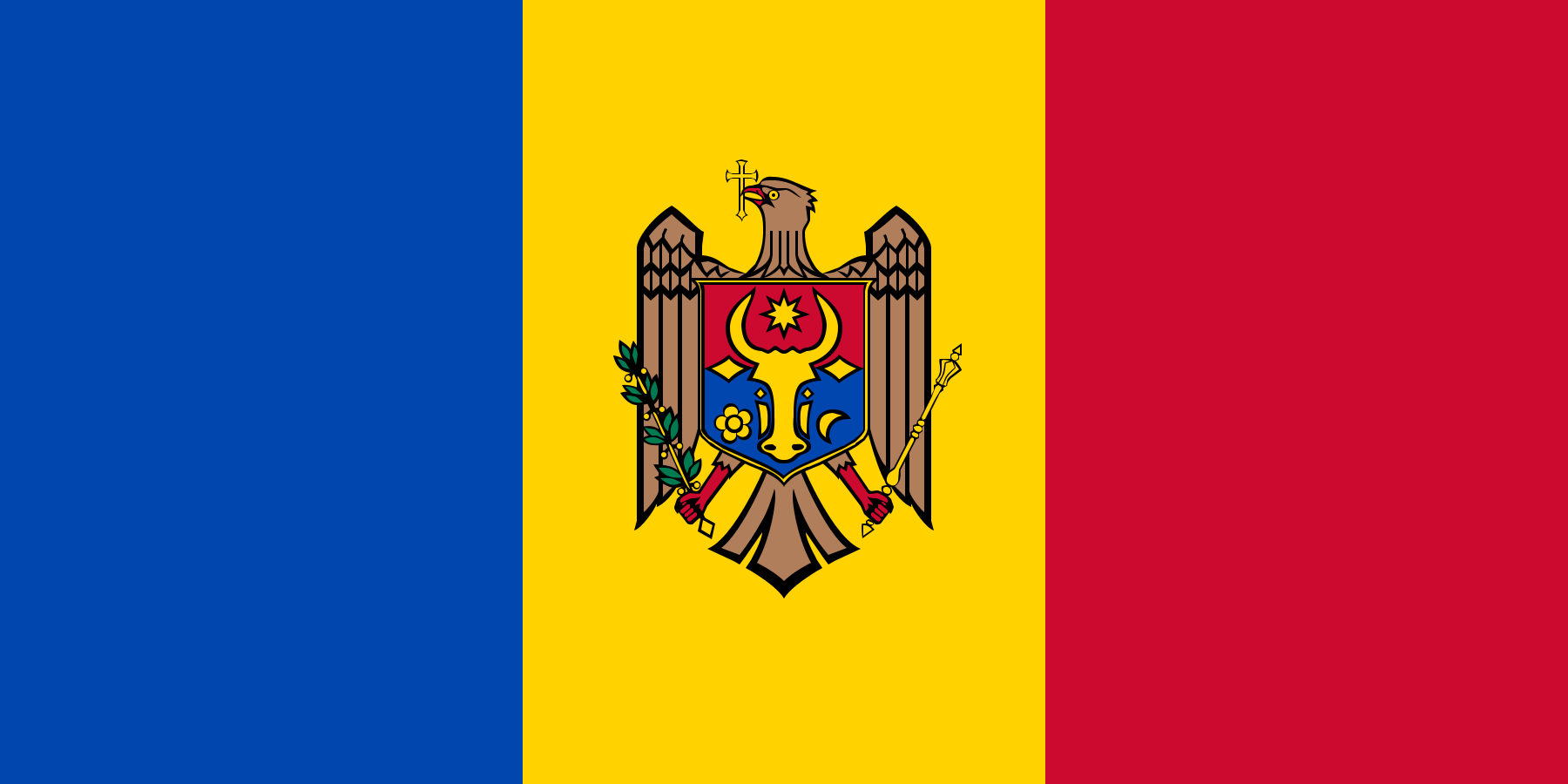
 Bessarabia in 1917: from imperial province to the demand for autonomy
Bessarabia, the land between the Prut and the Dniester, came into being in 1812, when the Treaty of Bucharest handed the eastern half of the Principality of Moldavia to the Russian Empire. At first an oblast with wide autonomy, it lost its self-government in 1828 and became the Bessarabia Governorate. Through the nineteenth century Ukrainian, Russian, Bulgarian, Gagauz, Jewish and German settlers arrived, so that by about 1920 Slavs alone made up more than a fifth of the population, and from the 1860s Romanian was banned in schools and in church. The result was illiteracy rather than assimilation: in 1897 only 18% of men and 4% of women could read. In the First World War 300,000 Bessarabians were mobilised into the Russian army. According to Russian Wikipedia, at the start of the century Moldavians were the majority, with about 20% Ukrainians, 11% Jews, about 8% Russians, 5% Bulgarians and 4% Gagauz. The Hotin district in the far north probably had a Ukrainian majority, and the southern Budjak had few Moldavians as well. That mix gave every conflict of 1917–1924 a different colour in each district. 1 2 3
After the February Revolution the governor handed his powers to Constantin Mimi, chairman of the governorate zemstvo, who became Commissar of the Russian Provisional Government. Committees led by teachers and intellectuals appeared in nearly every village, and in April a congress of cooperatives in Chișinău demanded political, administrative, educational, religious and economic autonomy and a legislature called Sfatul Țării, the Council of the Country. The same month the National Moldavian Party was founded under Vasile Stroescu, uniting nobles and socialists alike; Pan Halippa and Ion Pelivan were among its members. In June a teachers' congress voted to switch teaching from Russian to Romanian and to adopt the Latin alphabet, though some delegates protested that they were not "Romanians" but "Moldavians", a quarrel over identity that never went away. When the Ukrainian Central Rada claimed Bessarabia in July, a delegation convened by Mimi, the Moldavian soldiers' committees and the Rumcherod in Odessa all protested, and the Rada withdrew its claim. 4 5 6
Soldiers and peasants carried the revolution into the streets. In spring 1917 "Moldavian Revolutionary Committees of Soldiers" appeared in Odessa, Kiev, Sevastopol and on the Romanian Front at Iași, and on 2 May more than 10,000 Bessarabian soldiers met in Odessa to demand autonomy and Moldavian units. On 30 May General Dmitry Shcherbachov, commander of the Romanian Front, allowed sixteen cohorts of Moldavian soldiers to be formed and stationed in Bessarabia's nine districts. Bands of deserters from the collapsing Russian army looted and killed, and by October whole regiments had turned into gangs. Peasants did not wait for the zemstvos or the Provisional Government. The First General Congress of Peasants of All Bessarabia, meeting in Chișinău on 14–15 October, reported that the land was being seized in disorder, as peasant committees and soviets divided up the estates. The congress also voted Ion Inculeț in as Commissar in place of Mimi, a move planned by Kerensky. From 2 to 9 November a Moldavian soldiers' congress in Chișinău, whose 9,000 delegates claimed to speak for 300,000 soldiers, proclaimed Bessarabia's autonomy and laid down the make-up of Sfatul Țării. 4 5 7 3
Sfatul Țării and the Moldavian Democratic Republic (December 1917)
Sfatul Țării opened in Chișinău on 4 December 1917. Its members were chosen by organisations rather than elected. Planned at 120 seats, it grew to 135 and then 150: in the end 44 came from the Moldavian soldiers' congress, 30 from the soviet of Moldavian peasants, 21 from towns and zemstvos, 10 from parties, 16 from cooperatives, unions and cultural societies, and 29 from minority organisations. By nationality there were 105 Moldavians, 15 Ukrainians, 13 Jews, 6 Russians, 3 Bulgarians and others. The Socialist Revolutionary Ion Inculeț became president and Pan Halippa vice-president. Inculeț, a lecturer at Petrograd University sent by Kerensky, had at first said that Bessarabia should stay in Russia. The veteran nationalist Ion Pelivan had initially won a majority, but minority deputies wanted someone loyal to the revolution and the Russian Democratic Republic, and a link to Russian state authority was useful, so the choice shifted to Inculeț. A contemporary account quoted by English Wikipedia judged the body "mainly appointive", not a representative assembly by normal standards, but a genuine governing organ amid the anarchy. 4 7 3
On 15 December Sfatul Țării proclaimed Bessarabia the Moldavian People's Republic, an equal member of "a single Russian Federative Democratic Republic". A "Bessarabian Republic" was proposed, but Pantelimon Erhan carried the argument that the state should bear the name of its largest people. The declaration promised that Sfatul Țării would hold power until a people's assembly was elected by universal suffrage, that a land law would give the land to those who worked it, and it pledged an eight-hour day and higher wages, abolition of the death penalty and rights for all nationalities. In practice, Russian Wikipedia notes, the government declared the Soviet Decree on Land void and placed all land under its own administration pending legislation. In December Sfatul Țării elected a nine-member Council of Directors General, with Erhan as chairman and director for agriculture: seven Moldavians, one Ukrainian and one Jew, with Ion Pelivan for foreign affairs. According to Russian Wikipedia the Petrograd Soviet and Sovnarkom recognised the new republic; Romanian accounts report that Lenin told a delegation, "You have every right to self-determination." 4 5 8 3 9
The new republic, however, did not control its territory. A joint meeting of SRs, Social Democrats and trade unions in Bender recognised Soviet power soon after the October Revolution, and the Chișinău soviet soon followed. Red Guards were formed, political prisoners freed, and peasant committees kept the Council of Directors' officials out of the villages. Moldavian soldiers refused to put down the peasant movement, and most units nominally under Sfatul Țării fell under Bolshevik influence. When the military director Teodor Cojocaru fell ill, Lieutenant Gherman Pântea took over, and by early January 1918 there were two cavalry regiments, an infantry regiment and sixteen cohorts, but their name suffered when the soldier Ilie Catărău used his men to loot villages and had to be arrested. In December the government sent envoys to Iași to ask the Entente and Romania for troops, and Pelivan sought help from Shcherbachov. According to Russian Wikipedia, on 28 December (Old Style) Erhan put the entry of Romanian troops to a vote in the peasant faction, which passed it with 38 votes, and the socialist bloc walked out of Sfatul Țării in protest. Pântea recalled that Moldavian soldiers were furious that "the Romanians would come to take away the land won in the revolution". 3 10 4 5 7

 January–March 1918: the Rumcherod and the Romanian advance
The Rumcherod, short for the Central Executive Committee of the Soviets of the Romanian Front, Black Sea Fleet and Odessa Oblast, was created at a congress in Odessa in May–June 1917. At first SRs and Mensheviks dominated it, but after it was dissolved on Nikolai Krylenko's order, a second congress held from 23 December 1917 to 5 January 1918 elected a new Rumcherod of 180 members: 70 Bolsheviks, 55 Left SRs, 23 from peasant organisations and 32 others, chaired by Vladimir Yudovsky. The new body recognised the Soviet government and became the supreme organ of the Odessa Soviet Republic. In Chișinău its Front Section, the Frontotdel, began preparing resistance to a Romanian entry. Iona Yakir, a native of Chișinău, had joined the Bolsheviks in 1917 and sat on the governorate soviet and the revolutionary committee. In mid-January 1918 the Frontotdel and pro-Bolshevik soldiers took control of Chișinău, and members of Sfatul Țării went into hiding. Russian Wikipedia records that on 19 January a detachment of Transylvanian volunteers approaching from Razdelnaya was disarmed by Rumcherod troops and Moldavian units that had changed sides, and sent to Odessa. 11 12 5 13 3
Ion I. C. Brătianu's Romanian government, with Entente approval, decided to intervene. Romanian troops crossed the Prut on 23 January, and General Ernest Broșteanu's 11th Infantry Division entered Chișinău on 26 January. Under pressure in the meantime, Inculeț and Erhan had wired Iași asking for the Romanian army to be withdrawn, but were ignored. Around Bălți Captain Anatolie Popa, once loyal to Sfatul Țării, fought the Romanians, and Yakir's small force resisted but was overwhelmed by the regular army. According to Russian Wikipedia, Romanian troops surprised a congress of Sixth Army soldiers at Bolgrad; in Chișinău five members of the presidium of the gubernial peasant congress were shot as anti-Romanian, and Rudnev, chairman of a Bessarabian congress of soviets that met on 31 January, was executed together with 45 delegates. Soviet Russia and Soviet Ukraine broke off relations with Romania. In the south the anarchist Anatoly Zheleznyakov organised the defence of Vylkove at the mouth of the Danube; according to English Wikipedia, Bolshevik gunboats held up the Romanians for several days from 27 January, but Vylkove fell on 3 February. 4 5 7 13 3
The heaviest fighting came at Bender (Tighina), the fortress town guarding the Dniester bridge, defended by a Bender headquarters under Grigory Borisov together with the Rumcherod Front Section, soldiers of the Zaamursky regiments and workers' detachments. Russian Wikipedia writes that the Romanians first entered the town in early February, were driven out by reinforcements from across the river, and finally took it on 7 February, after which about 3,000 residents were herded in front of the locomotive depot and kept in the cold, and some 500 defenders were shot. English Wikipedia, closer to the Romanian account, describes a five-day battle won by the Romanians at a cost of 141 dead, with 800 guns captured. Meanwhile Mikhail Muravyov, commanding the Red Army group of forces in Ukraine, rushed 3,000 men to the Dniester by rail in a single day and blocked a Romanian crossing. Under Entente pressure Alexandru Averescu signed for Romania on 5 March, and Christian Rakovsky, Yudovsky, Muravyov and others for the Soviet side on 9 March, a protocol to liquidate the Russo-Romanian conflict: Romanian troops were to leave Bessarabia within two months and order was to pass to local militia. 14 3 4 12 15
The protocol was never honoured. On the same 5 March Romania signed a preliminary peace with Germany and Austria at Buftea, and according to English Wikipedia a secret agreement let Romania annex Bessarabia in return for free passage of German troops to Ukraine. As German and Austrian forces swept into Ukraine and took Odessa, Rakovsky and the Rumcherod had to retreat; the Rumcherod moved via Mykolaiv and Rostov-on-Don to Yeysk in April and ceased to function in May. Russian Wikipedia says that right after the protocol Romanian troops took Akkerman and completed their hold on Bessarabia. The northern Hotin district was occupied by Austro-Hungarian troops in March, and Alexandru Marghiloman's peace in May ceded 600 square kilometres, including part of Hotin, to Austrian Bukovina. Meanwhile, on 6 February, Sfatul Țării unanimously declared the independence of the Moldavian Democratic Republic, citing the Ukrainian People's Republic's declaration of independence, which had cut Bessarabia off from Soviet Russia; the declaration reassured the population that the "brotherly Romanian troops" had come only to guard railways and grain stores. The Council of Directors was replaced by a Council of Ministers under Daniel Ciugureanu. 16 11 15 17 3 4
The two union votes of 1918 and Soviet non-recognition
The union was decided in Iași first. Inculeț and Ciugureanu shuttled there in March, and according to Russian Wikipedia they were told on 2 April that Romania, with the consent of both the Entente and the Central Powers, meant to annex Bessarabia, and on 5 April were handed a plan for a "conditional union". The French envoy Saint-Aulaire also urged Inculeț to move quickly. The landowner-dominated county councils of Bălți, Soroca and Orhei were first to petition for union, preferring the monarchy to the radical land reform of a Sfatul Țării dominated by left-wing populists. With Prime Minister Marghiloman in Chișinău, the vote was held on 9 April. Russian Wikipedia writes that the building was surrounded by Romanian troops with machine guns and that the vote was by open roll call rather than secret ballot. German, Bulgarian and Gagauz deputies announced their abstention, and Tsyganko of the peasant faction and Grekulov of the Russian Cultural League argued that only a referendum could decide the question. The result was 86 for, 3 against, 36 abstentions and 13 absent; 83 Moldavians voted for, while the abstainers included 8 Ukrainians, 6 Russians, 5 Bulgarians and 11 Moldavians. 3 7 1 4
The union of 9 April was conditional. Sfatul Țării would carry out a land reform which the Romanian government would accept, and Bessarabia would remain autonomous with its own democratically elected diet, which would vote local budgets, control zemstvos and town councils, and appoint the local administration. Further clauses provided for territorial conscription; no change to local laws and administration without local representatives' consent; respect for minority rights; two Bessarabian ministers in the Romanian government; direct, equal, secret and universal suffrage in all elections; constitutional freedom of speech and belief; and an amnesty for political offences committed during the revolution. That night in Iași Ferdinand I signed the decree of union with its conditions. Inculeț left the chair to become Romania's Minister of State for Bessarabia, and Constantin Stere was elected president of the diet. In April–June, Russian Wikipedia records, railwaymen struck first in Chișinău and then across Bessarabia, and munitions depots were burned or blown up at Bender, Ungheni and Ocnița. Marghiloman later admitted that the union had been decided in Romania. 1 4 7 3
The conditions lasted eight months. Once the Romanian parliament had approved the land reform in November 1918, the leaders of the Moldavian Bloc, on the very day Bukovina declared its unconditional union, urged the diet to drop the other conditions too. Russian Wikipedia writes that before the vote General Văitoianu, Romania's general commissioner for Bessarabia, summoned the deputies and pressed them to give up autonomy. The session on the night of 9–10 December was not publicly announced and lacked a quorum: according to English Wikipedia only 44 of 125 members attended, all voting in favour. They scrapped conditions two and three, the autonomous diet and local administrative powers, declared the union unconditional and voted to dissolve Sfatul Țării. The American scholar Charles King regards the vote as illegitimate. Many absent deputies sent a memorandum demanding the restoration of autonomy, to no effect. In autumn 1919 Bessarabia elected members of the Romanian Constituent Assembly, who on 20 December ratified the union acts along with those of Transylvania and Bukovina. Soviet Russia refused to recognise the union, arguing that Bessarabia had never been Romanian before 1918 and that the vote had been imposed under military occupation; until 1940 Soviet maps marked Bessarabia as occupied territory. 4 1 16 3 10
Reactions to the union divided along national and political lines. Alexander Loesch, the German deputy who abstained on 9 April, said he had no mandate from his community, but on 7 March 1919 a congress of Bessarabia's German colonists at Tarutino unanimously accepted the union, citing Sfatul Țării's guarantee of every nationality's right to be educated and judged in its own language. The Ukrainian Central Rada protested against Romania's "annexation". The Romanian government replied that Bessarabia had not been annexed but had declared "union with the motherland" by a decision of Sfatul Țării, that Ukraine had raised no claim to Bessarabia at Brest-Litovsk, and that on 19 January 1918 it had told the Romanian general Coandă it would not object. Opposition was stronger on the White side. Alexander Krupensky, the most powerful man in Tsarist Bessarabia, the former Chișinău mayor Alexander Schmidt and the former justice director Mihail Savenco formed a "Committee for the Defence of Bessarabia" in Odessa, which sent a memorandum to the Paris Peace Conference and appealed to French opinion, portraying Bessarabia as under Romanian military occupation. Their campaign was later supplanted by the Bolsheviks' proclamation of a Bessarabian Soviet Republic. 4
1919: the Khotyn and Bender uprisings
Hotin County lay at the northern tip of Bessarabia between Bukovina and Podolia, with mostly Ukrainian villages. On 22 October 1918 its zemstvo voted by majority for reunion with Russia, and on 10 November, as the Austrians left, General Cleante Davidoglu's Romanian troops moved in. They enforced an exclusion zone around the town, requisitioned food and collected weapons, and Davidoglu proclaimed Bessarabia "Romanian land today and forever", telling dissenters to leave for Podolia. Land legislation that returned land to owners or made peasants pay for it added to the anger. Peasant guerrillas were active from about 7 January 1919; on 19 January trained partisans crossed the Dniester from the territory of the Ukrainian People's Republic and took a string of villages, and on 23 January Khotyn itself rose and drove out the Romanian garrison. The rebels proclaimed a "Bessarabian Directorate", formed in Kamianets-Podilskyi, as their government, and their "Bessarabian People's Army" reportedly grew from 2,000 to 30,000 men. Russian Wikipedia says the revolt spread to about 100 villages. 17 18
The rising was mixed from the start. Ukrainian peasants formed its core, alongside groups of Moldavians, Cossack deserters from the Ukrainian People's Army, local Bolsheviks and Colonel Zhurari of the White "Committee for the Salvation of Bessarabia", who had trained guerrillas at Tiraspol with Volunteer Army money. The Directorate itself split between advocates of a "Republic of Little Bukovina" open to the Ukrainian People's Republic and of a "Bessarabian Democratic Republic" that would in effect have extended Soviet Russia. It arrested Khotyn's mayor and demanded 1.5 million roubles within three days, a burden that fell mainly on the town's Jews. The leaders of the Ukrainian People's Republic, who could not afford a war with Romania, formally forbade intervention, though some say units helped. On 25 January Christian Rakovsky, head of the Soviet Ukrainian government, asserted a claim to Bessarabia and Bukovina. Reinforced Romanian troops counter-attacked on 28–30 January and by 1 February had pushed the rebels back over the Dniester. Davidoglu had orders to crush resistance "with the greatest violence, including the complete destruction" of rebel villages. 17
The repression is disputed starting with the numbers. The Romanian historian Stănescu, citing Romanian military documents, put rebel dead at 300–400; other Romanian army records boasted of seven villages burned and up to 5,000 insurgents killed. The Ukrainian historian Potylchak counts 22 villages destroyed and 11,000 victims, including the execution of 165 railwaymen and 500 unarmed civilians, while judging estimates of 15,000 or more probably exaggerated; the figure of 11,000 was first publicised by International Red Aid in 1925. Romanian losses were 369, including 159 killed. The British naval officer McLaren reported looting, beatings and the shooting of 53 peasants at Nedăbăuți, but Khotyn's mayor and rabbis testified that the Romanians had restored order. Among Romanian generals, Ion Antonescu criticised the random killings as making Romania look like a "country of savages". About 50,000 peasants and 4,000–10,000 armed rebels fled across the Dniester. In early February Grigory Kotovsky's Bolsheviks, pushed out of Tiraspol by French troops, crossed the river and briefly chased Romanian soldiers out of Bender before a French–Romanian force drove them back. 17 19
In spring 1919 the Bolsheviks formalised their claim. On 5 May the Second Regional Bolshevik Conference in Odessa proclaimed a "Provisional Workers' and Peasants' Government in exile", and on 11 May the Bessarabian Soviet Socialist Republic was set up at Tiraspol as an autonomous part of the RSFSR, with Ivan Krivorukov as chairman and Mihail Bujor among its commissars for foreign affairs; it never governed any part of Bessarabia. In early May Vladimir Antonov-Ovseenko weighed a march to "free Bessarabia" through Khotyn, and ultimatums demanding withdrawal were radioed to the Romanian government. But Nykyfor Hryhoriv's mutiny on 8 May and Denikin's offensive made a campaign impossible. A rising went ahead in Bender anyway on 27 May: rebels led by Grigory Borisov, mostly railwaymen, together with about 150 men of the Third Ukrainian Soviet Army who had crossed the river, seized the station, post office, telegraph and the railway bridge, while some French soldiers stayed neutral or joined them. That evening Romanian troops and French colonial Algerian units crushed the rising, and at least 150 rebels were executed. The Bessarabian Soviet government was disbanded in September after Denikin's army took Odessa. 20 21 14 17
Romanian Bessarabia: land reform, emergency rule and the Paris treaty
Bessarabia's land reform was legislated by Sfatul Țării in 1918–1919 but changed considerably under Romanian pressure. Sfatul Țării had meant to give land to the peasants free; pressure from the Old Kingdom's great landowners brought compensation for former owners. The reform was more radical than in the Old Kingdom or Transylvania, with lower payments and lower exemption limits, but it also reversed some of the land seizures peasants had made during the revolution, which caused resentment. Of the 1.5 million desyatinas (40% of farmland) held by large landowners in 1917, 38.6% went to peasants, about a third was restored to its owners, and the rest became state property, much of it later awarded to Romanian army officers, officials and clergy. Deputies who had voted for union in 1918 received 50 hectares each. The target was 6 hectares per person, but more than two-thirds of households got less than 5, and in 1931 367,800 families were still landless. Peasants had to pay for their land over twenty years with little state support or credit, and implementation dragged on into the early 1930s. To win recognition of the union, Romania promised preferential compensation to former owners with British, French and Italian citizenship. 16 1
The manner of rule changed what union meant. According to the Dutch scholar Wim van Meurs, Bessarabia long remained under a state of emergency and military administration, justified by border incidents and unrest among peasants and minorities, with strict censorship against Bolshevik propaganda. The zemstvos that had run local affairs were abolished in the early 1920s, and education and health services shrank with them. Charles King writes that corrupt and heavy-handed Romanian administrators were especially common in the region, and that the Siguranța secret police kept the minorities under wide surveillance, treating refugees from across the Dniester and Bessarabian students as potential Bolshevik agents. Russians were regarded as "Bolsheviks in disguise", their churches and libraries closed or Romanianised, and locals came to feel that Bessarabia had been "occupied by Romania rather than united with" it. In Hotin the prefect was investigated in 1923 for buying up every pig in the county and selling them in Bukovina. In 1924 Pan Halippa accused the government of turning Bessarabia into an "inferno" where the Moldavian people suffered more than under the Tsars. On the other hand, turnout in the November 1919 elections was 72.2%, and the Moldovan historian Anatol Petrencu holds that Bessarabia enjoyed multi-party democracy in this period. 16 1 17
The Dniester stayed restless after the fighting ended. In summer 1919 the Romanian government let Bessarabian White officers enlist in Denikin's Armed Forces of South Russia, but the Whites too regarded Bessarabia as Russian. Denikin promised members of the Salvation Committee to help them take Bessarabia once he had finished off the Ukrainian People's Republic, and a 14th Infantry Division began forming for its recovery. The 12 million roubles the Whites collected for the purpose were seized by Kotovsky and the Red Army, which retook Tiraspol without a fight in February 1920. Soviet subversion followed. A Romanian diplomatic cable of June 1920 claimed 200 Red Army recruiters were active in Hotin County, and from October the Ukrainian Communist Party's foreign-infiltration office, Zakordot, organised small guerrilla units for hit-and-run raids across the Dniester. In 1921 officials and clergymen were murdered, and the manor of the landowner Moșan, accused of organising reprisals after 1919, was attacked and several of his family killed. Romania prosecuted 1919 rebels for years; in 1925–1926 a peasant sentenced to five years on fabricated gendarmerie testimony proved at retrial that he had not even been in Bessarabia during the revolt. 17
International recognition was never completed. In the Paris Peace Conference's Territorial Commission on Romanian Affairs, the only Romanian question on which the American, British, French and Italian delegates agreed was that Bessarabia should belong to Romania. On 28 October 1920 Britain, France, Italy and Japan signed the Treaty of Paris with Romania, recognising its sovereignty because "from the geographical, ethnographical, historical and economic point of view the union of Bessarabia with Romania is fully justified". Japan, however, never ratified it, so the treaty never entered into force. The United States refused to sign because Russia had not been represented, and while keeping political and economic ties it treated Bessarabia as territory under Romanian occupation rather than as part of Romania. On 1 November representatives of the RSFSR and Soviet Ukraine declared that no agreement on Bessarabia concluded without them had any force and that they were in no way bound by a treaty signed by other governments. Soviet and Romanian envoys met repeatedly, in Copenhagen, Warsaw, Genoa and elsewhere, without agreement, and historians of both countries long argued over who first broke the 1918 agreement with the Rumcherod. 1 22 16 10 23
1924: the Vienna talks and the Tatarbunary Uprising
From 27 March to 2 April 1924 Soviet and Romanian delegations met in Vienna to normalise relations. Romania had not recognised the new USSR and the two had no diplomatic ties. Nikolay Krestinsky led the Soviet delegation, and Maxim Litvinov proposed a plebiscite in Bessarabia. The Romanian delegation retorted, citing Leon Trotsky, that no plebiscite had ever been held anywhere in the Soviet Union, and argued that Bessarabia was Romanian in character and its people had repeatedly exercised self-determination, making a plebiscite "futile and offending". On 2 April Romania rejected the proposal and broke off talks. According to Russian Wikipedia, on 6 April the foreign commissariat told Pravda in Moscow, "Until a plebiscite we will regard Bessarabia as an inalienable part of the Soviet Union." On 28 July a royal decree banned the Romanian Communist Party. In December 1923 the sixth conference of the Balkan Communist Federation had already condemned Romania for seizing other peoples' lands in 1918 while Russia was weak. 23 24 16
A rising was already being prepared. In May 1922 a party committee directly under Soviet control was set up in southern Bessarabia, led by the Comintern agents Andrey Klyushnikov (alias Nenin) and Nikolai Shishman with three local activists, and taking orders not from the Romanian Communist Party but from a special centre in Odessa. They organised revolutionary committees with armed squads of 20–30 men in 25 villages and the towns of Cahul and Ismail across the three counties of Cahul, Ismail and Cetatea Albă, and stockpiled 3,000 grenades, 1,000 rifles, seven machine guns and more at Strumok and Nerushai. On 8 August 1924 a meeting chaired by Vasil Kolarov, secretary of the Balkan Communist Federation, drew up a Comintern plan dividing Romania into five zones for risings in mid-September, counting on peasant anger at the 1921 land reform and the famine that the summer drought of 1924 had brought to southern Bessarabia. According to Russian Wikipedia, Grigory Kotovsky, commanding a cavalry corps across the border, proposed to Mikhail Frunze to settle the matter with "a dashing cavalry raid". Klyushnikov told the participants that the Red Army would come to their aid once the rising began. 23 24 25
On 11 September thirty men landing by boat raided the Black Sea village of Nikolaievca and killed the mayor and two gendarmes. When several leaders were arrested, Nenin brought the timetable forward, and on the night of 15–16 September armed groups seized the town hall of Tatarbunary and proclaimed a "Moldavian Soviet Republic" as part of Soviet Ukraine. The town secretary, the gendarmerie chief, two Romanian soldiers and others were killed, and Nenin told the assembled residents that the Red Army had crossed the Dniester. The rebels numbered 4,000–6,000, mostly Ukrainians and Russians; Romanians, Bulgarians and Germans hardly joined. Forty German volunteers from Sarata were the first to fight them, followed by artillery and marines of the Romanian Third Army Corps and the Danube flotilla. At dawn on 18 September Romanian troops stormed Tatarbunary after shelling it. Klyushnikov was shot by a gendarme as he fled. English Wikipedia says 1,600 people were arrested and 3,000 died; Russian Wikipedia says more than 3,000 died and that the Romanians used chemical shells when they took the town on the 19th. At the 1925 "Trial of the 500", 489 people were prosecuted and 85 convicted. 23 24 25
After Tatarbunary: the Moldavian ASSR (October 1924)
Tatarbunary left a long mark inside and outside Romania. The "Trial of the 500" ran for 103 days, from 24 August to 2 December 1925, before the Third Army Corps military court. Most defendants spoke no Romanian and needed interpreters, and the government's file ran to some 70,000 pages. Only nine defendants were Romanians, and none of the 85 convicted. The heaviest sentence, life at hard labour for the rebel leader Iustin Batishchev, was later cut to 16 years. The trial drew international attention: Romain Rolland, Paul Langevin, Theodore Dreiser, Albert Einstein and others spoke up for the defendants, and Henri Barbusse travelled to Romania to watch the proceedings and then wrote The Hangmen. The authorities admitted their response had been disproportionate, but Romania became known abroad as a "prison of minorities". The third Mârzescu Law, passed in December 1924, banned the Communist Party in practice and led to the arrest of almost all its members, most of them non-Romanians. Many participants in the rising fled across the Dniester to the village of Jura in the Moldavian ASSR, where they were well received, but suffered greatly in the Great Purge of 1937–1938. 23
Right after the rising was crushed a new republic appeared east of the Dniester. In February 1924 Kotovsky and nine others, including Bolsheviks from Romania, sent a memorandum to the Central Committees of the Russian and Ukrainian Communist Parties claiming that 500,000–800,000 Moldavians lived on the left bank of the Dniester and that a Moldavian republic would be a powerful political and propaganda instrument in the Bessarabian question. Foreign Commissar Georgy Chicherin objected that it would only strengthen Romania's position on Bessarabia and stir up "Romanian chauvinism". The Ukrainian party Politburo counselled caution on 7 March and on 18 April, finding the Moldavian numbers inflated, judged autonomy inappropriate, but Moscow ignored it. On 29 July the Russian party's Central Committee ordered an autonomous Moldavian republic to be created within Ukraine, and on 12 October the All-Ukrainian Central Executive Committee decreed it. Its official capital was the "temporarily occupied city of Chișinău"; the provisional capital was Balta. In the 1926 census reported by Russian Wikipedia, Ukrainians made up 48.5% of the population and Moldavians 30.1%. 26 27 19
Assessments: Romanian, Soviet and Moldovan historiography
Romanian historiography generally treats the union of 1918 as a legitimate act of national self-determination: Sfatul Țării embodied sovereignty, Bessarabia was land Tsarist Russia had taken from Moldavia in 1812, and the Romanian army came only to end anarchy. The British historian Bernard Newman thought there was little doubt that the vote represented the prevailing wish in Bessarabia. On this view the uprisings of 1919 and 1924 were the work of outsiders. The Romanian historian Gheorghe I. Brătianu wrote that not one uprising took place in Bessarabia that was not organised by communist partisans sent from across the Dniester, and the American scholar Clark called Tatarbunary "a Communist raid, engineered from without". Even the non-communist Romanian socialist Ilie Moscovici wrote in 1925 that agents provocateurs of the Third International had toyed with peasants' lives. Yet Romanian opposition papers and the lawyer Constantin Costa-Foru saw Tatarbunary as a disaster rooted in harsh and incompetent administration, and accused the government of inflating the communist scare to extend martial law to the whole country. 1 17 23
Soviet historiography told the opposite story: Bessarabia had never been Romanian before 1918, Sfatul Țării voted at the point of Romanian guns, and the next 22 years were an "occupation". The uprisings were depicted as the "heroic struggle of the Bessarabian workers" and an expression of class conflict. Rakovsky first placed Khotyn in the Soviet pantheon in 1925, and Soviet authors later turned 50,000 refugees into 50,000 casualties. Yet even this narrative shifted: early-1950s Moldavian textbooks called Khotyn and Tatarbunary "weak, isolated, ill-prepared" revolts, before 1960s works rewrote Khotyn as a "major revolt". Soviet writing erased the role of the White Salvation Committee. The Dutch scholar van Meurs sees no documented Soviet role at Khotyn and regards it as a local movement, and the Romanian military historian Madgearu likewise calls the Bolshevik-instigation thesis counterfactual. Conversely, van Meurs considers Tatarbunary too neatly timed between the failure of the Vienna talks and the proclamation of the Moldavian ASSR for the Kremlin not to have been involved. 17 23 16 10
Moldovan and Western scholarship asks different questions. Charles King treats the Bessarabian revolts as modern jacqueries, peasant risings, and judges the November 1918 vote for unconditional union illegitimate for lack of a quorum. Western researchers note that the land reform changed the distribution of land but not agricultural policy, and that the administration was so unstable and corrupt that a posting to Bessarabia was regarded as a punishment. Ukrainian and Russian authors point to the economic crisis, the 1921 agrarian policy, the drought and famine of 1923–1924 and harsh administration as causes of Tatarbunary. The Moldovan historian Ludmila Rotari notes that the rebels' slogans, such as "Long live Soviet power" and "Union with Soviet Ukraine", were political rather than social. Since 1991 Moldovan historiography has split between a current that stresses Moldovan statehood and denies any modernisation under Romania, and one that starts from Bessarabia's Romanian character and stresses integration and modernisation. The separate standardisation of a "Moldavian language" and the Cyrillic policy begun in the Moldavian ASSR added language to the dispute. Svetlana Suveică observes that writing on interwar Bessarabia has been driven by authors' political affiliations, mostly to argue for or against the legality of Romanian rule. 23 1 16 6 26
Consequences
Bessarabia remained Romanian until 1940; the Paris Protocol of 1920 won it recognition from some of the Allies, but the USSR never accepted it. In October 1924 the Moldavian Autonomous Soviet Socialist Republic was created within the Ukrainian Soviet Socialist Republic.
Timeline & Map
- 11917.04.19–04.20Cooperatives' congress demands autonomy
The First Congress of Cooperatives of Bessarabia in Chișinău demanded autonomy and a legislature called Sfatul Țării.
- 21917.10.14–10.15First All-Bessarabian Peasants' Congress
The peasants' congress reported widespread land seizures and voted Ion Inculeț in as Commissar in place of Mimi.
- 31917.11.02–11.09Moldavian Soldiers' Congress
Some 9,000 delegates proclaimed Bessarabia's autonomy and set the make-up of Sfatul Țării.
- 41917.12.04Sfatul Țării opens
Bessarabia's first assembly opened and elected Inculeț its president.
- 1917.12.15Moldavian Democratic Republic proclaimed
Sfatul Țării proclaimed a Moldavian People's Republic within a Russian Federative Democratic Republic.
- 1918.01.23Romanian troops cross the Prut
With Entente approval, Romanian troops entered Bessarabia.
- 51918.01.26Romanians enter Chișinău
General Broșteanu's 11th Infantry Division entered Chișinău; pro-Soviet troops fell back on Bender.
- 61918.02.03Fall of Vylkove
After Bolshevik gunboats held out for several days, Vylkove at the Danube mouth fell to the Romanians.
- 1918.02.06Declaration of independence
Sfatul Țării unanimously declared the Moldavian Democratic Republic independent.
- 71918.02.07Fall of Bender
According to Russian Wikipedia, the Romanians took Bender after days of fighting and shot some 500 defenders.
- 1918.03.05–03.09Averescu–Rakovsky protocol
Both sides signed a protocol requiring Romanian troops to leave Bessarabia within two months; it was never honoured.
- 81918.04.09Conditional union vote
Sfatul Țării voted 86 to 3 with 36 abstentions for union with Romania on condition of autonomy.
- 91918.12.10Unconditional union; Sfatul Țării dissolved
Forty-four deputies, short of a quorum, dropped the autonomy conditions and voted to dissolve the diet.
- 101919.01.23Khotyn Uprising
Partisans from across the Dniester and local peasants drove the Romanian garrison out of Khotyn; the rising was crushed by 1 February.
- 111919.05.11Bessarabian Soviet Republic
The government-in-exile proclaimed in Odessa on 5 May was set up at Tiraspol as an autonomous republic of the RSFSR.
- 121919.05.27Bender Uprising
Railwaymen and some 150 Red Army men took the town but were crushed that evening; at least 150 were executed.
- 1919.12.20Ratification by the Romanian Constituent Assembly
Deputies elected in Bessarabia ratified the union acts with those of the other provinces.
- 1920.10.28Treaty of Paris
Britain, France, Italy and Japan recognised Romanian sovereignty over Bessarabia; Japan never ratified and the treaty never took effect.
- 1920.11.01Soviet non-recognition statement
The RSFSR and Soviet Ukraine declared any Bessarabian agreement made without them void.
- 1924.03.27–04.02Vienna talks collapse
Romania rejected a Soviet proposal for a plebiscite in Bessarabia and broke off the talks.
- 131924.09.15–09.18Tatarbunary Uprising
Rebels led by Klyushnikov proclaimed a "Moldavian Soviet Republic"; the Romanian army crushed them within three days.
- 141924.10.12Moldavian ASSR established
The All-Ukrainian Central Executive Committee created the Moldavian ASSR east of the Dniester, with Balta as provisional capital.
Related people 16
Soviet forces and insurgents12
Leadership3
Known as Nenin, he organised revolutionary committees in southern Bessarabia from 1922, proclaimed a Moldavian Soviet Republic at Tatarbunary in September 1924 and was shot by a gendarme while fleeing.
Soviet negotiator; head of the Soviet Ukrainian governmentChristian Rakovsky1873–1941Directed Rumcherod forces in 1918 and signed the 9 March protocol with Averescu; in January 1919 asserted Soviet Ukraine's claim to Bessarabia and Bukovina.
Head of the Soviet delegation at ViennaNikolay Krestinsky1883–1938Led the Soviet delegation at the March–April 1924 Vienna talks with Romania.
Participants8
A native of Chișinău, he joined the Bolsheviks in 1917, sat on the governorate soviet and revolutionary committee, and led Bolshevik resistance to the Romanian entry in 1918 before being overwhelmed.
Organiser of the defence of VylkoveAnatoly Zheleznyakov1895–1919According to Russian Wikipedia, he organised the defence of Vylkove at the mouth of the Danube in January–February 1918.
Commander of Soviet forces in the southMikhail Muravyov1880–1918In 1918 he rushed 3,000 men to the Dniester to stop a Romanian crossing and on 9 March signed the protocol liquidating the conflict with Romania.
Bessarabian-born Red commanderGrigory Kotovsky1881–1925Briefly drove Romanian soldiers out of Bender in February 1919 before being repelled, and in 1924 led the memorandum that launched the Moldavian ASSR.
Commander of the Ukrainian FrontVladimir Antonov-Ovseenko1883–1938In May 1919 he weighed a march to "free Bessarabia" through Khotyn but was dissuaded by supply problems and Romanian successes elsewhere.
Soviet diplomatMaxim Litvinov1876–1951Proposed a plebiscite in Bessarabia at the Vienna talks, which Romania rejected.
Secretary of the Balkan Communist FederationVasil Kolarov1877–1950On 8 August 1924 chaired the meeting that drew up the Comintern plan for risings in five zones of Romania in mid-September.
Deputy People's Commissar for Military AffairsMikhail Frunze1885–1925Promoted the founding of the Moldavian ASSR with Kotovsky in 1924; according to Russian Wikipedia Kotovsky proposed a cavalry raid on Bessarabia to him.
The Sfatul Țării and the Moldavian Democratic Republic4
Leadership2
Sent by Kerensky as commissar, he presided over Sfatul Țării and the Moldavian Democratic Republic, steered the April 1918 union vote and then became Romania's Minister of State for Bessarabia.
Chairman of the Council of Directors GeneralPantelimon Erhan1884–1971Headed the Moldavian Democratic Republic's first government from December 1917 with land reform as its priority; according to Russian Wikipedia he put the entry of Romanian troops to a vote, and he voted for union in 1918.
Participants2
A founder of the National Moldavian Party, he read out the proclamation of the Moldavian Democratic Republic and led the union movement; in 1924 he accused the Romanian government of turning Bessarabia into an "inferno".
Director General for Foreign AffairsIon Pelivan1876–1954A veteran of the National Moldavian Party, he handled foreign affairs in the Erhan and Ciugureanu governments and sought military aid from Shcherbachov in Iași.
Related terms
Sources: reference 1reference 2reference 3reference 4reference 5reference 6reference 7reference 8reference 9reference 10reference 11reference 12reference 13reference 14reference 15reference 16reference 17reference 18reference 19reference 20reference 21reference 22reference 23reference 24reference 25reference 26reference 27
← Historical events