Revolution and war in the Caucasus
How did the independent republics of Georgia, Armenia and Azerbaijan and the mountaineer governments of the North Caucasus arise from the collapse of the Russian Empire, and why had all of them become Soviet republics within four years?
Refusing to recognise the October Revolution, Transcaucasia passed through a month-long federation under the Ottoman offensive of 1918 and split into three republics, Georgia, Armenia and Azerbaijan. After the Bolshevik Baku Commune, massacres between peoples, successive Ottoman, German and British occupations, Denikin’s Whites, and the mountaineer republic and imams’ risings of the North Caucasus, the Red Army and Kemal’s Turkey divided and settled the region in 1920–1921.


 1917: A different road from Petrograd
After the February Revolution, the Russian Provisional Government replaced the Viceroy of the Caucasus in March 1917 with the Special Transcaucasian Committee (Ozakom), chaired by the Duma deputy Vasily Kharlamov. As in Petrograd, though, dual power took hold: the Ozakom never managed to impose its authority on the soviets, above all the Tbilisi Soviet. News of the Bolshevik seizure of power on 7 November reached the Caucasus the next day, and the Tbilisi Soviet declared against it at once. The Georgian Menshevik Noe Zhordania argued that the coup was illegal and that the Caucasus should ignore Bolshevik directives and wait for order to return. A meeting in Tbilisi on 24 November, attended by the parties, the regional soviets, the Ozakom, the Caucasus Front command, British and French military attachés and the US consul, refused to recognise the Soviet Council of People's Commissars (Sovnarkom); the Bolshevik minority read out a denunciation and walked out. On 28 November the Ozakom gave way to the Transcaucasian Commissariat, a coalition in which Georgian Mensheviks held the key portfolios of interior, war and agriculture while the Musavat, the Dashnaks and the Socialist Revolutionaries shared the rest. Evgeni Gegechkori was its chairman and commissar for external affairs. The Commissariat described itself as a caretaker that would govern only until the All-Russian Constituent Assembly met. For armed force it depended on the ethnically organised Armenian, Georgian and Muslim national councils, and it had almost no means of enforcing the laws it passed. 1 2 3
On 18 December the commander of the Caucasus Front, General Mikhail Przhevalsky, acting for the Commissariat, concluded the Armistice of Erzincan with the Ottoman Third Army, and exhausted Russian soldiers began leaving the front en masse. The Commissariat resolved to demobilise the army as far as possible and to "nationalise" its units, and Armenian and Georgian corps, along with a Muslim corps around Ganja, began to form. Meanwhile the Second Caucasian Regional Army Congress, held in Tbilisi in early January 1918 and dominated by Bolsheviks and Left SRs, resolved that soldiers should go home with their weapons and form Red Guards. Gegechkori closed Tbilisi to Bolshevised units and had Georgian troops seize the Tbilisi arsenal, and on 19 January a telegram issued in the name of Zhordania, as head of the Transcaucasian regional centre of soviets, told local soviets to take weapons from units passing through. Clashes over arms broke out at station after station. The bloodiest was at Shamkhor on 22–25 January: according to Russian-language sources, attacks by Azerbaijani armed bands killed about 2,000 Russian soldiers and wounded several thousand, and more than 30 guns, about 100 machine guns and 12,000 rifles were seized. The Baku Soviet turned the incident against the Commissariat. The historian V. M. Mukhanov argues that Shamkhor tipped Transcaucasia into anarchy, after which clashes between Armenians and Azerbaijanis became almost daily events. 3 4 5 6
When the All-Russian Constituent Assembly met for the first and only time in Petrograd on 18 January and was dispersed by the Bolsheviks, the Commissariat's leaders concluded that their ties to Russia had effectively been cut. In mid-January they had left unanswered an Ottoman invitation to join the peace talks at Brest-Litovsk, unwilling to act apart from Russia; now they decided to create a legislature of their own, so that Transcaucasia would have a legitimate government able to negotiate with the Ottomans directly. The Transcaucasian Seim opened in Tbilisi on 23 February. Instead of holding new elections it used the Constituent Assembly results, with the threshold lowered to a third so that smaller parties could take seats, and Nikolai Chkheidze became its chairman. Three blocs dominated: the Georgian Mensheviks with 30–32 seats, the Musavat and non-party Muslims with 30, and the Dashnaks with 27. The Bolsheviks boycotted it, insisting that the Sovnarkom was the only legitimate government for Russia, Transcaucasia included. Meanwhile the Ottoman army broke the armistice in mid-February and retook Erzincan (13 February) and Trabzon (24 February). The Seim split from its first session. The Dashnaks wanted autonomy within Russia and self-determination for Western Armenia, the Azerbaijanis wanted peace with the Ottomans regardless of Russia, and the Georgians mostly sided with them. Independence was shelved, and the Seim resolved to negotiate with the Ottomans on the basis of the 1914 border and self-determination for the peoples of eastern Anatolia. 2 7 8 6
 The Baku Commune
While Tbilisi rejected the Sovnarkom, the oil city of Baku went the other way. In October 1917 the Bolsheviks under Stepan Shaumyan won control of the Baku Soviet's executive committee, and in mid-November the Soviet declared itself the supreme authority in Baku. In December the Sovnarkom named Shaumyan its temporary extraordinary commissar for the Caucasus. Even so, the Bolsheviks lacked a majority of their own in the Soviet, and the city's largest group, its Muslims, was poorly represented in it. Muslim resentment grew after the arrest on 9 March of General Talyshinski, commander of the disbanded Caucasian Native Cavalry Division. On 30 March the Soviet, acting on an unfounded report that the Muslim crew of the steamer Evelina was armed and ready to revolt, tried to disarm them, and street fighting broke out. These were the March Days, which lasted until 2 April. The Soviet set up a Committee of Revolutionary Defence, including Shaumyan, Prokofy Dzhaparidze and Nariman Narimanov, declared a state of siege and shelled Muslim neighbourhoods. When the 3,000–4,000-strong Dashnak forces, neutral at first, joined the Soviet side, the fighting took on the character of an ethnic massacre. Shaumyan himself wrote that the Dashnaks' participation lent the civil war something of that character, that it could not be avoided, and that the Bolsheviks had gone into it deliberately. Estimates of the dead vary widely. Independent historians most often accept about 3,000 Muslim victims, a figure Shaumyan also gave in a private letter to Lenin. Azerbaijani representatives claimed 12,000, while the Dashnak leader Karekin Pastermadjian put the toll at over 10,000 Azerbaijanis and nearly 2,500 Armenians. 5 8 9
After the March Days many Muslim survivors fled to Ganja, and the Musavat ceased operating in the Baku Governorate. In April the Baku Soviet formed a Baku Council of People's Commissars made up only of Bolsheviks and Left SRs. Soviet historiography called this government the "Baku Commune"; English-language sources date its founding to 13 April, Russian ones to 25 April. Led by Shaumyan, it nationalised the banks, shipping companies, fisheries and the oil industry and reorganised the courts and schools, and in May it decreed the nationalisation of mineral resources (22 May) and an eight-hour working day. But its army was 70 percent Armenian and under strong Dashnak influence, and in the north the forces of Najmuddin Gotsinsky had taken Petrovsk, cutting Baku off from grain supplies from the North Caucasus. The Azerbaijan Democratic Republic, proclaimed on 28 May, asked the Ottomans for military help, and Enver Pasha's brother Nuri Pasha raised the Caucasus Army of Islam at Ganja. On 6 June Baku's commissar for military affairs, Grigory Korganov, ordered an offensive on Ganja, but the Baku Red Army was beaten at Goychay on 27 June – 1 July and fell back. According to English-language sources, troops Shaumyan had requested from Moscow, and grain collected in the North Caucasus, were held at Tsaritsyn on the orders of Joseph Stalin. The Dashnaks, Right SRs and Mensheviks pressed to call in the British under Lionel Dunsterville, then in northern Persia. On 25 July a majority of the Soviet voted to invite them, and the Bolshevik commissars resigned. The next day a bloodless coup installed the Centrocaspian Dictatorship, led by Socialist Revolutionaries and Mensheviks. 5 8 10 9 11
When the vanguard of the Army of Islam reached the heights above Baku on 30 July, Dunsterville hurried troops forward, but his main contingent arrived only on 16 August, and the British in the battle numbered roughly 1,000. The backbone of the defence was the Baku Army of about 6,000 men under the former tsarist general Georgy Dokuchaev, most of them Armenians. Nuri Pasha's force combined some 14,000 Ottoman soldiers with the Azerbaijani corps and North Caucasian volunteers. The main assault began on 26 August; after Binagadi Hill and Diga fell at the end of the month, Dunsterville told the Centrocaspian leaders on 1 September that he was thinking of withdrawing. The final attack came on 14 September, and that night the remnants of Dunsterforce and the Baku Army sailed for Enzeli. On 15 September the Ottoman-Azerbaijani army entered Baku, and the massacre of Armenians known as the September Days followed. Estimates of the dead range from 10,000 to 30,000. A special commission of the Armenian National Council counted 8,988; the Armenian Genocide Museum gives 29,063. German officers attached to the expedition protested directly to Nuri Pasha. 9 12 13 11
After the Commune fell, Shaumyan and the other Bolshevik leaders tried to reach Astrakhan but were intercepted by the Caspian flotilla and jailed in Baku. On 14 September, as the city fell, a group led by Anastas Mikoyan got them out, and they boarded the steamer Turkmen, again bound for Astrakhan. The ship went to Krasnovodsk instead. Recent historians think the sailors feared arrest in Astrakhan; Soviet historiography said two British officers on board ordered the change of course. Arrested at Krasnovodsk, the prisoners were handed to the Ashkhabad Committee led by the Socialist Revolutionary Fyodor Funtikov, and on the night of 20 September, 26 of them were shot between the stations of Pereval and Akhcha-Kuyma on the Transcaspian Railway. They became known as the 26 Baku Commissars. British responsibility remains disputed. The British liaison officer Reginald Teague-Jones attended the committee meeting but did not pass on his superior Wilfrid Malleson's suggestion that the prisoners be handed over as hostages. The historian Richard Ullman argues that because the committee depended on British support, Teague-Jones could have stopped the executions had he wished, but chose not to intervene. Funtikov, executed in 1926, blamed Teague-Jones; Britain denied involvement and said local officials had acted alone. The affair further soured relations between Britain and the Soviet government. How Mikoyan, who was in the group, survived is still unclear. 10 5
A federation that lasted a month
On 3 March Soviet Russia signed the Treaty of Brest-Litovsk and left the war. The treaty handed Kars, Ardahan and Batumi, which Russia had taken in the Russo-Turkish War of 1877–78, to the Ottoman Empire, and according to the historian Richard Hovannisian a secret annex obliged the Bolsheviks to disband Armenian national units. Transcaucasia, which had not been party to the talks, told foreign governments that it would neither honour the treaty nor evacuate those districts. On 14 March a Seim delegation led by Akaki Chkhenkeli, which included Alexander Khatisian, opened peace talks at Trabzon with the Ottoman delegate Rauf Bey. At the first session Rauf asked whom the delegation represented; the Ottomans treated it as speaking for the peoples of the region rather than for a state. Meanwhile the Ottoman army retook Erzurum on 12 March and crossed the 1914 border by the end of the month. The Ottomans would continue only if Transcaucasia first declared independence, and on 5 April Chkhenkeli urged the Seim to accept the Brest-Litovsk terms as the basis for talks. The mood in Tbilisi was different. Irakli Tsereteli made an impassioned speech for defending Batumi and repudiating the treaty, and on 14 April the Seim, outvoting the Azerbaijani deputies who were unwilling to fight fellow Muslims, declared a state of war with the Ottoman Empire. As soon as the vote was over, Tsereteli and Zhordania left to join the defence of Batumi. 14 6 2 15 7
Batumi, however, fell to the Ottomans with little resistance on that same 14 April. English-language sources put its garrison at about 3,000, while a Russian-language source speaks of some 14,000 soldiers and 100 guns. The Ottomans also laid siege to Kars. With Ottoman military superiority now plain, the Georgian National Council decided that declaring independence was the only way out. On 22 April the Seim, over Dashnak hesitation and Socialist Revolutionary opposition, proclaimed Transcaucasia "an independent democratic federative republic". Gegechkori's government stepped down, and Chkhenkeli became prime minister and foreign minister. The new republic informed Vehib Pasha, commander of the Ottoman Third Army, that it accepted the Brest-Litovsk terms, and on Chkhenkeli's order to cease fighting the Armenian troops gave up the fortress of Kars on 25 April. According to English-language sources the Ottomans took some 11,000 rifles and 67 guns there. Angered by the loss of Kars, the Dashnaks at first refused to join the cabinet. The Ottoman Empire recognised the federation on 28 April but kept advancing. According to a Russian-language source, Germany and the Ottoman Empire signed a secret agreement on 27 April dividing Transcaucasia into spheres of influence. 2 6 7
When talks reopened at Batumi on 11 May, the Ottoman delegate Halil Bey declared that Brest-Litovsk no longer applied, since the two sides had since been at war, and tabled a draft treaty demanding, besides Kars and Batumi, the districts of Akhalkalaki, Akhaltsikhe and Surmalu and large parts of Alexandropol, Yerevan and Etchmiadzin. Running along the Kars–Julfa railway, the line would have put practically all of Armenia under Ottoman rule. Ottoman troops took Alexandropol on 15 May and advanced again on 21 May. The Armenians made their stand at Sardarabad (21–29 May), Bash Abaran (21–24 May) and Karakilisa (24–28 May). At Sardarabad, about 40 km west of Yerevan, a counter-attack led by Daniel Bek-Pirumyan threw back an Ottoman force estimated at 7,500–10,000 men and closed the road to Yerevan. The Georgian leaders, meanwhile, had turned to Germany for protection. On 26 May Tsereteli told the Seim that the federation had failed, and the Seim, citing "basic differences" on questions of war and peace, certified the dissolution of Transcaucasia and laid down its powers. The same day Zhordania read out Georgia's declaration of independence. On 28 May the Azerbaijani National Council led by Mammad Amin Rasulzade and the Armenian National Council in Tbilisi each declared independence. On 4 June the three states signed the Treaty of Batum with the Ottoman Empire. Armenia was left with less than a ninth of Eastern Armenia, and most of the 1.25 million pre-war inhabitants of the ceded lands had been Armenians. 2 16 6 17 18
The Democratic Republic of Georgia: a Menshevik social democracy
On 26 May 1918, the day the Transcaucasian federation dissolved, the National Council of Georgia declared independence, and two days later it placed the country under German protection in the Treaty of Poti. According to Russian-language accounts, a German expeditionary force of about 3,000 men under Friedrich Kress von Kressenstein was shipped from Crimea to Poti, and German diplomatic pressure halted the Ottoman advance. The first government was led by Noe Ramishvili, but from the summer of 1918 Noe Zhordania headed the government, with Evgeni Gegechkori as foreign minister and deputy chairman. After Germany's defeat, British troops took its place. In the elections to the Georgian Constituent Assembly on 14 February 1919 the Social Democrats (Mensheviks) won 81.5 percent of the vote and 109 of 130 seats, and on 21 March Zhordania formed a purely Social Democratic cabinet. Nikolay Chkheidze was elected president of the assembly, though he was in Paris for the peace conference and missed its first session. The act of independence guaranteed political rights regardless of nationality, creed, social rank or sex; with women voting, women and representatives of nine ethnic groups sat in parliament. The assembly passed 126 laws, covering land reform, judicial and local-government reform, jury trials and autonomy for minorities such as the Abkhaz, and Georgia's first university opened in Tbilisi. For this the republic has been called the "first social democratic state." Its main armed force was the People's Guard, founded on 5 September 1917 as the Workers' Guard. It answered to parliament rather than the war ministry and was commanded throughout by the Menshevik activist Valiko Jugheli. The economy, by contrast, was in crisis: the workforce at the Chiatura manganese mines fell from 3,500 in 1913 to 250 in 1919, and the towns went short of food. 19 20 21 22 23
The young republic clashed repeatedly with its neighbours and its minorities. On 7 December 1918 war broke out with Armenia over the Armenian-majority districts of Borchaly (Lori) and Akhalkalaki. Armenian forces advanced to within 48 km of Tbilisi (one account says about 10 km), but a late Georgian counterattack and Allied pressure brought a ceasefire at midnight on 31 December. The British set up a Lori neutral zone under their supervision, and the outcome is usually judged inconclusive, with each side claiming success. During the war Armenians in Georgia were arrested en masse; according to Russian-language accounts, all Armenian men aged 18 to 45 were declared prisoners of war and interned in a camp near Kutaisi. In South Ossetia, land grievances, ethnic tension and Bolshevik agitation fed one another. Rebels plundered Tskhinvali in March 1918, and Soviet power was proclaimed at Roki in October 1919. On 8 May 1920 a Soviet republic was again proclaimed at Roki, backed by a Bolshevik force from Vladikavkaz, and on 8 June Soviet authority was declared throughout South Ossetia. Jugheli's People's Guard retook Tskhinvali on 12 June and put down the revolt with great violence. Many villages were burned; about 5,000 people died and 20,000 Ossetians fled to Soviet Russia. Ossetian sources put the dead at 4,812–5,279, or 6–8 percent of the region's Ossetians, and call it genocide. Georgia rejects the figures as exaggerated and describes the campaign as an anti-Bolshevik operation; a European Union report also found the genocide allegations unfounded. In Abkhazia the Georgian Guard ousted the Bolshevik commune that had taken Sukhumi in April 1918 on 17 May, and on 8 June the Abkhaz People's Council joined Georgia as an autonomous unit. Georgian troops also held the Sochi district for a time in 1918–1919. 24 20 25 26 27 19
In January 1920 Soviet Russia offered an alliance against the White armies in South Russia; Georgia declined, citing neutrality, and Zhordania remarked, "I prefer the imperialists of the West to the fanatics of the East." When the 11th Army Sovietized Azerbaijan in April, Sergo Ordzhonikidze asked Moscow for permission to advance into Georgia. The Georgian government ordered mobilization on 1 May and appointed Giorgi Kvinitadze, director of the Tbilisi military school, commander-in-chief. On the night of 2–3 May some 25 Bolsheviks attacked the school as a first step toward seizing power, but Kvinitadze and his cadets drove them off; the three Armenian Bolshevik ringleaders were court-martialled and executed. Red Army units that crossed the border, apparently on Ordzhonikidze's own initiative, were also thrown back. Facing war with Poland, Lenin decided against opening a second front. On 7 May Grigol Uratadze and Lev Karakhan signed the Treaty of Moscow. Russia recognized Georgia's independence unconditionally and promised not to interfere in its affairs; Georgia undertook to disarm and intern forces hostile to Russia, and a secret supplement guaranteed the Communist Party freedom to organize and publish. Gegechkori considered this an infringement of sovereignty, but Zhordania put international recognition first. The released Bolsheviks founded a Communist Party of Georgia, only to be re-arrested by Interior Minister Noe Ramishvili, and the Soviet envoy Sergei Kirov exchanged sharp notes with Gegechkori. That August, with Irakli Tsereteli's help, Karl Kautsky came to Georgia; Russian-language sources say he stayed three months in the autumn of 1920. In 1921 he published Georgia: A Social-Democratic Peasant Republic, which Leon Trotsky answered in a rebuttal. Nine months of uneasy peace ended with the Red Army invasion of February 1921. 20 21 28 29 19 30 31
The Republic of Armenia: a land of refugees under the Dashnaks
The Armenian National Council in Tbilisi declared independence on 28 May 1918 and sent the Dashnak leaders Hovhannes Kajaznuni and Alexander Khatisian to Yerevan to form a government. Kajaznuni became the first prime minister, and Khatisian, as foreign minister, signed the Treaty of Batum on 4 June. Though Ottoman forces had been held at Sardarabad and elsewhere, the treaty confined Armenia to about 11,000 km² around Yerevan. Enver Pasha said he had consented only to "a small Armenian state that could never in any way affect the interests of the new Turkish empire." An estimated 50,000 to 100,000 Armenians were killed during the Ottoman invasion of May–September 1918, and the withdrawing Ottoman army carried off livestock, farm tools and food. The historian Firuz Kazemzadeh wrote that in the summer of 1918 Armenia held at least 600,000 refugees. The winter that followed was catastrophic. Before relief arrived, 150,000 to 180,000 refugees, some 20 percent of the population, died of famine and exposure. About 200,000 inhabitants had died by mid-1919; Armenia's interior ministry counted 192,000 deaths from typhus and famine by that summer, and Soviet estimates reach 300,000. In Yerevan alone, 19,000 people caught typhus in 1919. The United States sent $11 million in aid. 17 32 33
As the Ottomans withdrew under the Armistice of Mudros, Armenia expanded. This was also when it fought Georgia over Lori in December 1918: Prime Minister Kajaznuni warned that unless Georgian troops left "that part of Armenia occupied forcibly by Georgia," Armenia would take the necessary measures, and the Armenian side remembers the war as a liberation of Armenian land. On 10 April 1919 the Ottoman-backed Southwest Caucasus Republic surrendered to Armenian and British forces, and the Kars Oblast was annexed, bringing Armenia to more than 44,000 km². Of the more than 100,000 Armenians who had fled in April 1918, 60,000 returned. The annexation of Nakhchivan was announced in May, and on 28 May, the first anniversary of independence, Khatisian read out the Act of United Armenia proclaiming union with Western Armenia. Khatisian served as prime minister from May 1919. The 1919 parliamentary election confirmed the Dashnaks' monopoly; the Bolsheviks boycotted it. From July, however, Muslim insurgencies encouraged by Azerbaijani and Turkish envoys broke out in Kars and Nakhchivan. American relief workers confirmed that 10,000 Armenians had been killed and 45 villages destroyed around Nakhchivan, and by the end of 1919 Armenia had lost all of Nakhchivan. 17 24 33
In the war with Azerbaijan over Karabakh and Zangezur, the leading Armenian actors were armed commanders outside the government. Andranik, who called the Treaty of Batum treason and refused to recognize the republic, led 3,000–5,000 men and some 30,000 refugees into Zangezur and controlled it by September 1918. The historian Donald Bloxham argues that he set out to make Zangezur homogeneously Armenian by destroying Muslim villages; Antranig Chalabian contends that he alone prevented the annihilation of Zangezur's 60,000 Armenians. In December, within 40 km of Shusha, he halted at the request of the British commander, General William Thomson. The historian Christopher Walker concluded that Karabakh stayed under Azerbaijani jurisdiction because of "Andranik's trust of the word of a British officer." Andranik disbanded his force at Etchmiadzin in April 1919 and left Armenia. On 22 August 1919 the Karabakh Armenians agreed to remain an autonomous part of Azerbaijan pending the peace conference. An Azerbaijani offensive on Zangezur in November was beaten back, and in January 1920 Garegin Nzhdeh's partisans, enraged by the massacre of Armenians at Akulis, "wiped out" nine villages and 40 hamlets southeast of Goris. In March 1920 a Karabakh uprising organized by agents of the Armenian republic failed and led to the massacre of Shusha's Armenians (see the Azerbaijan section below). Nzhdeh's and Dro's forces entered Karabakh in April, but after Azerbaijan's Sovietization they withdrew on 24 May and handed power to local Bolsheviks. Azerbaijani diplomats, for their part, claimed that 300 Muslim villages had been destroyed since 1918. 17 34 35 36
Soon after the Red Army entered Baku, Armenia's Bolsheviks moved too. An Armenian Communist Party had been founded in secret in January 1920, and on 1 May there were anti-government demonstrations in Yerevan and other towns. On 5 May Khatisian's cabinet resigned, and an all-Dashnak cabinet under Hamo Ohanjanyan declared a state of emergency. On 10 May the armoured train Vardan Zoravar under Sargis Musayelian joined the rebels, whose revolutionary committee proclaimed Soviet Armenia in Alexandropol and also took Kars and Sarıkamış. When the Western Armenian guerrilla commander Sebouh Nersesian reached Alexandropol on the 13th, the rebels abandoned the town the next day. The leaders were imprisoned, and some were killed while being moved between prisons. On 4 June the Soviet government warned that relations would suffer if the persecution of Communists continued. Soviet Armenia later celebrated the revolt as a heroic struggle, while critics remarked that "Bolshevism in Armenia existed only in the heads of intellectuals." Diplomacy brought both hope and disappointment. On 1 June 1920 the US Senate rejected an American mandate for Armenia by 52 votes to 23. But the Treaty of Sèvres, signed by Armenian delegates on 10 August, recognized Armenia as "free and independent" and submitted its frontier in the vilayets of Erzurum, Trebizond, Van and Bitlis to arbitration by the President of the United States. The "Wilsonian Armenia" boundary drawn by Woodrow Wilson's administration included an outlet to the Black Sea. The same day, Armenia agreed a provisional line with Soviet Russia that left Karabakh, Zangezur and Nakhchivan as disputed districts under Russian occupation. The Treaty of Sèvres was never ratified, and that autumn the Turkish Nationalist invasion began. 37 17 33 38 39
The Azerbaijan Democratic Republic
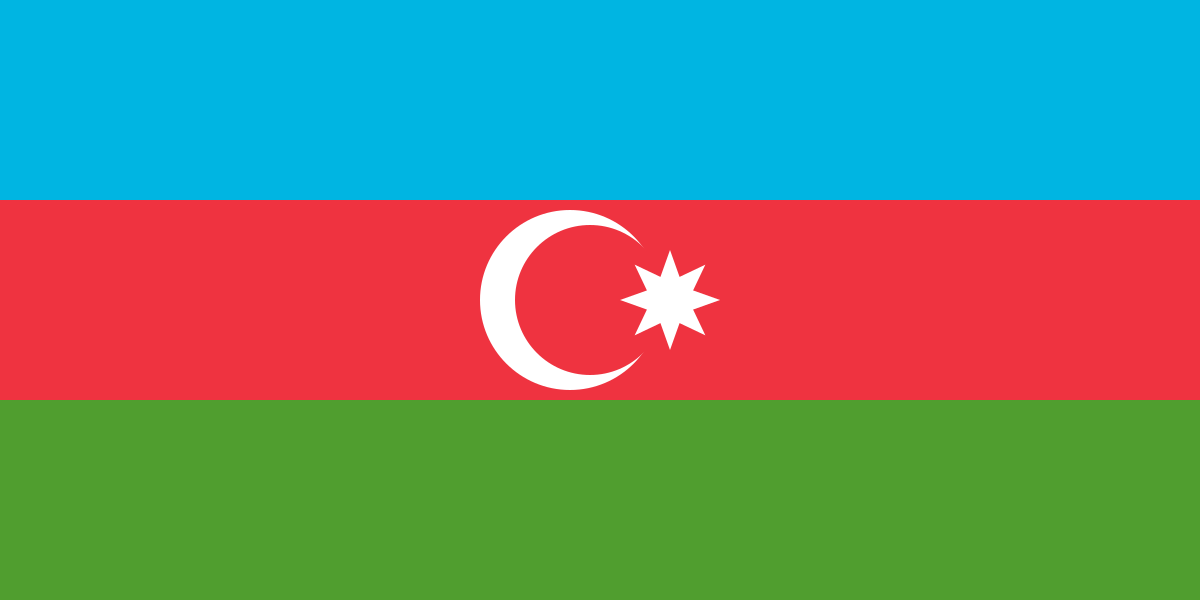
When the Transcaucasian Democratic Federative Republic dissolved on 26 May 1918, the Muslim faction of the Transcaucasian Sejm reconstituted itself as the Azerbaijani National Council. Led by Mammad Amin Rasulzade, whom it had unanimously elected chairman, the council proclaimed the Azerbaijan Democratic Republic in Tbilisi on 28 May. Its National Charter declared Azerbaijan a sovereign democratic republic covering the south and east of Transcaucasia and promised all citizens full civil and political rights regardless of ethnicity, religion, class, profession or sex. With Baku in Bolshevik hands, the government made Ganja its temporary capital, and the first prime minister, Fatali Khan Khoyski, headed the cabinet. Khoyski is credited with a central role in the alliance with the Ottoman government that removed the Centrocaspian Dictatorship from Baku, and the city became the capital only after the Ottoman Army of Islam and Azerbaijani units entered it in September 1918. The governing party, Musavat ("Equality"), had begun in 1911 as a secret society with pan-Islamist, pan-Turkist and socialist ideas and evolved into an Azerbaijani nationalist party; Rasulzade joined it on his return in 1913 and soon led it. Legalised after the February Revolution, Musavat became the leading party of Caucasian Muslims. The republic's foreign policy is usually divided into an Ottoman orientation (May–October 1918), a Western orientation (November 1918 – January 1920) and a search for broader cooperation (January–April 1920). 40 41 42 43
The National Council was dissolved when parliament opened in December 1918 (on the 5th or the 7th, depending on the source). Described as the first democratic parliament in the Muslim East, it was chaired by Alimardan Topchubashov, who was recognised as head of state and represented Azerbaijan at the Paris Peace Conference in 1919. Sources give its size as either 96 or 120 seats; Musavat, with 38 members, formed the largest faction together with some independents, while Ahrar, Ittihad and the Muslim Social Democrats sat alongside representatives of Armenian (21 of 120 seats), Russian, Polish, German and Jewish minorities. All five cabinets were coalitions of Musavat and other parties: Khoyski led the first three and Nasib Yusifbeyli the last two, with the conservative Ittihad as the main opposition. In 145 sessions parliament considered more than 270 bills and adopted 230. In 1919 it gave women the same political rights as men, making Azerbaijan the first Muslim-majority country to enfranchise women. Baku State University was founded on 1 September 1919, and 100 students were sent abroad at state expense. In the Russian Civil War the republic declared itself neutral, siding with neither Reds nor Whites. When Woodrow Wilson received the Azerbaijani delegation in Paris, he was cool, urging a confederation of the Transcaucasian peoples and saying the Azerbaijani question could not be settled before the Russian question as a whole; yet on 12 January 1920 the Allied Supreme Council extended de facto recognition to Azerbaijan along with Georgia. 40 43 41
Contesting Karabakh (Nagorno-Karabakh) with Armenia, the Azerbaijani government appointed Khosrov bey Sultanov governor-general of Karabakh on 15 January 1919. Britain, which kept a small detachment in Shusha, accepted the appointment but insisted that the territory's final status belonged to the peace conference, and the Armenian assembly of Karabakh rejected Azerbaijani authority in February and again in April. After clashes between the two communities in Shusha in June 1919, Sultanov blockaded the Armenian quarter, and in mid-June some 2,000 Azerbaijani irregular horsemen attacked the nearby Armenian village of Khaibalikend, leaving about 600 dead. An agreement of 22 August placed Karabakh provisionally within Azerbaijan, with internal autonomy, until its final status was decided, but according to Armenian accounts the Azerbaijani authorities soon reinforced their garrisons, disarmed the Armenians and imposed an economic blockade. On the night of 22 March 1920 an Armenian attempt to disarm the Azerbaijani garrison failed, and from 22 to 26 March Azerbaijani troops and townspeople burned the Armenian quarter of Shusha and massacred its inhabitants. Estimates of the dead range from 500 to 30,000 depending on source and definition: Richard Hovannisian, citing a contemporary Armenian government report, put the toll at about 500 in the town itself, Jörg Baberowski at 8,000, and Tessa Hofmann at 20,000 in the days of and following the pogrom. Five to six thousand Armenians escaped, and by 11 April some thirty villages in Karabakh had been devastated, leaving about 25,000 people homeless. 36 44
 Between oil and the Straits: Britain and the Whites
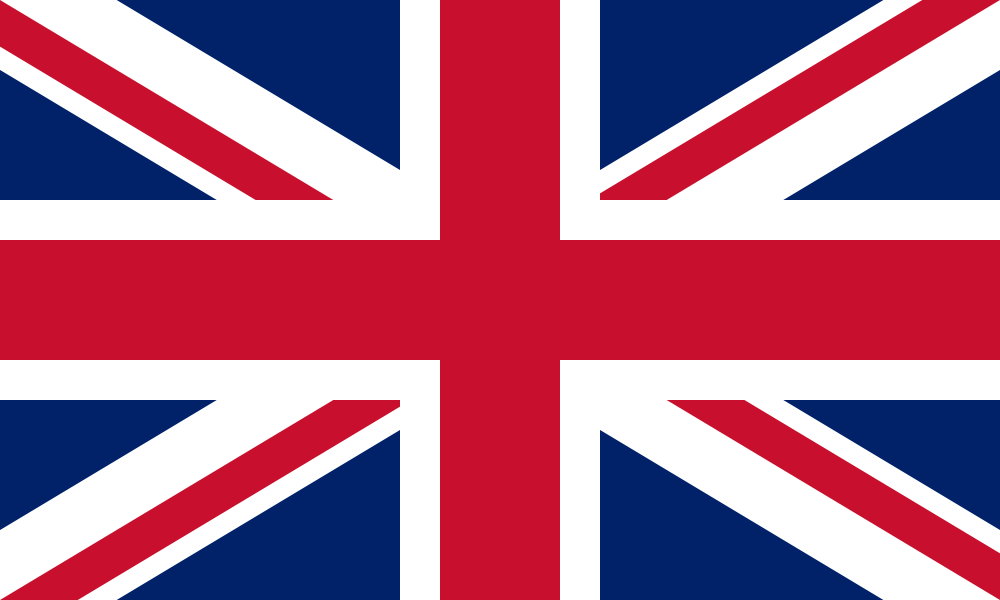
When the Armistice of Mudros on 30 October 1918 forced the Ottomans out of Transcaucasia, Britain took their place. On 16 November General William Thomson, commander of the North Persia Force, met Musavat representatives in Bandar-e Anzali and set out his aims: the evacuation of Ottoman and Azerbaijani units from Baku, keeping Armenian troops out of the city, a local militia under British administration, oil from the Baku fields for Britain, and control of the eastern terminus of the Transcaucasus Railway. The next day he entered Baku with soldiers of the British Indian Army and a Russian detachment under Nikolai Baratov; sources put the British force at anywhere from about 2,000 to 5,000 men. Declaring himself military governor, Thomson imposed martial law, ordered the Azerbaijani flag taken down and told his audience that the Allies could not go home without restoring order in Russia, to the delight of Baku's Russians. He did not at first recognise the republic, though he tacitly cooperated with it. In November and December British troops occupied key points such as Baku, Tbilisi and Batumi, giving them control of the Transcaucasus Railway and of oil and kerosene shipments from Baku, and the 27th Division in the Batum oblast also served as a supply terminal for Denikin's Volunteer Army. Britain set itself up as the arbiter of regional quarrels: in January 1919 it mediated an end to the Georgian–Armenian border war of December 1918, leaving a neutral zone under a British governor in the middle of the disputed district, and in April 1919 it dissolved the Kars-based provisional government of the Southwestern Caucasus. 45 40 20 46 47
Yet British policy was double-edged. The Georgian historian A. Menteshashvili argues that Britain helped Denikin's army, which fought for a "united and indivisible" Russia and the overthrow of the Bolsheviks, while encouraging the hopes of local governments that sought to secure their sovereignty with British help, manoeuvring by "divide and rule" as circumstances required. Noe Zhordania later recalled that the British command also represented Denikin's interests and offered Georgia autonomy after a victory over the Bolsheviks in return for submission to Denikin. The sharpest clash came on the Black Sea coast at Sochi. In July 1918 Georgian troops pushed back the Reds and advanced through Sochi as far as Tuapse, and when a local council declared Sochi's "temporary" union with Georgia on 18 September, the White leadership protested bitterly. Talks between the Volunteer Army and a Georgian delegation led by Foreign Minister Evgeni Gegechkori at Ekaterinodar on 25–26 September broke down, and on 6 February 1919 the Whites captured the Georgian commander and his staff at Gagra and drove the Georgians back across the Bzyb River. Britain drew a demarcation line on the Bzyb; when the Georgians counter-attacked in April, it intervened again and set a new line on the Psou River. Talks in Tbilisi in May effectively ended the conflict, and the Psou remains the Russian–Georgian border today. On 16 June 1919 Azerbaijan and Georgia signed a defensive treaty against Denikin's Volunteer Army, which was threatening their borders. With the situation judged stable, British forces left Baku on 19 August 1919. 20 27 40
On 12 January 1920 the Allied Supreme Council granted de facto recognition to Georgia and Azerbaijan, and subsequently to Armenia. Russian-language accounts say the Allies had withheld recognition throughout 1919 in the expectation that Denikin would win, and moved only once his defeat and the Red Army's approach to the Caucasus were known, intending the republics as buffer states between Soviet Russia and the East. The recognition had clear limits. In the House of Commons the Under-Secretary for Foreign Affairs, Greenwood, stated that it did not prejudge the republics' boundaries and had brought no change in representation, and the United States declined to endorse it. An Azerbaijani assessment holds that, in Transcaucasia at least, Allied action against Bolshevism rarely went beyond words such as status quo, recognition and diplomatic remonstrance. Meanwhile the Armed Forces of South Russia were collapsing. On 29 January 1920 the Caucasus Army, made up mainly of Kuban Cossacks, was disbanded and replaced by the short-lived Kuban Army; the remnants of the Volunteer Army were evacuated from Novorossiysk to Crimea on 26–27 March, and the Kuban Army surrendered to the Red Army on 18–20 April. In early April Denikin handed all authority to Pyotr Wrangel. British troops handed Batumi over to the Georgian army and left on 7 July 1920, a withdrawal also attributed to the 1920 Treaty of Moscow, under which Soviet Russia recognised Georgian independence in exchange for Georgia's promise not to host forces hostile to Russia. 40 20 48 47 46 19
 The North Caucasus: Soviet republics, the Mountain Republic and an imam's emirate
After the empire's collapse, rival authorities piled up in the North Caucasus. The Kuban Rada of the Kuban Cossacks proclaimed the Kuban People's Republic on 28 January 1918 and declared independence on 16 February. On 1 March the Bolsheviks founded the Terek Soviet Republic at the Second Congress of the Peoples of the Terek in Pyatigorsk; unlike other Soviet republics it was a coalition government, and its capital later moved to Vladikavkaz. When the Terek authorities decided to confiscate Cossack land for landless Chechens and Ingush, the Cossacks rose in July under Georgy Bicherakhov. Sergo Ordzhonikidze, sent to Vladikavkaz in July, fled to the mountains when the Cossacks seized the city in August, persuaded the Chechens and Ingush that the soviet system resembled the Islamic order they wanted, and with Ingush help retook Vladikavkaz in mid-August; by the end of 1918 he effectively controlled every Bolshevik body in the region. On 7 July the North Caucasian Soviet Republic was formed from the Kuban–Black Sea, Stavropol and Terek Soviet republics with Ekaterinodar as its capital, but Denikin's Volunteer Army took Ekaterinodar on 16 August, and having lost most of its territory by year's end the republic was abolished on 11 January 1919. The Terek republic fell to the Volunteer Army early that year. The Kuban Rada, which had backed the Whites, drifted away from Denikin, seeking federation first with Ukraine and then with Georgia, and in April 1919 its delegation at the Paris Peace Conference announced a break with him. In November 1919 Denikin had the Rada building surrounded, ten members arrested and a delegate, Alexey Kulabukhov, publicly hanged for treason. By early 1920 the Red Army held most of the Kuban. 49 50 51 52 53 54
Mountaineer self-rule began with the Union of the Mountaineers of the North Caucasus and Dagestan, founded at Vladikavkaz in May 1917 with the Chechen oil magnate Tapa Chermoev as chairman of its central committee and the Avar scholar Najmuddin Gotsinsky as mufti. Driven out by the Bolsheviks in early 1918, its leaders moved to Temir-Khan-Shura and then to Tbilisi, and on 11 May 1918 they declared the independence of the Mountainous Republic of the Northern Caucasus (sources place the declaration either at the Batumi peace conference or in Istanbul). With an Ottoman expeditionary force the republic took Temir-Khan-Shura and Derbent, but the Ottoman defeat soon forced the troops to withdraw. Britain, now the dominant foreign power, at first promised support but then, regarding Denikin as the main force against the Bolsheviks, urged the mountaineers to cooperate with the Whites, while Denikin refused any cooperation. The Whites quickly took Kabarda and North Ossetia but met fierce resistance in Chechnya and Ingushetia, where they resorted to scorched-earth tactics, and in May 1919 they captured Petrovsk and Derbent. Under Denikin's ultimatum the Kotsev government at Temir-Khan-Shura dissolved itself and fled to Tbilisi. The clergy split. Gotsinsky saw the communists as the greater threat and accepted Denikin as the lesser evil, while Sheikh Uzun-Hajji rejected both sides: "What difference does it make if the pig is black or white?" Proclaimed imam of Dagestan and Chechnya at Botlikh in May 1919, Uzun-Hajji declared the North Caucasian Emirate, a sharia monarchy under the protection of the Ottoman sultan, with its base at Vedeno on 19 September (the sultan's firman is believed to have been forged). Taking in Nikolai Gikalo's defeated Red units, the emirate beat the Whites at Vozdvizhenskoye and Shali and won Georgian recognition and arms. Estimates of its strength range from Denikin's 4,000–5,000 to 8,500 in a report to Lenin, though the Chechen historian Mairbek Vatchagaev holds it never exceeded 1,000. 52 55 56 57 58 59
In February–March 1920 the 11th Army arrived and, together with the Muslim clergy, drove Denikin's forces out of the Terek region and Dagestan. When the Red Army took Grozny at the end of March, Uzun-Hajji demanded the city and was refused; the Bolsheviks instead offered to recognise him as imam if he surrendered his temporal power. Already ill with typhus, he died on 30 March, and the emirate vanished a few days later. The Caucasian Bureau of the Russian Communist Party, formed on 8 April, was chaired by Ordzhonikidze, with Sergei Kirov, who had imposed Soviet power on Astrakhan with bloodshed in 1919, as his deputy. In the highlands, however, the new order soon met resistance. The Dagestan uprising, blamed on poor and abusive administration, grain requisitioning and terror, began in September 1920 with mountaineer bands crossing from Georgia. Led by Gotsinsky, with Imam Shamil's grandson Said Shamil as nominal leader, the rebels grew from about 600 to around 6,000 and perhaps 9,700 by January 1921; they controlled most of the Avar, Andi and Gunib districts, besieged the Red garrisons at Khunzakh and Gunib, and wiped out Red units in the Arakani gorge and at Botlikh. The Red Army brought in reinforcements, artillery, armoured cars, aircraft and, according to Russian sources, chemical weapons, retaking the strongholds between January and March 1921, and the Sovietisation of Georgia in February cut the rebels off from their rear. The last stronghold, Gidatl, fell in May. According to the Red commander Todorsky, the Red Army lost 5,000 dead; mountaineer losses are unknown, and about a hundred villages were destroyed. Meanwhile, on 20 January 1921, the Soviet government created the Mountain Autonomous Soviet Socialist Republic, covering the North Caucasus apart from Dagestan, with six districts including Chechnya, Ingushetia, Ossetia and Kabarda and about 800,000 people. It is seen as acknowledging the unity projects of the civil war, but it followed the deportation of 34,637 Terek Cossacks in 1920, and by 1924 it had been broken up into ethnic autonomous oblasts. 52 56 53 60 61 62 57 63
Sovietization, 1920–1921
Having driven the Whites out of the North Caucasus, the 11th Army reached the Azerbaijani frontier in April 1920. According to Russian-language accounts, the Baku operation was planned jointly by the leaders of the Azerbaijani Communist Party, the Caucasian Front commander Mikhail Tukhachevsky and the front's military-revolutionary council member Grigory Ordzhonikidze. At 3 a.m. on 27 April the armoured train "III International" crossed the border at the Samur bridge, twelve hours before Baku communists delivered their ultimatum to the government. That day workers' detachments and the fleet seized the city's station, post office and telegraph, and War Minister Samad Mehmandarov told parliament that armed resistance was not feasible. Late that night parliament voted, with one vote against, to hand over power on conditions that included preserving Azerbaijan's full independence and preventing the Red Army from entering Baku by force, and it dissolved itself at 2 a.m. on 28 April. A six-member Azerbaijani Revolutionary Committee (Azrevkom) including Nariman Narimanov proclaimed a Soviet republic and cabled Moscow for help; early on 28 April an armoured train carrying Anastas Mikoyan and others pulled into Baku station. Noe Zhordania's Georgian government declined Azerbaijan's request for military aid, while some Turkish officers urged the population not to resist the Red Army. Within ten to fifteen days Soviet rule had been established across the country except Nakhchivan (late July), and on 12 May 11th Army units entered Shusha. Drastamat Kanayan (Dro) and Garegin Nzhdeh, commanding Armenian forces in Karabakh, agreed on 24 May to withdraw, but in August Nzhdeh refused orders to leave southern Zangezur even after a Soviet–Armenian agreement allowed the Red Army into Zangezur, Karabakh and Nakhchivan. 64 65 35 44
The first days of the occupation brought what Baku residents called the "Week of Plunder", and the German historian Jörg Baberowski writes that the Bolsheviks entered Azerbaijan as occupiers. Reports indicate that 300 people were executed at Bayil prison in the first two days; Narimanov, who reached Baku on 16 May, proposed that no one be executed without the Revolutionary Committee's sanction, but the proposal was rejected. Between April and the end of October 1920 some 145 million poods of oil were shipped from Azerbaijan to Russia, and on 29 April Lenin said that the news from Baku meant "an economic base capable of revitalizing our entire industry". Resentment at the dismissal of officers of the former Azerbaijani army and the disbanding of its units erupted in the Ganja revolt of 26–31 May. Begun by about 2,000 soldiers, the rising grew to 10,000–12,000 as townspeople joined, and clerics called for holy war against the Bolshevik government. After a failed Red Army attack on 29 May, the 11th Army massed five infantry and six cavalry regiments and 57 guns and launched a general assault from the north on 31 May. Even the report of the 11th Army's head of operations recorded that shelling had destroyed half of Ganja, and after the suppression hundreds of officers and soldiers, twelve generals among them, were shot. All remaining Azerbaijani army formations were then disbanded, and uprisings elsewhere in the country were not fully suppressed until 1924. 64 66
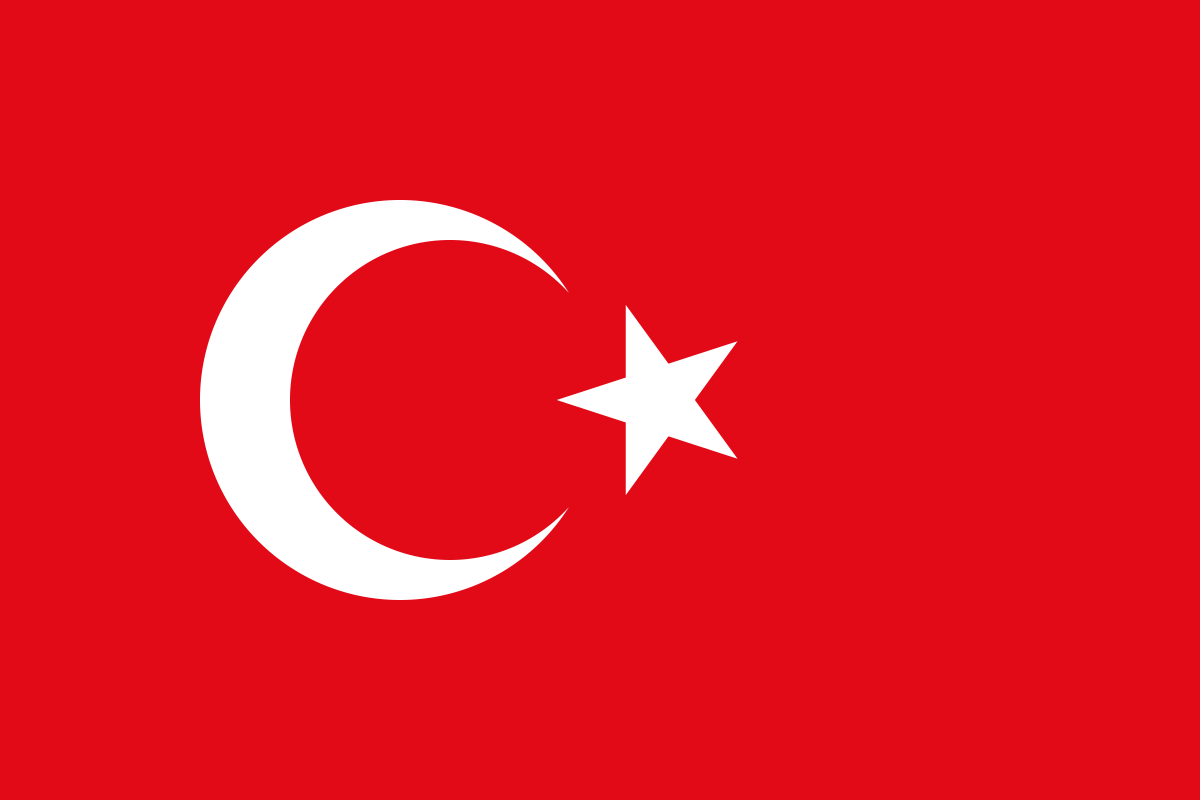
Rejecting the Treaty of Sèvres, the Grand National Assembly government in Ankara wrote to Lenin in Mustafa Kemal's name on 26 April 1920, pledging a common struggle against "imperialist governments" and asking for gold and arms; that year the Soviet government sent 6,000 rifles, ammunition and gold bullion. Kâzım Karabekir, appointed to command the Eastern Front in June, attacked Armenian positions around Oltu before dawn on 13 September, pushed through Sarıkamış, took Kars on 30 October and Alexandropol a week later. Armenia accepted a ceasefire on 18 November; estimates of Armenians massacred during the invasion run from about 60,000 to as many as 100,000. Meanwhile Stalin, on Lenin's instruction, ordered Ordzhonikidze to enter Armenia from Azerbaijan and install a pro-Bolshevik government. On the night of 28–29 November Anatoly Gekker's 11th Army crossed at Karavansarai (today Ijevan), and an Armenian Revolutionary Committee proclaimed a Soviet republic. On 2 December the Armenian government signed an agreement with the Soviet plenipotentiary Boris Legran and handed power to a Soviet government; it promised that Dashnak members would not be persecuted and that Soviet Russia would guarantee Armenia's security. In the early hours of the next day Alexander Khatisian's delegation signed the Treaty of Alexandropol with Karabekir, ceding the former Kars oblast and Surmalu to Turkey, limiting the army to 1,500 riflemen and renouncing Sèvres. Because the government had resigned the day before, the treaty is regarded as invalid, yet its borders became the framework for the later Treaty of Kars. The Red Army entered Yerevan on 4 December, and the Cheka followed on the 6th. 67 68 69 70
The Soviet Armenian authorities broke their promise not to persecute Dashnaks. About 1,000 officers were arrested and marched on foot from Yerevan to Alaverdi; in February 1921 Daniel Bek-Pirumyan and other commanders of the Battle of Sardarabad were shot, and peasants' wheat was requisitioned without compensation. The Dashnaks rose on 13 February and entered Yerevan on the 18th, where a Salvation Committee of the Fatherland under the last prime minister, Simon Vratsian, took up the functions of government. But the far more numerous Red Army opened a large offensive on 24 March and retook Yerevan on 2 April, and the insurgents and refugees withdrew to Zangezur. There Nzhdeh had already rejected the Soviet proposal to attach Zangezur and Karabakh to Soviet Azerbaijan and on 25 December 1920 declared Syunik self-governing. On 26 April 1921 a congress at Tatev monastery proclaimed the independent Republic of Mountainous Armenia, renamed the Republic of Armenia on 1 June with Vratsian as prime minister. It capitulated in July 1921 after Soviet promises to keep Syunik within Soviet Armenia, and Nzhdeh and the republic's leaders crossed into Persia. The Bolshevik government reviewed the causes of the revolt, decided to treat the population with more tolerance, and appointed Alexander Myasnikov chairman of Armenia's Council of People's Commissars. As for Karabakh, on 5 July 1921 the Caucasian Bureau of the Russian Communist Party decided to leave its mountainous part under Azerbaijani jurisdiction. 71 72 35 44
The Bolshevik leadership was divided over Georgia, whose independence it had recognized in the Treaty of Moscow of May 1920. The Caucasian Bureau, chaired by Ordzhonikidze with Sergei Kirov as his deputy, and Stalin as People's Commissar of Nationalities repeatedly pressed for a military overthrow; Leon Trotsky opposed a "premature intervention" and wanted a preparatory period so that the population could make the revolution itself; and Lenin at first rejected the use of force and called for extreme caution. On the night of 11–12 February 1921, at Ordzhonikidze's instigation, Bolsheviks attacked Georgian posts in the largely Armenian district of Lori and at Shulaveri, and a Georgian Revolutionary Committee headed by Filipp Makharadze appealed to Moscow for help. On 14 February the Russian Communist Party Central Committee conditionally allowed the 11th Army to occupy Tbilisi, a decision Karl Radek opposed and that was kept from Trotsky, then in the Urals. Gekker's main force crossed the border on 16 February; after a week of fighting for the Kojori heights, the Georgian commander-in-chief Giorgi Kvinitadze ordered a withdrawal, and on 25 February the Red Army entered Tbilisi and proclaimed a Georgian Soviet Socialist Republic. Meanwhile Karabekir issued an ultimatum on 23 February demanding Georgia's evacuation of Ardahan and Artvin and occupied the border districts, and on 8 March Turkish troops took up positions around Batumi under a verbal agreement with the Georgian government, provoking a crisis with Moscow. On 2 March Lenin stressed the "tremendous importance" of an acceptable compromise with the Mensheviks, but they turned down the offer of a coalition. 73 74 75
On 16 March Soviet Russia and the Grand National Assembly government signed a treaty of friendship in Moscow. Turkey gave Batumi and the area north of Sarp to Soviet Georgia and received the Kars oblast, and Nakhchivan became an autonomous territory under Soviet Azerbaijan's protection. On the same day Britain signed a trade agreement with the Soviet government that effectively committed it to refrain from anti-Soviet activity in the former Russian Empire, ending Georgian hopes of Western intervention. When Turkish troops would not leave Batumi, the Georgian government agreed an armistice with the Revolutionary Committee at Kutaisi on 17 March, and on the 18th Georgian troops under General Giorgi Mazniashvili fought the Turks in the streets of Batumi. Meanwhile the Menshevik government sailed into exile on an Italian ship, and on the 19th Mazniashvili handed the city to the Revolutionary Committee. Talks broken off by the Batumi fighting resumed at Kars on 26 September, and on 13 October Turkey and the three Soviet republics of Armenia, Azerbaijan and Georgia, with Soviet Russia participating, signed the Treaty of Kars; Karabekir was among the Turkish signatories. The treaty reaffirmed the Moscow terms, giving Ardahan, Artvin, Kars and Surmalu to Turkey, making the northern part with Batumi the Adjar autonomous republic within Georgia, and requiring Turkish troops to withdraw from the Alexandropol area. The borders it drew between Turkey and Armenia, Georgia and Azerbaijan remain in place today. 76 73 77 78
Assessment: national revolution, civil-war front or international conflict?
Soviet historiography treated the sovietization of Transcaucasia as part of "the Civil War and Foreign Intervention". Early Soviet writing called the Georgian campaign a "revolutionary war", but as that term became hard to distinguish from "aggression" the official account shifted to a story of local workers and peasants rising and asking the Red Army for help. Soviet authors described the role of Russian units as "fraternal, internationalist assistance" protecting the working people of Transcaucasia from Entente and Turkish intervention, and a 1967 Soviet book portrayed Armenia's November 1920 as a rising of the working people that ended Dashnak rule. In Azerbaijan April 1920 was commemorated as the "April Revolution" until the term vanished from documents after the repressions of 1937–1938. By contrast, Firuz Kazemzadeh, noting that the 11th Army crossed the border before any official request, attributed the Musavat government's fall to "the power of a resurgent Russia", and Jörg Baberowski and others describe it as an invasion. Exiles and post-independence state bodies reached the same conclusion: a 1989 commission of the Georgian Supreme Soviet found the events of 1921 to have been "military interference, intervention, and occupation", Azerbaijan's 1991 constitutional act on restoring independence calls April 1920 an "occupation", and since 2010 Georgia has marked 25 February as Soviet Occupation Day. The verdicts do not all point one way, however: Tadeusz Swietochowski explained the Musavat collapse by the masses' "communal consciousness" and indifference, and several historians argue that for Armenia only Soviet intervention prevented the completion of the Armenian genocide. 73 64 70 67
From the standpoint of international history, the sovietization of Transcaucasia was both the last front of the Russian Civil War and a process in which Soviet Russia and Kemal's Turkey jointly dismantled the Entente's order in the region. In February 1920 Kemal instructed Karabekir to break up Britain's "Caucasus barrier" from the rear, and in August he told the Grand National Assembly that the Red Army's occupation of Azerbaijan was "our objective, influence, and work". The Azerbaijani historian R. Mustafazadeh identifies this Turkish–Soviet rapprochement as the most critical factor in the fall of the Azerbaijan Democratic Republic. In November 1920 Stalin argued that the Caucasus mattered not only for raw materials and fuel but for its strategic position between Europe and Asia and between Russia and Turkey, framing control of the region as a contest between the revolution and the Entente. The two allies' interests collided over Armenia and Batumi, however, and the Bolsheviks gave up their attempt to keep Ani and Kulp for Armenia and made large territorial concessions at Kars. Britain had withdrawn, and the world largely met with silence the appeal that the exiled Georgian leadership sent from Istanbul to the world's socialist parties on 27 March 1921. The Dashnaks still reject the Treaty of Kars as a breach of international law concluded under Moscow's control. 64 77 73
In March 1920, ahead of the push on Baku, Lenin told Ordzhonikidze that Baku was "extremely, extremely important" but recommended "acting with greater caution" toward Georgia. After the occupation of Georgia in 1921 he recognized that the pro-Bolshevik revolt had lacked the popular backing claimed for it and favoured reconciliation with the Georgian intelligentsia and peasantry, while moderates such as Makharadze urged tolerance toward the Mensheviks, gradual land reform and respect for Georgia's sovereignty. But after being booed at a Tbilisi workers' meeting in July 1921, Stalin removed Makharadze in favour of Polikarp Mdivani and replaced the Georgian Cheka leadership with harder men, Lavrentiy Beria among them. The union of the three republics that Ordzhonikidze set in motion in late 1921 became the Federative Union of Socialist Soviet Republics of Transcaucasia on 12 March 1922 and, on 13 December, a single federal state, the Transcaucasian Socialist Federative Soviet Republic. Mdivani and Makharadze, who wanted Georgia to enter the Union as a republic in its own right, were branded "national deviationists", and after Ordzhonikidze struck a member of Mdivani's group Lenin concluded in late December 1922 that Stalin and Ordzhonikidze were guilty of imposing Great Russian nationalism. The intensified repression that followed the defeat of the Georgians in this "Georgian affair" led to the August 1924 uprising and reprisals that cost several thousand lives. And on 30 December 1922 the Transcaucasian federation became one of the four founding republics, with Russia, Ukraine and Belarus, in the formation of the USSR. 64 75 78 79
Consequences
Azerbaijan in April 1920, Armenia in December and Georgia in February 1921 were Sovietised by the Red Army, and in the North Caucasus the Dagestan uprising was put down in May 1921. The Treaty of Moscow of March 1921 and the Treaty of Kars of October fixed the present borders, leaving Kars and Ardahan to Turkey and Batumi to Georgia. Bound together in the Transcaucasian federation in 1922, the three republics took part in the formation of the USSR.
Timeline & Map
- 11917.11.28Transcaucasian Commissariat formed
In Tbilisi, Georgian Mensheviks, the Musavat, the Dashnaks and others replaced the Ozakom with a government of their own that refused to recognise the Sovnarkom. Evgeni Gegechkori was its chairman.
- 21917.12.18Armistice of Erzincan
Russian forces on the Caucasus Front and the Ottoman Third Army agreed a ceasefire. Russian soldiers headed home en masse and the front dissolved.
- 31918.01.22–01.25Shamkhor incident
Azerbaijani armed bands attacked trains carrying Russian soldiers home near Shamkhor station. Russian-language sources put the dead at about 2,000.
- 41918.03.30–04.02March Days in Baku
Fighting between the Baku Soviet with Dashnak units and the Musavat turned into a massacre of Muslims. Estimates of the dead range from about 3,000 to 12,000.
- 1918.04.22Transcaucasian Democratic Federative Republic proclaimed
After the loss of Batumi, the Seim bowed to Ottoman demands and proclaimed an independent federal republic. Kars was handed to the Ottomans three days later.
- 51918.05.21–05.29Battle of Sardarabad
West of Yerevan, Armenian forces halted the Ottoman advance; fighting went on at the same time at Bash Abaran and Karakilisa.
- 1918.05.26–05.28Federation dissolved, three states declare independence
On 26 May the Seim dissolved and Georgia declared independence; Azerbaijan and Armenia followed on the 28th. On 4 June all three signed the Treaty of Batum with the Ottoman Empire.
- 61918.05.28
 Treaty of Poti: German protection
Two days after independence Georgia accepted German protection; some 3,000 German troops landed at Poti and the Ottoman advance was halted.
- 1918.09.15Fall of Baku and the September Days
After Dunsterforce withdrew, the Ottoman-Azerbaijani army entered Baku, and 10,000–30,000 Armenians were massacred.
- 1918.09.20Execution of the 26 Baku Commissars
Arrested at Krasnovodsk, 26 leaders of the Baku Commune were shot beside the Transcaspian Railway on the orders of the Ashkhabad Committee.
- 71918.11.17Thomson's British troops enter Baku
General William Thomson entered Baku, vacated by the Ottomans, with British Indian and Russian troops, proclaimed himself military governor and imposed martial law.
- 81918.12Azerbaijani parliament opens
A parliament replaced the National Council. Musavat was the largest faction, minorities including Armenians and Russians held seats, and in 1919 it enfranchised women.
- 91918.12.07–12.31Armeno-Georgian War
The two republics fought over Lori and Akhalkalaki. After Armenian forces advanced toward Tbilisi, a British-brokered ceasefire created the Lori neutral zone.
- 101919.02.06Whites drive back the Georgians at Sochi
Denikin's forces captured the Georgian command at Gagra and pushed the Georgians beyond the Bzyb; British intervention later fixed the line on the Psou.
- 111919.02.14Georgian Constituent Assembly election
The Social Democrats (Mensheviks) won 81.5 percent and 109 of 130 seats; on 21 March Noe Zhordania formed a one-party government.
- 121919.04.10Armenia takes over Kars
The Southwest Caucasus Republic surrendered to Armenian and British forces and the Kars Oblast passed to Armenia; the annexation of Nakhchivan followed in May.
- 131919.05Volunteer Army occupies Dagestan
The Whites took Petrovsk and Derbent, and under Denikin's ultimatum the government of the Mountainous Republic dissolved itself and fled to Tbilisi.
- 141919.09.19North Caucasian Emirate proclaimed
Uzun-Hajji proclaimed a sharia monarchy under Ottoman protection, based at Vedeno, and fought Denikin's forces.
- 1920.01.12Allies recognise Georgia and Azerbaijan de facto
The Allied Supreme Council recognised the two republics (and later Armenia) de facto, while stating that their boundaries were not prejudged.
- 151920.03.22–26Shusha massacre
After a failed Armenian uprising, Azerbaijani troops and townspeople burned Shusha's Armenian quarter and massacred its inhabitants; estimates range from 500 to 30,000 dead.
- 161920.04.27–28The 11th Army enters Baku
As armoured trains crossed the border, the Azerbaijani parliament voted to hand over power and a Revolutionary Committee proclaimed a Soviet republic.
- 171920.05.03–05.07Tbilisi coup attempt and Treaty of Moscow
A Bolshevik attack on the Tbilisi military school was repulsed. On 7 May Soviet Russia recognized Georgian independence, and a secret supplement legalized the Communist Party in Georgia.
- 181920.05.10–05.14May Uprising in Armenia
A Bolshevik revolutionary committee proclaimed Soviet Armenia in Alexandropol; government troops suppressed the revolt within four days.
- 191920.05.26–31Ganja revolt
A revolt led by officers of the former Azerbaijani army grew to over ten thousand before the 11th Army crushed it with shelling and a general assault.
- 201920.06.08–06.12Suppression of the South Ossetian uprising
A revolutionary committee declared Soviet power across South Ossetia, but the People's Guard retook Tskhinvali on 12 June. About 5,000 died and 20,000 fled.
- 1920.08.10Treaty of Sèvres
Armenia was recognized as "free and independent" and its western frontier left to US presidential arbitration, but the treaty was never ratified.
- 211920.09–1921.05Dagestan uprising
A mountaineer revolt led by Gotsinsky seized most of highland Dagestan but was crushed by the Red Army after Georgia's Sovietisation; the Reds lost 5,000 dead.
- 221920.09.13–11.18Turkish invasion of Armenia
Karabekir's Eastern Front army took Kars on 30 October and Alexandropol in early November; Armenia accepted a ceasefire on 18 November.
- 231920.11.29–12.04Sovietization of Armenia
The 11th Army crossed near Ijevan; the government handed over power on 2 December and the Red Army entered Yerevan on the 4th.
- 241920.12.03Treaty of Alexandropol
Khatisian's delegation signed away the Kars oblast and Surmalu to Turkey, but the treaty is regarded as invalid because the government had resigned the day before.
- 251921.01.20Mountain ASSR founded
The Soviet government created a Mountain autonomous republic of six districts and about 800,000 people covering the North Caucasus apart from Dagestan.
- 261921.02.13–04.02February Uprising in Armenia
The Dashnaks retook Yerevan and held it for 42 days before a Red Army offensive drove them back to Zangezur.
- 271921.02.16–25Invasion of Georgia and fall of Tbilisi
Crossing the border on the pretext of the Lori uprising, the 11th Army took Tbilisi after the fighting on the Kojori heights and proclaimed a Georgian Soviet republic.
- 1921.03.16Treaty of Moscow
Soviet Russia and the Ankara government signed a friendship treaty leaving the Kars oblast to Turkey and Batumi to Georgia and making Nakhchivan autonomous under Azerbaijan's protection.
- 281921.03.18–19Battle of Batumi and the Georgian government's exile
While Georgian troops fought the Turks in the streets, the Menshevik government left by sea into exile and the city passed to the Revolutionary Committee.
- 291921.04–07Republic of Mountainous Armenia
Proclaimed at a congress in Tatev, Nzhdeh's republic capitulated in July after a promise that Syunik would remain in Armenia.
- 301921.10.13Treaty of Kars
Signed by Turkey and the three Soviet republics, it fixed borders that remain in place today.
Related people 30
Soviet forces15
Leadership7
Led the Baku Soviet, set up the Baku Commune after the March Days and was executed on 20 September 1918.
Member of the Baku Committee of Revolutionary DefenceNariman Narimanov1870–1925Sat on the Soviet's Committee of Revolutionary Defence during the March Days. Headed Azrevkom and the Soviet Azerbaijani government and tried to curb indiscriminate executions and confiscations.
Sovnarkom memberJoseph Stalin1878–1953According to English-language sources, held troops and grain bound for Baku at Tsaritsyn. Repeatedly pressed for the military overthrow of Georgia and in July 1921 replaced the Georgian Revolutionary Committee leadership.
Bolshevik commissar with the Red Army in the CaucasusGrigory Ordzhonikidze1886–1937Sought permission to advance into Georgia after Azerbaijan's Sovietization and apparently pushed troops across the border on his own initiative in May 1920. Retook Vladikavkaz with Ingush help in 1918 and became chairman of the Caucasian Bureau in April 1920. Directed the advances into Azerbaijan, Armenia and Georgia and instigated the Lori rising that opened the invasion of Georgia.
Chairman of the Soviet Russian Council of People's CommissarsVladimir Lenin1870–1924Deferred an invasion of Georgia to avoid a second front during the Polish war and agreed to the Treaty of Moscow talks. Urged caution over Georgia, consented to the invasion on 14 February 1921, then backed a conciliatory policy.
Chairman of Armenia's Council of People's CommissarsAlexander Myasnikov (Myasnikyan)1886–1925Was appointed head of the Soviet Armenian government after the February Uprising was suppressed.
Chairman of the Georgian Revolutionary CommitteeFilipp Makharadze1868–1941Led the Revolutionary Committee at Shulaveri and appealed to Moscow for help, but was removed in July 1921 as insufficiently firm.
Implementers & commanders1
Participants7
Freed the imprisoned commissars as Baku fell, was arrested with them at Krasnovodsk, and escaped execution. Entered Baku aboard an armoured train on 28 April 1920.
Russian signatory of the Treaty of MoscowLev Karakhan1889–1937Signed the 7 May 1920 Treaty of Moscow recognizing Georgian independence on Russia's behalf.
Soviet plenipotentiary in GeorgiaSergei Kirov1886–1934Posted to Tbilisi after the Treaty of Moscow, he protested the re-arrest of Georgian Communists. Enforced Soviet power in Astrakhan in 1919 and, as deputy head of the Caucasian Bureau, took part in mobilising against the Dagestan uprising. Co-led the Caucasian Bureau with Ordzhonikidze and became First Secretary of the Azerbaijani Communist Party in 1921.
People's Commissar of WarLeon Trotsky1879–1940Opposed a "premature intervention" in Georgia but later defended the invasion in a pamphlet.
Caucasian Front commanderMikhail Tukhachevsky1893–1937According to Russian-language accounts, helped draw up the plan of the Baku operation.
Chairman of the Georgian Revolutionary Committee (1921)Polikarp Mdivani1877–1937Succeeded Makharadze but opposed merging Georgia into the Transcaucasian federation, becoming central to the Georgian affair.
People's Commissar for Foreign AffairsGeorgy Chicherin1872–1936Protested the Turkish occupation of Batumi in a formal note.
Transcaucasian national governments7
Leadership5
As chairman of the Seim convened in February 1918, told the Ottomans it would not recognise the Brest-Litovsk terms. Was elected president of the Constituent Assembly and led the delegation seeking recognition at the Paris Peace Conference.
Chairman of the Transcaucasian CommissariatEvgeni Gegechkori1881–1954Headed the Commissariat, closed Tbilisi to Bolshevised troops returning from the front and stepped down when the federation was proclaimed in April 1918. Regarded the Treaty of Moscow's internment clause as an infringement of sovereignty and traded notes with Kirov over the re-arrest of Communists. Negotiated with the Volunteer Army over Sochi at Ekaterinodar in September 1918, without result.
Georgian Menshevik leaderNoe Zhordania1868–1953Denounced the October seizure of power as illegal, argued for a separate course for Transcaucasia and read Georgia's declaration of independence on 26 May 1918. Led the Menshevik government, pursued land reform and minority autonomy, and accepted the 1920 Treaty of Moscow to win recognition. Recalled that the British command also represented Denikin's interests and pressed Georgia to submit to him. Declined Azerbaijan's request for help in April 1920 and went into exile from Batumi in March 1921.
Armenian foreign minister and prime ministerAlexander Khatisian1874–1945Sat on the delegation at the Trabzon peace conference and signed the Treaty of Batum as foreign minister. As prime minister he read out the Act of United Armenia and resigned with his cabinet during the May Uprising. Signed the Treaty of Alexandropol in the early hours after his government had resigned.
Chairman of the Azerbaijani National CouncilMammad Amin Rasulzade1884–1955Led the National Council that proclaimed the Azerbaijan Democratic Republic on 28 May 1918, and signed the Treaty of Batum. In April 1920 he disagreed with the terms of surrender but bowed to the majority, and was spared execution through Stalin’s intervention.
Participants2
Called for the defence of Batumi and repudiation of Brest-Litovsk, and announced the federation's failure in the Seim on 26 May 1918. Lobbied for Georgian recognition at the Paris Peace Conference and helped arrange Karl Kautsky's 1920 visit to Georgia.
Armenian volunteer commanderAndranik Ozanian1865–1927Commanded a force of Western Armenian refugees, and in March 1918 talked Armenian leaders out of disarming Russian soldiers passing through Alexandropol. Held Zangezur while refusing to recognize the republic, halted his Karabakh advance at British request, and disbanded his force in 1919.
Ottoman and Turkish nationalist forces3
Leadership3
Created the Caucasus Army of Islam, put his brother Nuri Pasha in charge of it and ordered it to take Baku.
Commander of the Turkish Eastern FrontKâzım Karabekir1882–1948Units of his corps formed the core of the detachment that invaded Eastern Armenia in May 1918. Invaded Armenia, took Kars and Alexandropol, and signed the treaties of Alexandropol and Kars.
Chairman of the Grand National Assembly of TurkeyMustafa Kemal Atatürk1881–1938Sought a common struggle and aid from Lenin and ordered Karabekir to advance into Armenia.
The British and the Whites3
Leadership2
Defended Baku at the Centrocaspian Dictatorship's invitation and withdrew to Enzeli on the night of 14 September 1918.
Commander-in-chief of the Armed Forces of South RussiaAnton Denikin1872–1947Fought Georgia over Sochi in the name of a "united and indivisible" Russia, occupied the North Caucasus and Dagestan, and suppressed the Kuban Rada.
North Caucasian mountaineers1
Related terms
Sources: reference 1reference 2reference 3reference 4reference 5reference 6reference 7reference 8reference 9reference 10reference 11reference 12reference 13reference 14reference 15reference 16reference 17reference 18reference 19reference 20reference 21reference 22reference 23reference 24reference 25reference 26reference 27reference 28reference 29reference 30reference 31reference 32reference 33reference 34reference 35reference 36reference 37reference 38reference 39reference 40reference 41reference 42reference 43reference 44reference 45reference 46reference 47reference 48reference 49reference 50reference 51reference 52reference 53reference 54reference 55reference 56reference 57reference 58reference 59reference 60reference 61reference 62reference 63reference 64reference 65reference 66reference 67reference 68reference 69reference 70reference 71reference 72reference 73reference 74reference 75reference 76reference 77reference 78reference 79
← Historical events