Mongolian revolution and establishment of the republic
How did a struggle to restore autonomy pass through limited monarchy to a people’s republic?
After the 1921 revolution, Mongolia moved from a restricted monarchy to a people’s republic. Relations with the USSR shaped state institutions and domestic struggles over power.
Autonomy and outside powers after 1911
Outer Mongolia declared independence in 1911 as the Qing dynasty collapsed and enthroned the Bogd Khan. Its international status did not match its claims: the 1915 Kyakhta agreement recognized autonomy under Chinese suzerainty, and Chinese troops abolished that autonomy in 1919 amid the upheaval following the Russian Revolution. The coming revolution therefore addressed both social reform and the demand to escape outside military control. Source 1
The military and political turning point of 1921
In early 1921 Ungern-Sternberg’s White forces expelled Chinese troops from the capital and restored the Bogd Khan, but imposed violent military rule. Mongolian revolutionaries consolidated their organizations and sought Soviet Russian help. Operations involving forces led by Sükhbaatar and the Red Army secured the capital that summer, and a people’s government emerged in July. Soviet support helped defeat outside forces while also shaping the new government’s dependence. Source 1
The 1921 government did not immediately abolish the monarchy. It retained the Bogd Khan as a ruler with restricted powers while figures including Bodoo administered the government. This compromise reflected the authority of Buddhism and monarchy and the revolutionaries’ need to broaden their base. National independence, religious legitimacy and the pace of social revolution were not questions with a single settled answer. Source 1 · Source 2
Leadership conflict and the republican constitution
Disputes over Soviet relations and monarchical powers accompanied Bodoo’s execution on counterrevolutionary charges in 1922 and party leader Danzan’s purge in 1924. Criminal punishment of internal disagreement narrowed political alternatives. Sükhbaatar died in 1923; the later dominance of Choibalsan and the purges of the 1930s cannot be attributed to his personal direction. Source 2
After the Bogd Khan’s death in 1924, the basis for retaining the monarchy weakened. On November 26 the First Great Khural adopted a constitution and proclaimed the Mongolian People’s Republic; the capital became Ulaanbaatar. Constitutional and assembly institutions provided a new framework, while the party and Soviet relations remained politically central. The date here follows Mongolia’s parliament, November 26, rather than the November 25 found in an older English country study. Source 3 · Source 2
Building economic institutions in a pastoral society
Mongolia was a pastoral society in which monasteries and aristocratic households held substantial economic authority, rather than an industrial society dominated by factory workers. Early governments pursued fiscal and administrative reforms, cooperatives, trading institutions and banking. A joint Mongolian–Soviet bank established in 1924 and subsequent currency reform strengthened the state’s capacity to organize exchange and revenue. Trade with the Soviet Union altered older commercial dependencies while creating another external dependence. Source 4
Distinguishing foundation from later radicalization
Private herd ownership and monastic influence remained substantial in the mid-1920s. Rapid confiscation and pastoral collectivization after 1928 contributed to livestock losses, shortages and rebellion, followed by a policy retreat in 1932. Proclaiming a republic had not completed an economic transformation. Institutional independence, external dependence and the costs of coercive reform need to be examined as separate dimensions of the period. Source 4 · Source 5
After the throne fell empty, deciding not to seek a rebirth
The Bogd Khan died on 20 May 1924, aged 54, a year after the death of his wife Dondogdulam. The revolutionary government had allowed him to stay after 1921, but that forbearance had already pressed the khan down into a harmless symbol. Real power lay with the party and people's government that had executed Bodoo in 1922; the khan's name did little more than fill the head-of-state line in government documents. His death was therefore not an institutional tragedy but a vacancy. The difficulty was that the seat was not merely a throne: it was the seat of the Jebtsundamba Khutuktu, the highest living Buddha of Mongolian Buddhism. Born in Tibet, eighth in the line of incarnations, standing just below the Dalai Lama and Panchen Lama in rank, the Bogd Khan was the apex of the church before he was a khan. By tradition his death should have opened the procedure for finding the ninth rebirth. The people's government did not open it. It did not merely decline; it obstructed. Party and government declared that no new incarnation would be found, and sources record that rumors of a rebirth were already circulating within Mongolia that same year. Closing this door was a far weightier decision than removing one man. It was not the end of a dynasty but a choice to stop asking after the religious legitimacy that had upheld that dynasty. The party's Third Congress in August hardened this direction into doctrine. There Soliin Danzan, a founding member of the party from the finance bureaucracy, was executed on the charge of 'bourgeois tendencies,' and the program adopted close friendship with the Soviet Union, the purging of 'oppressor-class elements,' and a Leninist 'non-capitalist path of development.' Danzan's execution formed a pair with the khan's death. If the monarchy ended with a man's death, the moderate, nationalist current inside the party that had compromised with monarchy was cleared away by Danzan's execution. The Great Khural, sitting from 8 to 26 November, adopted the first constitution, renamed the country the Mongolian People's Republic, and renamed the capital Ulaanbaatar, 'Red Hero.' The new constitution provided that the government take custody of the khan's seal, the one tangible token of the authority he left behind, now passing from the church into the hands of the state. The ban on rebirths was not nailed into law at once: the Third Great Khural adopted a special resolution in 1926 barring the search, and the final prohibition came only with the Seventh Party Congress and Fifth Great Khural in 1928. But the direction had been set in the year the khan died. The decision not to seek a new living Buddha to crown the state religion, and the decision to replace the empty throne with a sheet of paper called a constitution, were two faces of the same movement.
A state apparatus on one mat, and a constitution that 'skips capitalism'
The first constitution, adopted by the Great Khural on 26 November 1924, was the text of a settlement reached inside the party only months earlier. At the third MPRP congress, held from 4 to 31 August that year, the party adopted the line that Mongolia would advance toward communism "bypassing the capitalist stage of development." This "non-capitalist path" was exactly the question Danzan had opposed: reading Marxism literally, he argued that societies must pass through definite stages. For that, Rinchino and Dambadorj branded him a "representative of the capitalists" and had him executed at the end of August. Once the congress closed, the remaining task was to put that decision into articles. On 24 October a constitution-drafting commission was formed, chaired by Prime Minister Tserendorj, with the Buriat revolutionary Elbegdorj Rinchino playing the central role in the drafting; fluent in both Mongolian and Russian, he had long translated and personally authored most of the party's documents.
The state apparatus the constitution designed was the Soviet system fitted onto a nomadic society. The supreme organ of power was the Great Khural (Grand People's Assembly), convened once a year; between its sessions, power lay with a thirty-member Little Khural elected by it. Within the Little Khural sat a five-member standing presidium, whose chairman was de facto head of state. The Council of Ministers held executive power, and local hurals (assemblies) were established in the districts. The same document abolished the theocratic monarchy, proclaimed the people's republic, nationalized feudal land holdings, and so dissolved the legal basis of aristocratic rule. The capital, Huree, was renamed Ulaanbaatar the same day, meaning "red hero." Three days later, on 29 November, the Little Khural's first session convened to form the government.
On paper the power the constitution set down was a layered system of assemblies, but in substance it was the party. Elections were indirect, and most of the thirty Little Khural members, including twelve ministers, belonged to the MPRP. The "people's power" written into the articles and the hand of the Soviet and Comintern advisers, who had shaped the draft and driven an opponent to execution at the congress, were different strata on the page. That gap became the structure of Mongolian politics from the moment the constitution was adopted.
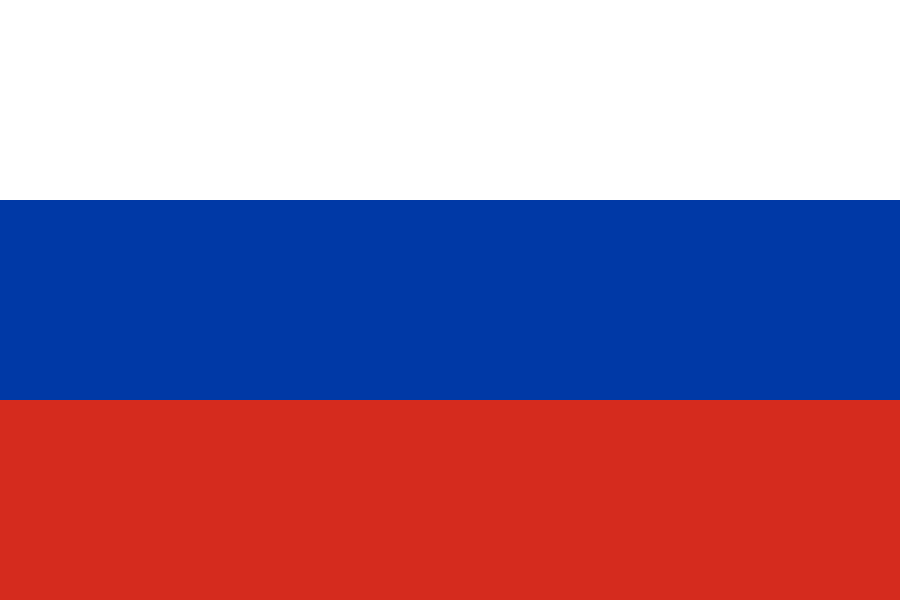
 A small neighbour republic: from Uryankhay to Tannu Tuva
Tuva (Uryankhay), between the Sayan and Tannu-Ola mountains north-west of Mongolia, followed a similar path after the fall of the Qing in 1911. Having proclaimed independence, it sought Russian protection against Chinese reintegration and on 17 April 1914 became the Russian protectorate of Uryankhay Krai. The Russian Civil War made the territory change hands again and again. The Soviets took the region in March 1918 but were pushed out in July by Pyotr Vologodsky's Provisional Siberian Government; that autumn Chinese troops, and then Mongolian troops under Magsarjav, occupied its south and west. After anti-Russian riots drove out the Siberian government in the spring of 1919, partisans under Pyotr Shchetinkin and Alexander Kravchenko came in that summer, but most left in September in pursuit of Kolchak's forces. China and Mongolia occupied the region from mid-1919 until early 1921. The Bolsheviks took the capital Khem-Beldyr in December 1920 and all of Tuva by March 1921, and when the Mongolian revolution of 1921 began, the Mongolian troops withdrew as well.
On 13–16 August 1921 an all-Tuvan constituent khural of about 300 delegates from every kozhuun, more than 200 of them herders, met at Sug-Bazhy with a delegation from Soviet Russia present. On 14 August the Tannu Tuva People's Republic was proclaimed, with the newly founded Tuvan People's Revolutionary Party in power and the khural's chairman Buyan-Badyrgy as the first head of state. The first constitution of 22 articles guaranteed freedom of religion but stated that in international affairs the state acted "under the auspices of Soviet Russia". The Soviet–Tuvan border was fixed in January 1923 and the Red Army withdrew, and the second Great Khural in September 1924 wrote non-capitalist development and the single-party rule of the Tuvan People's Revolutionary Party into the constitution. Only the Soviet Union (1924) and Mongolia (1926) ever recognized Tuva, and in 1926 its capital was renamed Kyzyl ("red"). Following Mongolia on the satellite path of "skipping capitalism", Tuva went through a Soviet-backed coup and purges in 1929 and was absorbed into the Russian Soviet Federative Socialist Republic in October 1944.
Who started the revolution, and what remained to be settled
With the 1924 constitution Mongolia became a separate state with a real skeleton, and that fact was never reversed. But what this period actually settled was the form of the state, not its standing. Internationally Mongolia was still treated as part of China, and recognition of its independence came only after the 1945 referendum. Domestically, too, the meaning of the non-capitalist path of development ran ahead of its institutions. How a pastoral society would build a national economy, what would replace the order of the monasteries and the nobility, and how much room Mongolia had to decide for itself in its relationship with the Soviet Union: none of these three was answered at the founding, and each remained contested for decades after.
The longest-running dispute concerns the revolution's very origin. As Fujiko Isono summarized in 1976, most historians until then saw the 1921 revolution as initiated by Soviet Russia and imposed on passive Mongols, a judgement that rested on near-total reliance on Russian and Chinese sources. Isono countered, using Mongolian-language materials published in Ulaanbaatar, above all the Three-Man History written by Choibalsan and others and the oral narratives of more than 470 partisans, that the revolution originated in a purely Mongolian situation. At the same time she concedes that the Mongols could never have succeeded without Soviet support. Between those two uncompromising positions, Russian scholarship now tends, as in Eduard Batunaev's 2021 survey, toward a compromise that treats it as a multifactorial phenomenon in which the Mongols' own drive for independence, the Comintern's advance eastward, and Soviet border security all converged.
Mongolia's own narrative is being rewritten as well. Soviet-era historiography canonized Sükhbaatar as the 'Lenin of Mongolia' and made 1921 the wellspring of legitimacy, but since 1990 Mongolia has been revisiting that official 'People's Revolution' narrative. The closing sentence of this section is therefore not a verdict but an open question. What the revolution erased was the monarchy; what it left behind was a threefold unfinished business: the independence of the state, the subject of the revolution, and the road of development.
Consequences
The revolutionary government of 1921 and republic of 1924 strengthened Mongolia’s separate state institutions and opened a challenge to aristocratic and religious hierarchies. Soviet and Comintern influence and internal purges grew alongside them. Pastoral collectivization and the mass repression of the 1930s were later developments, distinct from the economy and society at the republic’s foundation.
Timeline & Map
- 11911
 Independence declaration and Bogd Khan government
A separate state and monarchy were proclaimed amid the Qing collapse.
- 1914.04.17The Uryankhay protectorate
Tuva, independent after the fall of the Qing, became the Russian protectorate of Uryankhay Krai.
- 21919Chinese troops abolish autonomy
Outside military control helped galvanize revolutionary organization.
- 31921.07People’s government established
A limited-monarchy government followed Mongolian and Red Army victory.
- 41921.08.14The Tannu Tuva People’s Republic proclaimed
The all-Tuvan constituent khural proclaimed independence under the Tuvan People’s Revolutionary Party; the first constitution placed foreign affairs under the auspices of Soviet Russia.
- 51922Bodoo executed
Internal revolutionary disputes culminated in a purge.
- 61924.05Bogd Khan dies
The transition from monarchy to republic accelerated.
- 71924.11.26Constitution and people’s republic
The Great Khural adopted the first constitution.
Related people 9
Leadership2
Of Buryat origin, he effectively drafted the founding documents and the 1924 constitution, and at the Third Party Congress pushed the non-capitalist development line and had Dantsan purged.
military leader of the revolutionSükhbaatar1893–1923He led the 1921 Mongolian People's Revolution militarily and was canonized after his death as the father of the revolution.
Implementers & commanders1
Participants3
As prime minister in 1924, he led the drafting committee for the new constitution on October 24.
Adviser to the Mongolian revolutionBoris Shumyatsky1886–1938He served as an adviser to the Mongolian revolution.
Opposition & resistance1
Related terms
Sources: reference 1reference 2reference 3reference 4reference 5reference 6reference 7reference 8reference 9