The North African Campaign
Why did the war that began in the deserts of Italian Libya and Egypt swing back and forth for three years, and what did a campaign that ended with the American Torch landings and the surrender in Tunisia mean for the Allied war and the debate over the second front?
Beginning with Italy's entry into the war in June 1940, the North African campaign became a war of movement back and forth across the deserts of Libya and Egypt after the Italian army that invaded Egypt was destroyed in Operation Compass and Germany sent Rommel's Afrika Korps. After the siege of Tobruk, the defeat at Gazala and the fall of Tobruk, the Axis advance was stopped at El Alamein in 1942, and in October and November Montgomery's Eighth Army broke the Axis army. At the same time American and British troops landed in Vichy French Morocco and Algeria (Operation Torch), and a deal with Darlan brought the Vichy forces over to the Allies. Squeezed from east and west, the Axis forces surrendered in Tunisia on 13 May 1943. Behind the battles lay a war of supply over Malta and the Mediterranean convoys, a codebreaking war, and the persecution suffered by Libya's colonial population and the Jews of North Africa.

 Italy enters the war and invades Egypt
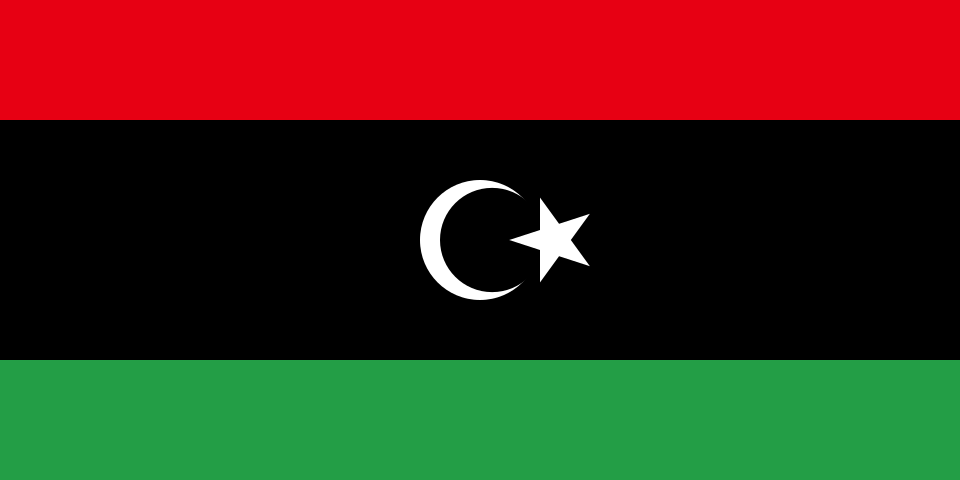
Libya, the stage of the North African campaign, was a colony Italy had taken from the Ottoman Empire in the Italo-Turkish War of 1911–1912. For years Italy held only the coast, and in Cyrenaica native troops tied to the Senussi order resisted from 1923 under Omar al-Mukhtar. The "pacification" campaigns led by Pietro Badoglio and Rodolfo Graziani used chemical weapons and mass executions of soldiers and civilians. In 1930–1931 alone 12,000 Cyrenaicans were executed, and all the nomadic peoples of northern Cyrenaica were forcibly moved into huge concentration camps in the lowlands. By the time the camps closed in September 1933, 40,000 of their 100,000 internees had died, and 100,000 Bedouin, almost half the population of Cyrenaica, had been expelled from land slated for Italian settlers. In 1934 Governor Italo Balbo unified the two colonies, and in 1939 the coastal provinces were incorporated into metropolitan Italy as the "Fourth Shore". The desert battles of the Second World War were fought on land where the memory of colonial conquest and mass killing was still fresh. 1
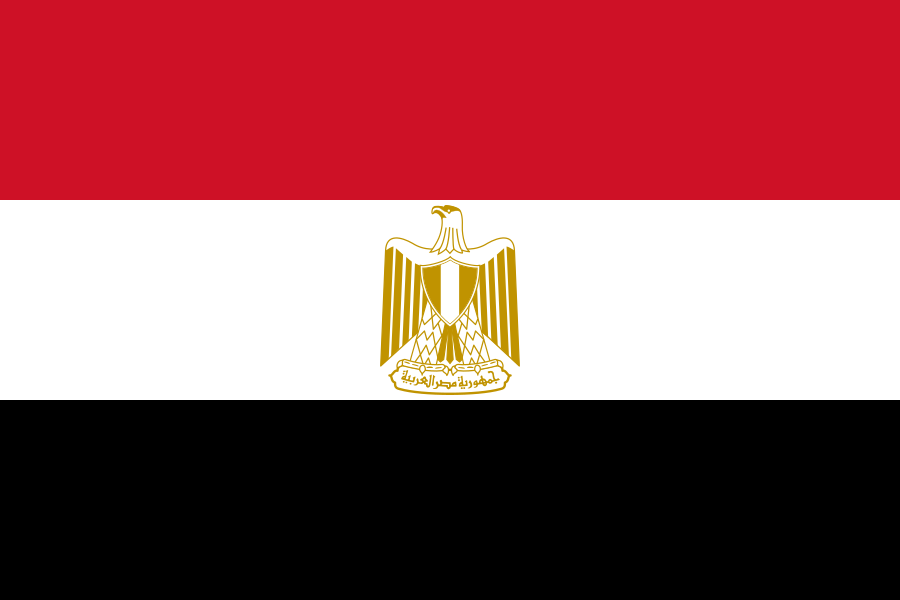
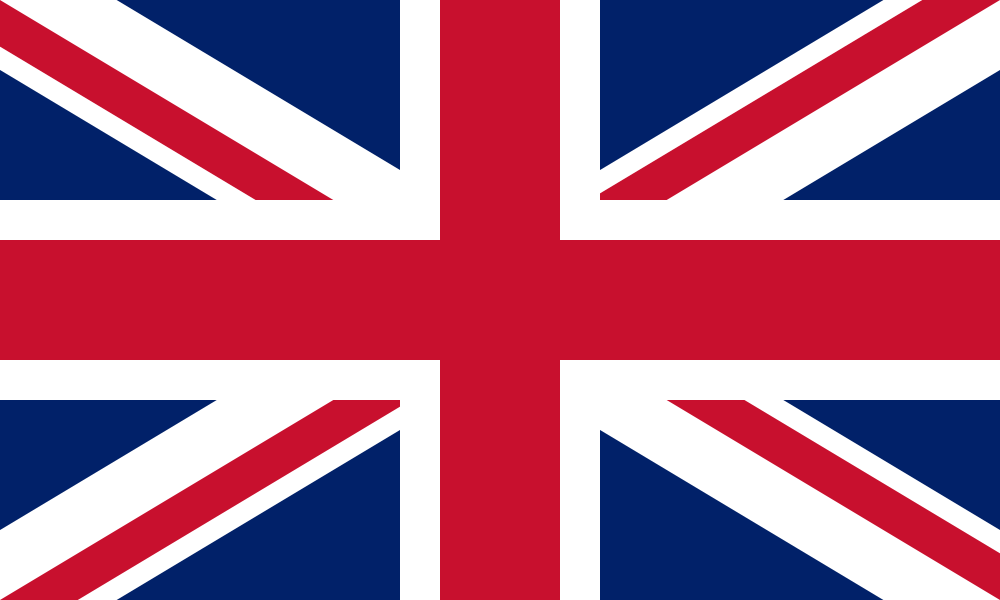
On 10 June 1940, a month after Germany opened its offensive in the West and days before France collapsed, Benito Mussolini declared war on France and Britain. His declaration said Italy did not intend to drag other peoples bordering her on land or sea into the conflict, so the Kingdom of Egypt, where British troops were stationed, formally remained neutral. Yet from the next day, 11 June, British forces in Egypt raided Italian positions in Libya, and on 14 June the 11th Hussars and part of the 1st Royal Tank Regiment crossed the border and took Fort Capuzzo. The North African campaign began with these raids and lasted until the Axis surrender in Tunisia on 13 May 1943. When the Armistice of Compiègne on 22 June left all of French North Africa under the Vichy government, Italian troops who had faced Tunisia moved east to Cyrenaica to reinforce the 10th Army. General Archibald Wavell, Commander-in-Chief Middle East, whose equipment was wearing out, ended the raids and left the Egyptian frontier to a small screening force. 2
When Balbo, the Governor-General of Libya who commanded the North Africa Supreme Headquarters, was killed in an accident, Mussolini sent Marshal Graziani in his place with orders to attack Egypt by 8 August. Graziani replied that the 10th Army was not properly equipped and that an attack could not possibly succeed, but Mussolini ordered him to attack anyway. The Italian strategy was to advance along the coast and seize the Suez Canal, but a shortage of lorries and aircraft meant the plan was repeatedly postponed and scaled back. On 13 September five divisions finally advanced down the coast road past Sollum, about 105 km into Egypt, and on 16 September halted around Sidi Barrani and built fortified camps. British dead in the advance numbered 40, Italian 120. The 10th Army was to wait in its camps until engineers had built the Via della Vittoria, an extension of the Libyan Via Balbia, and to accumulate supplies for an attack on the main British force at Mersa Matruh, about 130 km further east. 3 2
 Operation Compass and the arrival of the Afrika Korps
Operation Compass, planned as a five-day raid to pick off the dispersed Italian camps one by one, began on the night of 7/8 December 1940. The Western Desert Force under Richard O'Connor, about 36,000 men, faced some 150,000 men of the Italian 10th Army around Sidi Barrani and across Cyrenaica, overran the fortified posts in turn, drove the Italians out of Egypt and took Bardia and Tobruk. The Italian garrison of Tobruk surrendered on 22 January 1941. O'Connor sent the 7th Armoured Division across the desert to reach Beda Fomm ahead of the 10th Army retreating along the coast, and the trapped Italians surrendered on 7 February. In ten weeks the Commonwealth forces took 130,000 to 138,000 Italian and Libyan prisoners (figures vary by source), hundreds of tanks and more than a thousand guns and reached El Agheila, at a cost of about 1,900 killed and wounded. But in March the best units left for the campaign in Greece, vehicles were worn out, and the advance stopped at El Agheila. 4 2 5
Asked for help by Mussolini, Hitler sent German troops to Libya. The first units of this dispatch, Operation Sonnenblume ("Sunflower"), left Naples on 11 February 1941, and Erwin Rommel arrived in Libya on 12 February. The expeditionary force Hitler named the Afrika Korps was to reinforce the Italians and defend Tripoli and Tripolitania, and German commitment never exceeded one panzer division at first and later two panzer divisions and one motorised division; Italians still did most of the fighting. But Rommel went beyond his defensive orders, attacking El Agheila on 24 March and Mersa Brega on 31 March, and in April the British were driven out of Cyrenaica. On 6 April O'Connor was captured by a German patrol and spent more than two years in an Italian prisoner-of-war camp. Wavell wrote in 1949, "I had certainly not budgeted for Rommel after my experience of the Italians." Ultra decrypts that showed Rommel had been ordered not to attack also fed the British command's complacency. 6 2 7
From 10 April 1941 a garrison built around the 9th Australian Division under Leslie Morshead was besieged by German and Italian forces in the port of Tobruk. Known as the Rats of Tobruk, the defenders held out on supplies and replacements the Royal Navy ran in by night, and without Tobruk Rommel had to feed forward units at Sollum and the Halfaya Pass on the frontier along a long supply line reaching back to Tripoli. British attempts to relieve the siege, Operation Brevity in May and Operation Battleaxe in June, both failed, and after Battleaxe Wavell exchanged posts with Claude Auchinleck and went to India. Far to the south, Free French forces from French Equatorial Africa besieged the Kufra oasis from 31 January to 1 March 1941 and forced the surrender of its Italian and Libyan garrison. On 1 March their commander Leclerc and his men swore not to lay down their arms until their colours flew over Strasbourg Cathedral. 5 2 8 9
 From Crusader to the fall of Tobruk
Under Auchinleck the Western Desert Force gained XXX Corps and became the Eighth Army, a coalition of Commonwealth and exile forces: British troops alongside Australian, Indian, New Zealand and South African forces, the Sudan Defence Force and Marie-Pierre Koenig's Free French brigade. In Operation Crusader, launched on 18 November 1941, dispersed British armour lost 530 tanks in the first five days while knocking out about 100 Axis tanks, and on 23 November the 5th South African Brigade was destroyed at Sidi Rezegh. On the 24th Rommel launched his "dash to the wire" into the British rear, which instead gave the British armour time to recover. On 27 November the New Zealanders reached the Tobruk garrison and ended the 231-day siege, and Rommel, short of supplies, fell back in December via Gazala to El Agheila. But on 21 January 1942 the Axis, resupplied from Tripoli, counter-attacked by surprise and drove the Eighth Army back to the Gazala line. 2 10 5
On 26 May 1942 Rommel's Panzerarmee Afrika launched Operation Venezia, a decoy attack in the north while the main force swung round the southern end of the Gazala line. At the Bir Hakeim oasis at the southern end, about 3,600 men of the 1st Free French Brigade under Koenig held out from 26 May to 11 June. The garrison included Foreign Legion and African colonial battalions, and on the night of 10/11 June, with ammunition almost gone, it broke out to a rendezvous arranged by the British; about 2,700 men got away. The resistance lengthened the Axis supply route round the southern end of the line, and Churchill called the defenders the "Fighting French". Rommel held a position backing onto the British minefields, the Cauldron, defeated the poorly coordinated British Operation Aberdeen in detail, and the Eighth Army abandoned the Gazala line. 11 12
On 21 June the Axis broke through a weak spot on Tobruk's eastern perimeter and took the port within a day. The garrison of 33,000 men under Hendrik Klopper of the 2nd South African Division was captured, together with more than 1,000 serviceable vehicles, 5,000 tons of food and 1,400 tons of petrol. It was the largest surrender of British Empire forces in the war after the fall of Singapore in February 1942. The Battle of Gazala is reckoned the greatest victory of Rommel's career. The Axis pushed on into Egypt and forced the Eighth Army out of several defensive positions. To support the advance into Egypt, Operation Herkules, the planned assault on Malta, was postponed, a decision that let the British revive Malta as a base for attacks on Axis convoys bound for Libya. 11
 The war of supply and intelligence: Malta, Ultra and "the good source"
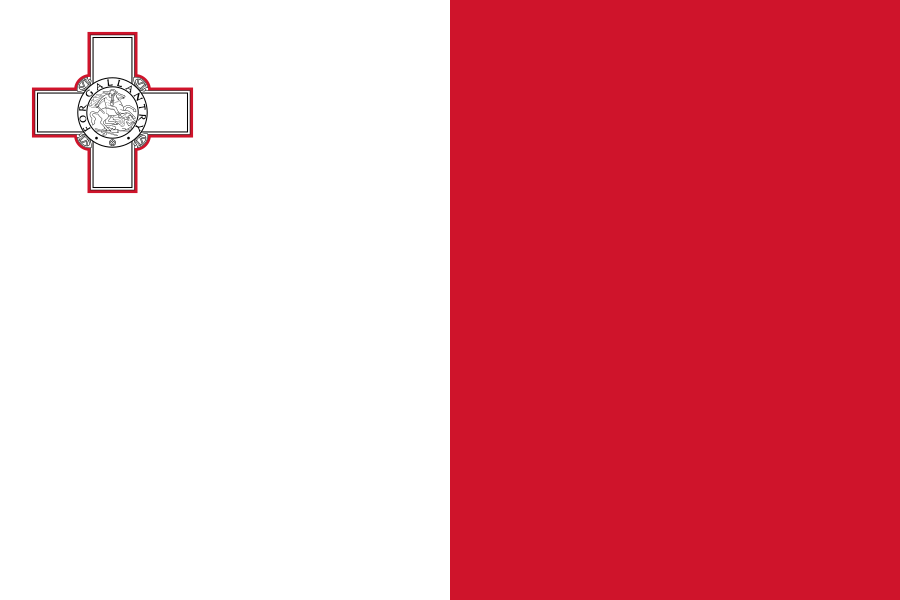
Victory in the desert depended on supplies brought across the sea. The North African coast has few natural harbours, and the British base at Alexandria on the Nile delta was some 2,100 km by road from the main Italian port of Tripoli. Between them, in the middle of the Mediterranean, lay the British colony of Malta. In May 1941 Rommel warned that "without Malta the Axis will end by losing control of North Africa". From June 1940 to November 1942 the Luftwaffe and the Regia Aeronautica tried to bomb and starve Malta into submission, flying 3,000 bombing raids over two years and dropping 6,700 tons of bombs on the Grand Harbour area alone. Air attacks directed by Albert Kesselring, who arrived in Sicily in January 1942 as Commander-in-Chief South, greatly reduced Malta's offensive capacity and let supply convoys from Italy reach Africa more regularly. Allied convoys and the RAF nonetheless held the island, and aircraft and submarines based there attacked convoys bound for Libya. Going over to the offensive after El Alamein and the Torch landings, Allied forces on Malta sank 230 Axis ships in 164 days by May 1943. 13 11 14
For a time the Axis led the intelligence war. Bonner Fellers, the US military attaché in Cairo, toured British headquarters and the front and sent detailed reports to Washington in the State Department's "Black Code"; after Italian intelligence secretly photographed the code book at the US embassy in Rome in September 1941, Germany and Italy were reading his reports. Known to the Germans as "the good source", Fellers kept Rommel informed of Allied strength and intentions from January to June 1942, and only on 29 June did he stop using the Black Code. The Afrika Korps' 621st Signals Battalion listened in on British units with poor radio discipline, until it was captured by the 9th Australian Division in July 1942. 2 15
On the Allied side Ultra, the decryption of German signals enciphered with the Enigma machine, came to play a growing role. At first its value was limited because information reached field commanders too late or misread Rommel's actual intentions, but by revealing the times and routes of Axis convoys across the Mediterranean it became central to cutting the supply line. To hide the decryption, the British flew a reconnaissance flight before attacking a convoy so that it seemed to have been found by chance. It has been estimated that 40 to 60 percent of Axis supply shipping was located and destroyed thanks to decrypts, but Vincent O'Hara and Enrico Cernuschi argued in 2013 that historians such as F. H. Hinsley greatly exaggerated Ultra's effects. By their count, 2.24 million of the 2.67 million tons of materiel, fuel and munitions shipped to Africa arrived, and "Ultra did not deny the Axis armies the supplies they needed to reach the Nile." 2
El Alamein
Before the railway halt of El Alamein, 106 km from Alexandria, the Eighth Army under Auchinleck's personal command stopped the Axis advance into Egypt in the First Battle of El Alamein, 1–27 July 1942. The front was a narrow neck between the sea to the north and the Qattara Depression, impassable to most vehicles, to the south. But neither the Axis, too far from its base at Tripoli, nor the exhausted Eighth Army could strike a decisive blow. In early August Churchill and Alan Brooke, Chief of the Imperial General Staff, came to Cairo and replaced Auchinleck as Commander-in-Chief Middle East with Harold Alexander. William Gott, appointed to command the Eighth Army, was killed when his transport aircraft was shot down by German fighters, and Bernard Montgomery took his place. 16 15
On 30 August Rommel opened his last big offensive, Operation Brandung, an attempt to envelop the Eighth Army from the south. Warned through Ultra, Montgomery left a gap in the south and dug in his armour and artillery on Alam el Halfa Ridge, 32 km behind the front, ordering the tanks to fight as static anti-tank guns. When the attacks on the ridge failed and fuel ran short, Rommel withdrew in early September. He blamed British air superiority, unaware of Ultra. Montgomery chose to build up and train for an autumn offensive rather than pursue, and with this battle the Axis lost the initiative in Africa. The sick Rommel left for Germany on 23 September and Georg Stumme took command. 17 15
The Second Battle of El Alamein began on the night of 23 October. The Eighth Army, with 195,000 men and 1,029 tanks, attacked the Panzerarmee's 116,000 men and 547 tanks. Montgomery's Operation Lightfoot was to cut two corridors through the northern minefields; on the first day Stumme went forward to see for himself, suffered a heart attack and died, and Hitler sent Rommel back from his sanatorium. When the offensive stalled, Churchill railed, "Is it really impossible to find a general who can win a battle?" As the breakthrough began with Operation Supercharge on 2 November, Hitler ordered the army to stand fast, telling Rommel to show his troops "no other road than that to victory or death", and Mussolini issued a similar order. Rommel thought the order demanded the impossible and retreated on 4 November. German losses were 1,149 killed, 3,886 wounded and 8,050 captured, Italian losses 971 dead, 933 wounded and 15,552 captured, and by 11 November Axis prisoners had risen to 30,000 (the Italian official history and Bayerlein give different figures). On 10 November Churchill said: "This is not the end. It is not even the beginning of the end. But it is perhaps the end of the beginning." 15
 The Torch landings and Vichy France
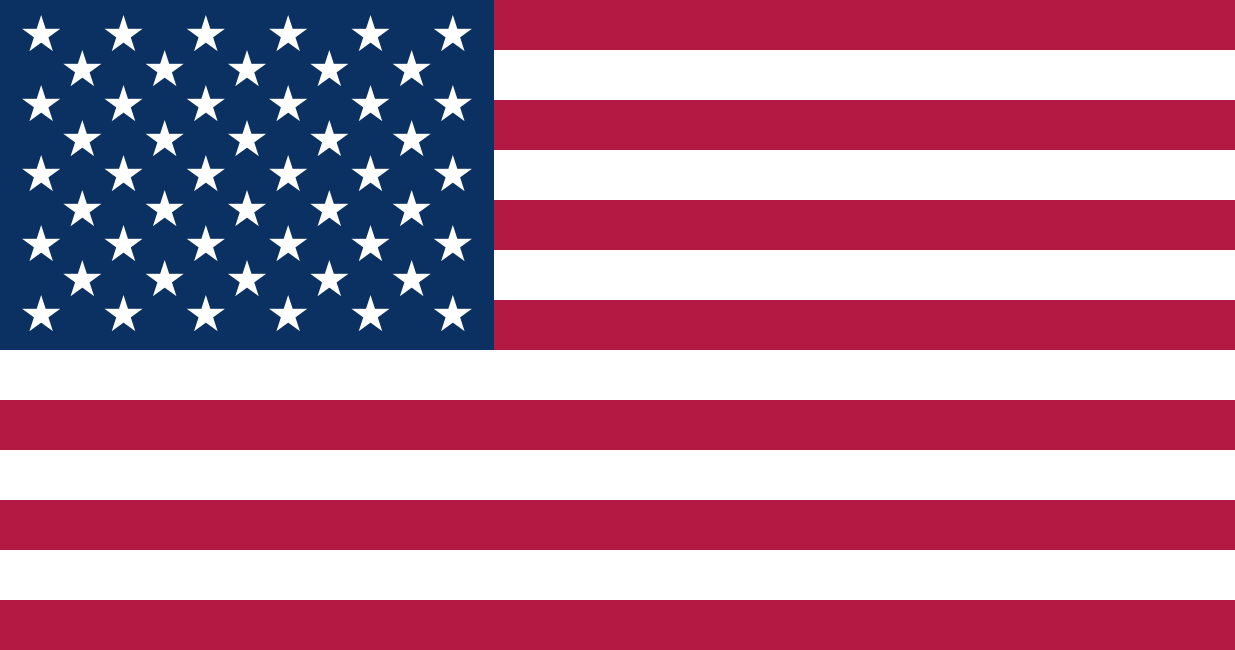
The landing in French North-West Africa was a compromise within the alliance. Even after the Combined Chiefs of Staff met in London on 30 July 1942, George Marshall and Ernest King declined to approve the plan and argued for an invasion of northern Europe that year, which the British rejected. When Churchill pressed for a landing in North Africa in 1942, Marshall suggested to Roosevelt that the United States abandon the Germany-first strategy and take the offensive in the Pacific; Roosevelt replied that this would do nothing to help Russia. Roosevelt then gave a direct order that Operation Torch take precedence over other operations and take place at the earliest possible date, one of only two direct orders he gave to military commanders during the war. Torch gave Britain its North African victory and the United States the chance to fight Germany on a limited scale, and for Stalin, who had long pleaded for a second front, it offered some relief for the Red Army by diverting Axis forces to North Africa. 2 18
The plan of the Allied supreme commander, Dwight Eisenhower, was to land simultaneously at Casablanca, Oran and Algiers and then move rapidly on Tunis, catching the Axis between his forces and the British advancing west from Egypt. George S. Patton's Western Task Force of 35,000 men sailed straight from the United States to Casablanca, Lloyd Fredendall's Centre Task Force of 18,500 to Oran, and Kenneth Anderson's Eastern Task Force of 20,000 to Algiers. When the landings began on 8 November, Vichy French forces resisted fiercely at Oran and in Morocco, contrary to the information of the American consul Robert Murphy, and off Casablanca the US Navy fought Vichy French and German vessels. In Algiers a coup by the French resistance on the 8th neutralised the French XIX Corps before the landing and arrested the Vichy commanders, and the city fell on the first day. 18 2
Admiral François Darlan, commander of the Vichy French forces, happened to be in Algiers on a private visit. After three days of talks and threats, Mark Clark and Eisenhower got Darlan and Alphonse Juin to order an end to resistance in Oran and Morocco on 10–11 November. Darlan declared that he would govern French North Africa on behalf of Pétain, whom he described as "prevented" from governing, and in return was installed as High Commissioner for North and West Africa, with many Vichy officials keeping their posts. The Clark-Darlan Accords signed between the United States and Darlan on 22 November gave the United States significant control over the French colonial empire in Africa, and Charles de Gaulle opposed them as an infringement on French sovereignty. Germany answered the landings by occupying the rest of Vichy France (Case Anton), but the main part of the French fleet at Toulon was scuttled before the Axis could use it. On 24 December Darlan was assassinated by Fernand Bonnier de La Chapelle, a 20-year-old monarchist and anti-Vichyist. His successor as High Commissioner, Henri Giraud, attended the Casablanca Conference in January 1943, broke with the Vichy regime in a speech in March and in June became co-president with de Gaulle of the French Committee of National Liberation, before being outmanoeuvred by de Gaulle the following year. 2 18 19 20 21
 The Tunisian campaign and the Axis surrender
Immediately after the Torch landings Germany and Italy rushed troops into Tunisia, which the Vichy forces had left. The Allies, wrestling with the Vichy authorities, did not advance rapidly, and only entered Tunisia in mid-November in single-division strength. Anderson's force, renamed the British First Army, came within 30 km of Tunis before Axis air superiority halted it, and by early December it was clear that Tunis and Bizerte could not soon be taken. On 8 December Hans-Jürgen von Arnim arrived to command the 5th Panzer Army. Montgomery's Eighth Army took Tripoli on 23 January 1943, and the Axis army that had retreated across Libya entered the Mareth Line in southern Tunisia, built by the French against an Italian invasion. In January it was renamed the First Italian Army under Giovanni Messe. 2 14
On 19–24 February Axis forces under Rommel fought their first major engagement with US troops at the Kasserine Pass, a 3 km gap in the Atlas Mountains in west-central Tunisia. Fredendall's US II Corps suffered heavy losses and was pushed back more than 80 km from its original positions west of the Faïd Pass, and British forces also lost all 11 of their tanks. But Rommel, short of fuel, ammunition and reserves, gave up all his gains under Allied artillery counter-attacks and withdrew by the 24th. Eisenhower relieved Fredendall, and the lessons of the defeat led the US Army to make sweeping changes in unit organisation, tactics, commanders and some equipment. Harold Alexander's 18th Army Group took over the coordination of the three Allied nations' forces. In early March the Eighth Army reached the Tunisian border, trapping Rommel and von Arnim between two armies, and Rommel went back to Germany for health reasons and did not return to Africa. 22 2
At the end of March the Eighth Army outflanked the Mareth Line after hard fighting, and in mid-April the First Army in central Tunisia launched its main offensive. On 7 May British armour entered Tunis and American infantry of II Corps entered Bizerte. On the 9th Omar Bradley's US II Corps cornered what remained of the 5th Panzer Army and took its surrender, and von Arnim surrendered to the Royal Sussex Regiment. On 12 May Messe cabled that he would fight on, but that evening he received Mussolini's order to surrender. Around noon on 13 May the First Italian Army surrendered to the Eighth Army, ending Axis resistance in Africa. Prisoner totals differ by source: over 170,000 in the six days after the fall of Tunis, over 260,000, or over 275,000, including most of the Afrika Korps. Allied casualties numbered 76,020: 38,360 British and Commonwealth, 19,439 Free French and 18,221 American. The loss of so many experienced troops cost the Axis all of Italy's African colonies, and two months later the Allies landed in Sicily. 14 2
Behind the lines: colonial subjects and Jews
The North African campaign was long described as a "war without hate", a purely military clash in the desert without the partisan murders and ethnic cleansing occurring across Europe. Recent historians have challenged this view. Many civilians lived in the region, and throughout the campaign Italian and German forces committed numerous atrocities and abuses against Allied prisoners of war and local Jewish, Berber and Arab populations. Patrick Bernhard's 2012 study examined Italian atrocities and the persecution of Arabs, Berbers and Jews behind the battle lines in North Africa. Many of the soldiers were themselves colonial troops: the Italian 10th Army included Libyan colonial divisions, and Indian and South African troops of the Eighth Army, African colonial battalions at Bir Hakeim and German légionnaires press-ganged out of the French Foreign Legion all fought in this desert. 2 3 12
Libyan Jews suffered under Fascist Italy's antisemitic laws and deportations by both the Italian and German armies. In January 1942 the Italian authorities applied Mussolini's "sfollamento" (evacuation) order to Libyan Jews, sending the Jews of Benghazi, Derna, Tobruk, Barce and other Cyrenaican towns to camps in the west. The worst was Giado (now Jadu), 235 km from Tripoli. Of the roughly 2,600 Jews held in this forced-labour camp, which operated from May 1942 until its liberation by British troops in January 1943, 562 died, mostly from hunger and louse-borne typhus. Giado had the highest death toll of all the North African labour camps of the Second World War, and its victims make up the largest number of Jewish victims of the war in the Muslim world. In 1942 German troops occupied the Jewish quarter of Benghazi, plundered shops and deported more than 2,000 Jews across the desert to labour camps, where more than a fifth of them died. 23 24
Having occupied Vichy Tunisia right after the Torch landings, the Germans arrested Moises Burgel, president of the Tunis Jewish community, and other prominent Jews on 23 November 1942. Some 100,000 Jews lived in Tunisia at the time. According to Yad Vashem, the Nazis imposed the yellow badge, fines and confiscation of property, and sent more than 5,000 Jews to forced-labour camps, where 265 are known to have been murdered. Another 160 Tunisian Jews living in France were sent to extermination camps in continental Europe. But with the front so close and ships and aircraft needed for military transport, Germany could not carry out the "Final Solution" in Tunisia, and Tunisian Jews were spared the mass deportations and killings that took place in Europe. Martin Gilbert treats the persecution of the Jews of French North Africa as part of the Holocaust in France. When British rule began on 23 January 1943, the Libyan Jewish community had been deeply scarred by the racial laws, the war and the camps. 25 23
 Assessment
The North African campaign has long been remembered through the name of one man, Rommel. The image historians call the "Rommel myth" began in 1941 as Nazi propaganda in which Rommel himself took part. The British wartime press spread the story of Rommel's genius to explain repeated defeats in North Africa, and it was used both by dissenters protesting social inequality within the British Army and by leaders like Churchill seeking to reduce class tensions. After the war the British depicted Rommel as the "good German", in line with the myth of the clean Wehrmacht, and Desmond Young's 1950 biography and the 1953 Rommel Papers cemented the myth. His reputation for a clean war served West German rearmament and reconciliation between former enemies during the Cold War, and former officers such as Hans Speidel, once Rommel's chief of staff, held that no West German army was possible without rehabilitating the Wehrmacht. The criticism that the phrase "war without hate" itself erases the experience of colonial subjects and Jews described above belongs to the same reassessment. 26 2
Whether the campaign stood in for the second front the Soviet Union demanded was disputed within the alliance. British and American leaders saw Torch as a realistic compromise that put American troops into combat and secured the Mediterranean route before a landing in Europe, while for Stalin, who had long pleaded for a second front to draw off the Wehrmacht, whether North Africa met that demand leads into the debate covered in "The Second Front and the Normandy Landings". The German forces sent to the desert never exceeded one panzer division at first and later two panzer divisions and one motorised division. Yet the burden was real: over half the German Ju 52 transport planes needed to supply the Axis forces encircled at Stalingrad were tied up supplying North Africa, and the surrender in Tunisia cost the Axis hundreds of thousands of experienced troops at once. The defeat led two months later to the invasion of Sicily and the fall of Mussolini's government, eliminating Germany's main European ally. 2 14 27
The desert war can also be read as a case of supply and sea control prevailing over tactical talent. Rommel won his greatest victory at Gazala but was stopped at El Alamein, at the end of a supply line stretching nearly 2,000 km from Tripoli. Montgomery's victory came after the arrival of Sherman tanks, 6-pounder anti-tank guns and Spitfires had given the Allies overwhelming superiority in both quantity and quality. Looking back in his 1950 memoirs, Churchill wrote: "Before Alamein we never had a victory. After Alamein we never had a defeat." But how much Ultra contributed to cutting the supply line is still disputed, and conclusions depend on how the struggle between Malta and the Italian convoys is judged. The figures also differ: prisoners in Operation Compass are given as 130,000 to 138,000 and in the Tunisian surrender as 170,000 to 275,000, depending on the source, and across the whole campaign nearly 400,000 Axis and Allied troops were lost, injured or died of disease. 15 2 4 14
Consequences
The Axis surrender in Tunisia on 13 May 1943 yielded 170,000 to 275,000 prisoners (figures vary by source), and Italy lost all its African colonies; Libya passed under British and French administration before independence in 1951. Two months later the Allies landed in Sicily, and the Italian campaign led to the fall of Mussolini's government. Vichy French North Africa, contested between Giraud and de Gaulle, was united under the French Committee of National Liberation in June 1943.
Timeline & Map
- 1940.06.10Italy enters the war
Mussolini declared war on France and Britain; the next day British forces in Egypt began raiding Italian positions in Libya.
- 11940.06.14Fort Capuzzo taken
The 11th Hussars and part of the 1st Royal Tank Regiment crossed the border and took Fort Capuzzo.
- 21940.09.13Italian invasion of Egypt
Graziani's 10th Army advanced about 105 km along the coast road and halted at Sidi Barrani on the 16th.
- 1940.12.09Operation Compass
O'Connor's Western Desert Force of about 36,000 men attacked the Italian camps around Sidi Barrani.
- 31941.01.22
 Italian surrender at Tobruk
The Italian garrison of Tobruk surrendered to Commonwealth forces.
- 41941.02.0710th Army surrenders at Beda Fomm
The trapped remnants of the Italian 10th Army surrendered; Compass took 130,000 to 138,000 prisoners.
- 51941.02.12Rommel arrives
Rommel, commander of the Afrika Korps sent in Operation Sonnenblume, arrived in Libya.
- 61941.03.01Kufra taken; the Oath
Free French forces took the surrender of Kufra oasis, and Leclerc and his men swore the Oath of Kufra.
- 71941.04.10Siege of Tobruk begins
A garrison built around the 9th Australian Division was besieged by German and Italian forces.
- 81941.11.18Operation Crusader
Auchinleck's Eighth Army opened its offensive to relieve Tobruk.
- 91941.11.27
 Siege of Tobruk lifted
New Zealand troops reached the garrison, ending the 231-day siege.
- 101942.01.21Axis counter-offensive
Resupplied, Rommel's army struck from El Agheila and drove the Eighth Army back to Gazala.
- 111942.05.26Battle of Gazala
Panzerarmee Afrika launched Operation Venezia round the southern end of the Gazala line.
- 121942.06.11Breakout from Bir Hakeim
After holding out for over two weeks, Koenig's Free French brigade broke out; about 2,700 of its 3,600 men escaped.
- 131942.06.21
 Fall of Tobruk
The Axis took Tobruk in a day and captured its garrison of 33,000.
- 141942.07.01–
27 First Battle of El AlameinThe Eighth Army under Auchinleck's personal command fought until the 27th and halted the Axis advance into Egypt.
- 151942.08.30Battle of Alam el Halfa
Rommel's last big offensive was stopped by Montgomery's defence of the ridge.
- 161942.10.23
 Second Battle of El Alamein
The Eighth Army, with 195,000 men and 1,029 tanks, opened its offensive.
- 171942.11.04Axis retreat
Despite Hitler's stand-fast order, Rommel retreated from El Alamein.
- 181942.11.08Torch landings
American and British troops landed at Casablanca, Oran and Algiers; in Algiers a resistance coup let the city fall on the first day.
- 191942.11.10Darlan's ceasefire order
Darlan ordered French forces in North Africa to cease resistance and declared he would govern on Pétain's behalf.
- 201942.11.22Clark-Darlan Accords
The United States and Darlan signed accords giving the US significant control over French Africa.
- 211942.11.23Tunis Jewish leaders arrested
German forces occupying Tunisia arrested Moises Burgel, president of the Tunis Jewish community, and other prominent Jews.
- 221942.12.24Darlan assassinated
Darlan was assassinated in Algiers by the 20-year-old monarchist Bonnier de La Chapelle; Giraud succeeded him as High Commissioner.
- 231943.01.23Tripoli taken
The Eighth Army took Tripoli; British rule in Libya began the same day.
- 241943.01Giado camp liberated
The Giado camp, where about 2,600 Libyan Jews had been held since May 1942 and 562 had died, was liberated by British troops (January 1943).
- 251943.02.19–
24 Battle of Kasserine PassRommel's Axis forces pushed the US II Corps back more than 80 km before withdrawing by the 24th.
- 261943.05.07Fall of Tunis and Bizerte
British armour entered Tunis and American infantry of II Corps entered Bizerte.
- 271943.05.13Axis surrender in North Africa
Messe's First Italian Army surrendered to the Eighth Army, ending Axis resistance in Africa.
Related people 34
Allies (Britain, the Commonwealth, the United States, Free France)20
Leadership7
Pressed for a North African landing and replaced Auchinleck with Alexander in Cairo in August 1942; after El Alamein he gave the "end of the beginning" speech.
President of the United StatesFranklin D. Roosevelt1882–1945Overrode his chiefs' opposition and gave a direct order that Operation Torch take precedence over other operations.
Allied supreme commander for Operation TorchDwight D. Eisenhower1890–1969Commanded the landings at Casablanca, Oran and Algiers and struck the deal with Darlan that ended Vichy resistance; relieved Fredendall after Kasserine.
Commander-in-Chief Middle EastArchibald Wavell1883–1950Set the frontier defence in 1940 and launched Operation Compass, but after Rommel's counter-offensive and the failure of Battleaxe in 1941 he was replaced by Auchinleck.
Commander-in-Chief Middle East; commanded the Eighth ArmyClaude Auchinleck1884–1981Relieved Tobruk with Operation Crusader and halted the Axis advance into Egypt at the First Battle of El Alamein, then was dismissed in August 1942.
Commander-in-Chief Middle East; 18th Army GroupHarold Alexander1891–1969Succeeded Auchinleck in August 1942 and, with the 18th Army Group uniting British, American and French forces in Tunisia, received the Axis surrender.
Commander of the Eighth ArmyBernard Montgomery1887–1976Stopped Rommel's last offensive at Alam el Halfa, broke the Axis army at the Second Battle of El Alamein and pursued it to Tripoli and the Mareth Line.
Implementers & commanders7
Destroyed the Italian 10th Army in Operation Compass and cut its retreat at Beda Fomm; captured by the Germans in April 1941.
Commander of the 1st Free French BrigadeMarie-Pierre Koenig1898–1970Held Bir Hakeim from 26 May to 11 June 1942 and then broke out.
Commander at the capture of KufraPhilippe Leclerc de Hauteclocque1902–1947Led the Free French forces that took the surrender of Kufra oasis on 1 March 1941 and swore the Oath of Kufra.
Commander of the Western Task ForceGeorge S. Patton1885–1945In Operation Torch he led 35,000 men sailing straight from the United States to land at Casablanca.
Commander of US II CorpsOmar Bradley1893–1981Cornered the remnants of the 5th Panzer Army and took their surrender on 9 May 1943.
Commander, Australian 9th Division · Tobruk garrisonLeslie Morshead1889–1959He led the garrison, built around the Australian 9th Division, in the 1941 Siege of Tobruk and commanded the division at the Second Battle of El Alamein in 1942.
Commander, XIII Corps · appointed to the Eighth ArmyWilliam Gott1897–1942He led the 7th Armoured Division and XIII Corps from the start of the desert war; appointed to the Eighth Army in August 1942, he was killed when his transport was shot down, and Montgomery took his place.
Participants6
With Eisenhower, got Darlan and Juin to order an end to resistance, and on 22 November concluded the Clark-Darlan Accords.
US consul in AlgiersRobert Murphy1894–1978Supplied the information that led the Allies to expect Vichy forces not to fight, and tried to win over Juin on the day of the landings.
US Army Chief of StaffGeorge C. Marshall1880–1959Argued for a landing in northern Europe in 1942, declined to approve the Torch plan and suggested to Roosevelt a Pacific offensive instead.
Chief of the Imperial General StaffAlan Brooke1883–1963Came to Cairo with Churchill in August 1942 and reshaped the Middle East command.
Leader of Free FranceCharles de Gaulle1890–1970Opposed the Clark-Darlan Accords as an infringement on French sovereignty, and in June 1943 became co-president with Giraud of the French Committee of National Liberation.
High Commissioner for French North and West AfricaHenri Giraud1879–1949Became High Commissioner after Darlan's assassination, attended the Casablanca Conference and broke with Vichy in March 1943; took the salute with Eisenhower and Alexander at the Tunis victory parade.
Axis (Italy, Germany)9
Leadership4
Went beyond his defensive orders to attack in 1941 and won his greatest victory at Gazala, but was stopped at El Alamein; after Kasserine he returned to Germany in March 1943.
Führer of GermanyAdolf Hitler1889–1945Sent the Afrika Korps to rescue his Italian ally and at El Alamein issued the "victory or death" stand-fast order.
Prime Minister of ItalyBenito Mussolini1883–1945Declared war on 10 June 1940 and forced Graziani to attack Egypt; in May 1943 he ordered Messe to surrender.
Governor-General of Libya; commanded the 10th ArmyRodolfo Graziani1882–1955Led the "pacification" of Libya in the early 1930s, invaded Egypt on Mussolini's orders in September 1940 and lost the 10th Army in Operation Compass.
Implementers & commanders2
He led the Italian 1st Army, formerly Rommel's, at the Mareth Line and made the last Axis surrender in Tunisia on 13 May 1943.
Commander, 5th Panzer Army and Army Group AfricaHans-Jürgen von Arnim1889–1962He took the 5th Panzer Army in Tunisia in December 1942, succeeded Rommel at the head of Army Group Africa in March 1943 and surrendered on 12 May.
Participants3
Unified the two colonies in 1934 and headed the North Africa Supreme Headquarters in 1940 until he was killed in an accident.
Commander-in-Chief SouthAlbert Kesselring1885–1960Arrived in Sicily in January 1942 and directed the air attacks on Malta that opened the way for Axis convoys.
Commander of the "pacification" of LibyaPietro Badoglio1871–1956With Graziani, led the Libyan pacification campaigns that used chemical weapons and mass executions.
Vichy France3
Participants2
Darlan claimed to govern North Africa on behalf of Pétain, whom he described as "prevented" from governing.
Commander, French forces in North AfricaAlphonse Juin1888–1967During the Torch landings of November 1942 he joined Darlan in ordering the resistance at Oran and in Morocco to stop, then ordered French forces in Tunisia to fight the Axis.
Outside the camps
Participants2
Had long pleaded for a second front; Torch eased some of the Red Army's burden by diverting Axis forces to North Africa.
Leader of the Cyrenaican resistanceOmar al-Mukhtar1858–1931He led the Senussi-linked resistance in Cyrenaica until Graziani's "pacification" captured and hanged him in 1931; he belongs to the colonial background of the Libya where the campaign was fought.
Related terms
Sources: reference 1reference 2reference 3reference 4reference 5reference 6reference 7reference 8reference 9reference 10reference 11reference 12reference 13reference 14reference 15reference 16reference 17reference 18reference 19reference 20reference 21reference 22reference 23reference 24reference 25reference 26reference 27