The architect of détente who used 'linkage' to build the first framework for superpower arms control, the face of American realism
In his notorious 1972 interview with Oriana Fallaci, he declared: 'Americans like the cowboy who leads the wagon train by riding ahead alone on his horse. This amazing, romantic character suits me precisely.' The comment infuriated Nixon.
A Jewish refugee who fled Nazi Germany at fifteen, Kissinger rose through Harvard's academic ranks to become the most consequential American foreign-policy maker of the Cold War. As National Security Advisor and Secretary of State under Nixon and Ford, he pioneered détente with the Soviet Union, devising the 'linkage' strategy that tied arms control and trade to Soviet restraint and conducting the secret backchannel with Ambassador Anatoly Dobrynin that broke the deadlock over SALT I and the ABM Treaty at the 1972 Moscow Summit. He opened relations with Mao's China through clandestine diplomacy, mediated the Paris Peace Accords to win the Nobel Peace Prize, but also presided over the bombing of Cambodia and covert interventions that earned him lasting accusations of war crimes.
Career timeline
1938–1943Fled Nazi Germany for the U.S.; studied accounting at CCNY, then drafted into the U.S. Army
1943–1949Served in U.S. Army intelligence in Europe, Battle of the Bulge; CIC agent tracking Gestapo and administering denazification
1950–1969Harvard professor of government, director of the Defense Studies Program; foreign-policy advisor to Rockefeller and Nixon campaigns
1969–1975National Security Advisor: led détente, China opening, SALT I negotiations; managed the secret Dobrynin backchannel
1971–1972Secret trips to Beijing, meeting Zhou Enlai; paved the way for Nixon's 1972 China visit
1973–1977Secretary of State: Paris Peace Accords, Nobel Peace Prize (1973), Middle East shuttle diplomacy; implicated in 1973 Chilean coup
1977–2023Founded Kissinger Associates; authored books and advised twelve U.S. presidents
The US president who declared the Cold War over with Gorbachev at Malta, yet whose caution nearly let history slip away
At the Malta joint press conference Bush declared: 'We can realise a lasting peace and transform the East-West relationship to one of enduring co-operation. That is the future that Chairman Gorbachev and I began right here in Malta.'
George H. W. Bush went from World War II naval aviator to oil magnate to the 41st president of the United States, bringing to the White House foreign-policy experience unmatched by any predecessor: CIA director, UN ambassador, and de facto ambassador to China. Upon taking office in 1989 he ordered a strategic review of Soviet policy, the so-called 'Bush pause,' that frustrated Gorbachev, but at the Malta summit that December the two leaders jointly confirmed the Cold War's end, and Bush's steady support for German reunification helped anchor the new European order. He built a multinational coalition to expel Iraq from Kuwait in the Gulf War, then lost his 1992 re-election bid after breaking his 'no new taxes' pledge amid a recession.
Career timeline
1924Born in Milton, Massachusetts, into a wealthy political dynasty
1942–1945Navy torpedo-bomber pilot; shot down at Chichijima, rescued by submarine
The 39th U.S. president whose administration marked both the peak and the end of détente
After the Soviet invasion of Afghanistan, Carter declared in his January 1980 State of the Union: 'An attempt by any outside force to gain control of the Persian Gulf region will be regarded as an assault on the vital interests of the United States of America.'
A Georgia peanut farmer and Baptist, Carter rose from Navy nuclear submarine officer to become a 'New South' governor who pledged to end racial discrimination. Elected president in 1976 as a Washington outsider, he brokered the Camp David Accords, returned the Panama Canal, and normalized diplomatic relations with the People's Republic of China. In June 1979 he brought détente to its peak by signing SALT II with Brezhnev in Vienna, only to withdraw the treaty from Senate consideration after the Soviet invasion of Afghanistan that December, proclaiming the Carter Doctrine and closing the era of détente. After leaving office he founded the Carter Center, dedicating his post-presidency to human rights, public health, and conflict mediation, and was awarded the Nobel Peace Prize in 2002.
The president's brother and attorney general who engineered the secret settlement of the Cuban Missile Crisis
He later wrote: 'The strongest argument against an all-out surprise attack was that it would be a Pearl Harbor in reverse and would blacken the name of the United States in the eyes of the world.'
The younger brother and most trusted adviser of President John F. Kennedy, he was appointed attorney general at 35 and led a crusade against organized crime while championing civil rights. During the 1962 Cuban Missile Crisis, he initially favored invasion but was persuaded by George Ball's Pearl Harbor analogy to support a naval blockade instead; in the crisis's final hours, his secret meeting with Soviet Ambassador Dobrynin, delivering the promise that U.S. Jupiter missiles would be removed from Turkey, was the key to the settlement. After his brother's assassination, he served as a U.S. Senator, opposing the Vietnam War and fighting poverty, before being assassinated during his own presidential campaign in 1968.
Career timeline
1952Campaign manager, JFK Senate campaign
1953–1955Assistant/Counsel, Senate Permanent Subcommittee on Investigations
He worried that the Malta Summit was premature, yet ultimately helped make it happen.
Brent Scowcroft was a former U.S. Air Force officer and national-security official whose realist approach emphasized disciplined policy coordination between presidents, diplomats, and military leaders. As national security adviser to Gerald Ford and George H. W. Bush, he helped manage arms policy and European diplomacy during the final years of the Cold War. He initially regarded the 1989 Malta Summit as premature because it might raise expectations without producing results, but then helped the administration navigate the meeting and the rapid transformation of U.S.-Soviet relations. In later years he continued to favor alliances and international institutions, criticizing the Iraq invasion and unilateralism.
Career timeline
1947Graduated from West Point and commissioned as a U.S. Air Force second lieutenant
1953Earned an M.A. in international relations from Columbia University
1967Earned a Ph.D. in international relations from Columbia University
1972–1973Military Assistant to President Richard Nixon
1973–1975Deputy Assistant to the President for National Security Affairs
1975–1977National Security Adviser to President Gerald Ford
1989–1993National Security Adviser to President George H. W. Bush
2001–2005Chairman of the President's Foreign Intelligence Advisory Board
The U-2 pilot whose six-minute, 928-photo run over Cuba on 14 October 1962 revealed Soviet missiles and ignited the Cuban Missile Crisis
"I kind of felt like I was going to be looked at as the one who started the whole thing. I wasn't anxious to have that reputation.", Associated Press interview, 2005
A native of Apalachicola, Florida, he enlisted in the Army Air Forces at 17 and flew combat missions in both the Korean War and two deployments to Vietnam. On the morning of 14 October 1962, his six-minute U-2 flight over western Cuba produced 928 photographs; analysts identified Soviet SS-4 medium-range ballistic missiles by noon, and the images landed on President Kennedy's desk, triggering the thirteen-day nuclear standoff.
Career timeline
1944Enlisted in the U.S. Army Air Forces
1952Began USAF pilot training; combat missions in the Korean War
1957Qualified on the U-2, the 50th pilot checked out on the aircraft
A party leader who lost power while seeking compromise
In October 1981, the Central Committee removed Kania and elected Wojciech Jaruzelski as First Secretary.
Stanisław Kania was a leader of the Polish United Workers' Party who tried to manage the widening breach between party control and social demands. After the strikes of August 1980 and the rise of Solidarity, he pursued dialogue with the union and the Catholic Church, while distrust within the party and the economic crisis narrowed the room for compromise. Under pressure from the Soviet leadership, he left the post of First Secretary in October 1981, succeeded by Wojciech Jaruzelski. Tried over responsibility for the introduction of martial law, he was acquitted in 2012.
Career timeline
1945Joined the Polish Workers' Party
1948Delegate to the founding congress of the Polish United Workers' Party
1968–1971Head of the PZPR Central Committee Administrative Department
1971–1980Secretary of the PZPR Central Committee
1975–1981Member of the PZPR Politburo
1980–1981First Secretary of the PZPR Central Committee
Kennedy's speechwriter whose pen chose 'quarantine' over airstrikes at the nuclear brink
Asked if he wrote 'ask not what your country can do for you,' his lifelong reply was: 'Ask not.'
John F. Kennedy's chief speechwriter and closest adviser, whom Kennedy called his 'intellectual blood bank.' During the 1962 Cuban Missile Crisis, he opposed the Joint Chiefs' call for airstrikes and backed the naval blockade, drafting Kennedy's October 22 televised address and choosing the word 'quarantine' over 'blockade' to avoid the legal implication of a declaration of war. He later called it 'the Kennedy speech with the greatest impact on the planet,' and also drafted the president's secret correspondence with Khrushchev. After the assassination he wrote Johnson's 'Let Us Continue' address, resigned in 1964, and spent decades as an international lawyer and author, endorsing Barack Obama in 2008.
Career timeline
1953–1961Chief legislative aide to Senator John F. Kennedy
1961–1964Special Counsel and chief speechwriter to President Kennedy
1964–1966Author (Kennedy, international bestseller)
Carter's National Security Advisor who drew the Soviet Union into the Afghan trap
That secret operation was an excellent idea. It had the effect of drawing the Russians into the Afghan trap… The day that the Soviets officially crossed the border, I wrote to President Carter: We now have the opportunity of giving to the USSR its Vietnam war.
Polish-born American political scientist and strategist, National Security Advisor under President Jimmy Carter (1977–1981). He drove the human-rights campaign against the Soviet Union, normalization with China, and the Camp David Accords, and articulated the Carter Doctrine committing U.S. force to the Persian Gulf. On July 3, 1979, he signed the finding authorizing covert aid to the Afghan mujahideen while warning Carter it could induce Soviet intervention; in 1998 he called it an 'excellent idea' that drew the USSR into 'its Vietnam war,' fueling the debate over whether the U.S. deliberately trapped the Soviet Union in Afghanistan. After the Cold War, his book The Grand Chessboard (1997) championed Eurasian geostrategy and NATO expansion, exerting a lasting influence on American statecraft.
Career timeline
1977–1981National Security Advisor
1973–1976Director, Trilateral Commission
1966–1968Member, Policy Planning Council, State Department
1960–1972Professor, Columbia University; Director, Research Institute on Communist Affairs
The chancellor who seized the initiative on the German question with a ten-point unification plan days before Malta
On 28 November 1989, Kohl rose in the Bundestag without having told his allies, or even his own foreign minister. President Bush received Kohl's letter summarizing the Ten-Point Plan just as the chancellor was already speaking in Bonn.
A Christian Democratic Union (CDU) politician who served sixteen years as chancellor of West Germany and reunified Germany, leading both European integration and German reunification. On 28 November 1989, without consulting his allies, he presented a 'Ten-Point Plan' for German unity to the Bundestag; days later, at the Malta summit, the German question dominated the proceedings on his terms. The following year, on 3 October 1990, Germany was reunified; together with French president François Mitterrand, Kohl drove the Maastricht Treaty and the introduction of the euro. He achieved reunification by extending the West German system into the former East, and after his long tenure ended with electoral defeat in 1998, he resigned as CDU honorary chairman amid a party donations scandal.
Career timeline
1959Elected to the Landtag of Rhineland-Palatinate (youngest member)
1969–1976Minister-President of Rhineland-Palatinate
1973–1998Chairman of the Christian Democratic Union (CDU)
1976–1982Leader of the CDU/CSU opposition in the Bundestag
1982–1998Chancellor of the Federal Republic of Germany
1989.11.28Presented the Ten-Point Plan for German unity to the Bundestag
1990.10.03Presided over German reunification
1998Defeated in federal elections; resigned as CDU chairman
An Austrian Europeanist who helped open the Iron Curtain
On 27 June 1989, Mock and Gyula Horn cut the fence near Sopron, making the border opening visible to the world.
Alois Mock was an Austrian People's Party politician who made European integration a central aim of Austrian foreign policy. As foreign minister, he pursued Hungary's border opening and Austria's entry into the European Communities, helping shape Central Europe's reordering at the end of the Cold War. On 27 June 1989, he and Gyula Horn symbolically cut the border fence, creating an international image of the openings that enabled East German escapes and preceded the collapse of the Eastern bloc.
Career timeline
1957Doctor of law, University of Vienna
1961–1966EEC and EFTA adviser in the Federal Chancellery; Austrian OECD mission in Paris
1966–1969Cabinet secretary to Chancellor Josef Klaus
1969–1970Federal minister for education, science, research, arts, culture and sport
1979–1989Federal chairman of the Austrian People's Party
The Ecuadorian UN envoy who shuttled through six years of Geneva talks to frame the Soviet withdrawal from Afghanistan
Gorbachev decided to withdraw 'because of perestroika and diplomacy,' he later wrote in his memoir, 'reinforced by military pressure': not because of Stinger missiles alone.
Cordovez was an Ecuadorian diplomat and UN Under-Secretary-General who, as Pérez de Cuéllar's Personal Representative on Afghanistan from 1982, spent six years shuttling between the Pakistani and Afghan delegations in Geneva to broker the accords that framed the Soviet withdrawal. He entered the UN in 1963 as part of Raúl Prebisch's team that founded UNCTAD, rose to head the ECOSOC secretariat, and handled crises from the Iran hostage affair to the Iran-Iraq war. The Geneva Accords were signed on 14 April 1988; Cordovez, nominated for the Nobel Peace Prize, later served as Ecuador's foreign minister and UN ambassador.
Career timeline
1935.11.03Born in Quito, Ecuador
1962Law degree with honors, University of Chile; admitted to the bar
1963Joined the UN; helped Raúl Prebisch found UNCTAD
1978UN Assistant Secretary-General for Economic and Social Matters
1981–1988Under-Secretary-General for Special Political Affairs; Personal Representative of the Secretary-General on Afghanistan
1988.04.14Brokered the signing of the Geneva Accords, framing the Soviet withdrawal
1988–1992Foreign Minister of Ecuador
2005–2007Permanent Representative of Ecuador to the UN
Czech playwright-turned-president whose absurdist theater critiqued the regime and whose dissident leadership ended communist rule
In February 1969, Havel published 'Český úděl?' in the journal Tvář, rebutting Kundera's lyrical nationalism: 'I do not believe in this fate… first and foremost we ourselves are the masters of our fate.'
Czech playwright, dissident, and statesman. His absurdist plays The Garden Party (1963) and The Memorandum (1965) won international acclaim for their satire of the Communist system. After the Prague Spring was crushed in 1968, he answered Milan Kundera's 'Český úděl' with 'Český úděl?', arguing the reforms had merely restored freedoms that existed thirty years earlier, and turned fully to dissident politics. He co-founded Charter 77, endured nearly four years in prison (1979–1983), led the Civic Forum in the 1989 Velvet Revolution, and became the last president of Czechoslovakia and the first president of the Czech Republic.
Career timeline
1963The Garden Party premieres, playwright debut
1968Resists via Radio Free Czechoslovakia during Warsaw Pact invasion
1969Publishes 'Český úděl?' in Tvář, rebutting Kundera
1977Co-founds Charter 77; first spokesperson
1979–1983Imprisoned for dissident activity; writes Letters to Olga
A Turkmen leader who turned late-Soviet rule into personal rule over an independent state
At the 1991 9+1 meetings, he weighed a reworked union against preserving Turkmenistan’s autonomy.
Saparmurat Niyazov was the Soviet-era party and government leader who became independent Turkmenistan’s first president. He led the Turkmen delegation in the 9+1 meetings during the 1991 New Union Treaty process, while the republic’s guarded autonomy limited his role in the negotiations themselves. After independence he invoked neutrality and state sovereignty while concentrating power in the presidency and using the Ruhnama and an extensive personality cult to organize public life. His rule remains a case of post-Soviet state formation fused with authoritarian consolidation.
Career timeline
1962Joined the Communist Party of the Soviet Union
1970–1980Cadre in the Communist Party of Turkmenistan Central Committee
1980–1984First Secretary of the Ashgabat City Party Committee
1985Chairman of the Council of Ministers of the Turkmen SSR
1985–1991First Secretary of the Communist Party of Turkmenistan
1990–1991Chairman of the Supreme Soviet of the Turkmen SSR
1990–2006President of Turkmenistan
1991Head of Turkmenistan’s delegation at the 9+1 New Union Treaty meetings
A peasant leader who carried Rural Solidarity into pluralist politics
On 19 March 1981 in Bydgoszcz, he was beaten and taken to hospital during the crackdown on the farmers’ demand to legalize Rural Solidarity.
Roman Bartoszcze was a Polish farmer and opposition politician who linked the organization of an independent farmers’ union with the reshaping of agrarian politics after democratization. He led the 1981 occupation in Bydgoszcz demanding legal recognition for Rural Solidarity, and was beaten during the authorities’ crackdown on 19 March. Interned under martial law, he later carried a rural-based anti-communist opposition into parliament and the Polish People’s Party.
Career timeline
1969Chair of a local branch of the Union of Rural Youth
1980Leader in the Rural Solidarity movement
1981Leader of the national strike committee of Rural Solidarity
On 16 August 1980, after initiating the Elmor strike, he went to the Gdańsk Shipyard and joined the Inter-enterprise Strike Committee.
Andrzej Gwiazda was an electronics engineer and trade union organiser who helped build Gdańsk’s independent labour movement in the late 1970s. He co-founded the Coastal Free Trade Unions and supported clandestine publishing, preparing worker organisation outside state control. On 16 August 1980, after initiating a strike at Elmor, he reached the Gdańsk Shipyard and joined the leadership of the Inter-enterprise Strike Committee, co-authoring the 21 demands that shaped early Solidarity. Interned and imprisoned after martial law, he later broke with Lech Wałęsa’s negotiating course and became a leading opponent of the Round Table compromise.
Career timeline
1966–1973Assistant, Institute of Cybernetics, Gdańsk University of Technology
1973–1981Engineer, Elmor electrical and automation works
1978–1980Co-founder and editor, Coastal Free Trade Unions
1980Presidium member, Inter-enterprise Strike Committee, and co-author of the 21 demands
1980–1981Vice-chairman, Solidarity Gdańsk region and National Coordinating Commission
1986–1989Leader, Solidarity National Commission Working Group
1989–1997Co-publisher and editor, Poza Układem
2007–2011Member, Institute of National Remembrance council
A historian who carried the memory of 1956 into diplomacy
At fifteen, he took part in the 1956 Revolution without a weapon.
Géza Jeszenszky is a historian who experienced the 1956 Revolution and a statesman who helped shape Hungary’s diplomacy during the transition from state socialism. He estimated that about 350 people were executed after the revolution, contributing to public memory of the repression’s scale. As a scholar he wrote on international-relations history and Hungary’s image abroad, while as a founding member of the Hungarian Democratic Forum he pursued new relations with the West.
Career timeline
1941Born in Budapest
1961–1966Studied history and English at Eötvös Loránd University
1976–2011Taught international-relations history at the Budapest University of Economics and Corvinus University
1987–1988Took part in Lakitelek and helped found the Hungarian Democratic Forum
1990–1994Hungarian Minister of Foreign Affairs
1998–2002Hungarian Ambassador to the United States
2011–2014Hungarian Ambassador to Norway and Iceland
Reagan's NSC Soviet expert who assembled the 'Soviet 101' briefing papers and the last US ambassador to the USSR
Matlock recalled, "I've never had a better student than Ronald Reagan. He knew that he didn't know a lot of things, and he wasn't ashamed of it."
Jack Matlock was an American Soviet specialist who fell in love with Russia reading Dostoevsky and spent a 35-year Foreign Service career immersed in US-Soviet relations, beginning with translating Kennedy-Khrushchev messages during the 1962 Cuban Missile Crisis from the Moscow embassy. As Reagan's NSC senior director for European and Soviet affairs, he assembled the 'Soviet 101' curriculum: 24 briefing papers by CIA and State Department analysts, and role-played Gorbachev in mock summits to prepare Reagan for Geneva. Appointed ambassador to the USSR in 1987, he witnessed the country's final four years and later judged Gorbachev's failure to secure a written SDI-sharing commitment from Reagan at Geneva a 'strategic error.'
Career timeline
1929Born Greensboro, NC; Duke University (BA), Columbia University (MA)
1956–1971Foreign Service: Vienna, Moscow, West and East Africa; translated Kennedy-Khrushchev correspondence during Cuban Missile Crisis
1971–1974State Department Director of Soviet Affairs
1974–1978Deputy Chief of Mission, US Embassy Moscow
The pragmatic diplomat who engineered the Cold War's final transition
In his November 29, 1989 Malta briefing memo, Baker wrote that Bush should project a "new pace and purpose" while leading as much as Gorbachev.
James Baker was a lawyer and Republican political operator who became central to American conservative politics through his long alliance with George H. W. Bush. After serving as treasury secretary on currency and international finance, he became secretary of state and helped manage the diplomacy of the Cold War's final years, German reunification, and the Gulf crisis. He did not treat Gorbachev's reforms as a matter of faith, weighing them against American interests and allied stability, yet he persuaded Bush to reach toward perestroika and translated that choice into the agenda and working arrangements of the 1989 Malta summit. His cautious realism slowed the inertia of confrontation while turning rapid change into negotiations that Washington could help manage.
Career timeline
1930Born in Houston, Texas
1952–1954Graduated from Princeton and served as a Marine officer
1957–1980Practiced corporate law in Houston
1981–1985White House chief of staff under President Reagan
1985–1988U.S. secretary of the treasury; advanced the Plaza Accord and Baker Plan
1989–1992U.S. secretary of state; managed the Malta summit and late-Cold War diplomacy
1992–1993Returned as White House chief of staff in the Bush administration
2010년대–Advised on public policy and international affairs
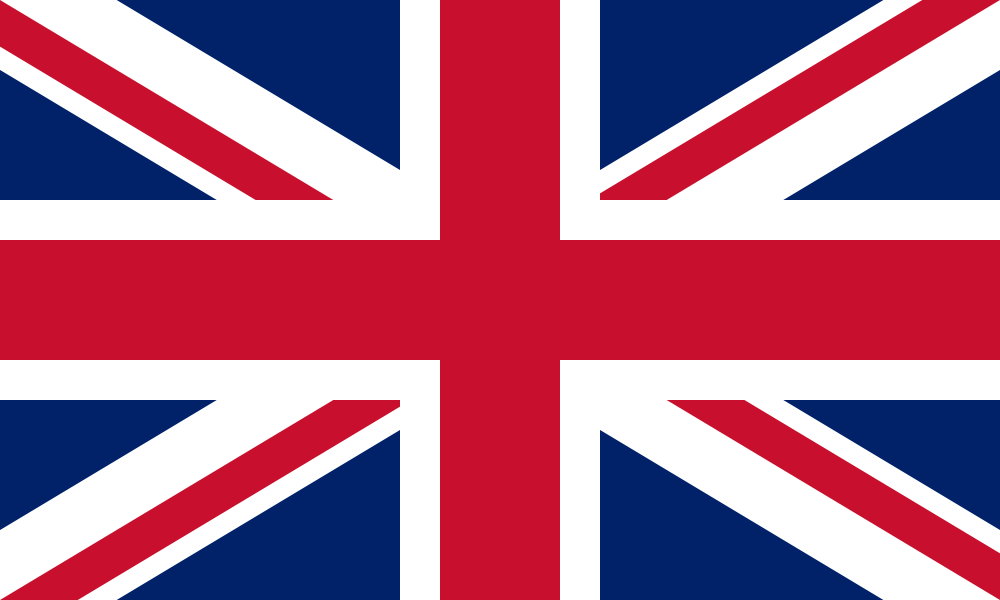
From ambassador to Moscow during perestroika to author of Afgantsy, the British diplomat who knew Russia from the inside
'On Christmas Day 1991 we were still wearing our funny hats and eating our mince pies when Mikhail Gorbachev came on television to tell the world that he had resigned as President of the Soviet Union,' recalling the end from Moscow.
British diplomat and author who served as ambassador to the Soviet Union (1988–1991) and then to the Russian Federation (1991–1992), witnessing perestroika, the August 1991 coup, the rise of Yeltsin, and the Soviet collapse from the inside. On close personal terms with Gorbachev, he later served as foreign policy adviser to Prime Minister John Major and chairman of the Joint Intelligence Committee. His 2011 book Afgantsy, the key revisionist account of the Soviet-Afghan War, argues that the Soviet 40th Army was never defeated on the battlefield and withdrew in good order, challenging the Western 'Soviet Vietnam' narrative and recasting the war as a failure of intelligence and political judgment, not of arms.
Career timeline
1951–1952Served in military intelligence, Vienna
1955Joined HM Diplomatic Service
1963–1966Posted to British Embassy Moscow (first tour)
1975–1978UK Permanent Representation to the EC, Brussels
1982–1984Minister for Trade, British Embassy Washington
1984–1988Deputy Under-Secretary, FCO; G7 Sherpa team
1988–1992British Ambassador to the Soviet Union, then Russia
1992–1993Foreign Policy Adviser to PM; Chairman, JIC
“We want a market economy without any adjectives.”
Václav Klaus was a Czech economist and politician who represented a radical route from state socialism to a market economy after 1989. He founded the Civic Democratic Party, helped lead the dissolution of Czechoslovakia, and later served as Czech prime minister and president. He sympathized with the Prague Spring's political liberalization but rejected its economic Third Way, a position that shaped the transition's call for an unqualified market economy and the subsequent Czech conservative line. As president, he challenged European integration and climate policy while emphasizing national sovereignty and markets.
Career timeline
1963Graduated from the Prague University of Economics
1971–1986Staff positions at the State Bank of Czechoslovakia
1987–1989Analyst at the Institute for Prognostics of the Czechoslovak Academy of Sciences
1989–1991Finance Minister of Czechoslovakia
1991–2002Founding chairman of the Civic Democratic Party
From anti-communist youth leader in 1989 to architect of 'illiberal democracy'
If we are sufficiently resolute, we can force the ruling party to submit itself to free elections. If we do not lose sight of the principles of '56, we can elect a government that will initiate immediate talks regarding the quick withdrawal of Soviet troops.
Viktor Orbán vaulted to national prominence as an anti-communist youth leader with his 1989 speech at Imre Nagy's reburial, demanding free elections and the withdrawal of Soviet troops from Hungary. Elected Hungary's youngest prime minister in 1998, he led the country into NATO; after losing power in 2002, he returned with a constitutional supermajority in 2010 and began systematically consolidating control over the judiciary, media, and electoral system, building what he openly calls an 'illiberal state.' In a landmark 2014 speech at Băile Tușnad, he publicly broke with liberal democracy and named Russia, Turkey, China, and Singapore as his models. His trajectory, from anti-Soviet resistance to author of a hybrid regime that became the longest-serving in Hungarian history, makes him a defining figure of 21st-century authoritarian populism.
Career timeline
1988Co-founded Fidesz (Alliance of Young Democrats)
1989Imre Nagy reburial speech; Fidesz representative at Opposition Round Table talks
1990MP (Pest County); Fidesz parliamentary group leader (until 1993)
1993–2000, 2003–President of Fidesz
1998–2002Prime Minister of Hungary; led NATO accession
2010–2026Prime Minister; constitutional overhaul and 'illiberal democracy' state-building
A ruler who recast the loss of the Soviet Union as a narrative of state restoration
“The collapse of the Soviet Union was the greatest geopolitical catastrophe of the century.”
Vladimir Putin is a Russian politician and former Soviet security officer who rose to national power amid the crises of the 1990s. Alternating between the presidency and premiership, he strengthened federal and presidential authority while making the restoration of Russia’s international influence a central narrative of rule. In 2005, he called the Soviet collapse “the greatest geopolitical catastrophe of the century,” a remark that condensed his memory of dissolution as a Russian experience of loss and dislocation. His rule also narrowed political competition and independent media while expanding the state’s military interventions abroad.
Career timeline
1975–1991Officer, KGB of the Soviet Union
1990–1996Head of the Committee for External Relations and senior deputy official, Saint Petersburg administration
1998–1999Director, Federal Security Service (FSB)
1999Secretary, Security Council of the Russian Federation