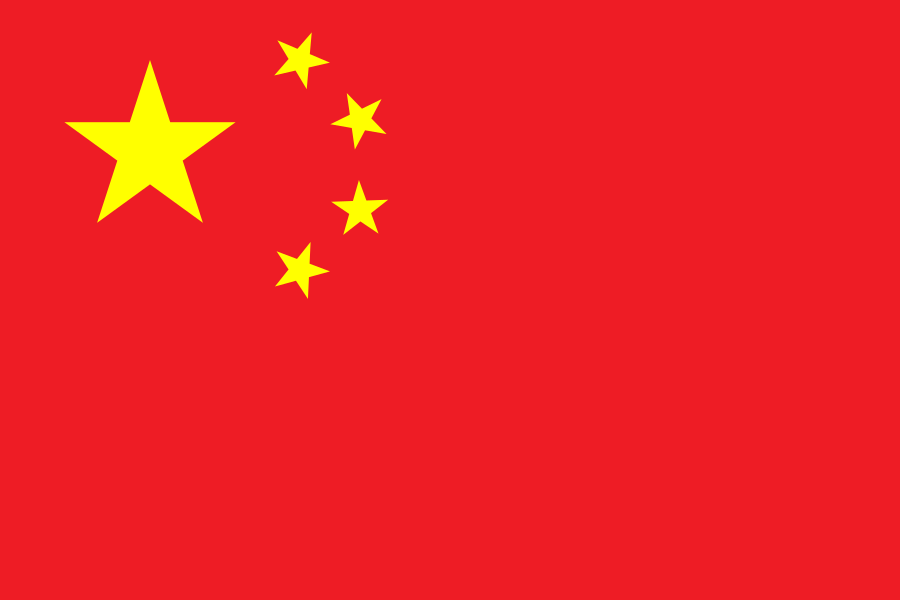
PLA marshal who commanded Chinese forces in Korea, then was purged for criticizing the Great Leap Forward
'I want to be a Hai Rui!' — In his 1962 'Letter of 80,000 Words' to Mao, invoking the Ming-dynasty official famed for his courage in admonishing the emperor
One of the ten marshals of the People's Liberation Army, he commanded the Chinese People's Volunteer Army in the Korean War and, as Minister of National Defense, pursued a Soviet-model professionalization of the military. His 1959 letter to Mao criticizing the famine and failures of the Great Leap Forward led to his purge as head of an 'anti-Party clique'; imprisoned and tortured during the Cultural Revolution, he died in custody in 1974 and was posthumously rehabilitated in 1978.
Career timeline
- 1928Rebelled against KMT forces, formed the Red 5th Army, joined Mao and Zhu at Jinggangshan
- 1930–1934Commander, Red 3rd Corps; directed defense of the Jiangxi Soviet
- 1934–1935Participated in the Long March; supported Mao at the Zunyi Conference
- 1937–1940Deputy Commander, Eighth Route Army; directed the Hundred Regiments Offensive
- 1947–1949Commander, Northwest Field Army; defended Yan'an, liberated five northwest provinces
- 1950–1953Commander and Commissar, Chinese People's Volunteer Army in the Korean War
- 1954–1959Minister of National Defense, CMC Vice-Chairman; Soviet-model military modernization
- 1959Purged at Lushan Conference for letter criticizing the Great Leap Forward; stripped of posts
The artist who turned 'Ol' Man River' into a hymn of struggle
In 1937, moved by the Spanish Civil War, he permanently changed the lyrics of 'Ol' Man River': 'But I keep laughin' / Instead of cryin' / I must keep fightin' / Until I'm dyin'. In Wales he declared: 'The artist must take sides. I have made my choice. I had no alternative.'
American bass-baritone concert artist, actor, All-American athlete, and committed socialist activist. A central figure of the Harlem Renaissance, he achieved global fame for 'Ol' Man River' in Show Boat and his landmark Othello. After visiting the USSR in 1934, he became a lifelong advocate for socialism and anti-colonialism, supporting the Spanish Republicans and leading the Council on African Affairs. During the McCarthy era his passport was revoked and he was blacklisted, but he refused to renounce his support for the Soviet Union. The Supreme Court restored his passport in 1958. His fusion of towering artistry and unwavering political commitment made him a symbol linking the Black freedom struggle with global anti-imperialism.
Career timeline
- 1915–1919Rutgers College: twice All-American, class valedictorian
- 1919–1923Columbia Law School (LL.B.) while playing in the NFL
- 1924–1928Starred in The Emperor Jones; became Harlem Renaissance star
- 1928–1939Global fame with Show Boat; first Black Othello in Britain (1930)
- 1934First USSR visit: 'Here I am not a Negro but a human being'
- 1937–1939Supported Spanish Republicans; visited International Brigades; Council on African Affairs
- 1943–1945Broadway Othello: first Black actor with white cast; record 296 shows
- 1949Paris Peace Congress speech; Peekskill riots; blacklisting began
- 1950–1958Passport revoked; HUAC; founded Freedom; Stalin Peace Prize (1952)
- 1958Passport restored (Kent v. Dulles); published Here I Stand
- 1958–1960Comeback tours: Europe, USSR, Australia, NZ; Othello at Stratford
- 1961–1963Health breakdown; recovered at Buch Clinic, East Berlin
- 1963–1976Seclusion in U.S.; died of stroke complications in Philadelphia
The PRC's first premier and an architect of its diplomacy
The diplomacy that enabled Nixon's 1972 visit to China reshaped the Cold War triangle.
A leader alongside Mao from the early Chinese revolution, he served as premier from 1949 until his death, directing state building and diplomacy and shaping power balances during the Cultural Revolution.
Career timeline
- 1949–1976Premier of the People's Republic of China
- 1954–1958Also foreign minister
- 1972Diplomacy opening the path to Sino-US normalization
Frankfurt School philosopher and the pre-eminent theorist of the 1960s New Left
'In its advanced positions, it is the Great Refusal — the protest against that which is' — One-Dimensional Man (1964)
Herbert Marcuse was a central philosopher of the Frankfurt School who fused Marxism with Freudian psychoanalysis to develop a critical theory of modern capitalist society. In Eros and Civilization (1955) he analyzed the repressive structures of capitalist society and explored the utopian potential of liberated Eros, while in One-Dimensional Man (1964) he diagnosed advanced industrial society as a 'one-dimensional' order where technological abundance erodes critical consciousness, introducing the concept of repressive desublimation. A German-Jewish émigré who fled Nazism for the United States, he served in the OSS during the war and later taught at Brandeis and UC San Diego, becoming the intellectual pillar of the 1960s student movements and the New Left. His radical thought, crystallized in the 'Great Refusal,' has had a lasting impact on critical theory and emancipatory politics.
Career timeline
- 1932Joined Institute for Social Research (Frankfurt School) in exile, Geneva
- 1934–1942Researcher, Institute for Social Research, Columbia University, New York
- 1942–1951Analyst, OSS and State Department; head of Central European Section
- 1954–1965Professor of political theory, Brandeis University
- 1965–1970Professor of philosophy, UC San Diego
Hungary's last Stalinist First Secretary; his three months in power ignited the revolution
On the night of October 23, 1956, Gerő took to the radio and denounced the student demonstration: 'We condemn those who seek to instil in our youth the poison of chauvinism.'
A central figure of Hungarian communism, he joined the party at its founding in 1918 and served in the 1919 Soviet Republic. As a Comintern operative and NKVD agent, he worked across Europe in France, Belgium, and Scandinavia, and during the Spanish Civil War he directed the purge of Trotskyists, earning the epithet 'the Butcher of Barcelona.' After WWII he became Rákosi's right hand, driving the Stalinization of Hungary's economy through crash industrialization and collectivization. Appointed First Secretary in July 1956 after Rákosi's forced resignation, he refused reform; on the evening of October 23 his radio broadcast denouncing student demonstrators as 'fascists' and 'chauvinists' detonated the Hungarian Revolution, and within forty-eight hours he was replaced by János Kádár and fled to the Soviet Union.
Career timeline
- 1918–19Founding member of the KPV; Young Communists activist in the Hungarian Soviet Republic
- 1925–36Comintern and NKVD operative: France, Belgium, Scandinavia, and elsewhere
- 1936–39Spanish Civil War: led the PSUC behind the scenes; directed the purge of POUM Trotskyists
- 1940–44Moscow exile: co-led the KPV Foreign Bureau with Rákosi; propaganda to POWs and enemy forces
- 1945–48Member of the High National Council; Minister of Trade and Transport
- 1948–53MDP Politburo member and Deputy General Secretary; Finance Minister: drove economic Stalinization
- 1953–56.07Interior Minister and Deputy Premier; July 1956: MDP First Secretary
- 1956–80Resigned Oct 25, fled to USSR; returned 1960, expelled 1962, died in seclusion
Architect of the Comintern Black Belt thesis: Southern Blacks are an oppressed nation with the right to self-determination
“The problem is fundamentally a question of an oppressed nation with full rights of self-determination.” — Negro Liberation, 1948
American communist, radicalized from the son of former slaves. He helped establish the Comintern thesis of Black self-determination in the Southern Black Belt, served on the CPUSA Politburo, and fought as a political commissar in the Spanish Civil War. Expelled in 1959 for opposing de-Stalinization, he became a leading figure in the Maoist New Communist Movement.
Career timeline
- 1917–1919WWI — served in US Army 8th Regiment (Black regiment), saw action in France
- 1922–1925African Blood Brotherhood → Young Communist League → CPUSA
- 1926–1930Moscow — KUTV and Lenin School; drafted Comintern resolutions on the Negro Question
- 1931–1938CPUSA Politburo member and Negro Department head — Scottsboro defense, Sharecroppers Union
- 1937Spanish Civil War — Regimental Commissar, Abraham Lincoln Battalion; Battle of Brunete
- 1943–1945WWII — served in US Merchant Marine
- 1948Published Negro Liberation — theorized Black freedom as the unfinished democratic revolution
- 1959Expelled from CPUSA for anti-revisionism and defending Black self-determination
- 1964–1978New Communist Movement — October League/CPML Central Committee; Black Bolshevik published
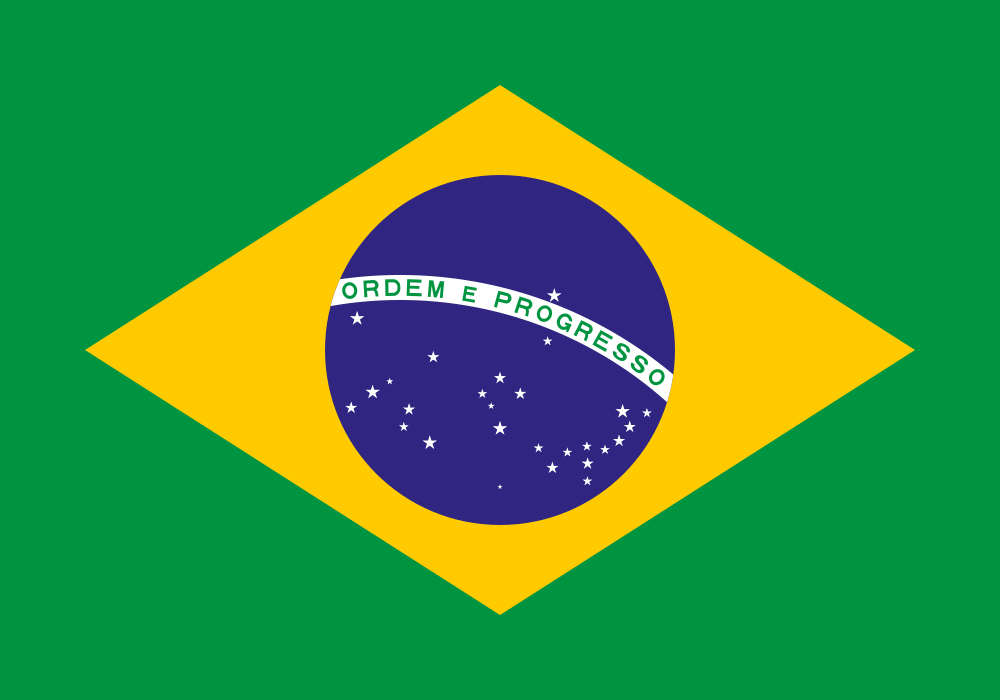
The Knight of Hope: Brazilian revolutionary who marched 25,000 km
Many people think I'm crazy. Most men who reach a certain age find their senses. In their youth, they are revolutionaries. Then they marry and must look after a family and settle down. But here I am at my age and I still haven't got good sense.
— Interview, 1984
Brazilian revolutionary and politician. As chief of staff of the Prestes Column (1925–1927), he led rebels on a 25,000-km march through Brazil, earning the name 'Knight of Hope.' Elected to the Comintern Executive Committee in 1935, he directed the ANL uprising and spent nine years in prison. He served as general secretary of the Brazilian Communist Party for 37 years (1943–1980), leading labour organizing and anti-dictatorship resistance from underground and Soviet exile. Expelled in the 1980s for opposing the party's Eurocommunist turn, he remained a revolutionary Marxist to the end.
Career timeline
- 1924–1927Chief of Staff, Prestes Column — 25,000 km march through 14 states
- 1931–1934Exiled in USSR; engineer and Marxist study
- 1934Joined the Brazilian Communist Party
- 1935ANL Honorary President · Comintern ECCI member · led armed uprising
- 1936–1945Imprisoned; elected PCB General Secretary (1943)
- 1945–1948Federal Senator; underground after party outlawed (1947)
- 1943–1980General Secretary, Brazilian Communist Party (37 years)
- 1971–1979Soviet exile under military rule; returned with 1979 amnesty
Marxist literary critic who first sang The Internationale in Chinese, and party leader in 1927
18 June 1935, a small hill in Changting's Zhongshan Park. Facing the firing squad, Qu Qiubai sat down on the grass, smiled at the executioner and said, "Right here is fine!" He died singing The Internationale.
A leading intellectual of the May Fourth generation, Qu learned Russian and became one of the first Chinese correspondents to report on Bolshevik Russia from Moscow. Returning in 1923, he succeeded Chen Duxiu as de facto leader of the CCP, directing an insurrectionary line that included the Guangzhou Uprising, and served on the Comintern Executive Committee Presidium. After his political fall, he co-led the League of Left-Wing Writers with Lu Xun and Mao Dun, laying the foundations of Marxist literary theory in China and translating Russian and Soviet literature: most enduringly The Internationale into Chinese. Arrested by the Kuomintang in 1935, he was executed in Changting, singing The Internationale on the way to his death.
Career timeline
- 1920–1922Moscow correspondent, Chenbao (Morning News)
- 1922Joined the CCP in Moscow
- 1923CCP Central Committee member; party propaganda and journal editor
- 1927–1928Head of CCP Provisional Politburo (de facto party leader)
- 1928–1930Comintern ECCI Presidium member; head of CCP delegation, Moscow
- 1930–1931CCP Central Committee; dismissed after 'putschist' criticism
- 1931–1934Led League of Left-Wing Writers, Shanghai; translation and literary criticism with Lu Xun
- 1934–1935Commissar of Education, Chinese Soviet Republic; editor of Red China
The republican who bound a divided Resistance together
When German officers tried to force his signature on a false statement, Moulin chose attempted suicide rather than dishonour.
Jean Moulin was a senior French civil servant and republican organiser who linked the internal Resistance to Free France against the Nazi occupation. As Charles de Gaulle’s representative, he coordinated rival movements and brought political parties and trade unions into the National Council of the Resistance. His work of unification unfolded amid fierce tensions over the movements’ independence and ended with his arrest and death after torture in 1943.
Career timeline
- 1922Chief of staff to the prefect of Savoie
- 1925–1930Sous-prefect of Albertville
- 1936Chief of staff in the Popular Front Air Ministry
- 1937–1939Prefect of Aveyron
- 1939–1940Prefect of Eure-et-Loir
- 1941–1943de Gaulle’s representative to the internal Resistance
- 1943First President of the National Council of the Resistance
A leader caught between revolutionary national politics and party centralism
After the 1948 break with the Soviet Union, he was arrested as a Soviet spy and disappeared from a Belgrade prison.
Andrija Hebrang was a Yugoslav communist revolutionary and wartime leader of the Communist Party of Croatia who helped organize resistance to occupation and political institutions in liberated territory. After the war he directed economic reconstruction and a heavy-industry development plan, becoming one of Yugoslavia’s most influential figures after Tito. Tensions over Croatian political autonomy and economic strategy brought him into conflict with the party center. After Yugoslavia’s 1948 break with the Soviet Union, he was accused of links to Soviet intelligence, expelled and arrested, and disappeared from a Belgrade prison in 1949.
Career timeline
- 1919Joined the Communist Party of Yugoslavia
- 1925–1928Worked in the Zagreb party organization
- 1941–1944Political secretary of the Central Committee of the Communist Party of Croatia
- 1943–1944Member of the Politburo of the Communist Party of Yugoslavia
- 1944–1946Worked in AVNOJ and administered industry and trade
- 1946–1948Chairman of the Economic Council and Planning Commission
- 1948Expelled from the party, placed under house arrest and arrested
- 1949Disappeared from a Belgrade prison and was recorded as dead
The Marxist macroeconomist who formalized effective demand before Keynes
Kalecki wrote in his 1943 essay: "'Discipline in the factories' and 'political stability' are more appreciated by the business leaders than are profits. Their class instinct tells them that lasting full employment is unsound from their point of view."
Polish Marxist economist who formalized the principle of effective demand before Keynes. He built a distinctive macroeconomics explaining profits, investment, and income distribution through class analysis, and later returned to socialist Poland to develop the theory of growth under planned economy.
Career timeline
- 1929–1936Researcher, Institute of Research on Business Cycles and Prices, Warsaw
- 1933Published 'Próba teorii koniunktury' — formalized effective demand ahead of Keynes
- 1936–1945Emigrated to England; research at LSE, Cambridge, and Oxford Institute of Statistics
- 1943Published 'Political Aspects of Full Employment' — predicted capitalist class resistance
- 1946–1954Deputy Director, UN Economic Department, New York; resigned under McCarthyist pressure
- 1955–1968Economic advisor to Polish Council of Ministers, deputy chairman of planning commission, professor at Warsaw University
- 1957Elected member of the Polish Academy of Sciences
- 1968Resigned in protest against antisemitic purges
A Stalin supporter at the heart of Tito’s party
At the April 1948 Central Committee meeting, he opposed Tito’s reply to Moscow.
Sreten Žujović was a Serb Yugoslav communist and labour organiser who passed through the First World War and the Yugoslav Partisan struggle. He helped organise the wartime uprising, served with the Supreme Headquarters, and became finance minister after liberation. In the 1948 conflict between Tito and Stalin, he defended the Soviet line as the sole dissenter at the decisive Central Committee meeting, and was removed from the party and office and imprisoned. Released after a public self-criticism in 1950 and later readmitted, he embodied the fracture between revolutionary internationalism and Yugoslav autonomy.
Career timeline
- 1918–1924Labour movement and trade-union organiser after the war
- 1924–1933Joined the Communist Party of Yugoslavia and worked as a party organiser
- 1938–1940Member of the Central Committee of the Communist Party of Yugoslavia
- 1941–1944Partisan command and Supreme Headquarters work in Serbia and Yugoslavia
- 1945–1947Federal Minister of Finance of Yugoslavia
- 1948Supported the Cominform line during the Tito–Stalin split
- 1948–1950House arrest and imprisonment, released after self-criticism
- 1950–1971Readmitted to the party; executive at Borba and an economic institute
Architect of the Korean Communist Party's rebirth; leader of the Workers' Party of South Korea
At his 1927 trial in Sinuiju, he ate his own excrement in court to feign insanity, securing medical release before escaping to Moscow.
The foremost leader of Korea's communist movement from the colonial era through liberation. He rebuilt the Communist Party of Korea and led the Workers' Party of South Korea, but after defecting north he was outmaneuvered by Kim Il-sung and executed as the scapegoat for the Korean War's defeat.
Career timeline
- 1921Joined Korean Communist Party (Irkutsk faction) in Shanghai
- 1922Secretary of Korean Communist Youth League; attended Far East Peoples' Congress in Moscow
- 1925Co-founded Communist Party of Korea; General Secretary of Korean Komsomol
- 1928–1930Studied at International Lenin School, Moscow; joined CPSU(B)
- 1931–1940Comintern Eastern Secretariat cadre; led underground organizing in Shanghai and Korea
- 1945Rebuilt Communist Party of Korea; became its leader and General Secretary
- 1946–1949Founded Workers' Party of South Korea; Vice Chairman (de facto leader)
- 1948–1953Deputy Premier and first Foreign Minister of the DPRK
A miner's son who built the Popular Front and led the French Communist Party for 34 years
'The French people will never make war against the Soviet Union' — address to the PCF Central Committee, February 1949, as France prepared to join NATO (reported by The New York Times, 23 Feb. 1949)
A coal miner's son who led the French Communist Party for 34 years (1930–1964). He designed the 1936 Popular Front and pioneered the 'French road to socialism' after the war, becoming a forerunner of Eurocommunism.
Career timeline
- 1912Begins work as a coal miner at age 12
- 1919–1920Joins the SFIO; helps found the PCF at the Tours Congress
- 1930–1964PCF general secretary; leads the party for 34 years
- 1936Architect of the Popular Front; supports Blum's social reforms
- 1939–1944Deserts the French army, exiled in Moscow; PCF runs the Resistance
- 1945–1947Minister of state under de Gaulle; deputy prime minister (1946–1947)
- 1950–1953Stroke; medical treatment in the USSR; Jacques Duclos runs the party
- 1964Resigns as secretary-general; dies on a Black Sea cruise ship
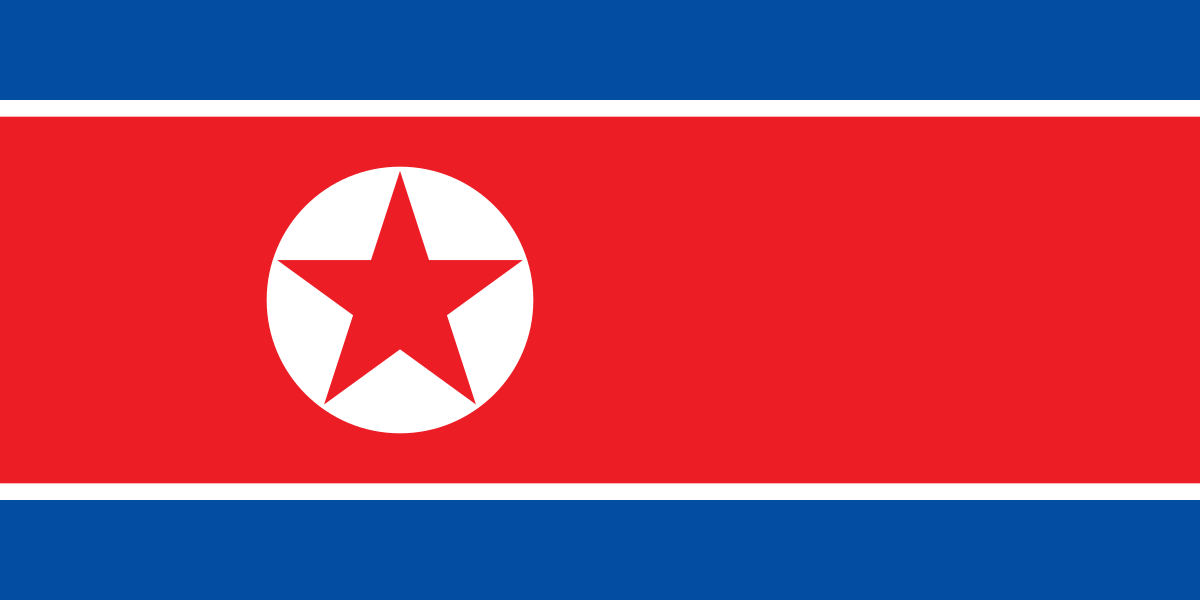
The Manchurian guerrilla who became the KPA's first commander and the DPRK's nominal head of state
In December 1955, Choe Yong-gon presided over the trial of Pak Hon-yong and sentenced him to death, rejecting pleas for clemency from Mao Zedong and Zhou Enlai.
After military training at Yunnan and Whampoa academies, he led anti-Japanese guerrilla war in Manchuria as chief of staff of the 2nd Route Army and commander of the 7th Army of the Northeast Anti-Japanese United Army, forming the Manchurian trio with Kim Il Sung and Kim Chaek. Returning in 1945, he played the decisive role in converting Cho Man-sik's Korean Democratic Party to a communist line; upon the DPRK's founding in 1948 he became its first Minister of National Defence and Chief Commander of the Korean People's Army, the KPA's senior field commander during the Korean War. From 1957 to 1972 he chaired the Supreme People's Assembly Standing Committee, the DPRK's nominal head of state, and served as the regime's diplomatic face abroad. He received a state funeral at his death in 1976 and was interred in the Patriotic Martyrs' Cemetery.
Career timeline
- 1923–1924Graduated from Yunnan Military Academy
- 1925–1927Instructor at Whampoa Military Academy
- 1936–1940Chief of Staff, 2nd Route Army & Commander, 7th Army, Northeast Anti-Japanese United Army
- 1942–1945Deputy Chief of Staff, 88th Special Brigade, Soviet Far East
- 1946–1955Chairman, Central Committee of the Korean Democratic Party
- 1948–1957Minister of National Defence & Chief Commander, Korean People's Army
- 1957–1972Chairman, Standing Committee of the Supreme People's Assembly
- 1972–1974Vice President of the DPRK
'Gallo': commander in Spain and the Resistance, PCI secretary-general who endured Cominform self-criticism and succeeded Togliatti
When he succeeded Togliatti as PCI secretary-general in 1964, Longo declared: 'I am a secretary, not a boss.'
A founder of the Italian Communist Party (PCI) at the 1921 Livorno Congress, Longo fought as inspector-general of the International Brigades in the Spanish Civil War under the nom de guerre 'Gallo.' During World War II he commanded the communist Garibaldi Brigades in the Italian Resistance and afterwards served as PCI deputy secretary under Palmiro Togliatti. In September 1947 he attended the founding Cominform conference at Szklarska Poręba as the PCI's delegate alongside Eugenio Reale, where the PCI and the French Communist Party were subjected to harsh criticism and forced into a self-critical turn toward militant struggle. Succeeding Togliatti as secretary-general in 1964, Longo pursued the 'Italian road to socialism' with growing autonomy from Moscow and formally opposed the Soviet invasion of Czechoslovakia in 1968.
Career timeline
- 1921Co-founder of the PCI at the Livorno Congress
- 1936–1939Inspector-General of the International Brigades in Spain, nom de guerre 'Gallo'
- 1943–1945Commander of the Garibaldi Brigades, Deputy Commander of the CVL
- 1945–1964Deputy Secretary of the PCI
- 1947.09PCI delegate to the Cominform founding conference (Szklarska Poręba)
- 1964–1972Secretary-General of the PCI
- 1972–1980Honorary President of the PCI
Konoe's confidant and the spy who helped save Moscow
I would like to go and die splendidly as a communist.
Hotsumi Ozaki was a journalist for the Asahi Shimbun and a committed communist who became the most vital Japanese asset in Richard Sorge's Tokyo spy ring. As an advisor to Prime Minister Fumimaro Konoe and a member of his inner 'Breakfast Club,' Ozaki accessed the highest-level cabinet secrets, and in September 1941 he supplied Sorge with the decisive intelligence that Japan would strike southward rather than invade the USSR, enabling Stalin to transfer Siberian divisions that turned the Battle of Moscow. Arrested in October 1941, he was the only Japanese civilian hanged for treason during the war; his prison letters to his wife and daughter, published postwar as Love Is Like a Falling Star, became a bestseller.
Career timeline
- 1926–1927Journalist, Asahi Shimbun
- 1928–1932Shanghai correspondent, Asahi Shimbun
- 1930Met Richard Sorge in Shanghai
- 1934–1941Key informant, Sorge's Tokyo spy ring
- 1937–1941Researcher, Shōwa Kenkyūkai; cabinet advisor
- 1938–1941Member, PM Konoe's Breakfast Club inner circle
- 1941.10Arrested in Sorge Incident
- 1944.11.7Hanged at Sugamo Prison
KSČ General Secretary who organized the February 1948 coup and built Czechoslovakia's people's democracy as its operational architect
In September 1947 Slánský returned from the Cominform founding meeting with Moscow's directive to seize power. 'As in the international field, we have gone on the offensive on the domestic front as well' — the February 1948 coup had begun.
After joining the KSČ Central Committee and Politburo in 1929, he rose as Gottwald's closest lieutenant. During WWII he directed Czechoslovak broadcasts from Moscow and fought in the 1944 Slovak National Uprising. As General Secretary (1945–1951), he mastered the party apparatus and directed the operational work of the February 1948 coup, converting Czechoslovakia into a Soviet-aligned people's democracy. Arrested in 1951, he was tried and executed in 1952 on charges of conspiracy, Trotskyism, Titoism and Zionism: the most distinctly antisemitic purge trial in the Eastern Bloc. Rehabilitated 1963; party membership restored 1968.
Career timeline
- 1921Joins the Communist Party of Czechoslovakia (KSČ)
- 1924Editor of Rudé Právo, the KSČ central organ
- 1927–1928Regional party secretary in Ostrava
- 1928–1929Regional party secretary in Kladno
- 1929Elected to the KSČ Central Committee and Politburo
- 1935–1938Deputy, National Assembly of Czechoslovakia
- 1939–1945Exile in Moscow; chief editor of Czechoslovak Radio Moscow, partisan in Slovak National Uprising
- 1945–1951General Secretary of the KSČ Central Committee
- 1948Commander of the People's Militia; directs operational work of the February coup
- 1951Deputy Prime Minister of Czechoslovakia
Romania's first communist leader who turned the country from a Soviet satellite toward a semi-autonomous course
On the morning of 30 December 1947, Gheorghiu-Dej and Petru Groza came to the Royal Palace after it had been surrounded by armed detachments, and demanded the King sign the abdication — or face bloodshed, as King Michael later testified in exile.
Romania's first communist leader, ruling from 1947 until his death in 1965. A railway worker by trade, he was imprisoned for leading the 1933 Grivița railway strike and emerged in detention as head of the party's 'prison faction.' Resisting Nikita Khrushchev's de-Stalinization after Stalin's death, he secured the withdrawal of Soviet troops in 1958 and pioneered Romania's semi-autonomous status within the Warsaw Pact through heavy industrialization and expanded trade with the West. His independent course passed to his successor Nicolae Ceaușescu, though his rule maintained domestic repression through the Securitate.
Career timeline
- 1930Joined the Romanian Communist Party
- 1933Led the Grivița railway strike; arrested and imprisoned
- 1936Elected to the Party Central Committee; leader of the prison faction
- 1944Escaped prison; General Secretary of the Romanian Communist Party
- 1947Forced King Michael's abdication; People's Republic proclaimed
- 1952–1955Prime Minister of Romania
- 1955–1965First Secretary of the Romanian Workers' Party
- 1961–1965President of the State Council (head of state)
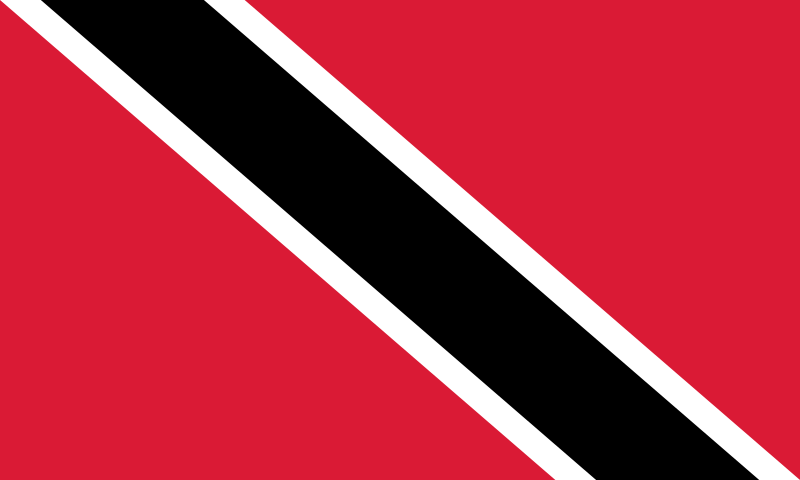
The Trinidadian Trotskyist and Pan-Africanist intellectual who revived the Haitian Revolution for Marxist historiography
“What do they know of cricket who only cricket know?” — Beyond a Boundary preface, inverting Kipling
Trinidadian Marxist historian. The Black Jacobins (1938) reframed the Haitian Revolution as liberation from below. He debated Black self-determination with Trotsky, co-developed the state-capitalist theory of the USSR, and analysed empire through cricket in Beyond a Boundary.
Career timeline
- 1901Born in Tunapuna, Trinidad, first child of schoolteacher Robert Alexander James and Ida Elizabeth
- 1910–1918Wins scholarship to Queen's Royal College; later teaches English and History there (Eric Williams among his pupils)
- 1932Moves to Lancashire; cricket correspondent for The Manchester Guardian; begins anti-colonial writing
- 1934–1936Joins ILP; Trotskyist activism; play Toussaint Louverture staged with Paul Robeson; publishes Minty Alley
- 1937–1938Publishes World Revolution and The Black Jacobins — praised by Trotsky, Orwell, and E.H. Carr
- 1938–1939US speaking tour at SWP invitation; debates the 'Negro Question' with Trotsky in Coyoacán, Mexico
- 1941–1951Forms Johnson–Forest Tendency with Dunayevskaya; state-capitalist analysis of USSR; Notes on Dialectics
- 1953Deported from US; writes Mariners, Renegades and Castaways on Melville while detained at Ellis Island
- 1957–1960Visits independent Ghana, writes on Nkrumah; edits The Nation, PNM party paper in Trinidad
- 1963Publishes Beyond a Boundary — cricket memoir exploring colonialism, class, and race
- 1970–1980Teaches at Federal City College (UDC), Washington D.C.; four volumes of selected writings published
- 1989Dies of chest infection in Brixton, London, aged 88; buried at Tunapuna Cemetery, Trinidad
The Turkish revolutionary poet who survived a 28-year sentence with verse: giant of 20th-century letters who fused modernism and communism
“Bury me under a plane tree in any village cemetery in Anatolia” — his last wish, Moscow, 1963
Born in Ottoman Salonica, Nâzım Hikmet encountered Mayakovsky and Lenin in 1921 and became a lifelong communist, returning to Turkey to pioneer free verse and transform its poetry. From "835 Lines" to the 16,000-line epic "Human Landscapes from My Country," his vast body of work sang the lives of ordinary people and the War of Independence. A military court sentenced him to 28 years; he served 12, his imprisonment sparking a global campaign by Picasso, Sartre, and Robeson. After escaping to the USSR in 1951 he spent 13 years in the peace movement and anti-colonial solidarity. His poetry is translated into over 50 languages; UNESCO declared 2002 the 'Year of Nâzım Hikmet.'
Career timeline
- 1913Publishes first poem, "Feryad-ı Vatan" (The Cry of the Homeland)
- 1918Graduates from the Ottoman Naval Academy; serves as naval officer
- 1921Travels to Anatolia to join the War of Independence; meets Mustafa Kemal
- 1922–1924Studies at KUTV, Moscow; joins the Bolshevik Party
- 1924–1925Returns to Turkey; edits Aydınlık, organ of the illegal Turkish Communist Party
- 1929Publishes "835 Lines" — revolutionises Turkish poetry with free verse
- 1933–1935First imprisonment for "Gece Gelen Telgraf"; writes "The Epic of Sheikh Bedreddin" in Bursa Prison
- 1938–1950Sentenced to 28 years for inciting mutiny; serves 12 years across four prisons
- 1939–1960Writes 16,000-line epic "Human Landscapes from My Country" in prison
- 1950Amnestied after international campaign and hunger strike; awarded International Peace Prize
- 1951–1963Exiled in the USSR; Bureau member of World Peace Council, anti-colonial and anti-war activism
- 1963.6.3Dies of a heart attack at his dacha in Peredelkino; buried at Novodevichy Cemetery
Beijing mayor purged as the Cultural Revolution's first major target, then the architect of post-Mao China's legal-institutional foundations
"Chairman Mao was not without any mistakes either. … Even if Chairman Mao's prestige is not as high as Mount Everest, it's still as high as Mount Tai. Even if you shovel off a few tons of dirt, it's still just as high" — at the 1962 Seven Thousand Cadres Conference, publicly criticizing Mao
A founding CCP member in Shanxi (1923) who rose through the anti-Japanese war and civil war to the Politburo in 1945. As Beijing mayor and first party secretary (1951–66), he governed the capital for 15 years as a loyal party stronghold. In February 1966, his 'February Outline' tried to contain the Cultural Revolution within academic debate; Mao annulled it and had Peng purged as a 'counter-revolutionary revisionist,' subjected to over 53 public struggle sessions, the Cultural Revolution's opening act. Rehabilitated under Deng Xiaoping in 1979, he chaired the Central Political and Legal Affairs Commission, pushed seven foundational laws through the NPC in three months, and as NPC Standing Committee chairman (1983–88) laid the institutional foundations of China's post-Mao legal system.
Career timeline
- 1923Joined CCP in Taiyuan; founding member in Shanxi province
- 1929–1935Imprisoned in Beijing and Tianjin; continued underground work from prison
- 1937–1941Organization director, North China Bureau; secretary, Shanxi-Chahar-Hebei Border Region
- 1941–1944Deputy director, Central Party School; led the Yan'an Rectification purge at the school
- 1945Elected to Politburo; sent to lead Northeast Bureau — removed 1946 after military defeats
- 1951–1966Mayor of Beijing and First Secretary of Beijing Municipal Committee
- 1966Head of Five Man Group, drafted February Outline; purged at May 1966 conference, opening the Cultural Revolution
- 1979–1988Chair of NPC Legal Affairs Commission, secretary of Central Political and Legal Affairs Commission; Chairman of 6th NPC Standing Committee (1983–88)
The student founder of the Cuban Communist Party martyred at 25: a face of Latin American anti-imperialism
December 1928, at a tense party meeting in Mexico City, Vittorio Vidali shouted at Mella: "Never forget — there are only two ways out of the International: expelled or dead!" A month later, Mella was assassinated on the street.
Student leader who co-founded the Communist Party of Cuba, organizing anti-imperialist student struggles at the University of Havana and establishing Cuba's first Marxist-Leninist party with Carlos Baliño in 1925. Exiled in Mexico for resisting the Machado dictatorship, he was assassinated at 25 in 1929 and became a foundational martyr of the Cuban revolutionary left, later claimed as a precursor by the Castro movement.
Career timeline
- 1922Enters University of Havana law school — co-founds FEU, serves as secretary
- 1923Becomes FEU president — convenes First National Student Congress, founds José Martí Popular University
- 1924Joins Havana Communist Group, creates Cuban section of the Anti-Imperialist League
- 1925Co-founds the Communist Party of Cuba with Carlos Baliño — Central Committee member; arrested, conducts 18-day hunger strike
- 1926Expelled from university and party — flees via Honduras and Guatemala to Mexico City
- 1926–1927Founds ANERC — writes for Cuba Libre and other revolutionary papers
- 1927Attends World Congress Against Colonial Oppression in Brussels — Moscow for RILU Fourth Congress
- 1929Shot dead on 10 January walking home in Mexico City — aged 25
The democratic socialist who came back wounded from the POUM militia and dissected the language of totalitarianism
Homage to Catalonia, on reaching Barcelona in December 1936: “It was the first time that I had ever been in a town where the working class was in the saddle.”
Born Eric Arthur Blair. Five years in the Indian Imperial Police in Burma and his reportage on destitution in Paris and London made him a writer; in December 1936 he went to Spain, joined the POUM militia through the Independent Labour Party, spent four months on the Aragon front and was shot through the throat at Huesca. The street fighting he witnessed in Barcelona while convalescing in May 1937, and the outlawing of the POUM that followed, broke him with Soviet communism for good, and he crossed the border with his wife with a warrant out for him as a Trotskyist. Homage to Catalonia, his account of it, sold 683 copies in its first six months. Orwell called himself a democratic socialist to the end, and Animal Farm and Nineteen Eighty-Four anatomize the hardening of a revolution into a new rule, and the language that holds it up.
Career timeline
- 1903Born Eric Arthur Blair in Motihari, British India, son of an official of the colonial opium department
- 1917–1921King's Scholar at Eton College
- 1922–1927Served in the Indian Imperial Police in Burma and resigned, disillusioned with imperial rule
- 1928–1932Down and out in Paris and London: dishwasher, schoolteacher, bookshop assistant
- 1933Published Down and Out in Paris and London under the pen name George Orwell
- 1936Wrote The Road to Wigan Pier from the northern coalfields; married Eileen O'Shaughnessy
- 1936.12Reached Barcelona and enlisted in the POUM militia through the Independent Labour Party
- 1937.01–05Served on the Aragon front at Alcubierre and Huesca; shot through the throat at Huesca in May
- 1937.05Caught in the Barcelona May Days while on leave, standing guard on a POUM building
- 1937.06Wanted after the POUM was outlawed; escaped with his wife into France
- 1938Published Homage to Catalonia, which sold 683 copies in six months
- 1941–1943Produced broadcasts to India in the BBC Eastern Service
- 1945Published Animal Farm
- 1949Published Nineteen Eighty-Four
- 1950.01.21Died of tuberculosis in a London hospital