
From the Spartacus League to GDR head of state, the sole founding member who lived the full arc of German communism
On the night of 15 January 1919, Pieck was arrested alongside Luxemburg and Liebknecht and taken to the Eden Hotel. He became the sole survivor — the last to witness his comrades alive.
A coachman's son turned carpenter, he joined the SPD in 1895 and was radicalized under Rosa Luxemburg's influence. Court-martialed for anti-war agitation, he co-founded the Spartacus League and the KPD. Arrested with Luxemburg and Liebknecht in January 1919, he alone survived. He served on the ECCI (1921) and its Presidium (1931), then led the KPD in Moscow exile as Comintern secretary. Returning after the war, he drove the SPD-KPD merger that created the SED and became the first President of the GDR in 1949, holding that office until his death.
Activities and affiliations
Career Timeline
- 1895Joins the Social Democratic Party of Germany (SPD)
- 1915Conscripted; court-martialed for anti-war agitation; flees to Amsterdam
- 1918–1919Co-founds Spartacus League and KPD; Central Committee member
- 1921ECCI member; elected to the Prussian Landtag
- 1928–1933Reichstag deputy
- 1931Elected to the ECCI Presidium
- 1934–1946KPD chairman (exile leadership)
- 1935–1943Secretary of the Comintern
- 1943Co-founds the National Committee for a Free Germany
- 1946–1950Co-chairman of the Socialist Unity Party (SED)
- 1949–1960President of the German Democratic Republic
Related historical events
- 1914–1918First World WarAnti-war activist court-martialedHe was court-martialed for anti-war agitation in 1915.
- 1918.10–1919.08The German Revolution of 1918–1919KPD leadershipCalled for the January demonstration and was arrested with Luxemburg and Liebknecht but survived.
- 1934–1939The Comintern’s Popular Front turnReporter on the Executive’s activitiesGave the Executive’s report at the Seventh Congress and dropped the social fascism thesis.
- 1941–1945The Great Patriotic WarWorked in the National Committee for Free Germany, political re-education of POWs
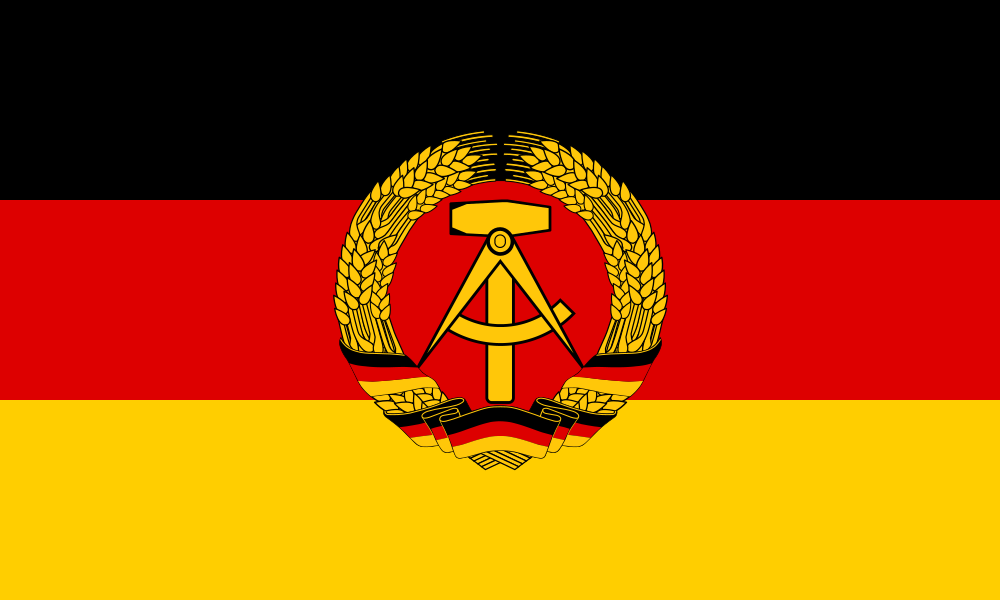
- 1944–1949The People's Democracies of Eastern EuropeCo-chairman of the Socialist Unity PartyCo-chairman on the Communist side from April 1946, he became the first president of the German Democratic Republic in October 1949.
- 1948–1949The Berlin Blockade and Airliftpresident of the Provisional People's ChamberHe converted the People's Council into the Provisional People's Chamber and presented the new state's constitutional claim.
Moscow Exile and the Anti-Fascist Front (1933–1945)
After the Nazi seizure of power in 1933, Wilhelm Pieck chaired an illegal KPD Central Committee meeting on the outskirts of Berlin before escaping to Paris and then Moscow. Following the murder of John Schehr by the Gestapo in 1934, Pieck assumed the party chairmanship. At the 7th Comintern Congress in 1935 he delivered the ECCI report and was elected Comintern secretary; that same year the 'Brussels' party conference, actually held near Moscow, confirmed him as KPD Central Committee chairman. At this conference Pieck jettisoned the 'social fascism' thesis and anchored the anti-fascist Popular Front line in German communist policy.
At the 'Bern' conference held near Paris in January–February 1939, Pieck outlined a programme for establishing a 'new democratic republic' in Germany after the overthrow of the Nazi regime. This was a tactical shift: rather than calling for an immediate dictatorship of the proletariat, it envisioned a transitional democratic government that could include anti-Nazi bourgeois forces. After the war broke out, Pieck remained in Moscow and, as Comintern secretary (1935–1943), coordinated the anti-fascist resistance of communist parties across Europe. In 1943 he co-founded the National Committee for a Free Germany (NKFD), drawing German officers from Soviet POW camps into the anti-Nazi front. Erich Honecker later recorded in his diary that 'only Pieck could talk to Stalin and contradict him.' In July 1945 Pieck returned to Berlin with the Red Army to direct political reconstruction in the Soviet occupation zone.
Postwar Reconstruction and Working-Class Unity
Returning to Berlin in July 1945, Wilhelm Pieck linked the political reconstruction of the ruins left by fascism to the organizational problem of the German workers’ movement. He regarded the division between communists and social democrats as a source of working-class weakness and, in 1946, helped create the Socialist Unity Party (SED) through the merger of the KPD and SPD in the Soviet occupation zone, becoming its co-chairman with Otto Grotewohl. The merger remained confined to that zone and did not take place between the parties in the western occupation zones.
In a 1946 address to repatriated prisoners of war, Pieck presented the SED not as claiming a party monopoly but as the most reliable force for anti-fascist and democratic reconstruction. He called for punishing war criminals and Nazi leaders, breaking the power of large landowners and war capitalists, carrying out land reform, and converting industry to peaceful production; workers, unions, and works councils, he argued, had to exercise decisive influence over reconstruction. The programme showed the party’s public turn toward a democratic postwar republic while revealing Pieck’s role in joining working-class unity to state reconstruction under occupation and division.