The first Soviet diplomat, a bridge between revolution, letters, and diplomacy, felled by a bullet in Lausanne
10 May 1923, the restaurant of the Hôtel Cécile, Lausanne. During dinner, White émigré officer Maurice Conradi approached and fired his pistol. Handing the revolver to the maître d', he said: "I have done a good deed — the Russian Bolsheviks have ruined all of Europe… This will benefit the whole world."
Vorovsky was a pioneer of Russian Marxist literary criticism and among the very first Soviet diplomats. Of Polish noble descent, he joined the Bolsheviks in 1903 and contributed sharp literary criticism and political feuilletons to Iskra and the party press under pseudonyms including P. Orlovsky. Appointed Soviet diplomatic representative to Scandinavia in late 1917, he opened revolutionary Russia's first diplomatic channels; from 1921 he served as Polpred to Italy and took part in the Genoa Conference. In 1923, while attending the Lausanne Conference, he was assassinated by a White émigré officer. The Swiss jury's acquittal of the killer led the USSR to sever diplomatic relations with Switzerland.
Career timeline
1894Enters revolutionary movement in student circles
1897–1899Arrested, exiled to Vyatka
1900–1904Exile in Geneva; writes for Iskra; joins Bolsheviks (1903)
1903Underground work in Odessa; liaison between Bolsheviks and Polish left
1905–1906Bolshevik press in Petersburg; arms procurement; IV Party Congress (Stockholm)
1915–1916Works at Siemens-Schuckert plant, Petrograd
1917.04Foreign Bureau of the CC in Stockholm (with Ganetsky and Radek)
1917–1919Soviet diplomatic representative to Sweden, Norway and Denmark
1919–1920Returns to Russia; heads the State Publishing House (Gosizdat)
1921–1923Polpred and trade representative to Italy
1922Participates in the Genoa Conference
1923.05.10Assassinated in Lausanne by White émigré officer M. Conradi
Soviet Union
Soviet communism
1872–1936
○ Natural causes
The first foreign commissar who translated the revolution into diplomacy
"Chicherin is a superb worker, most conscientious, intelligent, knowledgeable. Such people should be valued. That his weakness is a lack of 'commandership' — that is not a problem." — Lenin, July 1918
Born in 1872 at the Karaul estate, Tambov Governorate, into an old Russian noble family, he headed Soviet diplomacy for thirteen years until 1930. Taking over from Trotsky as Foreign Commissar in 1918, he broke the Versailles quarantine at Rapallo in 1922. Commissar for the USSR from 1923, he stepped down to Maxim Litvinov in 1930, his health ruined.
Career timeline
1918–1930People’s Commissar for Foreign Affairs
1898–1904Official of the Tsarist Ministry of Foreign Affairs
Soviet Union
Soviet communism
1876–1951
○ Natural causes
The diplomat of collective security, removed in 1939
The slogan that came to symbolize his collective-security diplomacy was that peace is indivisible. The sources do not fix a single occasion: the League of Nations plenum speech whose title explicitly takes up the indivisibility of peace is dated 1 July 1936.
Russian revolutionary and Soviet diplomat. Born in 1876 in Białystok, Grodno Governorate of the Russian Empire (today Poland), into a Jewish merchant family, as Meir-Henoch Wallach. As People's Commissar for Foreign Affairs in 1930–1939 he championed collective security; in May 1939 Stalin dismissed him and installed Molotov. During the Great Purge he publicly endorsed the purges and the campaign against the Trotskyites, and, sitting on the committee that decided the fate of Bukharin and Rykov, voted to expel and try them but not to execute them. In 1940 the NKVD planned his secret killing; it was not carried out. After the German invasion he returned to service as Deputy People's Commissar for Foreign Affairs and was Soviet ambassador to the United States in 1941–1943, concurrently envoy to Cuba. He died in Moscow on 31 December 1951 and was buried at Novodevichy Cemetery.
The Bolshevik who led the Profintern and was shot with the Jewish Anti-Fascist Committee
I have said everything and ask for no leniency. I need full rehabilitation or death. But if it ever turns out that I was innocent, restore me posthumously to the party and publish my rehabilitation in the newspapers.
Born into a Jewish melamed family in Ekaterinoslav Governorate, he joined the RSDLP in 1901. After the 1905 revolution, arrest, and exile, he fled to Paris and worked in the French trade-union movement. As General Secretary of the Red International of Labour Unions (Profintern) from 1921 to 1937, he organized the left wing of the international labor movement. Appointed Deputy Commissar of Foreign Affairs in 1939, he led the Sovinformburo during the war and supervised the Jewish Anti-Fascist Committee. Arrested in 1949, he retracted his confession at the 1952 JAC trial and dismantled the prosecution's case point by point, but was sentenced to death and shot. Posthumously rehabilitated in 1955.
Career timeline
1901–1908Joined RSDLP, fought in the 1905 revolution in Kazan, arrested, exiled, fled abroad
1909–1917Paris emigration, active in French Socialist Party and trade-union movement
1918–1921Headed textile workers', railway workers', and Moscow provincial trade-union councils
1921–1937General Secretary of the Profintern (Red International of Labour Unions)
1937–1939Director of State Literary Publishing House (Goslitizdat)
1939–1946Deputy Commissar (Deputy Minister) of Foreign Affairs of the USSR
1941–1948Deputy head (1941–1945) and head (1945–1948) of the Sovinformburo
1949–1952Arrested, tried, and shot in the Jewish Anti-Fascist Committee case
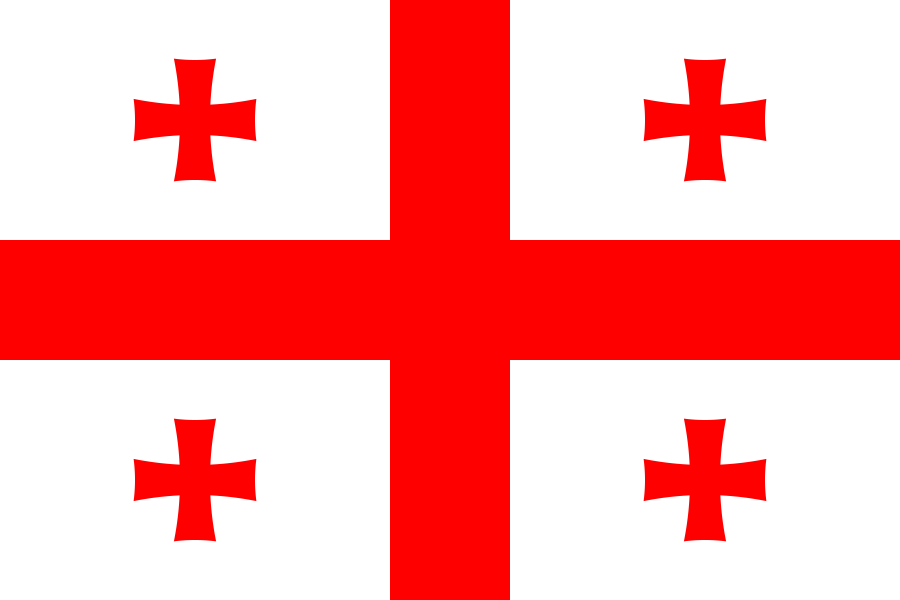
Menshevik politician who chaired the Transcaucasian Commissariat and became foreign minister of the Democratic Republic of Georgia
Born to a noble family in Martvili in 1881, he joined the Social Democratic movement as a student at Moscow University, became a Menshevik and sat in the Third State Duma from 1907 to 1912. From November 1917 to March 1918 he chaired the Transcaucasian Commissariat, then served as minister of war under the Transcaucasian Sejm. He signed the Georgian declaration of independence in May 1918 and was foreign minister, justice minister and deputy head of government of the Democratic Republic of Georgia. He left for France in March 1921 and from 1953 until his death in Paris in 1954 headed the government in exile.
Career timeline
1907–1912Member of the Third State Duma
1917Russian Provisional Government commissar for western Georgia
1917–1918Chairman of the Transcaucasian Commissariat
1918–1921Minister of Foreign Affairs of the Democratic Republic of Georgia
From Comintern underground courier to its organizational backbone, then devoured by the machine he built
At the June 1937 Central Committee plenum, when the resolution to grant NKVD chief Nikolai Yezhov emergency powers was tabled, Piatnitsky rose and said: "At this rate we will shoot the entire party." Silence fell over the hall. He was expelled from the plenum on 25 June.
An Old Bolshevik born to a poor Jewish tailor's family who taught himself to read. A virtuoso of the underground, he built Iskra's clandestine cross-border distribution network. Then, as Comintern secretary for twelve years, he became the organizational backbone of the International, managing liaison, finances, and cadre for communist parties worldwide. At the June 1937 Central Committee plenum he openly opposed granting the NKVD emergency powers; arrested a month later, he was tortured for a year and shot in July 1938. Rehabilitated in 1956.
Career timeline
1898–1902Built Iskra's clandestine courier network; operated as 'Freitag'
1903–1908Joined Bolsheviks; Odessa and Moscow committees; 1905 revolution
1914–1917Arrested, exiled to Yenisei province; returned to Moscow after Feb. Revolution
1917Moscow Party Committee, combat party centre; led railway Red Guard unit
1921–1923Member, ECCI
1923–1935Comintern Secretary — liaison, finance, and cadre placement for all parties
1935–1937Head, CC VKP(b) Administrative-Political Department
1937.06Spoke against NKVD emergency powers at CC plenum; expelled, arrested
Soviet Union
Soviet communism
1882–1955
○ Natural causes
From tsarist artillery officer to Stalin's first ambassador to Washington: a Russian nobleman who crossed revolution and diplomacy
At a White House reception, Roosevelt declared: 'If Mr. Troyanovsky says, looking at the moon, that this is the sun, I personally, gentlemen, will believe him.'
Alexander Troyanovsky was the first Soviet plenipotentiary to the United States, appointed in 1933 upon the establishment of diplomatic relations, and the architect of early cooperative ties with the Roosevelt administration. Born to hereditary nobility, trained as a tsarist artillery officer, he joined the Bolsheviks in 1904, broke with them for the Mensheviks in 1914, served on the Menshevik Central Committee and in the Constituent Assembly, then joined the Bolshevik Party in 1923 and entered Stalin's foreign-trade and diplomatic apparatus. As plenipotentiary to Japan (1927–1933) and then Washington, he negotiated the 1935 US–Soviet trade agreement and repeatedly urged Stalin to pursue rapprochement with America against Nazi Germany. His son Oleg Troyanovsky later served as Soviet Permanent Representative to the UN, founding one of the Soviet era's most durable diplomatic dynasties.
Career timeline
1904Joined RSDLP (Bolshevik faction), Kiev military organization
1909–1910Exiled to Yenisei province, escaped and emigrated
1914–1917Menshevik-defencist, collaborated with Lenin and Stalin in exile
1918Menshevik Central Committee member, Constituent Assembly deputy
1918–1921Red Army service, instructor at Senior Instructors School
1923Joined RCP(b)
1924–1927Chairman of Gostorg RSFSR, collegium member Narkomvneshtorg
1927–1933Plenipotentiary Representative to Japan
1933Deputy Chairman, Gosplan
1933–1938Plenipotentiary Representative to the US — first ambassador
1939–1955Professor at Higher Diplomatic School, Sovinformburo
Comintern
Communism
1883–1936
✕ Executed by shooting
He opposed October, vouched for Stalin, and was shot by him
In May 1924 Lenin's testament was read to a plenum of the Central Committee. Kamenev read the document; Zinoviev then spoke for Stalin and moved to re-elect him General Secretary by show of hands, which carried with only Trotsky's small group against. The testament was not reported to the congress.
One of Lenin's long-standing companions in exile and the first chairman of the Comintern's executive committee, he was an early face of international communism. Born Ovsei-Gershon Radomyshelsky to a Jewish dairy-farming family in Yelizavetgrad, today Kropyvnytskyi in Ukraine, he opposed the October 1917 rising publicly alongside Kamenev, yet as chairman of the Petrograd Soviet he controlled the party's northern base and became a full Politburo member in March 1921. After Lenin's death he formed a triumvirate with Stalin and Kamenev to isolate Trotsky, but was defeated at the XIV Party Congress in December 1925 and lost the Leningrad Soviet and Comintern posts in 1926. He then joined Trotsky in the United Opposition; in August 1936 the first Moscow trial sentenced him to death and he was shot, and he was rehabilitated in 1988.
Career timeline
1907–1917Lenin’s closest companion of the exile years
1917.10With Kamenev, opposes the rising; the leak scandal
1919–1926First chairman of the Comintern
1923–1925The triumvirate against Trotsky
1926–1927The United Opposition; expulsions and recantations
ECCI secretary who carried out the Stalinist purges (1928–1943)
In 1939 Stalin told Dimitrov: "Manuilsky is a toady! He was a Trotskyite! We criticised him for keeping quiet and not speaking out when the purges of Trotskyite bandits were going on, and now he has started toadying!" Almost every Old Bolshevik with a Trotsky link was killed or jailed except him.
A Bolshevik from Volhynia, born in the village of Sviatets to a priest's family (English sources say peasants) and a law graduate of the Sorbonne, he was a member of the Vpered group, joined the Mezhraiontsy in 1917, and held Ukrainian and Comintern posts. As ECCI secretary in the 1920s and 1930s he directed the Stalinist purges in the Comintern apparatus and foreign communist parties, and in 1945–46 he led the campaign against 'Ukrainian bourgeois nationalism'. In 1945 he headed Ukraine's delegation at San Francisco, chaired the committee that drafted the Preamble and Chapter 1 of the UN Charter, and from 1944 to 1952 was Ukrainian foreign minister.
Career timeline
1903Joins RSDLP while studying at St. Petersburg University; aligns with Bolsheviks
1905–1906Agitator for Petersburg Committee; organizes Kronstadt and Sveaborg mutinies
1906Arrested, sentenced to 5 years exile in Yakutia; escapes, emigrates to Paris
1907–1912Paris exile; intermittent illegal returns to Russia for underground work
1912–1913Underground work in St. Petersburg and Moscow; re-emigrates
1914–1917Anti-war position; edits Golos and Nashe Slovo with Trotsky
1917.05Returns to Russia, joins the Mezhraiontsy
1917.08VI Congress: Mezhraiontsy merge into the Bolshevik Party
1921–1922First Secretary of CP(B)U; People's Commissar for Agriculture during the famine
Sun Yat-sen's political advisor, architect of the First United Front, and the Comintern's global emissary
When American KMT supporters warned Sun Yat-sen, asking 'Do you know that Borodin is a pseudonym? Do you know his real name — Gruzenberg?', Sun replied: 'I know. Lafayette.'
Sun Yat-sen's political advisor and the Comintern's global emissary who engineered the First United Front between the KMT and the Chinese Communist Party. Born into a Jewish family, he joined the Bund at sixteen and the Bolsheviks in 1903, then after the 1905 Revolution emigrated to Chicago, where he ran a school for exiled Russian revolutionaries. In 1919 he became the first Soviet consul in Mexico and helped found the Mexican Communist Party. From 1923 in Guangzhou, he reorganized the Kuomintang into a Leninist vanguard party and established the Whampoa Military Academy. The United Front he built gave the CCP a foothold in mass politics, but it collapsed when Chiang Kai-shek purged the communists in 1927.
Career timeline
1903Joins the RSDLP; Bolshevik
1905–1907Revolutionary work in Riga; delegate to the 4th Party Congress in Stockholm
1907–1918Exile in the United States; runs an immigrant school in Chicago
1919First Soviet consul in Mexico; helps found the Mexican Communist Party
1919–1922Comintern agent touring Europe and the Americas
1923–1927Sun Yat-sen's political advisor; KMT reorganization, First United Front, Whampoa Academy
1932–1949Editor-in-chief of Moscow News and the Soviet Information Bureau
1949–1951Arrested in anti-cosmopolitan campaign; dies in Lefortovo prison
Soviet Union
Soviet communism
1884–1975
○ Natural causes
From Menshevik to Soviet envoy to the British Empire: a convert and survivor who stood at the center of world-war diplomacy
In November 1918 he wrote to the Menshevik Central Committee that he was "fortunate to have the great honor of taking part in the last heroic-desperate attempt of democracy to save the revolution." Two years later he joined the Bolsheviks.
A Soviet diplomat and historian who crossed from Menshevism to Bolshevism. As ambassador to Britain for eleven years from 1932, he served as a central channel of wartime Allied diplomacy and signed the Maisky–Sikorski agreement restoring Soviet-Polish relations. After the war, as Deputy People's Commissar for Foreign Affairs, he took part in the Yalta and Potsdam conferences and led the commission on German reparations. His London diplomatic diary is regarded as an unparalleled source on the inner workings of interwar and wartime Soviet diplomacy.
Career timeline
1903Joined RSDLP, Menshevik faction
1906–1908Arrested for 1905 revolution activity, exiled to Tobolsk
1912Graduated in economics from Munich University; moved to London
1917Deputy Minister of Labour, Provisional Government
1918Minister of Labour, Samara KOMUCh government; expelled from Menshevik party
1920–1921Declared conversion to Bolshevism; admitted to RKP(b)
1922–1923Head of Press Department, People's Commissariat for Foreign Affairs
1929–1932Plenipotentiary Representative of the USSR to Finland
1932–1943Plenipotentiary Representative / Ambassador of the USSR to the United Kingdom
Architect of Comintern propaganda and party history compiler
"We believe that Byelorussians are not a nation, and the ethnographic specifics that differentiate them from Russians must be erased" — in Zvyazda, the newspaper he edited, 6 October 1918.
A Latvian Bolshevik who built party organizations in Belarus and Latvia and twice served as First Secretary of the Communist Party of Byelorussia in the 1920s. As head of the Comintern Information-Propaganda Department he coordinated the ideological line of foreign communist parties, and as director of the Institute of Red Professorship (Party History) he authored the 1935 Short History of the CPSU, the direct precursor to the 1938 Short Course. Arrested in 1937, executed the following year, and rehabilitated in 1955.
Career timeline
1910Joined RSDLP(b)
1917Secretary of Minsk Soviet, editor of Zvyazda
1920–1922Secretary, Central Bureau of CP(b) of Byelorussia
1926–1927Head of Agitprop, CC VKP(b)
1927–1928First Secretary, CC CP(b) of Byelorussia
1928–1937Head of Information-Propaganda Dept., ECCI
1932–1935Director, Institute of Red Professorship (Party History)
1935–1937Deputy Head, Dept. of Party Propaganda & Agitation, CC VKP(b)
Soviet Union
Soviet communism
1890–1986
○ Natural causes
“Stone-arse”: the man who never changed his mind
His wife Polina Zhemchuzhina was arrested for treason in December 1948 and forced into divorce, and was released only after Stalin's death in 1953. Throughout, Molotov is said to have had dinner set for two every evening. 'She suffered because of me,' he said later.
An Old Bolshevik who joined the RSDLP in 1906 and was arrested and internally exiled twice before 1917. A full Politburo member from 1926, he became premier in 1930, overseeing collectivisation and the Great Purge; in 1939 he signed the Nazi–Soviet pact. As deputy chair of the State Defence Committee he attended the Tehran, Yalta and Potsdam conferences, and he initiated the 'Molotov Plan' against the Marshall Plan. In 1957 he failed to oust Khrushchev; sources date his expulsion to 1961 or 1962. Readmitted in 1984, he died in 1986.
From Volga flotilla commander to exile critic: the diplomat who wrote Stalin an open letter
December 1918, aboard the destroyer Spartak — disguised as an Estonian sailor and hidden among potato sacks, he was exposed when it turned out he didn't speak a word of Estonian.
Bolshevik naval commander of the Volga and Baltic fleets during the Civil War. As a Soviet diplomat he refused recall in 1938 and defected, publishing his 'Open Letter to Stalin' in 1939, a public denunciation of the Great Purge.
Career timeline
1910Joined Bolshevik faction while at St. Petersburg Polytechnic Institute
1912–1914Literary contributor to Zvezda and Pravda
1917Deputy chairman of Kronstadt Soviet; arrested after July Days, freed Oct 1917
1918Commissar of Naval General Staff, commander of Volga Flotilla — took Kazan, saved 432 prisoners from 'death barge'
1919–1920Captured by British, held in Brixton Prison; exchanged, commanded Volga-Caspian Flotilla, led Enzeli landing
1920–1921Commander of Baltic Fleet; twice awarded Order of the Red Banner
1921–1924Plenipotentiary to Afghanistan
1928–1930Chairman of Glavrepertkom (censorship); editor-in-chief, Krasnaya Nov
1930–1938Plenipotentiary to Estonia, Denmark, and Bulgaria
1938–1939Refused recall, defected in Paris; published 'Open Letter to Stalin' Aug 1939