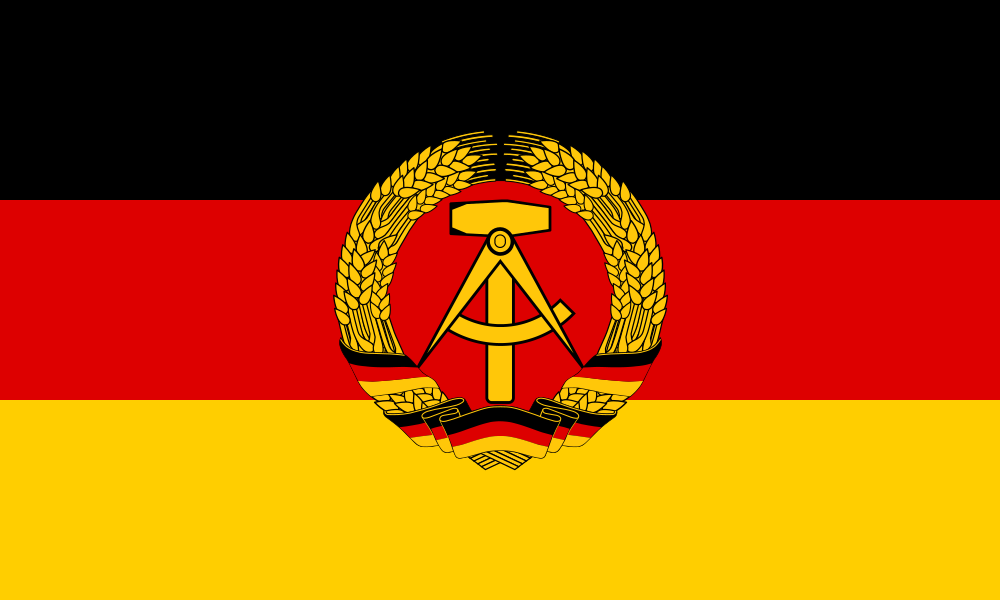
From the Spartacus League to GDR head of state, the sole founding member who lived the full arc of German communism
On the night of 15 January 1919, Pieck was arrested alongside Luxemburg and Liebknecht and taken to the Eden Hotel. He became the sole survivor — the last to witness his comrades alive.
A coachman's son turned carpenter, he joined the SPD in 1895 and was radicalized under Rosa Luxemburg's influence. Court-martialed for anti-war agitation, he co-founded the Spartacus League and the KPD. Arrested with Luxemburg and Liebknecht in January 1919, he alone survived. He served on the ECCI (1921) and its Presidium (1931), then led the KPD in Moscow exile as Comintern secretary. Returning after the war, he drove the SPD-KPD merger that created the SED and became the first President of the GDR in 1949, holding that office until his death.
Career timeline
- 1895Joins the Social Democratic Party of Germany (SPD)
- 1915Conscripted; court-martialed for anti-war agitation; flees to Amsterdam
- 1918–1919Co-founds Spartacus League and KPD; Central Committee member
- 1921ECCI member; elected to the Prussian Landtag
- 1928–1933Reichstag deputy
- 1931Elected to the ECCI Presidium
- 1934–1946KPD chairman (exile leadership)
- 1935–1943Secretary of the Comintern
- 1943Co-founds the National Committee for a Free Germany
- 1946–1950Co-chairman of the Socialist Unity Party (SED)
- 1949–1960President of the German Democratic Republic
The chancellor who made provisional statehood durable
As president of the Parliamentary Council, Adenauer helped present the Basic Law as a provisional settlement rather than a final constitution for a divided Germany.
Konrad Adenauer was a Catholic conservative statesman who helped shape the Federal Republic after the collapse of Nazism and the division of Germany. As president of the Parliamentary Council, he supported a provisional Basic Law rather than a permanent constitution, leaving open the possibility of reunification while establishing democratic institutions in the western zones. As the first Federal Chancellor, he pursued Westbindung, European integration, and a socially regulated market economy, while his anti-communist policy hardened the political division of the Cold War. His career thus joined parliamentary reconstruction with the consolidation of a state whose provisional founding became durable.
Career timeline
- 1906–1909Deputy mayor of Cologne
- 1917–1933Lord Mayor of Cologne
- 1921–1933President of the Prussian State Council
- 1948–1949President of the Parliamentary Council
- 1949–1963First Federal Chancellor of the Federal Republic of Germany
- 1951–1955Federal Minister for Foreign Affairs
- 1950–1966Chairman of the Christian Democratic Union
Weimar finance minister who founded the CDU in the Soviet zone in 1945 and was deposed for opposing the land reform
The son of a Cologne railway worker, he studied agriculture and from 1911 worked at the International Institute of Agriculture in Rome. A member of the Catholic Centre Party, he became Minister of Food in 1920 and was Minister of Finance from 1922 until the Cuno cabinet resigned in August 1923. Arrested after the Nazis took power, he later served as an economic adviser to the government of Colombia. Back in Germany he joined the resistance around Goerdeler, was arrested after 20 July 1944 and sentenced to death in January 1945, but his wife delayed the execution until the Red Army took Berlin. On 26 June 1945 he became the first chairman of the CDU of Berlin and the Soviet zone; because he refused to agree to the land reform without compensation, SMAD deposed him in December. In the West he founded the German Farmers’ Association and argued for reunification.
Career timeline
- 1911–1914Department director at the International Institute of Agriculture, Rome
- 1920Reich Minister of Food
- 1922–1923Reich Minister of Finance
- 1945Sentenced to death by a Nazi court
- 1945Chairman of the CDU in the Soviet zone; deposed in December
- 1948President of the German Farmers’ Association
Kaiser’s successor at the head of the East German CDU, who brought it into line with the SED as deputy prime minister
Born in Frohburg in Saxony, he worked as a journalist, moved through the left-liberal parties, helped found the German Democratic Party in 1918, and sat in the Weimar National Assembly and the Prussian Landtag. He joined the opposition after 1933 and went into hiding after the 1944 attempt on Hitler’s life. In 1945 he co-founded the CDU in the Soviet zone; when the Soviet authorities deposed Jakob Kaiser and Ernst Lemmer in 1947 he became acting chairman, and chairman in 1948. As a co-chairman of the German People’s Council he took part in drafting the GDR constitution, and in 1949 became deputy prime minister and head of the Church Office. A loyal supporter of the SED regime, he pushed out CDU members unwilling to follow the Communists. He died in 1957.
Career timeline
- 1918Co-founder of the German Democratic Party
- 1921–1933Member of the Prussian Landtag
- 1945Co-founder of the CDU in the Soviet zone
- 1948–1957Chairman of the East German CDU
- 1949–1957GDR deputy prime minister and head of the Church Office
Philosopher of the not-yet: thinker of concrete utopia and human emancipation in The Principle of Hope
“The true genesis is not at the beginning but at the end, and it begins only when society and existence become radical, i.e. grasp themselves at the root.” — The Principle of Hope
German Marxist philosopher who formulated the philosophy of concrete utopia and the 'not-yet' (Noch-Nicht) in his magnum opus The Principle of Hope. Alongside Lukács, Benjamin, Adorno, and Brecht, he shaped a central current of Western Marxism. Returned to East Germany in 1948 to hold the chair of philosophy at Leipzig and receive the GDR National Prize, but was forced into retirement after the 1956 Hungarian uprising for his humanistic Marxism; defected to West Germany in 1961. His thought profoundly influenced liberation theology and the 1968 student movements.
Career timeline
- 1905–1908Studies philosophy, physics, music at Munich and Würzburg; doctorate on Rickert
- 1912–1914In Heidelberg, associates with Max Weber, Simmel, and Lukács
- 1918Publishes The Spirit of Utopia — first major work
- 1921Publishes Thomas Müntzer as Theologian of Revolution
- 1920sFreelance journalist in Berlin; befriends Brecht, Benjamin, and Adorno
- 1933–1938Flees Nazi Germany for Switzerland, Austria, Czechoslovakia
- 1935Publishes Heritage of Our Times; analyses fascism's appeal through non-synchronism
- 1938–1947Writes the three-volume The Principle of Hope in US exile
- 1949–1957Chair of philosophy, Leipzig University; GDR National Prize (1955); Academy of Sciences
- 1957Forced into retirement for teaching humanistic Marxism after the Hungarian uprising
- 1961Defects to West Germany after Berlin Wall built; guest professor at Tübingen
- 1967Receives the Peace Prize of the German Book Trade
- 1968–1970sInfluences the 1968 movement and liberation theology; mentors Rudi Dutschke
Christian Democrat who led the CDU in the Soviet zone until SMAD removed him, then became West Germany’s minister for all-German affairs
A bookbinder from Hammelburg in Bavaria, he became a leader of the Catholic trade-union movement and was elected to the Reichstag for the Centre Party in 1933. He joined the resistance against the Nazis, was arrested by the Gestapo in 1938, and went into hiding after the 20 July 1944 plot. After the war he co-founded the CDU in the Soviet zone and became its co-chairman with Ernst Lemmer; as a Christian Socialist he called for the nationalisation of key industries. Critical of the Communists, he and Lemmer were removed as chairmen by the Soviet Military Administration in December 1947, and he moved to West Berlin. He opposed Adenauer’s Western integration in favour of a neutral, united Germany, and was minister for all-German affairs from 1949 to 1957. He died in Berlin in 1961.
Career timeline
- 1933Reichstag deputy for the Centre Party
- 1938Arrested by the Gestapo
- 1945–1947Co-chairman of the CDU in the Soviet zone
- 1947Removed by the Soviet Military Administration
- 1949–1957Federal Minister of All-German Affairs
The social democrat who became the voice of divided Berlin
“People of the world, look upon this city! You cannot, you must not, forsake us!”
Ernst Reuter was a German politician whose path from social democracy through communism and back reflected the upheavals of twentieth-century Europe. After Nazi persecution and exile in Turkey, he returned to Berlin and joined municipal administration to a practical social-democratic politics. During the Berlin Blockade, he gave West Berliners’ resolve an international voice and helped make the divided city a symbol of freedom and self-government. His career also reveals the tensions of a generation that moved from revolutionary radicalism toward democratic local government.
Career timeline
- 1912Joined the Social Democratic Party of Germany
- 1918–1919First chairman of the Volga German Autonomous Soviet Socialist Republic
- 1921First secretary of the Berlin district of the Communist Party of Germany
- 1926–1931Berlin city councillor for transport
- 1931–1933Mayor of Magdeburg
- 1935–1946Lecturer in urban planning at Ankara University and adviser to the Turkish government
- 1947Elected mayor of Berlin, without Soviet consent
- 1948–1953Mayor of West Berlin, Governing Mayor from 1951
First East German justice minister, dismissed and imprisoned in 1953 after opposing the prosecution of striking workers
A toolmaker from Berlin, he joined the SPD in 1910 and sat in the Prussian Landtag from 1928 to 1933. Under the Nazis he took part in a resistance group and was twice imprisoned. After the war he supported the forced merger of the SPD and KPD, sat on the SED’s Central Committee, and in October 1949 became the GDR’s first Minister of Justice. In the trial of the Gladow gang he had adult criminal law applied unlawfully so that a death sentence was possible. In an interview with Neues Deutschland on 30 June 1953 he said that members of the 17 June strike leadership would not be punished on mere suspicion; denounced as an “enemy of the state and the party”, he was dismissed, expelled and arrested, and sentenced to eight years. Released and pardoned in 1956, readmitted to the party in 1958, he died in 1973.
Career timeline
- 1910Joined the SPD
- 1928–1933Member of the Prussian Landtag
- 1949–1953GDR Minister of Justice
- 1953Dismissed, expelled and arrested
- 1956Released and pardoned
- 1958Readmitted to the SED
First East German Minister for State Security, purged in 1953 after trying to replace Ulbricht
Born in Gelsenkirchen to a gendarmerie sergeant’s family, he trained as a teacher and was a military leader of the Red Ruhr Army during the Kapp Putsch of 1920. As a GRU agent and Comintern military adviser he co-organised the Guangzhou Uprising in China, and in the Spanish Civil War, as “Gomez”, he led the International Brigades. He returned to Germany in 1947, joined the SED, and in 1950 became the first Minister for State Security and a Politburo member, building up the Stasi. After the uprising of June 1953 he moved to replace Ulbricht with Herrnstadt, but once Ulbricht had Khrushchev’s backing he lost his ministry and all his posts in July and was expelled from the party. He worked as a translator, died in East Berlin in 1958 and was rehabilitated after 1990.
Career timeline
- 1920Red Ruhr Army leader during the Kapp Putsch
- 1927–1930Comintern military adviser in China
- 1936–1938International Brigades commander in Spain (“Gomez”)
- 1950–1953GDR Minister for State Security; Politburo member
- 1953Stripped of all posts and expelled from the SED
SED Politburo member and chairman of the Central Party Control Commission who stood by Ulbricht in 1953
Born in Burg, the son of a Social Democratic worker, he worked as a tanner and left the SPD when it voted for war loans. He went through the USPD into the KPD and led its Magdeburg and East Prussia districts. Arrested in 1933, he escaped and went into exile, joining the National Committee for a Free Germany in the Soviet Union. He returned in 1945 with Anton Ackermann’s group and until 1946 was first secretary of the KPD in Saxony. From 1948 until his death he chaired the SED’s Central Party Control Commission, responsible for party discipline, and was a Politburo member and vice-president of the People’s Chamber. After the 1953 uprising, when a Politburo majority wanted to remove Ulbricht, he and Honecker alone stayed loyal. He died in East Berlin in 1971.
Career timeline
- 1918Joined the USPD; workers’ and soldiers’ council
- 1931–1933KPD political leader in East Prussia
- 1945–1946First secretary of the KPD in Saxony
- 1948–1971Chairman of the SED Central Party Control Commission
- 1950–1971Politburo member
German communist leader who built the GDR and erected the Berlin Wall
At a press conference on 15 June 1961 he declared, 'Nobody intends to build a wall'; two months later, on 13 August, his orders launched the Berlin Wall.
Born in Leipzig in 1893 to a tailor's family and trained as a joiner, he joined the SPD in 1912, passed through the USPD (1917) and the Spartacus League (1919) into the KPD (1920), and sat on the KPD Central Committee from 1923 and in the Reichstag from 1928 to 1933. After the Nazi takeover he fled via Paris and Prague to the Soviet Union to work for the Comintern, and returned on 30 April 1945 leading the 'Ulbricht Group'. He was pivotal in the forced 1946 merger of the KPD and SPD into the SED and became its First Secretary in 1950, the effective leader of East Germany. He backed the suppression of the June 1953 uprising, ordered the Berlin Wall in 1961, and launched the New Economic System in 1963. Forced out on 3 May 1971 'for health reasons' in favour of Erich Honecker, he died of a stroke on 1 August 1973.
Career timeline
- 1912Joins the Social Democratic Party of Germany (SPD)
- 1918Co-founds the Spartacus League and the KPD
- 1923–1933KPD Central Committee member, Reichstag deputy
- 1933–1945Exile in Paris, Prague and Moscow; works for the Comintern
- 1943Helps found the National Committee for a Free Germany
- 1950–1971First Secretary of the SED Central Committee
- 1960–1973Chairman of the GDR State Council
- 1971Forced to resign party leadership under Brezhnev pressure
The Social Democrat who led a divided state into being
In April 1946, he was elected co-chairman of the newly founded Socialist Unity Party alongside Wilhelm Pieck.
Otto Grotewohl was a Weimar-era Social Democratic politician who voted against Hitler’s Enabling Act and later led the postwar SPD in the Soviet occupation zone. Initially cautious, he helped drive the merger with the Communist Party under Soviet occupation authorities, becoming the SED’s co-chairman in 1946. The merger created the political foundation of East Germany, but it also followed the suppression of free choice within the SPD. As the GDR’s first head of government from 1949, Grotewohl helped build the new state while operating within the limits imposed by Soviet power.
Career timeline
- 1912Joined the Social Democratic Party of Germany
- 1920–1926Member of the Brunswick state parliament
- 1922–1924Brunswick Minister of Justice and Public Education
- 1925–1933Member of the Reichstag
- 1945–1946Chairman of the SPD Central Committee in the Soviet occupation zone
- 1946–1950Co-chairman of the Socialist Unity Party of Germany
- 1949–1964Chairman of the Council of Ministers of the GDR
- 1960–1964Withdrew from active politics because of severe illness
- 1964Died in East Berlin
A social democrat who moved from municipal politics into state power amid Germany's division
On 30 November 1948, he was elected Lord Mayor of the “provisional democratic magistrate” in Berlin's Soviet sector.
Friedrich Ebert Jr. was a German politician who moved from the Social Democratic Party to the leadership of the Socialist Unity Party, carrying both the symbolism of being the first president's son and the consequences of his own choices. The Nazis detained him in concentration camps for illegal political activity; after the war, he became a central figure in the Soviet zone as social democracy was forcibly fused with communism and the SED consolidated power. On 30 November 1948 he led the extraordinary assembly in the Soviet sector that deposed Berlin's elected magistrate and installed a rival East Berlin magistrate, then combined municipal reconstruction with senior work in East German state institutions.
Career timeline
- 1919–1925Editor of the Social Democratic daily Vorwärts
- 1927–1933Brandenburg an der Havel city councillor
- 1928–1933Member of the Reichstag
- 1946–1949President of the Brandenburg Landtag
- 1946–1979SED Central Committee and Politburo member
- 1948–1967First Lord Mayor of East Berlin
- 1949–1979People's Chamber and Council of State leadership
- 1971–1979Chairman of the SED People's Chamber faction
SPD leader who survived ten years in Nazi camps and, after the war, refused the merger with the Communists
Born in Kulm in West Prussia, he lost his right arm in the First World War and joined the SPD in 1918. As a member of the Württemberg Landtag and the Reichstag he fought the Nazis. Arrested in July 1933, he refused to sign a renunciation of political activity and spent ten years in concentration camps. In 1945 he rebuilt the party from Hanover, rejected the merger with the Communists urged by Otto Grotewohl in the Soviet zone, and called the KPD “red-painted Nazis”. Elected SPD chairman in 1946 and the Bundestag’s first leader of the opposition in 1949, he called for the nationalisation of heavy industry and a united Germany and opposed Adenauer’s integration with the West. He died in Bonn in 1952.
Career timeline
- 1918Joined the SPD
- 1930–1933Reichstag deputy
- 1933–1943Held in Nazi concentration camps
- 1946–1952SPD chairman
- 1949–1952Leader of the opposition in the Bundestag
SPD organiser in the Soviet zone who signed the merger with the KPD, then left the SED in 1948 and fled west
The son of a shipyard worker in Elbing, he joined the SPD in 1913 and became a white-collar union official in Brunswick, where he worked closely with Otto Grotewohl. Under the Nazis he belonged to a Social Democratic resistance circle and was imprisoned with Grotewohl in 1938. In May 1945 he and Grotewohl rebuilt the SPD in Berlin; he sat on its Central Committee and was the first SPD signatory of the agreement with the KPD and of the unity declaration. Elected to the SED Central Secretariat in 1946, he was isolated as the party was Stalinised and in September 1948 was relieved of all functions. In October he wrote a letter of resignation warning that the “party of a new type” would lead to a totalitarian dictatorship, and fled to the West. He died in 1964.
Career timeline
- 1913Joined the SPD
- 1938Imprisoned with Grotewohl
- 1945Member of the SPD Central Committee
- 1946Member of the SED Central Secretariat
- 1948Relieved of all functions, left the SED and fled west
The West German economic statesman who shaped currency reform and the social market economy
On 21 June 1948, he announced by radio the abolition of price controls and compulsory rationing for selected manufactured goods.
Ludwig Erhard was an economist and politician who conceived West Germany’s postwar order as a combination of competitive markets and social security. As director of the Bizonal Economic Administration in 1948, he helped prepare monetary reform and, alongside the introduction of the Deutsche Mark, began a staged relaxation of price and production controls that opened the institutional path to recovery. He is often mythologized as the sole architect of the economic miracle, although Allied reform, international conditions, and the recovery of production by workers and firms all mattered, while price liberalization initially raised living costs and provoked working-class resistance. As economics minister and later chancellor, he helped make that order part of West Germany’s political identity, but resigned in 1966 amid recession and the collapse of his coalition.
Career timeline
- 1919–1922Studied business administration at Nuremberg Business School
- 1925Received a doctorate in economics from Frankfurt University
- 1947Led the Bizonal Special Office for Money and Credit
- 1948–1949Director of the Bizonal Economic Administration
- 1949–1963West German Federal Minister of Economics, also Vice-Chancellor from 1957
- 1963–1966Second Federal Chancellor of West Germany
- 1966–1967Chairman of the Christian Democratic Union
- 1949–1977Member of the Bundestag
Communist who ran an anti-fascist sabotage network before the war and headed the Stasi from 1953 to 1957
Born in Münden in the Province of Hanover, he took part in the sailors’ revolt of 1918, joined the KPD in 1919 and led party military wings; he sat in the Reichstag in 1932–1933. In exile he organised the “Wollweber League” in 1936–1940, which carried out 21 known acts of sabotage against ships of fascist nations, and supplied arms to the Spanish Republicans. Back in Germany in 1946 he ran shipping administration. In July 1953, when Zaisser was removed and the Ministry for State Security was downgraded to a State Secretariat, he became its head, and in November 1955 Minister of State Security again. He clashed with Ulbricht and Honecker and sided with Schirdewan, resigned in 1957, and in 1958 was removed from the Central Committee for “factional activity”. He died in East Berlin in 1967.
Career timeline
- 1918Took part in the sailors’ revolt
- 1932–1933KPD Reichstag deputy
- 1936–1940Organised the Wollweber League sabotage network
- 1953–1955State Secretary of State Security
- 1955–1957Minister of State Security
- 1958Removed from the Central Committee
Frankfurt School philosopher and the pre-eminent theorist of the 1960s New Left
'In its advanced positions, it is the Great Refusal — the protest against that which is' — One-Dimensional Man (1964)
Herbert Marcuse was a central philosopher of the Frankfurt School who fused Marxism with Freudian psychoanalysis to develop a critical theory of modern capitalist society. In Eros and Civilization (1955) he analyzed the repressive structures of capitalist society and explored the utopian potential of liberated Eros, while in One-Dimensional Man (1964) he diagnosed advanced industrial society as a 'one-dimensional' order where technological abundance erodes critical consciousness, introducing the concept of repressive desublimation. A German-Jewish émigré who fled Nazism for the United States, he served in the OSS during the war and later taught at Brandeis and UC San Diego, becoming the intellectual pillar of the 1960s student movements and the New Left. His radical thought, crystallized in the 'Great Refusal,' has had a lasting impact on critical theory and emancipatory politics.
Career timeline
- 1932Joined Institute for Social Research (Frankfurt School) in exile, Geneva
- 1934–1942Researcher, Institute for Social Research, Columbia University, New York
- 1942–1951Analyst, OSS and State Department; head of Central European Section
- 1954–1965Professor of political theory, Brandeis University
- 1965–1970Professor of philosophy, UC San Diego
Communist who chaired the German Economic Commission, the forerunner of the GDR government, and led East German economic policy
Born in Feuerbach near Stuttgart, he worked as a metal presser at Bosch and passed through the Spartacists and the USPD into the KPD in 1919, becoming the party’s leading agricultural policy maker in the 1920s. Imprisoned after the Nazis came to power, he emigrated to the Soviet Union and in the Spanish Civil War commanded the XI International Brigade. Interned in France and handed to the Gestapo by Vichy in 1942, he was liberated at Mauthausen. In March 1948 he became chairman of the German Economic Commission (DWK), which carried out the eastern currency reform and the first plans. In the GDR he was a Politburo member, deputy prime minister and chairman of the State Planning Commission; at the Politburo session of 8 July 1953 he recommended replacing Ulbricht, yet kept his posts. Minister of Machine Construction and then of Foreign Trade, he died of a heart attack in 1961.
Career timeline
- 1919Joined the KPD
- 1923Head of the KPD agricultural division
- 1937–1938Commander of the XI International Brigade
- 1943–1945Mauthausen concentration camp
- 1948–1949Chairman of the German Economic Commission
- 1950–1961SED Politburo member; deputy prime minister
- 1955–1961Minister of Foreign and Inter-German Trade
East German heavy-industry minister who faced the striking workers outside the House of Ministries on 16 June 1953
The son of a coppersmith from Lauterbach in Hesse, he was working underground at seventeen, served in the First World War and in 1918 sat on a soldiers’ council. He joined the USPD in 1920 and the KPD in 1922, becoming the party’s political secretary in Saxony and a Reichstag deputy. Arrested in 1933, he survived the Nazi years in prisons and in concentration camps including Sachsenhausen and Flossenbürg. After the war he was Saxony’s minister for economics and planning, then deputy chairman of the German Economic Commission, and in the GDR minister of industry and of heavy industry. On 16 June 1953 he walked into the crowd outside the House of Ministries and tried to address it from a desk, but was whistled down. In 1958 Ulbricht pushed him out of his offices for a “deviant attitude”, and he turned to writing. He died in East Berlin in 1975.
Career timeline
- 1922Joined the KPD
- 1932–1933Reichstag deputy
- 1933–1945Imprisoned; held in Sachsenhausen and Flossenbürg
- 1948–1949Deputy chairman of the German Economic Commission
- 1949–1955Minister of Industry, then of Heavy Industry
- 1958Pushed out of office for a “deviant attitude”
Exiled SPD functionary who succeeded Schumacher as SPD leader and leader of the West German opposition
Born in Magdeburg, the son of a bricklayer, he joined the SPD in 1918 and led the Socialist Workers’ Youth. In May 1933 he went into exile in Prague with the party executive, helped form the exiled SPD (Sopade), and by way of Paris and Lisbon spent the war in London. Returning in February 1946, he worked in Kurt Schumacher’s office in Hanover and that year became his deputy, running the party organisation and its international contacts. After Schumacher’s death in 1952 he became party chairman, parliamentary leader and leader of the opposition. He lost to Adenauer as candidate for chancellor in 1953 and 1957, and backed the 1959 Godesberg Programme, with which the SPD broke with Marxism. He died in Bonn in 1963.
Career timeline
- 1918Joined the SPD
- 1928Chairman of the Socialist Workers’ Youth
- 1933Exile in Prague; member of the exiled SPD executive
- 1946SPD deputy chairman
- 1952–1963SPD chairman and leader of the opposition
East German jurist who succeeded Fechner as justice minister after the 1953 uprising and led its harsh political trials
Born into a liberal middle-class family in Bernburg, Anhalt, she was among the first women to study law in Germany. A Social Democrat, she married the physician Georg Benjamin, brother of Walter Benjamin, in 1926 and joined the KPD in 1927. Barred from practising law under the Nazis, she lost her husband in Mauthausen in 1942. After the war she worked in the justice administration of the Soviet zone, and as vice-president of the GDR Supreme Court presided over show trials of political undesirables and Jehovah’s Witnesses. On 15 July 1953 she succeeded Max Fechner, who had opposed prosecuting the striking workers, as minister of justice, and her heavy sentences against those arrested in June earned her the names “Red Hilde” and “the Red Freisler”. Ulbricht forced her to resign in 1967. She died in East Berlin in 1989.
Career timeline
- 1927Joined the KPD
- 1949–1953Vice-president of the GDR Supreme Court
- 1953–1967GDR Minister of Justice
- 1954Member of the SED Central Committee
- 1967Forced to resign by Ulbricht
Editor of Neues Deutschland who helped draft the 1953 New Course, moved against Ulbricht and was purged as a “faction”
Born into a wealthy Jewish family in Gleiwitz, he became a correspondent for the Berliner Tageblatt and an agent of Soviet military intelligence (GRU). Exiled in the Soviet Union from 1939, he edited the newspaper of the National Committee for a Free Germany. Back in Berlin in 1945 he ran the Berliner Zeitung and helped found Neues Deutschland, whose editor always followed Moscow’s line. In June 1953 he and Zaisser set themselves against Ulbricht, and he helped formulate the New Course approved by the Central Committee. After the uprising he proposed a collective leadership, but in July he was removed from the Central Committee for “anti-party factionalism” and in January 1954 expelled from the SED. He worked at the Central Archives in Merseburg, died in 1966 and was rehabilitated only in 1989.
Career timeline
- 1930Recruited as a GRU agent
- 1943Editor-in-chief of Freies Deutschland
- 1945Editor-in-chief of the Berliner Zeitung
- 1950–1953SED Central Committee member and Politburo candidate
- 1953Removed from the Central Committee for “anti-party factionalism”
- 1954Expelled from the SED
- 1989Posthumously rehabilitated
Economist and the SED’s chief ideologue until 1958, when he was expelled from the Politburo in the Schirdewan affair
Born in Leipzig, he joined the USPD in 1919 and the KPD in 1920 and worked as an editor on party papers. From 1926 he studied in Moscow at the International Lenin School and the Institute of Red Professors. In exile from 1933 he was Ulbricht’s secretary in Paris; in Moscow he lost his teaching posts in 1936 for alleged deviations, and in the war became chief editor of Moscow Radio’s German service. Returning with the Ackermann Group in 1945, he ran the party’s propaganda and education work, joined the Politburo in 1950 and was Central Committee secretary for propaganda from 1950 to 1955, effectively the party’s chief ideologue. In June 1953 he set up the command in Halle that put down the uprising. After 1956 he opposed the complete collectivisation of agriculture, and in 1958 he was expelled from the Politburo. He then directed the Institute of Economics of the Academy of Sciences.
Career timeline
- 1920Joined the KPD
- 1926–1932International Lenin School and Institute of Red Professors, Moscow
- 1941–1944Chief editor of Moscow Radio’s German service
- 1950–1958SED Politburo member
- 1950–1955Central Committee secretary for propaganda
- 1958–1969Director of the Institute of Economics, Academy of Sciences