The Radicals' 'Bull of Vaucluse', who helped build the Popular Front and dismantled it with his own hands
'Ah! les cons! s'ils savaient...', the words attributed to him on seeing the crowds cheering at Le Bourget airfield on his return from Munich on 30 September 1938. Whether he said them, and where and to whom, is disputed.
A baker's son and history teacher who rose to lead the Radical Party. He quit as premier after the 6 February 1934 riot, then as defence minister from June 1936 helped sustain the Popular Front, but after returning as premier in April 1938 he ended the 40-hour week by decree in November and broke the general strike. He signed the Munich accords in September 1938, declared war on Germany on 3 September 1939 and banned the Communist Party after the Nazi-Soviet pact. He fell over the failure to aid Finland in March 1940, stood trial at Riom and was interned near Buchenwald and at Itter Castle until 5 May 1945. Back in the Chamber after the war, he opposed de Gaulle's full powers in 1958 and died in Paris on 10 October 1970.
Career timeline
1884–1914Baker's son from Carpentras; history teacher
1914–1918Fights the First World War, rising from private to lieutenant
1919–1933Radical deputy; rises to lead the party
1934.01–02Premier; resigns the day after the riot of 6 February
1936–1940Defence minister, also premier from 1938
1938.04–09Returns as premier; signs the Munich agreement
1938.11Dismantles the 40-hour week by decree and breaks the general strike
1939.09Declares war on Germany; bans the Communist Party after the Nazi-Soviet pact
1940.03Falls over the failure to aid Finland
1940–1945Defendant at the Riom trial; interned near Buchenwald and at Itter Castle
1946–1958Returns to the Chamber; elder of the Radical Party
Bessarabian Socialist Revolutionary who headed the first government of the Moldavian Democratic Republic and put land reform first
Born in Tănătari, Bessarabia, in 1884, he graduated from the Chișinău seminary and the Faculty of Letters in Saint Petersburg and taught. A Socialist Revolutionary, he returned to Bessarabia in 1917 with Inculeț at Kerensky’s urging and was elected chairman of the governorate peasants’ soviet and to the Russian Constituent Assembly. In December 1917 he became President of the Council of Directors General, the Moldavian Democratic Republic’s first government, and Director General for Agriculture, putting land reform first. His view that the republic should bear the majority people’s name prevailed; he put the entry of Romanian troops to a vote, yet protested their presence, fearing they would be used to block land reform. He voted for union but resigned amid charges of a pro-Russian stance, and later sat in the Romanian Senate. He fled to Bucharest in 1940 and died there in 1971.
Career timeline
1917Chairman of the Bessarabian Governorate Soviet of Peasants’ Deputies
1917Member of the Russian Constituent Assembly
1917–1918President of the Council of Directors General and Director General for Agriculture
The 33rd president who framed the Cold War with the Truman Doctrine and the Marshall Plan
On his Oval Office desk sat a sign reading 'The buck stops here,' and from the atomic bomb to MacArthur's dismissal, he lived by it.
Truman was the 33rd president of the United States, who succeeded Franklin D. Roosevelt and ordered the atomic bombings of Hiroshima and Nagasaki in August 1945. In March 1947 he declared the Truman Doctrine (that 'it must be the policy of the United States to support free peoples who are resisting attempted subjugation by armed minorities or by outside pressures') and in April 1948 he signed the Marshall Plan into law, building the institutional framework for Western Europe's reconstruction and the containment of Soviet power. When North Korea invaded the South in 1950, he led the UN military response and later fired General Douglas MacArthur, reasserting civilian control of the military at the cost of his own popularity. Widely reviled at the end of his presidency, Truman was posthumously rehabilitated as a 'near great' president whose Cold War architecture outlasted the Soviet Union.
Career timeline
1884Born in Lamar, Missouri, the son of a farmer and livestock dealer
1917–1918WWI: captain commanding an artillery battery in France
1935–1945US Senator from Missouri; chaired the Truman Committee on wartime waste
1945.01–04Vice President; succeeded to the presidency on Roosevelt's death, April 12
1945–195333rd president: atomic bombs, Truman Doctrine, Marshall Plan, NATO, Korean War
1947.03.12Declared the Truman Doctrine, requesting aid for Greece and Turkey
1948.04.03Signed the Economic Cooperation Act, launching the Marshall Plan
1951.04.11Fired General Douglas MacArthur over Korean War strategy
Officer who negotiated the Treaty of Lausanne and succeeded Atatürk as Turkey’s second president
Born in Smyrna, an Ottoman officer, he won the First and Second Battles of İnönü in the War of Independence as chief of the General Staff and commander of the Western Front. As Turkey’s chief negotiator at Lausanne in 1922–1923 he faced down Curzon and replaced the Treaty of Sèvres with the Treaty of Lausanne. As prime minister for most of Atatürk’s presidency he carried out the secularising reforms; after the Sheikh Said revolt he pushed the Turkification of the Kurds, and he is considered one of those responsible for the Dersim massacre. Elected second president in 1938, he took the title “National Chief” and kept Turkey in armed neutrality in the Second World War. After defeat in the 1950 election he handed over power peacefully. He died in 1973.
Tatar revolutionary who led the Kazan Muslim Socialist Committee and became the first head of the Soviet Muslim Commissariat
Born in 1885 into a merchant family, in Kazan or in Kazaevo in Perm province according to different records, he took part in the 1905 revolution. After the St Petersburg Polytechnic he moved in 1912 to the law faculty of the Psychoneurological Institute, where he met Mikhail Frunze among others and organised a circle of Muslim students. After the February Revolution he led the Muslim Socialist Committee in Kazan and its newspaper Qızıl Bayraq, became a member of the Kazan Military Revolutionary Committee in October and was elected to the Constituent Assembly. In January 1918, on Lenin’s advice, he became head of the Muslim Commissariat (Muskom) and sent sailors to crush the Trans-Bulak Republic. Appointed extraordinary food commissar for the Volga in July, he was captured and executed after Komuch’s People’s Army took Kazan in August.
Career timeline
1907Entered the economics department of the St Petersburg Polytechnic
1912Law faculty of the Psychoneurological Institute; organised a Muslim student circle
1917Leader of the Kazan Muslim Socialist Committee; member of the Kazan Military Revolutionary Committee
1918Head of the Muslim Commissariat (Muskom)
1918Extraordinary food commissar for the Volga region
First head of the Crimean People’s Republic, the first elected mufti of Crimea and the poet of the Crimean Tatar anthem
Born in 1885 in the village of Büyük Sonaq near Dzhankoy, the son of an imam, he went to Istanbul in 1908 to study law and theology, founded the Young Tatar Writers’ Association and the secret organisation Vatan (Homeland), and returned to Crimea in 1912. In March 1917 he became chairman of the Crimean Muslim Executive Committee and the first mufti of Crimea elected by delegates rather than appointed by the Minister of the Interior. Arrested in June for anti-government agitation, he was freed after a protest bearing 5,000 signatures. He prepared the Qurultay and in December became chairman and director of justice of the Directory of the Crimean People’s Republic, but was arrested by the Bolsheviks in January 1918 and killed without trial by sailors in Sevastopol on 23 February. His poem “Ant etkenmen” became the Crimean Tatar national anthem.
Career timeline
1908–1912Studied law and theology in Istanbul; co-founded Vatan
1913Law faculty of the Psychoneurological Institute, St Petersburg
1917Chairman of the Crimean Muslim Executive Committee; mufti of Crimea
1917–1918Chairman and director of justice of the Directory of the Crimean People’s Republic
The Kadet politician who engineered Kolchak's dictatorship and stood with him to the end
On 22 September 1919 he wrote in his diary: 'General Knox came to see me… He received instructions from Churchill to support exclusively the Supreme Ruler.' The prime minister's own record from inside a collapsing regime.
A Kadet Party deputy in the imperial State Duma, he organized the military coup in Omsk in November 1918 that installed Alexander Kolchak as Supreme Ruler, the conspiracy's leader according to contemporary sources. He served as Kolchak's Minister of Internal Affairs and, from November 1919, as Chairman of the Council of Ministers, leading the crumbling White government as its only loyal politician to the end. Handed over with Kolchak by the Czechoslovak Legion to the Irkutsk Political Center in January 1920, he was shot without trial at dawn on 7 February 1920 on Lenin's direct orders.
Career timeline
1912Kadet Party deputy, Fourth State Duma (Tomsk province)
1914–1917Led 3rd Siberian Sanitary Detachment (First World War)
1917.02–05Provisional Government commissar and Kronstadt port commander
1918.08–11Led military-dictatorship campaign in Siberia, organized Omsk coup
1918.12–1919.05Kolchak government: Police Dept director → Deputy Interior Minister
1919.05–11Minister of Internal Affairs, Kolchak government
1919.11–1920.01Chairman of the Council of Ministers (Prime Minister)
1920.01–02Handed over by Czechoslovak Legion, imprisoned and shot alongside Kolchak
The Menshevik Labour Minister sent to calm the crowds during the April Crisis
On 20 April 1917, as 15,000 armed soldiers and sailors gathered before the Mariinsky Palace outraged by Milyukov's note, Skobelev and Gots were sent to address them: their speeches were unavailing.
A son of Baku's wealthy Molokan merchant class, he studied at the Vienna Polytechnic and helped edit Trotsky's Vienna Pravda. After the February Revolution he became deputy chairman of the Petrograd Soviet; during the April Crisis he was sent with Abram Gots to calm the armed crowds outside the Mariinsky Palace, and on 5 May 1917 he entered the first coalition government as Minister of Labour. He opposed the October Revolution but later reconciled, joining the Bolshevik Party in 1922 and working in the Soviet foreign trade system until his execution during the Great Purge in 1938.
Career timeline
1903Joined RSDLP; led Baku oil workers' strike
1906–1912Exile in Vienna; edited Trotsky's Pravda; graduated Vienna Polytechnic (1912)
1912–1917Deputy, Fourth Duma (Russian population of Transcaucasia); Menshevik faction
The Greek prime minister who accepted British aid under invasion
When Germany invaded on 6 April 1941, he rejected the German demand that British forces leave Greece.
Alexandros Koryzis was a lawyer, economist, and banker who helped organize state finance and agricultural credit in Greece. He served as an official and minister under Ioannis Metaxas's authoritarian regime, but became prime minister as an administrator rather than a party politician. After Metaxas's death in January 1941, he led the government in accepting British military assistance and resisting the German invasion, binding Greece's war effort to the Allied coalition. He died by suicide on 18 April, as German forces advanced.
Career timeline
1903Joined the National Bank of Greece
1915Helped organize the bank's agricultural-credit branch
1919–1920Economic adviser in Smyrna and founder of a National Bank branch
1925–1928First president of the Autonomous Currant Organization
1928–1933Deputy governor of the National Bank of Greece
1936–1939Minister of State Hygiene and Welfare
1939–1941Governor of the National Bank of Greece
1941Prime minister of Greece, also holding foreign affairs and defence portfolios
Soviet Union
Soviet communism
1885–?
○ Later fate unknown
A local Soviet official caught in the revolution's backlash
On March 2, 1921, the Kronstadt insurgents arrested and imprisoned him.
Pavel Vasiliev was a Bolshevik local official who led the Kronstadt Soviet at the end of the Russian Civil War. He represented Soviet authority as sailors and workers opposing war communism and party rule turned their demands into an open confrontation. In March 1921 the insurgent forces arrested him alongside Nikolai Kuzmin, making his detention a revealing moment in the tension between revolutionary Soviet democracy and the party’s monopoly of power.
Career timeline
1919–1921Chairman of the Kronstadt Soviet
1919–1921Chairman of the Kronstadt Soviet executive committee
1921.03.01Represented Soviet authority at the Anchor Square assembly
1921.03.02Spoke at the delegate meeting and was arrested by the insurgents
Soviet Union
Soviet communism
1886–1925
✕ Killed in crash
Lenin's periphery-builder who brought Soviet power to Belarus and Armenia
When news of the October Revolution reached Minsk, Myasnikov immediately formed and led a Military Revolutionary Committee, and Soviet power was established there without bloodshed.
An Armenian Bolshevik born to a merchant family in Nakhichevan-on-Don. He joined the RSDLP in 1906 and was administratively exiled to Baku for illegal literature, where Shaumyan influenced him. In 1917 he led the Western Front Bolsheviks in Minsk and played the leading role in establishing Soviet power there. He chaired the Byelorussian SSR Central Executive Committee in February 1919, then from May 1921 headed the Armenian SSR Council of People's Commissars, building Soviet Armenia's state institutions and economy. From 1922 he chaired the Transcaucasian SFSR Union Council and served as first secretary of the Transcaucasian Kraikom. He wrote on Marxist-Leninist theory and Armenian literature. On 22 March 1925 his aircraft caught fire and crashed near Tiflis, killing him alongside Atarbekov and Mogilevsky; the cause of the fire was never established.
Career timeline
1906Joined the RSDLP; exiled to Baku for illegal literature — met Shaumyan
1911–1914Graduated Moscow University law faculty (1911); army service, then assistant barrister writing for Bolshevik press
1914–1917Served on the Western Front in WWI, revolutionary propaganda among soldiers
1917.09–1918.05Chairman of North-Western Regional Party Committee, Minsk VRK chairman, Western Front Commander
1919.01–02First Chairman of the Central Executive Committee and Military Commissar of the Byelorussian SSR
1919–1920Military organiser then secretary of Moscow Party Committee; head of Political Directorate, Western Front
1921–1922Chairman of the Council of People's Commissars and Military Commissar of the Armenian SSR; deputy chairman of ZSFSR
1922–1925Chairman of the Transcaucasian Union Council, first secretary of the Transcaucasian Kraikom — USSR CEC Presidium, Revolutionary Military Council, candidate CC member
1925.03.22Died in a plane fire near Tiflis alongside Atarbekov and Mogilevsky
Right-radical officer who organised the Szeged National Army and as prime minister in 1932–1936 steered Hungary towards Italy and Germany
Born in Murga, Tolna County, the son of the village schoolmaster, he served as an Austro-Hungarian officer in the First World War. In Szeged in 1919 he founded the paramilitary MOVE and played a leading role in organising Horthy’s National Army, and in 1921 he led the armed opposition to King Charles’s return. He became defence minister in Bethlen’s government in 1929 and prime minister in 1932. He aligned with Mussolini, signing the Rome Protocols in 1934, and as the first foreign head of government to visit Hitler concluded a trade agreement with Germany. He died of illness in Munich in 1936.
Gömbös’s successor as prime minister in 1936–1938, who announced the Győr programme and introduced the First Jewish Law
Born in Budapest, he began his civil-service career in Pest County in 1909 and after the revolutions was head of Győr and Komárom counties. He entered parliament in 1927 and became Gömbös’s minister of agriculture in 1935. Succeeding Gömbös as prime minister in October 1936, he promised a return to Bethlen’s constitutional course and in 1937 banned the Party of National Will and had Szálasi imprisoned. In March 1938 he announced the Győr programme, but after the Anschluss he brought pro-German politicians into the cabinet and negotiated with the extreme right, and resigned in May. The First Jewish Law his government introduced passed under Imrédy, and from December 1938 until his death he was Speaker of the House of Representatives.
Hungarian communist who backed Soviet intervention with Kádár in 1956 and became prime minister after the revolution was crushed
Born into a German Catholic family in Seregélyes, he studied law and was taken prisoner on the Eastern Front in 1915 and sent to Tomsk. There he joined the Bolsheviks and commanded an international POW unit; back in Hungary in 1918 he helped found the Hungarian Communist Party and was war commissar of the Slovak Soviet Republic. He lived in the Soviet Union from 1922 to 1936 and, under the name Otto Flatter, commanded the XI International Brigade in the Spanish Civil War. After the war he was Budapest’s chief of police and then a diplomat. In the 1956 revolution he was interior minister under Imre Nagy, but in November he went to Moscow with János Kádár and openly backed Soviet armed intervention. As minister of the armed forces and public security in Kádár’s government he helped organise the security regiments and the Workers’ Militia, and he was prime minister from 1958 to 1961.
Career timeline
1915Captured by the Russians; held in Tomsk
1918Co-founder of the Hungarian Communist Party
1919War commissar of the Slovak Soviet Republic
1936–1939Commander of the XI International Brigade in Spain
1946–1949Budapest chief of police
1956Interior minister under Nagy; minister of the armed forces and public security under Kádár
Worker-poet known as Tsishka Hartny who headed the first Soviet government of Byelorussia
Born into a peasant family in Kapyl in 1887, he worked as a tanner, joined the Hramada in 1904 and wrote for Nasha Niva. From 1913 he worked in Petrograd factories and wrote poetry under the pen name Tsishka Hartny. In 1918, as secretary of the Belarusian National Commissariat, he campaigned for a Belarusian republic against Vilgelm Knorin and Alexander Myasnikov and won the support of Lenin and Stalin. From 1 January to 3 February 1919 he headed the Provisional Workers’ and Peasants’ Government of the Socialist Soviet Republic of Byelorussia. He later ran publishing and cultural institutions and became an academician, but was expelled from the party in 1931, arrested in 1936 and died in 1937 in a psychiatric hospital in Mogilev; some accounts say he took his own life.
Career timeline
1913Worker at the Vulkan plant in Petrograd
1918Secretary of the Belarusian National Commissariat
1919Head of the Provisional Workers’ and Peasants’ Government of the Socialist Soviet Republic of Byelorussia
1920–1931Member of the Central Executive Committee of the BSSR
1928Academician of the Academy of Sciences of the BSSR
Albanian physician and politician, the people's republic's formal first head of state
The Constituent Assembly opened on 11 January 1946 and proclaimed the people's republic the same day, becoming the People's Assembly on 16 March. Other records give election on 10 or 12 January and departure on 31 July.
Albanian physician and politician. Born on 5 February 1887 in Gjirokastër, Ottoman Empire, he studied medicine in Istanbul, served two weeks in prison over a 1924 attempt on Zogu, backed Fan S. Noli's June Revolution and co-founded the anti-Zogu KONARE in exile in 1925. After the Italian invasion of 1939 he joined the occupation government's Council of State, later regarded it as a mistake, joined the National Liberation Movement and chaired the Anti-Fascist Council at the Congress of Përmet in 1944. In 1946 he became chairman of the Constituent Assembly and served as formal head of state until 1953, though real power lay with Enver Hoxha, first secretary of the Party of Labour.
Career timeline
1914–1920According to Albanian Wikipedia, he served in the Gjirokastër battalion and in Vlorë in 1914 and was sent to Vienna; municipal physician in Ballsh 1915–1918 and physician at Tirana hospital in 1920
1923–1924Municipal physician in Durrës
1924Imprisoned two weeks over an assassination attempt on Zogu; backed Fan S. Noli's June Revolution, fled abroad and was sentenced to death in absentia
1925–1932Helped found the anti-Zogu KONARE and edited its newspaper Liria Kombëtare in Geneva (editor from 1926)
1933–1939Political emigrant in Zante, Greece; returned after the Italian invasion of 1939
1940–1943Member of the occupation government's Council of State, listed until 13 January 1944, joining the Front in August 1943; later joined the National Liberation Movement
1943.09Chairman of the Standing Committee of the National Liberation General Council
1944.05Chairman of the Anti-Fascist National Liberation Council at the Congress of Përmet, in charge of foreign affairs
1944.10–1946Minister of Foreign Affairs in the Anti-Fascist National Liberation Committee chaired by Enver Hoxha (until 9 February or 22 March 1946 according to different sources)
1946–1954Deputy for Gjirokastër (elected in the 2 December 1945 and 28 May 1950 elections)
1946.01–1953Chairman of the Constituent Assembly and then of the Presidium of the People's Assembly as formal head of state (English Wikipedia records the Constituent Assembly chairmanship; ShtetiWeb dates election to 12 January and service to 31 July)
1952–1953His brother Besim Nishani was arrested for propaganda against the people's government (arrested 1 October 1952, eight months in pre-trial detention) and his wife separated from him; a 1953 right-wing press report described her forced eviction and house arrest and his own virtual captivity
1953.07Officially requested to resign citing health on 24 July, with Haxhi Lleshi succeeding on 1 August; other records say Hoxha forced the resignation
Last prime minister of independent Lithuania, who accepted the Soviet ultimatum of 1940, took the presidency and handed power to Paleckis
Born to a smallholding peasant family near Skapiškis, he studied law and was minister of defence (1919, 1926–1927), governor of the Klaipėda Region and mayor of Kaunas. After serving in autumn 1939 as government commissioner for the Vilnius region, he became prime minister that November, and in June 1940 he argued for accepting the Soviet ultimatum. When Smetona left the country he became acting president, announced on the radio the next day that he was now president in his own right, and on 17 June appointed Justas Paleckis prime minister and resigned. Lithuania regards this takeover of the presidency as unconstitutional. A month later he tried to escape to Sweden but was arrested in Riga and deported to Saratov; he was imprisoned in 1941. Released in 1954 but not allowed to return to Lithuania, he died in Vladimir in 1955.
Wartime prime minister who refused German deportation demands and sought a secret armistice with the Western Allies
From an old gentry family of Szabolcs County, he was a county lord-lieutenant and minister of agriculture from 1932 to 1935, a conservative of the Bethlen school. In 1941 he voted in the upper house against the Third Jewish Law. Made prime minister at Horthy’s request in March 1942, he kept up the war against the Soviet Union while refusing German demands to deport Hungary’s Jews and negotiating an armistice with the Western Allies. A secret preliminary armistice was signed off Istanbul in September 1943, but when Germany occupied Hungary in March 1944 he was ousted and hid in the Turkish legation. Captured in October 1944, he was held in Dachau and Mauthausen until freed in 1945; he went into exile in 1946 and died in New York.
Career timeline
1921–1929Lord-lieutenant of Szabolcs County
1929–1931Deputy under-secretary, Ministry of Trade
1932–1935Minister of agriculture
1942–1944Prime minister; secret armistice talks with the Allies
1944–1945Refuge in the Turkish legation; Dachau and Mauthausen
Crimean Tatar national communist who pressed Crimean Tatar interests as head of the Crimean ASSR and was executed
Born in 1888 into a merchant family in Bakhchysarai, he worked from the age of 14 at the newspaper Terciman, where Ismail Gasprinsky tutored him. He took part in the 1905 revolution and lived in the Ottoman Empire in 1909–1912. In 1916 he chaired a Crimean Tatar labour union, and in 1917 he was a Qurultay delegate and led the left wing of Milliy Firqa. He joined the Bolsheviks in 1918 and served in the Cheka special department on the Caucasus front in 1919–1920. From December 1920 he called for Crimea to be recognised as a famine region, and in 1921–1924 he was People’s Commissar of the Workers’ and Peasants’ Inspection of the Crimean ASSR. As chairman of the Crimean Central Executive Committee from 1924 he opposed Jewish resettlement, but in 1928 he was executed on charges linked to a murder case; he was rehabilitated in 1990.
Career timeline
1916Chairman of a Crimean Tatar labour union
1917Qurultay delegate; leader of the left wing of Milliy Firqa
1919–1920Cheka special department officer on the Caucasus front
1921–1924People’s Commissar of the Workers’ and Peasants’ Inspection, Crimean ASSR
1922Head of the Crimean emergency troika against banditism
1924–1928Chairman of the Central Executive Committee of the Crimean ASSR
Christian Democrat who led the CDU in the Soviet zone until SMAD removed him, then became West Germany’s minister for all-German affairs
A bookbinder from Hammelburg in Bavaria, he became a leader of the Catholic trade-union movement and was elected to the Reichstag for the Centre Party in 1933. He joined the resistance against the Nazis, was arrested by the Gestapo in 1938, and went into hiding after the 20 July 1944 plot. After the war he co-founded the CDU in the Soviet zone and became its co-chairman with Ernst Lemmer; as a Christian Socialist he called for the nationalisation of key industries. Critical of the Communists, he and Lemmer were removed as chairmen by the Soviet Military Administration in December 1947, and he moved to West Berlin. He opposed Adenauer’s Western integration in favour of a neutral, united Germany, and was minister for all-German affairs from 1949 to 1957. He died in Berlin in 1961.
Career timeline
1933Reichstag deputy for the Centre Party
1938Arrested by the Gestapo
1945–1947Co-chairman of the CDU in the Soviet zone
A liberal statesman at the threshold of liberation and civil war
At Caserta, he agreed that military command after liberation would pass to the British commander, General Scobie.
A Greek liberal politician, Papandreou opposed the monarchy while also confronting the communist movement, combining social reform with firm anti-communism. During the Second World War he led the government-in-exile and, through the Lebanon Conference and the Caserta Agreement, helped establish a framework for resistance participation in government and the integration of armed forces. Returning in 1944 as prime minister of the Government of National Unity, he sought to restore state authority amid British intervention and conflict between EAM and non-EAM forces, a project that gave way to the Dekemvriana and civil war. He later founded the Centre Union and defended parliamentary democracy until his death under house arrest after the 1967 military coup.
Career timeline
1916Joined Venizelos's insurgent government and organised anti-monarchist support.
1923Minister of the Interior
1930–1932Minister of Education, expanding schools for refugee children.
1935Founded the Democratic Socialist Party of Greece
1944–1945Prime minister of the government-in-exile and Government of National Unity; represented Greece at Lebanon and Caserta.
1950–1952Deputy prime minister
1961–1965Leader of the Centre Union, winning the 1963 and 1964 elections.
1967–1968Held under house arrest by the military regime
The social democrat who became the voice of divided Berlin
“People of the world, look upon this city! You cannot, you must not, forsake us!”
Ernst Reuter was a German politician whose path from social democracy through communism and back reflected the upheavals of twentieth-century Europe. After Nazi persecution and exile in Turkey, he returned to Berlin and joined municipal administration to a practical social-democratic politics. During the Berlin Blockade, he gave West Berliners’ resolve an international voice and helped make the divided city a symbol of freedom and self-government. His career also reveals the tensions of a generation that moved from revolutionary radicalism toward democratic local government.
Career timeline
1912Joined the Social Democratic Party of Germany
1918–1919First chairman of the Volga German Autonomous Soviet Socialist Republic
1921First secretary of the Berlin district of the Communist Party of Germany
1926–1931Berlin city councillor for transport
1931–1933Mayor of Magdeburg
1935–1946Lecturer in urban planning at Ankara University and adviser to the Turkish government
1947Elected mayor of Berlin, without Soviet consent
1948–1953Mayor of West Berlin, Governing Mayor from 1951
Independence activist, linguist, and Yan'an faction leader who served as the first head of state of the DPRK
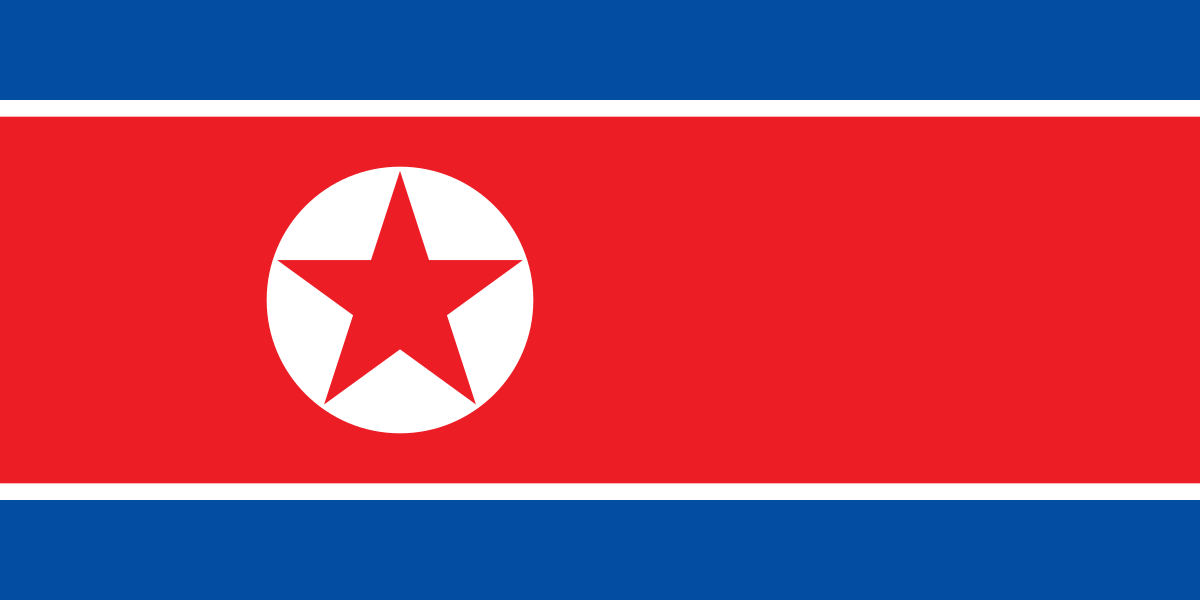
On the day the People's Assembly adopted the new DPRK flag in July 1948, Kim Tu-bong personally lowered the Taegeukgi and raised its replacement. Barely a year earlier, he had been the man passionately explaining the old flag's philosophical meaning to a skeptical Soviet general.
A Hangul linguist trained under Chu Sigyŏng who led the Korean Independence League in Yan'an. Became the DPRK's first head of state in 1948, though real power lay with Kim Il Sung. Purged and vanished in the 1958 August Faction Incident.
Career timeline
1908–1916Studied Hangul under Chu Sigyŏng; helped compile MalMoi dictionary
1919Joined March First Movement, then exiled to Shanghai provisional government
1920–1930sCombined communist activism with linguistic research in Shanghai
1942–1945Founded Korean Independence League in Yan'an; led the Yan'an faction
1946.02–08Chairman of the New People's Party of Korea
1946.08–1949.06Chairman of the Workers' Party of North Korea Central Committee
1948.09–1957.09Chairman of the SPA Standing Committee — first head of state of the DPRK
1957–1958Dismissed from all posts over August Faction Incident; disappeared
Finnish president who, as wartime prime minister, negotiated the Moscow Peace Treaty
This trial is a farce. The real prosecutor is not the Finnish state but the government of one superpower, and the real defendant is the Finnish people.
When the Winter War broke out, Risto Ryti became prime minister of Finland and led the legitimate government that the Soviet Union refused to recognize while backing the Terijoki puppet regime; he negotiated the Moscow Peace Treaty in March 1940. A liberal economist and governor of the Bank of Finland, he was elected president and led Finland through the Continuation War in cooperation with Germany, but in 1944 he signed the Ryti-Ribbentrop Agreement in his personal capacity and resigned, enabling his successor Mannerheim to make peace with the USSR. Convicted to ten years' imprisonment in the post-war war-responsibility trials under Soviet pressure, he was pardoned in 1949 and is remembered in Finland as a leader who sacrificed himself for his country.
Career timeline
1919–1924Member of Parliament (National Progressive Party)
1927–1929Member of Parliament (National Progressive Party)
1921–1924Finance Minister
1924–1939Governor of the Bank of Finland
1944–1945Governor of the Bank of Finland
1925Presidential candidate, National Progressive Party