A technical planner who linked electrification to regional development
Instead of several small stations along the Dnieper rapids, he proposed a single dam with an immense-for-its-time 560-megawatt capacity.
Ivan Alexandrov was a Russian and Soviet engineer who connected hydropower with economic regionalization after beginning his career in railways and bridge design. He designed the Dnieper hydroelectric project around a single large dam and treated electricity generation together with industrial location and transport. His work on GOELRO placed electrification within a planned reorganization of the national economy, leaving a mark on the spatial thinking of the later Five-Year Plans. Working between scholarship and state planning, he led Gosplan’s energy sector in the early 1930s before returning in his final years to research and teaching.
Career timeline
1901Graduated from the Moscow Engineering School; worked on railway and bridge design
1912Began research and design work on irrigation in Central Asia
1920Began developing and designing a large hydroelectric station on the Dnieper
1920–1921Contributed to GOELRO and jointly directed economic regionalization work
1921–1932Member of the Presidium of Soviet Gosplan; led its energy sector
1932Elected a full member of the Academy of Sciences of the USSR
1932–1936Led the Academy of Sciences’ transport section and focused on research and teaching
First Commissar for Food, purged for his NEP-era agrarian Marxism
In 1917, should our party have begun with 'war communism,' or could it have proceeded from what in 1921 would be called the 'new economic policy'? I held the latter opinion even then.
Born in Smolensk, the son of a land surveyor, into a family of ethnic Polish origin with insurgent traditions. He joined the Moscow 'Workers' Union' in 1895 and organized Smolensk's first social-democratic circle, and was elected to the RSDLP Central Committee at the 5th Congress in 1907. After the October Revolution he became the first People's Commissar for Food Supply; he resigned over the proposed broad coalition but continued his duties until December. As Deputy People's Commissar of Agriculture from 1922 to 1928 he interpreted NEP as accumulating funds through 'strong' peasant farms, and protected the economist N. D. Kondratiev. Arrested on 11 June 1937, he was convicted in the trial of the so-called 'Moscow Centre' on 20 September 1937, sentenced to death and shot the same day; he was rehabilitated in 1956. Some accounts give his death as 1940.
Career timeline
1895Joined Moscow 'Workers' Union,' organized Smolensk's first SD circle
1902Moscow Committee of RSDLP; arrested, exiled to Yakutia for 6 years
1905Secretary of Proletary editorial board in Geneva; Petersburg Committee member
1907Elected to RSDLP Central Committee at the 5th Congress as a Bolshevik
1917First People's Commissar for Food Supply (Oct–Dec); resigned over failed coalition
1922–1928Deputy People's Commissar for Agriculture
1926–1930Director of the International Agrarian Institute; General Secretary of the Peasant International
1929–1935Editor of Katorga i ssylka, head of Society of Former Political Prisoners publishing
On 1 March 1921, before the Kronstadt uprising, Kalinin entered the fortress unarmed with his wife, was met with applause at Anchor Square, but the sailors derailed his speech with jeers and catcalls.
A peasant-born Bolshevik metalworker who became the Soviet Union's formal head of state from 1919 until his death in 1946, serving 27 years as the country's nominal president. He signed the key laws of the mass-repression period, including the 7 August 1932 decree on state property, the 1 December 1934 decree on simplified terror cases, and the 7 April 1935 decree lowering criminal responsibility to 12. He also approved a cipher from the Belarusian first secretary proposing to shoot 3,000 and expel 9,800 people, and in March 1940 signed the order to execute 25,700 Polish officers and prisoners. Yet on 4 May 1932 he voted against the expulsion of 38,000 peasant families as unfounded, and the reversal halted the operation.
The capitalist who gave his workers a nine-hour day and built the Progressive Bloc to challenge the autocracy
On 16 May 1917, addressing the congress of military-industrial committees, he warned: "Anti-state tendencies, masking their true essence under a slogan hypnotizing the masses, are leading Russia in giant strides toward catastrophe."
One of Russia's largest textile magnates, he was a pioneering industrialist who introduced a nine-hour working day, worker housing, schools, and hospitals as early as 1900. As founder of the Progressist Party and Deputy Chairman of the Fourth Duma, he organized the Progressive Bloc during World War I, making himself the parliamentary opposition's central figure against the tsarist autocracy. After the February Revolution he served twice as Minister of Trade and Industry in the Provisional Government and, as Kerensky's deputy premier, chaired the cabinet meeting that was arrested at the Winter Palace on the day of the October Revolution. He spent his later decades in French emigration as chairman of Milyukov's newspaper Последние новости and a leading voice of left-liberal émigré politics.
Career timeline
1897–1905Heads family textile firm; introduces 9-hour day, worker housing, schools, hospital in 1900
The five-star chief of staff who warned Roosevelt the Yalta Poland deal was 'so elastic' it could stretch from Yalta to Washington
Leahy told Roosevelt: 'This is so elastic that the Russians can stretch it all the way from Yalta to Washington without ever technically breaking it.' Roosevelt answered: 'I know, Bill, but it is the best I can do for Poland at this time.'
William Leahy was a Fleet Admiral of the US Navy who served as Chief of Staff to Presidents Roosevelt and Truman during World War II, functioning as the de facto first Chairman of the Joint Chiefs. After serving as CNO, Governor of Puerto Rico and Ambassador to Vichy France, he was recalled in 1942 and spent the war coordinating Allied grand strategy as the nation's most senior officer. At the Yalta Conference in February 1945, he read the Poland agreement and told Roosevelt: 'This is so elastic that the Russians can stretch it all the way from Yalta to Washington without ever technically breaking it.' Roosevelt replied, 'I know, Bill, but it is the best I can do for Poland at this time.' Though he later condemned the atomic bomb, he did not oppose its use at the time; after the war he rejected plans that relied on nuclear first use.
Career timeline
1875Born in Hampton, Iowa, the son of Irish immigrants
1897Graduated from the Naval Academy; served on USS Oregon in the Spanish-American War
1927–1931Chief of the Bureau of Ordnance; first of his Academy class to reach flag rank
1937–1939Chief of Naval Operations; oversaw fleet expansion and war preparations
1939–1940Governor of Puerto Rico; developed military bases and New Deal public works
1940–1942Ambassador to Vichy France; failed to restrain Pétain's collaboration with Germany
1942–1949Chief of Staff to the President and de facto JCS chair; attended Yalta and Potsdam
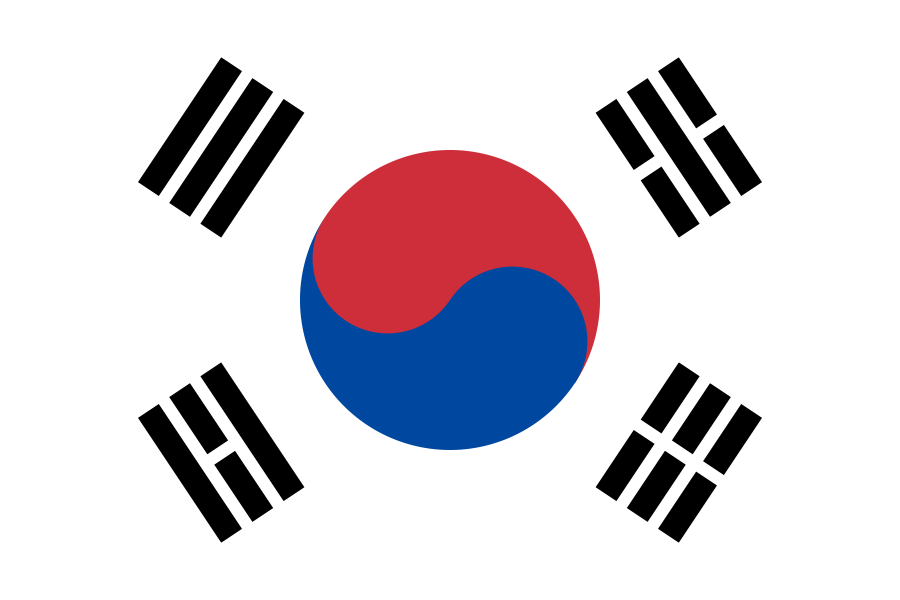
First president of South Korea who demanded unification by force and refused to sign the armistice
In a July 1950 letter to Truman: 'I pray… that we can turn to the offensive, break through the hard crust of enemy forces and start the victorious march north.'
Syngman Rhee was a Korean independence activist imprisoned during the late Joseon period for his activities with the Independence Club; after his release he earned a PhD in political science at Princeton, and in 1919 became the first president of the Korean Provisional Government. In 1948 he was elected the first president of the Republic of Korea, building a fiercely anti-communist state under the National Security Law and publicly demanding the forcible reunification of the peninsula by marching north across the 38th parallel. During the Korean War he refused any armistice short of unification, and in 1953 he unilaterally released 27,000 anti-communist prisoners of war, nearly derailing the ceasefire talks; he never signed the armistice. Forced to resign by the April Revolution in 1960 after a rigged election, he died in exile in Hawaii.
Career timeline
1896–1898Independence Club and Hyeopseong Club activist; editor of Maeil Sinmun
1899–1904Imprisoned at Hanseong Prison; wrote The Spirit of Independence
1905–1910Studied in the US; PhD in political science, Princeton
1919–1925First President, Korean Provisional Government
1948Speaker of Constituent Assembly; elected first President of ROK
1948–19601st–3rd President; extended rule through constitutional amendments
1960–1965Resigned after April Revolution; exiled in Hawaii
Bolshevik Central Committee member and Duma leader who was the Okhrana's best-paid spy
At a Bolshevik fundraising ball in February 1913, Stalin — wearing a suit and silk cravat lent by Malinovsky — was arrested while Malinovsky was talking to him; Malinovsky shouted he would free him.
A Polish-born labour organiser who rose to the Bolshevik Central Committee and leadership of the party's Duma faction (1912), Malinovsky was simultaneously the Okhrana's highest-paid secret agent, codenamed 'Portnoi' (the Tailor). Having won Lenin's deep trust, he penetrated the party leadership and enabled the arrests of Ordzhonikidze, Sverdlov, and Stalin, while deepening the Bolshevik-Menshevik split on police instructions. Forced to resign in 1914, he returned to Soviet Russia in 1918, was convicted by the Supreme Tribunal, and executed by firing squad in the Kremlin. His exposure deepened the culture of conspiratorial mistrust within the Bolsheviks, contributing to the paranoid logic that later fuelled the Great Terror.
Career timeline
1901–1905Served in Izmailovsky Guards Regiment
1906–1909Secretary, St. Petersburg Metalworkers Union
1910Recruited as Okhrana secret agent 'Portnoi'
1912Elected to Bolshevik Central Committee at Prague Conference
1912–1914Bolshevik deputy, Fourth State Duma; faction leader
1914.5Forced resignation; fled abroad
1914–1918POW in German prison camp
1918.11Returned; sentenced to death by Supreme Tribunal; shot
Founder of Rabotnitsa and organizer of Russia's first International Women's Day
On the eve of Rabotnitsa's first issue in February 1914, police raided the editorial office and arrested the entire board, Samoilova included. The publication permit had been a trap. But Anna Yelizarova, who arrived late and escaped the sweep, got the first issue out on 23 February — International Women's Day.
Daughter of an Irkutsk priest, she studied philosophy at the Bestuzhev Courses. In Paris in 1902 she met Lenin and joined Iskra, then spent a decade as an underground propagandist, arrested three times. As Pravda's editorial secretary, the letters from working women moved her to organize Russia's first International Women's Day in 1913. In 1914 she co-founded Rabotnitsa, the first Marxist newspaper for working women; she revived it after the February Revolution. She headed Zhenotdel in Ukraine, served on Kommunistka's board, and led the political department of the Volga agit-steamer Red Star before dying of cholera in Astrakhan in 1921.
Career timeline
1896Enrolled at the Bestuzhev Courses in Petersburg, studied philosophy
1897–1901Active in the student movement; first arrest and expulsion in 1901
1902–03Studied in Paris; met Lenin and joined Iskra
1903–12Joined RSDLP; underground propagandist — arrested three times across Tver, Odessa, Rostov, Lugansk
1907Delegate to the 5th RSDLP Congress in London
1912–14Editorial secretary of Pravda
1913.02Organized Russia's first International Women's Day meeting; hundreds of working women attended
1914.02Launched Rabotnitsa with Inessa Armand — arrested on the eve of the first issue
1917Revived Rabotnitsa after the February Revolution; organized the First Conference of Women Workers
1918.01Co-organized the First All-Russian Congress of Working Women
1919–20Head of Zhenotdel for the CP(b)U in Ukraine; delegate to 8th Party Congress
1920–21Editorial board of Kommunistka; political commissar of the Volga agit-steamer Red Star
Father of the Chilean labour movement and pioneer of Latin American communism
"Reading is one of the best means of emancipation for the working classes. That is why we urge you to read much." — Recabarren's constant refrain at workers' gatherings throughout Chile.
A lifelong organizer and theorist who dedicated himself to building Chile's labour movement and socialist party. Witnessing the brutal conditions of nitrate miners, he joined the Democratic Party but broke with its reformism in 1912 to found the Socialist Workers' Party (POS). Despite repeated imprisonment and exile, he launched and edited workers' newspapers, toured the country raising class consciousness, and in 1922 affiliated the party to the Comintern, transforming it into the Communist Party of Chile. Beset by internal party conflicts and failing health, he took his own life in 1924, but the organizational, educational, and press foundations he laid became cornerstones of the Chilean and Latin American revolutionary tradition.
Career timeline
1894Joined the Chilean Democratic Party
1906Elected deputy for Tocopilla (denied seat)
1908–1909Exile in Argentina and Europe
1912Founded Socialist Workers' Party (POS) and El Despertar newspaper
1918Co-founded Communist Party of Argentina, first national directorate
1921Elected deputy for Antofagasta
1922Transformed POS into Communist Party (PCCh), attended 4th Comintern Congress
Vyborg Bolshevik organizer who turned the Women's Day protest into the February Revolution
On 28 February, hearing of the Provisional Government's formation, Kayurov shouted to the soldiers: "Comrades! Has the workers' blood been flowing in the streets of Petrograd for three days merely to exchange one landlord for another?"
A metalworker who joined the RSDLP in 1898, Kayurov was a Bolshevik organizer in Petrograd's Vyborg district who, on 23 February 1917, defied the party committee's caution and transformed the women textile workers' International Women's Day strike into a revolutionary general strike. On 27 February he led an armed detachment that raided arsenals for rifles, freed revolutionaries from prisons, and attacked police stations: the moment the street protest became an armed uprising. After heading the 5th Army's political department in the Civil War, he worked in economic administration until 1932, when he and his son founded the Union of Marxist-Leninists with Ryutin's platform, an open challenge to Stalin; he died in Kazakh exile in 1936.
Career timeline
1898Joined the RSDLP, Bolshevik faction
1905Took part in Sormovo December armed uprising
1912–17Underground party work, Vyborg district, Petrograd
1917.02Led February Revolution actions; chairman, Vyborg District Soviet
1917.07Hid Lenin in his apartment
1918–20Head of Political Dept, 5th Army (Eastern Front)
1921–22Special commissioner, Sibrevkom; chair, Siberian Party Purge Commission
1932Founded Union of Marxist-Leninists; arrested, 3 years exile
1935–36Re-arrested, 3 years Kazakh exile; died in exile
A physician of the Left Opposition who shares a name with the first president of Russia
He has no connection to Boris Yeltsin, the first president of Russia. Even the Russian spellings differ: Eltsin for him, Yeltsin for the president.
He was born in 1876 in Zvenigorodka, Kiev Governorate (some sources give 1875). He joined the RSDLP in 1897 and completed medical studies at Novorossiysk University in Odessa the following year, working thereafter as a physician. Exiled to Ufa Governorate in 1910 for revolutionary activity, he worked as a sanitary doctor in Belebey and attached himself to the Bolsheviks. After the revolution he served in local soviets and on various commissions, and from 1923 he belonged to the Left Opposition and signed the Declaration of 46. Expelled from the party in 1927, he was exiled to Ust-Vym early the next year and held in the Suzdal political isolator in 1929. Arrested again in 1936 and exiled to Siberia, he was one of the organizers of a hunger strike by political prisoners in Magadan that year. He was shot in 1937 and rehabilitated on 23 November 1956. His son Viktor Borisovich Eltsin was also active in the opposition.
Career timeline
1897Joined the RSDLP
1898Graduated in medicine, Novorossiysk University, Odessa
1910Exiled to Ufa Governorate; sanitary doctor in Belebey
1923Joined the Left Opposition, signed the Declaration of 46
1927Expelled from the party
1928–1929Exiled to Ust-Vym, then held in the Suzdal political isolator
1936Arrested again, exiled to Siberia, organized a hunger strike of political prisoners in Magadan
The revolutionary-historian who seized the railways in October and wrote the party's history
After his 1935 arrest, fellow prisoners recalled, he never renounced his Bolshevik views and delivered lectures to inmates on party history and the October Revolution.
An Old Bolshevik active in the revolutionary movement from 1897. As a member of the Petrograd Military Revolutionary Committee in October 1917 he led the seizure of the railway stations, then served as the first People's Commissar of Railways (1918–1919), managing transport through the Civil War. He became the founding rector of Sverdlov Communist University and a central figure in party historiography, directing the Lenin Library from 1925 to 1935. He authored over 500 works on the history of the revolutionary movement. Arrested in 1935, he was shot in 1937.
Career timeline
1897–1903Organised Social Democratic circles at Moscow University; repeated arrests and exile
1904–1905Met Lenin in Geneva, returned to St Petersburg to build Bolshevik organisation during 1905
1906–1913St Petersburg Bolshevik committee executive; repeated arrests; co-opted to Central Committee
1917.3–10Co-founded the Military Organisation, edited Soldatskaya Pravda, prepared the July Days and October
1917.10Member of Petrograd Military Revolutionary Committee; led seizure of railway stations
1918–1919People's Commissar of Railways; member of Revolutionary Military Council of the Republic
1919–1921Founding rector of Sverdlov Communist University; deputy chair of VTsIK
1922–1935Deputy head of Istpart; party history writing; director of the Lenin Library
1935–1937Arrested, sentenced to 5 years; retried during the Great Purge and shot
The revolutionary who led Kazakhstan's 'Little October'
In December 1925, at the party conference in Kyzyl-Orda, he declared that "before my arrival, no Soviet power existed in Kazakhstan," opening his "Little October" course.
A Bolshevik who joined the party in 1903, he was elected to the Central Committee and its Russian Bureau at the 1912 Prague Conference and took part in the October uprising through the Petrograd Military Revolutionary Committee. He led the establishment of Soviet power in the Urals from Ekaterinburg and was among those responsible for organizing the execution of the tsarist family at the Ipatiev House in July 1918. As First Secretary of the Kazakh autonomous republic's party organization from 1925 to 1933 he ruled with virtually no outside interference, pushing radical collectivization and forced sedentarization under the slogan "Little October," which is recorded together with the Kazakh famine of 1930–1933. Sacked in 1933, he served as USSR Chief State Arbitrator (1933–1939) before his arrest in 1939; he was shot in 1941 and rehabilitated in 1961.
Career timeline
1903Joined RSDLP, Bolshevik faction
1906–09Petersburg Committee, then Moscow Committee
1912Elected CC member and Russian Bureau (Prague Conference)
1917–18Petrograd MRC; established Soviet power in the Urals
1922–25Chairman of Samara Governorate Executive Committee; famine recovery
1925–33First Secretary, Kazakh Kraikom; ruled with virtually no outside interference, 'Little October' collectivization
Founder of Soviet neurosurgery and Chief Surgeon of the Red Army
During an air raid, he refused to take shelter, replying: "The wounded cannot hide. A doctor's place is beside the patient's bed."
Nikolai Burdenko founded Soviet neurosurgery and served as Chief Surgeon of the Red Army through the Great Patriotic War, serving in four wars and revolutionizing field surgery. He abandoned the priesthood for medicine, volunteered for the Russo-Japanese War, and was shot carrying wounded under fire, earning the Cross of St. George. In 1932 he created the world's first Central Neurosurgical Institute in Moscow, pioneered brain-tumor surgery, and developed bulbotomy. As Surgeon-General from 1937, he performed thousands of front-line operations, introduced penicillin, and oversaw a service that returned 72.3% of wounded to duty without a single epidemic. He became the first president of the USSR Academy of Medical Sciences in 1944. He died in 1946 at seventy, having suffered three strokes but completing his final report from his hospital bed.
Career timeline
1904–1905Medical orderly, Russo-Japanese War; shot saving wounded, Cross of St. George
1906–1910Graduated Yuryev University with distinction; Doctor of Medicine; trained in Germany and Switzerland
1910–1917Professor of surgery, Yuryev University; Red Cross consultant, Northwestern Front; Surgeon-Consultant, 2nd Army; Chief Military Sanitary Inspector (Mar–May 1917)
1918–1923Professor of surgery, Voronezh University; organized Red Army hospitals, field-surgery courses, Pirogov Medical Society
1923–1937Prof. of surgery, Moscow State Univ./1st Moscow Medical Inst.; founded neurosurgical department
1932Founded world's first Central Neurosurgical Institute, Moscow; director
1937–1946Chief Surgeon of the Red Army; Winter War & Great Patriotic War; thousands of operations; introduced penicillin
1944–1946First President, USSR Academy of Medical Sciences
The 'Demon' Underground and the Only Woman Vice-Chair of Sovnarkom
In the Bolshevik underground she took the codename 'Demon' (Демон) — by one account, from Lermontov's poem used as a cipher book. The name stuck for life as an emblem of her fierce revolutionary persona.
An Iskra agent and Bolshevik organiser co-opted to the Central Committee in 1903, she helped lead the 1905 and 1917 Moscow uprisings. During the Civil War she served as political commissar of the 8th and 13th Armies and became the first woman awarded the Order of the Red Banner. Her role organising the Red Terror as Crimean party secretary in 1920–21 remains fiercely debated. In 1939 she became Deputy Chair of Sovnarkom (the only woman to hold that post) and was one of the very few Old Bolshevik women to survive the Stalin-era purges, dying in 1947.
Career timeline
1896Joined the RSDLP; began Social Democratic activity in Kiev
1901Iskra agent in Odessa and Yekaterinoslav
1903–04Co-opted to the CC; member of the Bolshevik Bureau of Committees of the Majority
1905Secretary of the Moscow Committee; helped lead the December uprising
1917Secretary of the first legal Moscow Bolshevik Committee; led October uprising in Rogozhsko-Simonovsky district
1918–20Political commissar of 8th and 13th Armies; Luhansk defence; first woman to receive the Order of the Red Banner
1920–21Responsible Secretary of the Crimean Party Committee; member of the Crimean Revolutionary Committee — organised the Red Terror
1924–34Member of the Central Control Commission; NKPS collegium; district party secretary in Perm and Moscow
1939–40Chairman of the Commission of Soviet Control
1939–43Deputy Chair of the USSR Council of People's Commissars — the only woman in the post
1943–47Deputy Chair of the Party Control Commission
The diplomat of collective security, removed in 1939
The slogan that came to symbolize his collective-security diplomacy was that peace is indivisible. The sources do not fix a single occasion: the League of Nations plenum speech whose title explicitly takes up the indivisibility of peace is dated 1 July 1936.
Russian revolutionary and Soviet diplomat. Born in 1876 in Białystok, Grodno Governorate of the Russian Empire (today Poland), into a Jewish merchant family, as Meir-Henoch Wallach. As People's Commissar for Foreign Affairs in 1930–1939 he championed collective security; in May 1939 Stalin dismissed him and installed Molotov. During the Great Purge he publicly endorsed the purges and the campaign against the Trotskyites, and, sitting on the committee that decided the fate of Bukharin and Rykov, voted to expel and try them but not to execute them. In 1940 the NKVD planned his secret killing; it was not carried out. After the German invasion he returned to service as Deputy People's Commissar for Foreign Affairs and was Soviet ambassador to the United States in 1941–1943, concurrently envoy to Cuba. He died in Moscow on 31 December 1951 and was buried at Novodevichy Cemetery.
Wehrmacht field marshal who directed the encirclement of Leningrad
In September 1941 he believed Leningrad was about to fall, but the city did not surrender.
Wilhelm Ritter von Leeb was a German field marshal and one of the Wehrmacht's senior operational commanders in the Second World War. In 1941 he led Army Group North through the Baltic states toward Leningrad, completing the land encirclement and directing the operational pressure that sustained it. Forces under his command committed crimes against civilians and cooperated with the SS in the murder of Jews. Convicted after the war in the High Command Trial for transmitting the Barbarossa Decree and its criminal application by subordinate units, he was sentenced to time served and released.
Career timeline
1895Entered the Bavarian Army
1914–1918Served on the Eastern Front and in the Serbian campaign during the First World War
1930–1933Commander of the 7th Division
1939–1941Commander of Army Group C
1941.06–1942.01Commander of Army Group North, directing the attack and encirclement of Leningrad
1948Convicted in the High Command Trial and released after a sentence of time served
A Nazi German naval commander who pursued a grand surface fleet
In the 1940 planning for Operation Sea Lion, control of the English Channel and the vulnerability of invasion transport exposed the German navy’s fundamental weakness.
Erich Raeder was an admiral who rose through the Imperial German Navy and went on to command the navies of the Weimar Republic and Nazi Germany. He pursued a battleship-centered ocean fleet combined with commerce raiding, although Germany’s navy was unready to confront the Royal Navy when the Second World War began. Raeder was skeptical of Operation Sea Lion in 1940, pointing to German weakness in controlling the English Channel and the vulnerability of an invasion transport, and those naval limits constrained the plan’s feasibility. At the postwar International Military Tribunal at Nuremberg, he was convicted of conspiracy, crimes against peace, and war crimes, sentenced to life imprisonment, and released in 1955.
Career timeline
1894Entered the Imperial German Navy
1912–1918Senior naval staff officer; served in the First World War
1928–1935Chief of the Naval Command, Reichsmarine
1935–1939Commander-in-chief of the Kriegsmarine; Generaladmiral
1939–1943Grand Admiral and commander-in-chief of the Kriegsmarine
1943Resigned as commander-in-chief and retired
1946–1955Convicted at Nuremberg and served a life sentence
From the Spartacus League to GDR head of state, the sole founding member who lived the full arc of German communism
On the night of 15 January 1919, Pieck was arrested alongside Luxemburg and Liebknecht and taken to the Eden Hotel. He became the sole survivor — the last to witness his comrades alive.
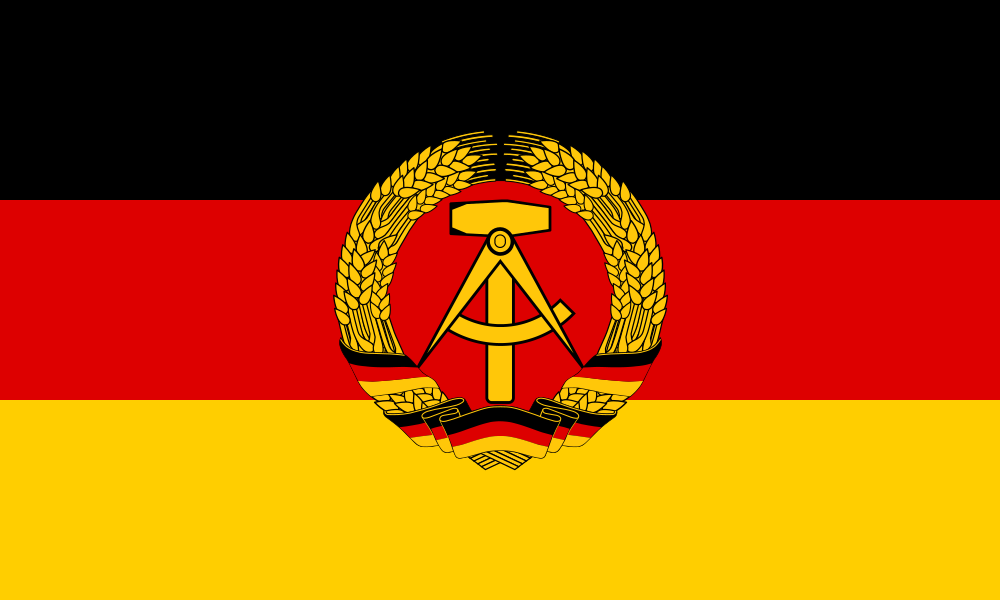
A coachman's son turned carpenter, he joined the SPD in 1895 and was radicalized under Rosa Luxemburg's influence. Court-martialed for anti-war agitation, he co-founded the Spartacus League and the KPD. Arrested with Luxemburg and Liebknecht in January 1919, he alone survived. He served on the ECCI (1921) and its Presidium (1931), then led the KPD in Moscow exile as Comintern secretary. Returning after the war, he drove the SPD-KPD merger that created the SED and became the first President of the GDR in 1949, holding that office until his death.
Career timeline
1895Joins the Social Democratic Party of Germany (SPD)
1915Conscripted; court-martialed for anti-war agitation; flees to Amsterdam
1918–1919Co-founds Spartacus League and KPD; Central Committee member
1921ECCI member; elected to the Prussian Landtag
1928–1933Reichstag deputy
1931Elected to the ECCI Presidium
1934–1946KPD chairman (exile leadership)
1935–1943Secretary of the Comintern
1943Co-founds the National Committee for a Free Germany
1946–1950Co-chairman of the Socialist Unity Party (SED)
1949–1960President of the German Democratic Republic
The chancellor who made provisional statehood durable
As president of the Parliamentary Council, Adenauer helped present the Basic Law as a provisional settlement rather than a final constitution for a divided Germany.
Konrad Adenauer was a Catholic conservative statesman who helped shape the Federal Republic after the collapse of Nazism and the division of Germany. As president of the Parliamentary Council, he supported a provisional Basic Law rather than a permanent constitution, leaving open the possibility of reunification while establishing democratic institutions in the western zones. As the first Federal Chancellor, he pursued Westbindung, European integration, and a socially regulated market economy, while his anti-communist policy hardened the political division of the Cold War. His career thus joined parliamentary reconstruction with the consolidation of a state whose provisional founding became durable.
Career timeline
1906–1909Deputy mayor of Cologne
1917–1933Lord Mayor of Cologne
1921–1933President of the Prussian State Council
1948–1949President of the Parliamentary Council
1949–1963First Federal Chancellor of the Federal Republic of Germany
1951–1955Federal Minister for Foreign Affairs
1950–1966Chairman of the Christian Democratic Union
The Tsentralka sailor whose killing ignited the Potemkin mutiny; his Odessa funeral became a mass revolutionary demonstration
'To delay means to fail the revolution. At this moment, everywhere, workers and peasants are striking out. We must join the common fight.'
Born into a Ukrainian peasant family in Volhynia, he was conscripted into the Black Sea Fleet in 1898 and became an artillery non-commissioned officer on the battleship Potemkin. He joined the RSDLP in 1903, helped found the Sevastopol Sailors' Tsentralka (Central Committee), and hid a red flag aboard ship as he prepared the fleet-wide uprising. On 27 June 1905, confronting officers over maggot-infested meat, he was mortally wounded by Chief Officer Giliarovsky's rifle; two days later his funeral in Odessa swelled into a mass political demonstration that the Potemkin answered by shelling the city.
Career timeline
1898Conscripted into the Black Sea Fleet
1900Graduates mine-artillery school; assigned as gunner, battleship Potemkin
1903Joins RSDLP; helps found the Sevastopol Sailors' Tsentralka
1905.06.27Mortally wounded by Chief Officer Giliarovsky during the Potemkin mutiny; dies aboard
The poet-bomber who stayed his hand seeing the Grand Duchess and children: the 'ethical terrorist' behind Camus' Les Justes
At his trial: "I am not a defendant, I am your prisoner. We are two warring camps. Learn to look the advancing revolution right in the face."
A Socialist-Revolutionary Combat Organization member and poet, who assassinated Tsar Nicholas II's uncle Grand Duke Sergei Alexandrovich with a bomb in the Moscow Kremlin on 4 February 1905. Two days earlier, seeing the Grand Duke's wife and young nephews in the carriage, he had refused his throw: an act that earned him the name 'ethical terrorist' and later inspired Albert Camus' play Les Justes. He had cut his teeth in the Petersburg Union of Struggle, broken with the Social Democrats over their rejection of direct action, and joined the SR Combat Organization under Evno Azef, taking part in the surveillance for the Plehve assassination. At his trial he told the court to 'learn to look the advancing revolution right in the face'; he was hanged at Schlisselburg at twenty-seven.
Career timeline
1897–1899Studied at Moscow and St. Petersburg Universities; joined Petersburg Union of Struggle for the Liberation of the Working Class (1898)
1899Exiled to Ekaterinoslav for leading a student strike
1902Arrested in Berlin carrying revolutionary literature, handed over to Russia, exiled to Yaroslavl
1903Joined the SR Combat Organization in Geneva under Evno Azef
1904Participated in surveillance for the assassination of Interior Minister Plehve
1905.2.4Assassinated Grand Duke Sergei Alexandrovich with a bomb in the Moscow Kremlin
1905.4.5Delivered denunciation of tsarism at Senate special tribunal; sentenced to death
A non-party workers' lawyer elected the first chairman of the Petersburg Soviet in 1905
Khrustalev shone with a double light, of the party and of the masses, but both lights were reflected, someone else's.
A non-party workers' lawyer, he was elected the first chairman of the Petersburg Soviet at the height of the 1905 Revolution. His independence helped him command workers' trust, but effective political direction was seized by Social Democrats led by Trotsky and Parvus. After escaping Siberian exile in 1907 he lived as an émigré, returned to Russia as a war patriot, and in 1918 led the self-declared 'Pereyaslav Republic' against the Bolsheviks before being executed by the local revkom the following year.
Career timeline
1905.10–11First chairman, Petersburg Soviet; elected unanimously on 14 Oct
1905.11–1906Arrested; sentenced to Siberian exile
1907Escaped Siberia; London Party Congress, then emigration
1909–1914Left RSDLP; syndicalism and publishing in Paris
1915–1917Arrested on return; 3 years' katorga; freed by February Revolution
“Iron Felix”: the ascetic who forged the revolution’s sword
On 20 July 1926, visibly ill, he delivered a furious two-hour speech against the United Opposition at the Central Committee plenum — then collapsed of a heart attack and died hours later.
Born to Polish gentry, he spent eleven years in Tsarist prisons and exile. In December 1917 he founded the Cheka and administered the Red Terror, demanding of his men “clean hands, a cool head and a burning heart.” He died of a heart attack in 1926, minutes after a furious speech to the Central Committee. The institution he built outlived him under many names.
Career timeline
1897–1917Eleven years of prison and exile; freed in 1917
1917.12Founds and chairs the Cheka
1921–24Also Commissar of Transport; rebuilds the railways
1924–26Chairs the Supreme Economic Council; industrial recovery