Hungary's New Course
Why did Moscow order the Hungarian leadership to reverse Rákosi's course after Stalin's death, and how far did the correction go?
At the Kremlin talks of June 1953 the Soviet leaders condemned Rákosi's forced industrialization and mass repression and installed Imre Nagy as prime minister. The June resolution and the programme speech of 4 July brought an amnesty, the closing of the internment camps, lighter delivery quotas and the right to leave the cooperatives, but Rákosi, still first secretary, tried to slow the correction after Beria's fall.
A system deaf to its own signals: the crisis of 1952
The crisis of the Hungarian communist system began not in 1953 but in the summer of 1952. The targets of the first five-year plan had been revised upwards in 1951, and when drought and frost ruined the 1952 harvest every branch of the economy showed serious imbalances. In August 1952 Ernő Gerő, the deputy prime minister in charge of the whole economy, warned Mátyás Rákosi that lost agricultural exports alone would cost $12 million (150 million foreign-exchange forints), that feed and potatoes would have to be imported, and that an emergency loan would have to be requested from the Soviet Union. A January 1953 report on arable farming found that since 1949 bread-grain harvests had run 6 per cent, fodder grain 15 per cent and potatoes 13 per cent below the averages of the 1930s — and only seven copies of it were made. 1
The gravest situation was in the countryside. The summer of 1952 brought the first mass resistance to compulsory deliveries: threshers' strikes, refusals to surrender quotas and occasional violence. At Szakmár-Réztelek in Bács-Kiskun County three hundred peasants marched, swearing not to let a single grain of wheat leave the village, and Interior Minister Árpád Házi arrived with units of the State Protection Authority (ÁVH). Deputy Prime Minister Imre Nagy, responsible for agriculture, proposed to the party Secretariat that free-market grain trading be allowed again, and it was in August. None of this relieved the shortage of food and seed in Hungarian villages at the beginning of 1953. 1
Repression, too, had gone beyond its limits. A joint report by the justice and interior ministries and the party's Administrative Department counted court sentences of 72,300 in 1949, 98,000 in 1950 and 120,000 in 1952, with 500,000 penalties for petty offences alone; in August 1952 a report inside the party apparatus found that "excessive severity" was being applied against workers. Rákosi nonetheless imitated Stalin's last wave of vengeance. At the end of February 1953 he announced to the Central Leadership the arrest of Gábor Péter, head of the ÁVH, and several officers and functionaries; Political Committee members István Kovács and Zoltán Vas were criticized and sent to the provinces. All of them were of Jewish origin: the "anti-Zionist" purge had been inspired by Moscow. This was how matters stood when news of Stalin's death arrived on 5 March. 1
Moscow's reckoning after Stalin
Stalin's heirs had two problems at once: the succession, which could not be raised in his lifetime, and the consolidation of the empire. In their view the tensions in East Germany, Czechoslovakia and Hungary were approaching flash point. Mass terror had grown so large and unpredictable that it no longer deterred anyone and obstructed the rational running of the economy; forced growth had caused severe imbalances, and in most countries living standards fell sharply in 1951–2. Hungarian collectivization was reproducing on a smaller scale what had happened in the Soviet Union in the 1920s and 1930s: food shortages, rural flight, falling herds and land left uncultivated. 1
Under Stalin, Rákosi alone had a direct line to Stalin, and what information reached Moscow, and in what form, depended on that bilateral dialogue. After Stalin's death the shelved reports acquired a new significance, above all those of Kiselyov, the Soviet ambassador in Budapest, who had reported critically on living standards, repression and the mood of the intelligentsia; Molotov reread his earlier reports before the June talks. At the end of May Rákosi was summoned to Moscow and given his instructions, and on 3 June the party Secretariat resolved to slow investment and raise consumption, cut the government from 32 members to 17 or 18, separate the posts of prime minister and party leader, and relieve Rákosi of the title of general secretary. 1
Three days in the Kremlin: 13–16 June 1953
On 12 June eight leaders of the Hungarian Working People's Party — the ruling party formed in 1948 by merging the Communists and Social Democrats — flew to Moscow in a special plane from the military airfield at Tököl. The Soviet party Presidium had chosen them personally: Rákosi; deputy prime ministers Gerő, Nagy and István Hidas; Béla Szalai, head of the Council of Ministers' secretariat; Agriculture Minister András Hegedüs; Rudolf Földvári, first secretary of the Budapest party committee; and István Dobi, president of the Presidential Council and formal head of state. Secretariat members Mihály Farkas and József Révai were not invited. Most of the delegation had no idea why they were being summoned. The next day, in Stalin's former office, they faced Malenkov, Beria, Molotov, Khrushchev, Bulganin and Mikoyan. The East German leaders Ulbricht and Grotewohl had been through a similar "consultation" days earlier, and East Berlin announced its "New Course" on 11 June. 1 5 3 4 6 7
Rákosi reported as though he had done his homework, but Malenkov cut him short: "We gain the impression that the Hungarian comrades are underestimating the shortcomings." Beria came with the most figures: "Is it acceptable in Hungary, with its population of 9,500,000, to have instituted proceedings against 1,500,000 people?" He denounced Rákosi for personally directing state security, intervening in investigations and ordering physical violence, and was the first to name Nagy, saying it would be more fitting for the head of government to be "Hungarian". Molotov, admitting that "leaderism" had originated in the Soviet Union, attacked the goal of autarky; Bulganin criticized the army purges and Farkas; Mikoyan criticized an iron and steel industry in a country with "neither iron ore nor coke of its own" and superfluous projects such as the underground railway. 1
Nagy, the first Hungarian to speak, shared the blame but generalized the cause: "The main source of the problems is separation from the masses. We have not paid attention to the people's needs." He raised the kulak list — anyone on it was excluded from society — and remarked that Rákosi, Gerő and Farkas decided many questions among themselves without the rest of the Secretariat. Khrushchev declared that Rákosi was responsible for the mistakes as a whole and was "unable to work collectively". At the session of 16 June Beria complained that the Hungarian draft contained no figures and had the repression statistics and Rákosi's personal responsibility for directing the ÁVH written in; Molotov said there was no need to fear the dissolution of forcibly organized cooperatives. The abolition of the kulak list, which Nagy defended, was the only Hungarian proposal the Soviet side accepted in the two days of talks. 1
The talks ended with appointments: Nagy would become prime minister, Rákosi would stay at the head of the party but share power, and Defence Minister Farkas would be replaced by István Bata. "The Soviet Union is also responsible for what kind of power there is in Hungary," Malenkov said. Asked what would happen if Rákosi did not help, Beria replied that he would "ruin himself"; in participants' recollections the phrase became "we will break his spine". The humiliated Rákosi said he very much regretted that he "was not taught a lesson like this before". 1
The June resolution: a self-criticism kept from the public
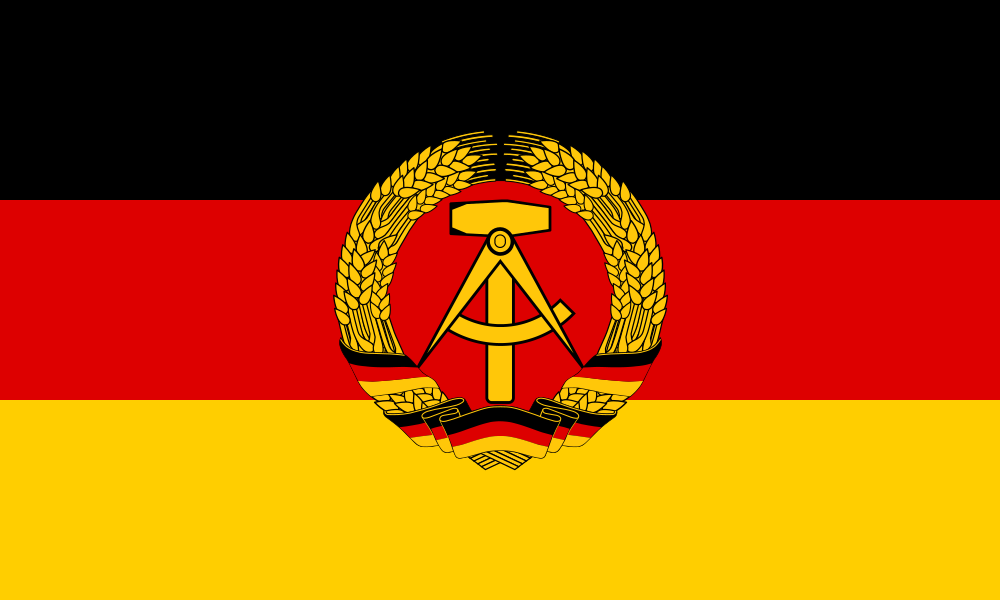
On 17 June, the day after the delegation returned, an uprising broke out in East Germany and was put down by Soviet tanks. At an expanded Political Committee meeting on 20 June Rákosi conceded that without "an immediate turn" "the gravest of crises" threatened, calling this "one of the most decisive turning-points" since the seizure of power. At the expanded Central Leadership meeting of 27–28 June he spent more than an hour criticizing his personality cult, "leaderism", the concentration of power and the sidelining of cadres of "Hungarian origin". Nagy went further: "the roots of the mistakes go much deeper than they appear to do at first glance"; the economic policy "can be described without exaggeration as an adventurist policy", and the party must not be content with "half-measures". 1 7
The resolution had four parts: the mistakes, their causes, immediate measures and organizational tasks. It branded the excessive industrialization pursued since 1951 as "megalomania" with "elements of adventurism", and admitted that the 1949 debate in which Nagy had been branded "opportunistic" over collectivization had been wrong. It included the figures Moscow demanded: 850,000 petty-offence sentences by the police between 1951 and 1 May 1953, and 650,000 persons before the courts between 1950 and the first quarter of 1953, of whom 387,000 were sentenced, plus almost 400 million forints exacted in fines for undelivered produce. The leadership had been "clique-like", concentrated in "Comrades Rákosi, Gerő, Farkas and Révai", and Rákosi had been wrong to tell the ÁVH whom to arrest and how to investigate, and to order detainees mistreated. The abolition of the kulak list, the cancellation of delivery arrears and the right to leave cooperatives followed. 1
The resolution was never published. According to Rákosi, a telephone call came from Moscow during the meeting saying it should be made public only once results had appeared, and he proposed that the measures be announced in Parliament as the new government's programme rather than in a party communiqué. A prime minister's programme speech left no room to criticize the party leadership or its leader. The appointments did not support the turn either: Farkas, Révai, Károly Kiss and Árpád Házi left the Political Committee, but the new members were mostly young cadres Rákosi and Gerő had picked in 1951–3, Gerő became deputy prime minister and interior minister, and only two ministers of the new government, István Bata and Sándor Zsoldos, had not served under Rákosi. The full text first appeared in the samizdat press in 1985. 1 4
4 July: the programme speech in Parliament
The Rákosi government resigned on 3 July and the Nagy government was elected early on 4 July. Nagy's programme speech was reported in the midday news and broadcast in full at eight that evening. "The raised targets of the five-year plan exceed our strength in many ways," he said; "the development of socialist heavy industry cannot be an end in itself," and the attempt at industrial autarky would be abandoned. He declared the production of individual peasant holdings a national interest and promised security of ownership, and said trade licences would again be issued to private retailers and artisans. He promised an end to unwarranted purges of the old intelligentsia, and on religion he spoke of "toleration" instead of administrative coercion. 1 2
The passage people remembered longest was that higher education had been forced — "Let us not build castles in the air" — and that investment would go to the elementary schools of "the hopes for the future, the little Hungarians": a communist prime minister speaking of little Hungarians in a country whose national festivals had been abolished. The more important passage concerned legality. Nagy said legality had not applied in the judicial and police organizations and local councils, and that prosecutions, petty-offence proceedings, compulsory deliveries, tax collection and the kulak list had offended the people's sense of justice; he used the word "legality" four times in a few sentences. It meant the government was ending its hostilities against the people. As émigré interviews after 1956 and oral histories of the 1980s agree, it was the first speech by a communist leader since 1945 with which most of the country agreed. 1
Foreign papers compared the programme with Lenin's New Economic Policy. The New York Times Vienna correspondent wrote that if the speech could be believed, individual peasants in Hungary were now better protected from forced collectivization than in Yugoslavia. At Bled, Tito asked the AFP correspondent Ferenc Fejtő, "Tell me, who is this Imre Nagy?" — "He has a reputation of being a full-blown Bukharinite, very interested in the Yugoslav experiences," Fejtő replied. Those who had gained privileges from the policies of recent years, by contrast, received the programme with suspicion. 1
Beria's fall and two speeches
Beria was arrested in Moscow on 26 June (he would be executed on 23 December). In early July the Soviet leaders summoned Nagy, Rákosi and Gerő to brief them on the resolution condemning him; Khrushchev said Beria's behaviour during the discussion of the Hungarian question had contributed to his exposure. Rákosi immediately tried to revise the June consultation, but the Soviet leaders would not bend. Still, he had lost his fiercest critic. Rákosi, and later János Kádár — for the last time to Gorbachev in 1985 — spread the impression that Nagy was "Beria's man"; Rainer writes that there is no documented evidence for this at all. 1 9
At the Budapest party activists' meeting on 11 July, broadcast live, Rákosi gave a militant speech. He mentioned the criticism only briefly and said the old objectives and slogans, from industrialization to the priority of cooperatives, were unchanged; "it would have been more sensible to have announced the tasks first in the party's name" was aimed at Nagy's speech in Parliament. "We will not tolerate anti-cooperative agitation either" drew applause. Nagy, at the same meeting, gave a weak speech listing measures such as the cancellation of delivery arrears and reduced quotas. Within a week it was evident either that the party was changing its policy with remarkable speed or that the leadership was not united. 1 3
On 16 July Nagy went on his own initiative to Ambassador Kiselyov and expressed concern that the "joint plan for the transformation of the economy and politics" was not progressing as planned, saying that since Beria's arrest Rákosi viewed his efforts to uphold the programme "almost as an attempt to restore capitalism". Days later the Soviet party asked the Hungarians for a report on their results. When Malenkov presented a government programme to the Supreme Soviet on 8 August stressing living standards, light industry and agriculture, it was clear that Beria's fall did not mean a return to the Stalinist order. At the end of September Rákosi complained to the chargé d'affaires Yuri Andropov that the leadership had "clumsily" criticized only its own mistakes, to the enemy's advantage, but he could not reverse the decisions of June and July. 1 8
Amnesty, camps closed, cooperatives left: autumn 1953
The amnesty of 24 July cancelled sentences of up to two years and cut longer ones by a third, but excluded political prisoners. What it did release widely were penalties that were formally for common or economic crimes but were in fact political reprisals — delivery arrears, supply offences, "arbitrary departure" from work — and the preventive repression of expulsion and internment. The ÁVH camps at Recsk, Kistarcsa, Kazincbarcika and Tiszalök and the Hortobágy camps for deportees were closed; the Hungarian gulag more or less ceased to exist in the autumn of 1953. A report of November 1953 counted almost 748,000 persons affected. Of almost 40,000 prisoners 15,761 were released; of more than 5,000 internees 3,234 were freed by the end of October; 7,281 deportees at Hortobágy regained their freedom. 1
Yet many thousands of political prisoners, communists and social democrats among them, remained behind bars. Few of those released could return home or recover their property; a central order precluded compensation, and some were placed under police surveillance or the secret police's "operative control". In the economy three packages followed: heavy-industrial investment was cut and shifted to agriculture, light industry and housing; wages of 928,000 people rose by just over 100 forints on average while price cuts in July and September returned about a billion forints to the public; and burdens on the peasantry were eased and delivery quotas reduced. Private artisans, 200,000 in 1949, had fallen below a quarter of that in four years; their number exceeded 100,000 in 1954. On 27 October Nagy received a delegation of Catholic bishops and agreed to a series of concessions to the church. 1
Spontaneous withdrawals from the agricultural cooperatives began almost as soon as the programme speech was heard; members went home with the livestock and implements they had been forced to contribute. Rather than stop this administratively, the leadership offered those who stayed greater benefits and made leaving harder: those withdrawing did not get back the land they had brought in and shouldered the cooperative's debts twice over; dissolution required a two-thirds majority in an open vote, and if ten members wished to continue the cooperative survived. By the end of 1953 only 688 of more than 5,000 cooperatives (12 per cent) had been wound up, but membership fell by a third, from 376,000 to 250,000. 1
How far could correction go?
Nagy explained the New Course in terms of his own theory: Hungary had unjustifiably shortened the period of the "people's democratic transition" in favour of the policies of a later, "more developed" stage, and a process that had gone too far should be directed back onto a slower but surer path. His two-volume collection One Decade, published in October 1954, reprinted his 1945–7 writings on land reform and small peasant farming and a study on the slow transition banned in 1948. But five years after the acceleration of 1947–8 politics, the economy and society had been transformed, and hardly anything of the people's democratic stage remained to return to. What Nagy had to change was the classical Stalinist system assembled at lightning speed, and the mentality of the new ruling stratum conditioned to it. 1 2
Borrowing from the economist János Kornai, Rainer writes that the coherence of the classical system was also its weakness: if one strand breaks, it all unravels sooner or later. Alterations meant to defend the system attack its integrity and create new problems, leaving only complete rigidity or continual correction and postponement. Amid the economic tensions and political conflicts of 1954 Nagy tried to push correction into real reform, but after Malenkov's demotion in Moscow he lost all his positions in the spring of 1955. 1 11 8 2
Even so, the results of 1953–5 were lasting. The self-confidence of the Hungarian Stalinist leadership evaporated once and for all. Partial self-criticism and correction bred uncertainty, introspection and a propensity for revision among leaders, then in the apparatus and above all among the party intelligentsia. The believers in the New Course, known as the party opposition after the spring of 1955, could not be swept aside precisely because their alternative stayed within the bounds of the system, and for those who wanted a change of system "communism with a more human face" was a first step. Nagy's correction became the point of departure and reference for the more radical changes of the autumn of 1956. Back in office in October 1956, Nagy promised in a radio address to begin the reforms decided in 1953 and then postponed. 1 2 10
Consequences
By the autumn of 1953 the Hungarian camp system had in effect been dismantled and almost 748,000 people benefited from the amnesty and cancelled penalties, though thousands of political prisoners stayed in jail. Nagy lost all his posts in the spring of 1955, but the Stalinist leadership never regained its self-confidence, and the New Course became the point of departure and reference for the revolution of 1956.
Timeline & Map
- 1952.08
 Free grain trading allowed
Free-market grain trading was allowed again on Nagy's proposal.
- 1953.02Gábor Péter arrested
Rákosi announced the arrest of the ÁVH chief and several officers.
- 1953.03.05
 Death of Stalin
A committee of Rákosi, Gerő and Nagy handled the tasks after his death.
- 1953.06.03Party Secretariat resolution
It resolved to cut investment and separate the premiership from the party leadership.
- 1953.06.13Kremlin talks begin
The Soviet leaders condemned Rákosi's course and repression.
- 1953.06.16Second day of Kremlin talks
The abolition of the kulak list and Nagy's premiership were settled.
- 1953.06.17
 East German uprising
Soviet tanks put down the strikes and uprising in East Germany.
- 1953.06.27June resolution of the Central Leadership
Rákosi criticized himself and the resolution on the new course was adopted.
- 1953.07.04Nagy's programme speech
Nagy promised legality and living standards in Parliament.
- 1953.07.11Rákosi's activists' speech
After Beria's fall Rákosi stressed that the old goals were unchanged.
- 1953.07.24Restricted amnesty
Sentences of up to two years were cancelled, political prisoners excepted.
- 1953.08.08Malenkov's Supreme Soviet speech
Its stress on living standards and light industry strengthened Nagy.
- 1953.10.27Meeting with the Catholic bishops
A series of concessions to the church was agreed.
- 1953.12688 cooperatives dissolved
Membership fell from 376,000 to 250,000.
Related people 16
Leadership2
Won the abolition of the kulak list in the Kremlin and promised legality and living standards in his 4 July programme speech.
Soviet prime ministerGeorgy Malenkov1901–1988Chaired the Kremlin talks, demanded a reshuffle and backed the course with his August speech.
Participants8
Prepared the first draft of the June resolution and could not hide his antipathy to Nagy.
Agriculture minister and Political Committee memberAndrás Hegedüs1922–1999A young cadre invited to Moscow, he entered the new Political Committee.
Soviet first deputy premier and interior ministerLavrentiy Beria1899–1953Challenged the 1.5 million prosecutions, condemned Rákosi's direction of the ÁVH and first named Nagy.
Secretary of the CPSU Central CommitteeNikita Khrushchev1894–1971Blamed Rákosi for the mistakes as a whole and said he could not work collectively.
Soviet foreign ministerVyacheslav Molotov1890–1986Attacked autarky and Révai's ideological monopoly and said forced cooperatives could be dissolved.
Soviet deputy premierAnastas Mikoyan1895–1978Criticized an iron and steel industry without raw materials and projects such as the underground.
Soviet defence ministerNikolai Bulganin1895–1975Criticized the purges in the Hungarian army and Mihály Farkas.
President of the Presidential CouncilIstván Dobi1898–1968Included in the Moscow delegation without real power, he objected to dissolving the cooperatives.
Opposition & resistance1
Targets & victims3
Criticized by Bulganin in the Kremlin, replaced as defence minister and dropped from the new Political Committee.
Ideology secretary, one of the ruling foursomeJózsef Révai1898–1959Molotov attacked his ideological monopoly, and he was dropped from the new Political Committee.
Former head of the State Protection Authority (ÁVH)Gábor Péter1906–1993Arrested in February 1953; Beria demanded that his case be reviewed.
Witnesses & chroniclers2
Sources: reference 1reference 2reference 3reference 4reference 5reference 6reference 7reference 8reference 9reference 10reference 11
← Historical events