The people's democracies with their reformers and dissidents, decolonization and national liberation, Cold War statesmen and anti-communist regimes, 1956, 1968, 1989 and after.
Carmelite friar and Free French admiral whose Republic of Cochinchina as High Commissioner opened the road to war
On 1 June 1946, while Ho Chi Minh was negotiating in France, he unilaterally proclaimed Cochinchina’s provisional government, intensifying the conflict with the Democratic Republic of Vietnam.
A naval officer from Brest who became a Carmelite friar after the First World War, he returned to the navy in the Second and led de Gaulle’s Free French naval forces. Arriving as High Commissioner for Indochina on 31 October 1945 to restore colonial administration, he set up an autonomous Republic of Cochinchina in 1946 while the Viet Minh leaders were negotiating in France, breaking the Ho–Sainteny agreement of 6 March and effectively starting the war. He directed a hard line including the Haiphong shelling and was recalled in 1947.
Career timeline
1920Entered the Carmelite order as a friar.
1940Joined de Gaulle’s Free French forces.
1945De Gaulle named him High Commissioner for Indochina; he arrived there on 31 October.
1946Proclaimed Cochinchina’s provisional government on 1 June and supported the armed seizure of Lang Son and Haiphong in November.
1947On 4 March, the French government recalled him and relieved him of his post.
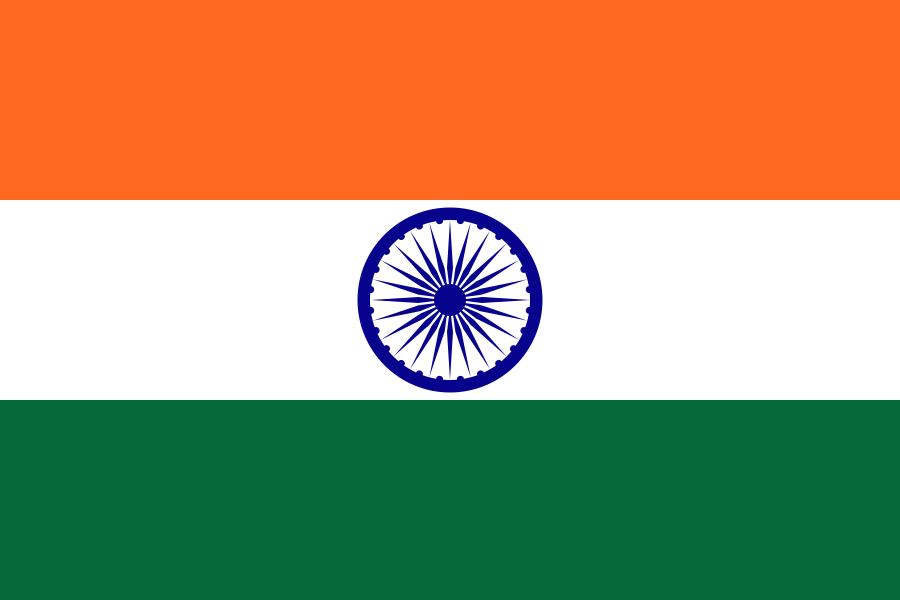
India's first prime minister and co-founder of the Non-Aligned Movement
'Long years ago we made a tryst with destiny, and now the time comes when we shall redeem our pledge… At the stroke of the midnight hour, when the world sleeps, India will awake to life and freedom.' (Independence eve address, 14 August 1947)
A towering leader of the Indian independence movement, he became independent India's first prime minister in 1947 and held the office until his death in 1964. He anchored the new republic in parliamentary democracy, secularism, and planned economic development, while charting a foreign policy of non-alignment that refused subordination to either Cold War bloc. With Tito he issued the 1954 joint statement that first defined 'non-alignment' as a positive, active policy, not passive neutrality, and went on to co-found the Non-Aligned Movement through the 1956 Brioni Declaration and the 1961 Belgrade summit. The Sino-Indian War of 1962 shook his domestic standing, yet he is remembered as the architect of the Indian republic.
Career timeline
1929, 1936–37President, Indian National Congress
1946–1947Interim Prime Minister of India
1947–1964Prime Minister of India
1947–1964Minister of External Affairs (concurrent)
Independence activist, linguist, and Yan'an faction leader who served as the first head of state of the DPRK
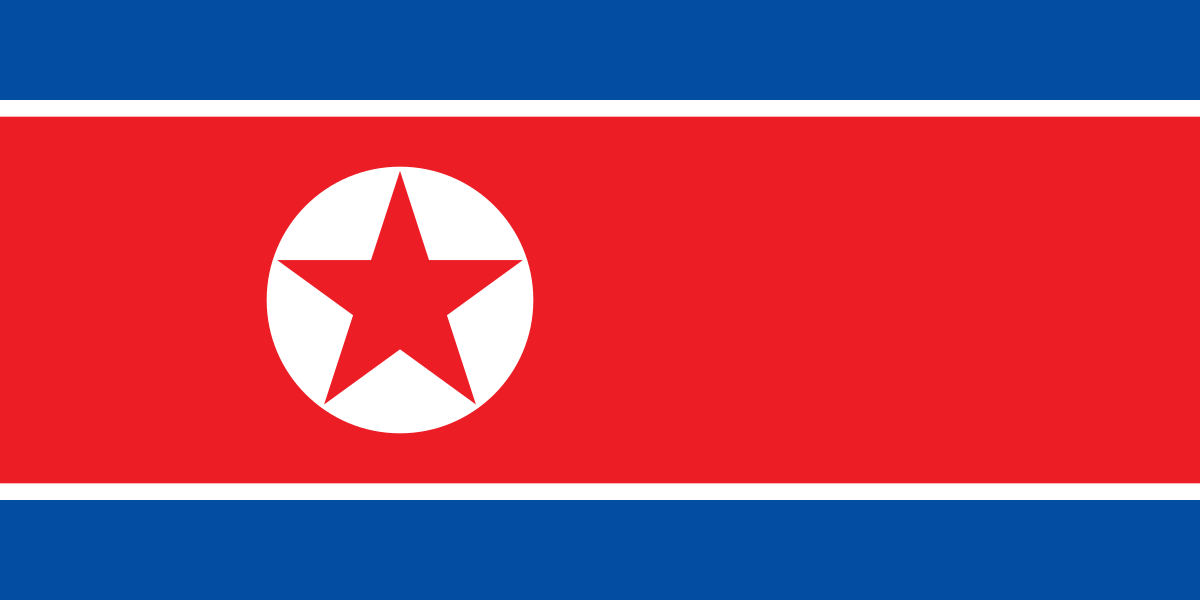
On the day the People's Assembly adopted the new DPRK flag in July 1948, Kim Tu-bong personally lowered the Taegeukgi and raised its replacement. Barely a year earlier, he had been the man passionately explaining the old flag's philosophical meaning to a skeptical Soviet general.
A Hangul linguist trained under Chu Sigyŏng who led the Korean Independence League in Yan'an. Became the DPRK's first head of state in 1948, though real power lay with Kim Il Sung. Purged and vanished in the 1958 August Faction Incident.
Career timeline
1908–1916Studied Hangul under Chu Sigyŏng; helped compile MalMoi dictionary
1919Joined March First Movement, then exiled to Shanghai provisional government
1920–1930년대Combined communist activism with linguistic research in Shanghai
1942–1945Founded Korean Independence League in Yan'an; led the Yan'an faction
1946.2–1946.8Chairman of the New People's Party of Korea
1946.8–1949.6Chairman of the Workers' Party of North Korea Central Committee
1948.9–1957.9Chairman of the SPA Standing Committee — first head of state of the DPRK
1957–1958Dismissed from all posts over August Faction Incident; disappeared
He took on France, Japan and America in turn to win Vietnam's independence
“Nothing is more precious than independence and freedom.” — wartime radio address, 1966
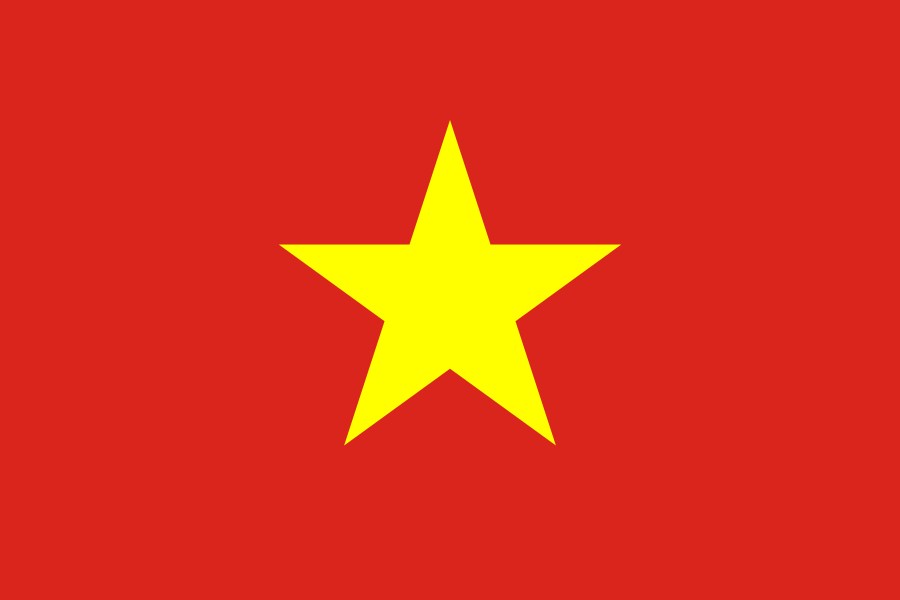
Vietnamese revolutionary. After three decades of exile, including helping found the French Communist Party and the Communist Party of Vietnam, he led the Viet Minh to declare Vietnam's independence in 1945. He led North Vietnam through wars against France and the United States, becoming the symbol of Vietnamese independence.
Career timeline
1911–1920Wanders the world as sailor and laborer; founding member of the French Communist Party
1925Published French Colonialism on Trial
1927Published the revolutionary training text The Revolutionary Path
1930Founds the Communist Party of Vietnam
1941–1945Founds the Viet Minh against Japanese and French rule
1945.9Declares independence; first President of the DRV
1946–1954First Indochina War; victory at Dien Bien Phu
1955–1969Leads the unification war as North Vietnam's president
Pro-Soviet Social Democrat and first post-liberation premier who sided with the Communists in 1948 and merged his party into theirs
During the Communist coup of February 1948, he led the Social Democratic push for union with the Communists; the merger later that year brought his party into the one-party system.
A diplomat from Olomouc, he served as envoy to the Netherlands, Romania, the United States, Switzerland and Austria and, as the exile government’s ambassador in Moscow during the war, grew close to the Soviet Union. Prime minister of the Košice government from April 1945, he led the National Front government until June 1946. As Social Democratic leader he advocated close co-operation with the Communists, and when the non-Communist ministers resigned in February 1948 he stayed and openly backed the Communists. After the coup he merged the Social Democrats into the Communist Party and held high office under the regime.
Career timeline
1945–1946Prime minister of the Košice government and post-liberation Czechoslovakia.
1946–1947Chairman of the Czech Social Democratic Party; in November 1947, party members ousted him for being too submissive to the Communists.
1948After the February coup, he led the merger of the Social Democrats with the Communists and joined the Communist Party Central Committee.
1948–1953Served as deputy prime minister.
1951–1953Minister of the State Office for Religious Affairs.
1953–1964Chairman of the National Assembly.
1968Supported the Prague Spring reforms and protested the Soviet invasion of Czechoslovakia.
Czechoslovak interior minister whose purge of non-communist police in February 1948 triggered the government crisis and communist takeover
The cabinet voted to reverse his purge, but Nosek ignored the order: eight Prague police commanders were replaced by communists, and twelve non-communist ministers resigned.
The son of a miner, he joined the Social Democratic Party at eighteen and took part in founding the Communist Party of Czechoslovakia in 1921. After the Nazi occupation he fled to Britain, where he served as vice-chairman of the London-based Czechoslovak State Council; returning in 1945 as Minister of the Interior, he systematically packed the police and security apparatus with communists. On 13 February 1948 he dismissed eight non-communist senior police officers, triggering a cabinet crisis in which twelve non-communist ministers resigned, clearing the way for Klement Gottwald's communist takeover.
Career timeline
1910Joined the Czechoslovak Social Democratic Workers' Party (ČSSD)
1921Founding delegate, Communist Party of Czechoslovakia (KSČ)
1929Elected to the KSČ Central Committee
1941–1942Member, then vice-chairman, Czechoslovak State Council in London
1945–1953Minister of the Interior of Czechoslovakia
Stalin's most trusted East European proxy, architect of Poland's Stalinist system and guardian of the Oder–Neisse border
On 5 February 1947, atheist communist Bierut took Poland's presidential oath and ended it with the traditional 'Tak mi dopomóż Bóg' — So help me God.
A Polish communist trained in Comintern schools, he joined the PPR leadership in 1943 with Soviet backing and served as Chairman of the State National Council (1944–47), President (1947–52), PZPR General Secretary (1948–56), and Prime Minister (1952–54). He secured the Oder–Neisse border at Potsdam and drove the Six-Year Plan's heavy industrialization, collectivization, and socialist realist cultural policy, presiding over Warsaw's reconstruction. His regime used the Ministry of Public Security to suppress armed opposition and confronted the Catholic Church. He died of a heart attack in Moscow in March 1956, days after Khrushchev's Secret Speech.
Career timeline
1912Joins Polish Socialist Party – Left (PPS-Lewica)
1918Joins the Communist Party of Poland (KPRP/KPP), discontinues activity, and formally functions as a member again from 1921
1925–1930Trained in the secret school of the Communist International (1925–26) and the International Lenin School in Moscow (from November 1927 to 1930); Comintern instructor
1933–1938Arrested by the Sanation regime (December 1933), sentenced to 7 years; amnestied December 1938
1943Joins the PPR Secretariat (23 November); elected Chairman of the State National Council (31 December)
1947–1952President of the Republic of Poland (until the Council of State was chosen on 20 November 1952)
1948–1956General Secretary of the PZPR, First Secretary from 17 March 1954
1952–1954Prime Minister of the People's Republic of Poland (20 November 1952 – 18 March 1954)
1916–1921Lublin food cooperative manager and board member; co-organizer of the leftist Union of Workers' Cooperative Associations; co-founder of the Warsaw Housing Cooperative in 1921
1927–1933Head of the KPP Central Technique; Comintern special missions in Austria, Czechoslovakia and Bulgaria
1944–1949Secret member of the PPR Politburo from August 1944; from 24 February 1949 chaired the PZPR CC Politburo Security Commission supervising the repressive apparatus
Architect of Hungary's Sovietization who built one-party rule through 'salami tactics'
Released on 30 October 1940 and reaching Moscow on 6 November, Rákosi stood beside Stalin atop Lenin's Mausoleum the next day as the October Revolution Day parade crossed Red Square.
General secretary of the Hungarian Communist Party (1945–1948) and then general secretary, later first secretary, of the Hungarian Working People's Party (1948–1956), he ruled Hungary as its de facto leader from 1948 to 1956. Arrested in 1925, he received an 8.5-year sentence in 1926 and a life term in 1935, serving over fifteen years in prison before reaching Moscow in November 1940. After returning in 1945 he dismantled the democratic parties through 'salami tactics' and forced the Social Democrats into a merger to build one-party rule, bearing responsibility for mass imprisonment, forced-labour camps and the Rajk show trial. He handed the premiership to Imre Nagy in 1953 yet obstructed reform as first secretary, was removed on 18 July 1956, expelled from the party in 1962, and died in Gorky on 5 February 1971 after deportation to Krasnodar, Tokmak and Arzamas.
Career timeline
1919People's Commissar of Trade, Hungarian Soviet Republic; commands Red Guard and Red Army
1921–1924Secretary, Executive Committee of the Comintern
1925–1940Imprisoned under the Horthy regime (8.5-year sentence, later life; freed 1940)
1940–1945Leads the Foreign Bureau of the Hungarian Communist Party, Moscow
1945–1948General Secretary, Central Committee of the Hungarian Communist Party
1948–1956First Secretary, Central Committee of the Hungarian Working People's Party (MDP); General Secretary until 1953
1952–1953Chairman of the Council of Ministers, Hungarian People's Republic
1956–1971Forced exile in the USSR (Kirghizia, Arzamas, Gorky)
Moderniser and anti-fascist icon who never touched the land order that finally undid his dynasty
In 1936 he told the League of Nations, 'God and history will remember your judgment.'
Descended from the Solomonic dynasty, Haile Selassie I was the 20th-century emperor who modernised Ethiopia and, with his 1936 speech to the League of Nations, became a global symbol of anti-fascism. From his regency he drove reform through the 1931 constitution and the abolition of slavery, and after exile under Italian occupation he returned with British forces in 1941 to restore the throne. But his modernisation, which left the northern rist and gult tenures and the southern land-grant system intact through compromise with the nobility and clergy, never freed the peasantry from tenancy, and the 1972 Wollo famine turned opinion against him. Deposed by the Derg in September 1974, he was strangled on the junta's orders the following August, months after the proclamation that nationalised the land system his reign had preserved.
Career timeline
1916Regent Plenipotentiary and heir apparent, de facto ruler
1917Crowned Le'ul-Ras (duke)
1928Crowned Negus (king)
1930Crowned Emperor (Negusa Nagast)
1936–1941Exiled in Britain during the Italian occupation
1941Returned and restored the imperial throne
1963Presided over the OAU's founding, first chairman
A U.S. general whose offensive command was bound to racial prejudice
“Don't let a bunch of Chinese laundrymen stop you.”
Edward Almond was a United States Army general who served in two world wars and Korea, leaving a record that combines an aggressive command style with racial prejudice. In World War II he commanded the largely African American 92nd Infantry Division, then blamed its combat performance on the soldiers' race and opposed using Black troops in combat. In Korea, as Douglas MacArthur's chief of staff, he was placed in command of X Corps after the Inchon landing force was formed, contributing to the capture of Inchon and Seoul. His wide dispersal of forces in the northeast and underestimation of Chinese strength helped deepen X Corps' crisis in late 1950.
Career timeline
1915Graduated from Virginia Military Institute
1918Commanded the 12th Machine Gun Battalion, 4th Division, in France
1942–1945Commanding general, 92nd Infantry Division, in the Italian campaign
1946–1949Personnel chief, then chief of staff, Far East Command in Tokyo
1950–1951Commanding general, X Corps, directing Inchon and northeast operations
1951–1953Commandant, U.S. Army War College; retired in 1953
Yugoslavia's partisan leader who chose non-alignment
The 1948 Cominform split threw Tito's Yugoslavia out of the Soviet bloc and showed that a socialist state could take an independent line, while the dispute was as much a geopolitical struggle in the Balkans as an ideological one.
He was born in Kumrovec to a Croat father, Franjo Broz, and a Slovene mother, Marija, and identified as a Croat like his father and neighbours. Wounded and captured by Russian forces while serving as an Austro-Hungarian Army sergeant major in the First World War, he joined the Communist Party in Omsk in 1920 and led the Communist Party of Yugoslavia as General Secretary from 1939. Appointed commander-in-chief of the Partisans in 1941, he led the national liberation struggle through the Second World War and then headed the Yugoslav federation until his death on 4 May 1980 at Ljubljana Medical Centre. After the 1948 Cominform rift, tens of thousands accused of Stalinism were held in forced labour camps such as Goli Otok, where hundreds died.
Career timeline
1941–1945Leader of the Yugoslav Partisans and national liberation struggle
Agrarian leader who opposed communist rule and was hanged after a show trial
State Department emissary Mark Ethridge called Petkov "the bravest man I've ever known."
A leader of the Bulgarian Agrarian National Union (BZNS), he studied law in Paris after the First World War and returned in 1929 to work as a journalist. He co-founded the anti-fascist Fatherland Front in 1943 but broke from it in 1945 to lead the opposition against the Communists' monopolisation of power, and in the 1946 election his opposition coalition won 101 seats in the Grand National Assembly. Arrested in parliament in June 1947 and sentenced to death in August for a supposed military plot, he was hanged on 23 September, eight days after the Paris peace treaty came into force.
Career timeline
1929Returned and worked as a journalist
1938Elected to the 24th National Assembly (invalidated that December)
1941Leader of BZNS 'Aleksandar Stamboliyski'
1943Helped found the Fatherland Front
1944Minister without portfolio in the first Fatherland Front government (to Aug 1945)
1945Leader of the anti-communist United Opposition
The world's first woman foreign minister and head of the Romanian party's "Muscovite faction", brought down by Gheorghiu-Dej's 1952 purge
At the Central Committee plenum of 26 and 27 May 1952 Gheorghiu-Dej denounced Pauker, Luca and Georgescu as an "anti-party faction" and removed Pauker from the Politburo. Dej had returned from Moscow with Stalin's approval, and the Slánský trial was spreading the purge of Jewish communists across Eastern Europe.
Born Hannah Rabinsohn to an Orthodox Jewish family in Vaslui County, she taught Hebrew before joining the Social Democratic Party in 1915 and took part in founding the Romanian Communist Party in 1921. Arrested in 1935, she was sentenced to ten years at the Craiova trial the following year, then sent to Moscow in a 1941 prisoner exchange with the Soviet Union, where she led the exiled Romanian communists under the Comintern. Back in Romania in 1944 she joined the Politburo and the Central Committee Secretariat, and in November 1947 became foreign minister, the first woman in the world to hold such a post. With Vasile Luca and Teohari Georgescu she formed the so-called "Muscovite faction" that contested party control with Gheorghiu-Dej's prison faction, but in May 1952 Dej, with Stalin's approval, had her expelled from the Politburo on the charge of committing both "right" and "left" deviations, and in July she lost the foreign ministry as well. Arrested in February 1953, she was released after Stalin's death, expelled from the party without trial, and spent her last years as a translator at the political publishing house. Time magazine put her on its cover in 1948 as "the most powerful woman alive", yet Robert Levy's research shows that she braked forced collectivization and allowed Jewish emigration to Israel, a more moderate course than Dej's.
Career timeline
1915Joined the Social Democratic Party
1921Founding member of the Romanian Communist Party
1935–1936Arrested; sentenced to ten years at the Craiova trial
1941Sent to the USSR in a prisoner exchange; led exiled Romanian communists under the Comintern
1944Returned to Romania; Politburo member and Central Committee secretary
1947–1952Minister of Foreign Affairs
1952Removed from the Politburo and the foreign ministry
1953–1954Arrested; released after Stalin's death; expelled from the party
'Il Migliore': the strategist who led Western Europe's largest communist party for forty years
In the 'Yalta memorandum' written on his deathbed, he argued for polycentrism — autonomy from Moscow (1964)
Founder and secretary of the Italian Communist Party. He steered the Comintern Popular Front and, with the 1944 Salerno turn, brought the PCI into the anti-fascist coalition government. On his deathbed, his Yalta memorandum argued for polycentrism, anticipating Eurocommunism.
Career timeline
1921Among the founders of the Italian Communist Party
1927–1964Party secretary; builds the PCI into Western Europe's largest communist party
1935–1939Comintern executive; guides the Popular Front in the Spanish Civil War
1944The Salerno turn: into the anti-fascist coalition government
1946–1948Constituent Assembly 'father of the constitution'; survives a 1948 assassination attempt
1964Dies at Yalta; his memorandum argues for polycentrism
The American intelligence official who institutionalized covert war
In 1945, negotiations for the surrender of northern Italy hastened the war's end while excluding the Soviet representative and Italian partisans.
Allen Dulles was an American diplomat, lawyer, and intelligence chief who linked wartime secret negotiations to the covert interventions of the Cold War. As head of the OSS station in Bern, he advanced Operation Sunrise, the negotiation of the German surrender in northern Italy, while its exclusion of the Soviet ally and implications for Italian partisan power exposed the tensions within the Allied coalition. He later led the CIA through coups in Iran and Guatemala and the failed Bay of Pigs invasion, expanding both the reach of the American intelligence state and the questions of responsibility attached to it. His resignation after Cuba did not end his influence, which remains emblematic of the union of intelligence gathering and imperial intervention.
Career timeline
1916–1926U.S. State Department diplomat in Europe and the Near East
1927–1944Legal adviser on diplomacy and arms limitation; Council on Foreign Relations secretary and president
1942–1945Chief of the OSS station in Bern; led the Operation Sunrise negotiations
1945Chief of the OSS station in Berlin
1951–1953CIA Deputy Director for Plans and Deputy Director of Central Intelligence
1953–1961Director of Central Intelligence
1963–1964Member of the Warren Commission investigating the Kennedy assassination
German communist leader who built the GDR and erected the Berlin Wall
At a press conference on 15 June 1961 he declared, 'Nobody intends to build a wall'; two months later, on 13 August, his orders launched the Berlin Wall.
Born in Leipzig in 1893 to a tailor's family and trained as a joiner, he joined the SPD in 1912, passed through the USPD (1917) and the Spartacus League (1919) into the KPD (1920), and sat on the KPD Central Committee from 1923 and in the Reichstag from 1928 to 1933. After the Nazi takeover he fled via Paris and Prague to the Soviet Union to work for the Comintern, and returned on 30 April 1945 leading the 'Ulbricht Group'. He was pivotal in the forced 1946 merger of the KPD and SPD into the SED and became its First Secretary in 1950, the effective leader of East Germany. He backed the suppression of the June 1953 uprising, ordered the Berlin Wall in 1961, and launched the New Economic System in 1963. Forced out on 3 May 1971 'for health reasons' in favour of Erich Honecker, he died of a stroke on 1 August 1973.
Career timeline
1912Joins the Social Democratic Party of Germany (SPD)
1918Co-founds the Spartacus League and the KPD
1923–1933KPD Central Committee member, Reichstag deputy
1933–1945Exile in Paris, Prague and Moscow; works for the Comintern
1943Helps found the National Committee for a Free Germany
1950–1971First Secretary of the SED Central Committee
1960–1973Chairman of the GDR State Council
1971Forced to resign party leadership under Brezhnev pressure
A Marine commander whose caution helped save a surrounded division
“Retreat, hell! We're just attacking in another direction.”
Oliver P. Smith was a U.S. Marine general who served in World War II and the Korean War, known for expertise in amphibious operations and a cautious command style. As commander of the 1st Marine Division, he led the Inchon landing and the advance to Seoul in 1950, then directed the division’s breakout from Chinese encirclement at the Chosin Reservoir. Against speed-first orders from MacArthur and Almond, he prepared supply lines and an airfield, choices that helped preserve his force and sustain the operation.
Career timeline
1917Commissioned second lieutenant, U.S. Marine Corps
1934–1936Studied at the École Supérieure de Guerre in France
1944Commanded 5th Marines in the New Britain operation
1944–1945Assistant division commander, 1st Marine Division, Peleliu and Okinawa operations
1950–1951Commanding general, 1st Marine Division, Inchon, Seoul and Chosin operations
1953–1955Commanding general, Fleet Marine Force, Atlantic
First JCP chairman who endured 18 years in imperial prisons
At the 1956 20th Party Congress, Khrushchev asked delegates to rise in memory of Stalin, Gottwald, 'and the little-known Kyuichi Tokuda'—and the entire congress rose.
A founding member of the Japanese Communist Party (1922), he was arrested in 1928 under the Peace Preservation Law and spent 18 years in prison without recanting, emerging in 1945 to rebuild the party as its first secretary-general. When the Cominform condemned the JCP's peaceful-revolution line in 1950, Tokuda swung the party toward armed struggle aligned with Moscow and Beijing; purged from public office, he defected to China and directed the party from his Peking Organization until his death in 1953.
Career timeline
1922Co-founded the JCP, Central Committee member
1928–1945Arrested under Peace Preservation Law; 18 years in prison (Abashiri, Chiba, Toyotama, Fuchu)
1945JCP Secretary-General (first post-war leader)
1946–1950House of Representatives member (3 terms, Tokyo 3rd district)
1950–1953Defected to China; led 'Peking Organization,' directed armed struggle
The Social Democrat who led a divided state into being
In April 1946, he was elected co-chairman of the newly founded Socialist Unity Party alongside Wilhelm Pieck.
Otto Grotewohl was a Weimar-era Social Democratic politician who voted against Hitler’s Enabling Act and later led the postwar SPD in the Soviet occupation zone. Initially cautious, he helped drive the merger with the Communist Party under Soviet occupation authorities, becoming the SED’s co-chairman in 1946. The merger created the political foundation of East Germany, but it also followed the suppression of free choice within the SPD. As the GDR’s first head of government from 1949, Grotewohl helped build the new state while operating within the limits imposed by Soviet power.
Career timeline
1912Joined the Social Democratic Party of Germany
1920–1926Member of the Brunswick state parliament
1922–1924Brunswick Minister of Justice and Public Education
1925–1933Member of the Reichstag
1945–1946Chairman of the SPD Central Committee in the Soviet occupation zone
1946–1950Co-chairman of the Socialist Unity Party of Germany
1949–1964Chairman of the Council of Ministers of the GDR
1960–1964Withdrew from active politics because of severe illness
Australia's Foreign Minister who led the small and medium powers' fight against the great-power veto at San Francisco
On the emergency subcommittee with Stettinius and Gromyko, Evatt displayed 'an attitude of conciliation' and proposed the draft that on 20 June broke the deadlock over the General Assembly's powers of discussion.
An Australian Labor politician and jurist, Evatt was appointed the youngest-ever High Court justice at 36 and later served as Attorney-General and Minister for External Affairs under the Curtin and Chifley governments. At the 1945 San Francisco Conference he led the small and medium powers' resistance to the Security Council veto, submitting 38 amendments, and sat on the emergency subcommittee with Stettinius and Gromyko that resolved the deadlock over the General Assembly's powers of discussion. As President of the UN General Assembly in 1948 he guided the drafting of the Universal Declaration of Human Rights, and chaired the Ad Hoc Committee on Palestine that paved the way for the partition plan. He became Labor leader in 1951 but the party split over communism and three successive election defeats drove him from politics in 1960.
Career timeline
1925–1930MLA for Balmain, New South Wales Legislative Assembly
1930–1940Justice of the High Court of Australia
1941–1949Attorney-General and Minister for External Affairs
A social democrat who moved from municipal politics into state power amid Germany's division
On 30 November 1948, he was elected Lord Mayor of the “provisional democratic magistrate” in Berlin's Soviet sector.
Friedrich Ebert Jr. was a German politician who moved from the Social Democratic Party to the leadership of the Socialist Unity Party, carrying both the symbolism of being the first president's son and the consequences of his own choices. The Nazis detained him in concentration camps for illegal political activity; after the war, he became a central figure in the Soviet zone as social democracy was forcibly fused with communism and the SED consolidated power. On 30 November 1948 he led the extraordinary assembly in the Soviet sector that deposed Berlin's elected magistrate and installed a rival East Berlin magistrate, then combined municipal reconstruction with senior work in East German state institutions.
Career timeline
1919–1925Editor of the Social Democratic daily Vorwärts
1927–1933Brandenburg an der Havel city councillor
1928–1933Member of the Reichstag
1946–1949President of the Brandenburg Landtag
1946–1979SED Central Committee and Politburo member
1948–1967First Lord Mayor of East Berlin
1949–1979People's Chamber and Council of State leadership
1971–1979Chairman of the SED People's Chamber faction
Postwar foreign trade minister who resigned in February 1948 and went back into exile
On 20 February 1948, Ripka joined non-Communist ministers in resigning amid a government crisis over police appointments. President Beneš accepted the resignations; after the Communist takeover, Ripka went into exile again.
A journalist turned National Socialist politician, he went to England in 1940 and became secretary of state in the foreign ministry of the London exile government. Returning in 1945, he became minister of foreign trade and sat in the Constituent Assembly from 1946 to 1948. One of the non-Communist ministers who resigned over the police purge in February 1948, he left the country again when the Communists took power. In exile he wrote on Czechoslovakia, Munich and the events of February 1948, and he died in London in January 1958.
Career timeline
1940Went to Britain and served as minister of state in the foreign ministry of the government in exile in London.
1945Named minister of trade in the provisional government and returned to Czechoslovakia in May.
1946–1948Served in the Constituent Assembly.
1948After resigning in February, went into exile and wrote about Czechoslovakia, the Munich Agreement, and the events of February 1948.
A national hero of two world wars who became an unlikely last bastion of the Prague Spring
In Moscow in August 1968, when Brezhnev demanded he install a 'workers'-peasants' government,' Svoboda replied that he would put a bullet in his own head unless Dubček and the reformist leaders were released.
A World War I veteran who deserted the Austro-Hungarian army for the Czechoslovak Legion, Svoboda organized the 1st Czechoslovak Army Corps in the USSR during World War II and emerged a national hero, liberating his homeland from the east. As Minister of Defense, he declared in February 1948 that 'the army will not march against the people,' enabling the Communist takeover, only to be purged and spend the 1950s imprisoned and in obscurity. Elected president in March 1968 on Dubček's recommendation, he consented to the Prague Spring reforms; after the Warsaw Pact invasion that August, he flew to Moscow and threatened to shoot himself in Brezhnev's presence unless the kidnapped reform leaders were freed. During normalization he passively acquiesced to the muzzling of the press and Dubček's removal, remaining in office until a constitutional provision forced him out in 1975.
Career timeline
1915–1920Czechoslovak Legion: battles of Zborov and Bakhmach, Siberian withdrawal
1921–1939Officer in the Czechoslovak Army; battalion commander at Munich
1939–1945Organizes Czechoslovak units in Poland and USSR; commands 1st Corps at Kiev and Dukla
1945–1950Minister of National Defense of Czechoslovakia
1950–1951Deputy Prime Minister and chairman of the State Committee for Sport
1951–1954Purged: arrested, imprisoned, then released to work on a cooperative farm
1954–1959Commandant of the Klement Gottwald Military Academy
The US Army lieutenant general who signed the Korean Armistice as UNC delegate after 158 truce meetings
In June 1952, seeing the meeting was going nowhere, Harrison stood up and walked out, leaving General Nam Il flabbergasted at the table.
A cavalry officer decorated for valor in Normandy and the Bulge, he became the senior UNC delegate at Panmunjom in May 1952 and led the truce talks through more than a year of stalemate. On 27 July 1953, scarcely acknowledging his counterpart General Nam Il, he signed eighteen copies of the Korean Armistice Agreement and ended three years of open combat. A devout evangelical Christian who served as president of the Officers' Christian Fellowship, he lived by the discipline of a man under orders to the last.
Career timeline
1917Graduated West Point, commissioned cavalry 2nd lieutenant
1944ADC 30th Infantry Division, Normandy and Battle of the Bulge
1946–1949Chief of Reparations Section, GHQ, occupied Japan
1950–1951Commanding General, 9th Infantry Division, Fort Dix