From the Spartacus League to GDR head of state, the sole founding member who lived the full arc of German communism
On the night of 15 January 1919, Pieck was arrested alongside Luxemburg and Liebknecht and taken to the Eden Hotel. He became the sole survivor — the last to witness his comrades alive.
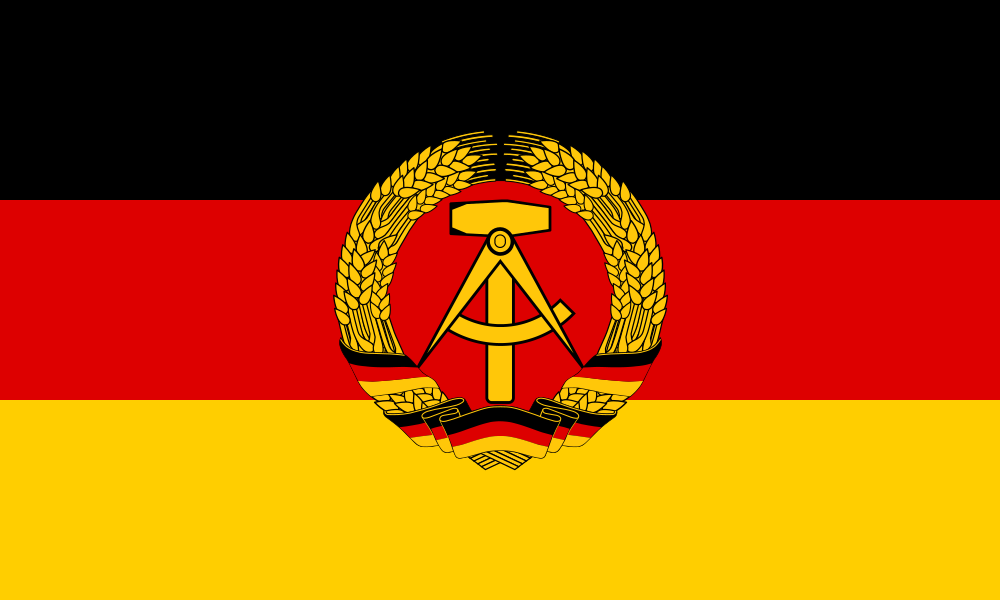
A coachman's son turned carpenter, he joined the SPD in 1895 and was radicalized under Rosa Luxemburg's influence. Court-martialed for anti-war agitation, he co-founded the Spartacus League and the KPD. Arrested with Luxemburg and Liebknecht in January 1919, he alone survived. He served on the ECCI (1921) and its Presidium (1931), then led the KPD in Moscow exile as Comintern secretary. Returning after the war, he drove the SPD-KPD merger that created the SED and became the first President of the GDR in 1949, holding that office until his death.
Career timeline
- 1895Joins the Social Democratic Party of Germany (SPD)
- 1915Conscripted; court-martialed for anti-war agitation; flees to Amsterdam
- 1918–1919Co-founds Spartacus League and KPD; Central Committee member
- 1921ECCI member; elected to the Prussian Landtag
- 1928–1933Reichstag deputy
- 1931Elected to the ECCI Presidium
- 1934–1946KPD chairman (exile leadership)
- 1935–1943Secretary of the Comintern
- 1943Co-founds the National Committee for a Free Germany
- 1946–1950Co-chairman of the Socialist Unity Party (SED)
- 1949–1960President of the German Democratic Republic
The chancellor who made provisional statehood durable
As president of the Parliamentary Council, Adenauer helped present the Basic Law as a provisional settlement rather than a final constitution for a divided Germany.
Konrad Adenauer was a Catholic conservative statesman who helped shape the Federal Republic after the collapse of Nazism and the division of Germany. As president of the Parliamentary Council, he supported a provisional Basic Law rather than a permanent constitution, leaving open the possibility of reunification while establishing democratic institutions in the western zones. As the first Federal Chancellor, he pursued Westbindung, European integration, and a socially regulated market economy, while his anti-communist policy hardened the political division of the Cold War. His career thus joined parliamentary reconstruction with the consolidation of a state whose provisional founding became durable.
Career timeline
- 1906–1909Deputy mayor of Cologne
- 1917–1933Lord Mayor of Cologne
- 1921–1933President of the Prussian State Council
- 1948–1949President of the Parliamentary Council
- 1949–1963First Federal Chancellor of the Federal Republic of Germany
- 1951–1955Federal Minister for Foreign Affairs
- 1950–1966Chairman of the Christian Democratic Union
Weimar finance minister who founded the CDU in the Soviet zone in 1945 and was deposed for opposing the land reform
The son of a Cologne railway worker, he studied agriculture and from 1911 worked at the International Institute of Agriculture in Rome. A member of the Catholic Centre Party, he became Minister of Food in 1920 and was Minister of Finance from 1922 until the Cuno cabinet resigned in August 1923. Arrested after the Nazis took power, he later served as an economic adviser to the government of Colombia. Back in Germany he joined the resistance around Goerdeler, was arrested after 20 July 1944 and sentenced to death in January 1945, but his wife delayed the execution until the Red Army took Berlin. On 26 June 1945 he became the first chairman of the CDU of Berlin and the Soviet zone; because he refused to agree to the land reform without compensation, SMAD deposed him in December. In the West he founded the German Farmers’ Association and argued for reunification.
Career timeline
- 1911–1914Department director at the International Institute of Agriculture, Rome
- 1920Reich Minister of Food
- 1922–1923Reich Minister of Finance
- 1945Sentenced to death by a Nazi court
- 1945Chairman of the CDU in the Soviet zone; deposed in December
- 1948President of the German Farmers’ Association
Kodang Cho Man-sik, the Korean Democratic Party leader removed from the northern political stage in 1946
On 30 December 1945 Cho's party adopted its anti-trusteeship resolution despite pressure from the Soviet military command, and on 5 January 1946 the command confined him to the Koryo Hotel. From this point nationalists disappeared from the northern political stage and the left took the lead.
Cho Man-sik (1883-1950), pen name Kodang, was born in Kangso, South Pyongan Province, and worked as an educator, Presbyterian elder, journalist and politician. He graduated from Meiji University in 1913, taught at Osan School and became its headmaster in 1915, and later headed the Pyongyang YMCA, the Korean Product Promotion Society and the Chosun Ilbo. He pursued anti-Japanese activity on Gandhi's nonviolent line. After liberation he chaired the South Pyongan Committee for the Preparation of Korean Independence and then the South Pyongan People's Political Committee, a left-right coalition that also included the South Pyongan Communist Party. He founded the Korean Democratic Party on 3 November 1945, and on 5 January 1946 the Soviet military command confined him to the Koryo Hotel. No confirmed reports of him remain and his death is reported rather than established.
Career timeline
- 1913–1915Graduated from Meiji University in 1913, became a teacher at Osan School that year and its headmaster in 1915, working in national education
- 1920s–1930sGeneral secretary of the Pyongyang YMCA and elder at Sanjonghyon Church; president of the Korean Product Promotion Society, chair of the Sin'ganhoe Pyongyang branch and president of the Chosun Ilbo
- 1945.08Chaired the South Pyongan Committee for the Preparation of Korean Independence, then the South Pyongan People's Political Committee, a left-right coalition
- 1945.10–11Land reform and tenancy disputes over the 7:3 system exposed his position; right-wing members left the committee for the South, and on 24 November its name dropped "political", turning it into a left-led body
- 1945.11.03Founded the Korean Democratic Party and was elected its leader on an anti-trusteeship line
- 1945.12.30His party's central committee adopted an anti-trusteeship resolution rejecting trusteeship outright
- 1946.01.05Confined to the Koryo Hotel by the Soviet military command and removed from the political stage
- 1946.02Choe Yong-gon took over the party, and its first congress on 24 February elected him leader
- 1948–1950Kept in detention without trial amid failed exchange talks; confirmed reports end and his death is reported and presumed, its date and circumstances not established
The laconic reformer who replaced Churchill mid-Potsdam and built Britain's postwar welfare state
After winning the 1945 election, Attlee stood in silence with George VI at Buckingham Palace before volunteering, "I've won the election." The King replied, "I know. I heard it on the Six O'Clock News."
Clement Attlee was the man who replaced Winston Churchill as British prime minister in the middle of the Potsdam Conference, after Labour's landslide victory in July 1945. He had served loyally as Churchill's deputy in the wartime coalition, but voters chose the unassuming reformer over the war hero and his promise of a welfare state. His government created the National Health Service, nationalised major industries, and began dismantling the British Empire by granting independence to India and Pakistan. Abroad, he championed the Marshall Plan and NATO, aligning Britain firmly with the United States as the Cold War took shape.
Career timeline
- 1935–1955Leader of the Labour Party
- 1940–1942Lord Privy Seal (wartime coalition)
- 1942–1945Deputy Prime Minister (wartime coalition)
- 1945–1951Prime Minister of the United Kingdom
- 1951–1955Leader of the Opposition
Czechoslovak Communist who led the trade-union central council, became prime minister after February 1948 and president in 1953
He helped build the Communist Party and its unions, became premier after its 1948 takeover, and succeeded Gottwald as president in 1953, serving until his death in 1957.
A stonemason from Zákolany in Bohemia, he came from the Social Democrats to help found the Communist Party. Arrested under the German occupation, he was held in Pankrác prison and Dresden and from 1940 in Sachsenhausen concentration camp. Back home after liberation he became chairman of the Central Council of Trade Unions and a member of the Communist presidium, and briefly chaired the Constituent Assembly in 1946. He succeeded Gottwald as prime minister in June 1948 when Gottwald became president, and became president himself on Gottwald’s death in 1953. He favoured a more humane rule but was outflanked by Novotný.
Career timeline
- 1921Helped found the Communist Party of Czechoslovakia and organize its press, trade unions, and cooperatives.
- 1929–1939Served as secretary-general of the Communist Trade Unions.
- 1945Became chairman of the postwar Revolutionary Trade Union Movement.
- 1948Became a member of the political secretariat and prime minister after the Communist takeover.
- 1953–1957Succeeded Gottwald as president and served until his death.
National Socialist leader who led the ministers’ resignation in February 1948 and headed the exile Council of Free Czechoslovakia
In February 1948 he resigned with non-Communist ministers in an attempt to halt unconstitutional measures by the Communist interior minister. After the coup, he escaped surveillance to the West and led the political exile movement.
Born to a small tradesman in Tábor in Bohemia, he became a teacher and was mayor of Prague from 1937 to 1939. Arrested after the German occupation, he was held in Dachau and Buchenwald until American troops freed him in 1945. As postwar chairman of the National Socialists he was again mayor of Prague and, after leading the second party in 1946, deputy prime minister. In September 1947 he, Masaryk and Drtina received boxes of explosives. He resigned with the other non-Communist ministers in February 1948, escaped surveillance after the coup and chaired the exile Council of Free Czechoslovakia from 1949 to 1974.
Career timeline
- 1937–1939Mayor of Prague.
- 1945–1946Returned as mayor of Prague and became chairman of the Czechoslovak National Socialist Party.
- 1946–1948Deputy prime minister.
- 1949–1974Chairman of the exile Council of Free Czechoslovakia.
From civil-rights lawyer of the March 1st Movement to first Chairman of the DPRK Supreme People's Assembly: a progressive nationalist
When he submitted a motion of non-prosecution during the March 1st Movement trial, the Japanese courtroom erupted in protest — and the scene, reported nationwide, made Ho Hon the symbol of the anti-colonial lawyer.
One of colonial Korea's 'three great civil-rights lawyers,' he defended the 47 national representatives of the March 1st Movement and handled pro bono cases for workers and independence activists. Elected chairman of Singanhoe's Central Executive Committee in 1927, he led the united-front anti-Japanese struggle, and after liberation served as Prime Minister of the People's Republic of Korea and chairman of the South Korean Workers' Party before crossing north, becoming the bridge by which Korea's independence movement passed into socialism.
Career timeline
- 1907Passed the first Korean Empire bar examination
- 1919Defended March 1st Movement leaders; President, Korean Bar Association
- 1927Chairman, Central Executive Committee of Singanhoe
- 1945Vice Chairman, Preparatory Committee; Prime Minister, People's Republic of Korea
- 1946Chairman, South Korean Workers' Party
- 1948Chairman, Supreme People's Assembly; President, Kim Il Sung University
Hungarian communist who backed Soviet intervention with Kádár in 1956 and became prime minister after the revolution was crushed
Born into a German Catholic family in Seregélyes, he studied law and was taken prisoner on the Eastern Front in 1915 and sent to Tomsk. There he joined the Bolsheviks and commanded an international POW unit; back in Hungary in 1918 he helped found the Hungarian Communist Party and was war commissar of the Slovak Soviet Republic. He lived in the Soviet Union from 1922 to 1936 and, under the name Otto Flatter, commanded the XI International Brigade in the Spanish Civil War. After the war he was Budapest’s chief of police and then a diplomat. In the 1956 revolution he was interior minister under Imre Nagy, but in November he went to Moscow with János Kádár and openly backed Soviet armed intervention. As minister of the armed forces and public security in Kádár’s government he helped organise the security regiments and the Workers’ Militia, and he was prime minister from 1958 to 1961.
Career timeline
- 1915Captured by the Russians; held in Tomsk
- 1918Co-founder of the Hungarian Communist Party
- 1919War commissar of the Slovak Soviet Republic
- 1936–1939Commander of the XI International Brigade in Spain
- 1946–1949Budapest chief of police
- 1956Interior minister under Nagy; minister of the armed forces and public security under Kádár
- 1958–1961Prime minister of Hungary
Christian Democrat who led the CDU in the Soviet zone until SMAD removed him, then became West Germany’s minister for all-German affairs
A bookbinder from Hammelburg in Bavaria, he became a leader of the Catholic trade-union movement and was elected to the Reichstag for the Centre Party in 1933. He joined the resistance against the Nazis, was arrested by the Gestapo in 1938, and went into hiding after the 20 July 1944 plot. After the war he co-founded the CDU in the Soviet zone and became its co-chairman with Ernst Lemmer; as a Christian Socialist he called for the nationalisation of key industries. Critical of the Communists, he and Lemmer were removed as chairmen by the Soviet Military Administration in December 1947, and he moved to West Berlin. He opposed Adenauer’s Western integration in favour of a neutral, united Germany, and was minister for all-German affairs from 1949 to 1957. He died in Berlin in 1961.
Career timeline
- 1933Reichstag deputy for the Centre Party
- 1938Arrested by the Gestapo
- 1945–1947Co-chairman of the CDU in the Soviet zone
- 1947Removed by the Soviet Military Administration
- 1949–1957Federal Minister of All-German Affairs
The social democrat who became the voice of divided Berlin
“People of the world, look upon this city! You cannot, you must not, forsake us!”
Ernst Reuter was a German politician whose path from social democracy through communism and back reflected the upheavals of twentieth-century Europe. After Nazi persecution and exile in Turkey, he returned to Berlin and joined municipal administration to a practical social-democratic politics. During the Berlin Blockade, he gave West Berliners’ resolve an international voice and helped make the divided city a symbol of freedom and self-government. His career also reveals the tensions of a generation that moved from revolutionary radicalism toward democratic local government.
Career timeline
- 1912Joined the Social Democratic Party of Germany
- 1918–1919First chairman of the Volga German Autonomous Soviet Socialist Republic
- 1921First secretary of the Berlin district of the Communist Party of Germany
- 1926–1931Berlin city councillor for transport
- 1931–1933Mayor of Magdeburg
- 1935–1946Lecturer in urban planning at Ankara University and adviser to the Turkish government
- 1947Elected mayor of Berlin, without Soviet consent
- 1948–1953Mayor of West Berlin, Governing Mayor from 1951
The Reformed pastor-president who declared neutrality before Soviet tanks
At a press conference on November 1, 1956, asked about the likelihood of a new Soviet assault: "Such a tragedy is humanly impossible… it will never take place."
A Reformed pastor who became the face of Hungary's post-war democracy as founder and leader of the Independent Smallholders' Party. After his party's landslide victory, he served as prime minister (1945–46) and was elected the republic's first president, but communist salami tactics forced his resignation in 1948 on fabricated treason charges against his son-in-law; he spent the next eight years under house arrest. In October 1956 he joined Imre Nagy's revolutionary government as minister of state and was present at the November 1 cabinet meeting that voted unanimously to withdraw from the Warsaw Pact and declare neutrality. Arrested after the crushing of the uprising, he was sentenced to six years and amnestied in 1959; the Supreme Court annulled his conviction in 1989.
Career timeline
- 1921–1929Reformed pastor; edited church periodicals
- 1936–1944Smallholders MP; pressed to exit the war; hiding after German occupation
- 1945–1946Prime Minister
- 1946–1948President of the Republic; forced to resign
- 1948–1956House arrest
- 1956.10–11Minister of State in Nagy's revolutionary government
- 1958–1959Sentenced to 6 years; amnestied 1959
- 1989Rehabilitated
India's first prime minister and co-founder of the Non-Aligned Movement
'Long years ago we made a tryst with destiny, and now the time comes when we shall redeem our pledge… At the stroke of the midnight hour, when the world sleeps, India will awake to life and freedom.' (Independence eve address, 14 August 1947)
A towering leader of the Indian independence movement, he became independent India's first prime minister in 1947 and held the office until his death in 1964. He anchored the new republic in parliamentary democracy, secularism, and planned economic development, while charting a foreign policy of non-alignment that refused subordination to either Cold War bloc. With Tito he issued the 1954 joint statement that first defined 'non-alignment' as a positive, active policy, not passive neutrality, and went on to co-found the Non-Aligned Movement through the 1956 Brioni Declaration and the 1961 Belgrade summit. The Sino-Indian War of 1962 shook his domestic standing, yet he is remembered as the architect of the Indian republic.
Career timeline
- 1929President, Indian National Congress
- 1936–1937President, Indian National Congress
- 1946–1947Interim Prime Minister of India
- 1947–1964Prime Minister of India
- 1947–1964Minister of External Affairs (concurrent)
Independence activist, linguist, and Yan'an faction leader who served as the first head of state of the DPRK
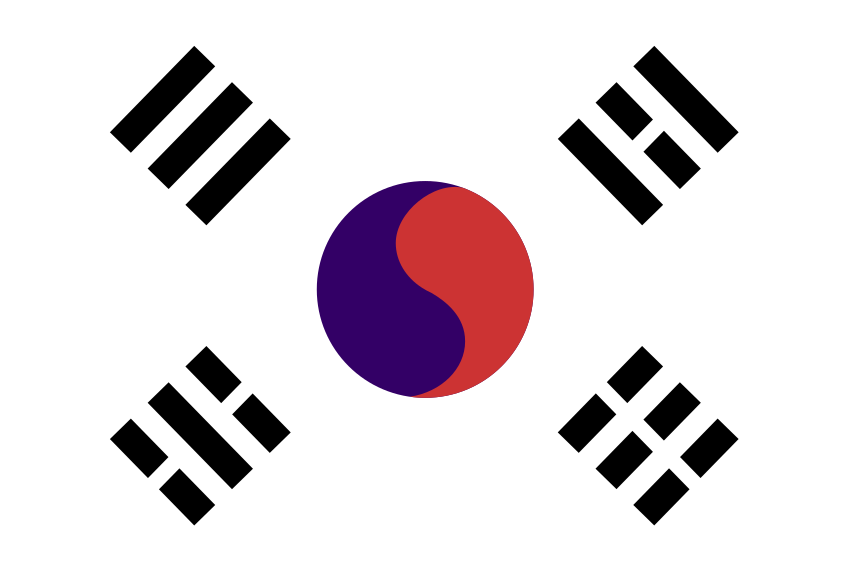
On the day the People's Assembly adopted the new DPRK flag in July 1948, Kim Tu-bong personally lowered the Taegeukgi and raised its replacement. Barely a year earlier, he had been the man passionately explaining the old flag's philosophical meaning to a skeptical Soviet general.
A Hangul linguist trained under Chu Sigyŏng who led the Korean Independence League in Yan'an. Became the DPRK's first head of state in 1948, though real power lay with Kim Il Sung. Purged and vanished in the 1958 August Faction Incident.
Career timeline
- 1908–1916Studied Hangul under Chu Sigyŏng; helped compile MalMoi dictionary
- 1919Joined March First Movement, then exiled to Shanghai provisional government
- 1920–1930sCombined communist activism with linguistic research in Shanghai
- 1942–1945Founded Korean Independence League in Yan'an; led the Yan'an faction
- 1946.02–08Chairman of the New People's Party of Korea
- 1946.08–1949.06Chairman of the Workers' Party of North Korea Central Committee
- 1948.09–1957.09Chairman of the SPA Standing Committee — first head of state of the DPRK
- 1957–1958Dismissed from all posts over August Faction Incident; disappeared
He took on France, Japan and America in turn to win Vietnam's independence
“Nothing is more precious than independence and freedom.” — wartime radio address, 1966
Vietnamese revolutionary. After three decades of exile, including helping found the French Communist Party and the Communist Party of Vietnam, he led the Viet Minh to declare Vietnam's independence in 1945. He led North Vietnam through wars against France and the United States, becoming the symbol of Vietnamese independence.
Career timeline
- 1911–1920Wanders the world as sailor and laborer; founding member of the French Communist Party
- 1925Published French Colonialism on Trial
- 1927Published the revolutionary training text The Revolutionary Path
- 1930Founds the Communist Party of Vietnam
- 1941–1945Founds the Viet Minh against Japanese and French rule
- 1945.09Declares independence; first President of the DRV
- 1946–1954First Indochina War; victory at Dien Bien Phu
- 1955–1969Leads the unification war as North Vietnam's president
Pro-Soviet Social Democrat and first post-liberation premier who sided with the Communists in 1948 and merged his party into theirs
During the Communist coup of February 1948, he led the Social Democratic push for union with the Communists; the merger later that year brought his party into the one-party system.
A diplomat from Olomouc, he served as envoy to the Netherlands, Romania, the United States, Switzerland and Austria and, as the exile government’s ambassador in Moscow during the war, grew close to the Soviet Union. Prime minister of the Košice government from April 1945, he led the National Front government until June 1946. As Social Democratic leader he advocated close co-operation with the Communists, and when the non-Communist ministers resigned in February 1948 he stayed and openly backed the Communists. After the coup he merged the Social Democrats into the Communist Party and held high office under the regime.
Career timeline
- 1945–1946Prime minister of the Košice government and post-liberation Czechoslovakia.
- 1946–1947Chairman of the Czech Social Democratic Party; in November 1947, party members ousted him for being too submissive to the Communists.
- 1948After the February coup, he led the merger of the Social Democrats with the Communists and joined the Communist Party Central Committee.
- 1948–1953Served as deputy prime minister.
- 1951–1953Minister of the State Office for Religious Affairs.
- 1953–1964Chairman of the National Assembly.
- 1968Supported the Prague Spring reforms and protested the Soviet invasion of Czechoslovakia.
Stalin's most trusted East European proxy, architect of Poland's Stalinist system and guardian of the Oder–Neisse border
On 5 February 1947, atheist communist Bierut took Poland's presidential oath and ended it with the traditional 'Tak mi dopomóż Bóg' — So help me God.
A Polish communist trained in Comintern schools, he joined the PPR leadership in 1943 with Soviet backing and served as Chairman of the State National Council (1944–47), President (1947–52), PZPR General Secretary (1948–56), and Prime Minister (1952–54). He secured the Oder–Neisse border at Potsdam and drove the Six-Year Plan's heavy industrialization, collectivization, and socialist realist cultural policy, presiding over Warsaw's reconstruction. His regime used the Ministry of Public Security to suppress armed opposition and confronted the Catholic Church. He died of a heart attack in Moscow in March 1956, days after Khrushchev's Secret Speech.
Career timeline
- 1912Joins Polish Socialist Party – Left (PPS-Lewica)
- 1918Joins the Communist Party of Poland (KPRP/KPP), discontinues activity, and formally functions as a member again from 1921
- 1925–1930Trained in the secret school of the Communist International (1925–26) and the International Lenin School in Moscow (from November 1927 to 1930); Comintern instructor
- 1933–1938Arrested by the Sanation regime (December 1933), sentenced to 7 years; amnestied December 1938
- 1943Joins the PPR Secretariat (23 November); elected Chairman of the State National Council (31 December)
- 1947–1952President of the Republic of Poland (until the Council of State was chosen on 20 November 1952)
- 1948–1956General Secretary of the PZPR, First Secretary from 17 March 1954
- 1952–1954Prime Minister of the People's Republic of Poland (20 November 1952 – 18 March 1954)
- 1916–1921Lublin food cooperative manager and board member; co-organizer of the leftist Union of Workers' Cooperative Associations; co-founder of the Warsaw Housing Cooperative in 1921
- 1927–1933Head of the KPP Central Technique; Comintern special missions in Austria, Czechoslovakia and Bulgaria
- 1944–1949Secret member of the PPR Politburo from August 1944; from 24 February 1949 chaired the PZPR CC Politburo Security Commission supervising the repressive apparatus
- 1955Awarded the East German Order of Karl Marx
Architect of Hungary's Sovietization who built one-party rule through 'salami tactics'
Released on 30 October 1940 and reaching Moscow on 6 November, Rákosi stood beside Stalin atop Lenin's Mausoleum the next day as the October Revolution Day parade crossed Red Square.
General secretary of the Hungarian Communist Party (1945–1948) and then general secretary, later first secretary, of the Hungarian Working People's Party (1948–1956), he ruled Hungary as its de facto leader from 1948 to 1956. Arrested in 1925, he received an 8.5-year sentence in 1926 and a life term in 1935, serving over fifteen years in prison before reaching Moscow in November 1940. After returning in 1945 he dismantled the democratic parties through 'salami tactics' and forced the Social Democrats into a merger to build one-party rule, bearing responsibility for mass imprisonment, forced-labour camps and the Rajk show trial. He handed the premiership to Imre Nagy in 1953 yet obstructed reform as first secretary, was removed on 18 July 1956, expelled from the party in 1962, and died in Gorky on 5 February 1971 after deportation to Krasnodar, Tokmak and Arzamas.
Career timeline
- 1919People's Commissar of Trade, Hungarian Soviet Republic; commands Red Guard and Red Army
- 1921–1924Secretary, Executive Committee of the Comintern
- 1925–1940Imprisoned under the Horthy regime (8.5-year sentence, later life; freed 1940)
- 1940–1945Leads the Foreign Bureau of the Hungarian Communist Party, Moscow
- 1945–1948General Secretary, Central Committee of the Hungarian Communist Party
- 1948–1956First Secretary, Central Committee of the Hungarian Working People's Party (MDP); General Secretary until 1953
- 1952–1953Chairman of the Council of Ministers, Hungarian People's Republic
- 1956–1971Forced exile in the USSR (Kirghizia, Arzamas, Gorky)
First East German justice minister, dismissed and imprisoned in 1953 after opposing the prosecution of striking workers
A toolmaker from Berlin, he joined the SPD in 1910 and sat in the Prussian Landtag from 1928 to 1933. Under the Nazis he took part in a resistance group and was twice imprisoned. After the war he supported the forced merger of the SPD and KPD, sat on the SED’s Central Committee, and in October 1949 became the GDR’s first Minister of Justice. In the trial of the Gladow gang he had adult criminal law applied unlawfully so that a death sentence was possible. In an interview with Neues Deutschland on 30 June 1953 he said that members of the 17 June strike leadership would not be punished on mere suspicion; denounced as an “enemy of the state and the party”, he was dismissed, expelled and arrested, and sentenced to eight years. Released and pardoned in 1956, readmitted to the party in 1958, he died in 1973.
Career timeline
- 1910Joined the SPD
- 1928–1933Member of the Prussian Landtag
- 1949–1953GDR Minister of Justice
- 1953Dismissed, expelled and arrested
- 1956Released and pardoned
- 1958Readmitted to the SED
Yugoslavia's partisan leader who chose non-alignment
The 1948 Cominform split threw Tito's Yugoslavia out of the Soviet bloc and showed that a socialist state could take an independent line, while the dispute was as much a geopolitical struggle in the Balkans as an ideological one.
He was born in Kumrovec to a Croat father, Franjo Broz, and a Slovene mother, Marija, and identified as a Croat like his father and neighbours. Wounded and captured by Russian forces while serving as an Austro-Hungarian Army sergeant major in the First World War, he joined the Communist Party in Omsk in 1920 and led the Communist Party of Yugoslavia as General Secretary from 1939. Appointed commander-in-chief of the Partisans in 1941, he led the national liberation struggle through the Second World War and then headed the Yugoslav federation until his death on 4 May 1980 at Ljubljana Medical Centre. After the 1948 Cominform rift, tens of thousands accused of Stalinism were held in forced labour camps such as Goli Otok, where hundreds died.
Career timeline
- 1941–1945Leader of the Yugoslav Partisans and national liberation struggle
- 1945–1980Leader of socialist Yugoslavia
- 1948Break with Stalin and the Cominform
Agrarian leader who opposed communist rule and was hanged after a show trial
State Department emissary Mark Ethridge called Petkov "the bravest man I've ever known."
A leader of the Bulgarian Agrarian National Union (BZNS), he studied law in Paris after the First World War and returned in 1929 to work as a journalist. He co-founded the anti-fascist Fatherland Front in 1943 but broke from it in 1945 to lead the opposition against the Communists' monopolisation of power, and in the 1946 election his opposition coalition won 101 seats in the Grand National Assembly. Arrested in parliament in June 1947 and sentenced to death in August for a supposed military plot, he was hanged on 23 September, eight days after the Paris peace treaty came into force.
Career timeline
- 1929Returned and worked as a journalist
- 1938Elected to the 24th National Assembly (invalidated that December)
- 1941Leader of BZNS 'Aleksandar Stamboliyski'
- 1943Helped found the Fatherland Front
- 1944Minister without portfolio in the first Fatherland Front government (to Aug 1945)
- 1945Leader of the anti-communist United Opposition
- 1946Member of the 6th Grand National Assembly
First East German Minister for State Security, purged in 1953 after trying to replace Ulbricht
Born in Gelsenkirchen to a gendarmerie sergeant’s family, he trained as a teacher and was a military leader of the Red Ruhr Army during the Kapp Putsch of 1920. As a GRU agent and Comintern military adviser he co-organised the Guangzhou Uprising in China, and in the Spanish Civil War, as “Gomez”, he led the International Brigades. He returned to Germany in 1947, joined the SED, and in 1950 became the first Minister for State Security and a Politburo member, building up the Stasi. After the uprising of June 1953 he moved to replace Ulbricht with Herrnstadt, but once Ulbricht had Khrushchev’s backing he lost his ministry and all his posts in July and was expelled from the party. He worked as a translator, died in East Berlin in 1958 and was rehabilitated after 1990.
Career timeline
- 1920Red Ruhr Army leader during the Kapp Putsch
- 1927–1930Comintern military adviser in China
- 1936–1938International Brigades commander in Spain (“Gomez”)
- 1950–1953GDR Minister for State Security; Politburo member
- 1953Stripped of all posts and expelled from the SED
The world's first woman foreign minister and head of the Romanian party's "Muscovite faction", brought down by Gheorghiu-Dej's 1952 purge
At the Central Committee plenum of 26 and 27 May 1952 Gheorghiu-Dej denounced Pauker, Luca and Georgescu as an "anti-party faction" and removed Pauker from the Politburo. Dej had returned from Moscow with Stalin's approval, and the Slánský trial was spreading the purge of Jewish communists across Eastern Europe.
Born Hannah Rabinsohn to an Orthodox Jewish family in Vaslui County, she taught Hebrew before joining the Social Democratic Party in 1915 and took part in founding the Romanian Communist Party in 1921. Arrested in 1935, she was sentenced to ten years at the Craiova trial the following year, then sent to Moscow in a 1941 prisoner exchange with the Soviet Union, where she led the exiled Romanian communists under the Comintern. Back in Romania in 1944 she joined the Politburo and the Central Committee Secretariat, and in November 1947 became foreign minister, the first woman in the world to hold such a post. With Vasile Luca and Teohari Georgescu she formed the so-called "Muscovite faction" that contested party control with Gheorghiu-Dej's prison faction, but in May 1952 Dej, with Stalin's approval, had her expelled from the Politburo on the charge of committing both "right" and "left" deviations, and in July she lost the foreign ministry as well. Arrested in February 1953, she was released after Stalin's death, expelled from the party without trial, and spent her last years as a translator at the political publishing house. Time magazine put her on its cover in 1948 as "the most powerful woman alive", yet Robert Levy's research shows that she braked forced collectivization and allowed Jewish emigration to Israel, a more moderate course than Dej's.
Career timeline
- 1915Joined the Social Democratic Party
- 1921Founding member of the Romanian Communist Party
- 1935–1936Arrested; sentenced to ten years at the Craiova trial
- 1941Sent to the USSR in a prisoner exchange; led exiled Romanian communists under the Comintern
- 1944Returned to Romania; Politburo member and Central Committee secretary
- 1947–1952Minister of Foreign Affairs
- 1952Removed from the Politburo and the foreign ministry
- 1953–1954Arrested; released after Stalin's death; expelled from the party
'Il Migliore': the strategist who led Western Europe's largest communist party for forty years
In the 'Yalta memorandum' written on his deathbed, he argued for polycentrism — autonomy from Moscow (1964)
Founder and secretary of the Italian Communist Party. He steered the Comintern Popular Front and, with the 1944 Salerno turn, brought the PCI into the anti-fascist coalition government. On his deathbed, his Yalta memorandum argued for polycentrism, anticipating Eurocommunism.
Career timeline
- 1921Among the founders of the Italian Communist Party
- 1927–1964Party secretary; builds the PCI into Western Europe's largest communist party
- 1935–1939Comintern executive; guides the Popular Front in the Spanish Civil War
- 1944The Salerno turn: into the anti-fascist coalition government
- 1946–1948Constituent Assembly 'father of the constitution'; survives a 1948 assassination attempt
- 1964Dies at Yalta; his memorandum argues for polycentrism